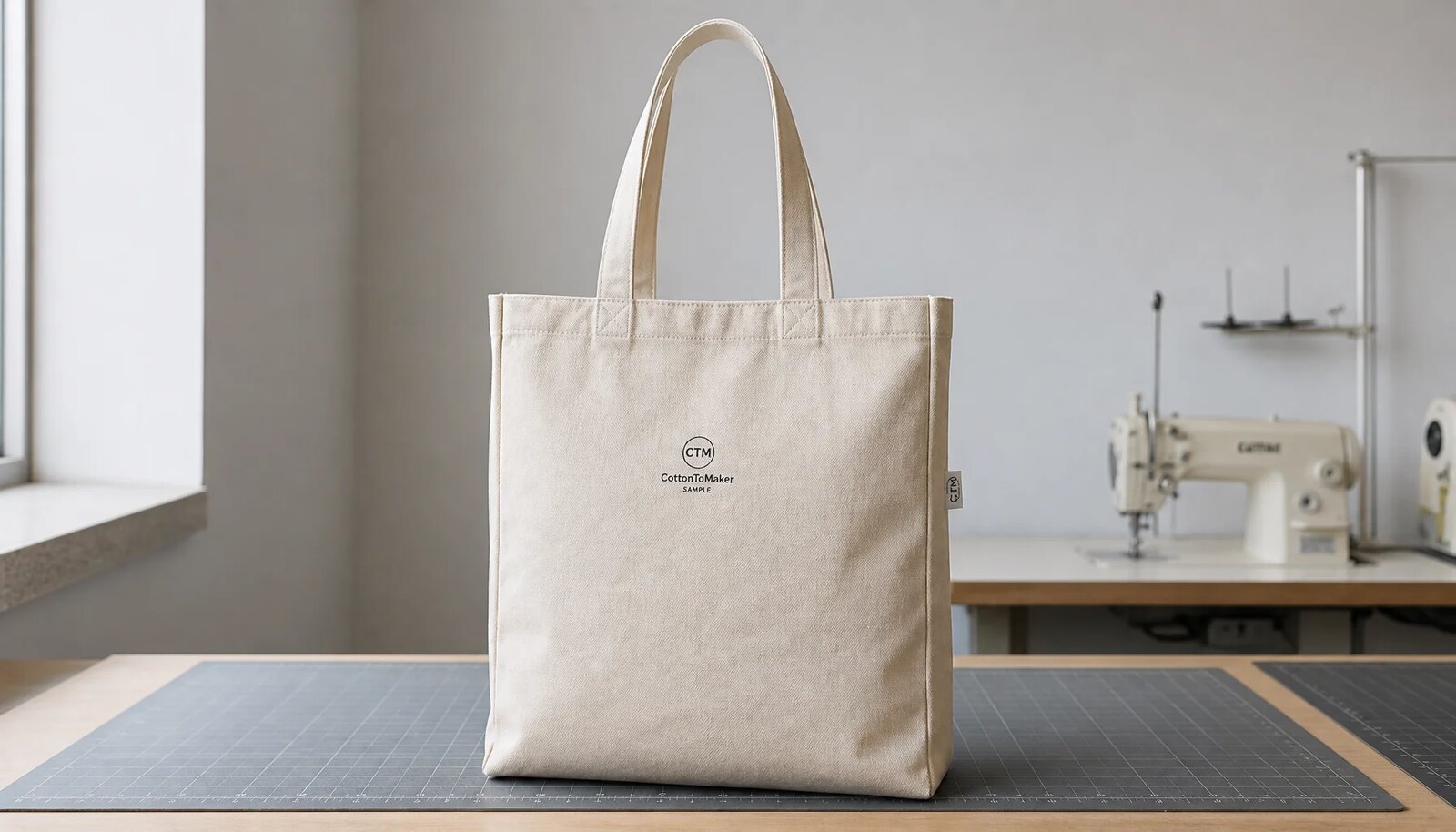
Why Placement Is a Procurement Spec
For event planners buying canvas grocery totes, logo placement is not just an art-board preference. It affects usable print area, decoration method, sewing sequence, sampling accuracy, QC tolerances, packing method, and the final impression when attendees carry the bag. A logo that looks balanced on a flat mockup can sit too close to a handle anchor, drift into a gusset fold, or disappear once the tote is filled with catalogs, bottled drinks, boxed samples, apparel, or grocery-style giveaways.
B2B buyers get better quotes when they describe the intended use before asking for price. A sponsor-visible registration tote needs a front logo that reads in a crowded hall and in event photos. A VIP retail-style tote may need heavier canvas, a smaller lower-corner logo, and a woven label. A sustainability program may prioritize reuse, fewer individual polybags, and a print that survives folding and normal handling. Each version changes cost, lead time, MOQ, and inspection criteria.
The keyword canvas grocery totes for event planners logo placement guide describes a very practical sourcing problem: buyers need a reusable cotton bag, a clear brand presentation, and a fixed event delivery date. The safest RFQ gives the supplier a finished product target, not only a logo file. That means finished dimensions, fabric basis, logo size, logo position, decoration method, placement tolerance, sample type, carton presentation, and delivery terms should be written before the PO is released.
- Decide whether the tote is a giveaway, sponsor item, retail merchandise item, kit bag, staff bag, or reusable shopping bag.
- Define where the logo must be seen: registration table, trade show aisle, conference chair, retail counter, outdoor queue, or post-event grocery use.
- State whether the tote will be viewed flat, filled, hanging, folded, stacked, or carried over the shoulder.
- Treat artwork, tote construction, decoration, QC, and packing as one buying specification.
Start With the Sewn Tote Shape
Logo placement begins with the finished bag, not the PDF artwork. A flat tote, boxed-bottom grocery tote, and side-gusset shopping tote do not provide the same printable surface. The side seams, top hem, handle anchors, bottom seam, gusset folds, and boxed corners reduce the practical decoration area. If a supplier positions artwork from cut-panel measurements only, the logo may shift after sewing, pressing, and folding.
For procurement comparison, list finished width, finished height, gusset depth, bottom construction, handle width, handle length, and handle drop. Finished size matters because it is what the attendee sees and uses. A 380 mm wide tote with a 100 mm bottom gusset behaves differently from a flat 380 mm tote. When the bag is filled, the gusset pulls the lower panel backward and can make low artwork less visible. That is why upper-middle placement is often safer for grocery-style event bags.
Handle construction also affects placement. A long shoulder handle may cross the logo when the tote hangs from a chair or hook. Shorter carry handles keep the front panel clearer but may be less useful after the event. Reinforced handle anchors and bar tacks are important for grocery loads, but they require clearance. A print frame, heat press platen, embroidery hoop, or patch stitch line should not fight with the handle reinforcement zone.
- Use finished sewn dimensions as the approval reference, not cut-panel dimensions.
- Ask the supplier to mark top hem, side seams, bottom seam, gusset fold, boxed corners, and handle anchors on the placement template.
- Reserve no-print clearance around handle stitching and top hem reinforcement.
- For wide-gusset grocery totes, avoid very low main logos unless lower visibility is intentional.
Specify Canvas Weight Correctly
Canvas weight is one of the first decisions that changes product feel and logo performance. An 8 oz canvas, often around 270 gsm, can work for light handouts but may feel soft for a grocery-style tote. A 10 oz canvas, often around 340 gsm, is a practical starting point for reusable event totes because it balances structure, printability, cost, and carton weight. A 12 oz canvas, often around 400 to 410 gsm, gives a firmer hand and better loaded appearance. A 14 oz canvas, often around 475 gsm, feels more retail-ready but can raise material cost, freight weight, sewing difficulty, and MOQ.
The exact gsm equivalent can vary because oz is usually expressed as ounces per square yard, while suppliers may quote gsm after different finishing steps. Greige canvas, finished canvas, dyed canvas, washed canvas, and shrink-treated canvas are not identical. A quote that says 12 oz may not be directly comparable unless the buyer knows whether the weight is before or after washing, dyeing, or finishing. For serious B2B comparison, ask for both the nominal oz and the measured gsm basis.
Fabric finish changes the way the logo prints. Natural canvas can make bright colors look warmer and slightly muted. Bleached canvas gives a cleaner base for color matching but may cost more or feel different. Dyed canvas requires ink opacity checks, especially for light logos on dark fabric. Washed canvas may reduce later shrinkage but can increase surface texture, which affects fine lines and QR codes. Approve print color and line clarity on the actual fabric base, not only on a digital proof or white paper printout.
- Use 8 oz only for light-duty giveaways where low cost matters more than structure.
- Use 10 oz to 12 oz for most reusable grocery totes for conferences, exhibitions, and branded event kits.
- Use 14 oz when premium hand feel and repeat use matter more than freight weight and lowest unit price.
- Ask whether fabric weight is quoted before or after finishing, washing, dyeing, or shrink treatment.
Map the Logo With Measurements
A useful placement map is specific enough that two suppliers can quote the same tote. Instead of writing centered on front, define the logo size and its position from sewn-bag reference points. For example: logo width 180 mm, centered horizontally on front panel, top edge of logo 95 mm below finished top hem, minimum 35 mm from side seams, and minimum 45 mm above the bottom gusset fold. The exact numbers depend on tote size, but the measurement method should be consistent.
The front upper-middle zone is usually the safest default for event grocery totes. It stays more visible when the tote is loaded and is easier to see in attendee photos. Full-front artwork can be effective, but it needs careful seam clearance and may increase print defects because large ink areas magnify fabric texture, opacity variation, and curing problems. Lower-corner placement can look premium, but buyers should accept that it will be less visible when the bag is folded, filled, or viewed across an event hall.
Side gusset printing is useful only when the construction supports it. A narrow gusset leaves little room for readable artwork, and a deep gusset introduces fold and seam alignment risk. If the event needs a side sponsor mark, a woven label or short vertical print may be more controlled than a detailed logo. Multi-location branding should be listed as separate decoration lines because front print, back print, side label, patch, and hangtag each have different setup costs, tolerances, and QC checks.
- Specify every logo location with millimeter measurements from sewn-bag reference points.
- Define a no-print zone around seams, hems, handle anchors, gusset folds, and boxed corners.
- State whether the logo should read best when the tote is flat, filled, carried, hanging, or folded for distribution.
- For multi-location branding, list each placement separately with size, method, color, and tolerance.
Choose the Right Decoration Method
Screen printing is often the strongest default for bulk canvas grocery totes with one to three spot colors. It gives good opacity on cotton canvas, scales well at event quantities, and keeps the surface feel relatively flat. It also gives buyers predictable setup economics when the same logo will be repeated across 500, 1,000, 2,500, or more pieces. The buyer should ask whether printing happens before sewing or after sewing, because that changes placement control and possible seam restrictions.
DTF and heat transfer can be useful for short runs, complex sponsor artwork, gradients, or last-minute event changes. The tradeoff is surface feel and durability risk. Transfer film may look shinier than ink, feel heavier on canvas, or show edge lift if press temperature, pressure, dwell time, or adhesive choice is wrong. For reusable grocery totes, ask the supplier to test folding, rubbing, and normal handling before bulk approval. A decoration that looks good in a photo may still fail after tight carton packing.
Embroidery, patches, and woven labels should be used for a specific reason. Embroidery can add texture, but it may distort lighter canvas and is not ideal for small sponsor text. A patch can look premium, but it adds component MOQ, attachment labor, edge alignment checks, and packing thickness. A woven label creates a subtle retail-like finish, especially on side seams or hems, but it may not provide enough sponsor visibility by itself. Quote these methods separately instead of treating them as simple artwork changes.
- Use screen print for simple high-visibility logos on 10 oz to 12 oz canvas.
- Use DTF or heat transfer for short runs, many colors, gradients, or late artwork changes after testing adhesion and fold performance.
- Use woven labels for subtle side branding, origin detail, repeat program identity, or clean front-panel design.
- Use patches only when added cost, attachment QC, and packing thickness are acceptable.
Write a Comparable RFQ
Many canvas tote quotes are hard to compare because suppliers are pricing different products. One quote may include a 10 oz natural canvas tote with one-color front print. Another may include 12 oz canvas, reinforced handles, a side label, individual packing, export cartons, and a sample fee. A lower unit price is not meaningful if setup, packing, inspection, or decoration responsibility is missing. A strong RFQ forces every supplier to answer the same fields.
Separate the RFQ into construction, decoration, packing, and commercial terms. Construction covers finished size, fabric weight, fabric color, gusset, seam type, handle width, handle drop, reinforcement, and trimming standard. Decoration covers logo size, location, colors, method, setup, artwork format, placement tolerance, color reference, and sample approval. Packing covers fold method, inner pack count, export carton quantity, carton dimensions, gross weight, carton marks, barcodes, and event sorting labels. Commercial terms cover MOQ, price breaks, sample fees, payment terms, incoterm, lead time, and excluded charges.
MOQ should be broken down by component. The sewn bag may have one MOQ, custom-dyed canvas another, screen printing another, and woven labels or patches another. A buyer ordering 800 totes may discover that label MOQ is 1,000 or patch MOQ is 2,000. That does not make the order impossible, but it changes the true unit cost and leftover component plan. Ask suppliers to show MOQ and setup charges clearly, especially for multi-sponsor artwork that may not repeat.
- Quote the same quantity breaks from each supplier, such as 500, 1,000, 2,500, and 5,000 pieces.
- Require line items for bag body, handles or reinforcement, decoration setup, decoration run charge, labels, patches, packing, and freight term.
- Ask whether screens, dies, label molds, transfer setups, and artwork files are reusable for repeat orders.
- Confirm whether the quote is for finished goods ready to ship, ex-factory production, or delivered event-ready cartons.
Evaluate Supplier Routes
The right supplier route depends on event timing, decoration complexity, and the amount of control the buyer needs. A direct factory with in-house cutting, sewing, printing, QC, and packing often gives the best placement control because the bag template, print jig, sample room, and QC team are part of one workflow. This is useful for large runs, multi-location branding, and programs where cartons must match across several shipments.
A factory that outsources decoration can still be a good choice when the method requires specialty equipment, such as embroidery, patches, woven labels, or a print process outside the bag factory's normal line. The issue is not outsourcing itself; the issue is accountability. Ask who checks the first decorated pieces, who owns the goods during transfer, who pays for rework if placement drifts, and how many days decoration handoff adds to the schedule. Put those answers in the PO or quality agreement.
Local decorators using imported blanks can solve rush timing, especially when blank inventory is already in the destination market. The risk is blank consistency. Different blank lots may vary in fabric shade, shrinkage, dimensions, handle drop, and seam placement. A decoration proof from one blank lot does not guarantee the next lot will match. For urgent local decoration, approve the actual blank lot, not a generic stock photo or old sample.
- Choose in-house production when placement consistency, schedule control, and fewer handoffs matter most.
- Use outsourced decoration when a specialty method is required, but define defect ownership before PO release.
- Use sourcing agents for multi-product event kits while still requesting factory-level evidence for the tote and decoration.
- Use local decoration for urgent dates only after confirming blank lot, size, fabric shade, handle position, and construction.
Approve Samples Like a Buyer
A digital mockup is useful for layout discussion, but it is not production approval. The pre-production sample should be a finished sewn tote using the intended canvas weight, handle construction, logo size, decoration method, and folding method. If final bulk fabric is not available yet, the supplier should identify the substitute and explain what could change. Buyers should avoid approving placement from a flat artwork proof alone because the sewn tote shape determines the real result.
Sample review should be measurable. Check finished width, height, gusset depth, handle drop, logo width, logo height, and the logo distance from the top hem, side seams, bottom seam, gusset fold, boxed corners, and handle anchors. Photograph the sample flat, filled with typical event contents, hanging by the handle, carried if possible, and folded as it will be packed. These views show issues a bench photo hides, such as a handle crossing the logo or a side label disappearing in a fold.
Approval records should be simple and strict. Keep one sealed reference sample for dispute control and one working sample for factory QC or third-party inspection. Written approval should record date, sample version, fabric weight, fabric color, decoration method, logo placement numbers, color reference, and any accepted deviations. If the sponsor logo, print size, color, or position changes after approval, treat it as a new strike-off or sample update, not a casual file replacement.
- Measure the logo on the sewn bag and compare it with the placement map.
- Approve color on the actual canvas base under practical light, not only on screen or white paper.
- Review the tote flat, filled, hanging, and folded before approving production.
- Keep sealed and working reference samples for bulk inspection and dispute resolution.
Set Tolerances and QC Rules
Quality control should be defined before bulk production starts. For many standard front prints on canvas totes, buyers may use a placement tolerance such as plus or minus 5 mm from the approved measurement, but the right tolerance depends on logo size, bag construction, and supplier capability. Small woven labels, patches, and side-gusset marks often need tighter visual control because a small shift is more obvious. Whatever tolerance is chosen, define the reference points and measuring method.
Print QC should go beyond color. Inspectors should check for ink bleed, pinholes, incomplete coverage, ghosting, smearing, uneven opacity, heavy ink buildup, registration error, poor cure, transfer edge lift, cracking after folding, and pressure marks from packing. Fine sponsor names, URLs, and QR codes should be tested on the actual canvas because texture can reduce clarity. If scanning matters, test QR codes from several production pieces, not only the approved sample.
Construction QC matters because grocery totes are expected to carry real weight. Inspect handle anchors, bar tacks, top hem reinforcement, side seams, bottom seams, gusset corners, panel squareness, trimming, and loose threads. A strong logo on a weak tote is still a bad buy. Final inspection should include packed cartons because the fold direction can hide labels, crease transfers, or mark heavy ink. Cartons should also match quantity, inner pack count, carton marks, gross weight, and event sorting requirements.
- Define placement tolerance, skew tolerance, color tolerance, print defect limits, and acceptable construction defects before PO release.
- Check logo alignment against top hem and side seams, not only center position.
- Perform rub, flex, fold, and adhesion checks on decorated areas, especially for transfer prints and large ink coverage.
- Inspect cartons for count, fold direction, carton marks, barcode labels, gross weight, and event distribution instructions.
Plan Packing and Lead Time
Packing is part of logo placement because the wrong fold can damage or hide the branding. Bulk event distribution may use 25, 50, or 100 pieces per inner pack so staff can stage totes quickly. Retail-style programs may require individual polybags, recycled paper bands, hangtags, stickers, insert boards, or barcode labels. Each option changes labor, material cost, carton dimensions, freight weight, and how the tote appears when opened. If the logo must face outward for fast event setup, write that into the packing spec.
Lead time includes more than sewing days. A realistic timeline may include artwork check, digital proof, strike-off, sample production, sample shipping, approval, fabric reservation, cutting, sewing, decoration setup, bulk decoration, curing, trimming, inspection, packing, export documents, inland trucking, and freight booking. The largest schedule risk is often late artwork change. New sponsor logos, revised Pantone colors, QR code updates, or a change from front-center to side-gusset placement can restart sampling or setup.
Landed cost should be compared at program level. A heavier canvas may improve structure but increase carton weight. A patch may improve perceived value but add setup, component MOQ, attachment labor, and inspection time. Individual packing may help retail presentation but slow distribution and add waste. A useful quote shows product cost, decoration cost, setup charges, sample charges, packing cost, carton data, incoterm, lead time assumptions, and excluded charges clearly enough for procurement to compare total event-ready cost.
- Specify whether totes ship flat, half-folded, rolled, individually packed, bulk packed, or packed with logo facing outward.
- Avoid fold lines through heavy ink, transfer edges, patches, woven labels, or QR codes.
- Build time for at least one correction round before promising the event delivery date.
- Compare landed cost including packing, inspection, inland freight, export charges, duty, warehousing, and urgent freight risk.
Specification comparison for buyers
| Buying decision | Practical B2B specification | Best use case | Quote or QC risk to control |
|---|---|---|---|
| Canvas body weight | 10 oz to 12 oz canvas, roughly 340 to 410 gsm depending on mill and finish | Most reusable event grocery totes where structure, print quality, and carton weight must stay balanced | Ask whether weight is greige, finished, washed, or dyed weight; do not compare oz values without the basis |
| Heavy canvas upgrade | 14 oz canvas, roughly 475 gsm before or after finish depending on supplier definition | Premium retail-style event totes, sponsor kits, and programs where longer reuse matters more than freight weight | Heavier fabric may raise MOQ, needle/sewing requirements, carton weight, and handle reinforcement needs |
| Default main logo zone | Front panel, centered horizontally, upper-middle third, measured from sewn top hem | Registration giveaways, conference bags, trade show grocery totes, and sponsor-visible carry bags | Confirm no-print clearance from top hem, handle anchors, side seams, bottom gusset fold, and boxed corners |
| Quiet logo zone | Lower corner on front panel with smaller artwork and defined edge clearance | VIP gifts, retail-style merchandise, sustainability programs, or co-branded events with restrained branding | Visibility drops when tote is filled, folded, stacked, or photographed from distance |
| Side gusset branding | Simple vertical logo, woven label, or short text only if gusset is wide enough | Secondary sponsor mark, campaign line, store name, or repeat-order identity detail | Fold lines and seam drift are more visible; require tighter placement tolerance and folded-bag approval |
| Woven label or patch | Custom side label, front patch, or hem label with separate component MOQ | Premium finish, repeat programs, retail-like look, or clean front panel strategy | Label MOQ, patch MOQ, attachment method, edge fray, alignment, and fold visibility must be quoted separately |
| Screen print | Spot-color screen print with Pantone target on actual canvas base | Bulk orders with one to three solid colors and strong logo visibility | Check screen setup cost, color opacity on natural canvas, cure, rub resistance, and placement jig control |
| DTF or heat transfer | Transfer decoration with approved film, adhesive, press settings, and peel method | Shorter runs, gradients, sponsor artwork with many colors, or late artwork changes | Test film edge lift, shine, hand feel, cracking after folding, and adhesion on textured canvas |
| In-house factory decoration | Cutting, sewing, printing, QC, and packing controlled by one production workflow | Orders where placement consistency, schedule control, and defect accountability are priorities | Verify decoration is truly in-house, who approves first production pieces, and who holds the sealed sample |
Buyer checklist before sampling
- Define the event use case: registration giveaway, expo grocery tote, sponsor kit, VIP retail item, staff bag, merchandise item, or post-event reusable shopping bag.
- State the finished sewn tote dimensions in millimeters or inches: width, height, gusset depth, bottom construction, handle width, handle length, and handle drop.
- Specify canvas weight with basis: oz per square yard and/or gsm, plus whether the figure is greige, finished, washed, dyed, or pre-shrunk fabric weight.
- Identify fabric color and finish: natural, bleached, dyed, pigment dyed, enzyme washed, prewashed, shrink-treated, or laminated if applicable.
- Choose the logo location before final artwork: front upper-middle, full front, lower corner, back panel, side gusset, woven label, patch, hangtag, or multi-location branding.
- Lock logo size and position using sewn-bag reference points: top hem, side seam, bottom seam, gusset fold, boxed corner, and handle anchor.
- Define no-print clearance around seams, hems, folds, and handle stitching; use millimeters rather than visual terms like high, low, or centered only.
- Specify decoration method, number of colors, Pantone references, artwork format, minimum line weight, small text height, QR code size if used, and whether color is approved on actual canvas.
- Ask for itemized pricing for bag body, handles, reinforcement, decoration setup, decoration run charge, labels, patches, hangtags, packing, inspection, inland freight, and export charges.
- Confirm MOQ separately for the sewn bag, fabric color, each print color, each print location, woven labels, patches, custom hangtags, special cartons, and individual packing.
Factory quote questions to send
- What is the finished sewn tote size, and what tolerance do you hold on width, height, gusset depth, handle drop, handle length, and handle width?
- What canvas weight, weave, yarn type, and finishing treatment are included in the quote, and is the weight measured before or after washing, dyeing, or finishing?
- Is the bulk fabric natural, bleached, dyed, pigment dyed, or prewashed, and can the production lot be matched to the approved sample shade and hand feel?
- What seam construction, top hem width, handle reinforcement, bar tack pattern, and bottom gusset construction are included?
- Where exactly will the logo sit on the sewn bag, measured from the top hem, side seam, bottom seam, gusset fold, boxed corner, and handle anchor?
- What logo placement tolerance do you propose in millimeters, and how will your QC team measure it during production?
- What is the maximum print area in millimeters for this tote construction, and what clearance do you require from seams, folds, hems, and handles?
- Which decoration method are you quoting, and what ink, transfer film, adhesive, patch backing, label type, or embroidery thread will be used?
- How many colors are included, what setup charges apply, and are screens, dies, label molds, transfer files, or artwork setups reusable for repeat orders?
- What is the MOQ for the bag body, print setup, each extra print color, each extra logo location, woven labels, patches, hangtags, barcode labels, and packing accessories?
Quality-control points to confirm
- Measure logo placement on the finished sewn tote, not only on cut panels, using the agreed top hem, side seam, bottom seam, gusset fold, boxed corner, and handle anchor references.
- For a front logo, define acceptable horizontal and vertical variation, such as plus or minus 5 mm for many standard prints, with tighter limits for small labels or patch placements when feasible.
- Check logo skew against both the top hem and side seams; visible tilt should be classified as a defect even if the center point falls inside tolerance.
- Verify the printed area stays outside the agreed no-print zone around handle stitching, seams, gusset folds, bottom boxed corners, and hem reinforcement.
- Printed edges should be clean, fully cured, and free from bleed, pinholes, ghosting, smearing, heavy ink buildup, uneven opacity, or incomplete coverage over canvas texture.
- Fine text, sponsor names, registration URLs, and QR codes must remain legible on the actual canvas after curing, folding, and normal handling.
- Color should be checked against the approved physical reference on the actual canvas base, because natural cotton, dyed canvas, and washed fabric can shift perceived color.
- Transfer prints should be checked for edge lift, adhesive bleed, excessive shine, cracking after folding, pressure marks, and poor adhesion on textured fabric.
- Screen prints should be checked for cure, rub resistance, registration between colors, mesh marks, ink strike-through, and consistent opacity across the bulk lot.
- Handle stitching, bar tacks, top hem reinforcement, bottom seams, and gusset corners should be checked for skipped stitches, loose threads, raw seam allowance, and panel distortion near the logo.