Start With a Placement Brief Buyers Can Measure
For artisan bakeries, logo placement on canvas grocery totes is not just a creative preference. It affects how the tote is cut, printed, sewn, inspected, folded, packed, displayed, and photographed. A mark that looks perfect on a flat digital proof can shift visually once the bottom gusset opens. It can bow around pastry boxes, sit too low under a baguette sleeve, or disappear behind long handles when the bag hangs from a hook.
The cleanest RFQ turns the placement into production data. Instead of “print logo front center,” give the supplier the finished tote size, front panel width between side seams, top opening reference, bottom fold line, artwork width, artwork height, top margin, side margins, centerline, and acceptable tolerance. Those details help factories price the same job and prevent a low quote from being based on looser placement control.
Ask early how the supplier plans to print. Printing flat panels before sewing usually gives a smoother print surface and efficient screen setup, but sewing must then preserve the intended position. Printing finished bags can reduce sewing-related drift, yet it limits how close the artwork can sit near seams, gussets, and handle reinforcement. Neither route is automatically better; the right answer depends on tote construction, artwork size, and tolerance.
- Use finished bag dimensions, not cutting dimensions, because sewing, turning, washing, and pressing can change the visible panel.
- Measure placement from the top opening, side seams, bottom fold, gusset fold, and finished front-panel centerline rather than from a cropped photo.
- State whether the logo must read when the tote is flat, hanging, standing filled, carried side-on, or folded for shipment.
- Attach a placement diagram with millimeter measurements for print width, print height, top margin, side margins, center point, and skew limit.
- Ask whether the factory prints panels before sewing or finished bags after sewing, then request the realistic tolerance for that method.
Define the Bakery Use Case Before Sizing
The best logo location changes with the tote’s job. A resale tote near the checkout needs a clean front panel, consistent folding, retail-ready labels, and packing that protects the printed face. A giveaway bag can usually accept simpler finishing if the logo remains visible and the handles hold. A farmers market tote needs better capacity, a stable gusset, and comfortable handles. A holiday hamper tote may need a smaller or slightly higher logo because rigid boxes push the front panel outward.
Bakery contents are not neutral. Tall bread sleeves pull attention upward. Square pastry boxes open the gusset and can curve a large print. Coffee bags and small jars add dense weight, which makes handle attachment and top hem strength more important. Bottled drinks or preserves can stress the bottom corners. Share the expected contents with the supplier, even if they are approximate, so construction and placement are quoted against real use rather than a generic shopping tote.
For multi-location bakeries, placement consistency becomes brand control. If one branch uses a city line, another uses a seasonal slogan, and a third uses a collaboration mark, keep the base logo grid fixed. Treat variable copy as a controlled artwork layer. That makes sampling, production checks, and reorder negotiations much easier.
- For resale totes, prioritize clean front presentation, low visible defect tolerance, hangtag or barcode needs, and repeatable fold direction.
- For loyalty or giveaway orders, prioritize one-color print efficiency, acceptable fabric grade, and carton packing for store allocation.
- For farmers market use, prioritize gusset depth, shoulder comfort, handle strength, and side visibility while carried.
- For holiday hampers, test filled shape because rigid boxes can push the logo forward, curve the print, or hide the lower panel.
- For branch programs, lock one placement grid and change only approved variable text, dates, locations, or seasonal marks.
Lock Construction Before Artwork Approval
Logo placement cannot be finalized until the tote body is known. A flat tote gives the cleanest print surface but less grocery capacity. A canvas grocery tote with side and bottom gussets stands better and carries more bakery volume, yet the front panel changes shape when loaded. Many bakery programs fall around 350-420 mm wide, 350-400 mm high, and 100-160 mm deep, but baguettes, wine, boxed pastries, and jars may call for different proportions.
Handle drop is a common source of placement trouble. Short hand-carry handles can leave more of the upper front panel open. Long shoulder handles are more comfortable, but they may cover the top of the artwork when the tote hangs. A 25-40 mm top hem plus handle stitch boxes can remove usable print space near the opening. Put the logo too high and it competes with reinforcement; put it too low and the bottom fold or filled contents can distort it.
Approve construction with real sample views, not only a line drawing. Ask for flat, filled, standing, and hanging photos. If exact bakery contents are unavailable, use substitute weights and boxes with similar dimensions. The goal is simple: confirm that the front panel reads well in the situations customers will actually see.
- Common bakery grocery tote range: 350-420 mm width, 350-400 mm height, and 100-160 mm gusset, adjusted for actual contents.
- Short hand-carry handles may be around 300-350 mm total length depending on style, but confirm finished handle drop rather than only cut length.
- Shoulder handles are often around 550-650 mm total length, but can cover upper artwork if the logo sits too high.
- Top hem, handle stitch boxes, side seams, bottom folds, and gusset folds reduce the safe print zone even when flat fabric looks large.
- Approve construction and logo placement together because a small size change can make a previously balanced logo look wrong.
Control Canvas Weight and Surface Quality
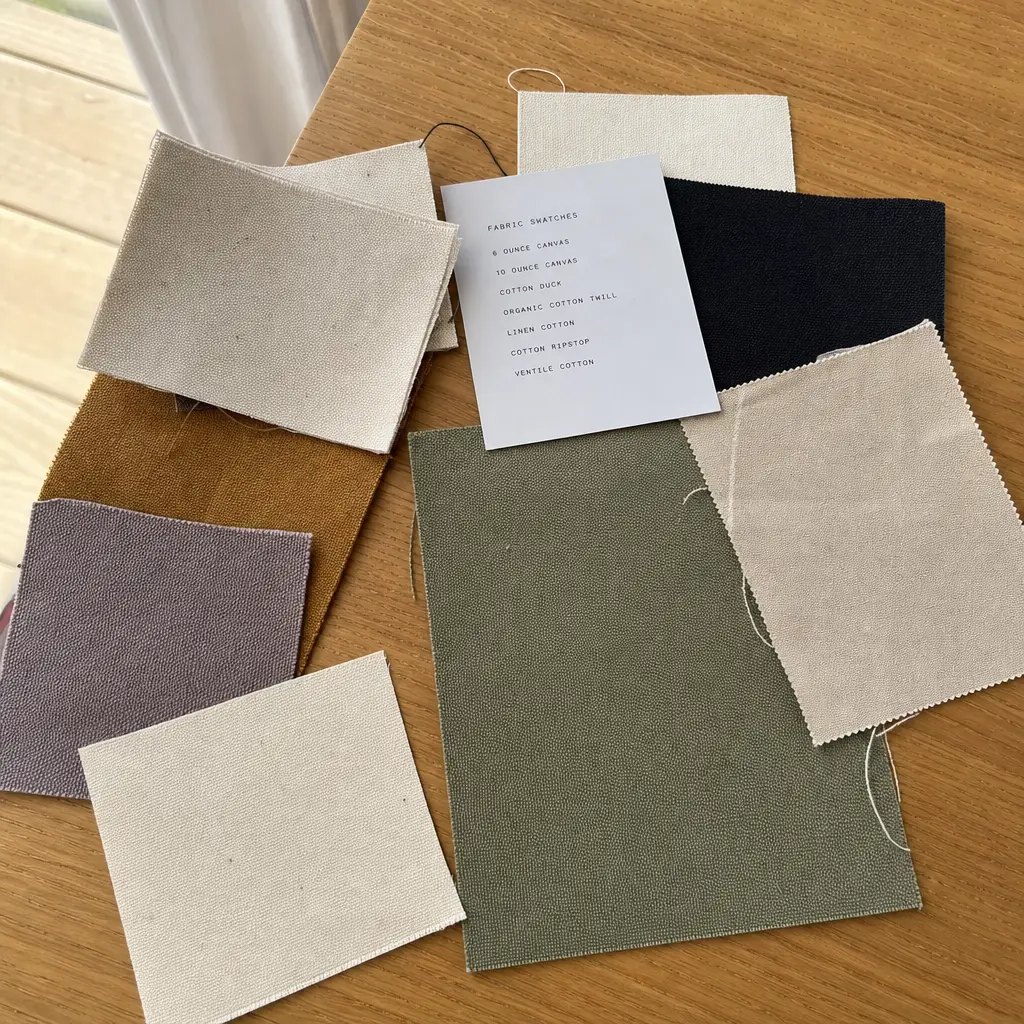
Canvas weight changes both performance and appearance. A 6 oz or 8 oz cotton canvas may work for cost-sensitive promotions, but it is more likely to wrinkle under a bold logo and show the shape of contents. For reusable artisan bakery grocery totes, 10-12 oz canvas, roughly 280-340 GSM depending on weave and supplier standard, is often the more practical range. It offers better body and print stability without the freight and sewing cost of very heavy canvas.
Heavier 14-16 oz canvas can feel premium, but it is not automatically the smarter buy. It can require stronger needles, slower sewing, more attention at folded seams, and higher freight cost. It may also raise MOQ if the mill or factory does not stock that exact weight. Require suppliers to state actual GSM tolerance, such as ±5%, and clarify whether weight is measured before or after washing, dyeing, or finishing.
Surface character matters for bakery branding. Natural canvas often includes seed specks, slubs, lint, and shade variation. That texture can support an artisan look, but it can interrupt thin serif lettering, small founding dates, line drawings, and pale ink. Bleached or dyed canvas gives a cleaner base, but adds dye-lot control, rub resistance, colorfastness, and MOQ questions. Approve the canvas swatch and print strike-off together because the base fabric changes the perceived ink color.
- Natural canvas should have a defined acceptable level for seed specks, slubs, shade variation, lint, and small dark fibers.
- Dyed canvas should be checked for shade consistency, dry/wet rub, and ink opacity, especially when printing white or pale colors.
- Washed or pre-shrunk canvas should be quoted separately because it affects hand feel, shrinkage, dimension tolerance, and unit cost.
- Fine serif text, thin borders, and detailed wheat illustrations may need thicker strokes on rough canvas to remain legible.
- Ask for fabric swatches from the same quality planned for bulk production, not only a catalog photo or previous-order sample.
Set Front Logo Coordinates That Survive Filling
For a standard bakery canvas grocery tote, the safest front branding zone is usually centered horizontally and placed high enough to remain visible when filled, but low enough to avoid handle reinforcement. On many totes around 380 mm wide by 380 mm high with a bottom gusset, a practical starting point is placing the artwork top edge 90-120 mm below the top opening. Treat that as a starting coordinate, not a universal rule. Handle drop, print height, top hem, and filled-bag shape still need to be checked.
Artwork size deserves the same discipline. A front logo width of 180-280 mm often works better than a near-full-width print because it keeps the artwork away from side seams and gusset folds. For round bakery seals, specify diameter and center point. For horizontal logos with a shop name, founding date, city line, or slogan, specify minimum text height and line thickness so the supplier can flag anything likely to fill in or break on textured canvas.
Tolerance should be written on the approval sheet and purchase order. A usable spec might say: logo centered on front panel, artwork top edge 105 mm from finished top opening, tolerance ±5-8 mm, maximum skew 5 mm. If a franchise standard, retail fixture, or brand book requires tighter control, ask the factory to confirm it can hold that tolerance at production speed before you release bulk printing.
- Keep main artwork at least 35-50 mm from side seams and gusset folds unless a special wrap effect is sampled and approved.
- Avoid placing small text across the bottom fold line because it can disappear when the tote stands, folds, or expands.
- Define both vertical placement and horizontal centering; a logo can meet top-margin tolerance but still sit off-center.
- For two-sided print, state whether front and back share identical coordinates or whether the back uses a smaller mark, URL, or care line.
- Specify maximum skew by measuring both top corners of the artwork from the top opening and setting an acceptable difference.
Use Secondary Branding Only Where It Helps
Front placement does most of the brand work, but it is not the only useful surface. Side gusset branding can keep the bakery name visible when the tote is carried side-on, stacked in a bin, or displayed folded. Keep it simple: a vertical wordmark, a short URL, a small icon, or a product line. Detailed pastry illustrations and small serif text rarely perform well on gussets because the panel is narrow, folded, and curved when filled.
Labels can be cleaner than difficult print positions. A woven side label, top hem label, or folded loop label can add a premium retail finish and support private-label programs for hotels, cafes, distributors, gift shops, or bakery collaborations. Labels need their own approval: size, fold type, yarn or print color, sewing position, text legibility, edge finish, and MOQ. Do not treat them as a late add-on after the bag has already been costed.
Handle branding should be used carefully. Direct printing on handles faces folding, rubbing, hand oils, and tension. It is also harder to keep centered in bulk. If the buyer wants a branded handle detail, a woven tab, hangtag, paper wrap, or top hem label is usually more controlled. In food-adjacent retail settings, avoid accessories that detach easily or complicate store handling.
- Use gusset printing for simple vertical text, a small icon, or a short URL, not detailed bakery illustrations.
- Keep gusset artwork away from seam bulk and confirm whether it is printed before sewing or after assembly.
- Use woven labels for premium marks, private-label identification, subtle side branding, or retail SKU differentiation.
- Avoid direct handle printing unless the factory provides samples showing fold durability, rub resistance, and centering control.
- Include label dimensions, fold type, stitch position, color standard, and artwork file in the RFQ, not as a late accessory.
Match Print Method to Artwork Risk
Water-based screen printing is often the best fit for canvas grocery totes with artisan bakery branding. It gives a softer hand than heavy surface prints and works well for one to three solid brand colors, such as dark brown, black, deep green, burgundy, navy, or warm gray on natural canvas. It suits shop seals, slogans, branch names, wheat icons, and repeat wholesale orders. The risks are practical: fine detail loss, ink absorption variation, and color shift caused by the fabric base.
Other methods can work, but each needs a reason. Plastisol ink may give stronger opacity on some darker fabrics, though the heavier surface feel may not match a natural bakery aesthetic. Heat transfer can reproduce gradients and detailed illustration, but it may show a film edge, feel less integrated with canvas, or crack/lift if process control is weak. Digital printing can support detailed art or lower quantities, but color stability, hand feel, and unit cost vary by supplier equipment and fabric pretreatment.
Tie the print method to the artwork and order volume. A one-color bakery seal on natural canvas should not be priced or inspected like a four-color croissant illustration on dyed fabric. Ask suppliers to quote included print size, number of colors, screen charges, strike-off charges, reorder screen policy, and whether artwork changes are charged per version.
- Use screen print for solid logos, shop seals, slogans, branch names, simple icons, and repeat bulk orders.
- Use transfer or digital print only when low quantity, gradients, or detailed artwork justify the extra process checks.
- Use woven labels or hangtags for small premium marks, side details, private-label identification, or barcode/SKU information.
- Approve Pantone targets on a real strike-off because natural canvas color changes perceived ink shade.
- Check dry rub, light wet rub, tape pull, and packing offset before releasing dark solid prints or white ink on dyed canvas.
Build Quotes That Reveal the Real Cost
A tote quote can hide many cost drivers inside one unit price. Ask the supplier to separate the base bag, fabric upgrade, custom size, print setup, number of colors, number of positions, labels, hangtags, barcode stickers, sample charges, packing style, inspection, inland freight, export documents, and Incoterm. This makes comparison fair. It also prevents a cheap-looking quote from excluding screen charges, label sewing, carton upgrades, or courier costs.
MOQ is shaped by setup time, material availability, artwork versions, and packing complexity. A supplier may accept a lower quantity for a one-color print on stock natural canvas, but the unit price will be higher because cutting, screen setup, printing line changeover, sewing preparation, and inspection are spread across fewer units. For many bakery programs, 500-1,000 pieces per artwork is a realistic planning range for standard natural canvas with one front print. Custom dyed fabric, multiple branch artworks, woven labels, or individual retail packing can push MOQ higher.
Compare landed cost, not only EXW or FOB unit price. A heavier canvas may improve hand feel but increase gross weight and CBM. Individual polybags may protect retail presentation but add labor, material, and volume. A lower tote price can be offset by inefficient carton dimensions, fewer pieces per carton, or a folding method that marks the print.
- Request price breaks at 500, 1,000, 3,000, and 5,000 pieces using the same size, fabric, artwork, packing, and Incoterm.
- Ask for separate charges for extra color, second-side print, gusset print, woven label, hangtag, barcode sticker, and individual polybag.
- Compare freight using carton dimensions, gross weight, net weight, pieces per carton, and estimated CBM, not only unit price.
- Quote dyed canvas, organic canvas, recycled canvas, washed canvas, and heavier canvas as separate material options.
- Clarify repeat-order costs for screens, samples, labels, and artwork revisions when the logo placement remains unchanged.
Approve Samples With Numbers, Not Instinct
A digital proof is useful for layout direction, but it is not enough for logo placement approval. First approve the tote body if the size, gusset, handle drop, top hem, or fabric weight is new. Then approve a printed pre-production sample after the construction is settled. This sequence avoids the common problem of paying for print corrections on a bag shape that was never truly approved.
The printed sample should travel with a measurement sheet. Record finished width, height, gusset depth, handle drop, fabric weight, logo width, logo height, distance from top opening, left and right side margins, bottom clearance, and skew. Add photos flat, standing filled, and hanging. For bakery buyers, the filled photo is not optional; bread, boxes, jars, and coffee bags shape the front panel differently from flat documents or apparel.
Approval files need to be clear enough for production and inspection teams that were not in the artwork meeting. Keep the final artwork file name, Pantone target, print method, approved sample photos, measurement diagram, placement tolerance, packing instruction, and carton mark together. If the sample is approved with corrections, require written confirmation of the corrected measurement before bulk printing begins.
- Approve the actual canvas quality or a production swatch before print strike-off, especially for natural, dyed, recycled, or organic canvas.
- Check whether ink prints evenly over slubs, seed specks, rough weave areas, and folded zones that may contact the logo during packing.
- Use a ruler in sample photos so procurement, merchandising, and factory teams review the same placement data.
- Do not release bulk printing until logo coordinates and tolerance are written on the approved sample sheet and purchase order.
- Request first bulk production photos or a first-piece report when the order has strict brand guidelines or multiple artwork versions.
Inspect Bulk Goods for Bakery-Specific Risks
A strong QC plan focuses on the defects that matter for bakery tote sourcing: logo position, print durability, visible fabric cleanliness, odor, handle strength, seam quality, gusset shape, and carton condition. Natural cotton canvas may contain some seed particles and slubs, so define whether those are acceptable character marks or defects. If the tote is sold near food, oil stains, mildew marks, damp odor, or sharp chemical smell should not be treated as minor cosmetic issues.
Placement inspection should be numeric. Measure the artwork top edge from the top opening, left and right margins from the side seams, and skew by comparing the artwork’s left and right top-edge distance. A centered front print may allow ±5-8 mm depending on order type and factory capability, while finished bag width and height may allow ±10 mm. The inspection plan should state sample quantity, measurement points, and what counts as minor, major, or critical.
Functional checks should reflect actual bakery use. Load testing should use the expected filled weight plus an agreed safety margin and should observe handle slippage, stitch popping, top hem tearing, seam failure, and panel distortion. Print checks should include dry rub, light wet rub, tape pull, and packing offset after curing. Carton checks should confirm count, SKU, artwork version, moisture protection if required, shipping marks, and no excessive pressure on printed faces.
- Inspect printed panels before final packing for offset, skew, pinholes, ink smears, color mismatch, ghosting, and transfer marks.
- Reject sharp chemical odor, mildew odor, visible oil stains, dirty handling marks, or damp cartons for bakery retail programs.
- Check handle reinforcement with a filled-bag hanging test rather than only a brief hand pull on an empty tote.
- Record defects by artwork version, production lot, operator line if available, and carton number so issues can be isolated.
- Confirm cartons match approved packing direction, piece count, inner protection, shipping marks, and barcode or SKU requirements.
Specification comparison for buyers
| Spec decision | Recommended option | When it fits | Buyer risk to check |
|---|---|---|---|
| Front logo position | Center the artwork on the finished front panel. For many standard bakery grocery totes, set the artwork top edge about 90-120 mm below the top opening and keep the main logo within a 180-280 mm wide print area. | Checkout resale totes, farmers market bags, loyalty packaging, holiday hampers, and filled-bag product photography where the front panel must stay readable. | A logo approved only on a flat mockup may sit too low after the bottom gusset opens, curve around boxed contents, or be partly hidden by handles when hanging. |
| Placement reference method | Use fixed finished-bag references: top opening, side seam-to-side seam panel width, bottom fold line, gusset fold, and vertical centerline. | Multi-supplier RFQs, franchise programs, repeat orders, seasonal artwork, and artwork libraries that need repeatable placement. | If the brief only says “front center,” each factory may measure from a different point, making samples and quotes hard to compare. |
| Placement tolerance | Set target coordinates plus tolerance, typically ±5 mm for premium controlled placement or ±8 mm for standard bulk screen printing. | Bakeries that need consistent branding across stores, retail fixtures, photo shoots, or reorder lots. | Tighter tolerances can require slower setup, first-piece approval, jigs, extra measurement time, and higher inspection cost. |
| Fabric weight | Use 10-12 oz cotton canvas, roughly 280-340 GSM depending on weave, with a stated GSM tolerance such as ±5%. | Reusable bakery grocery totes carrying bread, pastry boxes, coffee bags, packaged pantry items, bottled drinks, and small jars. | 6-8 oz canvas can wrinkle and show contents; 14-16 oz canvas increases sewing difficulty, carton weight, freight cost, and unit price. |
| Canvas surface | Choose natural cotton canvas with an approved seed-speck/slub standard, or use bleached/dyed canvas when cleaner visual control is required. | Natural canvas suits artisan, farm-style, and kraft bakery branding; dyed canvas suits formal retail color systems and private-label programs. | Uncontrolled slubs, seed specks, lint, and shade bands can break fine serif letters or make solid ink look uneven. |
| Print method | Use water-based screen print for 1-3 solid brand colors, with a strike-off on the actual bulk canvas quality. | Bakery logos, shop seals, one-color slogans, wheat icons, branch names, and repeat wholesale orders. | Small text, gradients, white ink on dyed canvas, or pale ink on natural canvas need sample approval, opacity review, and rub checks before bulk release. |
| Side gusset branding | Use a simple vertical wordmark, URL, small icon, or product line on one gusset, keeping clear of seam bulk and fold lines. | Totes carried side-on, stacked in bins, folded for display, or sold in retail settings where side visibility matters. | Gusset print has higher alignment risk and may distort when the tote is filled or folded. |
| Handle and label branding | Prefer woven side labels, top hem labels, hangtags, or paper wraps over direct handle printing. | Premium resale totes, private-label bakery programs, hotel/cafe collaborations, gift shop SKUs, or distributor merchandise. | Handle printing is harder to center, may crack on folds, and faces repeated hand abrasion. |
| MOQ planning | Plan around 500-1,000 pieces per artwork for stock natural canvas with one front screen print; request price breaks at 500, 1,000, 3,000, and 5,000 pieces. | Bakery chains, seasonal campaigns, wholesale distributors, store openings, and retail buyers testing sell-through. | Custom dyed canvas, multiple artwork versions, woven labels, special packing, or non-stock dimensions can raise MOQ and extend lead time. |
Buyer checklist before sampling
- Define finished tote width, height, gusset depth, handle drop, handle width, top hem depth, seam type, fabric weight in oz/GSM, and finished-size tolerance before discussing artwork placement.
- Provide vector artwork in AI, EPS, SVG, or print-ready PDF with outlined fonts, Pantone targets, minimum line thickness, minimum text height, and a note on whether the logo must read when the tote is flat, filled, hanging, carried, or folded.
- Specify logo coordinates in millimeters from finished-bag references: top opening to artwork top edge, left and right side seam margins, artwork width and height, centerline, bottom clearance, and gusset fold clearance.
- State whether the order requires one front print, two-sided print, gusset print, woven side label, top hem label, hangtag, barcode sticker, care label, retail belly band, or individual packaging.
- Identify the commercial use: resale, gift-with-purchase, farmers market retail, catering order add-on, holiday hamper, loyalty program, distributor promotion, franchise store merchandise, or private-label collaboration.
- Request an unprinted construction sample when tote size, gusset, handle drop, or fabric weight is not approved; request a printed pre-production sample before bulk print release.
- Set written acceptance tolerances for logo position, skew, print color, coverage, fabric weight, finished size, shrinkage, stitching, handle load, odor, stains, loose threads, and carton packing.
- Confirm ink type, curing method, minimum curing time before packing, dry rub expectation, light wet rub expectation, tape-pull result, and packing offset control for printed panels.
- Ask for carton dimensions, gross weight, net weight, pieces per carton, estimated CBM, folding method, inner liner or polybag use, shipping marks, and palletization if required.
- Build schedule allowance for artwork correction, sample making, courier transit, approval, fabric preparation, cutting, printing, curing, sewing, trimming, inspection, packing, documents, and shipment handover.
Factory quote questions to send
- What canvas weight do you recommend for a bakery grocery tote carrying bread loaves, pastry boxes, coffee bags, bottled drinks, and small jars, and what actual GSM tolerance will be used for bulk fabric?
- Is the quoted fabric natural cotton canvas, recycled cotton canvas, organic cotton canvas, bleached canvas, dyed canvas, or blended canvas, and is shrinkage controlled before cutting?
- What finished width, height, gusset depth, handle drop, handle width, top hem depth, seam allowance, and reinforcement method are included in the quotation?
- What finished-size tolerance can you hold after sewing, and does that tolerance change for washed canvas, dyed canvas, or heavier 14-16 oz canvas?
- What is the safe print area on the finished front panel after allowing for top hem, handle stitch boxes, side seams, bottom fold, and gusset expansion?
- Will you print panels before sewing or print finished bags, and what placement tolerance can you realistically maintain for each method during bulk production?
- Which print method is included, how many colors are included, what ink type will be used, and what are the setup charges per screen, per color, and per artwork?
- Can you provide a strike-off and printed pre-production sample on the actual canvas quality with measured logo position, and will that sample be sealed as the bulk production standard?
- What is the MOQ per artwork, fabric color, print method, label type, and packing style, and how does unit price change at 500, 1,000, 3,000, and 5,000 pieces?
- What handle construction is included: self-fabric handles, cotton webbing handles, cross-stitch reinforcement, bar-tack reinforcement, or both cross-stitch and bar-tack?
Quality-control points to confirm
- Finished size should be measured after sewing and normal handling, with an agreed tolerance such as ±10 mm for width and height and ±5 mm for handle drop unless the retail fixture requires tighter control.
- Logo placement should be measured from fixed finished-bag reference points, commonly controlled within ±5-8 mm for centered front screen print; record both vertical position and left/right centering.
- Logo skew should be checked by measuring the artwork top edge from the top opening on both left and right sides; define the maximum acceptable difference, such as 5 mm for controlled retail presentation.
- Fabric weight should be verified by a documented GSM method on a measured fabric sample rather than relying only on catalog terms such as “heavy canvas” or “premium cotton.”
- Fabric appearance should be checked for oil stains, mildew marks, excessive seed specks, lint, shade panels, weaving slubs, needle damage, dirt, and visible contamination inconsistent with bakery retail use.
- Print quality should show even coverage, no unacceptable pinholes in solid areas, no heavy ink edge build-up, no misregistration, no smears, no ghosting, and no transfer marks after folding or packing.
- Ink curing should be checked with dry rub, light wet rub, and tape pull on the approved fabric, especially for dark solid ink on natural canvas and white or pale ink on dyed canvas.
- Handle attachment should pass a practical filled-bag hanging test using the buyer's expected load plus safety margin, with no stitch popping, top hem distortion, seam tearing, or handle slippage.
- Stitching should have consistent SPI as agreed with the factory, locked ends, no skipped stitches at gusset corners, clean thread trimming, and reinforcement at all handle stress points.
- Gusset shape should be inspected filled and standing because a tote that measures correctly when flat can twist, lean, or distort the logo if side seams and bottom corners are uneven.