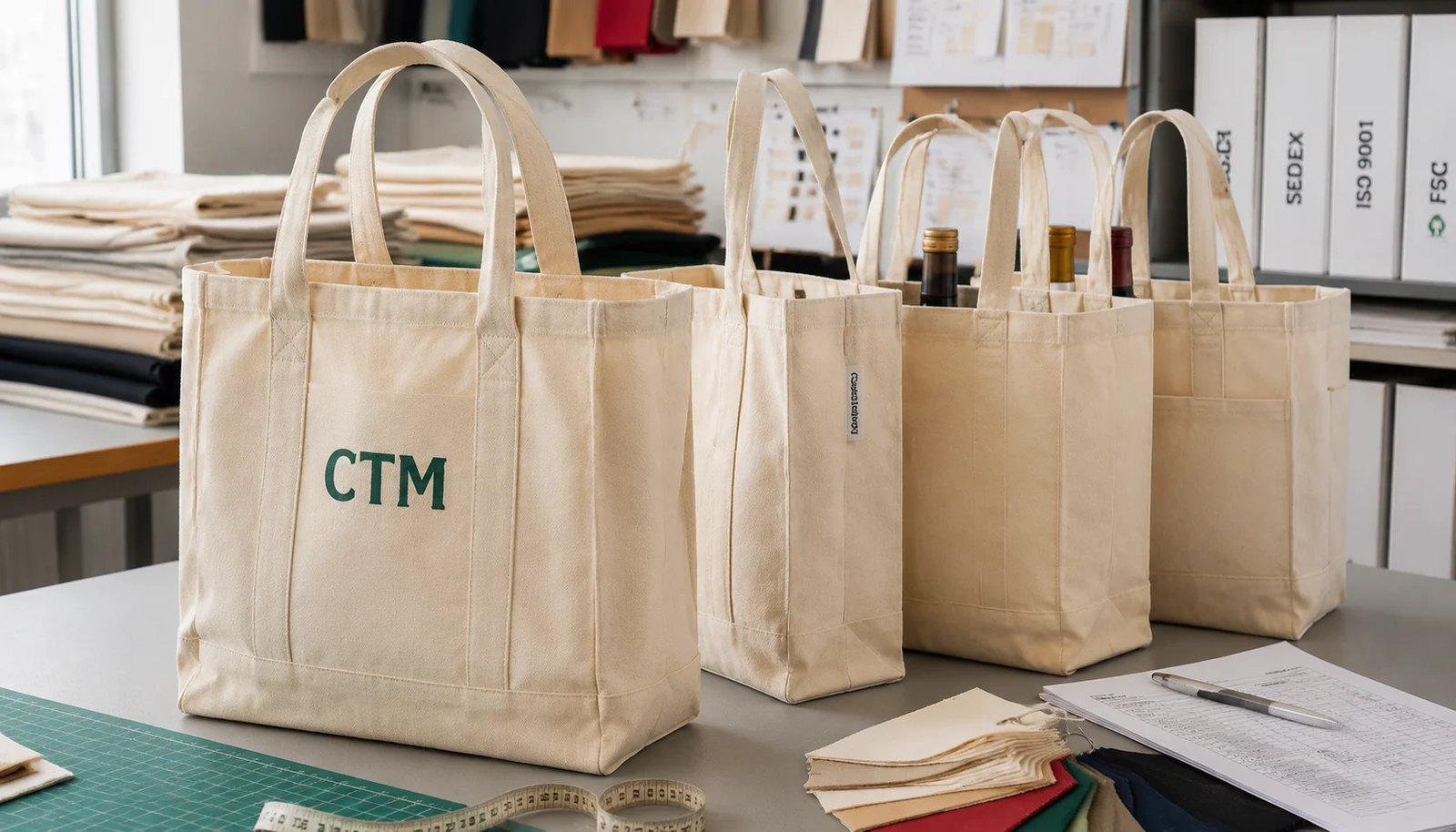
Why this tote category needs a stricter sourcing brief
Canvas totes for liquor retail look simple, but buyer risk is higher than the product suggests. These bags may carry glass bottles, sit at checkout under close customer visibility, and pass through distribution centers that expect accurate labels and carton counts. A weak handle root, shallow gusset, or poorly cured print becomes obvious immediately at store level.
That is why the best buying approach is not to treat the item as a generic promotional tote. For liquor retail, the bag is both a functional carry item and a branded retail accessory. The sourcing brief has to cover load use, construction, print durability, documentation, and receiving format together.
Many quote comparisons fail because suppliers are not pricing the same bag. One quote may assume 220 GSM canvas with a basic flat handle attachment. Another may assume 280 GSM with a box-X reinforcement and a deeper base gusset. A third may include barcode labels and retail-ready cartons, while a fourth excludes them. Unless the buyer standardizes the target, the price comparison is misleading.
- Typical claim drivers are torn handle roots, collapsed gussets, print scuffing, shade inconsistency, and carton count errors.
- Retail and distributor requirements matter almost as much as sewing quality.
- The goal is not a longer RFQ. The goal is a clearer RFQ with fewer hidden assumptions.
Define the bottle-load program before discussing price
The most practical starting point is the carry use case. A single-bottle checkout tote has different requirements from a reusable grocery tote expected to carry two bottles plus food items. If the buyer asks suppliers to make the tote 'strong enough,' each supplier will define strength differently. Instead, state the normal working load, likely bottle count, and expected service life.
For example, a bag intended for one standard 750 ml bottle and light add-on items may allow a lighter fabric and simpler reinforcement than a bag intended for two bottles or repeat weekly use. A paid reusable bag should also be specified more tightly than a free giveaway because customers will judge value, comfort, and durability more directly.
Retail handling should also be written into the brief. Can staff load the bag quickly at checkout? Should the bag open easily and stand better when empty? Is shoulder carry required, or hand carry only? Those details affect gusset width, body shape, and handle drop more than many buyers initially expect.
- State intended normal load in kg, not just 'bottle use.'
- Clarify one-bottle, two-bottle, or mixed grocery use.
- Note whether the bag is giveaway, paid reusable, or part of a loyalty program.
- Add checkout handling needs if speed and presentation matter.
Write the base specification in measurable terms
After the use case is clear, lock the core construction. For canvas grocery totes used in liquor retail, fabric should be specified by fiber content, weave, and finished GSM with tolerance. Avoid vague language such as heavy duty canvas. A buyer can compare 100% cotton canvas at 280 GSM ±5% across suppliers; they cannot compare 'premium canvas' with any confidence.
Dimensions also need to be complete. Width and height alone are not enough for bottle-carry applications. The bottom gusset largely determines whether the bottle base sits flat and whether the bag opens efficiently at the counter. If side gussets are used, they should be listed separately. Handle width, total length, and usable drop should also be specified because comfort and balance depend on them.
Handle construction deserves its own line item in the RFQ. State whether the handles are self-fabric or cotton webbing, how far they are inserted into the body, and what reinforcement pattern is required. This is where many failures begin. A bag may look acceptable on a sample table but fail early if handle insertion is shallow or stitching is inconsistent.
- Useful RFQ fields: fiber content, weave, finished GSM, dimensions, gusset, handle width, handle length, handle drop, and reinforcement pattern.
- Example measurable tolerances: body size ±1 cm, handle length ±0.5 cm, print placement ±0.5 cm, GSM ±5% or as agreed.
- Ask to review the bag opened and loaded, not only laid flat.
Fabric and construction ranges buyers can use as a starting framework
Buyers often ask for a practical specification range rather than one fixed formula. The right construction still depends on the target load and brand positioning, but a framework tied to use is more useful than broad marketing adjectives.
For a light promotional tote intended mainly for one bottle or low-stress checkout use, a lower finished canvas weight may be acceptable if the base dimensions are sensible and handle sewing is clean. For a reusable retail tote intended for repeat carry, buyers usually move into heavier finished canvas with a wider base and more explicit reinforcement. The point is not to chase the highest GSM; it is to match the fabric and sewing package to the load target.
Where possible, tie construction to a documented buyer standard. If the retailer expects the bag to carry a 4-6 kg normal working load, write that into the RFQ and ask the supplier to propose the corresponding fabric and handle package. That produces more accountable quotes than asking for a premium feel without a load definition.
- Light promotional use: lower GSM may be acceptable if the load target is low and the service life expectation is short.
- Reusable bottle-carry use: heavier canvas, clearer handle reinforcement, and tighter gusset control are usually justified.
- Do not treat GSM alone as a strength guarantee; review seam quality and handle construction with equal weight.
Choose print and branding methods around durability, not just logo appearance
For many liquor retailer programs, simple spot-color screen print remains the most commercially practical branding method. It scales well for bulk, is easier to cost consistently, and suits natural or dyed canvas for straightforward logos. But print method selection should not stop with artwork approval. Buyers should ask how the print behaves during folding, bundling, shipping, and store handling.
Natural canvas can shift the perceived logo color, especially for lighter inks. Dyed canvas may require a white underbase to achieve brightness, but that can change hand feel and raise rub-transfer risk if cure control is poor. Heavy ink coverage may also require different bundling or interleaving rules. These are sourcing details, not just art-room details.
Small trims matter too. Side labels, woven tabs, care labels, and barcode stickers can affect both appearance and receiving speed. Their placement should be approved on the pre-production sample, and their cost should be quoted separately so buyers can compare suppliers on equal terms.
- Ask for a print strike-off on the actual bulk fabric, not just a digital proof.
- Confirm if underbase printing is included on dyed cloth and how it affects cost and rub performance.
- Break out labels, stickers, and special trims as separate quote lines.
- If print coverage is heavy, discuss fold direction and bundling method before bulk packing.
What supplier compliance evidence should actually be requested
In this category, the most useful compliance evidence is product-specific. A broad factory claim is less useful than clear support for the actual fabric, dyes, inks, labels, and packing materials being used for your order. If a retailer has a restricted substances list or a standard declaration format, give it to the supplier before sampling and price approval.
For simple natural canvas bags with minimal printing, the risk profile is usually lower than for dark dyed fabric, coated materials, or heavy print coverage. But lower risk does not mean no documentation. Buyers should still ask what declarations can be provided, whether third-party testing is available if required, and how the tested sample would be linked to bulk production.
Traceability is especially important when a compliance question appears after shipment. The buyer should be able to identify which fabric source, ink series, label source, and production lot were used for the approved order. This does not require a complicated system, but it does require written control over approved inputs.
- Ask for declarations and test support tied to the actual order components.
- If testing is required, define standard, timing, sample source, and cost responsibility before bulk starts.
- Confirm who controls records if printing or other steps are subcontracted.
Use a sample path that proves function as well as appearance
A common sourcing mistake is approving the tote mainly on look and logo size. For liquor retail, the sample process should prove that the bag works. Can a standard bottle sit flat? Does the gusset open properly at checkout? Do the handles feel balanced when loaded? Does the print mark adjacent panels after folding? These questions should be answered before the PO moves into bulk production.
A staged sample path is usually the cleanest approach. If the shape is new, start with a blank sample to confirm dimensions and handle geometry. If dyed fabric is involved, approve the color stage. Then review a strike-off on actual production fabric. Finally, approve a full pre-production sample with correct print, labels, and intended packing method.
This process saves time later because each stage closes a different risk point. The blank sample checks function. The strike-off checks print behavior. The full pre-production sample checks the total build. If the retailer has strict warehouse rules, a packing sample or carton mockup can prevent avoidable receiving issues.
- Load the sample with the intended bottle count during review.
- Fold and repack the printed sample several times to check offset or scuffing.
- Review the bag under consistent lighting, especially on natural canvas.
- Record all approval comments in writing and attach dated photos.
QC standards that should be written into the order
Quality control is stronger when the buyer states exactly what will be checked and against which standard. For bottle-carry totes, handle roots, bottom seams, gusset accuracy, and print cure should be treated as high-risk checkpoints. Generic wording such as good workmanship is not enough.
For inspections, buyers should name the inspection framework they expect. Many import programs use ANSI/ASQ Z1.4 or an equivalent sampling standard with an agreed AQL level. That gives both sides a defined sample size and acceptance basis. If the order is high visibility or the bag is sold rather than given away, buyers may also add in-line checks or a pre-shipment inspection requirement.
Functional testing should be simple but documented. If the tote is sold for reusable bottle carry, ask for an agreed internal load test tied to the stated normal working load. Print durability can also be checked with a rub method that both sides understand. Carton quality matters too, because damaged or wet cartons create downstream problems even if the bags themselves are fine.
- Name the inspection standard and AQL level in the PO or quality appendix.
- Treat handle roots, gusset depth, and bottom seams as critical inspection points.
- Add a documented load test for bottle-carry programs.
- Check print rub, carton sealing, and moisture protection before shipment.
Packing and carton rules can change landed cost more than buyers expect
A tote that is sewn correctly can still create problems if the packing standard is weak. Over-compression can distort handles or cause print offset. Poor carton labels slow receiving. Mixed logos inside a carton may save labor at origin but increase sorting costs at destination. For liquor retail buyers moving through DC networks, packing discipline is part of compliance, not an afterthought.
The RFQ should therefore include units per carton, bundle rules, carton size, gross-weight cap, shipping marks, barcode format, and moisture protection if needed for the route. If several logo versions or SKUs are involved, state whether cartons must be segregated by artwork, PO line, or store code. That gives buyers a fair comparison between low-price bulk packing and retail-ready carton execution.
Carton engineering also affects freight. Oversized cartons waste cube, while overweight cartons create handling risk. A slightly higher ex-factory price can still be commercially better if the supplier ships in a format that reduces receiving labor and protects the bags more effectively.
- Write carton count, gross-weight cap, and marking format into the RFQ.
- Ask for pilot carton photos or a packing sample for strict retailer programs.
- Separate logo/SKU versions in the way the destination warehouse actually needs.
- Review cube efficiency as well as unit price.
How to compare suppliers on total program fit, not FOB alone
The best supplier for a liquor retail tote program is rarely the one with the lowest headline FOB quote unless all assumptions are equal. Buyers should compare fabric, construction, print method, labels, compliance support, packing, and inspection scope line by line. Otherwise one supplier may look cheaper only because it assumed a lighter cloth, no barcode labels, looser cartons, or no test support.
A clean quote matrix helps internal alignment too. Procurement can compare cost structure, logistics can review carton readiness, and compliance can review evidence requirements. This is especially useful when several store artworks or repeat orders are involved.
Repeat-order stability should also be considered part of commercial value. A supplier who can hold the same pattern, fabric source, print method, and carton format across reorders reduces reapproval work and lowers the chance of late surprises.
- Use price breakouts for fabric, print, labels, testing, and packing extras.
- Compare real program fit: small mixed-SKU capability, retail-ready cartons, or bottle-load performance.
- Treat consistency on reorders as a cost advantage, not only a quality advantage.
Specification comparison for buyers
| Supplier option | What to verify | Commercial advantage | Buyer risk to control |
|---|---|---|---|
| Direct sewing factory | fabric swatch, approved sample, seam close-ups, logo test photos, packing pilot, and final inspection evidence | Better sample-to-bulk control and faster production feedback | May be weaker on export paperwork or branded packing unless checked early |
| Trading company | Factory name, production photos, trim-source proof, and who owns QC decisions | Can coordinate small mixed orders and extra services | Markup can hide real factory capability and slow defect decisions |
| Specialized bag workshop | bag size, gusset, handle drop, seam allowance, stitch density, reinforcement patch, and loading expectation | More practical for detailed construction, trims, and repeat programs | Capacity may be limited during peak seasons |
| Low-price general supplier | 8-12 oz cotton canvas, 120-220 gsm cotton, recycled cotton, or blended fabric selected by use case and target price | Useful for simple promotional runs with loose specs | Material downgrades, weak packing, and vague inspection scope can erase savings |
| Retail-ready supplier | fold method, inner bundle, carton count, carton mark, moisture protection, SKU separation, and warehouse receiving needs | Can handle labels, SKU separation, carton marks, and receiving rules | Higher unit cost must be compared against reduced warehouse work |
| Compliance-focused supplier | Fabric records, labeling review, test plan, and production traceability | Safer for retail programs and repeat brand orders | Documentation claims need evidence, not only sales language |
| Local sample room plus bulk factory | Signed sample, bulk factory handoff, first-piece photos, and deviation owner | Good for complex branding before large production | Sample room quality may not match bulk line unless handoff is controlled |
Buyer checklist before sampling
- Define the actual carry profile in the RFQ: one 750 ml bottle, two bottles, or mixed grocery use. State a target load in kg and whether the bag is for occasional checkout use or repeat reusable use.
- Specify fabric in measurable terms: fiber content, weave, finished GSM, base color, and GSM tolerance. Example: 100% cotton canvas, finished 280 GSM ±5%.
- List complete bag dimensions with tolerances: width, height, bottom gusset, side gusset if used, handle width, handle full length, and effective handle drop.
- State handle construction clearly: self-fabric or webbing, ply/layer build, insertion depth, reinforcement pattern, and whether left-right alignment tolerance is critical for shelf presentation.
- Define the branding method and approval path: print method, color count, maximum print area, print placement tolerance, and whether a white underbase is allowed on dyed fabric.
- Provide compliance requirements before quote stage: retailer restricted substances list if applicable, requested declarations, and whether third-party testing is mandatory or optional.
- Lock the sample sequence before PO: blank size sample if new shape, print strike-off on actual fabric, full pre-production sample, and packing sample or carton spec sign-off.
- Include packing rules in the quote request: bundle count, units per carton, gross-weight cap, moisture barrier, shipping marks, barcode format, and SKU/logo segregation rules.
- Ask for price breakout lines for body fabric, print, labels, testing, sample charges, packing extras, and split-artwork handling so quote comparisons stay clean.
- Set the inspection plan in advance: AQL level, inspection stage, sample size standard, load-test requirement, and carton drop/moisture checks for export orders.
Factory quote questions to send
- What exact fabric are you quoting: fiber content, weave, finished GSM, GSM tolerance, and stock versus custom fabric source?
- Is the quoted fabric weight measured after finishing, and what internal record do you use to verify GSM consistency across a bulk lot?
- Will cutting, sewing, printing, and packing be completed in-house or subcontracted, and who signs off QC at each stage?
- What handle construction is included in the quote: handle material, width, insertion depth, reinforcement pattern, and standard stitch count per inch or per 3 cm?
- What print method is included, how many colors, what print area, and what price change applies if artwork size or color count increases?
- For dyed canvas, is a white underbase included where needed, and how does that affect rub resistance, hand feel, and cost?
- What is the MOQ by size, fabric color, and logo version, and can multiple artworks share one fabric lot or one production window?
- What sample stages are included in timing and price: blank sample, lab dip if dyed, strike-off, full pre-production sample, and shipping sample?
- What product testing can you support for chemical compliance, colorfastness, print rub, and load performance, and how will the tested sample be linked to bulk production?
- How will bags be packed inside cartons, what is the carton gross weight, what moisture protection is included, and can cartons be labeled by PO line, barcode, or store code?
Quality-control points to confirm
- Fabric must match the approved construction and finished GSM tolerance; inspectors should spot-check weight by sample cut method or supplier-record review and confirm no excessive finishing is being used to mimic heavier cloth.
- Bag dimensions must meet agreed tolerances, with special attention to bottom gusset depth, body width, and handle length because these directly affect bottle fit and carry comfort.
- Handle roots must be inspected for insertion depth, reinforcement pattern, skipped stitches, broken threads, and secure back-tacking. Stitch density should match the approved sample or sewing spec.
- Print placement must stay within the agreed tolerance, and color should be checked against the approved standard under consistent lighting. Heavy-coverage prints should also be checked for offset transfer after folding.
- Print rub should be checked with a simple documented method such as 10 dry rubs and 10 slightly damp white-cloth rubs on approved sample and inspection pieces, with no major color transfer or surface damage beyond the buyer standard.
- Finished bags for bottle-carry use should pass a documented internal load test such as 2x the stated normal working load held for a defined time or an agreed static hang test, plus a short carry or lift cycle on random samples.
- Appearance inspection should reject major slub holes, oil marks, mildew odor, severe panel skew, needle damage, mixed shade lots, or visible contamination that would be unacceptable at retail checkout.
- Carton inspection should verify count accuracy, barcode and shipping marks, SKU/logo separation, gross weight, moisture protection, and carton condition before loading.
- For export orders, random cartons should be checked for basic drop resistance and sealing integrity, for example one corner/edge/face drop sequence appropriate to carton size and packed weight, if this is part of the buyer standard.
- Final inspection should be run to a named AQL plan, such as ANSI/ASQ Z1.4 at the agreed level, so acceptance is based on a defined sample size rather than a subjective pass/fail review.