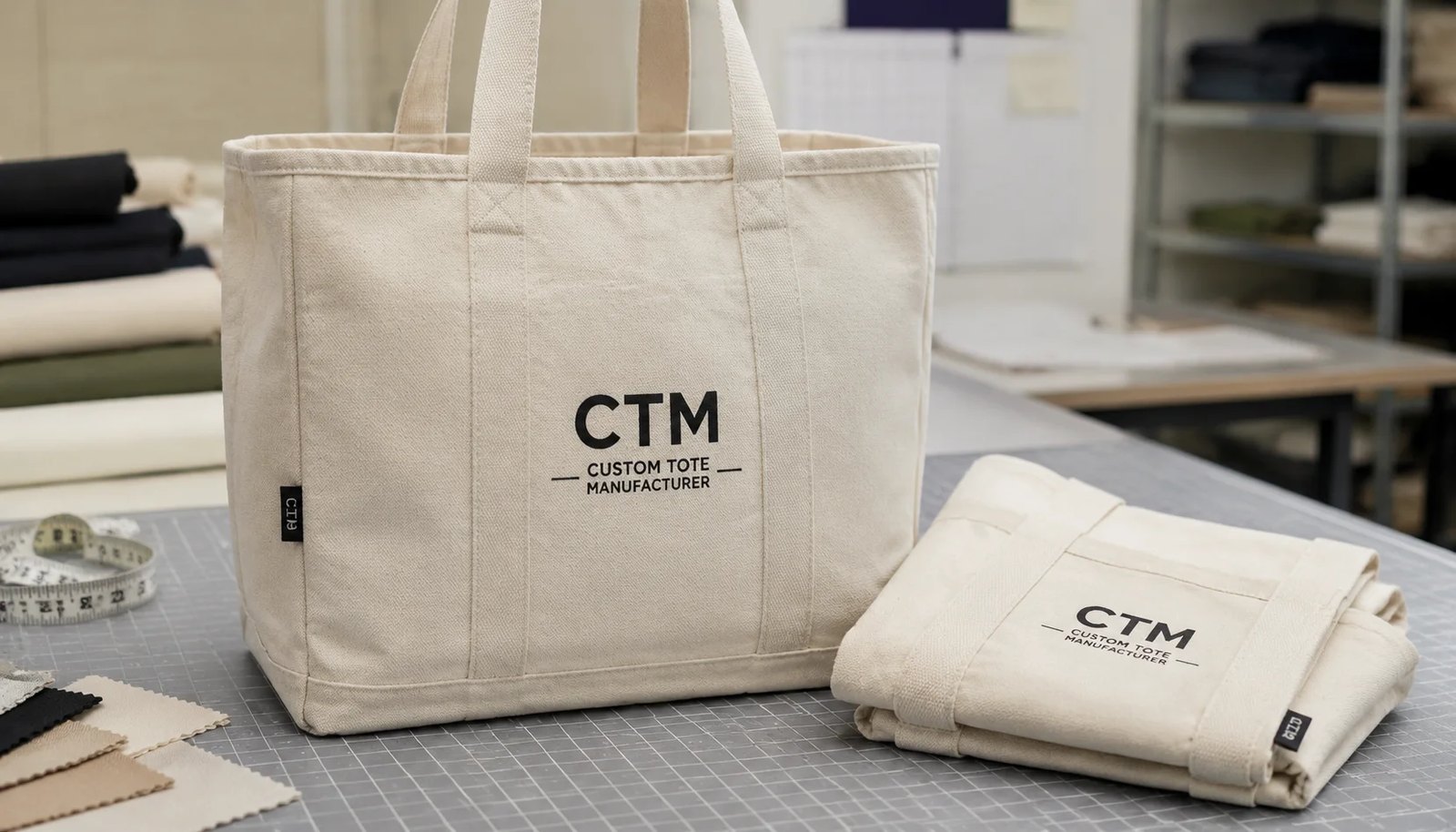
Start With The MOQ Problem
For liquor retailers, the hard part is not simply finding a factory willing to make canvas grocery totes. The practical problem is negotiating a workable MOQ without weakening the bag spec. Retail buyers often need store-group quantities, regional artwork, opening-event stock, or distributor replenishment. A factory, however, calculates MOQ around fabric purchase, cutting efficiency, print setup, sewing line balance, and packing labor. If those drivers are not separated in the RFQ, the quote becomes hard to compare and easy to misunderstand.
A strong MOQ negotiation starts by fixing the base bag first: fabric, size, gusset, handle, stitching, and packing. Once the base is stable, discuss whether the factory can split the same production run across different logos, cities, store names, or campaign artwork. This is more realistic than asking for a very low MOQ on a fully custom bag with different fabric colors, sizes, and print methods. The buyer gets flexibility where it matters, while the factory can keep material and production planning under control.
- Negotiate MOQ around one base construction before discussing logo splits.
- Treat fabric color changes, size changes, and print method changes as separate MOQ drivers.
- Use finished bag measurements in the RFQ so every supplier quotes the same product.
- Separate trial-order quantity from repeat-order forecast; both matter to factory pricing.
Build The Base Specification
Canvas grocery totes for liquor retail programs need more structure than a light promotional cotton bag. A common working range is 10 oz to 12 oz canvas, roughly 340-407 GSM depending on the mill and finishing. The higher end feels stronger and stands better with bottles inside, but it increases fabric cost, carton weight, and freight volume. An 8 oz canvas tote may be acceptable for light giveaways, but it often feels underbuilt for customers carrying glass bottles, mixers, snacks, and loyalty merchandise.
The bag shape matters as much as fabric weight. A boxed bottom gusset helps the tote sit upright at checkout and makes packing bottles easier. For liquor stores, a finished size around 38-42 cm wide, 35-40 cm high, and 10-15 cm gusset is often more practical than a narrow fashion tote. Handle length should match the carrying style. A 55-65 cm finished handle length usually supports shoulder carry, while short handles may be better for bottle-specific carriers but less useful as grocery totes.
- Fabric: 10 oz natural canvas for balanced cost; 12 oz for heavier premium retail programs.
- Size: list finished width, height, gusset, and handle drop separately.
- Structure: boxed bottom gusset is better than a flat tote for mixed liquor and grocery baskets.
- Handles: specify handle width, length, material, and reinforcement stitching.
Understand Factory MOQ Logic
MOQ is not one fixed number. A supplier may have one MOQ for stock natural canvas, another for dyed canvas, another for custom-woven fabric, and another for printed panels. A low MOQ may be possible when the factory already holds raw fabric or can combine your order with other cutting. The same quantity may become difficult if the buyer requests a special dyed shade, heavy canvas, unusual handle tape, or many print versions with separate screens.
Procurement teams should ask what part of the MOQ is caused by material and what part is caused by production setup. If the factory says 1,000 pieces minimum, it may mean 1,000 pieces per fabric color, not necessarily per logo. If the fabric, size, handles, and packing stay identical, it may be possible to split 1,000 pieces into several print designs, provided each design meets a reasonable screen-print setup quantity. This negotiation works best when the buyer provides an annual or seasonal forecast instead of only demanding the lowest first order.
- Fabric MOQ: driven by fabric roll length, dyeing batch, and cutting waste.
- Print MOQ: driven by screen setup, ink mixing, registration, and curing time.
- Sewing MOQ: driven by line setup, folder adjustment, reinforcement operation, and packing flow.
- Packing MOQ: driven by carton size, inner bundles, labels, barcodes, and store allocation work.
Use MOQ Levers Carefully
There are good ways and poor ways to reduce MOQ. A good lever keeps the physical bag the same and changes only the printed artwork. Another good lever is using the factory's available natural canvas instead of a custom dyed canvas. A poor lever is reducing fabric weight or removing handle reinforcement without telling the retail team. That may lower the quote, but it changes the customer experience and can create product failure at the store level.
If the order is for a liquor chain or distributor group, propose a base-order structure. For example, one production lot can use the same 10 oz natural canvas body, same size, same handle, same carton packing, and several one-color logo versions. The factory still needs to make and register separate screens, but cutting and sewing remain efficient. This approach is more credible than asking a supplier to produce small quantities of many different bag sizes and colors at the same unit price.
- Best MOQ lever: one base bag with multiple print versions.
- Useful cost lever: natural canvas instead of custom dyed canvas.
- Risky cost lever: thinner canvas, narrower handles, or reduced reinforcement.
- Operational lever: accept factory-standard carton quantity when it does not hurt distribution.
Choose The Print Method
For most canvas grocery totes used by liquor retailers, screen print is the safest commercial choice. It handles solid logos, store names, campaign artwork, and limited-color graphics with stable cost. On rough canvas, very fine text and thin lines can fill in or break during printing, so artwork should be reviewed at actual print size. If the design includes small legal text, QR codes, or detailed crests, a printed sample is more important than a digital proof.
Heat transfer can work for full-color artwork or gradients, but it changes the hand feel and may not match the reusable, natural look that many liquor retailers want. Embroidery is possible for premium programs, but it raises cost and is not always suitable for large grocery tote logos. The RFQ should not simply say 'logo printing'. It should define method, colors, print size, print location, Pantone reference, edge distance, and whether both sides are printed.
- Screen print: best for 1-3 solid colors and repeat retail orders.
- Heat transfer: useful for full-color artwork, but review feel and wash durability.
- Embroidery: premium look, higher cost, less suitable for large coverage.
- Artwork control: provide vector file, Pantone targets, and maximum print area.
Compare Quotes By Data
Two suppliers can quote the same canvas grocery tote description and still mean different products. One may quote 10 oz canvas before finishing, while another quotes finished GSM. One may include box-X handle reinforcement, while another only uses a straight stitch. One may include export cartons, while another adds carton charges later. Unit price alone is not enough for MOQ negotiation because low quantities often expose every hidden setup cost.
A usable quote should separate the commercial lines that affect decision-making. Procurement teams should request unit price by quantity tier, sample charge, print screen charge, artwork charge if any, packing cost, inland transport, export carton details, payment terms, and validity date. For importers, carton dimensions and gross weight are not minor details. A heavier canvas tote can move the freight calculation enough to change landed cost, especially for air shipment or small consolidated sea shipments.
- Request price tiers such as 500, 1,000, 2,500, and 5,000 pieces for the same spec.
- Separate screen charge from unit price so logo splits are easy to calculate.
- Get carton CBM and gross weight before comparing landed cost.
- Record quote validity because cotton fabric and freight costs can move between inquiry and deposit.
Control Sample Approval
Sampling should answer production questions, not create a display piece that bulk production cannot repeat. For MOQ negotiation, the first sample may be a blank construction sample made from available fabric. That sample confirms size, gusset, handle length, reinforcement, and sewing quality. The printed sample then confirms artwork scale, ink coverage, print position, and color. For larger or more sensitive retail programs, a pre-production sample from actual bulk fabric should be approved before mass cutting.
The buyer should measure and photograph the sample with a ruler before approval. Note finished size, handle drop, print position from top edge and side seam, fabric shade, stitch density, and any tolerance accepted. If a sample is approved with comments, those comments must appear in the production record. A common mistake is approving a sample informally in an email thread, then discovering the factory followed the physical sample while the buyer expected later comments to control the order.
- Blank sample: confirm shape, sewing, handle strength, and material hand feel.
- Printed sample: confirm artwork size, color, print edge, and curing quality.
- Pre-production sample: confirm actual fabric lot, actual print setup, and final packing method.
- Approval record: include photos, measurements, and written tolerances.
Set QC Thresholds
Canvas is a natural-looking material, but that does not mean every defect is acceptable. Buyers should define which variations are normal and which are rejectable. Minor slubs may be acceptable on natural canvas, while oil stains, dark marks on the front logo area, broken stitching, skipped reinforcement, and heavy shade mismatch should not pass. The QC standard must reflect the product's retail use: customers will carry glass bottles, and the bag will represent the retailer's brand at checkout and after purchase.
For functional checks, handle attachment is the first priority. The bag should be tested with a realistic load, not only pulled by hand for a second. Stitching should be even, thread ends trimmed, and reinforcement consistent across samples. Print QC should include placement, color, registration, ink coverage, and rub resistance. If the logo is printed on natural canvas, the buyer should accept that texture may show through slightly, but should not accept patchy coverage caused by poor ink control.
- Measure finished dimensions against agreed tolerance before checking appearance.
- Open cartons from different production points, not only the top carton.
- Test handle strength with a realistic retail load and short movement cycle.
- Reject heavy stains, broken seams, missing reinforcement, and uncured print.
- Keep one approved sample sealed for comparison during final inspection.
Plan Packing And Distribution
Packing decisions affect both cost and store execution. Flat packing usually keeps carton volume lower and protects print areas better than random loose packing. Bundle packing by 10, 25, or 50 pieces can help a distributor allocate bags to stores. Individual polybags add labor, material cost, and plastic waste; they may be necessary for e-commerce resale but are often unnecessary for in-store grocery tote programs.
For liquor retailers with multiple branches, carton marks and allocation labels can save time after import. The RFQ should state whether cartons need store codes, SKU labels, barcode labels, country-of-origin labels, or mixed-logo carton separation. Mixed-logo packing can reduce warehouse handling, but it adds factory packing complexity and increases the chance of carton content errors. For low MOQ orders, simple single-design cartons are usually safer unless the distribution requirement is very clear.
- Flat pack to reduce CBM and avoid unnecessary creasing.
- Use bundle counts that match store replenishment quantities.
- Define carton mark format before mass packing starts.
- Avoid mixed-design cartons unless allocation accuracy is more important than packing simplicity.
Protect The Schedule
Lead time should be counted from deposit and final sample approval, not from the first inquiry. A realistic schedule includes artwork review, sample making, sample shipping, approval comments, bulk fabric preparation, cutting, printing, curing, sewing, trimming, inspection, packing, and export handover. MOQ negotiation can also affect timing. A small order may wait for fabric availability or line grouping, while a larger order may secure more predictable production planning.
The highest schedule risk usually appears before bulk production begins. Late artwork changes, unclear Pantone references, unapproved packing labels, and delayed deposit can push the order more than sewing time itself. For seasonal liquor retail campaigns, such as holiday gifting, new store launches, or regional promotions, buyers should set an internal approval deadline and a final artwork freeze. The supplier can then quote a lead time that reflects real production instead of a best-case estimate.
- Count lead time from approved sample and deposit, not from RFQ date.
- Freeze artwork before screen making to avoid setup waste and delay.
- Approve carton marks and labels before packing week.
- For event programs, build buffer for inspection and freight booking.
Specification comparison for buyers
| Spec decision | Recommended option | When it fits | Buyer risk to check |
|---|---|---|---|
| Fabric weight for liquor grocery loads | 10 oz to 12 oz canvas, usually around 340-407 GSM | Best for mixed bottle, snack, and grocery purchases where the bag must feel reusable, not disposable | Quotes using 8 oz canvas may look cheaper but can feel weak after washing and may deform under bottle weight |
| Canvas type and finish | Natural cotton canvas with shrinkage-controlled finishing | Fits earthy retail branding and accepts screen print well on simple logos | Uncontrolled shrinkage can distort print placement and reduce finished bag size after steam pressing or consumer washing |
| Bag structure | Box bottom gusset with reinforced stress points at handle joints | Works for liquor stores selling bottles plus packaged goods because the bag stands and packs more easily | Flat totes are cheaper but do not carry bottles as neatly and can cause poor in-store user experience |
| Handle construction | Self-fabric handles, cross-stitched or box-X reinforced, 55-65 cm finished length | Good for shoulder carry and heavier retail baskets | Low MOQ factories may reduce handle width or omit reinforcement unless it is written into the RFQ |
| Print method | Screen print for 1-3 solid colors; heat transfer only for complex artwork or gradients | Screen print gives durable branding on canvas and keeps unit cost stable at volume | High ink coverage on rough canvas can crack or look uneven if mesh, ink type, and curing are not controlled |
| MOQ negotiation route | Negotiate by shared fabric, shared size, or split logo only after one approved base spec | Useful when liquor retailers need several store brands, regions, or seasonal designs | Multiple sizes, fabric colors, or print methods should not be treated as one MOQ because setup and cutting waste change |
| Packing format | Flat packed in export cartons, with optional bundle count by store allocation | Reduces freight volume and helps distributors ship to multiple retail branches | Individual polybags raise cost and plastic use; loose packing can create dirt marks on natural canvas |
| Quote basis | Request FOB unit price with separate sample, mold/screen, packing, carton, and inland cost lines | Allows procurement teams to compare suppliers without hidden charges | A single all-in unit price can hide low-grade fabric, weak packing, or later add-on charges for artwork screens |
Buyer checklist before sampling
- Define finished bag size, not only cut size; include tolerance for width, height, gusset, and handle drop.
- State fabric weight in oz and GSM range, plus whether the canvas is natural, dyed, bleached, or washed.
- Specify expected retail load, such as four 750 ml bottles plus grocery items, and request reinforcement details.
- Limit MOQ negotiation to one stable base construction before adding logo, color, or regional version splits.
- Request pre-production sample approval before bulk cutting, especially if fabric color or print placement matters.
- Compare quote lines for fabric, print, packing, sample, screen charge, inland transport, and export carton specification.
- Require print artwork size, Pantone targets, ink type, and curing method to be listed in the supplier PI or production sheet.
- Define carton packing method, units per carton, carton dimensions, gross weight, and whether bags are flat packed or bundled.
- Set QC acceptance points for stitching, handle strength, print rub resistance, carton condition, and quantity tolerance.
- Build approval time into the schedule; do not treat sample shipping, artwork revision, and deposit payment as production days.
Factory quote questions to send
- What is the minimum order quantity for this exact fabric weight, bag size, handle construction, and print method?
- Can the MOQ be split across several printed logos if fabric, size, handle, and packing remain the same?
- What is the MOQ change if we use 10 oz canvas instead of 12 oz canvas, or natural canvas instead of dyed canvas?
- Is your quoted fabric weight measured before or after finishing, and what GSM tolerance do you control in production?
- What reinforcement is included at the handle attachment point, and is box-X stitching included in the base price?
- Which print method is included in the quote, how many colors are included, and are screen charges separate?
- What sample types are available: blank construction sample, printed sample, pre-production sample, and shipment sample?
- What are the carton dimensions, units per carton, gross weight, and expected CBM for the quoted packing method?
- What is the normal lead time after deposit and approved sample, and which steps can delay the schedule?
- What inspection standard do you use for fabric defects, stitching defects, print defects, stains, and carton damage?
Quality-control points to confirm
- Finished size tolerance should normally be controlled within about plus or minus 1 cm for width and height, with gusset and handle drop listed separately.
- Fabric weight should be verified against the agreed GSM range using actual production fabric, not only a lab swatch.
- Handle attachment should have consistent reinforcement, no skipped stitches, no loose thread clusters, and no tearing after reasonable load testing.
- Print position should be measured from the finished bag edge, not from the unsewn panel edge, with placement tolerance agreed before production.
- Screen print should pass basic dry rub and tape tests without heavy ink lift, cracking, or smearing after curing.
- Natural canvas should be checked for oil marks, heavy slubs, stains, and color shade variation across panels and handles.
- Cartons should be export strength with correct marks, clean inner protection, and no over-compression that creases the print area.
- Final inspection should include quantity count by carton, packing method, carton measurement, gross weight, and randomly opened bag checks.