1. Plan Backward From the Launch Date, Not Forward From the PO Date
For tech startups, a custom canvas grocery tote is rarely a standalone purchase. It is usually tied to a product launch, conference handout, retail drop, onboarding kit, brand partnership, or investor event. That means the important date is not simply when the factory finishes sewing. The real question is when the bags must be available at the point of use: your warehouse, 3PL, event venue, retail distributor, or destination country port.
This is where many tote bag schedules break down. One supplier may quote 25 days based only on cutting, printing, sewing, and packing after all materials are ready. Another may quote 35 days including fabric booking, sampling, and final packing. If procurement compares those numbers without aligning the start and end points, the lowest lead time can be misleading.
A better approach is to map the order into milestone dates: artwork freeze, sample approval, deposit release, material readiness, bulk completion, ex-factory handover, freight departure, customs clearance, and final arrival. This gives a startup team a procurement schedule that can be managed like any other launch-critical purchase. It also makes internal ownership clearer, because many delays happen on the buyer side rather than the supplier side.
If your event date is fixed, the safest planning method is backward scheduling with a buffer. The buffer is not wasted time. It protects the order against realistic issues such as revised artwork, slower sample approval, a fabric lot swap, vessel rollover, or customs inspection.
- Define one commercial arrival date and one internal target date; the internal target should usually be earlier.
- Record whether the promised delivery date means EXW, FOB, ETD, ETA, or warehouse receipt.
- Ask the supplier when lead time starts: after deposit, after artwork approval, after sample approval, or after fabric readiness.
- Do not let sales, design, and logistics each run separate timelines; use one shared approval calendar.
- If an event date cannot move, treat air freight as a contingency line item early rather than a last-minute rescue.
2. Lock the Commercial Specification Before Asking for Final Pricing
Canvas grocery totes look simple, but small specification gaps create big quote differences. A buyer who asks only for a “canvas tote with logo” will receive prices built on different assumptions about GSM, gusset, handle reinforcement, print size, packing, and inspection. Those prices are not directly comparable.
For B2B procurement, the RFQ should act like a mini technical pack. It should define finished size, bottom gusset, handle length, handle drop, fabric weight in oz and GSM, body color, artwork position, print method, packing method, and destination. If one of those items is still undecided, note that clearly and ask for an option price rather than leaving the supplier to guess.
This is especially important for startup buyers because the first tote order often sets the benchmark for reorders. If the first PO is vague, then every repeat order becomes a negotiation over what was meant. A tighter RFQ shortens quotation time, improves internal approvals, and makes it easier to compare suppliers on like-for-like terms.
Good RFQs also reduce schedule risk. If a supplier must come back to ask for print area, handle drop, gusset depth, or carton requirements, each clarification adds delay before sampling can even begin.
- Use both inches and centimeters if your team works across regions, but nominate one unit as the manufacturing control unit.
- State whether dimensions are finished dimensions after sewing or panel cut dimensions before sewing.
- Specify the logo size and allowable print placement tolerance, for example center print ±0.5 cm.
- If requesting natural canvas, say whether slight off-white or seed-speck variation is commercially acceptable.
- If the order needs retail routing labels or 3PL labels, include that in the first RFQ, not after bulk production starts.
3. Choose Fabric by End Use: 10 oz to 12 oz Is Often the Practical Sweet Spot
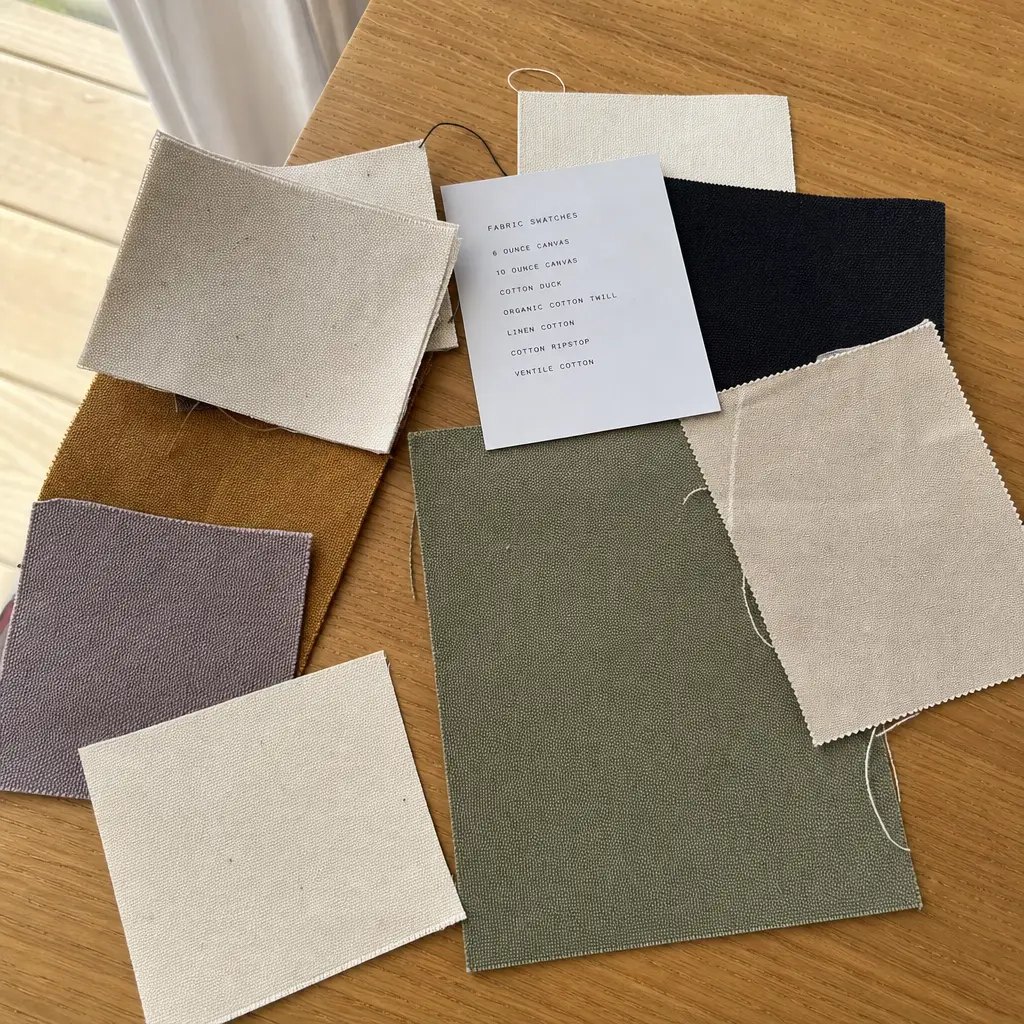
For reusable grocery totes, fabric weight is one of the most important decisions because it affects perceived quality, carrying performance, sewing speed, and freight. In most B2B programs, 10 oz to 12 oz cotton canvas, roughly 340-410 GSM depending on weave and finishing, is the practical range for a bag that feels durable without becoming unnecessarily heavy.
A lighter 6 oz to 8 oz canvas can work for low-cost promotion or one-time event distribution, but buyers should not expect the same structure or load confidence as a proper grocery tote. At the other extreme, 14 oz or heavier canvas can feel premium, yet it also increases fabric cost, needle wear, handling difficulty, carton gross weight, and shipping cost. Heavier fabric is not automatically a better buy if the tote must be folded, mailed, or packed densely for events.
Terminology also matters. One supplier may describe fabric in ounces per square yard, another in GSM, and another simply as 'canvas.' Those are not enough by themselves. Procurement should ask for composition, weight, weave, and finishing. Two different mills can both supply 12 oz canvas but produce visibly different hand feel, opacity, and shrinkage behavior.
If launch timing is tight, natural stock canvas is usually the lower-risk choice. Custom dyed canvas often requires lab-dips, shade approval, and more fabric preparation time. For startup programs where speed matters more than color-body complexity, a natural canvas body with spot-color logo printing is often the cleanest sourcing path.
- Ask whether GSM tolerance is stated against greige fabric, finished fabric, or the final bag panel.
- Natural canvas usually shortens lead time because stock availability is more common than custom dye lots.
- If dyed canvas is required, ask how many shade approvals are included and whether bulk shade variation is controlled lot-by-lot.
- Clarify whether the fabric is pre-washed, pre-shrunk, bleached, or untreated, because finishing affects hand feel and dimensions.
- If sustainability claims are required, ask separately about cotton origin or certifications rather than assuming all canvas is equivalent.
4. Construction Details Matter More Than Many Startup Buyers Expect
The main construction choices for canvas grocery totes are not cosmetic. They affect load performance, production time, and quality consistency. A flat tote is quicker and cheaper, but a bottom gusset usually makes more sense for grocery programs because it improves capacity and helps the bag hold boxed or irregular items more securely.
Handle design is another common source of mismatch. A shoulder tote may need a finished handle length around 55-60 cm, but what users feel is often the handle drop, not only the total length. If the bag will be carried over a hoodie, jacket, or laptop bag, confirm the drop on the physical sample. A handle that looks acceptable on a tabletop can be uncomfortable in actual use.
The handle attachment is the highest-stress area. For procurement buyers, the phrase 'reinforced handles' is too vague. Ask what reinforcement pattern is used. A box-X stitch is common for stronger attachment on tote bags, while simple straight stitching may be adequate only for lighter-duty promotional use. Ask about stitch density and whether bartacks are added where relevant.
Interior seam finishing also changes labor time and appearance. Raw seams, overlock seams, bound seams, and folded seams each have different cost and finish implications. If the tote is for retail sale or premium gifting, cleaner inside finishing may justify extra labor. If the program is a conference giveaway, a simpler seam finish may be commercially acceptable if durability is still maintained.
- Specify finished width, height, gusset depth, and handle drop, not just a generic tote size name.
- Ask whether handles are self-fabric folded straps or separate webbing handles.
- Request the exact reinforcement pattern at the handle root on the approved sample.
- Clarify whether inside seams are raw, overlocked, bound, or turned-and-stitched.
- If a bottom board, snap, zipper, or internal pocket is added, expect extra sample and production time.
5. Match the Print Method to the Artwork, Quantity, and Reuse Expectations
Most tech startup canvas grocery totes use front-panel branding rather than full-surface decoration. For 1 to 3 solid colors, screen printing is usually the most commercial method because it offers consistent branding, repeatability for reorders, and better economics at moderate volume. It also avoids the plastic hand feel associated with some transfer films.
However, screen print on canvas is not as simple as screen print on very smooth promotional fabric. The textured weave can influence edge sharpness and color coverage. Buyers should ask whether the artwork uses spot colors, whether underbase treatment is needed on darker fabrics, and whether the print area is measured from the panel centerline or from the seam edge.
Heat transfer or digital methods may be suitable for gradients, photographic detail, or small runs with many versions. But startup buyers should not default to those methods only because a digital mockup looks clean. Reusable tote bags are folded, rubbed, and handled repeatedly. Print adhesion, cracking risk, and hand feel must be reviewed on the actual fabric used for production.
A practical approval process includes exact artwork size, print location, color references, and a physical sample. If logo placement is critical, specify tolerance. On many tote programs, buyers accept print placement within about ±0.5 cm to ±1 cm depending on artwork size and the sewing layout. The acceptable range should be written down before bulk production begins.
- Screen print usually suits solid startup logos and repeat orders better than complex transfer methods.
- Ask whether print color approval is by Pantone reference, approved strike-off, or approved sample.
- If using natural canvas, expect printed colors to look slightly warmer than they do on bright white substrates.
- Confirm whether the supplier prints cut panels before sewing or prints finished bags after sewing.
- If there are multiple artworks, require packing separation controls to prevent mixed-SKU cartons.
6. Build a Realistic Lead Time Map With Decision Gates
The phrase 'lead time' is too broad unless each stage is broken out. For custom canvas grocery totes, the normal sequence may include RFQ review, artwork check, quotation revision, sample development, courier transit, sample approval, fabric readiness, print setup, cutting, printing, sewing, trimming, inline inspection, final packing, and freight handover.
For a stock natural-canvas tote with straightforward screen print, a pre-production sample may often take roughly 7-14 working days including print setup, not counting buyer approval time. Bulk production timing then depends on quantity, line capacity, and whether fabric is already available. Once custom dyeing, extra trims, retail tags, or multiple SKUs are added, each step becomes less predictable and usually longer.
What matters most for procurement is not only the nominal lead time but also the gate that can stop the process. Typical stoppoints include missing vector files, unresolved Pantone references, unapproved sample comments, delayed deposits, uncertain carton labels, and late changes to the print area. These are manageable if the buyer identifies them in advance.
Ask suppliers to separate sample lead time, production lead time, and freight time. Also ask what assumptions their schedule relies on. A supplier that quotes 30 days with stock fabric is giving a different commitment from one quoting 30 days while still waiting for fabric weaving or dye approval.
- Request a milestone schedule, not one single lead-time number.
- Ask which step is the critical path: fabric, printing, sewing capacity, or packing.
- Track buyer-controlled delays separately from supplier-controlled delays so internal teams understand schedule ownership.
- Require the supplier to flag immediately if stock fabric assumptions change after PO confirmation.
- Keep one internal decision maker responsible for final sample sign-off to avoid slow committee approval.
7. Use the Pre-Production Sample as a Signed Reference Standard
In B2B sourcing, a sample is not just a sales tool. It is the most practical way to convert a vague idea into an enforceable production reference. For tote bags, this matters because many quality variables are tactile or dimensional: fabric stiffness, seam finish, handle feel, print hand feel, and the way the gusset opens when loaded.
The best control method is a sealed pre-production sample paired with a signed specification sheet. The sheet should record material, dimensions, print location, print method, approved color references, handle construction, seam finish, and packing notes. If there are exceptions, note them precisely. 'Move print down 1 cm' or 'increase handle drop to 27 cm' is useful. 'Please improve quality' is not.
This process is also valuable for future reorders. Startups often place a small first order, then repeat when the campaign performs well. If the original approved sample and tolerance sheet are documented properly, reordering becomes faster and less subjective. If not, the second order may drift in size, handle feel, or body shade even when both parties think they are repeating the same product.
If possible, keep one sample with the buyer, one with the factory, and one for the inspection team. That reduces debate later if the shipment is reviewed by third-party QC personnel who were not part of the original sample discussion.
- Measure and record sample width, height, gusset, handle length, and handle drop before bulk approval.
- Write down the print size and the distance from top edge or side seams if placement is important.
- Approve carton marks and labels at the same time as the product sample when possible.
- If the sample differs from the original RFQ, update the PO spec so finance and inspection teams use the same reference.
- Do not rely only on phone photos for shade or print approval; physical review is safer on canvas.
8. Set Measurable Tolerances and QC Criteria Before Production Starts
Round-two sourcing accuracy depends on measurable quality language. Terms such as 'good quality,' 'retail grade,' or 'strong handles' are not enough for inspection. Procurement buyers should define tolerances and defect categories before bulk production starts so the factory and the inspector are using the same standard.
For many canvas grocery tote programs, practical dimensional tolerances might be width and height within ±1 cm, bottom gusset within about ±0.7 cm, and handle drop within ±1 cm after sewing and pressing. Fabric weight tolerance should also be discussed because actual delivered fabric can vary from the nominal spec. Print placement tolerance should be agreed for visible front logos, especially when alignment to the center panel matters.
Quality control should focus on use conditions, not only appearance. Handle attachments, open seams, major stains, severe odor, wrong fabric, and wrong artwork are more commercially important than minor loose threads. Print checks should include dry-rub resistance and repeated fold handling, especially when transfer prints are used.
If the order is inspected by AQL, define defect classes. Critical defects may include unsafe foreign material, wrong logo, wrong material, or unusable handle failure. Major defects may include open seams, severe print misregistration, or dimensions outside tolerance. Minor defects may include small thread tails or slight natural slub variation that does not affect use.
- Ask the factory what AQL level it commonly supports and whether your customer requires a different standard.
- Measure dimensions after the bag is fully finished, not during panel cutting.
- Check handle root stitching on multiple bags per carton, not only on the top sample.
- Inspect cartons for count, labels, gross weight, and moisture exposure risk in addition to the bags themselves.
- If the destination retailer has packaging rules, include them in QC criteria before final packing begins.
9. Packing, Carton Data, and Freight Planning Should Be Decided Early
Packing is often treated as an afterthought, but for tote bags it directly affects freight cost, receiving efficiency, and launch readiness. Bulk folding into export cartons is usually the most efficient method for B2B grocery tote programs. Individual polybags may be useful for retail presentation or hygienic single-unit handling, but they add labor, plastic, and carton volume.
Carton specifications should be agreed before the PO is finalized. Buyers should request pieces per carton, carton dimensions, gross weight, and estimated total CBM. This helps logistics compare sea, air, and express options realistically. It also prevents the common problem where finished goods are ready but the buyer still has not approved carton markings, barcode placement, or pallet requirements.
Warehouse and distributor requirements also matter. Some 3PLs limit carton weight for manual handling. Some retail DCs require SKU labels, PO numbers, country-of-origin marks, or routing labels in fixed positions. If those requirements arrive late, packed cartons may need to be reopened and relabeled, causing avoidable delay.
For startups with sustainability messaging, packing choices can affect brand consistency. If the outer marketing message emphasizes reusable or low-waste products, unnecessary single-unit plastic may create internal conflict. Procurement should align the packing method with both operational needs and brand expectations.
- Confirm pieces per carton early; overfilled cartons may reduce handling quality and increase damage risk.
- Request estimated CBM and gross weight before booking freight.
- If polybags are required, specify thickness, suffocation warning requirements, and whether air holes are needed.
- State whether pallets are required and, if so, what pallet standard applies at destination.
- Require random carton opening before shipment to verify count, artwork segregation, and label accuracy.
10. Compare Supplier Quotes by Total Usable Value, Not Just Unit Price
A lower tote price is not a procurement win if it is based on lighter fabric, weaker construction, reduced QC, or excluded packing requirements. For startup buyers, the real comparison is total usable value delivered on schedule. That includes product suitability, sample speed, lead-time reliability, packing readiness, and landed cost.
A good quote comparison sheet should list unit price, sample fee, setup or screen charges, MOQ basis, fabric spec, print method, packing method, pieces per carton, carton size, gross weight, estimated CBM, incoterm, production lead time basis, payment terms, and quote validity. If one supplier recommends a substitute fabric or construction, ask for that as a separate option so the baseline comparison remains clean.
Freight assumptions should also be separated from manufacturing cost. A supplier quoting FOB is not directly comparable to one quoting EXW or DDP. Likewise, a quote built around 8 oz fabric is not a saving if your actual use case requires 10 oz to 12 oz grocery-grade canvas. Procurement discipline means standardizing the quote framework before evaluating the numbers.
Finally, ask about reorder conditions. The most commercially useful factory partner is not only the one that can make a first order, but also the one that can repeat the tote consistently when your campaign scales. Reorder setup charges, repeat lead time, and fabric continuity are worth discussing at the quotation stage.
- Use one comparison template for all suppliers so omissions are visible immediately.
- Separate one-time charges from repeat-order unit pricing.
- Normalize all quotes to the same incoterm before internal evaluation.
- Do not approve a substitute fabric based on description alone; ask for a swatch or sample confirmation.
- Evaluate communication quality and schedule clarity alongside price, because poor quote discipline often predicts execution problems.
Specification comparison for buyers
| Spec decision | Recommended option | When it fits | Buyer risk to check |
|---|---|---|---|
| Fabric weight for reusable grocery load | 10 oz to 12 oz cotton canvas, about 340-410 GSM | Retail grocery programs, onboarding kits, event merchandise, and startup launches needing a durable but still foldable bag | Ask how GSM is measured and confirm tolerance; 8 oz can feel too light for grocery use, while 14 oz+ increases sewing time, carton weight, and freight cost |
| Bag construction | Open-top tote with bottom gusset 8-12 cm and reinforced handle box-X stitch | Most reusable grocery tote programs where capacity and upright packing matter | Flat totes cost less but reduce usable volume; weak handle reinforcement is a common failure point |
| Finished size tolerance | Width/height ±1 cm, gusset ±0.7 cm, handle drop ±1 cm after sewing and pressing | Buyers who need measurable QC criteria for inspection and reorder consistency | If tolerance is undefined, factories may apply their own standard and disputes become subjective |
| Print method | Screen print for 1-3 spot colors; heat transfer only when artwork detail requires it | Logo-led startup branding with repeat reorders and practical durability needs | Screen print coverage can vary on textured canvas; low-grade transfer film may crack or lift under repeated folding |
| Color choice | Natural canvas body with 1-2 brand-color prints | Tighter launch calendars where stock natural canvas is easier to source than custom dyed fabric | Natural cotton shade can vary slightly by lot; dyed body colors usually add lab-dip approval and extra days |
| MOQ structure | 1 size, 1 fabric, 1 print layout, 500-1,000 pcs as a practical pilot lot | Startups balancing usable unit economics with lower inventory exposure | Splitting MOQ across many colors, SKUs, or print versions creates extra setup, more line changeovers, and slower QC control |
| Packing format | Bulk packed 25-50 pcs per export carton, folded flat, with carton marks matched to PO and SKU | B2B distribution, warehouse receiving, and event rollout where efficiency matters | Individual polybags add labor, plastic, and carton volume; overpacked cartons can exceed warehouse weight limits |
| Approval path | Sealed pre-production sample with signed spec sheet covering fabric, dimensions, print, stitching, and packing | Any order tied to a launch date, investor event, retail delivery window, or distributor handoff | Approving artwork only by email leaves disputes on stiffness, seam finish, print hand feel, and handle length unresolved |
Buyer checklist before sampling
- Define finished bag width, height, bottom gusset, handle length, handle drop, fabric weight, fabric color, print size, print location, and seam finish in the RFQ before asking for price.
- State the delivery milestone clearly: ex-works date, FOB port handover, vessel ETD, air dispatch date, destination port ETA, or warehouse arrival date.
- Specify target quantity by SKU and avoid splitting the first order into too many body colors or artwork versions if timing is critical.
- Send editable vector artwork and Pantone references, and note whether slight natural cotton shade variation is acceptable on the bag body.
- Request measurable tolerances in writing for fabric GSM, finished dimensions, print placement, print color variation, and carton quantity.
- Ask whether fabric is stock natural canvas, stock dyed canvas, or make-to-order woven or dyed fabric, because this changes lead time materially.
- Approve one sealed pre-production sample and use the same sample as the reference for factory production and third-party inspection.
- Build buffer time for artwork correction, courier transit, buyer approval delay, print test revision, port congestion, and customs clearance.
- Confirm packing details early: carton quantity, carton dimensions, gross weight, barcode labels, carton marks, pallet requirements, and whether individual polybags are required.
- Compare quotes only when the same incoterm, fabric GSM, print method, packing method, and sample assumptions are used across all suppliers.
Factory quote questions to send
- What exact fabric are you quoting: cotton canvas composition, oz weight, GSM, weave type, and acceptable production tolerance?
- Is the quoted fabric from in-stock natural canvas, in-stock dyed canvas, or fabric that must be woven, bleached, or dyed after PO?
- What finished size tolerance will you control for width, height, gusset depth, handle length, and handle drop after sewing and pressing?
- What stitch specification is included for handle attachment: box stitch, box-X stitch, bartack count, stitch density, and thread type?
- Which print method is included, how many spot colors are included, what is the maximum print area, and is there a screen or setup charge?
- How many working days are needed for artwork review, sample making, sample dispatch, sample approval, bulk material preparation, printing, sewing, inspection, and export packing?
- What MOQ applies per color, per artwork, per size, and per print setup, and what surcharge applies if we split the order into multiple SKUs?
- What packing is included in the quote: bulk carton, individual polybag, paper band, hangtag, barcode sticker, carton label, and palletization?
- What inspection standard and AQL level do you support for fabric defects, sewing defects, print defects, and packing errors?
- Can you provide carton size, carton gross weight, pieces per carton, and estimated shipment CBM based on the quoted packing method?
Quality-control points to confirm
- Fabric weight should be checked from actual production fabric or cut panels, not copied only from a mill declaration or prior order record.
- Finished dimensions should be measured after sewing, pressing, and relaxation; record width, height, gusset, handle length, and handle drop against agreed tolerance.
- Handle attachment should use the approved reinforcement pattern with consistent stitch density, no skipped stitches, and no loose thread buildup at stress points.
- Print color should be checked against an approved physical sample or Pantone reference under controlled light, with acceptable variation defined before bulk production.
- Print performance should pass practical dry-rub checks and repeated fold checks suitable for reusable grocery use on textured canvas.
- Seams should be checked for straightness, seam allowance consistency, open seams, fraying, puckering, and exposed raw edges where a cleaner finish was specified.
- Natural canvas should be checked for noticeable stains, major slubs, holes, yarn contamination, and panel-to-panel shade variation beyond the approved sample range.
- Cartons should be verified for count accuracy, SKU separation, PO marks, barcode labels, gross weight, destination labels, and sufficient burst strength for export handling.
- Random packed cartons should be opened before shipment to verify folding direction, odor, moisture, mixed artwork risk, and bag count against carton markings.
- If needle control is required by the buyer or end customer, confirm whether the factory has a documented needle breakage and fragment control procedure.