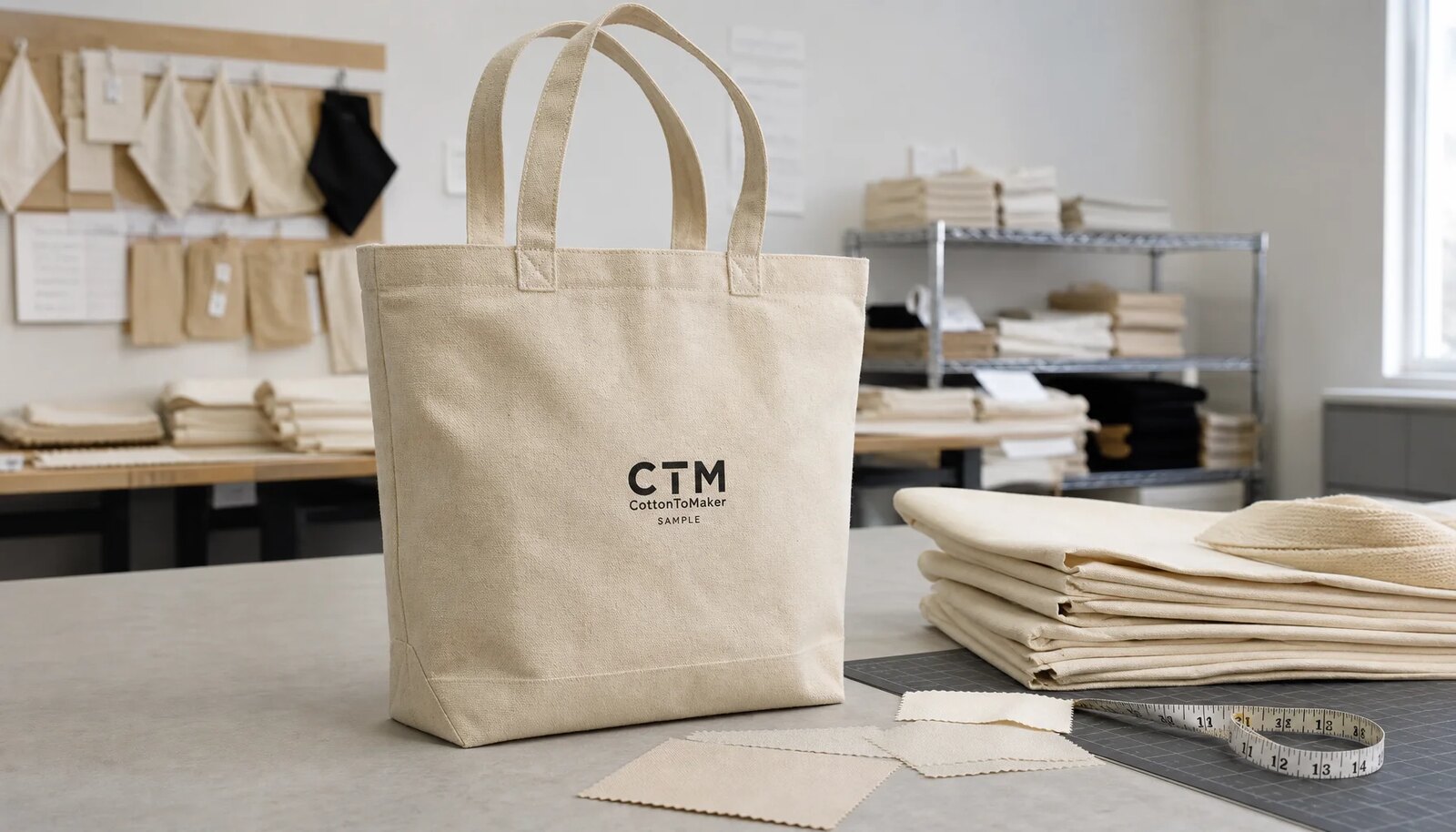
Plan Backward From the Warehouse Date
Craft fair tote programs rarely fail on the public event date alone. They fail in the quieter days before the fair, when cartons still need to be received, counted, sorted by design, labeled for venues, or moved into vendor kits. For procurement teams, the working deadline is the required in-warehouse date: the day approved, packed, sellable canvas grocery totes must be physically available for the next operation.
If the first booth setup is on a Saturday, receiving bags on Friday is too tight. A single warehouse usually needs at least 10-14 days before setup to handle receiving, count checks, shortage claims, repacking, and local delivery. Multi-venue craft fair programs need more room because one late carton can affect a specific city, sponsor, or retail SKU even when the total order count looks correct.
For imported custom canvas grocery totes, an 8-12 week planning window from complete RFQ to usable inventory is a practical baseline for normal custom programs. That does not mean every stage takes the same amount of time. The timeline includes quote clarification, sample development, artwork approval, bulk fabric preparation, cutting, printing, sewing, inspection, export handover, freight, customs clearance, and final delivery. Nearshore or domestic sourcing may reduce transport time, but it still needs sample approval, production scheduling, and QC.
- Set the warehouse date before you request prices, then work backward to sample approval, bulk start, inspection, and freight handover.
- Build in 10-14 days before the first setup date for single-location receiving and longer for venue sorting or regional delivery.
- Ask which milestone starts lead time: deposit, artwork approval, sample approval, fabric arrival, or signed order confirmation.
- Put the event date, required warehouse date, delivery address, receiving hours, and appointment rules in the RFQ.
- Agree on a late-order fallback before production starts: priority designs first, partial shipment, simplified print, or air freight for critical cartons only.
Convert Fair Demand Into Buy Quantities
A useful sourcing quantity starts with the job the tote must do. Canvas grocery totes may be sold as merchandise, used as gift-with-purchase packaging, handed out by sponsors, packed into vendor welcome kits, issued to staff, or placed at checkout. Those uses do not carry the same margin, quality expectation, or reorder risk. A resale tote can justify heavier canvas and cleaner finishing; a free checkout bag may need a lower-cost spec that still carries goods safely.
Procurement should model demand by event count, expected traffic, conversion rate, sponsor commitments, inventory policy, and acceptable leftover stock. Dated artwork creates higher leftover risk because the bag may not be usable after the season. Evergreen artwork is more forgiving and may support a larger run, especially when setup cost is spread across more pieces. The important step is alignment: marketing, finance, warehouse, and purchasing should agree before screens are made or fabric is cut.
Do not hide complexity inside one total number. A 5,000-piece order in one natural canvas body with one black logo is a clean production run. The same 5,000 pieces split across ten city logos, two print sides, and four destination carton labels becomes a more detailed program. The factory must manage separate screens, ink changes, version checks, sorting, packing lists, carton labels, and inspection records.
- Build the order plan by use case: resale, giveaway, vendor kit, checkout packaging, staff use, sponsor activation, or replenishment.
- Show quantities by artwork version, fabric color, handle color, SKU, destination, and carton-label requirement in the first RFQ.
- Add a controlled overage for replacements, sales samples, photography, and late venue additions instead of depending on factory extras.
- Avoid very small dated artwork splits unless the event requires them, because leftover stock can become obsolete.
- Confirm whether split shipments or priority release are possible if the first event needs inventory before the full program is ready.
Lock Fabric Weight, Finish, and Tolerance
Fabric weight drives cost, structure, print feel, durability, carton weight, and freight. For craft fair grocery totes, 10 oz to 12 oz cotton canvas is often the practical range. It feels more substantial than light promotional cotton while remaining foldable enough for carton packing and event handling. As a reference, 10 oz canvas is often around 270 GSM, and 12 oz canvas is often around 320-340 GSM, but actual values vary with yarn, weave, finishing, and supplier convention.
Ask for both oz and GSM. A quote that says only canvas is not specific enough for bulk buying, and a quote with GSM but no tolerance is still weak. The purchase specification should include a fabric-weight tolerance, an approved swatch, and a rule that substitute fabric cannot be cut without buyer approval. This protects you from accidental downgrades to lighter cotton sheeting, looser weave, or a finish that changes the hand feel.
Finish matters as much as weight. Natural unbleached canvas may show cotton flecks, seed specks, shade variation, and occasional slubs. Many craft brands like that honest look, but QC still needs limits for oil marks, stains, mildew smell, chemical odor, excessive slubs, and panel shade mismatch. Bleached canvas looks cleaner but can show dirt more easily. Dyed canvas supports stronger branding, yet it adds shade approval time, dye-lot risk, and possible MOQ increases. Washed canvas may feel softer but can shrink and shift print placement if not planned.
- Use 8 oz only when low cost and foldability matter more than grocery structure or retail hand feel.
- Use 10 oz when the program needs a balanced grocery tote for jars, books, produce, textiles, and general purchases.
- Use 12 oz when the bag is a retail item or needs a sturdier feel for heavier handmade goods.
- Use 14 oz or heavier only when premium hand feel justifies added material cost, carton weight, and freight cube.
- Keep an approved swatch and state GSM tolerance, shade standard, finish, shrinkage expectation, and odor limits in the specification.
Write the Tote Spec Like a Product Brief
A canvas grocery tote should not be quoted as a generic tote bag. Craft fair shoppers often carry awkward combinations: candles beside books, produce beside folded textiles, small ceramics beside packaged food. The bag must open well, sit reasonably flat when loaded, and hold stress at the handles and bottom corners. Procurement should define finished width, height, bottom depth, seam type, handle material, handle width, handle drop, reinforcement, label details, and measurement method.
A common grocery-style reference size is about 38 W x 35 H x 10 D cm, but the right size depends on the product mix. If ceramics, jars, or boxed goods are common, bottom depth may matter more than front height. If the tote will hang on a retail rack, folded thickness and handle presentation may matter. If it will be used at checkout, booth staff will care about how quickly it opens and whether it stands up enough to pack with one hand.
Handles deserve their own line in the spec. Shoulder-carry grocery totes usually need about 25-30 cm handle drop. Handle width often sits around 2.5-3.8 cm depending on material, comfort, and cost target. Cotton webbing can improve consistency and comfort, while self-fabric handles create a matching canvas appearance. Reinforcement should be described as X-box stitching, bartack stitching, or another defined pattern. Words like strong, durable, or premium are not enough for inspection.
- State finished dimensions in centimeters and clarify whether measurements are taken flat, after washing, or after final pressing.
- Define bottom construction as boxed bottom, bottom gusset, side gusset, or flat tote instead of relying on the word grocery.
- Specify handle material, handle width, handle drop, seam allowance, reinforcement pattern, thread color, and stitch-density expectation.
- Ask whether side seams are lockstitched, overlocked, bound, folded, or otherwise finished for heavier loads.
- Confirm whether woven labels, care labels, hangtags, barcode stickers, retail sleeves, or inside pockets are included or excluded.
Match Print Method to Artwork Risk
Screen printing is the default choice for many canvas grocery totes because it works well for simple logos, sponsor marks, slogans, and bold illustration. It is usually strongest for 1-3 solid spot colors, vector artwork, clean edges, and moderate ink coverage. On textured cotton canvas, however, tiny type, reversed lettering, gradients, halftones, distressed art, and tight multi-color registration can become inconsistent. The risk is not theoretical; the weave and cotton flecks can change how an edge reads.
Heat transfer, digital print, and embroidery may still be valid options. Heat transfer can support detailed or full-color artwork, but buyers should check film edge, adhesion, flexibility, wash behavior if relevant, and hand feel on textured canvas. Digital print may require pretreatment and more sampling time. Embroidery can look premium for small marks, but it is slower and usually not practical for large grocery-tote graphics.
Print placement needs fixed measurements. A centered logo on a mockup is not an inspection standard because sewing variation, gusset depth, and pressing can shift the visual center. Prints too close to the bottom gusset may fold or distort when the tote is loaded. Large dense prints may also change the hand feel of the front panel. Approve the artwork on the actual fabric, not only on a clean digital template.
- Provide vector artwork for screen printing and Pantone references when brand color matters.
- Specify print size in centimeters and placement from the top edge, side seam, and bottom gusset line.
- State whether the quote covers one side, two sides, the same design on both sides, or different artwork by side.
- Request a printed pre-production sample for fine text, dense ink blocks, color-critical logos, or multi-color registration.
- Ask how curing, crocking, rub resistance, print transfer, and ink odor are checked before packing.
Control MOQ Before Versions Multiply
MOQ is not only a total piece count. Factories plan around fabric procurement, cutting efficiency, print setup, sewing-line scheduling, inspection, packing, and carton marking. A 3,000-piece run in one bag body with one black print can move efficiently. A 3,000-piece program split across six artwork versions, two fabric colors, two handle colors, and three destinations takes more control and may carry more setup cost.
Craft fair programs often grow more complicated as the season gets closer. A city wants its own logo. A sponsor requests a separate side print. A retail partner asks for a different carton label. These changes are manageable when they are shown before quoting. They become expensive when they appear after the supplier priced one simple total quantity. Keep a live quantity matrix and ask the factory to confirm whether MOQ applies per bag body, fabric color, handle color, artwork, print side, shipment, or carton-label version.
The easiest way to reduce split risk is to keep the physical tote common. Use one canvas weight, one stock fabric color, one handle specification, one print method, and one carton format. Then vary artwork only where it has real value. If the budget cannot support many small versions, consider one shared season design and use paper inserts, hangtags, or venue labels outside the sewing and printing line.
- Ask whether MOQ applies per bag size, fabric color, handle color, print artwork, print side, destination, or carton-label version.
- Request pricing for one shared design versus multiple artwork splits so stakeholders can see the cost of complexity.
- Expect screen, setup, ink-change, or sorting charges when artwork differs, even if the tote body is identical.
- Avoid mixed cartons unless the warehouse needs them and the packing list controls the exact mix.
- Freeze artwork and quantity splits before bulk printing to reduce rework, overruns, and short-count disputes.
Use Samples as Approval Tools, Not Souvenirs
Samples are production controls. The plain construction sample should prove the canvas hand feel, finished size, bottom depth, handle drop, handle comfort, seam finish, and reinforcement before print setup begins. Load it with realistic fair goods. Put jars, books, folded textiles, or boxed products inside. Check whether the bottom sits correctly, whether the handles feel comfortable, and whether the tote folds and stacks the way your warehouse expects.
After construction is approved, request a printed pre-production sample from bulk or bulk-equivalent fabric. This sample should use the final artwork size, ink color, print method, and placement. Natural canvas can change the look of a print because flecks, weave texture, and ink absorption affect opacity and edge sharpness. A digital proof is useful for layout, but it cannot confirm ink behavior, hand feel, or curing on real fabric.
Sample approval should leave a record that an inspector can use. Note finished width, height, gusset depth, handle drop, handle width, fabric weight, print size, print position, reinforcement pattern, label placement, and packing expectations if they matter. Keep one approved sample with the buyer and one sealed reference sample at the factory. If a third-party inspection is planned, share the approved sample photos and written tolerances before inspection day.
- Approve a plain construction sample before releasing complex artwork, screens, or bulk cutting.
- Approve a printed pre-production sample before bulk printing for any new artwork, new fabric, or color-critical order.
- Mark print placement from fixed edges instead of approving visual centering only.
- Photograph handles, bottom corners, seam finish, labels, and print surface for the QC file.
- Do not start bulk production until the approved sample, specification sheet, artwork files, and quantity matrix match.
Map Lead Time by Stage
Supplier lead time language can be too compressed. A factory may say production takes 25 days, while sample approval, courier time, fabric booking, artwork revision, inspection, export paperwork, and freight sit outside that number. A better lead time plan breaks the order into stages so procurement can see what is waiting, what can run in parallel, and where a delay will hit the event calendar.
For normal imported custom canvas grocery totes, quote clarification may take 2-5 working days when the RFQ is complete. Plain and printed samples may need 7-18 days depending on print method, courier speed, and revision count. Bulk production often takes about 20-35 days after all approvals for standard custom orders, but capacity, fabric availability, print complexity, quantity splits, and packing requirements can change that. Final inspection, corrections, export documents, and handover can add another 3-7 days before freight begins.
Freight deserves its own line. Ocean freight is usually more economical for heavy canvas totes, but it needs more calendar time and can be affected by sailing schedules, port conditions, customs review, and domestic delivery appointments. Air freight can rescue a portion of a late order, yet canvas totes are bulky and heavy relative to unit value. When the schedule is already tight, simplifying the product is often safer than assuming freight upgrades will solve everything.
- Map target dates for RFQ close, deposit, artwork approval, sample approval, bulk start, inline check, final inspection, export handover, customs, and warehouse receipt.
- Ask whether production capacity is reserved before deposit or only after final sample approval.
- Use stock natural canvas, standard size, one-color print, and standard carton packing when the schedule is compressed.
- Avoid custom dyeing, complex registration, many artwork splits, and venue-specific cartons when the deadline is tight.
- Decide in advance which designs or cartons ship first if partial shipment becomes necessary.
Compare Quotes by Landed Usable Cost
A quote is only comparable when it describes the same bag. For canvas grocery totes, the offer should state finished dimensions, fabric oz and GSM, fabric finish, construction, handle specification, reinforcement, print method, color count, print side count, artwork versions, MOQ, sample cost, setup charges, unit price by quantity break, packing method, carton dimensions, gross weight, lead time, trade term, port, payment terms, and quote validity.
Procurement should compare landed cost per usable approved tote, not just EXW or FOB unit price. Landed cost can include screen charges, samples, courier fees, export cartons, labeling, inspection, export handling, freight, duty estimate, customs brokerage, local delivery, repacking, and expected reject allowance. A low unit price can disappear quickly if carton data is missing, setup fees are excluded, or defect risk is higher.
Trade terms need alignment. EXW, FOB, CIF, DAP, and DDP allocate cost and responsibility differently. Comparing EXW from one supplier with DDP from another distorts the decision. For multi-venue craft fair programs, accurate carton labeling and packing separation can save downstream labor, so include those services in the quote instead of treating them as late logistics details.
- Compare suppliers on the same trade term and route whenever possible, such as FOB-to-FOB or DDP-to-DDP.
- Request carton dimensions, gross weight, and pieces per carton early because boxed-bottom canvas totes can create high freight cube.
- Include screen fees, sample fees, inspection cost, labeling, local handling, and expected reject allowance in the cost model.
- Ask for price breaks at realistic quantities instead of pushing for an MOQ the fair season cannot sell through.
- Treat vague quotes as incomplete until fabric, construction, print, packing, lead time, exclusions, and tolerances are confirmed.
Set QC Rules for Grocery-Use Risk
Quality control should focus on the defects that cause returns, complaints, or event disruption. For canvas grocery totes, the main risks are handle strength, seam integrity, finished size, print quality, fabric cleanliness, odor, carton counts, and version separation. A nice-looking front print does not help if handles fail, cartons contain the wrong city logo, or the bags arrive with a mildew smell.
The approved pre-production sample should become the working standard. Typical sewn cotton bag tolerances may be around ±1 cm for finished width, height, and handle drop unless the buyer specifies tighter requirements. Print placement may need a tolerance such as ±0.5-1 cm depending on logo size and layout. GSM tolerance should be agreed with the supplier and checked against the approved fabric. If the tote is positioned as grocery-capable, the expected load, such as 8 kg or 10 kg, should be written into the specification and tied to handle and seam checks.
Inspection should combine visual and functional checks. Review stitch consistency, open seams, skipped stitches, bottom-corner alignment, handle reinforcement, print curing, rub resistance, stains, odor, shade variation, loose threads, carton labels, and packing list accuracy. When artwork versions are split by venue, carton control is part of QC. A perfect tote in the wrong carton can still miss the craft fair it was made for.
- Define tolerances for finished size, handle drop, print placement, GSM, carton quantity, and artwork-version separation before production starts.
- Inspect handles, side seams, bottom seams, gusset corners, and stress points instead of checking only the front logo.
- Reject open seams, broken handles, wrong artwork, uncured ink, heavy stains, strong odor, mildew smell, and visible print transfer.
- Use an agreed AQL level for visual inspection when order size, buyer policy, or shipment value justifies third-party QC.
- Require pre-shipment photos or inspection reports showing bag details, carton marks, bundle counts, and packing list checks.
Specification comparison for buyers
| Spec decision | Recommended option | When it fits | Buyer risk to check |
|---|---|---|---|
| Fabric weight for grocery use | 10 oz to 12 oz cotton canvas, typically about 270-340 GSM depending on weave and finishing | Craft fair resale, farmers market bags, retail merchandise, vendor kits, grocery promotions, and heavier handmade goods | Quotes listing only canvas may hide lighter sheeting; confirm GSM tolerance, weave density, shrinkage, and approved swatch |
| Finished size | Approx. 38 W x 35 H x 10 D cm as a common grocery reference; adjust to product mix | Works for candles, jars, books, folded textiles, produce, small ceramics, and bundled purchases | Oversized bags increase fabric yield loss, carton cube, and print distortion; undersized bags reduce practical reuse |
| Bag construction | Boxed bottom or bottom gusset with reinforced handle stitching and secure side seams | Best when the tote must stand open better and carry square or mixed products | Flat totes quote cheaper but pack poorly for groceries and may not match buyer expectations |
| Handle specification | Cotton webbing or self-fabric handles, 2.5-3.8 cm wide, 25-30 cm drop for shoulder carry | Useful when shoppers carry purchases around a fair and reuse the tote after the event | Short drops, narrow handles, weak stitch density, or poor seam allowance can cause discomfort or handle failure |
| Print method | Screen print for 1-3 solid spot colors; transfer or digital only when artwork requires detail | Reliable for most natural canvas branding, sponsor logos, and craft fair merchandise graphics | Fine type, gradients, dense ink blocks, and full-color art require physical print testing on actual fabric |
| MOQ planning | Quote by bag body, fabric color, handle color, artwork version, print side, and carton-label split | Important when one season includes several cities, sponsors, retail SKUs, or destination cartons | Small splits add screens, setup time, sorting labor, carton complexity, and schedule risk |
| Sample route | Plain construction sample plus printed pre-production sample from bulk or bulk-equivalent fabric | Reduces risk for size, handle comfort, bottom depth, print scale, ink absorption, and color approval | Approving only a digital mockup misses shrinkage, fabric shade, print hand feel, and sewing details |
| QC tolerances | Typical sewn-bag tolerances: finished size ±1 cm, handle drop ±1 cm, print placement ±0.5-1 cm, GSM per agreed fabric tolerance | Gives inspectors measurable acceptance points before shipment release | Unwritten tolerances lead to subjective disputes and inconsistent inspection decisions |
| Packing format | Flat packed in inner bundles of 25 or 50 pieces; export cartons kept at practical manual-handling weight, often under 18-22 kg gross where possible | Suitable for distributors, event organizers, museum shops, and multi-venue fair programs | Overpacked cartons can crease prints, deform gussets, exceed handling limits, or create short-count disputes |
Buyer checklist before sampling
- Confirm the first craft fair setup date, required in-warehouse date, receiving appointment rules, local delivery time, and all final ship-to locations before requesting prices.
- Specify finished width, height, bottom gusset or boxed-bottom depth, fabric weight, fabric finish, handle material, handle width, handle drop, reinforcement style, seam type, and stitch color.
- State whether the tote must carry a defined load such as 8 kg or 10 kg, and ask the supplier how handle attachment and seam strength will be checked against that use.
- Define fabric color precisely: natural, bleached, dyed, washed, unwashed, organic if required, plus acceptable shade variation, cotton flecks, slubs, odor, and shrinkage expectations.
- Provide vector artwork, Pantone references where needed, number of print colors, print size in centimeters, print position from fixed edges, print side count, and whether artwork differs by side.
- List quantities by artwork version, fabric color, handle color, SKU, venue, carton-label requirement, and destination instead of giving only one total order quantity.
- Request a plain construction sample and a printed pre-production sample, with timing, sample cost, courier cost, and approval milestone shown separately from bulk production.
- Define acceptance criteria for GSM tolerance, finished dimensions, handle drop, handle pull performance, stitch quality, print registration, curing, rub resistance, stains, odor, and carton quantity.
- Require packing details including pieces per inner bundle, pieces per carton, carton dimensions, gross weight, mixed-design rules, barcode labels, venue labels, PO labels, and shipping marks.
- Ask suppliers to state trade term, named port or delivery point, payment terms, quote validity, sample charges, screen charges, excluded fees, and the exact milestone that starts lead time.
Factory quote questions to send
- What exact cotton canvas weight is included in the quote, in oz and GSM, and what GSM tolerance will be used during fabric receiving and final inspection?
- Is the quoted fabric greige, natural, bleached, dyed, washed, unwashed, recycled, or organic-certified, and what documentation can be provided if a claim appears on the product or packaging?
- What shrinkage should we expect after finishing or washing, and are the quoted dimensions finished dimensions after sewing and finishing?
- What load is the tote construction designed to carry, and what handle pull, seam check, or internal test method do you use for grocery-style bags?
- What is the MOQ per bag size, fabric color, handle material, handle color, print artwork, print side, and carton-label or destination split?
- Which print method is included in the unit price, how many colors and sides are covered, and what screen, film, color-matching, artwork, or setup fees are additional?
- Can you make a plain construction sample first, then a printed pre-production sample from bulk or bulk-equivalent fabric before mass production starts?
- What lead time applies separately to fabric booking, dyeing if any, sample making, sample shipping, bulk cutting, printing, curing, sewing, inspection, packing, export documents, and handover to forwarder?
- What finished-size tolerance, handle-drop tolerance, print-placement tolerance, and fabric-weight tolerance can you commit to in the proforma invoice or specification sheet?
- How will boxed bottoms, handle reinforcement, seam allowance, stitch density, thread trimming, and print placement be controlled during production?
Quality-control points to confirm
- Finished bag dimensions checked against the approved tolerance after sewing and finishing, especially width, height, bottom gusset depth, boxed-bottom symmetry, handle length, and handle drop.
- Fabric weight verified against the approved standard using the agreed oz/GSM tolerance, with no unapproved switch from canvas to lighter cotton sheeting, looser weave, or different finish.
- Handle reinforcement checked by stitch pattern, stitch density, seam allowance, thread condition, bartack or X-box consistency, and pull performance suitable for the buyer’s stated load.
- Side seams, bottom seams, gusset corners, and stress points checked for skipped stitches, open seams, broken threads, puckering, raw edges, uneven corners, and loose thread trimming.
- Print color, logo scale, registration, edge sharpness, ink coverage, placement, curing, rub resistance, and hand feel matched to the approved printed pre-production sample.
- Canvas surface checked for oil marks, weaving defects, excessive slubs outside the agreed standard, stains, mildew smell, chemical odor, heavy creasing, shade variation, and dirt transfer.
- Artwork-version control checked by comparing bag print, carton label, inner bundle label, SKU code, packing list, and PO quantity before shipment release.
- Carton quantity, inner bundle count, carton strength, barcode labels, shipping marks, mixed-design rules, gross weight, and packing list accuracy checked before final shipment approval.