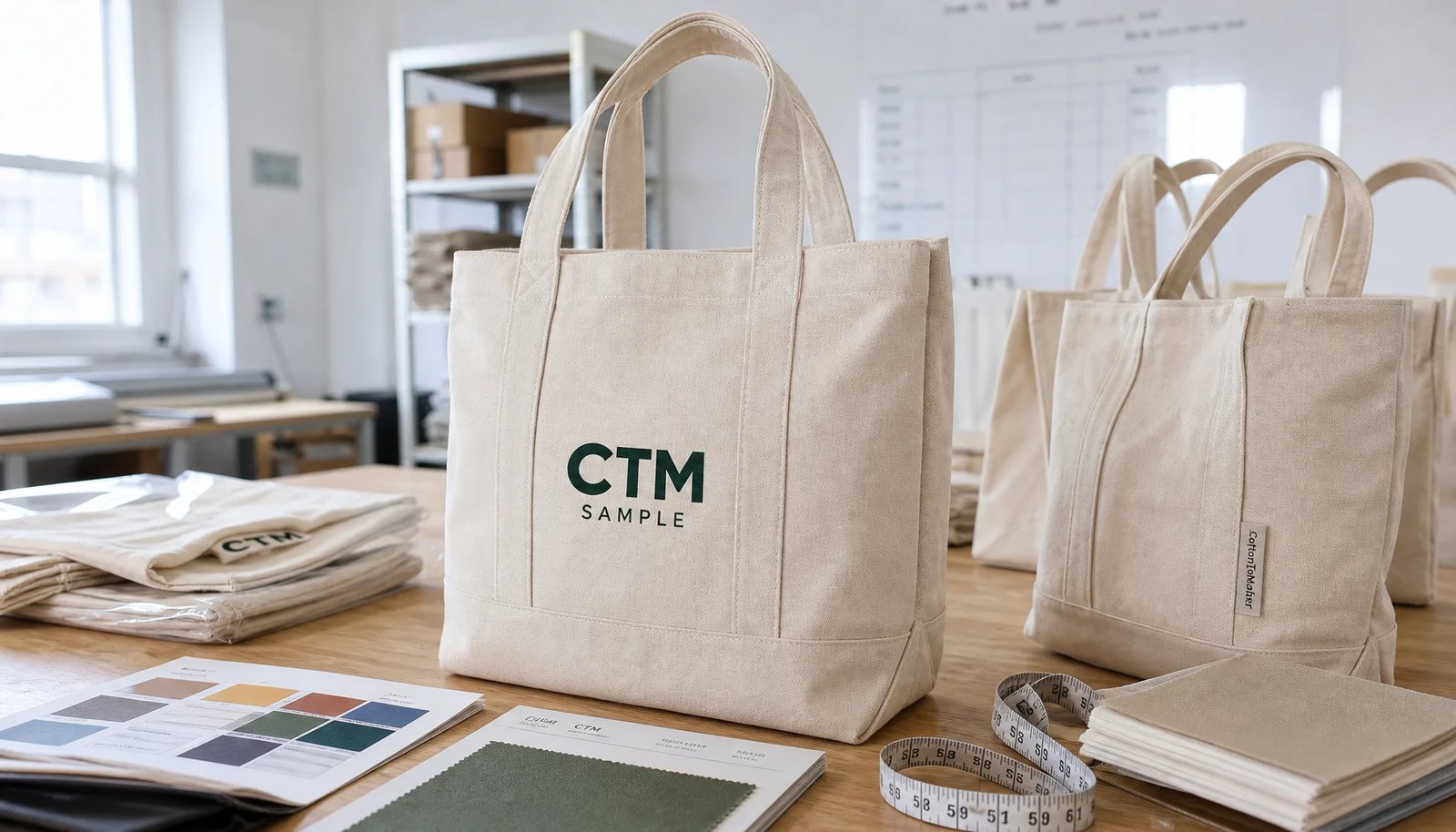
Start With the Bookstore Date, Not the Factory Date
Canvas grocery totes for university bookstores are usually tied to a fixed retail window: orientation, back-to-school, family weekend, alumni events, graduation, or a campus sustainability campaign. The mistake is to count only the factory's sewing days and ignore artwork approval, sampling, retail packaging, inspection, export handling, customs clearance, and campus receiving. A quote that says 25 to 35 days production is not a promise that cartons will be on the bookstore floor in five weeks.
A practical schedule starts from the date the store needs sellable inventory in hand. For a campus store, that may be several days before the public event because staff need time to receive cartons, scan barcodes, separate SKUs, merchandise displays, and handle shortages. If your purchasing team has internal PO approval or trademark licensing review, build that into the front end instead of expecting the factory to recover lost time at the end.
- For fixed launch dates, place the RFQ early enough to allow one full sample cycle and one artwork correction cycle.
- Treat production lead time as the period after deposit, approved artwork, approved sample, and available fabric unless the supplier states otherwise.
- Add time for final inspection and rework, because rejected cartons cannot be repaired after the vessel has sailed.
- For campus receiving, confirm blackout dates, dock hours, pallet restrictions, and whether mixed-SKU cartons are accepted.
Choose a Canvas Weight That Matches Real Carry Loads
For grocery-style bookstore totes, fabric weight drives both cost and performance. Many low quotes use 6 oz or 8 oz cotton canvas because it cuts fabric cost and lowers shipping weight. That may be acceptable for a giveaway with light handouts, but it often feels too soft for retail sale when the bag must hold books, sweatshirts, drink bottles, and groceries. For paid bookstore merchandise, 10 oz to 12 oz canvas, roughly 340 to 407 GSM, is a safer starting point.
Heavier fabric is not automatically better. A 14 oz tote can look premium, but it increases unit cost, makes folding bulkier, raises carton CBM, and may require stronger needles and slower sewing. If the tote will be printed with a large campus logo, mid-weight canvas often gives better print handling than very coarse fabric. For natural cotton canvas, buyers should also decide whether small slubs are acceptable or whether the front print panel must be cleaner grade fabric.
- Use 8 oz canvas only for low-load promotions, not as the default for a grocery tote sold at retail.
- Use 10 oz canvas when the target is affordable bookstore merchandise with acceptable structure.
- Use 12 oz canvas when the tote must stand better, carry heavier loads, or support a premium price point.
- Require fabric weight in both oz and GSM so suppliers cannot quote different standards under the same description.
Lock the Construction Before Comparing Prices
Canvas grocery totes are not one standard product. Two quotes can both say canvas grocery tote but include very different construction. The most important details are bottom gusset, side gusset, handle length, handle material, seam finishing, and reinforcement. A boxed bottom gusset adds cutting and sewing time but gives the tote usable capacity for folded apparel, textbooks, and grocery items. A flat tote may be cheaper but does not solve the same retail use case.
Handle specification is a common source of false savings. A 24 in shoulder handle is usually more useful for students walking across campus than a short hand-carry handle. If the handle is self-fabric, it may match the body but can feel bulky. Cotton webbing handles are more consistent, but their color and width must be specified. The handle attachment should include cross-stitching or bar-tacks; otherwise the stress point may fail before the body fabric does.
- State finished dimensions as width x height x bottom gusset, not just a general size name.
- Define whether the bottom is boxed, T-gusseted, or flat, because cutting yield and sewing cost change.
- Specify handle length, handle width, material, and reinforcement stitch pattern.
- For visible inside seams, decide whether raw edges, overlocked edges, or bound seams are acceptable for the retail price point.
Print Method Changes Both Schedule and Defect Risk
Most university bookstore canvas totes use screen printing because it is stable, cost-effective, and suitable for solid university colors. Spot color screen printing works well for one to three colors, block lettering, mascots, simple icons, and sustainability messages. It also gives a clear basis for quote comparison because screens, setup, color count, print size, and print positions can be itemized. For natural canvas, good ink coverage matters because the fabric texture can break up thin strokes.
Complex artwork changes the workflow. Fine seals, gradients, small sponsor logos, or multicolor mascot illustrations may require halftones, digital transfer, DTG, or revised art. Those choices can add sampling time and increase the chance of shade mismatch or edge issues. Licensed university artwork should be reviewed early because a factory cannot judge trademark rules. The buyer should provide vector artwork, Pantone references, print size, placement from bag edges, and any minimum clear-space requirements.
- For solid campus logos, specify screen print with Pantone color targets and acceptable tolerance.
- For very detailed artwork, request a print strike-off before the full pre-production sample.
- For dark dyed canvas, verify ink opacity because one pass may not cover strongly enough.
- For two-sided printing, note whether artwork is same or different on each side because screen setup and handling time change.
Understand MOQ Logic Before You Split Versions
MOQ is not only a sales rule. It comes from fabric procurement, cutting efficiency, print setup, sewing line planning, trim purchasing, carton labeling, and packing labor. A bookstore buyer may want four campus colors, three department logos, and separate alumni versions. The total quantity may look large, but the factory sees many small production lots if each version uses a different fabric color, print color, bag size, or packing label.
To control MOQ without weakening the retail program, consolidate the base tote where possible. Use one natural canvas body and vary the screen print by campus or department. If dyed canvas is needed, group artwork versions under the same body color and production batch. For distributors serving multiple university bookstores, a shared base spec with separate print runs is usually more efficient than treating each logo as a fully separate custom bag.
- Clarify whether MOQ is per order, per artwork, per fabric color, per print color, per size, or per packing SKU.
- Consolidate fabric and construction first; customize print and label second.
- Avoid small dyed-canvas runs unless the margin supports fabric dyeing and shade approval work.
- If several stores need the same base tote, quote one bulk body production with separated print and carton marks.
Build the RFQ Around Quote Data, Not Descriptions
A useful RFQ gives the supplier enough data to quote the same product every time. If the RFQ only says custom canvas grocery tote with logo, each supplier will make assumptions. One may quote 8 oz natural canvas with short handles and bulk packing. Another may quote 12 oz canvas with shoulder handles, individual packing, and inner cartons. The cheaper price may be a different bag, not a better supplier.
For importers and distributors, quote data must also support landed-cost comparison. Carton dimensions, carton weight, packing quantity, CBM, HS code suggestion, incoterm, port, and lead time basis affect the final cost more than many buyers expect. A tote that is slightly cheaper per unit but packed in oversized cartons can lose its advantage in ocean freight, warehouse handling, and campus delivery.
- Include target annual volume and first PO quantity so the factory can plan MOQ and price tiers honestly.
- Request EXW, FOB, or FCA terms consistently across suppliers before comparing unit prices.
- Ask for carton CBM and gross weight before final PO, not after production is packed.
- Require the quote to separate sample fee, screen charge, unit price, packing cost, and any label or barcode cost.
Use Samples to Freeze Risk Before Bulk Cutting
A pre-production sample is not a showroom sample. It should use the agreed fabric weight, final handle material, actual print method, and intended packing format. For campus bookstore programs, the sample must answer practical questions: does the bag stand when filled, does the shoulder handle feel right, does the logo sit level on the front panel, does the printed ink crack when folded, and does the folded bag look acceptable for retail display?
The sample approval should be written, not casual. If the bookstore licensing team approves the logo but the procurement team has not approved construction, the factory may still be exposed to later changes. If the buyer approves a digital mockup but not a physical sample, there is no agreed reference for fabric hand-feel, print opacity, or seam quality. Once bulk fabric is cut, changes to size, gusset, and handle length become expensive and slow.
- Approve fabric swatch, print strike-off, and full tote sample in that order when time allows.
- Measure the sample and record actual dimensions, not only visual approval.
- Load test the sample with realistic bookstore items, such as books and apparel, before signing off.
- Keep one signed sample at the factory and one with the buyer so final inspection has a physical reference.
Set Acceptance Criteria for Inspection
Canvas has natural variation, so QC rules must separate normal textile character from unacceptable defects. Small slubs on natural cotton may be acceptable away from the logo, while oil stains, mildew odor, large dark yarn knots in the print area, and mismatched front panels are not acceptable for retail. The QC standard should define which defects are critical, major, and minor before production begins.
Functional checks matter more than cosmetic perfection alone. Grocery totes are loaded and carried, so seam strength and handle attachment need special attention. AQL inspection can be used, but the checklist should include tote-specific tests: handle pull, seam stress, print rub, print registration, stitch density, loose threads, and carton count. If the order is for a fixed campus event, inspection should happen early enough to allow sorting or repair.
- Set dimensional tolerance for body size, gusset, handle length, and print placement.
- Define unacceptable print defects such as missing ink, pinholes in key logo areas, cracking, smearing, and tilted placement.
- Check stitch security at handle joints, bottom corners, side seams, and gusset folds.
- Inspect packed cartons for mixed SKUs, wrong labels, crushed boxes, and quantity shortages.
Plan Packing for Store Receiving and Shelf Readiness
Packing is often treated as an afterthought, but bookstore receiving teams care about it. Individual folding with a belly band, barcode sticker, hangtag, or recyclable bag can make the tote ready for quick scanning and merchandising. Bulk loose packing may be cheaper, but it can create heavy wrinkling, mixed logos, counting disputes, and slower store setup. The right packing method depends on whether the tote is sold as merchandise, used as a gift-with-purchase, or distributed at events.
Carton planning also affects freight and warehouse handling. Large grocery totes with gussets take more space than flat cotton bags, especially in 12 oz canvas. A high unit count per carton may reduce carton quantity but create heavy boxes that campus staff dislike handling. A lower count per carton may improve receiving and reduce damage but increase CBM. The RFQ should request carton quantity, dimensions, gross weight, and any pallet pattern needed by the distributor.
- For retail sale, use consistent folding, visible barcode placement, and carton labels by SKU.
- For event distribution, pack by count per carton and destination to reduce sorting at campus.
- Avoid over-compressing printed totes before ink has fully cured, especially for large front prints.
- Use carton marks that match the PO, SKU, artwork version, quantity, and destination receiving code.
Build a Lead Time Buffer That Survives Real Delays
A realistic canvas grocery tote schedule includes RFQ clarification, artwork preparation, sample making, sample shipping, buyer review, bulk material preparation, cutting, printing, curing, sewing, trimming, packing, final inspection, export paperwork, freight booking, transit, customs, inland delivery, and store receiving. Any one of these steps can stop the clock if the buyer and supplier have not defined responsibilities.
The most common delay is not sewing capacity; it is approval timing. A buyer may wait several days for licensing approval, a revised logo file, or internal PO release. During that time, the factory may not reserve fabric or production space unless terms are clear. For fixed university events, the safest method is to set a last approval date. If the approved sample or artwork arrives after that date, the delivery date must move or the shipping method must change.
- For repeat orders using approved specs, production can be faster, but fabric and print setup still need scheduling.
- For new dyed canvas, add time for lab dips, bulk shade approval, and possible re-dyeing.
- For holiday or back-to-school peaks, reserve production capacity earlier because tote lines fill quickly.
- For air freight rescue plans, compare the cost increase against the event value before assuming it is acceptable.
Specification comparison for buyers
| Spec decision | Recommended option | When it fits | Buyer risk to check |
|---|---|---|---|
| Fabric weight for campus retail use | 10 oz to 12 oz cotton canvas, about 340 to 407 GSM, pre-shrunk if washing is expected | Best balance for textbooks, sweatshirts, groceries, and bookstore impulse purchase displays | Quotes using 8 oz fabric may look cheaper but can lose structure, show print-through, and fail handle pull expectations |
| Bag size and bottom construction | Large grocery tote around 15 x 16 x 6 in with boxed bottom gusset and full side seams | Works for apparel, notebooks, water bottles, and food items without collapsing at checkout | Flat totes are easier to print but do not stand well on retail counters or fill efficiently in cartons |
| Handle length and reinforcement | 24 in shoulder handles with cross-stitch or bar-tack reinforcement at stress points | Suitable for students carrying across campus and alumni using the bag for daily shopping | Short handles reduce fabric cost but create returns when loaded bags cannot be carried comfortably |
| Print method for bookstore artwork | Spot color screen print for 1 to 3 solid colors; DTG or transfer only for complex gradients | Keeps unit cost predictable and provides strong coverage on natural or dyed canvas | Fine university seals, small legal text, and halftones need print trials before bulk approval |
| MOQ planning | Plan MOQ by fabric color, bag size, and print setup; consolidate artwork when possible | Useful for bookstore groups ordering multiple campus logos on the same base bag | Splitting colors and sizes can create hidden minimums for fabric dyeing, cutting, screens, and carton labels |
| Sample approval route | Pre-production sample using bulk fabric, real handle webbing, actual print method, and final packing style | Important for bookstore launch programs, orientation week, alumni weekend, and licensed logo review | Digital proofs alone cannot verify fabric hand-feel, print opacity, seam strength, or folded retail presentation |
| Packing format | Individual fold with belly band or clear recyclable bag, then inner cartons by SKU and master carton labeling | Fits campus store receiving teams that need barcode control, quick shelf replenishment, and clean storage | Loose bulk packing saves labor but increases wrinkling, counting disputes, and mixed-SKU receiving problems |
| Lead time buffer | Add 10 to 15 working days beyond quoted production time for sampling, artwork revision, inspection, and freight booking | Needed when the bookstore has a fixed semester, event, or move-in date | A factory production lead time does not include buyer approval delay, customs exams, truck appointments, or campus receiving blackout dates |
Buyer checklist before sampling
- Define the required in-store date, not only the event date, and work backward from campus receiving cutoffs.
- Specify bag dimensions including height, width, bottom gusset, handle length, and acceptable tolerance.
- State fabric weight in oz and GSM, plus whether natural, bleached, dyed, organic, or recycled canvas is required.
- Provide artwork as vector files with Pantone references, print size, placement, and licensed logo approval rules.
- Separate MOQ by base bag color, print version, packing style, barcode label, and shipping destination.
- Require a pre-production sample made with bulk fabric and actual print method before mass production starts.
- Set QC acceptance criteria for seam strength, handle pull, print registration, stains, odor, shade variation, and carton count.
- Request carton dimensions, gross weight, packing quantity, barcode labeling plan, and pallet requirements before placing the PO.
- Ask whether the quoted lead time begins after deposit, artwork approval, sample approval, or fabric arrival.
- Reserve buffer days for campus purchasing approval, import documentation, inspection, and local delivery appointment.
Factory quote questions to send
- What exact fabric weight are you quoting in oz and GSM, and is it greige, washed, pre-shrunk, dyed, or finished canvas?
- Is the MOQ based on total order quantity, per artwork, per fabric color, per bag size, or per packing SKU?
- What bag construction is included: boxed bottom, side gusset, inside seam binding, handle reinforcement, and seam allowance?
- Which print method is quoted, how many colors are included, and what is the maximum printable area on this tote size?
- Can the pre-production sample use bulk fabric and final print screens, and how many working days are needed after artwork approval?
- What tolerance do you apply to bag size, fabric weight, print placement, color shade, and carton quantity?
- What packing is included in the unit price: folding method, polybag or band, hangtag, barcode sticker, inner carton, and master carton?
- Does the production lead time include fabric procurement, cutting, sewing, printing, curing, trimming, packing, and final inspection?
- What quote data will you provide for landed cost comparison: carton size, carton weight, HS code, CBM, loading quantity, and incoterm?
- What buyer approvals can delay the schedule, and what is the latest approval date to meet the requested ship date?
Quality-control points to confirm
- Fabric weight should be checked by GSM test or swatch comparison against approved sample, not by supplier description only.
- Finished bag dimensions should stay within agreed tolerance, commonly plus or minus 0.5 in for body size and plus or minus 1 in for handle length.
- Handle attachment should pass a practical load test based on intended use, with no torn fabric, skipped stitches, or loose bar-tacks.
- Print color should match approved Pantone or signed sample under consistent light, with no obvious pinholes, smearing, cracking, or off-center placement.
- Seams should be cleanly stitched with no open seams, broken threads, raw fraying on exposed edges, or uneven gusset alignment.
- Natural canvas should be free from unacceptable stains, mildew odor, oil marks, large slubs in print zones, and mixed shade panels in the same visible face.
- Cartons should match the approved packing list by SKU, quantity, barcode label, destination mark, gross weight, and carton condition.
- Final inspection should include random unpacking after folded packing to check wrinkles, print transfer, odor trapped in polybags, and retail presentation.