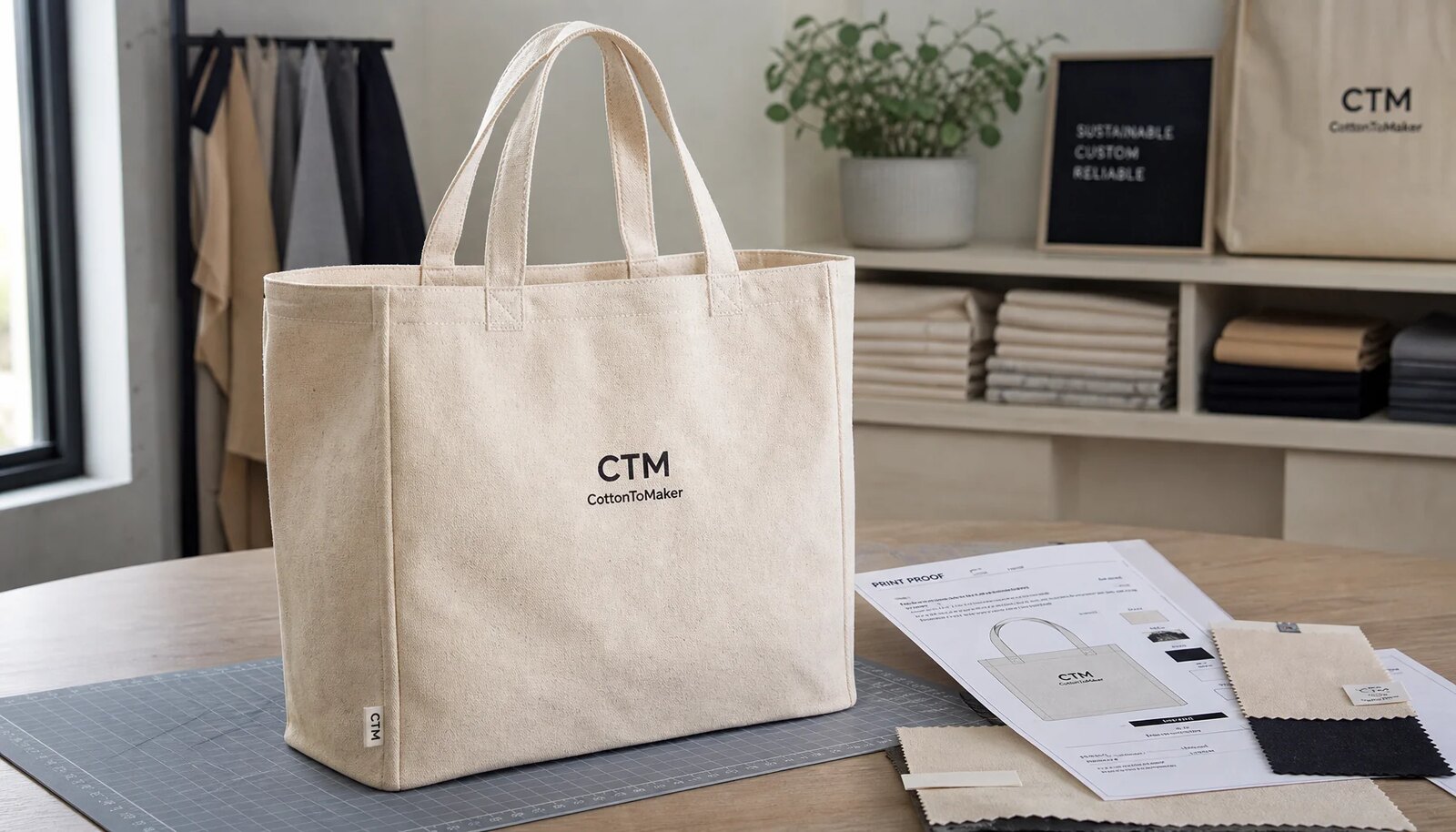
Why Print Proofing Matters for Hotel Retail Totes
Canvas grocery totes for hotel retail sit in a different quality category than giveaway bags. Guests buy them in a lobby shop, resort market, spa boutique, or destination store because the bag feels useful and represents the property. If the print is dull, crooked, sticky, cracked, or placed too close to the seam, the problem is visible before the guest even opens the bag. A print proofing checklist protects the buyer from approving artwork on a screen while leaving the factory too much room to interpret the physical product.
The main buying problem is not whether the supplier can print a logo. Most factories can. The risk is whether the print, fabric, stitching, and packing are all approved together before bulk production. A logo that looks clean on 8 oz smooth cotton may lose edge definition on 12 oz textured canvas. A tote that looks good flat may crease across the print when folded for retail packing. The proofing process must connect brand artwork to production conditions.
- Treat print proofing as a production approval, not a design approval.
- Use actual canvas fabric for strike-offs whenever color or fine detail matters.
- Approve print placement against the sewn bag shape, not only against a flat artwork file.
- Include packing in the approval because fold lines can damage the visual result.
Start With the Bag Spec Before Judging Artwork
Artwork proofing is unreliable if the tote specification is still moving. A grocery tote for hotel retail usually needs more structure than a simple event tote. Common workable sizes are around 35-42 cm wide, 35-40 cm high, with a 10-16 cm bottom gusset. Handle drop often sits around 22-28 cm for shoulder carry, but a shorter hand-carry handle may fit a pantry or market concept better. The print position must be judged after these choices are fixed.
Fabric weight changes both cost and print behavior. An 8 oz canvas may be acceptable for a light souvenir bag, but 10 oz to 12 oz is more common when the bag is sold as a reusable grocery tote. In GSM terms, that often falls around 270-340 GSM depending on the mill conversion. Heavier canvas improves perceived value and load performance, but it also increases sewing resistance, carton weight, freight cost, and the chance that ink sits unevenly on the textured surface.
- For a retail grocery tote, specify finished size plus gusset, not only panel size.
- For hotel use, define whether the bag must carry groceries, towels, bottles, books, or mixed retail goods.
- For canvas weight, request both ounces and GSM so supplier quotes can be compared.
- For natural canvas, decide whether cotton seed flecks and shade variation are acceptable.
Choose the Print Method Around the Artwork
Screen printing is usually the safest and most economical method for hotel logos, destination names, simple line art, and solid-color graphics. It gives good opacity, repeatability, and cost control when the artwork uses one to four spot colors. The buyer should still confirm mesh choice, ink type, curing method, and whether the factory is printing on cut panels or finished bags. Panel printing normally gives better flatness and registration, but the sewing process can shift the final relationship between print and seams.
Heat transfer, digital print, and DTG-style methods can solve gradient or multi-color artwork problems, but they should not be selected only because the PDF looks complex. Transfers can feel heavier on canvas and may crack if the finish is too plastic. Digital printing can lose saturation on unbleached natural canvas. Embroidery may look premium on a small chest-style mark, but it is not usually the best choice for large grocery tote graphics because it adds cost, weight, puckering risk, and longer production time.
- Use screen print for solid hotel marks and destination graphics with clean color separation.
- Use transfer or digital print only when gradients, photographs, or many colors are truly required.
- Avoid very small reversed text on coarse canvas; it may close during printing.
- Require the factory to state whether printing occurs before or after sewing.
Set Proofing Standards for Color and Placement
A proper print proof includes more than a centered logo. It should show actual print size, Pantone references, placement measurements, direction, and the approved print surface. For example, a buyer may specify the logo is centered on the front panel, 9 cm below the top edge, with plus or minus 5 mm placement tolerance. If the bag has a gusset, the artwork should not sit so low that it bends into the bottom fold when the tote is filled.
Color approval needs physical judgment because canvas changes the result. Natural canvas can warm up whites, dull bright blues, and make pale beige artwork nearly disappear. Dyed canvas can create opacity issues for light inks. Buyers should approve color using a strike-off on the nominated fabric and should keep that strike-off with the sealed sample. A factory cannot reasonably hold a perfect Pantone match on irregular cotton canvas, but it can hold an agreed shade range if the reference is physical and clear.
- Specify print placement from top edge, side seam, and bottom gusset line.
- Set a placement tolerance before bulk production, commonly plus or minus 5-8 mm depending on design.
- Approve ink color on fabric, not only from a digital proof or paper Pantone book.
- Reject artwork that crosses heavy seams unless the supplier proves it can be printed cleanly.
Use Samples in the Right Sequence
Many print mistakes happen because buyers approve the wrong sample. A prototype bag may confirm size and sewing, but it may use available fabric and a temporary print. A print strike-off may confirm ink behavior, but it does not confirm final sewing, label, and packing. A pre-production sample should combine final fabric, final print, final construction, final labels, and final packing. For hotel retail, that pre-production sample is the commercial approval point.
The sequence can be simple: approve artwork file, approve fabric swatch, approve print strike-off, approve full pre-production sample, then release bulk. For urgent orders, suppliers may suggest skipping the strike-off and going straight to a full sample. That can work for a one-color bold logo on natural canvas, but it is risky for fine lines, multiple Pantone colors, dark fabric, or artwork close to seams. The buyer should decide where the risk sits, not let the schedule decide automatically.
- Artwork proof confirms layout only; it does not prove ink behavior.
- Fabric swatch confirms hand feel and shade; it does not prove finished bag strength.
- Strike-off confirms print color and edge quality; it does not prove packing condition.
- Pre-production sample confirms the complete sellable item and should become the QC reference.
Understand MOQ Logic Before Splitting Hotel Logos
Hotel groups and distributors often want the same canvas grocery tote body with different property logos. This is sensible, but the MOQ is not only a bag quantity question. Natural canvas stock, cutting efficiency, screen setup, ink mixing, packing labels, and inspection paperwork all affect the minimum. A supplier may accept one shared bag body MOQ with smaller print splits, but each logo normally adds setup time, screen charges, approval samples, and risk of mixed packing.
Dyed canvas changes the calculation. If the body color is custom dyed for one property, the fabric mill MOQ may drive the order more than sewing capacity. If every property uses natural canvas and only the print changes, the buyer can often negotiate a more efficient program. The RFQ should show total program quantity, number of artworks, quantity per artwork, and whether the buyer accepts a shared production run. Without this data, quotes will hide assumptions and become difficult to compare.
- Separate body MOQ from print MOQ in the RFQ.
- List each hotel logo with quantity, print colors, and packing version.
- Expect added screen or setup charges for each artwork, even on the same tote body.
- For custom dyed canvas, request fabric MOQ and lab-dip timing before confirming launch dates.
Compare Quotes by Cost Drivers, Not Unit Price Alone
A low unit price can be caused by thinner fabric, smaller gusset, narrower handles, lighter stitching, cheaper packing, or excluded setup costs. For canvas grocery totes, the largest cost drivers are fabric weight and consumption, print complexity, labor for reinforced handles, label and retail packing requirements, carton volume, and order splits. If a buyer compares only the final unit price, the supplier with the weakest spec may look most competitive.
A useful quote separates cost elements. The buyer should see whether the price includes the bag body, printing, screens, samples, label, hangtag, individual packing, master carton, export carton marks, and inland handling. This is especially important for distributors and importers quoting landed cost to hotels. Carton dimensions and gross weight affect ocean freight, air freight, warehouse receiving, and parcel fulfillment. A 12 oz gusseted tote may sell better, but it must be costed with its real CBM.
- Request finished bag weight so fabric consumption can be sanity-checked.
- Request carton quantity, carton size, gross weight, and estimated CBM.
- Separate one-time charges from repeat-order unit costs.
- Compare quotes using the same fabric GSM, print size, handle spec, and packing method.
Build QC Thresholds Into the Print Approval
Print QC should be written before production starts. Acceptable variation is easier to manage when the factory knows the limits. For example, small pinholes may be unavoidable on textured canvas, but large missing ink areas, smeared edges, severe registration errors, and visible curing marks should be rejected. If the logo has small text, the buyer should identify which text must remain readable at arm's length. If the design uses a QR code, it must be scanned from production samples, not assumed from the file.
The inspection plan should also connect print quality to bag function. Ink should not transfer to adjacent bags after packing. Fold lines should not break the graphic. Heat curing should not scorch natural canvas or create a strong odor. Stitches should not run through the printed logo unless approved. The factory's internal QC and the buyer's third-party inspection should use the same sealed sample and same defect definitions. That avoids a common argument where the factory says the goods match normal production while the buyer expected retail shelf quality.
- Control color shade, print placement, skew, edge sharpness, registration, and ink coverage.
- Test light dry rub after curing, especially for dark inks and large solid areas.
- Inspect print after folding and packing, not only on fresh flat panels.
- Classify odor, stains, scorch marks, and ink transfer as retail presentation defects.
Do Not Treat Packing as an Afterthought
Packing is part of the print proof for hotel retail totes. A bag that arrives with hard fold marks across the logo may be technically usable but not retail-ready. Individual folding direction should protect the printed panel. Belly bands, hangtags, barcode stickers, and polybags should be positioned so they do not cover the main selling graphic unless the retail plan requires it. If the tote will hang in a gift shop, the buyer should decide whether a hangtag, header card, or folded shelf presentation works best.
Master carton packing also affects quality and landed cost. Too many heavy canvas totes per carton can crush lower layers and increase handling damage. Too few per carton increases freight and warehouse costs. Moisture protection matters for cotton canvas, especially during long ocean transit or humid storage. The RFQ should state whether cartons need neutral marks, hotel-specific marks, distributor item codes, barcode labels, or pallet requirements. Packing errors are expensive because they often appear after the product has already reached the destination warehouse.
- Approve folding method with the printed logo visible or protected as required.
- Avoid fold lines directly through heavy ink coverage where possible.
- Specify individual packing only when needed; it adds labor, material, and sometimes creasing.
- Confirm carton marks and item codes for each hotel logo to prevent warehouse mixing.
Protect the Schedule With Approval Cutoffs
Lead time for printed canvas grocery totes depends on fabric availability, artwork readiness, sample approvals, production capacity, curing time, inspection, packing, and shipping method. A simple natural canvas tote with one-color screen print can move faster than a custom dyed, multi-logo, retail-packed program. Buyers should separate sample lead time from bulk lead time and should define the point where the clock starts. In most cases, production lead time should start after written approval of the pre-production sample, deposit or payment arrangement, and final packing data.
Late artwork revisions are one of the most common schedule risks. Moving a logo by 2 cm may sound minor, but it can require a new screen, new strike-off, or new sample approval. Changing from natural canvas to black canvas can change ink system, opacity, and fabric availability. Adding hangtags or barcodes after production starts can delay packing even if sewing is complete. The purchase order should contain an approval cutoff date and a change-control rule so commercial teams understand what will affect the ship date.
- Confirm sample lead time separately from bulk production lead time.
- Freeze artwork, fabric, label, and packing before mass production release.
- Add buffer for strike-off approval if Pantone matching is important.
- Treat late logo splits, barcode changes, and packing revisions as schedule risks.
Specification comparison for buyers
| Spec decision | Recommended option | When it fits | Buyer risk to check |
|---|---|---|---|
| Fabric weight for hotel retail grocery tote | 10 oz to 12 oz cotton canvas, roughly 270-340 GSM, pre-shrunk or controlled shrinkage | Gift shop, pantry, resort market, and reusable grocery positioning where the bag must stand better than a thin promo tote | Supplier quotes may use different ounce-to-GSM conversions; require actual fabric GSM tolerance and finished bag weight |
| Print method for brand artwork | Screen print for solid logos; heat transfer or digital print only for gradients and photo-style artwork | Most hotel retail marks, destination graphics, and single-color property logos | Fine lines can fill in on textured canvas; require proof at actual print size, not only a PDF layout |
| Ink color approval | Pantone reference plus physical strike-off on production fabric | Brand standards where beige canvas affects perceived color | A Pantone match on paper is not the same as ink on natural canvas; approve under daylight and store lighting |
| Handle construction | Self-fabric canvas handles with cross-stitch reinforcement, 2.5-3.5 cm width | Retail bags expected to carry pantry goods, towels, books, or souvenirs | Cheap quotes may reduce handle width, stitch density, or reinforcement area without changing bag dimensions |
| Bag structure | Bottom gusset 10-16 cm with side gusset if the tote is used for groceries | Hotel markets, resort delis, spa retail, and boutique grocery sets | Flat totes photograph well but do not load well; verify packed capacity with real retail items |
| MOQ and color logic | MOQ driven by fabric dyeing, print setup, and carton efficiency; natural canvas usually has lower MOQ than dyed canvas | Multi-property programs needing one bag body with different hotel logos | Small logo splits may create extra screen charges, setup waste, and longer sample tracking |
| Retail packing | Individual fold with belly band or recyclable polybag; master carton with moisture protection | Hotel retail shelves, online shop fulfillment, or distributor warehouse receiving | Overtight folding can crease printed areas; packing method must be approved with the print proof |
| Production approval sample | Pre-production sample made with nominated fabric, real ink, final label, final packing, and carton marks | Orders where the tote is sold as merchandise rather than given away | A salesman sample can hide production substitutions; lock the approved sample as the factory reference |
Buyer checklist before sampling
- Define finished tote size with width, height, bottom gusset, side gusset, handle length, and measurement tolerance.
- State fabric as canvas with target ounce or GSM, composition, color, shrinkage expectation, and whether natural flecks are acceptable.
- Send vector artwork with Pantone references, actual print size, placement from seams, and minimum line thickness.
- Request a physical print strike-off on the selected canvas before approving bulk production.
- Approve one pre-production sample that includes final fabric, printing, stitching, labels, folding, and packing.
- Set print acceptance limits for color variation, registration, pinholes, ink smudges, edge sharpness, and rub resistance.
- Confirm carton quantity, carton size, gross weight, moisture protection, barcode needs, and retail-ready packing method.
- Require quote separation for bag body, printing, labels, packing, screen charges, sample fees, tooling, and inland freight.
- Freeze artwork, fabric, and packing before mass production; treat any later change as a schedule and cost revision.
- Keep one approved sample with the buyer and one sealed reference sample at the factory for QC comparison.
Factory quote questions to send
- What is the exact fabric weight in GSM and ounces, and what tolerance will be controlled during production?
- Is the quoted canvas greige, bleached, dyed, or washed, and what shrinkage or color variation should we expect?
- Which print method is included in the price, how many colors are covered, and what is the setup charge per screen or plate?
- Can you provide a physical strike-off on the same canvas before the pre-production sample, and how long does it take?
- What is the MOQ for the bag body, and how does the MOQ change if we split the order across several hotel logos?
- What handle width, stitch pattern, stitch density, and reinforcement size are included in the quote?
- Does the quote include inner label, side label, hangtag, belly band, barcode sticker, individual packing, and master carton marks?
- What are the sample lead time, production lead time after approval, and latest artwork approval date to protect the ship date?
- What inspection standard do you use for print defects, measurement tolerance, broken stitches, stains, odor, and packing errors?
- Can you provide carton dimensions, gross weight, estimated CBM, and loading quantity for landed-cost calculation?
Quality-control points to confirm
- Fabric GSM should stay within the agreed tolerance and match the sealed pre-production sample in hand feel and color tone.
- Finished size should be measured after sewing, not from cut panels, with separate tolerance for body, gusset, and handle drop.
- Print placement should be checked from the top edge and side seam, with skew controlled before the ink is cured.
- Pantone color should be judged on production canvas under consistent lighting, not only against a paper chip.
- Ink adhesion should pass light rub testing after curing, especially on dark ink over natural canvas.
- Fine artwork should remain open and readable; small text, thin lines, and QR codes need actual-size approval.
- Handles should withstand agreed load testing without seam tearing, stitch popping, or distortion around the reinforcement box.
- Cartons should be dry, clean, correctly marked, and packed to avoid crushing, hard creases, or print transfer between bags.