Define the Carton Problem Before the Bag Spec
For hotel retail programs, canvas grocery totes are not only a sewing item. They are a storage, freight, replenishment, and merchandising item. A tote that looks inexpensive in the unit price can become expensive if the folded size creates too many cartons, carton weight exceeds warehouse handling limits, or the print gets permanent creases because the packing method was not tested.
The buying problem is usually simple: the hotel wants a reusable canvas tote that feels retail-worthy, carries real guest purchases, and ships in predictable cartons. Procurement should therefore write the RFQ around finished bag performance and carton planning together. If the factory only quotes bag dimensions and unit price, the buyer still does not know the space needed in the container, backroom, retail shelf, or distributor warehouse.
- Start with expected use: hotel market groceries, spa retail, resort gifts, conference welcome bags, or paid reusable shopping bags.
- Set a target folded size and carton weight before approving a wide gusset or extra-heavy fabric.
- Require carton planning data in the first quote, not after the PO is placed.
- Treat print protection as part of packing design when the logo sits near a fold line.
Canvas Weight and GSM Choices
For canvas grocery totes, 10 oz to 12 oz cotton canvas is the usual practical range for hotel retail. In GSM terms, this is often about 340 to 407 GSM before washing, depending on yarn count and fabric construction. An 8 oz canvas can work for lightweight souvenir sales, but it may feel too soft for grocery positioning. A 14 oz canvas has a premium hand-feel, but it increases unit cost, sewing load, folded thickness, carton CBM, and sometimes needle marks around reinforced handles.
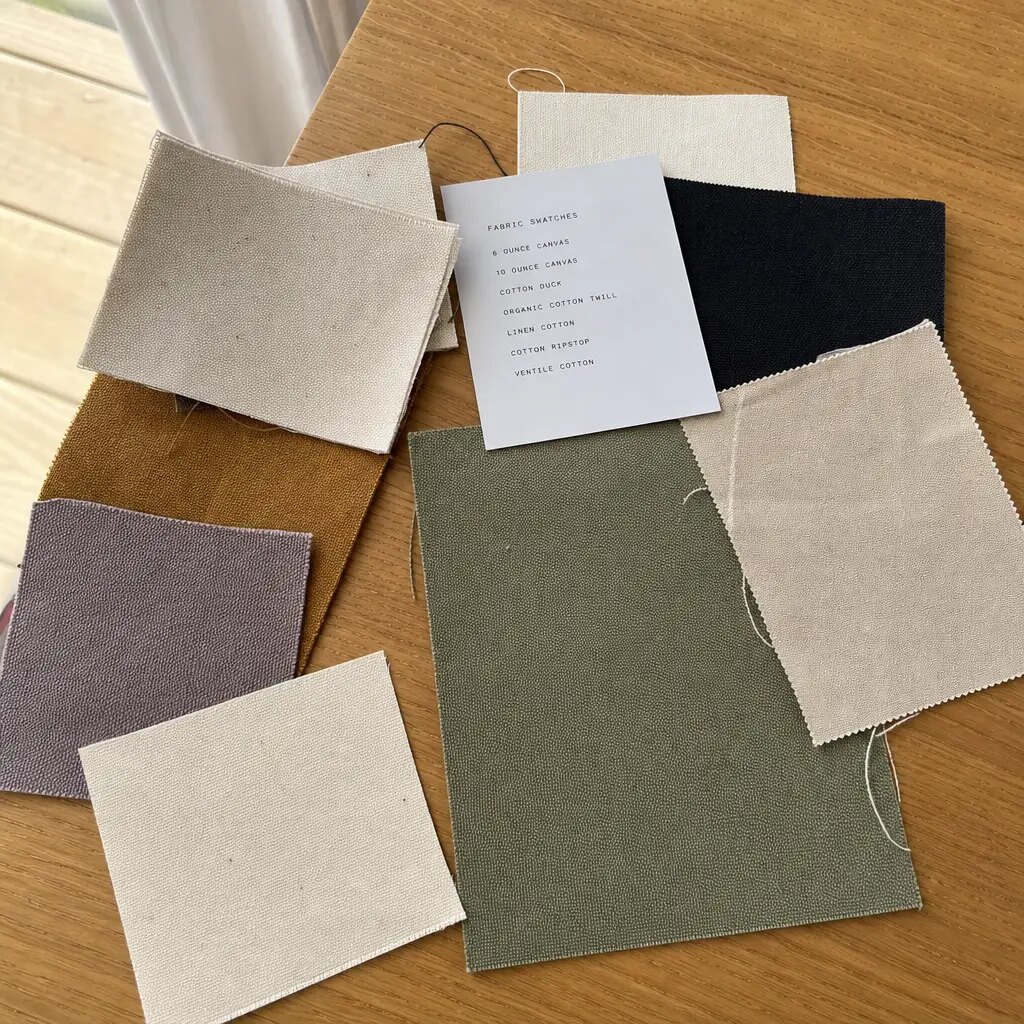
Do not compare suppliers by the word canvas alone. One quote may use natural unbleached canvas with visible cotton seeds, another may use bleached canvas, and another may use dyed fabric with a softer finish. Each option affects logo contrast, shrinkage, odor risk, colorfastness, and the way the bag folds into export cartons. A good RFQ names both fabric weight and finish so the factory cannot substitute a lighter fabric while keeping the same general description.
- Use 8 oz only when low carton weight and promotional cost matter more than structure.
- Use 10 oz for balanced retail cost, reasonable strength, and easier carton packing.
- Use 12 oz when the tote must stand better and support a higher perceived retail price.
- Use 14 oz only after confirming sewing capability, print hand-feel, and carton CBM impact.
Size, Gusset, and Handle Engineering
A common hotel retail grocery tote size is around 38 x 40 cm with a 10 to 12 cm gusset. This format carries boxed snacks, bottled drinks, folded apparel, room pantry items, and gift shop purchases without becoming oversized. If the bag is too tall, guests overload it and handles take more stress. If it is too narrow, it looks like a flat promotional tote rather than a grocery tote.
Handle length should be chosen for actual use, not only appearance. A hand-carry tote may use a shorter handle around 35 to 40 cm total length, while a shoulder-friendly grocery tote often needs around 55 to 60 cm. Wider handles improve comfort, but they also use more fabric and create a thicker fold. For hotel retail, self-fabric handles usually look more premium than cheap webbing, but the stitching pattern must be strong enough for loaded use.
- Specify finished size as width x height x gusset, not cut panel size.
- Define handle length from attachment point to attachment point after sewing.
- Use cross-stitching, box stitching, or bartack reinforcement for load-bearing handles.
- Avoid placing the logo too close to gusset folds if the carton pack is flat folded.
Print Method and Logo Placement
For most canvas grocery totes used in hotel retail, water-based screen printing is the most reliable option for one to three solid logo colors. It gives a softer hand-feel than heavy plastisol-style prints and works well on natural or dyed canvas. The limitation is detail. Very small lettering, thin lines, gradient artwork, and photographic graphics may not stay sharp on coarse canvas, especially after the bag is folded and packed.
Heat transfer can reproduce more complex artwork, but it changes the hand-feel and can create a patch-like surface. Digital printing can be useful for small runs or full-color artwork, but buyers should confirm wash resistance, rub resistance, and whether the supplier is changing the base fabric to suit the print machine. For carton planning, the important point is not only print method but also fold path. A beautiful print can look defective if every carton creates a hard crease through the center of the hotel logo.
- Provide vector artwork with Pantone references and actual print dimensions.
- Keep critical logo elements away from heavy fold lines and bottom gusset corners.
- Approve print color on bulk fabric, not only on paper or a digital proof.
- Test dry rub and fold resistance before releasing bulk print production.
MOQ and Cost Drivers Behind the Quote
MOQ for canvas grocery totes is driven by fabric purchasing, cutting efficiency, print setup, labor scheduling, and packing materials. A factory may accept 500 pcs for a simple natural canvas tote, but the unit cost will usually be higher because setup time is spread across fewer units. For dyed canvas, custom handle color, multi-color printing, or retail packaging, a more realistic production MOQ is often 1,000 to 3,000 pcs per design or color.
Buyers should request price breaks at several quantities instead of asking for only one unit price. The useful comparison is not just 1,000 pcs versus 5,000 pcs; it is whether the fabric lot, print screens, carton layout, and inspection cost change at those levels. If the supplier quote is much cheaper than others, look for missing items such as fabric weight reduction, thinner handles, no inner packing, weaker cartons, excluded hangtags, or assumed loose bulk packing.
- Fabric weight and finish affect both material cost and freight cost.
- Multi-color screen print adds screen charges, setup time, and rejection risk.
- Retail labels, hangtags, barcode stickers, and paper bands add labor even when material cost is low.
- Smaller cartons improve handling but can increase carton count and warehouse receiving work.
Carton Packing Plan That Buyers Can Use
A practical starting point for 10 oz to 12 oz canvas grocery totes is 100 pcs per export carton, often divided into inner packs of 25 pcs. The final carton size depends on bag dimensions, gusset depth, handle thickness, fabric stiffness, and whether the tote is folded once or twice. The supplier should run a packing trial using the approved sample construction before confirming carton size. Estimated carton data before sampling is useful, but it should not be treated as final.
For hotel retail distribution, carton consistency is often more important than squeezing in the maximum number of pieces. Overpacked cartons bulge, crush lower cartons, and create deep creases in the canvas. Underpacked cartons waste freight and may collapse during stacking. A good carton plan balances piece count, gross weight, print protection, loading efficiency, and warehouse handling limits.
- Target gross carton weight below 18 to 20 kg where possible for easier handling.
- Use 5-ply export cartons for ocean freight and distributor warehouse stacking.
- Place printed panels face-to-face only if ink transfer testing has passed.
- Add tissue, paper interleaving, or adjusted folding when dark ink may rub during transit.
Sample Approval Should Include Packing
Many tote programs fail because the buyer approves the bag sample but not the packed sample. A loose sample sent by courier does not show how the product will look after four to eight weeks in a compressed export carton. For canvas grocery totes, the pre-production sample should be folded in the intended carton method, pressed by hand as production will be packed, and reviewed for logo creasing, handle distortion, and panel skew.
The sample file should record measurable acceptance criteria. Photos are useful, but they are not enough. The buyer should sign off the finished size tolerance, fabric feel, print color, logo position, handle reinforcement, inner packing method, carton marks, and retail label position. If the factory later changes the fabric lot or packing method, that change should trigger written approval before bulk shipment.
- Approve one sample for appearance and one folded sample for packing behavior.
- Record fabric swatch, Pantone result, stitching thread, and handle construction in the sample file.
- Use the same folding method in production that was used for the approved packed sample.
- Keep a sealed factory reference sample for inspection and dispute handling.
Quality Thresholds for Retail Acceptance
Hotel retail buyers care about visible defects because the tote is often sold or used as part of a branded guest experience. Common defects include dirty canvas, oil marks, heavy slubs across the logo area, uneven gussets, loose threads, skipped stitches, crooked handles, print pinholes, and off-center artwork. These should be classified before inspection so the factory and third-party inspector apply the same standard.
A workable inspection plan for repeat orders is AQL 2.5 for major defects and AQL 4.0 for minor defects, with critical defects not allowed. Critical issues include mold odor, unsafe metal contamination, wrong logo, wrong country-of-origin marking, mixed customer designs, or cartons with incorrect PO data. For strength, the buyer can request a practical handle pull test based on expected use, such as holding a loaded bag for a defined time without seam tearing or handle slippage.
- Major defects include wrong dimensions beyond tolerance, weak handles, severe stains, and visibly crooked logos.
- Minor defects include small loose threads, light natural cotton specks, and slight shade variation within approved limits.
- Critical defects include mildew smell, wrong branding, unsafe contamination, and incorrect legal labels.
- Inspection photos should include open bag, bottom gusset, handle stitching, print close-up, inner pack, and carton mark.
Lead Time and Schedule Risk
A realistic schedule must separate sampling, material preparation, printing, sewing, finishing, packing, inspection, and export booking. A simple natural canvas tote may sample quickly, while dyed fabric or custom retail packaging adds time. If the hotel retail launch is tied to a resort opening, seasonal event, or conference calendar, the latest artwork approval date matters more than the nominal production lead time.
The main schedule risks are late artwork, slow sample comments, fabric shade approval, print screen correction, carton redesign after packing trial, and inspection rework. Buyers can reduce these risks by giving complete quote data at RFQ stage and by approving functional points early. Waiting until the final sample to decide barcode label size, carton mark format, or hangtag placement can delay production even when the tote itself is ready.
- Build in time for fabric swatch approval before bulk cutting.
- Reserve print drying and curing time before folding into cartons.
- Book inspection after the factory confirms at least 80 percent of goods are packed.
- Do not finalize freight booking until carton dimensions and gross weight are confirmed.
Quote Data Needed for Landed Cost
Procurement teams need more than FOB unit price to compare canvas grocery tote suppliers. Carton CBM, gross weight, packing method, local charges, sample charges, print setup, inspection cost, and defect allowance all affect landed cost. A supplier with a slightly higher unit price may be cheaper after freight if the carton plan is more efficient and the gross weight is controlled.
For distributors and importers, quote data also affects warehouse receiving and customer allocation. If a hotel group orders mixed logos for several properties, each SKU should have separate carton marks and packing lists. Mixed cartons can reduce freight slightly but create picking errors later. The RFQ should state whether the buyer wants single-SKU cartons, mixed cartons by destination, or master cartons with inner packs labeled by property.
- Request FOB price and, when useful, EXW price to see local handling assumptions.
- Request carton dimensions in centimeters and CBM per carton plus CBM per 1,000 pcs.
- Separate unit cost from screen charges, hangtag cost, label cost, and special packing cost.
- Require a packing list format that matches the buyer warehouse or hotel distribution plan.
Specification comparison for buyers
| Spec decision | Recommended option | When it fits | Buyer risk to check |
|---|---|---|---|
| Canvas weight | 10 oz to 12 oz cotton canvas, about 340 to 407 GSM before washing | Hotel gift shops, resort retail, pantry markets, and paid reusable grocery bags needing structure without excessive carton weight | Do not compare quotes only by oz; verify GSM, yarn density, shrinkage allowance, and whether the fabric is greige, bleached, dyed, or washed |
| Bag size | Main body around 38 x 40 x 12 cm with boxed bottom | General grocery, packaged snacks, wine-adjacent retail items, spa products, and mixed hotel market purchases | A wide gusset improves usability but increases folded thickness, carton CBM, and seam stress at the bottom corners |
| Handle construction | Self-fabric handles, 3.0 to 3.5 cm wide, cross-stitched at top edge | Retail bags expected to carry 6 to 10 kg in normal guest use | Cheap quotes may use narrow webbing or single-line stitching; define handle length, reinforcement pattern, and pull-test requirement |
| Print method | Water-based screen print for 1 to 3 solid colors; heat transfer only for complex small artwork | Hotel logos, destination graphics, simple retail branding, or seasonal gift shop designs | Thick ink on coarse canvas can crack after folding; approve print hand-feel, edge sharpness, rub resistance, and carton scuff protection |
| MOQ logic | Start from 1,000 to 3,000 pcs per color/design for efficient cutting and print setup | Importers consolidating several hotel locations or distributors building retail stock | Very low MOQ may carry higher unit cost, fabric lot variation, or digital print substitution unless clearly stated |
| Packing format | Flat folded, 25 pcs per inner polybag or paper band, 100 pcs per export carton | Most hotel retail replenishment and warehouse picking where carton count must stay predictable | Over-compression creates hard creases across the print; request carton dimensions and gross weight before PO release |
| Carton strength | 5-ply export carton, commonly 46 x 42 x 38 cm adjusted after pre-production folding trial | Ocean freight, distributor warehousing, and retail DC handling | Cartons that exceed 18 to 20 kg gross weight are harder to handle and more likely to crush lower cartons in stacking |
| Inspection standard | AQL 2.5 major and 4.0 minor with defined critical defects | Repeat retail programs where appearance, stitch strength, and barcode/carton accuracy affect sell-through | Without defect photos and measurement tolerance, inspectors may pass bags with skewed panels, weak handles, or off-position logos |
Buyer checklist before sampling
- Define fabric by oz and GSM, not only by the phrase canvas, and state whether the canvas is natural, bleached, dyed, or washed.
- Lock the finished bag size, gusset depth, handle length, handle width, and acceptable tolerance before sampling.
- Provide artwork in vector format with Pantone references and a maximum print area measured from the top edge and side seams.
- Require the supplier to quote carton size, pieces per carton, gross weight, net weight, and estimated CBM per 1,000 pcs.
- Decide whether each tote needs a barcode sticker, hangtag, care label, country-of-origin label, or retail belly band.
- Approve a physical pre-production sample made from bulk fabric or clearly record any differences from sampling fabric.
- Set acceptance criteria for handle pull strength, seam slippage, print rub, color shade, odor, stains, and packing presentation.
- Confirm whether spare cartons, replacement polybags, desiccants, palletization, or carton drop testing are included in the quote.
- Separate unit price from mold, screen, sample, courier, inspection, and local document charges so landed cost can be compared.
- Reserve schedule buffer for fabric dyeing, print drying, packing trial, inspection booking, and export document preparation.
Factory quote questions to send
- What exact canvas weight will you use in oz and GSM, and can you send a fabric swatch from the same mill lot before bulk cutting?
- Is the quoted fabric natural, bleached, dyed, washed, or enzyme-washed, and what shrinkage tolerance should we expect?
- What are the finished dimensions, handle length, gusset depth, and measurement tolerance after sewing and pressing?
- Which print method is included in the quote, how many colors are included, and what is the maximum recommended print size on this fabric?
- What MOQ applies per fabric color and per print design, and how does the unit price change at 1,000, 3,000, 5,000, and 10,000 pcs?
- How many pieces will be packed per inner pack and export carton, and what are the estimated carton dimensions, gross weight, and CBM?
- Can you provide photos of previous export carton packing for similar canvas grocery totes without showing confidential customer marks?
- What handle pull test, seam strength test, colorfastness test, and print rub test can your factory perform before shipment?
- What is the normal sampling time, bulk production time after sample approval, and latest artwork approval date for the requested ship window?
- Which items are excluded from the quote, such as hangtags, barcode labels, FSC paper bands, palletization, inspection rework, or courier cost?
Quality-control points to confirm
- Finished size tolerance should normally stay within plus or minus 1 cm for body width and height, and plus or minus 0.5 cm for handle width.
- Handle attachment should use cross-stitching or box stitching with no skipped stitches, loose threads, or tearing under a practical load test.
- Bottom gusset corners should be symmetrical, with no twisted seams or puckering that prevents the tote from standing squarely.
- Print placement should stay within plus or minus 5 mm from the approved sample unless the artwork or panel size requires tighter control.
- Ink should not transfer under dry rub and should not crack sharply when the bag is folded in the approved packing method.
- Canvas should be free from oil stains, mildew odor, black specks above agreed tolerance, heavy slubs in logo areas, and obvious shade panels.
- Carton marks, SKU labels, PO numbers, destination codes, and piece counts should match the buyer packing list before sealing.
- Export cartons should resist normal stacking, with no bulging, underfilled corners, weak tape closure, or mixed designs in the same carton unless approved.