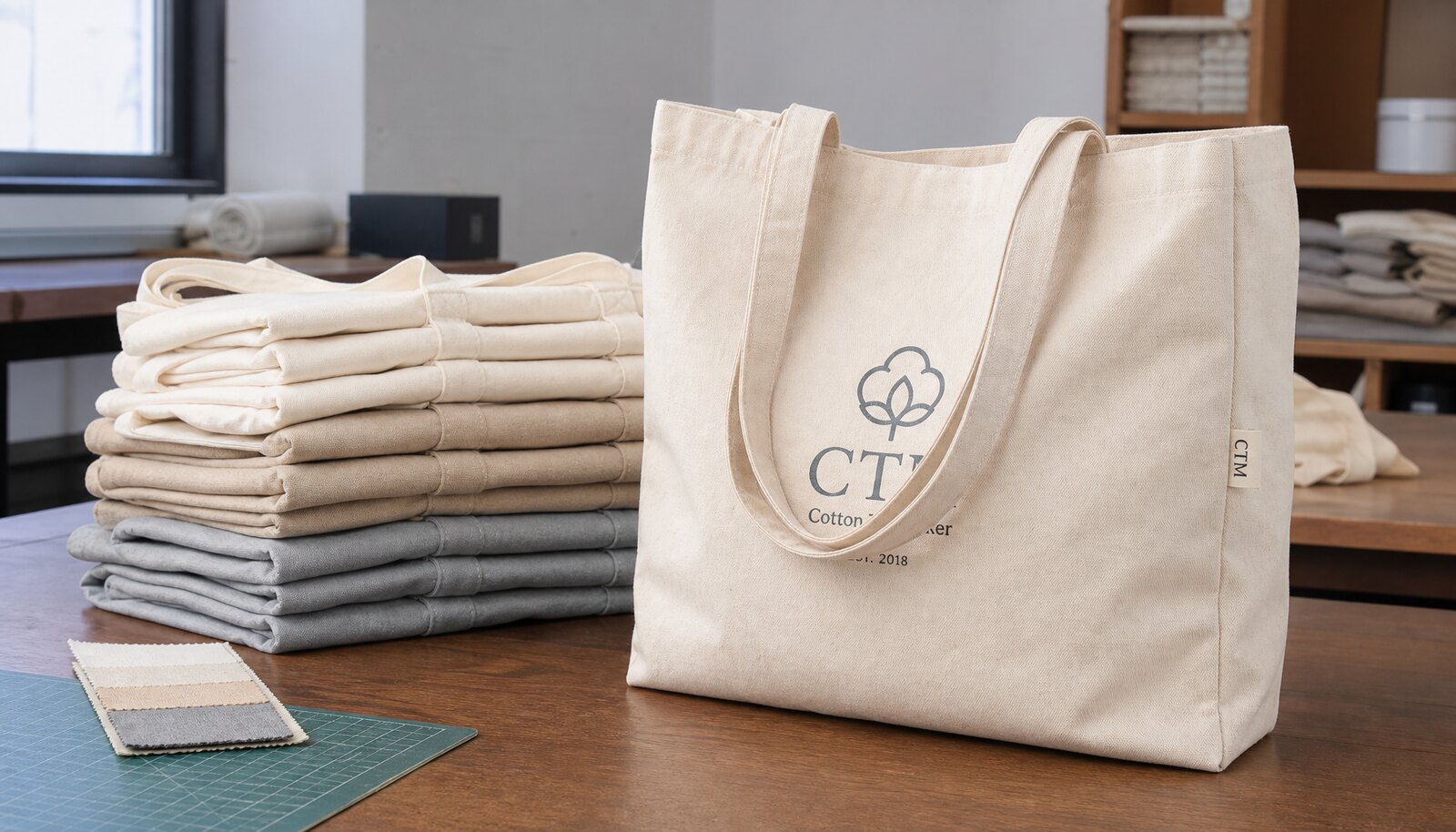
Why fabric weight is the first commercial decision, not a textile detail
When a buyer sources canvas grocery totes for gift shops, fabric weight is not a technical footnote. It affects the shelf story, the print result, the shipping cube, the resale price, and the likelihood that the bag will be treated as a “real gift” rather than a throwaway promo item. A tote that is too light can read as a giveaway bag. A tote that is too heavy can be expensive to sew, hard to fold, and difficult to price for an impulse customer at checkout.
For most gift shops, the practical sweet spot is usually 8–10 oz canvas, roughly 270–340 GSM finished weight. That range gives enough substance for repeat use, but it still packs and displays cleanly. If the retail setting is more premium—museum retail, destination shops, gallery stores, or curated souvenir counters—12 oz can justify a higher ticket because it creates a more substantial first touch. The key is to quote the same basis across suppliers. A quote based on raw cloth should never be compared with one based on finished cloth without adjustment.
Fabric weight also controls how much risk the buyer is taking on the shelf. A lightweight canvas may work well if the store wants a casual, lower-priced accessory and expects shoppers to fold it into a handbag. A heavier tote works better when the customer will use it as a daily reusable bag and the store wants the product to stand upright on a peg or shelf. In other words, the choice should start with channel and price tier, not with a generic idea of what a tote “should” be.
Finished weight versus loom-state weight: the comparison many RFQs miss
One of the biggest sources of confusion in tote sourcing is the difference between loom-state weight and finished weight. Loom-state, or greige fabric, is the cloth before washing, dyeing, softening, coating, and cutting. Finished weight is what the buyer actually receives in the bag after those processes. A factory can quote 10 oz canvas and still deliver a bag that feels lighter than another supplier’s 9 oz bag if the measurement basis is different.
This matters because cotton canvas can shrink, lose moisture, and change density after finishing. A pre-shrunk cloth may end up slightly heavier per area than the same yarn before finishing, while a softwashed or heavily processed cloth may feel less rigid even if the nominal weight is similar. Buyers should ask the supplier to state whether the number refers to the cloth before or after finishing, and what test method is used. If that answer is vague, the RFQ is not ready for apples-to-apples pricing.
A useful RFQ line is: “Quote finished fabric weight in GSM and oz, measured after the intended wash/soften process, with allowed tolerance stated.” That one sentence removes a lot of back-and-forth. If the supplier cannot quote finished weight confidently, ask for a sample swatch and a measured specimen instead of relying on brochure language.
How fabric weight changes hand feel, shelf shape, print clarity, and customer perception
The visual difference between an 8 oz tote and a 12 oz tote is not just thickness. Weight changes drape, wrinkle pattern, standing ability, and how the bag feels in a customer’s hand. A lighter tote usually folds more easily and feels more relaxed. That can be useful in tourist or impulse-buy retail, where the bag should be easy to carry home and easy to tuck away. A heavier tote stands better, looks more deliberate, and can feel more like a keep-forever gift than a one-time shopping accessory.
Weight also affects how the print behaves. Canvas is textured, so the weave can break up fine details. On looser or lighter cloth, lines can spread, small letters can fill in, and thin negative spaces can disappear. On heavier cloth, the surface usually looks more premium, but the coarse texture can still interrupt tiny lines. The practical lesson is simple: approve artwork at actual size on the actual fabric, not just from a digital mockup. What looks crisp on screen can look weak once ink hits woven cotton.
Shelf shape is another commercial difference buyers often under-specify. If the bag has to stand upright for display, weight alone is not enough. The body cut, bottom style, gusset depth, and handle balance all influence whether the tote looks structured or collapsed. In some cases, a flat-bottom build or a simple insert creates more retail value than increasing fabric weight by one step. That is why weight should be evaluated together with construction, not in isolation.
A practical comparison of 8 oz, 10 oz, and 12 oz canvas for gift-shop resale
The right fabric weight is usually the one that supports the retail price point after adding freight, packing, printing, and store markup. A lower-cost tote can still be the wrong choice if it feels too flimsy next to the shop’s other merchandise. Likewise, a premium tote can miss the mark if the store’s customers expect a lower checkout price. Use weight as a merchandising tool, not only as a durability metric.
The table below is designed to help buyers balance shelf positioning, quote pressure, and reorder stability. It is not a law of sourcing, but it is a useful starting point when comparing suppliers who may be quoting very different cloth bases or construction levels. Ask each supplier to anchor their quote to the same finished weight, same print method, same pack format, and same label requirements before judging price.
- Compare weight, structure, and carton efficiency together rather than one line item at a time.
- Treat 8 oz as entry-level retail, 10 oz as the balanced default, and 12 oz as the premium step-up unless your channel data says otherwise.
- If a supplier recommends a different range, ask them to explain it with a sample, not only with a verbal claim.
Fabric weight comparison table for gift-shop buying
Use this table to separate commercial deltas from textile language. It highlights where weight changes price, MOQ, and retail positioning so the team can stop arguing about “good quality” and focus on what the bag must do in store.
Indicative cost impact is relative, not a fixed market price. MOQ implications are also directional: actual minimums depend on whether the factory has stock cloth, whether the design uses one or more colors, and whether the order needs custom packing or labels.
- Ask suppliers to break out base unit price, print setup, sample fee, label cost, and packing cost.
- If MOQ is high, identify whether the constraint comes from fabric dye lot, print screen setup, or custom packaging.
- Keep quotation, sample approval, and inspection notes tied to one spec version so you do not compare different products by accident.
Construction choices that matter as much as fabric weight
Fabric weight cannot rescue a weak build. Two totes with the same GSM can perform very differently if one has a shallow seam allowance, sparse stitching, poor handle attachment, or an awkward bottom. For gift shops, the most important construction decisions are handle style, handle drop, seam allowance, body shape, bottom type, and whether any reinforcement is built in. These details change not only durability, but also how the tote presents on a hook or shelf.
Self-fabric handles are the most common option for canvas grocery totes because they keep the look cohesive and simplify sourcing. What matters is not only the handle material but also the way it is folded and sewn. Buyers should ask whether the handle is single-layer or folded, the width of the handle strap, where the stitch line runs, and whether bartacks are used at the top joins. If the tote will carry groceries or heavier purchases, the handle attachment is often the first failure point, so it deserves specific inspection language.
Bottom construction affects both functionality and display. A flat sewn bottom is simple and cost-efficient. A gusseted bottom improves volume and can make the tote look more retail-ready. A cardboard insert or base board adds rigidity and helps the tote stand upright, but it also adds cost, extra packing work, and a greater chance of distortion if cartons are over-compressed. Buyers should decide whether shelf structure or pack efficiency matters more before they ask for samples.
Print method versus fabric weight: what works, what fails, and what to ask for in the sample
For most gift-shop programs, one-color or two-color screen printing is the most dependable option because it delivers good opacity, clear branding, and stable repeat economics. It usually suits simple logos, destination names, or seasonal graphics. Screen print also tends to hold up better under abrasion than many low-cost transfer methods, provided the ink is properly cured and the fabric is not over-softened.
Transfer methods can be useful for short runs, multicolor artwork, or SKUs that do not justify screens. The tradeoff is that the print can feel more like a layer on top of the canvas rather than part of it. Buyers should inspect edge quality, fold resistance, and rub performance. If the tote is sold as a gift item rather than a pure promo item, visible film edges or a plastic feel can reduce perceived value.
Natural canvas and lightly colored canvas make print evaluation even more important because base shade affects opacity. White ink, pale inks, and thin strokes are the first elements to fail when the cloth texture is open. Ask the factory to print the actual artwork on the actual base color, then check it under normal store lighting. A proof on coated paper is not enough. The buyer should be able to see how the art behaves on the final material before approving production.
How to compare supplier types without turning the RFQ into a generic procurement exercise
The sourcing route affects control, speed, and repeatability. Direct factory sourcing is usually best for repeat retail programs where the buyer wants a stable fabric weight, consistent construction, and a reliable reorder path. It gives the clearest line of sight into mill selection, sewing methods, and packing decisions. The tradeoff is that the buyer needs a more disciplined RFQ and may spend longer in sampling and revision.
Trading companies can help when the buying team wants one point of contact, especially for smaller assortments or mixed product programs. They are often more flexible in coordination, but the buyer must work harder to confirm what is actually happening at the factory and which lot is being used. The important question is not whether the supplier is a factory or a trading company; it is whether they can prove continuity from sample to bulk.
Local stock or domestic wholesale routes are useful when speed matters more than customization. They can solve urgent replenishment or seasonal fill-in needs, but they rarely give the same control over weight, print, packing, or branding. In a gift-shop context, stock is a speed solution. It is not the right route when the tote is part of a branded retail program or when the buyer needs a specific retail positioning threshold.
What mill traceability, certification, and audit evidence are actually worth asking for
Buyers often ask for certificates because they sound official, but the more useful question is whether the paperwork matches the fabric and the factory you are actually buying from. For canvas grocery totes, mill traceability is valuable when the bag is part of a repeat program or when the retailer wants continuity across seasons. Traceability can be as simple as a fabric lot reference tied to the production record, plus a named mill source if the supplier is willing to disclose it. That is more helpful than a generic statement that “the fabric is available.”
Certifications and audits should be requested only when they matter to the channel or the retailer’s policy. If the buyer needs OEKO-TEX, GRS, BSCI, Sedex, or another standard, ask for the latest valid document and confirm the scope. A certificate for one facility does not automatically cover every subcontractor or every fabric source. If the supplier cannot explain the scope, the document is not enough on its own.
For a procurement team, the most useful evidence is usually a recent audit summary, fabric traceability by lot, and a willingness to link the approved sample to the bulk lot. If the supplier is vague about who spun, wove, dyed, or finished the cloth, that vagueness matters. It can make reorders inconsistent and makes it harder to defend quality if there is a problem later.
How fabric weight changes margins, shipping economics, and shelf pricing
Gift shops buy on margin, not only on ex-factory price. Fabric weight influences the entire landed cost picture because it changes material use, sewing difficulty, shipment volume, and sometimes packaging density. An 8 oz tote usually costs less to produce and may ship more efficiently because it folds compactly. A 12 oz tote can support a higher shelf price, but it also raises production cost and can reduce carton efficiency. The right choice is the one that still leaves room for the retailer’s markup after freight and packing are added.
Packaging is often undercounted in tote sourcing. If the store needs individual polybags, barcode stickers, hang tags, or shelf-ready folding, those costs need to appear in the quote comparison. A tote that is inexpensive in factory terms can become costly once it must be packed neatly, protected from dust, and labeled for retail scanning. In practice, the difference between bulk packing and shelf-ready packing can matter almost as much as one step of fabric weight.
Buyers should also think about visual merchandising. A more structured canvas tote can justify a higher price if it sits upright and looks like a premium accessory. A softer tote may work better if the store wants an easy, casual item near checkout. The best commercial answer is not always the heaviest cloth. It is the bag that supports the target price point and the store’s display style without forcing the merchant to discount it.
Specification comparison for buyers
| Buying factor | 8 oz canvas (about 270–300 GSM finished) | 10 oz canvas (about 300–340 GSM finished) | 12 oz canvas (about 340–410 GSM finished) |
|---|---|---|---|
| Shelf presence | Soft drape, casual gift-shop look, easiest to fold and hang; best for entry-level retail | Balanced body and softness; the safest all-round choice for most gift shops | More structured silhouette, stronger shelf presence, more premium first impression |
| Indicative unit cost impact | Lowest fabric cost; usually the easiest to sew and pack. Often the best choice when price is tightly capped | Mid-range fabric and sewing cost; usually the most commercially efficient option | Higher fabric cost, more sewing effort, and higher carton volume; can push retail price up |
| Likely MOQ implication | Usually the easiest to source at lower MOQ because mills and factories stock more standard cloth weights | Moderate MOQ; more flexible than custom weights, but still depends on print colors and packing | Often higher MOQ or higher per-unit pricing because of heavier cloth, extra handling, and fewer stock programs |
| Print behavior | Good for bold graphics; fine lines can open up if the weave is loose | Usually the safest surface for standard logos and gift-shop artwork | Works well for simple, premium branding, but very fine detail can break on heavy texture |
| Carry performance | Suitable for light grocery, souvenirs, and everyday carry | Good everyday reusable tote range for most retail use cases | Better for heavier contents and repeat use; more confidence for “keep and reuse” positioning |
| Retail positioning threshold | Entry-level souvenir, impulse buy, or promotional crossover | Mainstream gift-shop tote; most versatile for margin and sell-through | Premium gift, museum shop, destination retail, or higher-ticket branded program |
| QC focus | Check shrinkage, weave openness, handle pull, and print bleed | Check size tolerance, seam consistency, and print registration | Check seam allowance, bartacks, shape retention, and load performance |
Buyer checklist before sampling
- Confirm finished bag size, gusset depth, handle drop, and target load weight before requesting quotes.
- Specify fabric type, finished GSM or oz, weave density, color tolerance, and shrinkage limit in the RFQ.
- State the sales channel: gift shop, museum shop, tourist souvenir, resort retail, or grocery crossover.
- Send vector artwork and define logo size, placement, Pantone references, and minimum line thickness.
- Ask for finished fabric swatches, not only lab specs; request a pre-production sample and a load-tested approval sample.
- Agree packing format, carton marks, barcode needs, and whether the tote must arrive shelf-ready or bulk-packed.
- Record the approved sample version, inspection points, and tolerances in the PO or spec sheet.
- Ask the supplier to confirm whether the quoted weight is raw loom-state fabric or finished after washing, dyeing, or softening.
Factory quote questions to send
- Is the quoted weight raw loom-state, greige, or finished after dyeing, washing, softening, or coating? Please state the measurement basis.
- What tolerance do you allow on finished GSM/oz, and how do you verify it across the production lot?
- Can you supply a cut swatch and a finished sample from the same fabric lot you intend to use in bulk?
- What is the exact cloth composition, weave construction, and yarn count, and do you source the same mill lot for repeat orders?
- Do you have mill traceability records for the fabric, and can you identify the spinning or weaving mill by lot number if needed?
- Which certifications or audit evidence can you share for the fabric and the factory, such as OEKO-TEX, GRS, BSCI, Sedex, or a recent third-party audit report?
- What print method is included, what is the minimum readable line thickness, and what setup charges apply for artwork changes or extra colors?
- What seam allowance do you use, how many stitches per inch are standard, and where do you place bartacks or reinforcement stitches?
- What shrinkage should we expect after washing, steaming, or heat-setting, and do you pre-shrink the fabric before cutting?
- What carton pack count, inner pack, and protective materials are included, and do cartons meet export handling requirements?
Quality-control points to confirm
- Fabric weight must fall within the agreed finished range. Verify with a weigh-cut method on multiple pieces from the same lot, not a single swatch.
- Finished size should stay within an agreed tolerance, such as ±1/2 in or ±1.5 cm on body dimensions and handle drop, unless a different tolerance is written in the PO.
- Shrinkage should be pre-agreed. For most retail programs, set a practical target of no more than 3% in each direction after a wash or steam test unless the end use allows more.
- Stitch density should be specified. A practical baseline is 7–9 stitches per inch on general seams and 8–10 stitches per inch on load-bearing areas, with clean backtacking or bartacks at stress points.
- Seam allowance should be consistent, commonly 1/4–3/8 in or 6–10 mm depending on the bag style; measure at sample approval and during inline checks.
- Handle attachment should be checked at the top edge and at the stress points where the handle joins the body. Reinforcement should be symmetrical and free from skipped stitches.
- Load testing should match the real use case. Example: a tote intended for 10 lb working use should be suspended with an equivalent load for 30–60 seconds without seam separation, popped stitches, or visible distortion.
- For heavier retail programs, test a higher short-term load than the working load. If the bag is marketed for daily shopping, the factory should show a clear safety margin rather than only meeting the minimum.
- Print registration should stay centered within the approved tolerance, with no major halos, pinholes, bleeding, or cracking after a light rub and fold test.
- Color should match the approved standard within the buyer’s agreed visual tolerance. If using Pantone, confirm that natural fabric shade, base whiteness, and print opacity are acceptable before bulk.