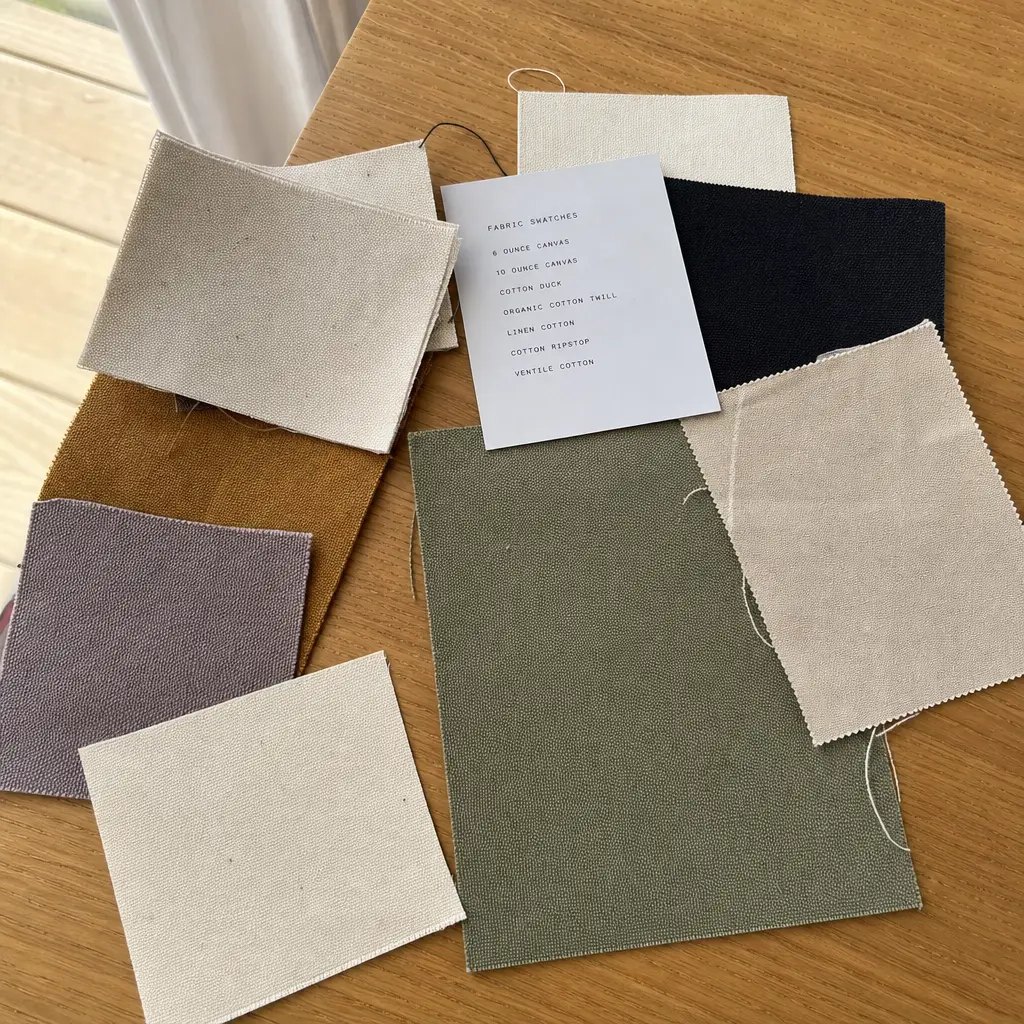
Why fabric weight matters more than the tote shape
For trade show exhibitors, the real buying problem is not whether the tote looks nice in a photo. It is whether the bag survives repeated handouts, holds a catalog plus samples, and still looks respectable when a prospect carries it around the hall. That is why fabric weight should be the first decision, not an afterthought after the artwork is approved.
Canvas grocery totes usually sit in a middle zone between promotional throwaways and retail-quality shopping bags. If the cloth is too light, the bag collapses, wrinkles badly, and telegraphs a low-value brand impression. If it is too heavy, the tote becomes expensive, bulky to pack, and slower to sew. The sweet spot depends on what the tote must carry and how much perceived value the campaign needs to create.
- Use fabric weight as the first gate: structure, feel, print performance, and freight all change with GSM.
- Define the bag’s job: brochure carrier, sample carrier, retail resale item, or premium sponsor gift.
- Set a target hand feel before you ask for quotes; factories will price against that target.
The practical GSM range for trade show tote buyers
For most exhibitors, 10–12 oz canvas, roughly 340–410 GSM, is the workable base. It gives enough body for a grocery-style tote, prints cleanly, and does not inflate freight the way heavier cloth does. In this band, you can usually keep the bag easy to fold, which matters when the tote must fit inside registration desk bins or be pre-inserted into event kits.
When the tote is meant to stand in for a retail shopping bag or carry heavier sample kits, 14–16 oz canvas, roughly 475–540 GSM, makes sense. That range feels more substantial and hides minor wrinkling better, but it also changes the whole commercial profile: more yarn cost, more sewing load, more carton weight, and usually a slower line speed. If the event is a one-day campaign and the bag is not part of the retail assortment, overbuilding it is usually waste, not quality.
- 10 oz and under: good for light brochures, low-cost handouts, and price-sensitive campaigns.
- 12 oz: the safest all-around choice for most trade show grocery totes.
- 14–16 oz: use when the tote must support samples, retail value, or repeated reuse after the show.
- Match the fabric weight to the handle construction; heavier cloth without stronger stitching is not a real upgrade.
How print method changes the cost and the failure rate
Print method should be selected after the fabric weight, not before. Screen printing remains the default for single-color or simple multi-color logos because it is efficient, sharp, and stable on medium-weight canvas. If your artwork is a clean logo, slogan, or icon, screen print usually gives the best cost-to-appearance ratio for bulk orders.
Heat transfer and digital print are useful when the run is smaller, the artwork has gradients, or you need quicker artwork testing before a larger production move. The tradeoff is durability and folding behavior. Some transfers look fine on a flat approved sample but crack or edge-lift after the bag is folded, stacked, and handled on a show floor. For that reason, always test the print after flexing the sample, not only when it comes out of the press.
- Screen print: best for volume, solid color branding, and clear unit economics.
- Heat transfer: useful for short runs and complex art, but test fold durability.
- Digital print: better for color variation or sampled campaigns, less efficient at high volume.
- Ask for ink coverage on the actual fabric color; natural canvas and dyed canvas behave differently.
A sourcing comparison that affects quote quality
The supplier route changes more than price. A factory-direct order usually gives the cleanest control over fabric, stitching, and packing, which matters when the tote must hit a trade show date without surprises. A trading company can still be useful if you need multiple options quickly, but the quote is only meaningful if each line item is tied to the same GSM, print method, and carton plan.
Many bad comparisons happen because one supplier is quoting a 10 oz blank bag with loose packing while another is quoting a 12 oz printed bag packed by 50 pieces per carton. That is not a real price comparison. A clean sourcing process compares like for like: same fabric weight, same handle length, same print count, same sample standard, and same packing specification.
- Factory direct: better when you need tighter control and a stable repeat program.
- Trading company: useful for fast option gathering, but confirm where each process happens.
- Same-SKU comparison: only compare quotes after spec, print, and packing are frozen.
- If a supplier refuses to break out print or packing, you lose visibility on the real cost driver.
What a real factory quote should separate line by line
A useful quote is not just a single unit price. It should separate tote body, print setup, printing, sewing, packing, and cartons so you can see where the money goes. For a trade show program, that breakdown matters because a change in handle length, a second print color, or a switch from bulk pack to retail fold can move the landed cost more than buyers expect.
In many factory quotes, the fabric and sewing together make up the largest share, while print setup is the swing item on short runs. Packing also matters more than teams assume. A bag that is cheaply packed but poorly folded can add labor at the destination, and the apparent savings disappear when your staff or 3PL has to rework every carton.
- Common cost buckets: fabric, sewing, print, packing, cartons, inland move, export paperwork.
- Short runs absorb setup charges; long runs dilute them.
- A higher fabric weight often raises freight twice: heavier cartons and lower cartons per pallet.
- Ask for a quote at multiple volumes so the MOQ logic is visible, not hidden.
MOQ logic for exhibitors, brands, and distributors
MOQ is rarely just a factory whim. It is usually tied to fabric availability, print setup, and efficient cutting and sewing batches. If you want a standard natural canvas bag with a one-color logo, the MOQ can stay relatively practical because the line can run with common materials. Once you add custom-dyed fabric, special lining, zipper closures, or complex inside pockets, the MOQ climbs because the factory has to manage extra material sourcing and more work steps.
For buyers managing trade show calendars, the key is not only the lowest MOQ. It is whether the supplier can hold the same spec at a repeat order. A 3,000-piece trial that cannot be repeated later at the same shade, weight, or stitch standard is poor planning. If the event program may continue across several quarters, ask whether the factory can archive the production sample and keep the fabric record for reorder consistency.
- Standard canvas tote with simple print: often the most MOQ-friendly route.
- Custom-dyed cloth, special trims, and internal pockets raise MOQ quickly.
- Repeatability matters: verify that the factory can match the same reference sample later.
- Do not accept “MOQ flexible” without a written spec boundary.
Sample approval should test function, not only appearance
A trade show tote sample should be treated like a production control tool. The first sample needs to confirm dimensions, fabric weight, print placement, handle length, and seam behavior. The second check should focus on functional use: can the bag sit flat, carry load without twisting, and keep the logo readable after being folded and reopened several times?
A good sample approval process includes a simple pass-fail standard. The sample should be measured, weighed if needed, and compared against the approved artwork proof and spec sheet. If the factory uses a lab dip or fabric swatch reference, keep it attached to the approved sample record. That way the mass run is not judged against memory or a casual photo in email.
- Approvals should cover size, weight, color, print, and seam quality.
- Keep one sealed reference sample for production comparison.
- Fold the sample and re-open it several times to expose weak print or handle distortion.
- Do not approve from renderings alone if the bag weight is critical.
Packing and carton planning for show-floor delivery
Packing is not a warehouse afterthought when the bags must arrive clean and ready. For trade show exhibitors, carton count and fold method affect unloading speed, storage at the venue, and the chance that the bags arrive crushed or wrinkled. If the tote is going straight to a booth, a simple bulk fold may be the best route. If the bags are going into VIP kits or retail channels, you may need individual folding or a banded pack method.
Carton planning also affects freight math. Heavier canvas can push cartons over preferred weight ranges, especially when the tote has a wide gusset or reinforced handles. Ask for carton dimensions and gross weight before you approve production, because the freight quote may shift once the cartons are finalized. If your destination has limited storage, smaller carton counts can be worth a slightly higher pack cost.
- Bulk pack is efficient, but it must still protect the print and corners.
- Carton size affects air and ocean freight more than many buyers expect.
- If the bags will be kitted, align the fold size with the kit assembler’s process.
- Request the packing list format before production so receiving is smooth.
Where schedule risk really comes from
The lead time on a tote order is usually not determined by sewing alone. Fabric availability, color approval, print setup, and sample sign-off are the usual delays. A standard natural canvas order can move quickly if the supplier already stocks the right cloth and the artwork is simple. Once the order depends on a custom shade or a revised sample, the calendar becomes more fragile.
For event buyers, a safe schedule includes buffer time for sample review, print correction, and carton approval. If the show date is fixed, work backward from the freight method rather than from the factory sewing time. A bag that is finished on time but misses the booking window is still late. Buyers should also watch for Chinese holiday closures, local fabric mill pauses, and queue time in the printing department, because those often matter more than the nominal production lead time.
- Standard canvas and standard print are the fastest route.
- Custom fabric colors and artwork revisions are the main schedule risks.
- Build a review buffer before the ship window, not just before the production start.
- Ask who owns each milestone: fabric, print proof, sample, packing, and dispatch.
A landed-cost view that helps you choose the right weight
The cheapest factory price is not always the cheapest landed cost. A 10 oz tote may save on unit price, but if it requires extra reinforcement, has a higher reject rate, or creates a weaker brand impression, the total value can be worse than a slightly heavier bag. On the other hand, a 16 oz tote can look premium but may increase freight and eat into your event budget without changing buyer behavior. The right answer sits in the middle, where function and total cost align.
When comparing landed cost, use the same assumptions for print count, packing method, and destination terms. A practical way to compare is to look at fabric cost, sewing labor, decoration, packing, inland transfer, and international freight as separate lines. If the supplier can only quote a single lump sum, ask for a breakdown. That is the only way to see whether the tote is truly expensive or whether the freight and packing are driving the total.
- Compare landed cost, not just factory unit price.
- Heavier canvas can reduce perceived cheapness but increase freight.
- Weak packing can erase any savings from a lower factory quote.
- A clean breakdown helps procurement defend the final spec internally.
Specification comparison for buyers
| Spec decision | Recommended option | When it fits | Buyer risk to check |
|---|---|---|---|
| Fabric weight | 10–12 oz canvas (about 340–410 GSM) | Main trade show giveaway that needs structure, print clarity, and repeat handling | Too-light cloth can wrinkle, show ink strike-through, and feel cheap at first touch |
| Premium display tote | 14–16 oz canvas (about 475–540 GSM) | Brand launches, buyer meetings, or retail-facing events where the tote itself is part of the message | Heavier cloth raises sewing cost, affects lead time, and can change freight cube |
| Supplier route | Factory direct with in-house sewing and print | You need control over fabric lot, stitching, and print registration | Verify whether print is truly in-house or subcontracted; hidden handoffs slow approval |
| Supplier route | Trading company with multi-factory sourcing | You need a fast quote across several fabric weights or trim options | Compare the same spec line by line or quotes will look cheaper than they are |
| Print method | Screen print for simple logos and solid spot colors | Large runs with one to three colors and a stable artwork file | Fine lines, gradients, and photo detail may soften or mis-register |
| Print method | Heat transfer or digital print for short runs | Sampling, limited campaigns, or variable artwork tests | Some transfers crack or peel after folding; require wash/flex testing if relevant |
| MOQ logic | 3,000–5,000 pcs for standard woven canvas tote specs | You want efficient unit cost and common fabric colors | MOQ can jump if you request custom dye, custom zipper, or special lining |
| Packing route | Bulk packed with carton count control | Importer handles final distribution or kitting at destination | Loose folds and weak carton specs can create corner crush and higher freight damage |
| Lead-time route | Pre-approved standard fabric plus standard print | You need speed before a scheduled show date | Slow fabric sourcing is the usual bottleneck, not sewing time |
Buyer checklist before sampling
- Confirm final bag size, gusset, handle drop, and usable loading weight.
- Specify fabric type, GSM/oz weight, color tolerance, and shrinkage expectations.
- Send vector artwork and define logo size, print position, and Pantone references.
- Ask for sample photos plus one physical pre-production sample before bulk approval.
- Agree carton packing, barcode or hangtag needs, and shipment marks before production.
- Record inspection checkpoints for stitching, print adhesion, stains, and quantity count.
Factory quote questions to send
- What exact fabric weight, yarn count, and weave are included in this price, and is the weight before or after finishing?
- Is printing done in-house, and what is the setup charge, color count limit, and acceptable file format?
- What seam reinforcement is included at the handle-to-body join, and can you share stitch specs or seam photos?
- What is the MOQ by fabric color and print method, and how does the price change at 3,000, 5,000, and 10,000 pcs?
- What is the packed carton quantity, carton size, and estimated gross weight per carton for freight planning?
- What sample types are available before production, and which sample is considered the approval standard?
- What is the standard lead time after sample approval, and what part of the process usually causes delays?
- Can you quote separate lines for tote, print, packing, cartons, and destination port terms so we can compare suppliers cleanly?
Quality-control points to confirm
- Fabric weight tolerance should stay within the agreed spec window, not a loose factory estimate.
- Handle stitching should be even, secure, and reinforced at the stress point; no skipped stitches or loose thread tails.
- Print registration should hold within a practical tolerance for the artwork size; reject visible blur or offset on logo edges.
- Measurements should match the approved spec for body width, height, gusset, and handle drop within agreed tolerance.
- Bag opening and bottom gusset should sit flat without twisting after folding and filling test.
- Color consistency should stay within the approved master sample or approved shade band across the run.
- Carton pack should match the count on the packing list, with no crushed corners or mixed bundles.
- Needle damage, oil marks, fabric stains, and broken threads should be sorted before packing, not at destination.