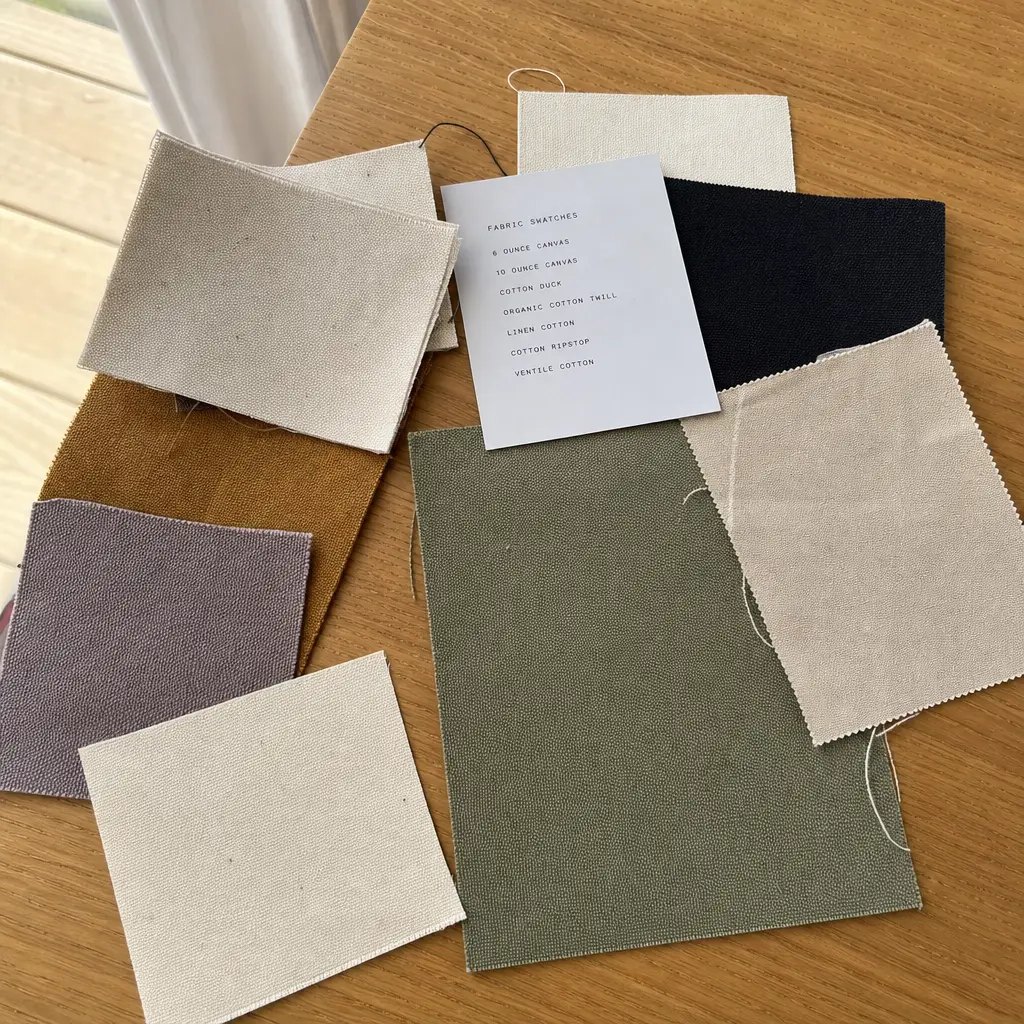
Why material selection drives the whole program
For canvas grocery totes used by tech startups, the sourcing mistake to avoid is treating the bag as a print surface first and a product second. The fabric, stitch build, and finishing process decide how the tote feels in hand, how it carries weight, how it photographs, and how long it stays in use. A bag can look excellent in a render and still fail in a warehouse, in a customer’s car, or on the first grocery trip if the spec is too light or the seam construction is too weak.
The starting point is the job the tote must do. A startup onboarding kit bag that holds a notebook, hoodie, and inserts does not need the same construction as a grocery tote that will carry bottles, produce, and dry goods every week. A buyer should define expected fill weight, frequency of use, and whether the tote is a giveaway, an internal kit component, or a retailable product. Those three answers usually narrow the material tier faster than any generic rule.
Material choice also shapes decoration quality, packing efficiency, and landed cost. Coarse canvas can make small logos look fuzzy, while denser canvas can sharpen print edges but require more careful sewing and sometimes more labor. A softer finish can make the tote easier to fold and ship, while a firmer finish can help it stand upright and feel more premium on shelf. Procurement teams should ask how the fabric behaves after cutting, printing, and finishing, not just how it looks on a flat swatch.
For startup programs, brand voice matters too. Natural greige canvas signals utility and simplicity. Bleached or lightly washed canvas usually reads cleaner and more retail-ready. Dyed canvas can work for a fashion or lifestyle launch, but it raises cost and often adds QC and lead-time risk. Matching the material story to the brand story is part of sourcing discipline, not just aesthetic preference.
The goal is not to buy the thickest canvas available. It is to choose the lightest, simplest build that still meets load, appearance, and repeat-use requirements. That is the most defensible position when you compare quotes, review samples, and explain the final recommendation internally.
Start with fabric weight, then verify GSM and construction
Canvas is often quoted in ounces, while some suppliers prefer GSM. Buyers should insist on both values in the RFQ so every quote is based on the same unit system. As a rough reference, 10 oz canvas often falls in the mid-300 GSM range, 12 oz in the low 400s, and 14 oz in the mid-400s or higher, but the exact conversion varies by yarn and weave. Treat those figures as a cross-check, not as a substitute for the supplier’s actual spec sheet.
Do not select the tote by weight alone. Two fabrics at the same nominal weight can perform differently if one has a tighter weave, cleaner yarn, or better finishing. A tightly woven 12 oz canvas may hold print edges and seam lines better than a looser 14 oz fabric. Ask for fabric construction details when available: yarn count, weave density, whether the fabric is pre-shrunk, and whether any finishing treatment changes hand feel or dimensional stability.
For most tech startup programs, 12 oz is the practical default because it balances body, cost, and flexibility. Move down to 10 oz when the tote is mainly promotional and light-duty. Move up to 14 oz when the bag must carry heavier groceries, remain boxy when empty, or support a more premium resale position. The right answer depends on use case and budget, not on a rule of thumb alone.
Also ask how the panels are cut relative to grain direction. Canvas can hang differently depending on orientation, and poor panel layout can make two bags from the same fabric behave differently when standing, folding, or carrying weight. If the bag must sit neatly in retail display or hold its shape in an employee kit, the factory should explain how they control cut accuracy and what seam allowance they use to keep dimensions consistent.
A useful procurement habit is to require a sewn sample, not just a swatch. A swatch confirms fabric look and feel, but only a sewn sample shows body, drape, handle comfort, and whether the bag still looks balanced once it is fully assembled. That single step catches more mistakes than nearly any other early-stage review.
Fiber content, weave, and finish change the business case
Fiber content should be stated clearly in the quote and on the spec sheet. A 100% cotton canvas gives the cleanest natural-material story and is usually the safest choice if the tote will be tied to sustainability language or premium merchandising. Cotton/poly blends can improve crease resistance or lower cost, but they change the hand feel and may not fit a brand that wants a fully natural product. If the supplier proposes a blend, ask for the exact ratio and the reason behind it.
The weave is equally important. Plain weave is the standard for grocery totes because it is stable, predictable, and easy to cut and sew. What buyers want to avoid is loose or irregular weaving that causes panel distortion, weak seam behavior, or uneven print absorption. Ask the factory whether it tolerates slubs or yarn irregularities, how much variation is considered normal, and whether any weaving defects are rejected before cutting.
Finish determines how the tote looks and behaves after assembly. Greige fabric is often the lowest-cost base, but it can come with more visual variation. Light bleaching can make the tote look cleaner and improve shelf appeal. Washing can soften the product and create a more relaxed retail look, but it can also bring shrinkage and dimension drift. If your program needs consistency across multiple shipments, request a finished-state sample and ask whether the bulk run will be processed the same way.
Buyers should also ask how the fabric performs after repeat handling. Canvas that looks strong out of the box can become limp, fuzzy, or uneven after folding and reuse. If the tote is intended for recurring grocery use, ask about linting, shrinkage after laundering if applicable, and whether the finish will hold color and structure over time. Those are not abstract quality questions; they are directly tied to brand perception and repeat exposure.
If the supplier has a fabric spec sheet, review it for yarn count, finishing process, shrinkage rate, and color consistency controls. Even if the supplier is not using laboratory language, they should still explain how they keep lots consistent and what they do when incoming fabric rolls vary slightly. The ability to answer those questions clearly is a strong signal of sourcing maturity.
Choose the decoration method from the artwork and order size
Tech startup artwork often includes gradients, thin fonts, multiple brand colors, and small layout elements. Not every decoration method can handle that well. Screen print is usually the most economical choice for simple logos and larger solid areas, but it can struggle with subtle gradients and very fine type on textured canvas. Heat transfer is often better for short runs and more detailed artwork, although it can feel less integrated into the fabric. Embroidery looks premium but is usually best for limited placements and smaller logos rather than a full-grocery-tote branding scheme.
The best decoration method is the one that supports the art file at the actual bag size. A logo that looks sharp on a monitor can soften or close up once it is reduced and applied to canvas. Ask the supplier to show the design at true production scale and on the actual fabric texture. Request a strike-off, print proof, or test sample that uses the final ink system and approximate final placement. That is the only reliable way to judge edge sharpness, color density, and visual balance.
Do not skip curing and adhesion questions if the tote will be reused. A logo that cracks, flakes, or rubs off after a few uses damages the program more than a slightly higher unit price ever would. Ask how the ink is cured, what rub resistance check is used, and whether the supplier can adjust print density or underbase to improve durability. For procurement, print quality is part of product quality, not just graphics quality.
If the design uses more than one color, ask the supplier to state the allowable registration tolerance. On canvas, slight color offsets may be visible faster than on smoother substrates. Good factories can usually tell you what overlap or misalignment range they consider acceptable. If they cannot, the buyer should assume the print process is not controlled tightly enough for a brand-sensitive program.
A practical rule is to match decoration complexity to run size. Simple artwork and higher volume usually favor screen print. Smaller batches with complex graphics often favor heat transfer. Premium positioning with a limited logo area may justify embroidery. The decision should be made on cost, durability, and approval risk together.
Handle build and seam design are the real durability test
Handles are the first place a tote shows whether it was engineered or merely assembled. A bag can pass a visual review and still fail the first time someone loads it with groceries. Buyers should specify handle width, handle drop, attachment style, and reinforcement method in the RFQ. Self-fabric handles usually keep the design cohesive and cost controlled, while webbing handles may provide a stronger, more obvious heavy-duty feel. The right choice depends on carrying load and brand presentation.
Ask the supplier to state how the top hem and handle junction are reinforced. Cross-stitching, bartacks, seam direction, and folded allowance all matter. A strong answer will include stitch placement, number of bartacks, or the method used to prevent pull-out. A weak answer sounds generic and relies on the word “strong” without any build detail. Procurement teams should treat that as a red flag.
Side seams and bottom seams also deserve attention. A tote that looks boxy in a mockup can twist, sag, or split at the corners if the bottom construction is too simple. Ask whether the bag uses single-needle construction, double stitching, a reinforced bottom seam, or another method. If the tote will carry bottles or denser grocery goods, seam stability is more important than decorative finish. If the tote is for retail resale, symmetry and seam cleanliness matter too.
Handle comfort is often overlooked. Thin or poorly finished handles can dig into the hand once the bag is loaded, even if the tote passes a basic pull test. That lowers repeat use and reduces the marketing value of the bag. If the tote is part of an employee program or customer gift, ask someone to carry the sample with realistic weight for several minutes and note whether the handle edge feels smooth, flat, or sharp.
A simple field test is worth more than a generic strength claim. Load the sample with the kind of items the tote is supposed to carry, then check handle stretch, seam distortion, mouth collapse, and overall balance. If the bag is intended for grocery carry, test it with a mixed load rather than empty-hand pulling. Real use exposes issues that a short bench test can miss.
MOQ, setup cost, and quote structure decide landed cost
MOQ is really a reflection of how many variables the factory must lock in. A plain natural canvas tote with one-color print can often be made at a lower MOQ because it uses common fabric and a simple setup. Add custom dyeing, washing, interior labeling, multiple print locations, or special packaging, and the MOQ rises because the factory must spread setup cost over a larger run. Buyers should not see MOQ as arbitrary; it is usually linked to manufacturing complexity.
This is why quote structure matters more than headline price. One supplier may show a low unit cost but charge separately for screens, plates, sampling, color matching, inserts, and packaging. Another may look slightly higher on unit price but include more of the setup work. The correct comparison is landed cost at your order size, not the lowest number in isolation. Procurement teams should calculate total cost including sample rounds and pack-out requirements before deciding.
For startup buyers, the order is often a pilot. You may be launching at an event, onboarding employees, or testing whether the tote can be sold as merch. Lower MOQ is useful if demand is uncertain, but only if the supplier is still using a stable production method. Sometimes a slightly higher MOQ with a simpler build is safer than a lower MOQ on a more complex custom process because the risk of quality drift is lower.
When negotiating MOQ, ask what constraint is driving it. Is it fabric sourcing, dye minimums, sewing line efficiency, print setup, or special packaging? That answer tells you whether the MOQ can move. If the supplier can use stock fabric and add only custom print, there may be room to reduce the minimum. If the order requires custom-finished fabric or a special wash process, the MOQ may be a true manufacturing constraint rather than a commercial preference.
Always ask what happens on reorders. A proper quote should say whether repeat orders can use the same spec without repeating the full sample cycle, whether screens or patterns are retained, and whether repeat pricing differs from the first order. That matters for procurement planning because the first run may be a test, but the second run is where the program starts to scale.
What a usable supplier quote should contain
A strong quote for canvas grocery totes should read like a production summary, not a marketing message. It should list fabric weight, fiber content, weave or finish, bag size, handle construction, print method, sample cost, lead time, carton pack, and any assumptions behind the price. If those elements are missing, the buyer will spend the next week reconstructing the spec line by line, and every answer may shift the commercial terms.
Ask the supplier to separate unit price from setup cost. This is especially important when comparing direct factory sourcing with trading-company sourcing or with a consolidated procurement route. The unit price may look attractive until you add sample charges, artwork setup, packaging materials, or freight assumptions. A complete quote makes it easier to compare suppliers on the same basis and reduces the chance of hidden cost later.
A good quote should also state what is excluded. For example, does the price include one-color print only, or does it include multi-color artwork? Does it include an inner polybag, barcode sticker, carton marks, or export palletization? Does it assume one sample revision or multiple rounds? Those details are critical for startup programs because the order often needs to move fast and the quote needs to survive internal review without extra back-and-forth.
Consistency matters. If one version says 12 oz and another says 400 GSM, that is fine if the numbers align. If one version says greige, another says bleached, and a third says washed, the quote is not stable enough for approval. Similar issues with carton size, pack count, or lead time should be resolved before the order goes to purchase order stage. Good procurement practice is to reject a quote that is still changing its own assumptions.
If you can, use a structured quote template. It does not need to be complicated, but it should be detailed enough that another buyer, QA lead, or logistics reviewer can check it without re-asking basic questions. That lowers approval friction and helps protect the program from avoidable disputes later.
For cost planning, it also helps to ask for indicative cost drivers by scenario. For example, a 10 oz stock canvas tote with one-color print and bulk packing should price differently from a 14 oz washed canvas tote with webbing handles, woven label, and retail folding. You do not need the supplier to give you a public rate card, but you do need to know which spec choices move cost most so your team can trade off budget, durability, and lead time intelligently.
Sampling and pre-production approval should be document-based
Do not approve a tote based on appearance alone. A clean-looking sample can still fail in bulk if the handles are too short, the seam allowance is narrow, the print is misaligned, or the fabric shrinks after finishing. Sample approval should cover geometry, print placement, stitch build, and how the bag behaves when empty and loaded. If the tote must stand up in a retail environment, structure is a quality requirement, not a nice-to-have.
For startup programs, the first sample often needs two distinct checks: a construction sample and a decoration proof. The construction sample confirms dimensions, seam build, handle comfort, and silhouette. The print proof confirms color, size, edge sharpness, and logo placement. Combining those into one rushed approval can create confusion later if the factory changes fabric or print method midstream. Separate sign-off points are safer.
The review should be written down. Mark the sample against an approved spec sheet and record what is acceptable and what is not. If the tote should measure 38 cm wide with a 26 cm handle drop, measure it. If the logo must sit 6 cm below the top hem, measure that too. Written approval reduces ambiguity and gives both sides a single reference if there is any later disagreement about the bulk result.
Request the sample in the actual bulk fabric whenever possible. A sample sewn in substitute material can look correct but behave differently in cutting, print absorption, and seam strength. If the supplier cannot provide the final fabric yet, ask them to clearly identify what is temporary. Buyers should never assume a generic sample is the same thing as a bulk-ready approval.
A practical approval checklist should include neutral-light visual inspection, measurement check, load test, print check from normal viewing distance, handle comfort check, and carton-pack review if the bags are shipping directly to a warehouse or fulfillment center. If the supplier can support a formal pre-production sign-off, use it. It is much cheaper to catch issues before bulk cutting than after the order is sewn.
Packing and carton design affect freight, shelf life, and damage rate
Tote packing is easier to underestimate than the tote itself. If the bag is folded too tightly, the print can crease and the fabric can retain a sharp fold line. If it is packed too loosely, carton count efficiency drops and freight cost rises. Buyers should specify the fold method, packing quantity, and whether the tote needs an inner polybag, tissue, insert card, or moisture protection. The right packing method depends on the channel: wholesale, retail, distributor replenishment, or direct fulfillment.
Carton size and case pack should be part of the commercial decision. Ask for pack count, carton dimensions, gross weight, and palletization assumptions if applicable. That lets logistics teams estimate cubic efficiency before confirming the order. For light but bulky products like canvas totes, a small change in folding method can materially change freight cost over a full shipment. Packing is not just protection; it is part of landed cost control.
Packing quality also affects how the product arrives. Canvas can pick up moisture, crease, and show pressure marks when cartons are overfilled. Printed bags should not rub against a hard fold line or rough carton edge if the decoration is sensitive. Ask the factory whether it uses tissue, interleaving, or print-side orientation controls. Those small steps often decide whether the tote looks retail-ready on arrival or needs extra handling at destination.
If the bags will go to a warehouse or retail receiving team, ask what labels and carton marks are required. SKU name, barcode format, case quantity, gross weight, and destination marks should be clear. If the warehouse cannot identify the product quickly, the shipment may be delayed or repacked, which adds cost and risk. Good packing design reduces downstream friction.
For large or time-sensitive orders, ask for a carton-packed sample photo before mass production. That gives you a realistic preview of folded size, print exposure, and how well the cartons fill. It is a small request that can prevent bigger surprises during shipping and receiving.
Lead time should be broken into milestones, not one finish date
Canvas tote lead times usually slip for predictable reasons: fabric was not reserved early, artwork approval took too long, sample feedback arrived in incomplete rounds, or the factory underestimated decoration setup. Buyers can reduce risk by locking the spec before asking for the price and by making sure the supplier knows whether the order is stock canvas or a custom-processed build. A vague brief almost always creates a vague schedule.
Separate sample lead time from bulk lead time. If the tote needs a custom color, wash, or decoration, the sample process may take longer than sewing once materials are approved. Ask the factory to show the critical path: fabric sourcing, print setup, stitching, final inspection, and packing. That helps you see exactly where schedule risk sits and which decision might move the ship date.
It is also worth asking what can start before final artwork approval. Some factories can reserve fabric, prepare carton templates, or book sewing capacity while print proofing is still in progress. Others cannot move until every detail is locked. Understanding that difference lets procurement teams manage dates more realistically and avoid making promises to internal stakeholders that the supplier cannot support.
Lead time is especially important for startup orders because the tote is often tied to a conference, onboarding date, launch calendar, or retail drop. If the bags miss the event window, the program loses most of its value even if the products are perfect when they arrive. In that environment, a realistic schedule is often more valuable than a fast quote.
Before release, ask the supplier to confirm the start date, not just the finish date. A finish date alone can hide a delayed start. Also ask whether holidays, inspection time, or port handling are included in the schedule. Even if the supplier cannot predict every disruption, a mature vendor should be able to explain the buffer it is using and how a late sample approval affects the finish date.
For planning purposes, many buyers use three rough buckets: stock fabric with simple one-color print is often the fastest, custom print on stock fabric is moderate, and custom-finished fabric or special washes are the slowest. Exact timing varies by factory and season, but that framework helps a startup team set realistic expectations without overpromising to marketing or operations.
Specification comparison for buyers
| Spec decision | Recommended option | When it fits | Buyer risk to check |
|---|---|---|---|
| Fabric weight | 10 oz for light promotional use; 12 oz for most startup programs; 14 oz for heavier grocery carry or retail resale | Employee onboarding kits, event merch, customer gifts, and reusable grocery totes where the bag must feel substantial without becoming too costly or bulky | Light canvas can look fine in mockups but collapse under load, show print distortion, or feel underbuilt at first touch |
| Fiber content | 100% cotton canvas for a natural story; cotton/poly only if wrinkle resistance, faster drying, or cost control matters more than a fully natural hand feel | Brand programs that need a premium, natural-positioned tote or a merchandising story tied to material authenticity | Blend ratio changes shrinkage, print behavior, and perceived quality; require the exact fiber percentage in the quote |
| Weave and finish | Plain weave with tight, even yarn formation; greige, bleached, or lightly washed finish based on brand positioning | General grocery use where print clarity, cut stability, and reliable sewing matter | Loose weave can bleed ink, fray at seams, and vary in shrinkage or appearance across lots |
| Decoration method | Screen print for simple logos and volume; heat transfer for detailed art or short runs; embroidery only for small premium placements | Launch kits, conference drops, and retail merch with defined artwork complexity | Thin lines, gradients, and small text may fail on the wrong method; request a strike-off or proof on actual fabric |
| Handle build | Cross-stitched self-fabric handles or reinforced webbing handles with stated width, drop, and bartack spec | Orders that may carry bottles, groceries, or mixed kit contents | Most handle failures come from weak reinforcement, short bartacks, or poor seam allowance at the top hem |
| MOQ route | Lower MOQ for stock fabric and one-color print; higher MOQ for custom fabric, wash, dye, or multi-location decoration | Pilot runs, startup launches, and merch tests with uncertain demand | Low unit price may hide setup fees, sample charges, packaging costs, or freight assumptions |
| Packing method | Bulk pack with a defined fold method; add inner protection only if the channel or print requires it | Wholesale replenishment, fulfillment prep, and distributor shipments | Overpacking can crease print panels; underpacking can raise freight cost and carton damage risk |
| Compliance pack | Fiber declaration, country-of-origin data, carton marks, and market-specific testing or labeling documents | Importers, retail buyers, and procurement teams with document controls | Missing documents can delay customs clearance, block onboarding, or force relabeling at destination |
| Supplier route | Direct factory sourcing for repeat orders; trading company only when you need aggregation, speed, or mixed-category coordination | Teams balancing margin, communication speed, and order complexity | Route choice affects price transparency, change control, and production accountability after sample approval |
Buyer checklist before sampling
- Confirm final bag size, gusset, handle drop, stitch allowance, and target load weight before asking for price.
- State fabric type, fabric weight in oz and GSM, weave density, finish, color tolerance, and expected shrinkage in the RFQ.
- Send vector artwork and define logo size, print position, Pantone references, and minimum line thickness if applicable.
- Ask for both photos and a physical pre-production sample before approving bulk; do not approve from mockups alone.
- Agree carton pack count, fold method, barcode or hangtag needs, outer marks, and palletization assumptions before production.
- Record inspection checkpoints for stitching, print adhesion, stains, measurement tolerance, handle strength, and quantity count.
- Match the tote use case to the spec: grocery carry, retail resale, employee kits, or event giveaways.
- Ask the supplier to identify which details are stock and which are custom so you can see where lead time and price change.
- Require the supplier to state all one-time setup charges separately from recurring unit costs.
- If the tote will be reused or washed, ask for the expected shrinkage range, colorfastness controls, and label method.
Factory quote questions to send
- What exact fabric weight, weave structure, yarn style, and finish are you quoting, and what tolerance range applies to each?
- What is the MOQ by color, by print method, and by packaging format, and which charges are one-time versus recurring?
- Can you quote sample cost, sample lead time, and whether the pre-production sample will use the same fabric lot and trims as bulk?
- What carton pack count, carton size, gross weight, and palletization assumption are you using for export shipment?
- Which QC standard do you use for seam strength, print alignment, measurement tolerance, and final defect acceptance?
- Can you separate unit price, print cost, packaging cost, sampling cost, and freight assumptions in the quote?
- What shrinkage do you expect after washing or pressing, and how do you control it during cutting and sewing?
- Will the fabric be stock greige, bleached, washed, dyed, or custom finished, and what does that change in MOQ and lead time?
- Can you confirm whether the handles are self-fabric or webbing, and specify width, drop, reinforcement, and stitch pattern?
- What documentation can you provide for fiber content, country of origin, carton labeling, and any market-specific testing before shipment?
Quality-control points to confirm
- Measure finished bag size against the approved spec and allow a clear tolerance: typically ±0.5 cm to ±1.0 cm on key dimensions unless the buyer spec says otherwise.
- Inspect fabric for even yarn density, visible slubs, color variation, weaving defects, and lot-to-lot surface consistency.
- Use a defined AQL sampling plan for bulk inspection; for many procurement programs, AQL 2.5 major / 4.0 minor is a practical starting point unless your policy requires something stricter.
- Test handle and side seam strength with realistic loading, especially at the top hem, bartacks, and bottom seam; specify a minimum load test such as 10 kg to 15 kg for 15 to 30 seconds if the bag is intended for grocery use.
- Check print registration, ink coverage, curing, and rub resistance; reject faint edges, offset logos, or color drift outside the agreed target.
- Confirm stitch quality at stress points: bartacks, top hem, bottom seam, handle anchors, and side seam intersections.
- Open random cartons and verify pack count, fold method, barcode or carton marks, moisture protection, and no crushed corners.
- Check that cut panels are matched for grain direction and that the tote hangs evenly when empty.
- Load a random finished bag to realistic use weight to see whether handles stretch, seams distort, or the mouth collapses.
- Review the pre-production approval against final bulk-ready materials, not against a generic sample from another fabric lot.