Start With the Retail Use, Not the Tote Name
A liquor retailer buying canvas grocery totes is not sourcing the same product as a conference giveaway bag. The bag may carry glass bottles, boxed spirits, mixers, snacks, loyalty-club merchandise, or a mixed checkout basket. Those loads are dense, awkward, and often fragile. Lead time planning improves when the buying team first defines what the tote must actually do in store.
The useful starting point is not a generic phrase such as heavy-duty canvas tote. It is a short use statement: two 750 ml bottles plus small grocery items, one boxed gift set, or a reusable checkout bag for mixed purchases. From there, the supplier can recommend fabric weight, gusset depth, handle length, and reinforcement. Without that information, factories may quote different products while using similar words.
This also keeps the project from becoming overbuilt. A bag for a one-week promotion does not always need the same construction as a year-round private-label reusable bag. Heavier fabric and extra reinforcement can be appropriate, but they add material cost, sewing time, and carton weight. The buyer’s job is to match specification to real store use, not to buy the heaviest possible canvas by default.
Treat lead time as a result of the specification. When the intended load, launch date, print method, and packing format are clear, the supplier can give a more credible schedule and identify the steps that may need buyer approval.
- Define the load: one bottle, two bottles, three bottles, boxed set, or mixed basket.
- Separate short-term promotional bags from repeat private-label reusable bags.
- Ask suppliers to quote against the same use case so price and timing comparisons are meaningful.
- Avoid relying on vague labels such as wine tote, grocery tote, or heavy canvas without dimensions and construction details.
Build a Spec That Factories Can Schedule
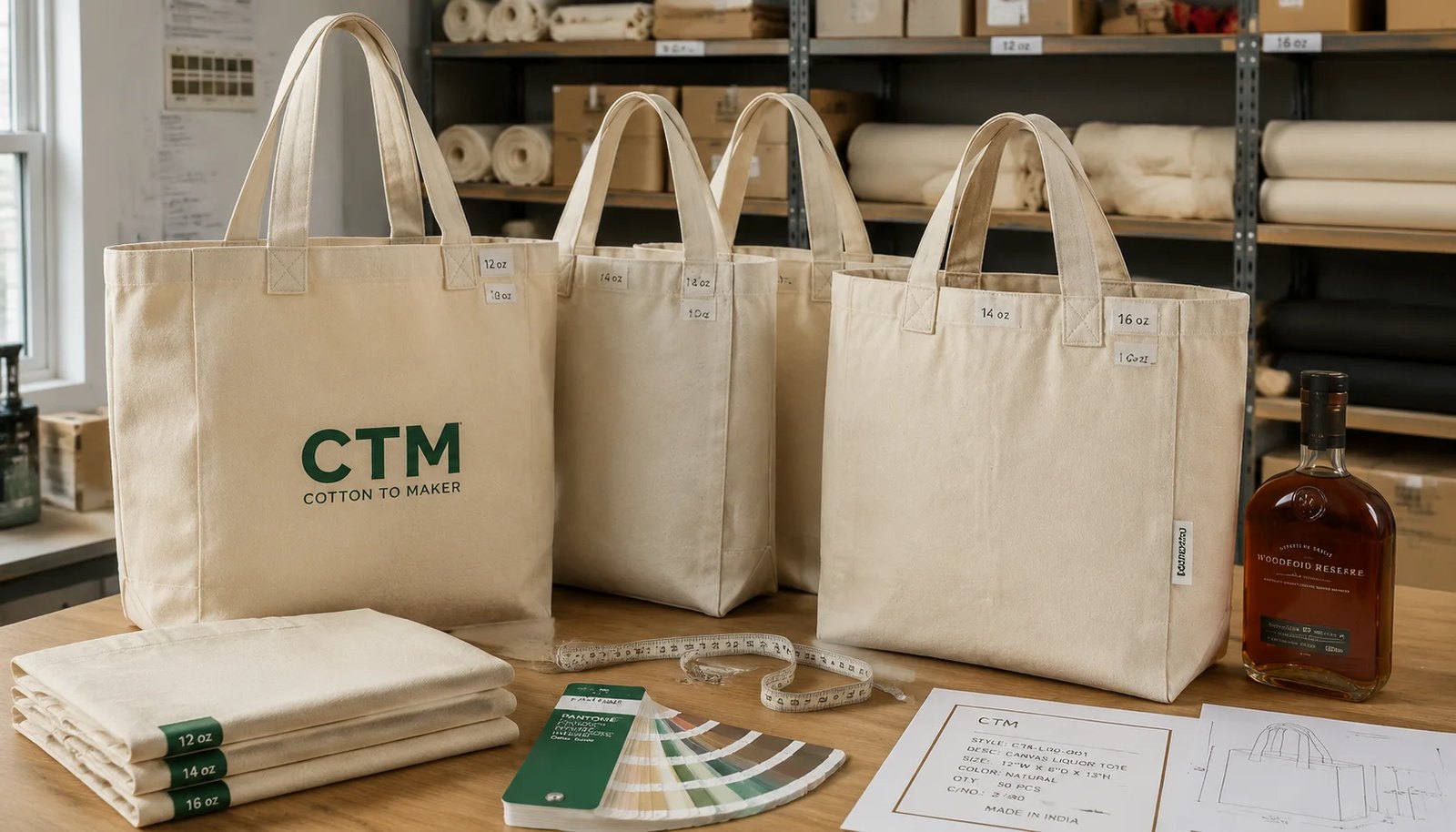
A practical specification should include finished dimensions, fabric weight, construction, handles, artwork, and packing. For many liquor retail grocery totes, 340 to 400 GSM, roughly 12oz to 14oz canvas, is a common starting range. Some buyers move heavier for a stiffer hand feel or more demanding bottle use. The correct choice depends on the whole bag, especially gussets, seams, and handle reinforcement.
Dimensions should be written in millimeters or centimeters. Width and height are not enough. The supplier also needs side gusset, bottom gusset, handle width, handle drop, seam type, and whether the tote must stand open at checkout. A wide bottom gusset can help bottle bases sit more securely, but it also changes cutting markers, sewing steps, and folding behavior.
Handle construction deserves early attention. Self-fabric handles keep the material family simple, while cotton web handles can be efficient if the webbing is available in the right shade and width. Either route should include a clear reinforcement method, such as box-cross stitching with bartack support at stress points. Long shoulder handles may be convenient for shoppers, but they place different stress on the attachment than short hand-carry handles.
If the tote must fit magnums, gift boxes, or nonstandard spirits packaging, provide physical dimensions or a sample reference. A few centimeters of gusset or handle drop can decide whether the bag works in store.
- Useful spec fields include width, height, side gusset, bottom gusset, fabric weight, handle width, handle drop, print size, and carton pack.
- For standard retail use, many buyers start around 12oz to 14oz canvas, then adjust after load and hand-feel review.
- Write reinforcement details into the RFQ instead of assuming the factory’s default is suitable for bottle loads.
- Include fit requirements for 750 ml bottles, 1.5 L bottles, gift boxes, or other key retail formats.
Use Planning Ranges With Clear Caveats
Lead time ranges are useful only when buyers understand what they include. A simple natural canvas tote with one-color screen print may move faster than a dyed heavy-canvas tote with multiple artworks and store-sort packing. Regional fabric availability, seasonal factory load, order size, and approval speed all affect the calendar. Any range should be treated as a planning estimate until the supplier confirms current capacity and material position.
A workable planning model separates the order into stages. RFQ clarification and quote confirmation may take one to three business days if the spec is complete. Artwork proofing or strike-off preparation may take several days. A PP sample may take three to seven days after final artwork and materials are clear. Stock natural canvas can sometimes be allocated quickly, while dyed or woven-to-order fabric can take longer and depends on mill schedule and approval rounds.
Cutting, printing, sewing, finishing, and packing vary with quantity and complexity. A consolidated order with one body color and one construction is easier to schedule than a multi-SKU assortment. Wide gussets, heavy fabric, long handles, and reinforced seams add handling time. Packing can also become a bottleneck if cartons must be sorted by store or promotion.
Most importantly, ask where the supplier’s quoted date ends. Production complete, ex-factory, booked on vessel, and delivered to warehouse are different milestones. Buyers should plan backward from the required in-warehouse date and include inspection, carton closeout, booking, trucking, and carrier cut-off time.
- Treat quoted stage durations as planning ranges, not universal guarantees.
- Ask whether the lead time starts from PO, deposit, artwork approval, material approval, or PP approval.
- Separate sewing completion from ex-factory and shipment-ready status.
- Build the calendar backward from the retailer’s warehouse or launch date.
Compare Fabric Routes Before You Chase Speed
Fabric sourcing is often the largest hidden variable in canvas tote timing. Natural canvas with a dark logo is usually the simplest route because it avoids lab dips and reduces shade approval pressure. That does not mean every supplier has every weight available at all times. Buyers should still ask whether the quoted cloth is on hand, mill stock, or subject to a new booking.
Custom dyed canvas adds more decision points. The mill may need greige fabric, dyeing capacity, finishing time, lab dip approval, and transport to the bag factory. If handles are a different material, they may need separate shade matching. A schedule that assumes first-round lab dip approval can change quickly if the brand team requests revisions.
Heavier canvas should be checked separately. A supplier may regularly run 12oz natural canvas but need extra time for 16oz or a special weave. Heavier material can also affect cutting efficiency, sewing speed, needle selection, and freight weight. None of these are reasons to avoid heavy canvas when it is needed, but they should be visible in the quote.
For repeat programs, consistency matters as much as speed. Ask whether future orders are likely to use the same mill base, what natural shade variation is acceptable, and how the supplier records fabric references.
- Natural canvas is often the shortest approval route, but availability still needs confirmation by weight and quantity.
- Dyed canvas requires lab dips, shade tolerance, and revision timing to be agreed before PO.
- Heavy canvas can change sewing speed and freight cost, not only fabric price.
- Repeat orders should reference retained fabric, color, and hand-feel standards.
Keep Print Choices Production-Friendly
Screen printing is usually the practical bulk method for liquor retail canvas totes, especially for one-color or two-color store logos. It is predictable, economical at volume, and easier to repeat than many image-heavy methods. For replenishment programs, simple artwork often protects both lead time and retail consistency.
Print complexity can still create delays. Large solid areas may require closer control of ink deposit, drying, and curing. Fine type on textured canvas may lose sharpness. Graphics placed near seams, gussets, or folded edges are harder to position consistently. These choices can increase rejection risk even when the bag itself is simple.
A print strike-off is useful when color, coverage, or placement matters. The buyer should approve the actual print method, ink color, print size, and placement tolerance before bulk. For chain programs with multiple store logos, confirm whether each artwork requires its own screen, setup charge, and approval step.
Digital print or transfer methods may fit small runs or detailed artwork, but the buyer should ask about durability expectations, unit cost, and throughput. Do not let a creative workaround hide a weaker schedule or a less suitable finish for repeated retail handling.
- One-color or two-color screen print on natural canvas is often the most efficient bulk route.
- Large solids, fine text, and seam-adjacent graphics need extra QC attention.
- State Pantone, print dimensions, side count, and placement tolerance in the RFQ.
- Use strike-offs when color match or ink coverage is important to retail presentation.
Control MOQ by SKU, Not Just Total Quantity
MOQ is both a price issue and a scheduling issue. A supplier may accept a total order quantity that looks attractive, but separate minimums may apply by fabric color, size, artwork, print method, or packing format. A 5,000-unit order can behave like one efficient run or several smaller runs, depending on how it is split.
Liquor retailers with multiple locations can often protect timing by standardizing the physical bag. One shared size, one body color, one fabric weight, and one construction allow larger cutting lots and simpler line planning. Store or region artwork can still vary, but the factory avoids changing the sewn product repeatedly.
Custom colors and uncommon trims make MOQ more sensitive. If an order barely meets the minimum for dyed canvas or specialty webbing, there may be little buffer for shade issues, roll defects, or late replacement. A consolidated order gives the supplier more room to manage material and production flow.
When comparing quotes, ask for MOQ by body color, bag size, artwork, and packing style. This exposes whether a low headline MOQ is truly useful for the assortment you need.
- Ask MOQ by color, size, artwork, print side, and packing format.
- Keep the bag body standardized when multiple stores need different logos.
- Recognize that fragmented SKUs can add setup, sorting, and packing days.
- Confirm whether custom fabric or trim minimums sit inside the quoted MOQ.
Use Samples to Close Decisions
Sampling should remove uncertainty, not open endless rounds of development. A clean sequence is artwork proof, print strike-off if needed, then one PP sample using the intended fabric, construction, handles, and packing method. This lets the buyer check print and function before bulk starts.
The PP sample should be tested as a retail item. Load it with the intended bottle count or boxed set, lift it by the handles, check whether it stands at checkout, and inspect how the gusset forms under weight. Flat measurements alone do not reveal whether the tote feels stable in real use.
Approval should be written and specific. Confirm dimensions, tolerances, fabric weight range, handle reinforcement, print color, placement, fold method, carton count, and label requirements. A short approval note with clear checkpoints is more useful than a general comment that the sample looks fine.
For repeat orders, a retained golden sample can shorten the process. Still, if the buyer changes fabric weight, gusset depth, handle drop, artwork size, or packing, a new PP sample is usually worth the time because it reduces the chance of bulk rework.
- Approve lab dips before making dyed-body PP samples.
- Check bottle fit, handle comfort, gusset shape, print placement, and fold method on the sample.
- Tie bulk release to written approval criteria, not only photos.
- Keep approved samples for final inspection and future reorders.
Plan Packing While You Quote
Packing affects labor, freight cube, receiving accuracy, and sometimes the factory completion date. Flat packing with fixed bundle counts is usually efficient for canvas grocery totes. It makes counting easier and keeps cartons manageable, especially for distributor or warehouse receiving.
Store-sort packing is different. If cartons must be packed by branch, event, region, or SKU ratio, the factory needs the store list, label rules, and assortment logic before finishing starts. This can be valuable for retail execution, but it adds counting and verification work. Late changes from bulk cartons to store-ready cartons are a common source of delay.
Individual polybags should be chosen intentionally. They may protect light-colored or premium bags, but they also add labor, material cost, and possible plastic-compliance questions. Inner bundles may be enough for many programs. Carton gross weight should also be set early if the receiving warehouse has manual handling limits.
Packing details belong in the RFQ because they affect both price and timing. A supplier quoting plain export cartons is not quoting the same work as a supplier quoting barcode-labeled store assortments.
- Specify fold method, bundle count, units per carton, and carton gross-weight limit.
- Provide barcode, shipping mark, and carton label requirements before production closes.
- Decide whether cartons are bulk, by SKU, by store, or by promotional kit.
- Confirm pallet rules if the shipment must arrive palletized.
Inspect the Real Failure Points
Quality control for liquor retail totes should focus on load-bearing performance and retail appearance. Handle attachment, seam security, boxed corners, fabric defects, print rubbing, and carton accuracy are the areas most likely to create problems. A beautiful print does not help if the handle stitching opens under bottle weight.
Measurement checks should cover width, height, gusset depth, and handle drop. Fabric verification should confirm the agreed GSM or oz range within tolerance. Print checks should include color, registration, edge sharpness, placement, ink coverage, and rub resistance against the approved standard.
Load testing should be practical and clearly defined. Use the intended bottle count or an agreed test weight on PP and inline samples. The purpose is to confirm the chosen construction under realistic use, not to create a universal strength claim. If the bag has longer handles, wide gussets, or heavier expected loads, test those conditions before bulk is far along.
Final inspection should include packing. Wrong counts, mislabeled cartons, mixed assortments, and overweight cartons create receiving disputes even when the bags are well made. Keep the approved bag, print standard, and carton label available so inspection is objective.
- Critical checks include handle stitching, side seams, bottom corners, fabric weight, print cure, and carton count.
- Inline inspection helps catch reinforcement problems before the full batch is sewn.
- Load tests should match agreed retail use and be documented in the inspection plan.
- Packing verification should happen before cartons are sealed.
Normalize Supplier Quotes Before Selecting
The lowest unit price or shortest quoted lead time is not automatically the best procurement choice. Two suppliers may quote different assumptions: stock 12oz natural canvas versus dyed 14oz, plain cartons versus store-sort packing, one print setup versus multiple artworks. Normalize the assumptions before comparing numbers.
A useful quote comparison separates cost drivers from timing drivers. Cost drivers include fabric, print, trims, sewing, labels, packing, sample charges, and setup fees. Timing drivers include material route, lab dips, sample days, print preparation, production days, inspection, packing, and shipment handoff. Ask what is included and what is excluded.
Also compare flexibility. Can the supplier split shipment by artwork if one SKU is late? Can they reserve fabric after deposit? Do they provide inline inspection photos or measurement records? Do they understand carton-label requirements? These details can be more valuable than a slightly shorter best-case promise.
For a retailer launch, the strongest quote is specific, transparent, and believable. A clear 35-day plan with confirmed material and approval gates is often safer than a 25-day promise that depends on unreserved stock, instant artwork approval, and no packing changes.
- Compare suppliers against the same fabric, size, artwork, reinforcement, and packing rules.
- Ask each supplier to identify the schedule stage with the most risk.
- Check whether inspection, rework allowance, booking handoff, and carton labeling are included.
- Choose the quote with the clearest assumptions, not only the fastest headline date.
Specification comparison for buyers
| Supplier route | Typical lead-time effect | Best fit | Buyer checks before PO |
|---|---|---|---|
| Stock natural canvas, 1-color print | Usually the fastest route when the supplier has suitable canvas available; still confirm allocation before relying on the date | Standard liquor-store logo bags, urgent replenishment, store-opening support, seasonal programs with limited artwork complexity | Confirm GSM or oz range, roll availability, print queue, PP sample days, carton format, and whether stock is reserved after deposit |
| Natural canvas, heavier construction | May add cutting and sewing time, especially with 14oz to 16oz canvas, wide gussets, or reinforced handles | Retailers wanting a stiffer reusable grocery tote for bottles plus mixed basket items | Ask whether the fabric weight is routine for the factory, whether sewing lines handle the thickness regularly, and how freight weight changes |
| Custom dyed canvas body | Adds lab dip approval, dye-lot control, and fabric processing time; timing varies by mill region, season, order size, and approval rounds | Private-label retail color systems, premium campaigns, brand-matched store merchandise | Get lab dip timing, revision allowance, shade tolerance, handle-match plan, and whether dyeing starts only after written approval |
| Multiple artworks on one shared bag body | Usually manageable, but print setup and packing complexity rise with each artwork | Chains, franchise groups, regional stores, and distributor programs that share the same physical tote | Clarify MOQ by artwork, screen charges, production grouping, carton marks, and whether one delayed artwork can ship separately |
| Store-sort or pre-assorted packing | Can extend finishing and packing even if sewing is complete; impact depends on number of stores and labeling rules | Retailers that want cartons packed by branch, event kit, SKU ratio, or distributor allocation | Provide the store list, carton labels, bundle counts, barcode rules, and tolerance for substitutions before bulk packing starts |
| Special trims, labels, or dividers | Often adds sourcing steps and extra approval points beyond the canvas bag itself | Gift programs, premium reusable bags, bottle-divider concepts, or branded merchandise shelves | Ask for trim MOQ, color-match risk, attachment method, sample approval timing, and whether trims are on the same critical path as fabric |
Buyer checklist before sampling
- Define the expected use: one bottle, two bottles, three bottles, boxed gift set, or mixed grocery basket. This drives fabric weight, gusset depth, handle drop, and reinforcement.
- State fabric in GSM and oz where possible, such as 340 to 400 GSM or about 12oz to 14oz, and agree on the acceptable tolerance for incoming material.
- Specify finished width, height, side gusset, bottom gusset, handle width, and handle drop in millimeters. Avoid vague size labels such as medium tote or wine bag.
- Confirm whether natural canvas is acceptable or whether a dyed body is required. For dyed canvas, ask for lab dip days, revision timing, and shade tolerance.
- List artwork details: Pantone references, print size, print side count, placement from seams and top edge, and whether any artwork crosses a gusset or fold line.
- Ask MOQ by body color, fabric weight, size, artwork, and packing format. Mixed programs often have more than one minimum.
- Decide whether you need an artwork proof, print strike-off, full PP sample, or retained repeat-order sample. Tie bulk approval to written checkpoints.
- Set packing rules at RFQ stage: fold method, units per bundle, units per carton, carton gross-weight limit, shipping marks, barcodes, and store-sort requirements.
- Build time after sewing for inspection, rework if needed, carton closeout, booking, truck handoff, and port or carrier cut-off. Sewing completion is not the same as shipment readiness.
- Keep one approved bag, one approved print standard, and one approved carton-label reference available for final inspection and repeat orders.
Factory quote questions to send
- What does your quoted lead time start from: PO, deposit, artwork approval, fabric approval, or PP sample approval?
- Please break the schedule into artwork proof, sample making, fabric sourcing, dyeing if any, printing, cutting, sewing, finishing, packing, inspection, and ex-factory handoff.
- Is the canvas stock-supported, mill stock, or woven to order? How much fabric is currently available for the requested weight and color?
- What GSM or oz range are you quoting, what tolerance will pass incoming inspection, and how is fabric weight verified?
- Does the quote assume screen print, digital print, heat transfer, or another method? How many colors, screens, sides, and setup charges are included?
- If the body is dyed, how many days are allowed for lab dips, how many revisions are included, and do handles need to match the body shade?
- What handle reinforcement do you use for bottle-weight grocery totes: box stitch, cross stitch, bartack, folded-edge reinforcement, or a combination?
- What are your normal tolerances for finished width, height, gusset depth, handle drop, print placement, and carton count?
- How will bags be folded and packed? Please quote carton size, units per carton, net weight, gross weight, bundle count, and barcode or shipping-mark assumptions.
- If one artwork, trim, or fabric color is delayed, can you split production or shipment by SKU without holding the full order?
Quality-control points to confirm
- Measure finished width, height, side gusset, bottom gusset, handle width, and handle drop against the approved spec before bulk release and during inline inspection.
- Verify fabric weight through roll records, mill documentation, or testing when the bag is intended for repeated bottle-carry use.
- Check fabric appearance for holes, stains, oil marks, severe slubs, shade variation, panel mismatch, and obvious weaving defects before cutting and during final inspection.
- Inspect print color, registration, edge sharpness, ink coverage, placement, curing, and dry rub resistance against the approved strike-off or artwork standard.
- Review handle attachment for stitch pattern, stitch density, thread tension, missed stitches, broken stitches, and reinforcement placement at the stress area.
- Run a practical load test on PP and inline samples using the intended bottle count or agreed test weight. Treat the result as a functional check, not a universal performance claim.
- Inspect side seams, boxed corners, bottom seams, top hem, and seam allowance. Stress-point defects should be corrected before the line continues.
- Confirm shrinkage or distortion risk if the canvas is washed, softened, preshrunk, or otherwise treated before cutting.
- Verify fold method, bundle count, SKU assortment, barcode placement, shipping marks, carton dimensions, and carton gross-weight limit before cartons are sealed.
- Retain the approved PP sample, print standard, and carton label as references for final inspection and future replenishment orders.