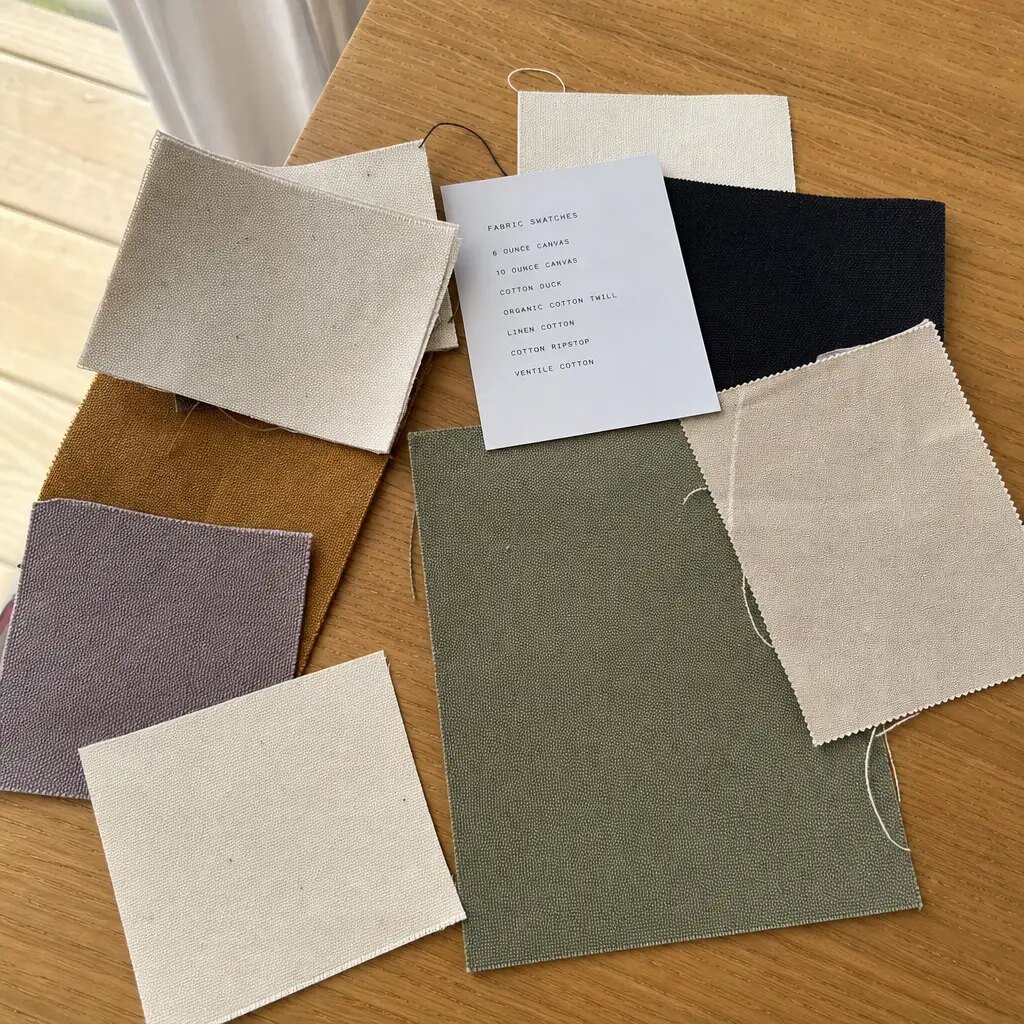
Start With the Load, Not the Fabric Number
A useful fabric weight guide for canvas grocery totes for farmers market vendors starts with the way the bag will actually be used. At a market, one tote may carry leafy greens and bread. The next may carry potatoes, jam jars, eggs, flowers, chilled items, or purchases from several stalls. The bag may be packed on a folding table, set on the ground, lifted into a vehicle, and reused every weekend. That is a different job from a conference tote that holds paper for a few hours.
For procurement buyers, fabric weight is a screening point, not the full product specification. Heavier canvas can add body and perceived value, but it cannot rescue a weak handle attachment, a shallow top hem, a twisted gusset, or poorly cured print. A 12 oz tote with thoughtful reinforcement can be a better grocery product than a heavier bag sewn like a flat promotional shopper.
The RFQ should describe the carry profile before it names the fabric. Light produce and bakery programs may need foldability, clean print, and easy booth storage. CSA pickup bags and farm shop totes may need stronger handle anchoring, a square base, and a more substantial hand feel. Premium retail bags also need consistent shelf presentation from reorder to reorder. When suppliers understand the use case, they can quote a tote instead of guessing at a phrase.
- Define the target load as light, mixed, dense, or premium retail before asking for price.
- Name the main goods the tote will carry: produce, jars, bottles, bread, flowers, cartons, or weekly CSA items.
- Decide whether the tote must stand upright when empty, sit open when loaded, or fold flat for back-of-booth storage.
- Include real market conditions in the RFQ, such as outdoor handling, damp produce, table abrasion, checkout speed, and repeated lifting.
Use Oz and GSM Without Letting Either Mislead You
Canvas tote sourcing often speaks in ounces because that is the familiar commercial shorthand. Procurement teams usually want GSM because it gives a measurable area weight. Both are useful. Neither tells the whole story alone. The same stated oz category can feel different depending on yarn count, weave density, finishing, moisture level, dyeing, washing, softening, brushing, or sizing.
For many reusable farmers market grocery totes, 12-14 oz canvas, commonly about 400-475 gsm, is the practical starting range. It offers enough body for mixed groceries while staying printable, sewable, and manageable in cartons. Lighter 10-11 oz canvas, often about 340-390 gsm, can work for smaller totes, lighter produce, and budget-driven programs. A 14-16 oz fabric, often about 475-540 gsm, moves toward premium weekly-use or CSA pickup bags. Above 16 oz, the buyer should expect more structure, higher unit cost, greater carton weight, and more sewing sensitivity.
Avoid treating an oz label as proof. Some suppliers use oz descriptions as product names for stock fabrics rather than a fresh measurement from the roll that will be cut. Others quote GSM before finishing while the buyer evaluates the finished sample after printing and sewing. A stronger B2B spec includes the commercial description, the measured GSM range, the measurement stage, and the tolerance. That is what lets two canvas grocery tote quotes be compared fairly.
- Use oz as sourcing shorthand and GSM as the measurable comparison point.
- Ask whether GSM is measured before finishing, after finishing, before washing, or after washing if a wash process is included.
- Request a swatch from the intended fabric, not only a stock sample from a previous order.
- Set a realistic GSM tolerance instead of asking for an exact number that production fabric cannot hold perfectly.
Match the Weight Range to the Buying Program
The best canvas weight depends on the program, not on a universal idea of heavy duty. A farmers market association selling merchandise has different priorities from a farm distributing CSA pickup bags. A grocery co-op may need retailer-ready presentation and repeat replenishment. A small vendor may care most about a clean one-color logo, a manageable MOQ, and a tote that feels credible at the booth.
Lightweight canvas around 10-11 oz can be right for smaller bags, seasonal giveaways, opening-weekend promotions, or light produce. The tradeoff is structure. A light tote may collapse when packed, stretch at stress points, show more texture through the print, or feel closer to a promotional item. Midweight 12-14 oz canvas is usually the safer center for reusable market grocery bags because it balances durability, printability, sewability, packability, and landed cost. It also works well with a 4-6 inch bottom gusset and reinforced handles.
Heavier 14-16 oz canvas is useful when the tote will carry dense goods often or sell as premium farm shop merchandise. Above 16 oz, be deliberate. The bag may stand more upright and feel more substantial, but cutting, sewing, folding, packing, and shipping usually become less forgiving. Heavy fabric needs the right needle, thread, seam allowance, fold engineering, and reinforcement. Without those details, the bag can pucker, the handles can pull, and the bottom corners can become bulky from carton to carton.
- 10-11 oz: better for smaller totes, light produce, broad giveaways, and compact storage.
- 12-14 oz: best default for reusable canvas grocery totes for farmers market vendors.
- 14-16 oz: suitable for CSA pickup, farm shop retail, and frequent weekly grocery use.
- 16 oz plus: reserve for structured premium totes where the buyer accepts higher material, sewing, and freight cost.
Specify the Construction That Actually Carries the Weight
Most tote failures happen where the load concentrates. The body panel may be strong enough, but the handles, top hem, side seams, bottom seam, and gusset corners decide how the bag performs. For grocery use, construction details are not factory preferences. They are core buying requirements.
Handles deserve close attention because shoppers lift dense goods repeatedly, often with one hand while holding something else. A practical grocery tote often uses 1.25-1.5 inch wide self-fabric or cotton webbing handles. For shoulder carry, a finished drop around 9-11 inches is common. Shorter drops can suit hand-carry booth bags. Longer drops may be comfortable when empty but unstable when the bag is loaded with jars or root vegetables.
The attachment method should be named in the PO. Box-X, bar tack, reinforced rectangle, or another approved construction can work if it is matched to the fabric and top hem. Self-fabric handles give a clean canvas look. Cotton webbing can improve comfort and strength. Either option should be tested on a physical sample, because photos rarely show thread tension, seam bulk, or whether the handle edge feels sharp under weight.
The gusset is what makes the tote behave like a grocery bag instead of a document bag. A 4-6 inch bottom gusset helps the tote sit open on a table, checkout counter, cart, or car seat. A deeper gusset can hold bulkier goods, but it should be tested for balance. The top hem also matters because it distributes handle stress. On heavier canvas, the factory must control needle choice and thread tension so folded areas do not pucker or develop needle damage.
- Specify finished handle width, handle drop, handle spacing, and reinforcement method in the PO.
- Require a bottom gusset for true grocery use unless the design is intentionally flat.
- Ask for stitch density and seam allowance for side seams, bottom seams, top hem, and handle attachment.
- Inspect whether the loaded tote hangs straight or twists; twisting often points to pattern, gusset, or sewing problems.
- Approve construction on a physical sample because handle comfort and seam bulk are hard to judge from photos.
Control Finished Size, Capacity, and Tolerances
Procurement quotes should use finished dimensions, not approximate cut dimensions. If a tote is described as 15 x 16 x 5 inches, the buyer should know whether that means usable finished width, finished height, and finished gusset depth after hemming, sewing, finishing, and pressing. If the supplier quotes cut panels, the production bag may hold less than expected.
Farmers market groceries are bulky and irregular. A common grocery tote range might sit around 14-16 inches wide, 14-17 inches high, and 4-6 inches deep, but the right size depends on the goods and the shopper experience. A very tall bag can hide small items and become awkward to pack quickly. A very wide bag can sag when loaded with dense products. A deeper gusset improves capacity only if the base is sewn square and the handles are positioned for balance.
Tolerances protect both sides. They do not excuse careless work; they define normal manufacturing variation before the order ships. The PO should include tolerance for finished width, height, gusset depth, handle drop, handle spacing, and print placement. For repeat seasonal orders, attach the same tolerance sheet to the RFQ, sample approval, purchase order, and inspection file. That keeps procurement, production, inspection, and receiving aligned.
- Quote finished bag dimensions after sewing and finishing, not only cut-panel size.
- Include finished handle drop and handle spacing because they affect balance and comfort.
- Set practical dimension tolerances before production, especially for retail or repeat-order programs.
- Measure samples flat and opened; gusseted bags can look correct flat but behave poorly when opened.
- Check capacity with actual products rather than relying only on nominal dimensions.
Choose Branding That Works on Natural Canvas
Farmers market totes usually need branding that is clear, durable, and easy to reorder. Screen print is often the best default for simple one- or two-color logos, farm names, market association marks, produce illustrations, and CSA messaging. It is cost-effective at volume, works well on many canvas weights, and gives suppliers a repeatable setup for seasonal replenishment.
Natural canvas is not a smooth white paper proof. It has texture, shade variation, small slubs, and a warmer base color. Fine type, thin reversed lines, large flood prints, and low-contrast ink can behave differently than expected. Ask the supplier to review artwork before sampling and flag details that may fill in, break up, show pinholes, or lose opacity. The proof should state print size, print location, distance from the top hem and side seams, ink color reference, and placement tolerance.
Other decoration methods can be right when the program calls for them. Woven labels or side tabs create a quieter retail cue and reduce large-surface abrasion. Heat transfers may support more color detail, but they need adhesion and edge checks. Embroidery can feel premium, although it may distort lighter canvas and add cost. Digital print may help complex artwork, but color, texture, and rub resistance should be proven on the intended fabric. The best decoration is the one that survives the handling at the right landed cost.
- Use screen print for bold one- or two-color artwork and repeat seasonal orders.
- Avoid tiny text, thin reversed lines, and low-contrast ink unless the printed sample proves readability.
- Define print placement from fixed points: top hem, side seam, centerline, and gusset fold.
- Ask for dry rub and wet rub checks when bags will be handled often or packed print-to-print.
- Quote decoration charges by color, location, setup, repeat run, and sample stage.
Build a Sampling Workflow Before Bulk Cutting
A tote sample should prove specification, performance, and repeatability. The workflow often starts with a fabric swatch, then a blank construction sample, then a printed sample. For larger programs, custom fabric, retailer packaging, or tight tolerances, add a pre-production sample before bulk cutting. That sample should use the intended production fabric, handles, thread, print method, labels, folding method, and packing format.
Do not approve the sample only because it looks good in a photo. Measure finished width, height, gusset depth, handle width, handle drop, handle spacing, and print placement. Inspect seam allowance, top hem, handle stitching, bottom corners, thread trimming, fabric odor, shade, and print opacity. Then load the tote with actual market goods or equivalent weight and carry it repeatedly. A clean empty sample may reveal handle strain, gusset twist, or uncomfortable carry once loaded.
Traceability matters. If a supplier sends a sample from available stock fabric while quoting production from a different roll, the buyer should know before approval. Keep one signed approved sample with procurement, one with the supplier, and one for inbound or third-party inspection. Attach the spec sheet and tolerance sheet to the sample record so reorders are judged against the same standard, not against memory.
- Approve fabric before approving the bag, especially when weight, finish, or shade matters.
- Use a blank sample to verify construction before spending time on decoration corrections.
- Use a printed sample to check opacity, placement, registration, curing, and handling marks.
- For larger orders, approve a pre-production sample made with bulk materials before mass production.
- Keep signed reference samples for procurement, supplier production, and final inspection.
Write QC Into the Purchase Order
Quality control should be built into the purchase order, not improvised after a defect appears. The PO should state fabric weight range, finished measurement tolerance, handle reinforcement, stitch requirements, print placement tolerance, acceptable fabric variation, packing method, carton marks, and inspection expectations. Words such as heavy duty or good quality are too vague for B2B sourcing.
Fabric should be checked before cutting when possible. Inspect GSM, shade, weave consistency, stains, mildew odor, oil marks, lint, broken yarns, and unacceptable contamination. Natural canvas can have slubs and shade variation, but the approved swatch should define the acceptable range. During sewing, inspect handle placement, top hem width, stitch density, side seam straightness, bottom gusset symmetry, thread tension, and thread trimming. During printing, inspect ink color, opacity, registration, centering, curing, smears, pinholes, ghosting, and print transfer risk.
A practical load check is especially useful for canvas grocery totes for farmers market vendors. Define the target load by the program, then load the bag, lift it by the handles, hold it, carry it briefly, and inspect stress points. The goal is not to create an unrealistic torture test. It is to confirm the tote survives the buyer's expected use. Check for handle tearing, seam burst, stitch opening, gusset distortion, and fabric damage around needle holes or folded stress points.
- Put measurable GSM, dimension, handle, and print tolerances in the PO.
- Inspect fabric before cutting to catch material issues early.
- Check sewing inline so weak handle attachments are corrected before the full order is finished.
- Confirm print cure and rub resistance before bags are packed in cartons.
- Use a defined load test and record pass or fail criteria for handles, seams, and gusset corners.
Plan Packing, Freight, and Landed Cost Early
Canvas tote packing affects landed cost more than many buyers expect. A heavier tote may look like a small unit-price upgrade, but the buyer also pays for carton weight, carton cube, pallet space, and sometimes extra handling. Bulk flat packing is usually efficient for farmers market vendor distribution, CSA programs, and back-of-booth replenishment. It keeps presentation simple and reduces packing labor.
Retail presentation changes the quote. Belly bands, insert cards, hangtags, barcode labels, individual polybags, tissue, slip sheets, and special folding methods can be correct for farm shops, co-ops, grocery retail, or online sales. They also add materials, labor, inspection time, and carton volume. Ask suppliers to quote packing formats separately so the merchandising team can decide whether the presentation supports the selling price.
Freight planning should happen during quoting. Ask for units per carton, carton dimensions, gross weight, net weight, estimated carton count, and pallet configuration if goods will be palletized. For retailer or distribution-center shipments, include barcode, carton label, routing guide, outer mark, and delivery appointment requirements. A well-made tote can still create avoidable cost if it arrives in the wrong carton format or without required labels.
- Compare unit price together with carton cube, gross weight, and pack count.
- Quote bulk pack and retail pack as separate options when the selling channel is not final.
- Check whether folded printed panels need tissue, slip sheets, or alternate folding to avoid scuffing or ink transfer.
- Ask for packing photos or a packing sample when retail presentation matters.
- Include carton marks, barcodes, routing requirements, and pallet needs in the RFQ.
Use an RFQ That Makes Quotes Comparable
A strong RFQ turns the tote idea into a controlled sourcing exercise. Begin with the use case and target load. Then state finished dimensions, fabric weight range, fabric color and finish, handle details, gusset depth, print method, artwork size, print location, label requirements, packing format, quantity, delivery date, inspection needs, and incoterm. Attach artwork, reference samples, carton-label requirements, and any retailer routing documents when they apply.
The RFQ should make suppliers price the same bag. Otherwise one quote may cover a 10 oz flat tote with simple stitching while another covers a 14 oz gusseted tote with reinforced handles and retail packing. Both may be called canvas grocery totes, but they are not the same product. Ask each supplier to confirm every specification line and list exceptions separately. Request alternate recommendations in a separate section so cost-saving ideas do not blur the base comparison.
When quotes arrive, compare total value instead of unit price alone. Review actual GSM, fabric finish, construction, print charges, setup charges, sample charges, packing, carton data, incoterm, lead time, inspection support, and reorder assumptions. A slightly higher quote may be the stronger purchase if it includes production fabric control, better handle reinforcement, clearer tolerances, and usable carton information. A low quote can also be right, but it should be supported by transparent specs rather than vague savings.
- Include finished size, GSM range, handle drop, gusset depth, print details, packing, quantity, delivery date, and incoterm.
- Ask suppliers to quote base specs and optional alternates separately.
- Require carton dimensions and gross weight with the quote so freight is not guessed later.
- Ask what drives MOQ: fabric color, artwork version, label version, handle option, packing format, or production setup.
- Turn the accepted quote into the PO specification so sourcing, production, inspection, and receiving use the same standard.
Specification comparison for buyers
| Spec decision | Recommended option | When it fits | Buyer risk to check |
|---|---|---|---|
| Fabric weight | 12-14 oz canvas, commonly about 400-475 gsm | Best starting point for reusable farmers market grocery totes carrying produce, bread, flowers, boxed goods, jars, and mixed purchases | Confirm measured GSM from the intended production roll; nominal oz names can vary by supplier and should not replace swatch approval |
| Lightweight canvas | 10-11 oz, commonly about 340-390 gsm | Budget resale bags, seasonal giveaways, smaller totes, light produce, or programs where foldability matters more than structure | May sag under dense goods, feel more promotional, show more print texture, or pull at handle anchors if reinforcement is weak |
| Mid-heavy canvas | 14-16 oz, commonly about 475-540 gsm | Premium vendor merchandise, CSA pickup bags, farm shop totes, weekly-use grocery bags, and bags expected to stand more upright | Higher sewing and freight cost; requires correct needle, thread, seam allowance, and reinforcement to avoid puckering or stress damage |
| Heavyweight canvas | 16 oz and above, commonly 540 gsm plus | Structured retail totes, premium farm-branded merchandise, gift shop products, and higher-price reusable grocery bags | Can be stiff, bulky in cartons, slower to sew, harder to fold, and more expensive to ship; construction must still carry the load |
| Handle construction | 1.25-1.5 in wide self-fabric or cotton webbing handles with box-X, bar tack, or reinforced rectangle stitching | Grocery-style carrying where shoppers may lift dense goods repeatedly and may carry by hand or shoulder | Narrow handles, single rows of stitching, or poor top-hem anchoring can fail before the fabric body wears out |
| Handle drop | About 9-11 in finished drop for shoulder-friendly grocery totes; shorter drops for hand-carry-only bags | Market shoppers carrying several purchases across parking areas, sidewalks, farm stands, and retail aisles | Too-short drops reduce usability; too-long drops can make a loaded bag swing, drag, or feel unstable |
| Gusset decision | 4-6 in bottom gusset for most grocery totes | Helps the tote open, sit on tables and checkout counters, and hold jars, produce, bread, flowers, and cartons | Flat totes save material but often behave like document bags; deep gussets need balance testing when loaded |
| Finished-size control | Quote finished dimensions after sewing and finishing, with tolerances stated in the PO | Any B2B program comparing multiple factories or planning repeat seasonal orders | Cut size is not finished size; shrinkage, hemming, sewing turn, and pressing can change usable capacity |
| Decoration method | Screen print for bold one- or two-color artwork; label, transfer, digital print, or embroidery when the artwork or channel requires it | Farm logos, market association marks, CSA bags, retailer-ready totes, and farm shop merchandise | Fine lines, low contrast, poor curing, transfer edges, and print-to-print packing can cause readability or durability issues |
Buyer checklist before sampling
- Define the buying purpose first: vendor checkout bag, farmers market merchandise, CSA pickup tote, grocery resale item, opening-weekend giveaway, or premium retail product.
- Set the target load profile in plain terms, such as light produce only, mixed grocery load, glass jars and bottles, flowers plus produce, or weekly CSA pickup.
- Specify fabric by both commercial oz description and measured GSM; include an agreed tolerance such as target GSM range or plus/minus percentage.
- Request a production-intent fabric swatch large enough to weigh, fold, print-test, rub-test, and compare against the approved sample.
- Lock finished bag width, height, gusset depth, handle width, handle drop, and handle spacing; do not compare quotes based on approximate or cut-panel dimensions.
- State whether the tote must stand upright when empty, sit open while loaded, fold compactly for storage, or prioritize premium shelf presentation.
- Choose handle material, width, drop, and reinforcement method; require the supplier to show handle attachment detail on the sample.
- Specify stitch density, seam allowance, thread color, thread type, top-hem construction, and bottom-gusset construction for the quoted weight range.
- Decide the print method by fabric surface, artwork detail, order volume, abrasion risk, and reordering needs rather than choosing by artwork preference alone.
- Request a decoration proof that shows print size, print location, distance from top hem and side seams, ink color reference, and centering tolerance.
Factory quote questions to send
- What is the actual measured GSM of the canvas you are quoting, what commercial oz description do you use for it, and what GSM tolerance do you hold across production rolls?
- Is the quoted canvas greige, natural, bleached, dyed, washed, softened, brushed, or otherwise finished, and how does that affect shrinkage, shade variation, MOQ, and lead time?
- Can you provide a swatch from the intended production fabric before sampling, with measured GSM, weave description, finish description, and fabric-width information?
- Are you quoting finished bag dimensions after sewing and finishing, and what tolerance will you hold for width, height, gusset depth, handle width, and handle drop?
- What are the cut-panel dimensions versus finished dimensions, and is any shrinkage, pressing, or washing included in your process?
- How are the handles made and attached: self-fabric, cotton webbing, folded canvas, single stitch, double stitch, reinforced rectangle, bar tack, box stitch, or box-X?
- What thread fiber, thread size, stitch density, seam allowance, needle setup, and top-hem construction will be used for this fabric weight?
- How is the bottom gusset constructed, and will the bag sit reasonably square when opened and loaded with the target use case?
- Which print method do you recommend for this artwork on this canvas weight, and what are the setup charges by color, screen, plate, print location, and repeat run?
- What ink, pigment, transfer, label, or embroidery material will be used, and what curing, rub, crocking, wash, or abrasion checks can you support?
Quality-control points to confirm
- Fabric GSM matches the approved target range within the agreed tolerance, with roll-to-roll variation checked before cutting.
- Canvas appearance matches the approved standard for shade, weave, slub level, hand feel, finish, odor, and cleanliness; natural variation is acceptable only within the approved range.
- Finished width, height, gusset depth, handle width, and handle drop are measured after sewing and finishing, using the tolerance sheet attached to the PO.
- Top hem is even and strong enough to anchor handles, with no raw-edge exposure, twisting, skipped stitches, loose threads, or visible needle damage.
- Side seams, bottom seam, and gusset corners are straight, secure, and symmetrical; the tote sits reasonably square when opened and loaded.
- Handle attachments are aligned on both faces and reinforced as specified, with no broken bar tacks, missed stitch lines, pulled seams, or asymmetric handle drops.
- Stitch density, seam allowance, thread type, thread color, and thread tension match the approved sample and remain consistent across checked cartons.
- Print size, placement, centering, ink color, opacity, registration, and edge clarity match the approved proof and sample within agreed tolerance.
- Decoration is free from pinholes, smears, ghosting, lint contamination, scorch marks, transfer edge marks, cracking, peeling, or unacceptable misregistration.
- Ink or decoration passes the agreed dry rub, wet rub if applicable, crocking, cure, handling, and packing-transfer checks for the intended use.