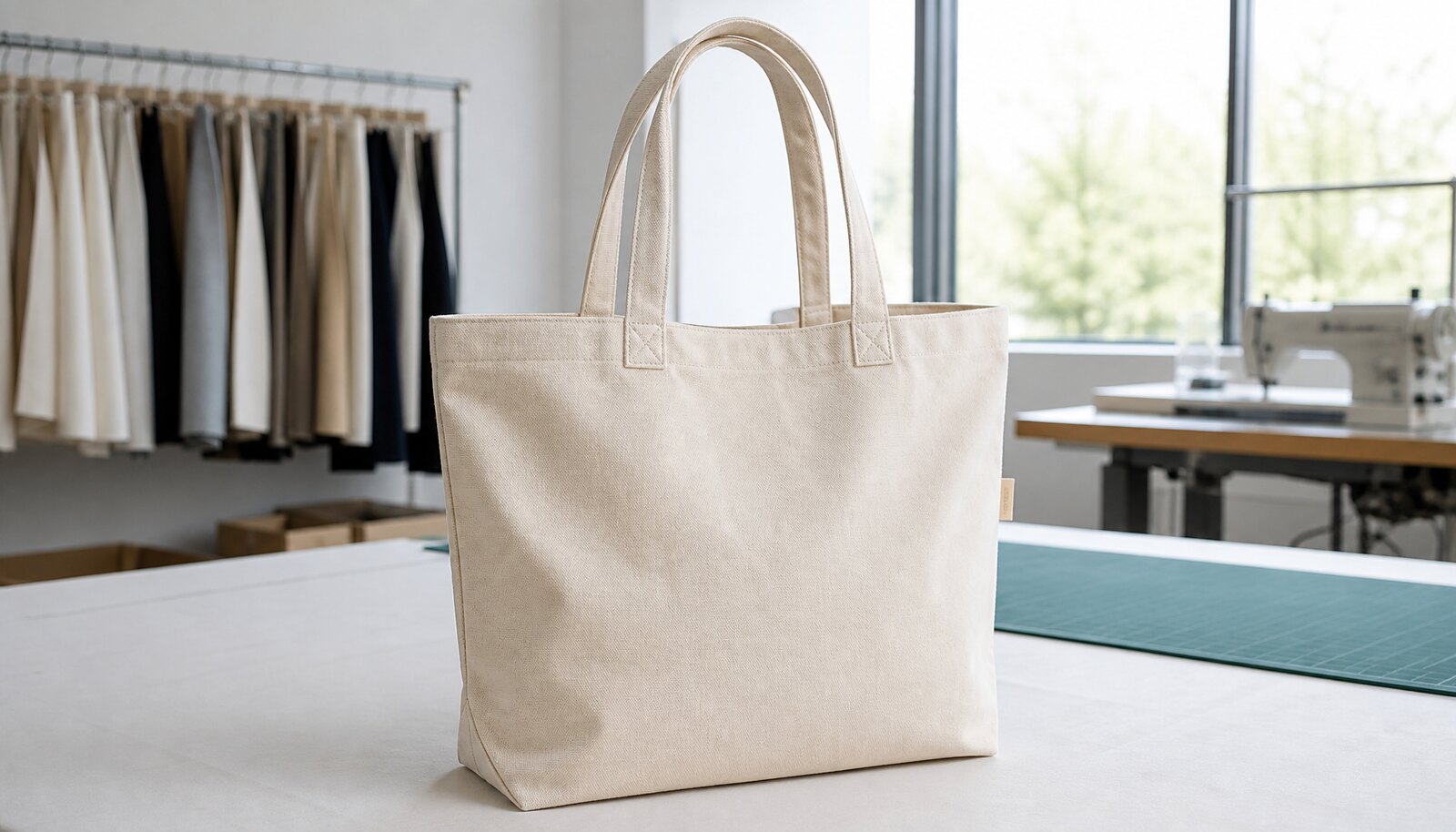
1. Start With the Contents, Not the Tote Photo
Canvas grocery totes for event planners are not just blank bags with a logo added near the end. In a live event, the tote becomes packaging, wayfinding, sponsor visibility, and sometimes retail merchandise all at once. It may carry registration papers, sample products, bottled drinks, boxed food, apparel, books, catalogs, tech accessories, or a full welcome kit. Those contents should drive the specification before a supplier quotes the job.
A good-looking empty sample can still fail when staff fills hundreds or thousands of bags under time pressure. Handles may feel too narrow. A shallow gusset may not hold a box. A dark logo may transfer when bags are stacked. A soft fabric may collapse on the registration table. These are not cosmetic inconveniences; they create labor, sorting, replacement, and brand problems at the worst possible moment.
Build the canvas grocery totes for event planners quality inspection checklist around real use. For paper-heavy welcome packs, watch fabric cleanliness, print placement, carton count, and presentation. For bottles, books, and dense sponsor kits, add stricter controls for handle attachment, bottom seams, and loaded lift checks. The most useful tote brief starts with the load, the event deadline, and the distribution plan.
- Document the event type, event date, attendee count, delivery address, receiving hours, and final in-hand deadline.
- List each expected content item with approximate quantity, size, and weight, including sharp corners, bottles, books, or rigid boxes.
- State whether the tote is a budget giveaway, premium sponsor item, VIP kit, retail pop-up bag, or reusable grocery-style attendee bag.
- Share photos or dimensions of contents when the tote must fit binders, boxed gifts, apparel bundles, bottles, or product samples.
2. Turn the Idea Into a Factory-Ready Specification
Suppliers cannot price accurately from words like large shopper, grocery tote, premium cotton bag, or similar to last year. Those terms leave too much room for interpretation. A procurement-ready specification should list finished width, finished height, gusset depth, handle width, handle drop, fabric weight, fabric color, seam construction, print method, print size, print location, label details, packing method, carton quantity, carton marks, and delivery terms.
Finished dimensions matter more than pattern dimensions. For example: 38 cm W x 40 cm H x 12 cm gusset, measured flat from seam to seam after sewing and before final packing. Without that measurement rule, the buyer may measure the finished tote, while the factory measures the cut panel or a pressed sample. Both sides may believe they are correct. Written tolerances keep the conversation factual.
Sewn canvas products need realistic tolerances. Body width and height commonly require about ±1 cm, while gusset depth and handle drop often need ±0.5 to 1 cm depending on the build. Logo placement is usually more sensitive because a slightly crooked or low sponsor logo is visible immediately. For simple one-panel screen prints, many buyers target ±3 to 5 mm after the factory confirms its fixtures can hold that range.
- Specify finished W x H x gusset instead of small, medium, large, shopper, or grocery size.
- Define handle drop separately from total handle length; handle drop controls carrying comfort and shoulder clearance.
- Place the logo by distance from top seam and center line, supported by an artwork placement file.
- Put size, handle, gusset, and print tolerances in the purchase order, PP sample approval sheet, and final QC checklist.
3. Choose Canvas Weight, Finish, and Shade With Eyes Open
For many event grocery totes, 10 to 12 oz cotton canvas, approximately 280 to 340 gsm on finished cloth, is a practical starting point. It feels more substantial than lightweight promotional cotton and usually gives a better base for screen printing. For simple paper handouts, an 8 to 10 oz fabric may be acceptable, but it will usually feel softer, wrinkle more easily, and stand less firmly on a table.
Heavier is useful only when the full construction supports it. A 12 to 14 oz canvas, roughly 340 to 420 gsm on finished cloth, is often better for books, bottles, dense catalogs, boxed kits, and premium retail-style event bags. But heavier canvas also increases material cost, sewing difficulty, carton weight, and sometimes lead time. If the handle reinforcement is weak, heavier fabric alone will not save the tote.
Be precise about how fabric weight is measured. Ounces and gsm may refer to greige fabric, dyed fabric, washed fabric, coated fabric, or finished cloth. Finished-cloth weight is usually the most useful for buyers because it describes what the event team receives. Ask the supplier to state the basis and tolerance. A common commercial tolerance is ±5%, but it should be agreed before production.
Natural canvas also needs a visual standard. Unbleached cotton may include seed flecks, slubs, and shade variation. That can look authentic for a natural brand, or it can look dirty beside a clean corporate logo. Bleached and dyed canvas can reduce variation, but they bring dye-lot control, possible minimums, and shade-approval steps. Approve the fabric appearance before bulk cutting, not after cartons are packed.
- Use 10 to 12 oz finished canvas for many welcome bags, sponsor kits, apparel packs, and reusable attendee totes.
- Move to 12 to 14 oz finished canvas for bottles, books, dense catalogs, boxed kits, or premium retail-style loads.
- Ask whether the canvas is natural, bleached, dyed, washed, coated, or otherwise finished, and confirm the weight basis.
- Approve shade, slub level, and natural fleck tolerance, especially on the front logo panel.
4. Build the Tote Around Stress Points
Fabric weight gets attention, but construction decides whether the tote survives real handling. A well-made 10 oz tote with good seam allowance and reinforced handles may perform better than a poorly sewn 12 oz tote. For event procurement, ask the supplier to quote the build, not only the fabric: body panel method, gusset style, seam allowance, stitch type, stitch density, thread, handle width, handle drop, and reinforcement pattern.
Grocery-style totes are often made with a folded body and side seams, separate front and back panels, side gusset panels, a boxed bottom, or a combination of these details. Boxed and gusseted constructions help bulky contents sit better and make the tote look more structured on tables or in photos. Flat totes are simpler and efficient for brochures, shirts, and lightweight giveaways, but they may not work for boxed or food-related kits.
Handles deserve a separate review. Many failures happen at the attachment point, not in the main fabric panel. A handle width of about 2.5 to 3.8 cm is common, but the right choice depends on expected load, look, and carrying style. Reinforcement may be box stitch, box-X, bar-tack, double row stitching, or another approved method. Do not accept strong handles as a spec. Ask for dimensions, stitch style, and a loaded lift check.
- Request inside seam photos, handle attachment close-ups, and a simple construction sketch for new suppliers or custom builds.
- Confirm seam allowance and stitch density; many canvas tote constructions use roughly 7 to 10 stitches per inch, but the approved sample should control the standard.
- Define handle width and handle drop in centimeters, then test the PP sample by hand or shoulder as intended.
- For heavier loads, require reinforced handle attachment and check that the stitching does not cut, tear, or distort the canvas.
5. Select Decoration Without Creating Brand Rejections
Decoration is where a functional tote can quickly become an event reject. Screen printing is usually the most cost-effective choice for simple one-color or two-color marks on medium to high volume canvas tote orders. It can give good opacity on natural canvas when the panel is flat, the ink is suitable, the screen is controlled, and the cure is complete.
Transfers and digital printing can make sense for short runs, gradients, complex artwork, or many logo versions. They are not automatically better. Heat transfer may sit on top of the canvas and can crack, lift, or show hard edges if the material or application settings are wrong. Digital print can reproduce detail, but it may look softer on textured canvas. Embroidery can look premium for small marks, yet large dense embroidery may distort fabric and is usually not ideal for big sponsor graphics.
Make print QC measurable. Confirm artwork version, logo size, ink color reference, print location, placement tolerance, opacity expectation, and cure check. For a simple front-panel screen print, ±3 to 5 mm may be a workable placement target if the factory confirms it. Require first printed piece approval before the run continues. Then check early, middle, and late-run pieces for screen drift, color change, opacity loss, smearing, and poor cure.
- Use screen print for simple logos, repeat programs, and medium or high quantities where cost control matters.
- Use transfer or digital print only after approving handfeel, edge behavior, color, fold performance, and durability on the actual canvas.
- Avoid hard folds directly through large printed logos where possible; include the fold direction in packing instructions.
- Inspect print orientation, opacity, registration, cure, backside staining, pressure marks, and ink transfer between stacked bags.
6. Qualify the Supplier Before You Compare Prices
Unit price is useful only after you know what is being priced. A direct factory may give stronger control when the order involves custom size, special sewing, fixed packing, and accountable QC. A trading company or exporter can also work well if it manages production transparently and accepts responsibility for the result. A local decorator may be fast for urgent small runs, but it may be limited to existing blank inventory and decoration rather than full construction control.
Ask who cuts, who sews, who prints, who packs, and who performs final inspection. If printing is outsourced, who approves the first printed tote? Who pays if the print color, placement, or cure is wrong? If sewing is outsourced, how are stitch density, handle placement, fabric lot mixing, and carton separation controlled? Subcontracting is not the problem. Unclear responsibility is.
Supplier qualification does not need to be complicated, but it should be specific. Request photos of similar canvas grocery totes, inside seams, handle reinforcement, printed panels, carton packing, and a sample QC report. Ask how defects are classified and what can be repaired before shipment. A reliable supplier will talk about fabric availability, sampling time, production queue, inspection windows, and freight timing instead of simply promising every deadline.
- Confirm whether cutting, sewing, printing, finishing, and packing are in-house or subcontracted.
- Request a sample inspection report, carton mark example, and production photos of similar tote construction.
- Clarify who pays for sorting, rework, replacement, or reinspection if final QC finds major defects.
- Send every supplier the same spec sheet, artwork, packing rules, delivery terms, and inspection expectations before comparing prices.
7. Approve a Real Pre-Production Sample
The pre-production sample is the buyer’s best opportunity to prevent a bad bulk run. It should use the final fabric quality, final fabric color, final dimensions, final handle construction, final thread color, final decoration method, final label, and intended folding method. A showroom sample may prove that the supplier can make a tote, but it should not release production. It may have been made with different cloth, ink, operators, seam tension, or packing.
Treat the PP sample like a small production inspection. Measure width, height, gusset, handle drop, handle width, logo size, and logo location. Fill it with the intended event contents and lift it several times. Look for twisting side seams, uneven handles, weak attachment points, distorted bottom corners, puckered print areas, and creases across the logo. If the bag must stand upright on a table, test that too.
Once approved, keep a golden sample and a written approval sheet. Ideally, the buyer keeps one sample while the factory keeps one on the production line. The approval sheet should record fabric weight, shade, actual measurements, handle construction, artwork version, label details, packing method, and accepted deviations. If a stakeholder changes logo size, handle length, fabric color, or carton quantity later, revise the approval. Otherwise production, inspection, and event teams may work from different assumptions.
- Do not release bulk production if the PP sample uses substitute fabric, approximate dimensions, or a different print method.
- Record actual sample measurements against the specification instead of approving by photo or general appearance.
- Perform a realistic load check using intended contents or an agreed inspection weight and duration.
- Sign and date the golden sample or approval sheet, then reference it in the purchase order and final inspection request.
8. Use a Defect-Based Quality Inspection Checklist
A practical quality inspection checklist separates defects into critical, major, and minor categories. Critical defects make the tote unsafe, unusable, or unacceptable for shipment. Examples include wet goods, mildew odor, severe contamination, sharp foreign objects, wrong product, or handles detaching under a normal loaded lift. Major defects affect function, brand presentation, or event readiness. These include open seams, missing reinforcement stitches, wrong fabric, wrong logo, badly crooked print, heavy stains, mixed artwork versions, and carton count errors.
Minor defects are smaller issues that do not materially affect function or presentation, such as a few trim thread tails, minor folding wrinkles, or slight natural flecks already accepted in the fabric standard. Classifying defects in advance prevents emotional arguments later. It also helps the inspector decide whether to release, sort, rework, or reject the shipment.
Inspection should not wait until every carton is sealed. Inline sewing checks can catch skipped stitches, seam allowance problems, and misplaced handles before the whole run is finished. Print-line checks can catch registration drift, color problems, and weak cure before packing. Final inspection then verifies finished goods against the golden sample, reviews random units, checks carton counts, and documents defects.
Many importers reference ANSI/ASQ Z1.4 or similar random sampling plans, but the exact AQL level and defect rules must be agreed in advance. Event buyers may choose tight acceptance for logo defects and more tolerance for minor thread trimming. The inspection report should show sample size, carton selection, defect photos, classifications, corrective actions, accepted quantity, rejected quantity, and the final release decision.
- Critical: wet packing, mildew odor, severe contamination, unsafe foreign object, wrong item, or handle failure under normal loaded lift.
- Major: open seams, missing bar-tacks, wrong logo, incorrect fabric, off-center print beyond tolerance, heavy stains, mixed SKUs, or count errors.
- Minor: small thread tails, slight approved canvas flecks, minor folding wrinkles, or tiny print edge variation within the accepted standard.
- Require defect photos with a ruler or reference point when size, print placement, seam, or stain defects are disputed.
9. Control Packing, Carton Marks, and Venue Receiving
Packing can make or break an event order even when the tote itself is well made. Factories often pack for freight efficiency. Event teams need cartons that are easy to receive, count, sort, and distribute. If bags arrive loose, over-compressed, mixed by logo version, or packed in cartons too heavy for staff, the buyer may spend expensive setup time sorting instead of preparing the event.
Define the fold method, inner pack quantity, master carton quantity, carton dimensions, carton gross weight, carton mark format, and separation rules. Separate by destination, logo version, language version, VIP batch, or booth allocation when needed. If the tote has a large screen print, avoid a hard crease through the logo if possible. If the print is dark or uses transfer, confirm that stacking will not cause blocking, ink transfer, pressure marks, or peeling.
Natural canvas must be packed dry and stored away from damp floors, chemicals, and strong odors. Carton marks should be operational: purchase order number, item name, color, logo version, quantity, carton number, destination, and event name if needed. For venue, distributor, or decorator delivery, barcode labels, pallet labels, appointment references, or routing marks may also be required. Packed-carton photos and random open-carton photos before shipment can catch mixed SKUs, missing labels, weak cartons, and poor folding while there is still time to fix them.
- Specify fold direction, inner pack quantity, master carton quantity, carton dimensions, and carton gross weight limit.
- Keep carton gross weight manageable for manual event receiving; 15 to 20 kg is often easier unless palletized handling is confirmed.
- Separate artwork versions, destinations, languages, event days, or VIP batches by carton whenever possible.
- Require carton marks to match the packing list, purchase order, and final inspection report.
10. Read MOQ, Lead Time, and Price Like a Factory
MOQ is shaped by fabric availability, dye lots, cutting efficiency, print setup, label sourcing, packing complexity, and production scheduling. A natural canvas tote in a standard size with one print color will usually be easier to source than a dyed tote with several logo versions, custom woven labels, hangtags, and location-specific carton packing. If the event quantity is low, simplify the spec first: stock natural canvas, standard dimensions, one print position, one or two ink colors, standard handles, and bulk packing.
Lead time should be broken into steps. Sampling, sample revisions, artwork approval, fabric preparation, cutting, sewing, printing, curing, packing, final inspection, shipment booking, export clearance, customs, inland transport, and venue receiving can all add calendar days. A quote that says 15 days production may assume immediate approval, available fabric, no sample revision, no inspection hold, and smooth freight. Work backward from the latest acceptable arrival date and add buffer for local delivery appointments and receiving checks.
Compare landed cost and risk, not only unit price. Ask what is included and excluded: sample fee, sample courier, screen setup, artwork separation, ink colors, labels, hangtags, individual polybags, barcode labels, export cartons, pallets, inspection, testing, export documents, inland freight, international freight, duties, local delivery, and reinspection. A cheaper unit price can become expensive if the packing is wrong, the fabric is lighter than expected, or the logo defects require local sorting.
- Ask for MOQ by fabric color, tote size, print color count, logo version, label type, and packing format.
- Request price breaks at realistic quantities and confirm that the same specification applies at every price level.
- Separate sample lead time, production lead time, inspection time, transit time, customs time, and local delivery time in the sourcing calendar.
- Challenge unusually short lead times by asking what fabric, print capacity, production slot, and approval steps are already secured.
Specification comparison for buyers
| Spec decision | Recommended B2B option | When it fits | Buyer risk to check |
|---|---|---|---|
| Supplier route | Direct factory or accountable exporter that documents cutting, sewing, printing, packing, inline QC, and final inspection in one production file | Repeat event programs, custom grocery tote sizes, multiple delivery points, sponsored merchandise, and fixed event deadlines | If sewing or printing is subcontracted without disclosure, responsibility for rework, replacement, and schedule recovery can become unclear |
| Finished size | Issue dimensions as finished W x H x gusset, for example 38 cm W x 40 cm H x 12 cm bottom/side gusset, with measurement method and tolerance stated | Registration kits, grocery-style welcome bags, boxed sponsor gifts, retail pop-ups, and merchandise tables | Generic words such as medium, large, shopper, or grocery size can produce the wrong capacity even when the sample photo looks similar |
| Fabric weight | 10 to 12 oz canvas, approximately 280 to 340 gsm on finished cloth, for standard event grocery totes | Welcome bags, sponsor kits, brochures, apparel, light retail merchandise, reusable attendee bags | If weight is quoted on greige cloth or before finishing, the final handfeel and strength may not match the buyer's expectation |
| Heavy-load fabric | 12 to 14 oz canvas, approximately 340 to 420 gsm on finished cloth, with reinforced handle attachment and controlled bottom seam construction | Bottled drinks, dense catalogs, boxed food items, books, tech accessories, or premium retail-style event bags | Heavier canvas increases material and sewing cost; weak handle reinforcement can still fail even when fabric weight is high |
| Typical size tolerance | Body width/height ±1 cm, gusset ±0.5 to 1 cm, handle drop ±0.5 to 1 cm, unless a tighter standard is confirmed by the factory | Most custom canvas tote bulk orders where fabric shrinkage, seam turning, and manual sewing variation must be allowed | No written tolerance causes disputes: the buyer may reject variation that the factory considers normal |
| Logo placement tolerance | Screen print centered to artwork with placement tolerance commonly ±3 to 5 mm for simple one-panel prints, confirmed against the approved sample | Sponsor logos, conference marks, retail event identity, and agency-managed branded programs | A functional bag can become a brand reject if the logo drifts, rotates, prints too low, or crosses a fold/crease line |
| Construction | Boxed or gusseted body, 2.5 to 3.8 cm handle width, defined handle drop, lockstitch or equivalent secure seam, and reinforced handle stitching | Event kits that must stand on tables, carry bulky items, or look structured in photographs and registration areas | A vague grocery tote spec may result in shallow gussets, twisted handles, narrow straps, weak back-tacking, or a collapsing bottom |
| Decoration method | 1 to 2 color screen print on a flat panel with first-article approval, ink color reference, cure check, and placement template | Medium to high volume event totes with simple sponsor marks and strong cost control | Low-opacity ink, poor cure, screen movement, or ink transfer during packing can create widespread logo defects |
| Pre-production sample | PP sample made from final fabric weight/color, final dimensions, final handle construction, final print method, final label, and intended fold/packing | New suppliers, first orders, visible sponsor branding, event orders with no time for local sorting, and custom constructions | Sales samples can hide differences in fabric shade, thread tension, print handfeel, label placement, and packing appearance |
Buyer checklist before sampling
- Define the event type, attendee count, delivery destination, receiving hours, latest acceptable arrival date, and whether goods ship to a venue, warehouse, decorator, distributor, or multiple locations.
- List expected contents and estimated filled weight. Separate light paper loads, apparel loads, boxed gifts, bottles, catalogs, books, and dense retail products because each load stresses the tote differently.
- Lock finished width, height, gusset depth, handle width, handle drop, seam allowance, and measurement method. State whether measurements are taken flat, seam-to-seam, and before or after final pressing/packing.
- Confirm canvas weight in oz and gsm, and state whether the weight is measured on greige cloth, dyed cloth, washed cloth, coated cloth, or finished cloth. Finished-cloth gsm is usually the most useful for buyers.
- Specify canvas color, dye/bleach requirement, acceptable shade range, whether natural flecks or slubs are acceptable, and whether front panels must be cut from cleaner fabric areas.
- Define construction: one folded body panel or separate panels, bottom gusset or side gusset, seam type, stitch density, thread color, handle attachment pattern, and reinforcement dimensions.
- Approve artwork file format, logo size, ink color reference, print position from top seam and center line, print tolerance, minimum ink opacity expectation, and acceptable registration movement.
- Require a true pre-production sample from final materials and final process. Do not release bulk production based only on a showroom sample, catalog photo, or similar previous order.
- Define handle stitch style, such as box-X, box stitch, bar-tack, or reinforced double row; state stitch density target, back-tack requirement, and loaded lift-check method.
- Set defect categories for open seams, skipped stitches, loose handles, stains, odor, mildew, print smudges, ink bleed, off-center logos, wrong labels, mixed artwork versions, and carton count errors.
Factory quote questions to send
- What exact canvas weight in oz and gsm are you quoting, and is the weight measured on finished cloth after dyeing/bleaching/finishing? What tolerance do you allow on fabric weight?
- What yarn/weave description can you provide, such as plain-weave cotton canvas, and what finishing process will be used? Is the fabric pre-shrunk, washed, bleached, dyed, or left natural?
- Will the tote be made from one folded body panel, separate front/back panels, side gusset panels, a boxed bottom, or another construction? Please provide a simple construction sketch or photos of a similar inside seam.
- What are your standard finished-size tolerances for width, height, bottom gusset, side gusset, handle width, handle drop, and print placement? Can you hold ±1 cm body size and ±5 mm print placement if specified?
- What stitch type, stitch density, seam allowance, thread specification, and handle reinforcement method are included in the unit price? Are bar-tacks or box-X reinforcements included or extra?
- What load-check method do you use for grocery totes? Can you perform a simple loaded lift check using an agreed weight and duration, and document the result with photos or video if requested?
- How many print screens, setup fees, artwork separations, ink colors, color passes, and curing steps are included? What ink type will be used for cotton canvas?
- How do you control screen print placement and cure? Do you approve a first printed piece before the full run, and what rub, fold, or adhesion check do you perform after curing?
- Can the pre-production sample be made from the same fabric quality, same color lot if available, same sewing construction, same print process, and same packing fold planned for bulk production?
- What is the MOQ by fabric color, tote size, logo version, print color count, label type, and packing format? How does the unit price change at 300, 500, 1,000, 3,000, and 5,000 pieces if those quantities apply?
Quality-control points to confirm
- Fabric weight is checked against the approved finished-cloth specification, with tolerance stated in the purchase order. A common commercial tolerance is ±5%, but tighter or looser tolerances must be agreed before production.
- Fabric panels are clean, dry, and free from holes, oil marks, mildew, water stains, excessive slubs, weaving breaks, heavy shade variation, or visible contamination on customer-facing areas.
- Canvas shade is compared against the approved sample under consistent lighting. Natural cotton flecks are acceptable only if they were approved; dark specks across the main logo panel should be controlled.
- Finished body dimensions match the approved specification within written tolerance, with special control on width, gusset depth, handle drop, and symmetry between left and right sides.
- Side seams, bottom seams, and gusset seams are straight and secure, with no skipped stitches, broken thread, puckering, open seam allowance, fraying raw edges beyond the approved finish, or needle damage.
- Stitch density is consistent with the approved sample, commonly around 7 to 10 stitches per inch for many canvas tote constructions unless another standard is specified by the factory and buyer.
- Handles are equal length, aligned symmetrically, not twisted, and attached with the approved box stitch, box-X stitch, bar-tack, double row, or reinforced pattern at stress points.
- Handle attachment areas show no tearing, loose back-tacking, thread nests, distorted fabric, or slipping after a basic loaded lift check using the agreed event load or a specified inspection weight.
- Print is in the correct location, color, size, and orientation, with no major misregistration, smearing, ink splatter, pinholes, low opacity, ghosting, screen marks, or visible rotation.
- Ink or transfer finish is adequately cured and does not transfer under a light dry rub check. It should not crack, lift, or peel under normal folding and handling expected for bulk packing.