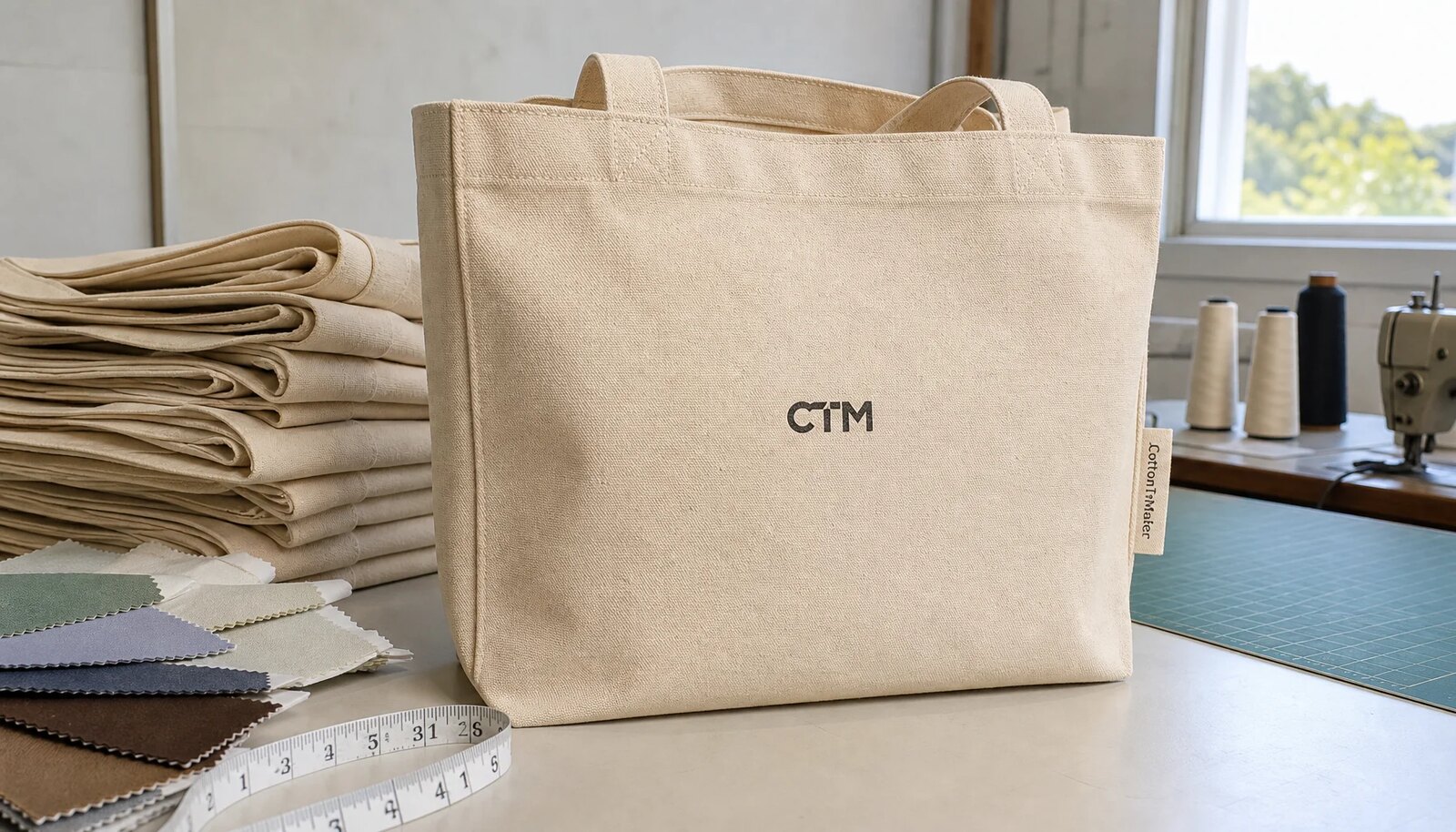
Start With the Use Case, Not the Logo
For canvas grocery totes used in events, the material choice should follow the load, the distribution model, and how long the bag must stay in circulation. A tote handed out at a one-day conference has a different requirement from a reusable grocery-style bag sold through a retail channel. If the bag only needs to carry brochures and a water bottle, heavy duck canvas is usually wasteful. If it must carry groceries, samples, or display materials repeatedly, a lighter promotional fabric will create complaints and returns.
The most common buying mistake is treating all canvas bags as the same because they look similar in a flat sample. Once the bag is sewn, printed, folded, and loaded, the differences show up fast. The fabric weight, weave density, handle reinforcement, and print method decide whether the tote feels premium or flimsy. Buyers who define the use case first usually get cleaner quotes and fewer revision rounds.
- Set the primary use: grocery carry, event giveaway, retail resale, or kit packaging.
- Define the expected load in practical terms, such as canned goods, catalogs, or sample items.
- Decide whether the bag must feel premium in hand or only function at low cost.
Choose the Canvas Weight by Real Load, Not Guesswork
For most event-led grocery tote programs, 10 to 12 oz finished canvas is the practical range. That level gives the bag enough body to stand upright, survive repeated folding, and support a normal grocery load without feeling overly rigid. If the bag is meant for lightweight giveaways, 8 oz may be enough, but it starts to look and feel promotional rather than retail-grade. Once you move above 12 oz, the tote can become strong but heavy, which increases fabric cost, sewing difficulty, and freight weight.
The important number is finished fabric weight, not only the raw cloth spec. Some suppliers quote raw canvas before wash finishing, pre-shrink treatment, or coating. That creates a false comparison because the bag you approve in sample form may not match bulk production after finishing. Ask the factory to state the weight basis clearly and to show whether the fabric is natural, bleached, dyed, or pre-washed. Those details affect hand-feel, shrinkage, and print sharpness.
- 8 oz: acceptable for lightweight handouts and low-load event use.
- 10 oz: balanced choice for reusable grocery totes with better structure.
- 12 oz and above: suitable when the bag must feel substantial or carry heavier contents.
Construction Details That Change Failure Rate
A tote bag can pass a visual review and still fail in use because the seams and handle attachment were not specified tightly enough. For grocery use, the handle reinforcement matters more than decorative extras. Cross-stitching, box-X stitching, and generous bar tacks reduce the chance of tearing when the bag is loaded from the top or swung by one handle. If the supplier only mentions handle length, the quote is incomplete. You need stitch construction, seam allowance, and where the reinforcement starts and ends.
Bottom construction also matters. A flat tote with a reinforced base panel or gusset will distribute weight better than a thin single-layer bag. If the event team expects bottles, produce boxes, or heavy catalogs, a gusseted base and tighter side seams are worth the extra sewing cost. Buyers should also decide whether the tote needs self-fabric handles, cotton webbing handles, or mixed material handles. Webbing can feel more durable, but self-fabric handles often look cleaner and keep the bag aligned with the canvas body.
- Specify handle drop, handle width, and reinforcement style in the RFQ.
- Ask for seam photos at the handle roots, side seams, and base corners.
- If load is important, request a simple pull test or load test method in writing.
Print Method Drives Both Appearance and Quote Risk
For canvas grocery totes, screen print is still the most reliable choice when the artwork is simple and repeat volume is meaningful. It gives good opacity, a clean brand mark, and stable unit cost once the screens are made. If the design has only one or two colors, screen print usually produces the strongest value for procurement teams. It also helps when event planners need a consistent logo across multiple batches, because the method is stable and easy to repeat.
Too many buyers let print choice follow design preference instead of production reality. Full-color artwork, fine gradients, or edge-to-edge coverage can force more expensive methods, slower curing, or lower yield. Embroidery and woven labels can work as premium touches, but they change the cost structure and are usually better as small brand accents rather than the main decoration. The factory quote should identify the exact method, number of colors, print size, print position, and curing process. If those are missing, the comparison is not usable.
- Screen print: best for simple logos, sponsor marks, and repeat runs.
- Heat transfer or digital methods: useful for complex artwork, but check wash resistance and cracking.
- Embroidery or woven labels: good as secondary branding, not as a low-cost primary logo solution.
Compare Sourcing Routes Before You Compare Prices
A low unit price means little if the supplier route is unclear. A direct bag factory can usually control fabric, sewing, and packing more tightly than a trading company that outsources each step. On the other hand, a sourcing partner may be useful if you need multiple product types in one shipment or if your internal team wants one point of contact. The right route depends on how much control you need over fabric selection, print approval, and carton consistency.
For canvas grocery totes, the safest route is usually the one that can show you real production evidence: stitched samples, fabric swatches, carton photos, and a line-by-line quotation. If a supplier cannot explain whether the bag is sewn in-house, how the print is applied, or what pack count goes into the carton, you are not comparing suppliers on equal terms. The table below is built to separate those sourcing decisions from surface-level price shopping.
How to Read Quotes Without Getting Misled
A useful quote for canvas grocery totes should break out the fabric weight, bag dimensions, handle spec, decoration method, sample cost, packing method, and the trade term being used. The biggest source of confusion is when one supplier includes everything in an FOB unit price while another leaves out packing or charges separately for each color change. That is not a real comparison. Ask every supplier to quote on the same basis, then normalize the quotes by production route and packing method.
Quote data should also expose where the cost is hiding. A low base price may be tied to thinner canvas, a smaller print area, weaker seam reinforcement, or a carton pack that increases freight cost later. If one factory offers a lower price only by reducing the handle width or using a lighter weave, that is a different product. Good procurement teams compare not just price, but the amount of bag actually delivered for the money.
- Request separate lines for fabric, sewing, print, label, packing, and sample fee.
- Ask whether the quote includes overrun tolerance, spare pieces, or replacement policy.
- Compare the same Incoterm across all suppliers before ranking the offer.
MOQ Logic: The Cheapest Run Is Not Always the Best Buy
MOQ on canvas grocery totes usually follows three things: fabric setup, print setup, and sewing efficiency. If you order one colorway with one simple print, the factory can spread its setup costs over a larger quantity and keep the unit price down. If you split the order into several bag colors, multiple artwork versions, or mixed pack assortments, the labor and setup time increase. That is normal, and it should be visible in the quote rather than hidden.
Buyers should be careful not to over-order just to reach a lower price point. Event programs often change late, and extra totes can sit in storage if artwork, date, or sponsor lineups shift. A better strategy is to ask the factory for breakpoints: what changes at 500, 1,000, 3,000, and 5,000 units. That lets procurement weigh the storage risk against the per-unit savings. If you are running a retail or distributor program, it is also worth asking whether the same pattern can be repeated later with the same fabric and color lot.
- One artwork version per run usually gives the cleanest pricing.
- Multiple bag colors or print positions should trigger a re-quote.
- Ask for the minimum cost-effective quantity instead of a vague MOQ answer.
Sampling and QC Need Real Acceptance Criteria
A sample is only useful if it matches the production path. The approved sample should use the final fabric, the final print method, the final thread color, and the final label or packaging method. If the sample is made from a different cloth or decorated by a different process, it is a reference piece, not a production control tool. Event buyers often approve a beautiful sample and then receive bulk goods that feel thinner, softer, or less durable. That usually means the sample was not tied tightly enough to the factory process.
A simple acceptance checklist helps avoid disputes. Measure the finished size, check handle length and symmetry, review stitch quality at stress points, and inspect print alignment after folding the bag. If the bag is intended for grocery loads, test it with the kind of items it will actually carry. For procurement, the question is not whether the sample looks good in a photo. It is whether the factory can repeat the same result in bulk without drifting on weight, color, or seam quality.
- Approve the pre-production sample only after confirming the final fabric lot and print method.
- Use a written tolerance range for size, print placement, and handle length.
- Request inline photos or a short production report if the order is time-sensitive.
Packing and Carton Planning Affect More Than Freight
Canvas grocery totes are simple products, but packing can create avoidable cost and damage. Bulk packing lowers labor, yet it can crease printed panels or cause shape distortion if the cartons are overfilled. Individual polybags protect the bags better, but they add material cost, handling time, and waste. For event planners and distributors, the right answer depends on whether the bags go directly to end users or are repacked into kits, retail displays, or warehouse inventory.
Carton data should be part of the quote, not a later shipping surprise. Ask for the number of bags per carton, carton dimensions, gross weight, and whether cartons are suitable for stacking during transit. If the bags will be distributed by multiple teams or sent to different venues, labeling matters as much as protection. A clearly marked master carton can prevent mix-ups, and a stable pack count helps receiving teams reconcile inventory quickly.
- Choose bulk pack for warehouse handling, not for direct premium presentation.
- Choose individual polybagging when print protection or retail presentation is critical.
- Confirm carton labels, pack count, and outer marks before production starts.
The Main Landed-Cost Traps to Remove Before Ordering
The biggest landed-cost mistakes usually come from under-specification, not from the bag itself. A cheap quote can expand quickly once you add stronger canvas, corrected artwork, better packing, or a necessary sample remake. Freight also changes if cartons are heavier or less efficiently packed than expected. If the bag is going into a retail channel, there may be additional labeling or compliance work that was never included in the first conversation. Procurement teams should build the quote around the finished product, not around the simplest possible version of it.
The final RFQ should describe the product as if the supplier were already starting production. That means material weight, size, handles, print, reinforcement, packing, and delivery term. It also means defining what happens if the first sample is not approved. The more precise the RFQ, the less likely you are to get a misleading low quote that turns into a correction charge later. In practice, the best savings come from removing ambiguity, not from pushing the factory to name a lower number.
- Do not compare prices before standardizing fabric weight, decoration, and packing.
- Include sample remake terms and artwork revision limits in the RFQ.
- Ask for a quote structure that separates production cost from freight and local charges.
Specification comparison for buyers
| Spec decision | Recommended option | When it fits | Buyer risk to check |
|---|---|---|---|
| Sourcing route | Direct bag factory with in-house sewing and print control | Best when you need one accountable supplier for fabric, stitching, and decoration | Confirm the factory actually cuts, sews, and packs on site; avoid a middleman quote disguised as factory direct |
| Sample path | Pre-production sample made from final fabric, final size, and final print file | Use when artwork placement, handle length, and bag hand-feel matter to the event experience | A sample on lighter fabric or a different print method can hide the real production result |
| Canvas weight | 10-12 oz finished canvas for reusable grocery use | Suitable for tote programs that need a sturdy, retail-ready feel and moderate load capacity | Check whether the quote states finished GSM or raw fabric GSM; washed canvas can shrink and change hand-feel |
| Decoration route | 1-2 color screen print for clear logos and repeat runs | Works for sponsor logos, event marks, and simple brand graphics at scale | Thin ink, poor curing, or too many colors can crack or bleed after folding and washing |
| Handle construction | Self-fabric handles with cross-stitch or box-X reinforcement | Good for grocery-style carry loads and frequent reuse | Weak handle bar tacks fail first; ask for stitch count and seam placement, not just handle length |
| MOQ strategy | One colorway per production run with limited artwork variation | Best when you want predictable pricing and lower setup waste | Mixed designs often trigger higher setup fees, more scrap, and slower approval cycles |
| Packing route | Bulk packed with clear carton count and size labels | Useful for distributors and event teams repacking into kits or store displays | Loose packing can create shipment damage or count disputes; request carton photos before dispatch |
| Lead-time route | Stock fabric plus custom print and sewing | Fits shorter event calendars and repeat programs with controlled artwork | Custom dyed fabric, special labels, or heavy embellishment can add weeks and create dye lot risk |
Buyer checklist before sampling
- Confirm the bag use case: grocery carry, welcome kit, retail giveaway, or resale item.
- Lock finished size, handle drop, and target load before requesting quotes.
- Specify finished fabric weight in GSM or oz, not only the fabric name.
- State whether the bag must be unlined, self-lined, or reinforced at the base.
- Provide artwork in vector format and note the number of print colors and placement size.
- Ask for sample photos of stitches, seams, handle attachment, and print registration.
- Request carton pack count, carton dimensions, and gross weight before booking freight.
- Compare quotes on the same basis: fabric, decoration, packaging, and Incoterm.
Factory quote questions to send
- What is the finished fabric weight in GSM or oz after washing or finishing?
- Is the bag sewn in-house, and do you control cutting, stitching, printing, and packing in one facility?
- What is the minimum order quantity by color, print version, and total order?
- Which print method is included in the quote, and what is the max print size?
- What reinforcement is used at the handles and base, and can you share stitch details?
- What is included in the sample fee, and will it be refunded against the order?
- What is the standard packing method, carton count, and master carton size?
- What is the quoted lead time from artwork approval to ready-to-ship goods?
Quality-control points to confirm
- Finished size tolerance should stay within an agreed range, especially on width and handle drop.
- Stitching at handle attachment points should be even, secure, and free of skipped stitches or loose thread ends.
- Print should be aligned, fully cured, and resistant to cracking when the bag is folded.
- Fabric should match the approved shade, weave, and hand-feel across the order, with no unexpected dye variation.
- Load test should reflect the event use case, not just a visual inspection of the sample.
- Cartons should match the agreed pack count, labeling, and stacking strength for transport and storage.