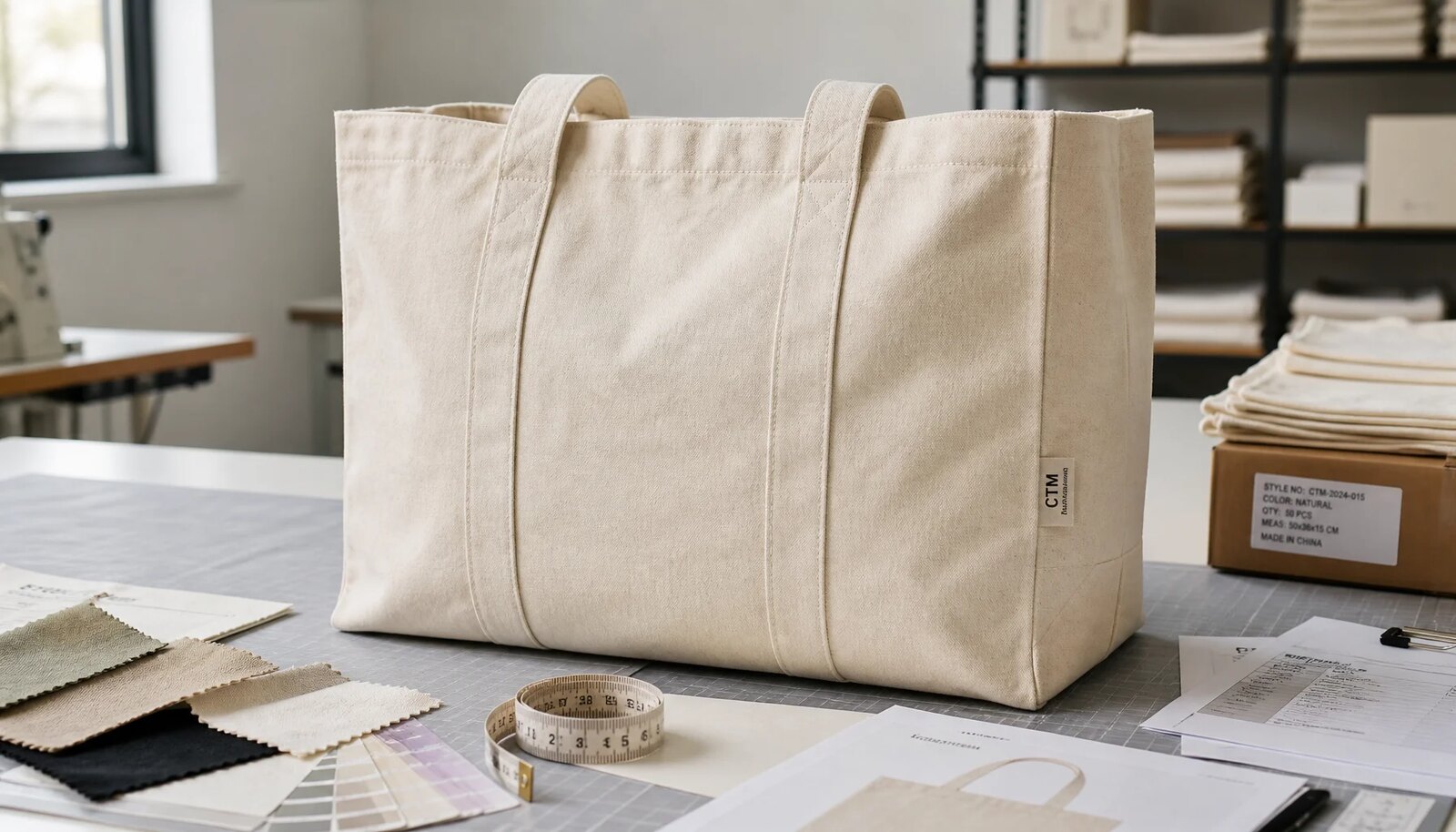
Begin with the buying job
Canvas grocery totes can look simple on a line sheet, but they rarely play a simple role for eco apparel brands. The same bag may be used as customer packaging, a gift-with-purchase, a wholesale support item, an event handout, or a retail accessory. Each job pushes the spec in a different direction. A checkout tote may need to fold flat, stay low in cost, and replenish quickly. A tote sold as merchandise needs cleaner sewing, better print control, barcode-ready packing, and a material story that can sit comfortably beside the apparel range.
Start the project by writing the business use before choosing ounce weight. Include the channel, target retail or giveaway value, order quantity, likely reorder quantity, number of SKUs, delivery destination, incoterm, launch date, artwork complexity, and warehouse receiving rules. That information changes the quote. Without it, suppliers tend to price their standard bag: standard fabric, standard handle, standard print size, standard carton. The sample may photograph well, yet the bulk order can miss the real operating need.
Eco positioning also needs early discipline. A canvas tote can support a lower-waste packaging program or an apparel brand's materials story, but the wording must be specific. Conventional cotton canvas, organic cotton canvas, recycled cotton blend, undyed natural canvas, and dyed cotton canvas are not interchangeable. They differ in documentation, shade control, strength, cost, availability, and claim risk. Procurement, marketing, and compliance should agree on the words the brand intends to use before the RFQ goes out.
- Classify the tote as merchandise, packaging, event stock, wholesale support, or replenishment inventory.
- Write the expected use case before selecting fabric weight or decoration method.
- Align sustainability claims with available documentation before purchase order approval.
- Treat the first order as the base spec for future reorders, not just a one-off launch sample.
Read canvas weight correctly
Fabric weight is one of the first numbers buyers ask for, and one of the easiest numbers to misunderstand. In tote sourcing, ounce labels can refer to greige fabric, finished fabric, washed fabric, or a local conversion. A bag described as 12 oz by one supplier may not feel the same as another 12 oz bag after finishing, pressing, and sewing. For cleaner comparisons, ask for finished GSM and a written tolerance. The tolerance can be a percentage or a defined range, but it should be visible on the quote, sample tag, and final specification sheet.
For many canvas grocery totes for eco apparel brands, 12 oz is a sensible starting point. It generally gives the bag enough body for repeated grocery or apparel use while still packing efficiently. A 10 oz canvas can be right for lower-cost event stock, lightweight apparel carry, or high-volume packaging programs where foldability and freight density matter. Check opacity, seam strength, and handle distortion before approving it. A 14 oz canvas feels more substantial and may support a higher-value retail accessory, but it brings thicker seam bulk, slower sewing, larger cartons, and higher freight weight.
Do not judge weight without judging surface. A tighter plain weave usually gives sharper print edges and a smoother logo area. A looser or more textured canvas may look more natural, but ink coverage can become uneven and small slubs may show through pale colors. Undyed natural canvas also shifts from cream to beige depending on cotton lot, mill practice, and finishing. If shade consistency matters across reorders, retain an approved swatch and require lot approval before cutting when the new shade falls outside the agreed band.
- Compare finished GSM instead of relying only on ounce labels.
- Use 10 oz when cost, foldability, and light carry matter more than structure.
- Use 12 oz for many reusable grocery tote programs that need a balanced feel.
- Use 14 oz when the tote is positioned as a heavier retail accessory.
- Ask whether the quoted weight is greige, finished, washed, or pre-shrunk.
Choose a material route you can document
Material selection should be written in sourcing language first and marketing language second. Conventional cotton canvas can be the correct choice when the buyer values durability, availability, print compatibility, and cost control. Organic cotton canvas may be needed when the tote must align with the brand's apparel sourcing standards. Recycled cotton or recycled cotton blends may support recycled-content goals and create a textured natural look, but the buyer should review blend percentage, yarn quality, strength, linting, and shade variation.
The main risk is vague claim language. Terms such as eco canvas, green cotton, sustainable cotton, or recycled style are not enough for a hangtag, product page, wholesale line sheet, or compliance file. Ask the supplier what exact wording can be supported and what documents will be provided with the shipment. Confirm whether the documentation covers the fabric only or the finished tote. Thread, labels, transfer film, care tags, and packaging may affect how the final item can be described.
Natural canvas is popular because it feels straightforward, avoids fabric dyeing, and pairs well with restrained branding. It still needs controls. Light cotton shows oil marks, warehouse dust, moisture stains, and handling dirt more easily than darker colors. Pale inks can shift visually on a natural base. If the tote will be sold, specify cleanliness standards and packing protection. If it will be used as packaging, decide in advance whether small yarn slubs are acceptable or whether the brand needs a cleaner fabric grade.
- Write exact material wording in the RFQ and purchase order.
- Request certificate scope and transaction documentation before approving organic or recycled claims.
- Confirm whether claim support applies to fabric, trims, labels, packaging, or the finished tote.
- Approve natural canvas shade, hand-feel, surface hairiness, and slub level with a physical swatch.
Engineer the bag, not just the fabric
Most tote failures do not happen in the center of the panel. They happen where the bag carries stress: handles, top hems, side seams, bottom corners, and gusset junctions. That is why a good spec goes beyond fabric weight. Define body width, body height, bottom gusset, side gusset if any, top hem depth, seam allowance, stitch type, stitch density, thread color, handle width, handle length, handle drop, and reinforcement style.
Handle design deserves real attention. A 25-30 mm handle width is common because it balances comfort, material use, and sewing efficiency. Narrow handles can dig into the hand or shoulder when the bag is loaded. Very wide handles may feel more premium, but they can look bulky on smaller bodies and increase cost. Handle drop should match the intended carry mode. Short drops suit hand carry and compact shelf display. Longer drops support shoulder carry, but they change how the bag hangs, folds, and stacks in cartons.
Gusset depth changes both usefulness and production behavior. A deeper bottom gusset helps the tote hold groceries, folded apparel, shoe boxes, and mixed retail purchases. It also adds sewing complexity and bulk at the bottom corners. A shallow gusset folds cleaner and may cost less, but the bag holds less in real use. Review loaded samples, not only flat samples. Look for twisting, seam strain, handle bite, corner puckering, and whether the tote returns to a presentable shape after the load is removed.
For repeat programs, build a construction sheet and keep it current. Include a dimension diagram, handle template, seam callouts, reinforcement photos, thread color, label location, print placement, and fold method. This document helps suppliers quote the same product and gives inspectors a measurable standard at final inspection.
- Define key dimensions in millimeters, including handle drop and gusset depth.
- Specify bar-tack or X-box reinforcement for handle joins.
- Review loaded samples with realistic contents, not only empty presentation samples.
- Keep one construction sheet for reorders, alternate quotes, and inspection reference.
Set tolerances while the quote is still flexible
Sewn canvas has normal variation. It is cut, sewn, pressed, and packed by process, not molded into a fixed shape. Still, vague tolerance language invites disputes. A body height that varies slightly may be harmless. A logo tilted by the same amount can look clearly defective. Procurement should write tolerances before bulk production begins, while the supplier can still confirm whether the fabric, sewing line, and decoration method can hold them.
Separate dimensional variation from visual failure. Body width, body height, bottom gusset, top hem depth, handle length, handle drop, and handle placement need measurable ranges. Print size and placement also need measurement points. Visual standards should cover logo tilt, stains, visible shade breaks, loose threads, seam puckering, and overall presentation. Handle reinforcement defects should usually be treated as major defects because they affect function, not only appearance.
Ask the supplier to respond to the tolerance table during quoting. Heavy canvas, deep gussets, thick folded hems, and large prints near seams all increase variation risk. A supplier may recommend a slightly wider tolerance for a practical reason. Review that feedback before order placement. A realistic written standard is more useful than a strict sentence no one can apply consistently at inspection.
- Write tolerances for body size, gusset depth, handle length, handle placement, print size, and print placement.
- Classify handle failures, broken stitches at stress points, wrong artwork, and severe print drift as major issues.
- Use visual standards for tilt, stains, surface marks, shade breaks, and retail presentation.
- Confirm tolerance capability before approving final price and production timing.
Match decoration to the artwork and fabric
Decoration should follow the artwork, the fabric surface, and the order profile. For bold logos, simple typography, and one to four flat colors, screen printing is usually the practical bulk choice for canvas grocery totes. It can deliver strong coverage and clear edges when the screen, ink, and curing process suit the fabric. Confirm ink type, color standard, curing method, maximum print area, placement tolerance, and whether the ink has been tested on the selected canvas.
Transfers, DTF, and related heat-applied methods can be useful for low quantities, gradients, detailed artwork, or frequent seasonal changes. They need closer review on thick or textured canvas. Look at film edge visibility, surface gloss, hand-feel, flexibility, and behavior after folding. A transfer may look clean on a flat sample and still crease, lift, or show a hard edge after carton compression.
Artwork placement should never depend only on the instruction centered. Provide print width, print height, distance from top edge, distance from side seam, and allowable tolerance. If the print sits near a gusset, crosses a seam, or falls on a fold line, expect higher risk. Natural canvas also changes color perception, especially for white, cream, pale green, light blue, and muted brand tones. A print strike-off on production canvas is the best early check when color matters.
Build approval evidence into the timeline. Approve the artwork file, the color reference, the strike-off, and the final sample as linked steps. If any stage changes, note the change in writing. For example, a strike-off on substitute canvas should not automatically approve bulk printing on final canvas unless the buyer accepts the risk.
- Use screen print for stable bulk artwork with limited flat colors.
- Consider transfers for short runs or detailed graphics after checking hand-feel and fold behavior.
- Approve print strike-offs on production canvas or the closest available production fabric.
- Measure print placement from fixed points instead of approving by eye.
Build an RFQ suppliers can price cleanly
A strong RFQ removes guesswork. Instead of asking for a canvas grocery tote price, send a production brief with target quantity, size, material route, finished GSM, body color, handle spec, gusset depth, seam construction, print method, artwork size, number of colors, label requirements, pack method, carton rules, inspection standard, incoterm, destination, and requested ship window. The supplier can then price the actual program, not a low-spec placeholder.
Ask suppliers to separate costs. A single unit price can hide sample charges, screen charges, artwork setup, label application, barcode labor, carton upgrades, packing changes, domestic freight, and export paperwork. If the first order is 1,000 pieces and the reorder may be 5,000 pieces, request both price levels. If artwork changes seasonally, ask for the setup cost per new design. If the tote runs in several body colors, confirm whether each color has a separate fabric MOQ and whether print charges repeat by color.
Compare quotes only after assumptions match. One supplier may quote 12 oz finished cotton canvas, reinforced handles, print strike-off, carton labels, and final inspection. Another may quote lighter fabric, single-needle seams, no label work, and bulk cartons. The cheaper quote may simply describe a weaker bag. A useful comparison sheet should show finished GSM, dimensions, handle construction, seam method, print method, MOQ, lead time, packing, incoterm, and excluded charges.
- Send artwork, dimensions, fabric route, and packing details before requesting final price.
- Ask for itemized charges, not only an all-in unit price.
- Compare quotes against the same fabric, construction, decoration, label, and packing assumptions.
- Request first-order and reorder pricing when the tote will become a recurring program.
Untangle MOQ and lead time
MOQ for canvas grocery totes is often built from several smaller minimums. Fabric mills may require a minimum booking for custom colors or special canvas. Print shops may have setup minimums by artwork and color. Label suppliers may require their own minimum. Packing changes can add labor minimums when different SKUs need separate carton marks, barcode labels, or inner bundles. A single MOQ number can look simple until variants are added.
Ask for MOQ by style, fabric color, print version, label version, and packing method. This matters for apparel brands running seasonal assortments. A 2,000-piece MOQ may sound workable until each body color requires 1,000 pieces and each print version has its own setup. Sometimes a larger consolidated order with fewer variants is cleaner than many small runs. It can improve cost, inspection consistency, and delivery reliability.
Break lead time into stages: fabric booking, swatch or lab dip approval if needed, sample making, print strike-off, pre-production sample approval, bulk cutting, printing, sewing, final inspection, packing, and handover. The critical path is often fabric or print approval, not sewing capacity. If the launch date is fixed, ask what must be approved by each date. Late artwork, revised claim labels, missing barcode files, or delayed packing instructions can move the whole schedule even when the factory is ready.
- Break MOQ down by style, body color, fabric booking, print version, label version, and packing method.
- Ask whether colors can share one production window or require separate runs.
- Review lead time by approval stage, not only total production days.
- Treat late artwork, labels, barcodes, and claim copy as schedule risks.
Approve samples with usable evidence
Sample approval should lower risk, not create false confidence. A photo cannot show fabric hand, stiffness, handle comfort, seam bulk, print coverage, shade, folding behavior, or recovery after compression. When timing allows, approve a physical pre-production sample made with the intended fabric, construction, decoration, label, and packing method. If exact production fabric is not available at sample stage, the supplier should state what differs and when the final material will be confirmed.
A good approval process includes a fabric swatch or lab dip where relevant, a print strike-off, and a full sewn tote. The swatch confirms weight, shade, surface, and hand-feel. The strike-off confirms ink color, edge clarity, coverage, and curing on the canvas. The full tote confirms sewing, handle placement, gusset behavior, label placement, and folded presentation. Approving only the sewn sample can hide print color risk. Approving only the print can miss construction problems.
Create a golden sample system after approval. Keep one approved sample with the buyer or quality team and one with the factory. Tag the samples with date, style number, material route, fabric weight, artwork version, dimensions, and any approved exceptions. For reorders, compare the new pre-production sample against the retained standard before releasing bulk cutting. If the program includes several colorways, keep references for the most sensitive combinations, not only the easiest natural canvas version.
Test the sample the way the bag will actually move. Fold it according to the pack method, leave it compressed, unpack it, and inspect print creasing and body recovery. Load it with realistic weight and check handle comfort, seam strain, and shape. Apply the barcode, hangtag, or woven label in the planned location. These simple checks catch many issues that polished sample photos miss.
- Approve fabric, print, sewing, label placement, and packing as connected stages.
- Use physical samples for final approval whenever timing allows.
- Keep tagged golden samples with both buyer and factory.
- Test loading, folding, compression, unpacking, barcode placement, and carton recovery before bulk production.
Control QC, packing, and landed cost
Canvas grocery tote QC should be defined before production starts. Common defects include loose threads, uneven handles, stains on natural canvas, print drift, tilted logos, inconsistent gussets, rough inside seams, mixed cartons, missing barcode labels, and wrong carton counts. Inspection becomes subjective when the purchase order does not define the standard. The final inspection team should have the approved golden sample, fabric swatch, print strike-off, artwork file, tolerance table, packing specification, and purchase order.
Defect classes make inspection more consistent. Critical defects may include unsafe contamination, sharp objects, or severe issues that make the tote unusable. Major defects may include broken stitches at stress points, handle failure, wrong artwork, wrong body color, heavy staining, severe print misalignment, missing labels, incorrect claim wording, or carton count errors. Minor defects may include small removable threads, slight shade variation within the approved range, or small print irregularities that do not affect presentation. The buyer should adapt these classes to the channel and order value.
Packing affects cost and receiving almost as much as sewing. Specify fold direction, individual polybag or no-polybag policy, inner bundle quantity, carton quantity, carton dimensions, net weight, gross weight, carton mark format, SKU label placement, and barcode requirements. If the brand avoids plastic packaging, define the alternative protection method. Natural and light canvas still needs protection from dust, moisture, oil marks, and dirty cartons.
Cartonization belongs in landed-cost comparison. Ask for pieces per carton, carton dimensions, gross weight, and estimated shipment volume before deciding which quote is cheaper. A low unit price can lose its advantage if cartons are oversized, over-compressed, mixed by SKU, or too heavy for the receiving team. For retail-ready totes, avoid packing so tightly that the print creases or the gusset collapses. For distribution centers, carton marks and SKU separation can be as important as the tote itself.
- Define critical, major, and minor defects before production begins.
- Inspect dimensions, stitching, handle reinforcement, print, labels, carton count, and SKU separation.
- Request carton dimensions and gross weight before comparing freight cost.
- Set cleanliness and moisture-protection expectations for natural canvas.
- Include packing labor, label work, carton upgrades, setup charges, and freight basis in landed-cost review.
Specification comparison for buyers
| Spec decision | Recommended option | When it fits | Buyer risk to check |
|---|---|---|---|
| Finished fabric weight | 10 oz canvas, often about 280-340 GSM after finishing depending on weave and treatment | Budget-sensitive giveaways, lightweight apparel carry, event stock, or programs where foldability and freight density matter | Confirm opacity, fabric tear strength, shrinkage, handle stress, and whether the bag feels too limp for retail sale |
| Finished fabric weight | 12 oz canvas, often about 340-420 GSM after finishing | Most reusable grocery totes for eco apparel brands that need a premium but still efficient construction | Require finished GSM tolerance, roll-to-roll shade control, and confirmation that the quoted weight is not greige-only |
| Finished fabric weight | 14 oz canvas, commonly above 420 GSM depending on weave and finish | Higher-value merchandise totes, heavier grocery use, or branded accessories sold at retail | Expect thicker seam bulk, slower sewing, higher needle stress, larger cartons, and higher freight per unit |
| Material route | Conventional cotton canvas with clear fiber composition and mill spec | Cost-controlled repeat programs where durability, availability, and print compatibility are the main goals | Avoid vague environmental wording; request exact composition and do not use unsupported claim language |
| Material route | Organic cotton canvas with valid scope and transaction documentation where required | Brands that need organic claim alignment with apparel sourcing standards or customer-facing copy | Check certificate scope, chain-of-custody requirements, invoice wording, trims, labels, and whether the final product claim is permitted |
| Material route | Recycled cotton or recycled cotton blend | Programs prioritizing recycled-content language or textured natural appearance | Confirm blend percentage, strength, shade variation, linting, documentation, and whether the recycled content applies to fabric only |
| Construction | Bottom gusset, double-needle side seams, folded top hem, and reinforced handle joins | Reusable grocery totes expected to carry folded apparel, footwear boxes, produce, or mixed retail purchases | Inspect corner turning, skipped stitches, seam allowance, bar-tack security, and dimensional consistency after pressing |
| Handle build | 25-30 mm handle width with bar-tack or X-box reinforcement and agreed handle drop | Most shoulder-carry or hand-carry grocery tote programs | Set handle length tolerance, placement tolerance, reinforcement size, stitch density, and load-test method before bulk production |
| Print method | 1-4 color screen print with approved ink and curing standard | Bold logos, flat artwork, stable repeat orders, and medium-to-large production runs | Check ink rub, edge sharpness, placement tolerance, color match, curing, and cracking after folding or carton compression |
Buyer checklist before sampling
- Define the tote's commercial role: retail SKU, gift-with-purchase, customer packaging, wholesale support, employee store item, event stock, or replenishment program.
- State target order quantity, expected reorder quantity, number of SKUs, delivery destination, requested incoterm, and required ship window before asking for final pricing.
- Confirm fiber composition, canvas weave, finished GSM, GSM tolerance, color standard, finish, and whether the supplier is quoting greige, finished, washed, or pre-shrunk fabric.
- Specify the material route exactly: conventional cotton, organic cotton, recycled cotton blend, undyed natural cotton, dyed cotton canvas, or another agreed construction.
- Request certificate scope and transaction documentation before using organic, recycled, or other sustainability claim language on the tote, hangtag, carton, or product page.
- Lock body width, body height, bottom gusset depth, side gusset if any, seam allowance, top hem depth, handle length, handle drop, and handle width in millimeters.
- Define seam construction, including single-needle or double-needle stitching, overlock or bound inside seams, stitch density, thread color, bar-tacks, and X-box reinforcement.
- State the intended load use in plain terms, such as light apparel carry, grocery carry, heavy retail purchase, or merchandise tote sold as a durable accessory.
- Provide production-scale artwork with color references, print size, placement measurements, acceptable placement tolerance, and notes on whether print may cross seams or folded areas.
- Request a print strike-off on production canvas or the closest available production fabric before approving the pre-production sample.
Factory quote questions to send
- What is the exact fiber composition, canvas weave, yarn count or construction description if available, finished GSM, GSM tolerance, color, finish, and expected shrinkage after sewing and pressing?
- Does the quoted fabric weight refer to greige fabric, finished fabric, washed fabric, or the final tote after production handling?
- Is the canvas conventional cotton, organic cotton, recycled cotton blend, or another material route, and what documentation can support the claim wording we plan to use?
- Are cutting, sewing, printing, finishing, inspection, and packing handled in-house, or are any stages subcontracted to another facility?
- What body dimensions, bottom gusset, side gusset if any, handle length, handle drop, handle width, seam method, stitch density, and reinforcement style are included in this price?
- What is your recommended maximum working load for this construction, and what internal handle-pull or load-hang check do you use before shipment?
- What print method are you quoting, how many colors are included, what is the maximum print area, what ink or transfer type will be used, and what color standard will be used for approval?
- Can you provide a print strike-off on production canvas before the pre-production sample is approved, and will it include the same curing or heat process used in bulk?
- What is the MOQ by style, body color, fabric booking, print version, label version, packing method, and carton mark requirement?
- Can mixed colors share one fabric booking or production window, and if not, what are the separate lead times and minimums for each color?
Quality-control points to confirm
- Finished fabric weight matches the approved finished GSM and tolerance, checked from more than one roll or carton instead of a single convenient cutting piece.
- Canvas shade, weave density, hand-feel, surface hairiness, and cleanliness match the approved swatch or agreed shade band under consistent lighting.
- Body width, body height, bottom gusset depth, top hem depth, handle length, handle drop, and handle placement stay within written tolerances after pressing and packing.
- Handle joins are secure, with clean bar-tacks or X-box reinforcement, no skipped stitches, no loose thread nests, no needle cuts, and no tearing at stress points.
- Stitch density, seam allowance, corner turning, side seam straightness, and inside seam finish match the approved sample and written construction sheet.
- The tote opens, stands, folds, or hangs as expected for the selected grocery, retail, or warehouse pack method, without severe twisting or asymmetry.
- Print size and placement are measured against the approved spec, with no unacceptable drift, tilt, ghosting, blur, pinholes, ink bleed, or visible registration error.
- Print color is checked against the approved strike-off, Pantone reference, or buyer standard under consistent light, especially for white and pale inks on natural canvas.
- Decoration passes agreed rub, fold, tape, or handling checks without cracking, peeling, staining the opposite panel, or transferring beyond the approved limit.
- Labels, woven tags, hangtags, barcode stickers, care information, claim wording, and country-of-origin details match the purchase order and approved artwork files.