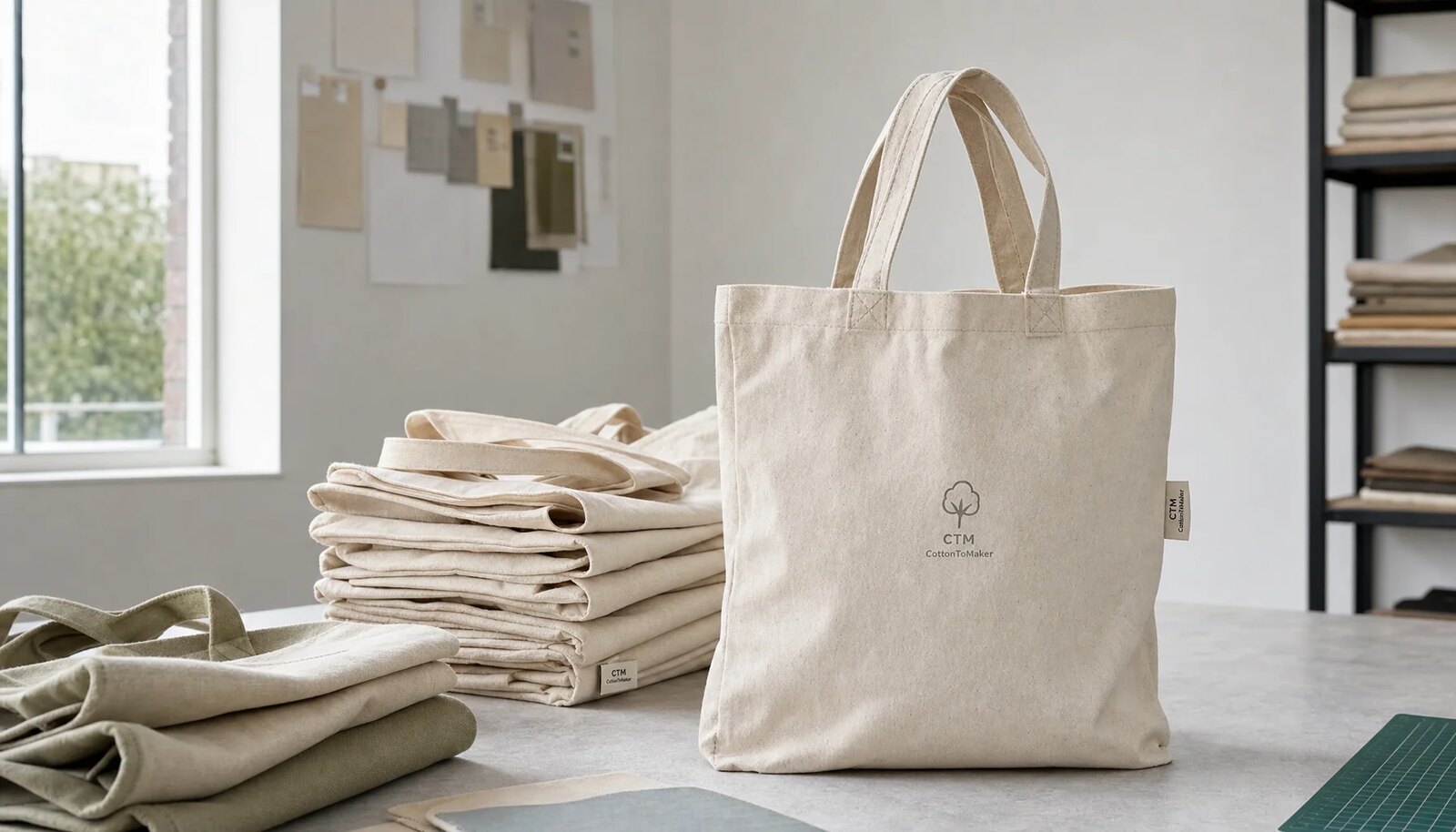
Start with the job the tote must do
Bulk tote orders usually fail in ordinary places: a handle pulls away, a bottom corner opens, a logo scuffs in the carton, or the finished fabric feels lighter than the sample. For corporate gifting, the recipient connects that failure with the brand, not with the factory. Procurement needs a specification that turns a nice-looking branded bag into a product with defined use, inspection, and acceptance rules.
The first brief should name the real use case. A conference handout for brochures does not need the same construction as a grocery tote carrying jars, drinks, boxed food, or an employee welcome kit with a bottle and notebook inside. Write the expected contents, target carry weight, distribution route, presentation standard, and receiving constraints before asking suppliers for price.
A digital proof can confirm artwork layout, spelling, and approximate position. It cannot prove finished GSM, handle strength, seam security, print cure, odor, or carton behavior. For a first order or a brand-sensitive reorder, use one signed physical control sample and make every quote, purchase order, inspection, and reorder refer back to it.
- Define the use case: grocery carry, employee kit, trade-show distribution, retail bundle, store opening gift, or client gift.
- List the highest-risk failures: handle tear, open corner, seam popping, print cracking, print scuffing, odor, wrong carton count, or late delivery.
- Write the expected contents before requesting price so suppliers are not guessing at load requirements.
- Approve one physical control sample for fabric, construction, logo, folding, and packing.
- Assign one buyer-side owner for post-sample changes so small edits do not quietly alter durability, cost, or lead time.
Build an RFQ suppliers can price consistently
A useful RFQ makes every supplier quote the same tote. Without that structure, one factory may price finished 12 oz canvas with reinforced handles, controlled placement, export cartons, and inspection support. Another may quote a nominal 12 oz bag with lighter finished fabric, basic stitching, a smaller logo area, and vague packing. The unit prices may sit next to each other in a spreadsheet, but they are not equivalent.
State finished dimensions, not cutting dimensions only. A common grocery format may be around 14 x 16 x 6 in., but the best size depends on contents, carton cube, freight budget, and presentation. Bigger bags use more fabric and increase carton volume. Smaller bags can reduce cost but may not sit properly around gift kits, boxed goods, or drinkware.
Handle drop and gusset shape belong in the RFQ, not in late sampling comments. Short handles can suit hand carry; longer handles may improve shoulder carry but can twist under heavy load. A side and bottom gusset helps contents sit flat and reduces corner strain. Put these decisions into a dimensioned drawing and use the same file for quotation, sampling, PO, inspection, and reorder.
- Request a drawing showing height, width, gusset, handle drop, handle width, and print placement measurement points.
- Set finished tolerances before sampling, including bag dimensions and print placement tolerance from seam landmarks.
- Clarify whether the tote must stand upright, fold flat, fit a mailer, fit an event kit, or meet a warehouse carton limit.
- Specify bottom gusset, side gusset, boxed bottom, or reinforced base only when it matches the load requirement.
- Use one shared specification sheet for RFQ, sampling, purchase order, inspection, and reorders.
Control canvas weight, weave, and finish
Fabric weight is one of the easiest places for quotes to drift. For grocery-style corporate gifting, 12-14 oz canvas, approximately 407-475 GSM, is a practical starting range when the tote needs structure and repeat-use potential. A 10 oz canvas can work for lighter events, but it may feel underbuilt for bottles, jars, catalogs, or heavier onboarding kits. Heavier canvas can improve hand feel while increasing unit cost, carton weight, stiffness, and fold marks.
Ask whether the quoted weight is finished fabric weight or greige fabric weight. Bleaching, dyeing, washing, and finishing can change weight, hand feel, shrinkage, and stiffness. A supplier quoting only a nominal ounce value may not be committing to controlled finished GSM. Procurement records should include expected finished GSM, tolerance, and confirmation that bulk material will be checked against roll records and the approved sample.
The weave and finish affect performance as much as the number. Loose canvas may feel thick while distorting under load. Stiff finishing can look structured on a table but crease sharply after compression. Natural unbleached canvas may include cotton specks and shade movement, so approve a realistic range. Dyed or bleached canvas needs closer review for shade matching, crocking, odor, and shrinkage.
- 10 oz canvas: useful for lightweight events and cost-sensitive programs where grocery loads are not expected.
- 12 oz canvas: a practical baseline for many corporate grocery totes that need body without excessive carton weight.
- 14 oz canvas: stronger hand feel for premium programs, with higher cost and reduced foldability.
- Natural canvas: approve shade range, cotton specks, and surface character before bulk production.
- Dyed or bleached canvas: check shade consistency, crocking, odor, shrinkage, and batch matching.
Engineer handles, seams, and stress points
Handles fail first because they concentrate the load where the handle enters the bag body. Every lift from a counter, floor, car trunk, or checkout line shocks that joint. Self-fabric handles and cotton webbing handles can both work, but the order should define width, insertion depth, reinforcement pattern, reinforcement size, stitch density, and thread type.
Box-X stitching, bar tacks, or dense multi-row reinforcement spreads force better than a single decorative stitch line. The reinforcement area should transfer load into the body panel, and the handle should be inserted deeply enough that the seam is not relying on a narrow fabric strip. Treat skipped stitches, broken reinforcement, loose thread, shallow insertion, and crooked stress stitching as major defects, not cosmetic notes.
Bottom construction needs the same attention. Gusset corners are common failure points because contents push unevenly against them. If the program includes bottles, jars, boxed food, notebooks, or drinkware, inspect the base and side seams after load testing. A reinforced base may be useful, but sample it deliberately because it changes folding thickness, carton count, and cost.
- Specify handle material, width, finished length, drop, insertion depth, reinforcement pattern, stitch density, and thread type.
- Classify skipped stitches, broken reinforcement, loose handle joins, and shallow handle insertion as major defects.
- Confirm seam allowance and whether interior edges are enclosed, overlocked, bound, or unfinished.
- Check bottom gusset corners after loading because weak corners may look fine when empty.
- Measure handle drop on a filled sample; comfort and balance can change once the tote carries real contents.
Choose decoration for wear
Print durability is part of product durability. A structurally sound tote can still disappoint the buyer if the logo cracks, dusts, peels, bleeds, or rubs onto the bag stacked beneath it. For simple one- or two-color corporate logos, screen printing is often practical because it balances cost, speed, opacity, and repeatability. The key variables are ink type, print pressure, curing, print area, and dense coverage on cotton texture.
Heat transfer can be useful for gradients, personalization, smaller runs, or artwork that is difficult to separate for screen printing. The risk is adhesion and flexibility. A grocery tote will be folded, stacked, rubbed, carried, and stretched slightly when filled. Transfer edges, dense zones, and fold lines need testing on the final canvas. Over-pressing can also flatten the fabric or leave a shiny patch.
Embroidery can feel premium for a small mark, side badge, or subtle brand detail. It is less efficient for large front graphics because high stitch counts can pucker canvas, add weight, and make the reverse side rough. Whatever decoration method is used, approve it on the actual tote fabric and final construction, not only as a digital proof or loose swatch.
- Screen print: practical for bulk corporate totes with simple logos, solid colors, and repeatable production.
- Heat transfer: useful for complex artwork, but test edge adhesion, fold cracking, hand feel, and packing abrasion.
- Embroidery: premium for small marks, but large embroidery can pucker canvas and increase cost.
- Specify artwork size, color reference, print location, placement tolerance, and soft-hand or high-opacity expectations.
- Approve a print strike-off and finished pre-production sample because a flat swatch does not prove bag-level wear.
Use clear durability pass and fail rules
Sample testing does not need to be complicated, but it must be repeatable. Test the pre-production sample with the same kind of contents recipients are likely to carry. Grocery use may mean bottles, cartons, jars, boxed food, or equivalent unevenly distributed weight. Employee kits may mean notebooks, drinkware, apparel, documents, and inserts. Record the load used, cycle count, tester, date, and result.
A practical buyer-side structural test is 20 lift cycles at the agreed normal load, followed by a 30-second hold. Lift with both handles, walk a short distance if space allows, set the tote down firmly, and repeat. The sample passes when there is no handle tearing, no broken reinforcement, no seam opening, no fabric splitting around stitch holes, and no open gusset corner. Minor fabric settling is normal; thread breakage, handle slippage, corner opening, or shape distortion that affects use should require correction before approval.
Print checks should be photographed separately. For a dry-rub check, rub the printed area with a clean white cloth using moderate pressure for 10 back-and-forth strokes. A pass means no obvious smearing, dusting, or color transfer visible to a recipient. For a damp-rub check, use limited moisture only where the use case makes it relevant; there should be no bleeding, transfer, or surface breakdown. Fold through the print five times and inspect for cracking, whitening, peeling, or edge lift. Stack printed faces as they will ship to check abrasion and transfer.
- Load cycle: 20 repeated lift-and-set cycles at the agreed normal load, followed by a 30-second hold.
- Structural pass: no handle tear, seam opening, broken reinforcement, split fabric around stitch holes, or open gusset corners.
- Major structural defect: seam popping, handle slippage, reinforcement thread breakage, fabric tearing, or distortion that changes usable shape.
- Dry-rub pass: no visible smearing, dusting, or unacceptable color transfer after 10 moderate strokes with a clean cloth.
- Fold-flex pass: no cracking, peeling, whitening, or edge lift after five folds through the printed area.
- Packing abrasion pass: no visible transfer marks or scuffed logo faces after samples are stacked in the intended shipping orientation.
- Odor pass: no strong chemical, damp, mildew, or oily odor after the sample is closed in clean packing for a short review period.
Put QC rules in the purchase order
Quality control works best when the rules are agreed before production starts. A purchase order that only says canvas tote with logo leaves too much room for interpretation. A stronger PO or tech pack references the approved sample, finished size tolerances, fabric weight tolerance, stitch requirements, logo placement tolerance, packing rules, defect classes, sampling plan, and inspection rights.
For bulk orders, buyers can reference a recognized sampling approach such as ANSI/ASQ Z1.4 or ISO 2859-1. General inspection level II is a common starting point for consumer goods inspection, with AQL limits set by defect severity. The exact AQL should be agreed with the supplier and inspection provider, but the structure matters: critical defects should not be accepted, major defects should have tight limits, and minor defects should be controlled so the shipment still looks professional.
Defect classification makes inspection useful. Critical defects may include safety hazards, severe contamination, mildew, or prohibited labeling issues. Major defects may include open seams, broken handle reinforcement, wrong fabric, incorrect size outside tolerance, wrong artwork, severe print failure, strong odor, wrong quantity, or incorrect carton markings. Minor defects may include small thread ends, slight cotton specks inside the approved range, or modest shade movement that does not affect the branded presentation.
- Retain one signed control sample with the buyer and one with the factory for fabric, construction, logo, and packing comparison.
- Use an agreed sampling plan, inspection level, AQL limits, and defect classification before production begins.
- Measure finished dimensions and logo position from consistent seam or edge landmarks.
- Request inline photos or checkpoints after cutting, sewing, printing, and packing for higher-risk orders.
- Require corrective action before shipment when defects affect load performance, brand appearance, safety, or receiving accuracy.
Compare quotes on total risk
A low unit price is useful only after the quotes are normalized. Two suppliers may list the same bag size while pricing very different products. One quote may include finished 12 oz canvas, reinforced handles, controlled print placement, export cartons, and inspection support. Another may use a nominal 12 oz description, lighter finished fabric, basic stitching, smaller logo coverage, vague carton pack, and excluded setup charges.
Force quotes into the same structure. Every supplier should state finished GSM and tolerance, bag size, gusset, handle construction, seam construction, print method, print area, number of colors, setup charges, sample charges, MOQ, price breaks, lead time, carton count, carton size, gross weight, inspection terms, documentation, and exclusions. Blank fields often become change orders once artwork, packing, or quality expectations become clearer.
Lead time should be compared from written pre-production sample approval, not from RFQ date. Fabric booking, dyeing, printing, drying, sewing, internal QC, packing, and inspection scheduling all affect readiness. If the order is tied to an event, store opening, onboarding batch, or holiday shipment, ask what must be frozen before the production slot is protected.
- Normalize quotes by finished GSM, construction, print area, carton pack, lead time, documentation, and inspection terms.
- Ask for MOQ and price breaks at practical quantities such as 1,000, 3,000, 5,000, and 10,000 pieces.
- Confirm whether setup, screens, digitizing, color matching, samples, labels, packing, and inspection support are included.
- Compare carton quantity, carton dimensions, and gross weight because freight and warehouse handling can change landed cost.
- Treat incomplete technical answers as a supplier risk signal, especially on fabric weight, reinforcement, print cure, and packing.
Control samples, packing, and receiving
Sampling should match order risk. A fabric swatch confirms weight, shade, and hand feel. A print strike-off confirms color and ink behavior. A fit sample confirms size and construction. A pre-production sample should combine final fabric, final sewing, final handles, final logo method, and final folding method. A packing sample is useful when carton cube, print scuffing, fulfillment handling, or warehouse receiving matters.
After approval, changes need discipline. Increasing logo size may require a new screen, more ink, longer curing time, or a new print location. Changing handle drop may require pattern updates and can affect carton packing. Adding colorways or artwork versions can create SKU and carton label confusion. Every change should be written, costed, dated, and approved before production continues.
Packing protects the order or damages it. Tight compression can create hard creases and print-to-print abrasion; loose packing wastes freight cube and allows cartons to shift. Cotton canvas also needs dry, clean handling. Long transit, humid storage, wet cartons, or goods packed before fully dry can create odor and mildew risk. Carton labels should make receiving fast: PO number, style, color, quantity, carton number, destination, SKU or barcode, and country-of-origin details where required.
- Separate sample types: fabric swatch, print strike-off, fit sample, pre-production sample, and packing sample.
- Do not approve bulk production from a digital artwork proof alone.
- Freeze fabric, size, handle construction, logo method, print placement, and packing method before production booking.
- Assign a unique SKU or line item to each color, artwork version, handle length, label, or packing method.
- Define pieces per inner bundle, pieces per export carton, carton dimensions, gross weight, and carton label content.
- Inspect cartons for dampness, crushing, weak tape, incorrect count, print scuffing, and label errors before shipment.
- Retain final inspection photos, carton photos, and signed sample records for reorders and claims.
Specification comparison for buyers
| Quote variable | Procurement target | How to verify | Buyer risk to check |
|---|---|---|---|
| Finished fabric weight | 12-14 oz canvas, approximately 407-475 GSM, stated as finished fabric weight after finishing | Request finished GSM tolerance, roll records, and a retained control sample; spot-weigh a measured fabric area during inspection when needed | Nominal ounce labels can hide lighter finished fabric, greige-weight quoting, loose weave, or downgraded reorder material |
| Fabric tolerance and finish | Agree finished GSM tolerance, commonly +/-5%, plus shade, hand feel, shrinkage, and stiffness range | Put tolerances in the RFQ, PO, and inspection checklist; compare bulk against the signed sample under consistent light | Without tolerance, a shipment can be technically close to the quote but visibly thinner, stiffer, softer, or off shade |
| Finished size and gusset | State height, width, gusset, handle drop, and tolerances from fixed measurement points | Use a dimensioned drawing and measure sampled bags after sewing and packing relaxation | Cut size and finished size differ; shrinkage and sewing variation affect logo placement, carton planning, and user comfort |
| Handle construction | Self-fabric or cotton webbing handles, usually 1-1.5 in. wide, with defined insertion depth and box-X, bar tack, or dense multi-row reinforcement | Inspect reinforcement size, stitch density, thread breaks, skipped stitches, insertion depth, and top-edge seam security | Decorative stitching may look neat while failing under grocery, kit, or drinkware loads |
| Practical load | Define a normal use load, such as 15-22 lb when supported by construction, plus contents used for testing | Run repeated lift, hold, walk, and set-down cycles with real contents or equivalent distributed weight | A tote can pass visual inspection while failing at handles, bottom corners, or side seams under uneven contents |
| Seam and gusset construction | Specify seam allowance, stitch density, enclosed or overlocked edges, bottom corner treatment, and reinforced stress points | Check seam consistency, loose threads, needle damage, open corners, and edge finishing during inline and final inspection | Weak seams may not appear until recipients load bottles, jars, boxed goods, notebooks, or drinkware |
| Print method and durability | Screen print for many simple logos; embroidery for small premium marks; heat transfer only when artwork or quantity justifies it | Approve the actual logo method on the actual canvas; run dry rub, damp rub when relevant, fold-flex, and packing abrasion checks | Poor curing, over-pressing, dense ink, or weak adhesive can cause cracking, peeling, scuffing, stiffness, or transfer marks |
| Logo placement tolerance | State print size, color reference, location, and placement tolerance from seams or bag edges | Use a marked measurement diagram and compare bulk production against the signed pre-production sample | Natural canvas texture affects color and edge sharpness; uncontrolled placement creates inconsistent gift sets |
| Lead time and sample timing | Quote lead time from written pre-production sample approval, not from RFQ date | Ask for dates for material booking, sample approval, production start, inspection, packing, and shipment handover | Event orders slip when artwork, fabric, or packing approvals are not frozen before production slots are reserved |
Buyer checklist before sampling
- Define the recipient use case: grocery shopping, employee welcome kit, retail promotion, store opening gift, event kit, conference handout, or premium client gift.
- List likely contents and target load, such as bottled drinks, boxed food, notebooks, apparel, catalogs, drinkware, documents, or promotional inserts.
- State finished bag size, gusset depth, handle drop, handle width, fabric weight in oz and GSM, fabric finish, fabric color, shrinkage expectation, and base reinforcement requirements.
- Use finished fabric weight, not only a phrase such as heavy canvas; ask whether the quote is based on greige fabric or finished material and require a GSM tolerance.
- Define handle construction in measurable terms: material, width, finished length, drop, insertion depth, reinforcement pattern, reinforcement size, stitch density, thread type, and stress-point criteria.
- Confirm seam construction, seam allowance, gusset style, bottom corner treatment, label placement, thread color, and whether raw edges are enclosed, bound, overlocked, or unfinished.
- Set logo requirements before quoting: print method, number of colors, artwork size, placement tolerance, Pantone or brand reference, acceptable color variation, and print hand feel.
- Request a physical pre-production sample made with final fabric, final construction, final logo method, final print size, final handle reinforcement, and intended packing fold.
- Use pass/fail sample checks: 20 repeated lift cycles at the agreed load, a 30-second hold, no open seams, no handle tear, no broken reinforcement, and no severe print rub-off.
- Set defect classes before production starts: critical, major, and minor defects; include finished size tolerance, fabric weight tolerance, stitch defects, print position tolerance, and corrective-action owner.
Factory quote questions to send
- Is the quoted fabric weight based on finished canvas after bleaching, dyeing, washing, or finishing, or on greige fabric before finishing? What finished GSM tolerance will you commit to in bulk?
- What yarn count, weave type, canvas finish, and shrinkage control are included in the price? Will the bulk fabric match the approved sample in shade, hand feel, stiffness, and shrinkage behavior?
- What finished bag size tolerance can you hold for width, height, gusset depth, handle width, and handle drop on this exact construction?
- How are the handles attached: material, width, insertion depth, reinforcement pattern, reinforcement size, thread type, stitch density, and top-edge seam treatment?
- What practical load do you recommend for this bag size and construction, and what internal test do you perform before approving packed goods for shipment?
- What seam construction and bottom corner treatment are included? Are raw edges enclosed, overlocked, bound, or left unfinished inside the bag?
- Which print method is included in the quote, how many colors are priced, what is the maximum print area, and what price changes apply for second-side printing or larger ink coverage?
- How do you control print durability: ink type, curing temperature or dwell control, transfer temperature and pressure, embroidery backing, dry rub, damp rub, fold-flex, and packing abrasion?
- Can you make a pre-production sample using the actual fabric, final logo method, final sewing construction, final handle reinforcement, and intended packing fold rather than substitute material?
- What sample cost, setup charge, screen fee, digitizing fee, label cost, or packing cost is excluded from the unit price?
Quality-control points to confirm
- Finished dimensions match the approved specification within agreed tolerances for height, width, gusset depth, handle drop, handle width, and print placement.
- Bulk fabric weight is checked against the approved sample, stated GSM tolerance, and available roll records; the fabric does not feel thin, brittle, damp, oily, excessively stiff, or inconsistent across cartons.
- Fabric shade and finish remain within the approved range, with no severe streaks, heavy creasing, mildew, contamination, strong chemical odor, or weaving defects that disrupt the logo area.
- Handle stitch lines are straight, dense, and reinforced at stress points; skipped stitches, loose thread, broken thread, crooked bar tacks, shallow insertion, or weak top-edge joins are not accepted.
- Base seams, side seams, and gusset corners are even, secure, and free from puckering, open seams, unraveling, needle cutting, or corner points that open under the agreed practical load.
- Thread color, stitch density, seam allowance, care label or woven label position, and construction details match the signed control sample unless a written change has been approved.
- Logo print edges are clean, centered, cured, and aligned to the approved placement; color is within the approved tolerance for cotton canvas texture and natural shade variation.
- Print durability passes agreed dry-rub, damp-rub when relevant, fold-flex, and packing abrasion checks; no unacceptable cracking, flaking, peeling, bleeding, dusting, or transfer marks appear on adjacent bags.
- Random practical load testing confirms the tote can hold the agreed contents without handle tearing, seam popping, base distortion beyond tolerance, or visible fabric stress around stitch holes.
- Inspection uses an agreed sampling plan, such as ANSI/ASQ Z1.4 or ISO 2859-1 general inspection level II, with defect classes and AQL limits stated before production.