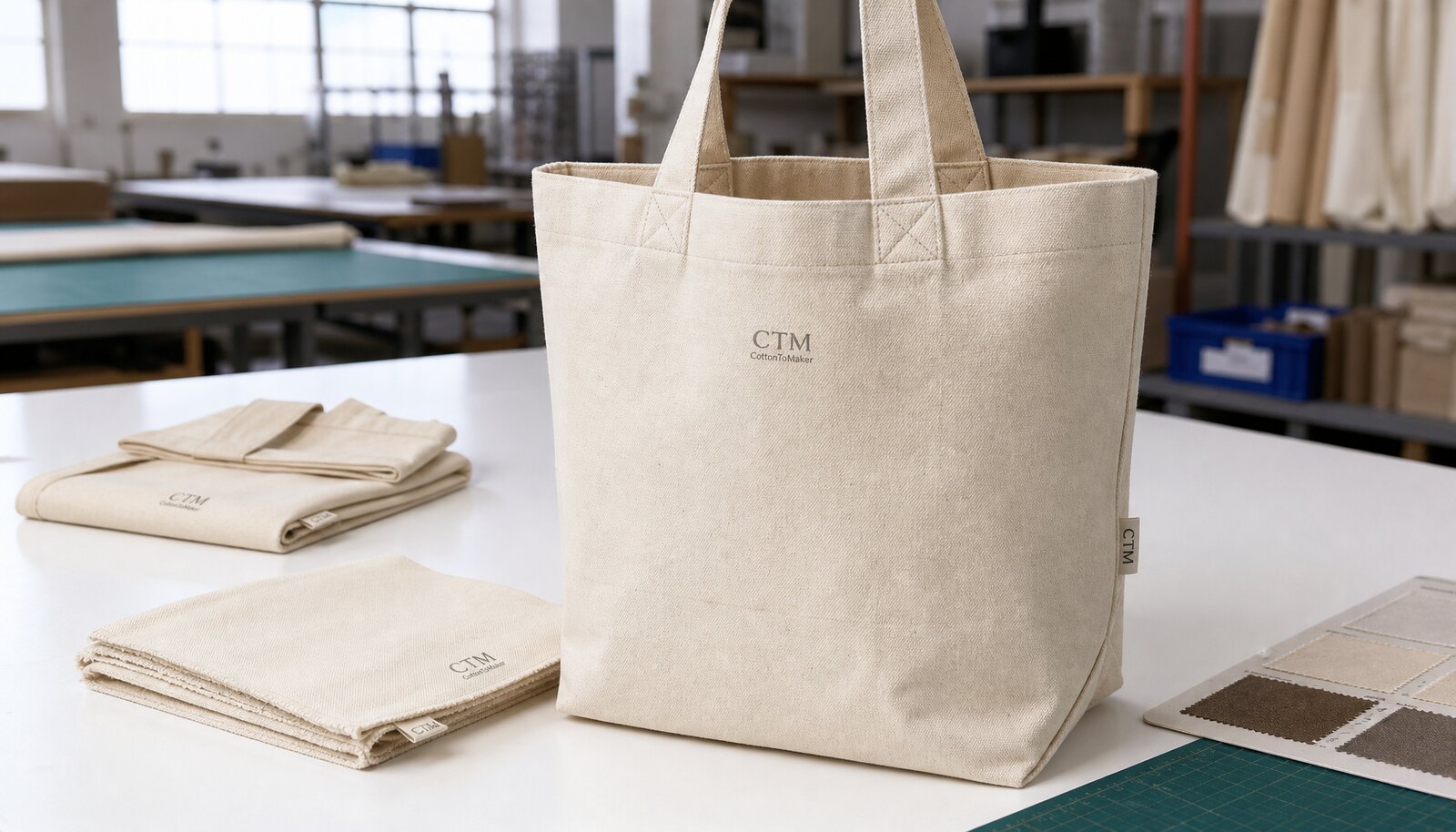
Start with the tote’s commercial job, not the fabric label
A canvas grocery tote for a boutique winery has a different job from a generic trade-show bag. It may sit beside premium bottles in the tasting room, hold farmers-market purchases during a release weekend, ship as part of a wine club gift, or support a regional distributor program. Those uses sound similar, but they do not call for the same bag. A one-day event giveaway can be lighter and simpler. A paid retail tote needs better body, cleaner printing, and stronger construction. A gift tote has to look intentional when it comes out of the carton.
That is why fabric weight should not be chosen in isolation. If the tote will carry bottles, pantry goods, books, or mixed checkout items, the handles and bottom seams matter as much as the canvas panel. If the front logo is the selling point, print sharpness and panel stability matter. If the order will be replenished several times a year, repeatable fabric weight, carton packing, and artwork control become procurement issues, not just design preferences.
A useful RFQ turns the bag into a measurable product. Instead of asking suppliers for “a nice 10 oz winery tote,” define the finished GSM range, bag dimensions, gusset depth, handle width and drop, reinforcement method, print process, working load, packing style, and inspection tolerances. You will receive quotes that are easier to compare, and the samples will be closer to what your team actually needs.
- Define whether the tote is a giveaway, paid retail item, wine club gift, distributor piece, or functional grocery carry.
- Connect fabric weight to a working load, such as 5 kg, 8-10 kg, or 12 kg, depending on the program.
- Treat the tote as a complete system: fabric weight, weave, finish, handle, gusset, seam, print, and packing all affect performance.
- Do not compare supplier prices until every quote is based on the same finished GSM, construction, artwork, and packing method.
Oz versus GSM: use finished GSM as the control point
Canvas tote bags are often described as 8 oz, 10 oz, or 12 oz. Those labels are familiar, but they can be loose. In textile conversion, 1 oz per square yard equals about 33.906 GSM. By that math, 8 oz is about 271 GSM, 10 oz is about 339 GSM, and 12 oz is about 407 GSM. In real sourcing conversations, however, the ounce label may be used as a commercial name rather than a verified finished weight.
The timing of the measurement matters. Greige fabric weight, washed fabric weight, dyed fabric weight, and finished fabric weight are not always the same. Washing, softening, calendaring, dyeing, and pre-shrinking can change the hand feel, apparent thickness, shrinkage, and final GSM. If one supplier quotes greige weight and another quotes finished weight, their prices may look inconsistent even when they are not pricing the same material.
For B2B procurement, finished GSM is usually the clearest control point because it describes the fabric the buyer will receive in the finished tote. A practical RFQ might read: “Natural cotton canvas, nominal 10 oz reference, finished GSM target 340, acceptable finished range 320-360 GSM after all finishing.” If the program is price-sensitive or intentionally rustic, the range may be wider. If the tote is premium retail merchandise, the range may need to be tighter, provided the factory confirms it can hold that tolerance in production.
- 8 oz nominal canvas converts to about 271 GSM; practical finished ranges often sit around 250-290 GSM.
- 10 oz nominal canvas converts to about 339 GSM; practical finished ranges often sit around 320-360 GSM.
- 12 oz nominal canvas converts to about 407 GSM; practical finished ranges often sit around 380-430 GSM.
- Write the accepted finished GSM range in the PO and state when and how the fabric weight will be checked.
Choosing between 8 oz, 10 oz, and 12 oz for winery use
An 8 oz nominal canvas can be the right choice when the bag is primarily promotional. It folds easily, keeps carton weight down, and can work for tasting-room handouts, light event programs, or a single bottle plus printed literature. The trade-off is presentation. Lighter canvas may collapse on a shelf, show more print distortion, and feel less substantial in the hand. If you choose 8 oz, do not also reduce the handle reinforcement to the point where the bag feels disposable.
A 10 oz nominal canvas is often the safest starting point for canvas grocery totes for boutique wineries. It has enough body for retail display, usually accepts screen printing well, and can support regular shopping use when the handles, gusset, seams, and thread are specified properly. For many paid winery retail programs, a finished 320-360 GSM canvas with a boxed bottom and reinforced handle attachments gives a practical balance between cost, feel, durability, and carton efficiency.
A 12 oz nominal canvas makes sense when the tote itself is part of the perceived value. Wine club gifts, premium release merchandise, gift sets, and higher-priced tasting-room items may justify the heavier hand feel and stronger structure. Still, heavier is not automatically better. The buyer should check carton size, freight volume, folding behavior, print curing, and customer comfort. A stiff 12 oz tote may look impressive on a table but feel bulky if the dimensions or handle drop are poorly chosen.
- Use 8 oz when the expected load is light and the commercial goal is promotion rather than premium retail.
- Use 10 oz as the baseline for most reusable grocery-style winery totes sold or used in tasting rooms.
- Use 12 oz when premium hand feel, shelf structure, or gift presentation justifies the higher landed cost.
- Do not upgrade fabric weight to cover weak construction; improve the handle, seam, and gusset specification first.
Construction details that decide real durability
Fabric weight gives the tote its body. Construction decides whether it survives real use. The first failure point is often not the canvas panel. It is more likely to be a handle attachment, a bottom corner, an open seam, loose top-hem stitching, or a gusset fold that was never reinforced properly. This is especially important for wineries because glass bottles create concentrated weight and hard edges.
Handle details should be written in measurable terms. Cotton webbing or folded self-fabric handles in the 25-38 mm range are common for grocery-style totes. The right handle drop depends on how the buyer wants the bag carried. A shorter drop suits hand carry. A longer drop allows shoulder carry. Many grocery tote programs use a handle drop around 25-30 cm, but the sample should be tested when filled, not only measured flat on a table.
The bottom deserves the same attention. A flat tote without a gusset is cheaper, but it has limited usable capacity and may not present well with groceries or bottles inside. A boxed bottom or defined side and bottom gusset helps the bag open cleanly and stand more predictably. For winery retail, pantry items, farmers-market use, and bottle-plus-accessory purchases, a 10-15 cm gusset is often practical. Corner sewing should be reviewed under load because weak corners can look fine on an empty sample.
- Specify handle width, handle drop, total handle length, handle material, reinforcement pattern, and stitch density.
- Use X-box stitching, bartacks, or another approved dense reinforcement for totes expected to carry grocery weight.
- Define side and bottom seam construction: folded, overlocked, bound, double-needle, lockstitched, or another approved method.
- Approve the tote after filling it with the intended load, not after reviewing only the empty sample.
Load testing: simple, written, and repeatable
“Strong enough” is not a specification. Boutique winery buyers do not usually need a laboratory certification for a standard canvas tote, but they do need a clear internal load check. A simple method gives the factory a target, gives the inspector a benchmark, and gives the buyer a way to compare suppliers fairly. Without it, durability becomes a matter of opinion.
Set the load according to the program. A light promotional tote may be specified for a 5 kg working load. A paid grocery-style tote often fits an 8-10 kg target. A premium heavier canvas tote may target 12 kg if the handle and bottom construction are designed for it. A practical test can include static hanging for 1 hour at the agreed load, followed by repeated lift cycles, such as 10 lifts from table height to carry height. Afterward, inspect the handle attachments, top hem, bottom corners, side seams, and bag shape.
The contents used for testing should resemble real use when possible. A bag loaded with soft, evenly distributed weights may behave differently from a bag holding bottles, jars, books, or boxed food. The goal is not to turn a winery tote into industrial lifting equipment. The goal is to make sure the construction matches the buyer’s promise to the customer.
- Define the working load before sampling and include it in the RFQ or technical sheet.
- Use a static hang plus repeated-lift test for totes that will carry groceries, bottles, books, or gift contents.
- Check handle attachment, bottom corners, seam slippage, fabric distortion, and loaded shape after testing.
- Record the approved test method in the PO so repeat orders are judged against the same benchmark.
Print quality on canvas: approve the real fabric, not a perfect mockup
Winery graphics often include details that are not forgiving on textured cotton: serif wordmarks, estate crests, vineyard line drawings, fine borders, release names, small appellation text, or QR codes. The same artwork can look crisp on one canvas and soft on another. A looser 270 GSM natural canvas may absorb ink and blur fine edges. A tighter 340 GSM canvas may hold lines better. A heavy 407 GSM canvas can look premium, but large ink areas may feel stiff if curing and ink selection are not controlled.
Screen printing is usually the most predictable option for repeat winery tote orders with one to three colors. It works well for simple logos, wordmarks, and limited color palettes. Digital printing is useful for short runs, multi-color art, or seasonal designs, but the buyer should expect different color behavior on natural cotton. Heat transfer may work for certain graphics, yet it can change the hand feel and should be flex-tested on the selected canvas before bulk production.
A digital mockup is useful for layout, not for production approval. Request a strike-off on the final canvas weight and color. Check logo dimensions, placement from the top hem and side seams, edge sharpness, ink coverage, color shift, rub resistance, and hand feel. If the artwork includes fine text or a QR code, test legibility at actual size. It is better to simplify artwork before production than to approve a beautiful proof that cannot be reproduced cleanly on textured canvas.
- Use screen print for repeat logos, simple winery marks, and tighter color repeatability.
- Use digital print for short runs or multi-color artwork, but approve the real output on the final canvas.
- Set a print placement tolerance, such as +/-5 mm for simple centered logos if the factory can hold it, or agree a wider tolerance before PO.
- Avoid tiny reversed-out text, very fine lines, and low-contrast ink unless the strike-off proves they work.
Quote structure: price drivers beyond fabric weight
GSM is important, but it is only one cost driver. A 340 GSM tote can be basic or premium depending on yarn quality, weave density, finish, handle type, seam construction, stitch density, print method, label details, and packing. Washing, pre-shrinking, softening, custom dyeing, pressing, thread trimming, and retail tagging all add cost. If one factory includes these steps and another excludes them, the lower unit price may not represent the better offer.
Print pricing also needs careful reading. A one-side, one-color screen print is not comparable to two-side printing, large ink coverage, four-color digital artwork, or special brand color matching. Setup charges should be separated from unit price so the buyer can compare first orders and repeat orders correctly. If the winery expects replenishment, ask whether screens can be stored and whether the same fabric base can be matched in later runs.
MOQ is rarely just one number. There may be a minimum for fabric color, another for artwork, another for bag size, and another for packing. Custom dyeing, special labels, or heavier canvas may require higher minimums because mills, dye houses, and sewing lines run in batch quantities. For a recurring winery merchandise program, a forecasted annual plan with scheduled releases may be more economical than frequent small emergency orders.
- Ask for itemized charges: fabric, sewing, print, setup, labels, hangtags, packing, inspection, and export carton.
- Compare quotes on the same Incoterm and packing method, not only the ex-factory unit price.
- Confirm whether screen, artwork, or setup charges apply again on repeat orders.
- Review carton CBM and gross weight because heavier canvas can raise landed cost beyond the unit price increase.
Sampling sequence for a lower-risk bulk order
A sample should prove more than appearance. For canvas grocery totes, it should confirm fabric hand feel, finished size, handle comfort, loaded shape, stitch quality, print behavior, folding, and carton packing. An empty tote can look excellent in a photo and still twist, sag, or strain once filled. Before approving production, load the sample as a customer would and carry it normally.
A sensible sequence starts with fabric swatches to confirm weight, color, and finish. Next, a construction sample or white sample can confirm the dimensions, gusset, handles, seam type, and sewing method before artwork slows the process. A print strike-off then proves the logo on the selected canvas. Finally, the pre-production sample should combine the final fabric, final construction, final print, labels, finishing, and packing method. Date it, sign it, and retain it as the inspection reference.
Ask how the sample was made. A sample-room tote may be sewn more carefully than bulk production. That is not necessarily a problem, but the factory should confirm that bulk will use the same fabric, pattern, thread, handle material, print method, finishing process, and folding direction. Any change after sample approval should require written buyer approval.
- Use swatches to choose fabric, but do not approve bulk production from swatches alone.
- Use a construction sample to confirm dimensions, gusset, handles, and seams before final artwork is involved.
- Use a strike-off to approve print on the actual fabric weight, finish, and color.
- Use a final pre-production sample as the signed reference for inspection, replenishment, and dispute resolution.
QC tolerances and defect classification for winery totes
Quality control should cover three areas: function, retail appearance, and receiving accuracy. Function checks include handle reinforcement, seam security, bottom corners, gusset shape, stitch density, and load performance. Retail appearance checks include stains, holes, heavy slubs, shade variation, print clarity, loose threads, crooked labels, and pressing. Receiving checks include carton count, SKU separation, barcode labels, carton marks, and packing list accuracy.
Tolerances should be agreed before production starts. Common commercial starting points include finished GSM within +/-5%, width/height/gusset within +/-1 cm, handle drop within +/-1 cm, and print placement within +/-5 mm to +/-10 mm depending on artwork size and factory capability. These are not universal rules. They are practical buyer-supplier benchmarks. If the program demands tighter control, the factory should confirm feasibility before PO release.
Defect classification prevents subjective arguments at final inspection. Critical defects may include unsafe contamination, broken needles or metal fragments, severe handle failure, or any issue that makes the tote unsafe or unusable. Major defects may include holes, heavy stains, open seams, skipped reinforcement, wrong logo, severe misprint, wrong size outside tolerance, or wrong carton count. Minor defects may include small thread ends, slight slubs, or natural cotton flecks that match the approved sample and retail expectation.
- Write tolerances into the PO instead of relying on the supplier’s internal standard.
- Classify handle failure, open seams, wrong artwork, holes, and heavy stains as major or critical depending on severity.
- Allow natural cotton flecks only if they match the approved sample and the brand’s retail expectation.
- Use retained samples and swatches to judge shade, hand feel, print quality, construction, and repeat-order consistency.
Packing, lead time, and landed cost control
Packing affects more than presentation. It changes freight cost, warehouse handling, receiving speed, and how the tote looks when it reaches the tasting room. Bulk flat packing is usually the most efficient option for importers, distributors, and wineries storing bags in a back room. Retail packing makes sense when the tote must arrive shelf-ready with a hangtag, barcode, belly band, tissue, or individual polybag. Every added step costs labor and can reduce the number of units per carton.
Request carton data before approving the final quote. Ask for units per carton, carton dimensions, net weight, gross weight, and estimated CBM. A heavier tote may reduce units per carton or require looser folding to protect the print. If the artwork is large, specify folding direction and whether the printed panel should face inward or be protected. Tight packing may save freight but create hard creases that hurt retail presentation.
Lead time should be broken into stages. Fabric procurement, lab dips, sample revisions, strike-off approval, cutting, sewing, printing, curing, finishing, packing, inspection, and export booking all take time. Custom dyed canvas, 12 oz fabric, multiple artworks, retail packing, and late artwork changes can extend the schedule. Landed cost should be evaluated only after carton CBM, packing style, Incoterm, freight mode, duty basis, and receiving requirements are clear.
- Use bulk packing unless shelf-ready retail presentation is required.
- Confirm carton size, carton count, gross weight, and CBM before approving the final quote.
- Specify folding direction when the print area may crease, crack, or transfer.
- Break lead time into production stages and connect buyer approval delays to the shipment schedule.
- Compare landed cost, not only unit price.
Specification comparison for buyers
| Spec decision | Recommended option | When it fits | Buyer risk to check |
|---|---|---|---|
| Controlling fabric weight term | Use finished GSM in the RFQ and PO; keep oz only as a familiar reference | International sourcing, multi-supplier quote comparison, repeat replenishment orders | Confirm whether GSM is measured before or after washing, dyeing, softening, calendaring, or pre-shrinking; nominal oz labels can hide a 5-10% difference |
| 8 oz nominal canvas | About 271 GSM by direct conversion; practical finished range often 250-290 GSM depending on finish | Event giveaways, light tasting-room promotions, low-price retail bags, single-bottle plus literature carry | Risk of weak body, more show-through, lower perceived retail value, print distortion, and handle stress if reinforcement is basic |
| 10 oz nominal canvas | About 339 GSM by direct conversion; practical finished range often 320-360 GSM | Most boutique winery grocery totes sold at checkout or used for club, market, and tasting-room merchandise | Verify yarn density and finish, not only GSM; two 340 GSM fabrics can differ in stiffness, shrinkage, weave openness, and print sharpness |
| 12 oz nominal canvas | About 407 GSM by direct conversion; practical finished range often 380-430 GSM | Premium retail totes, club member gifts, gift sets, sturdier shelf display, and heavier grocery positioning | Risk of over-specifying: higher fabric cost, larger cartons, stiffer hand feel, slower print curing, and higher freight volume |
| Load target | Define buyer-approved working load: common RFQ targets are 5 kg light, 8-10 kg retail, or 12 kg premium | Any tote expected to carry glass bottles, groceries, books, pantry goods, or mixed checkout purchases | Do not rely on fabric weight alone; handles, bartacks, seams, gussets, and thread quality usually determine first failure point |
| Handle construction | 25-38 mm cotton webbing or folded self-fabric handles with X-box, bartack, or dense lockstitch reinforcement | Retail grocery totes, wine club merchandise, event totes that may carry bottles, reusable shopping bags | Specify handle drop, handle width, stitch pattern, stitch density, thread type, and pull/load test method; vague “strong handle” language is not enough |
| Gusset and bottom | Boxed bottom or defined side/bottom gusset with reinforced corner sewing; typical grocery gussets are 10-15 cm | Totes that must carry grocery items, stand better on display, or hold bottle purchases plus accessories | A shallow gusset reduces fabric cost but also reduces usable capacity; poor corner sewing causes twisting and early seam stress |
| Print method | Screen print for repeat one- to three-color logos; digital print for short runs or complex seasonal art | Winery wordmarks, estate crests, vineyard line art, tasting-room merchandise, limited releases | Approve strike-off on final bulk fabric; check ink cure, rub resistance, edge sharpness, color shift on natural cotton, and print placement tolerance |
| Dimensional tolerance | State finished tolerance in PO: common commercial targets are +/-1 cm for width/height/gusset and +/-1 cm for handle drop | B2B orders where cartons, shelves, hangtags, or retail planograms require consistent size | Measure after finishing, pressing, and packing; washed canvas may shrink and distort if tolerance point is not defined |
Buyer checklist before sampling
- Define the commercial purpose first: paid tasting-room merchandise, winery club gift, event giveaway, grocery carry, bottle purchase support, distributor program, or seasonal retail item.
- Specify fabric weight as finished GSM, with nominal oz only as a reference. If using 8 oz, 10 oz, or 12 oz, include the acceptable finished GSM range and tolerance.
- State the fabric finish: natural unbleached, bleached, dyed, washed, pre-shrunk, softened, enzyme washed, or untreated. Each finish changes hand feel, shrinkage, color, and print behavior.
- List finished measurements, not pattern measurements: bag width, bag height, side gusset, bottom gusset, handle width, total handle length, handle drop, top hem depth, and seam allowance expectation.
- Set a practical working-load target. For example, 5 kg for light promotional carry, 8-10 kg for paid grocery-style retail, or 12 kg for premium utility positioning, subject to buyer approval.
- Define handle construction in measurable terms: cotton webbing or self-fabric, handle width, folded or unfolded, attachment size, X-box or bartack pattern, thread type, and stitch density.
- Require bottom and corner details: boxed bottom, side gusset, bottom gusset, folded seam, bound seam, overlock plus topstitch, or added bottom panel if needed.
- Lock artwork before sampling: print method, number of colors, Pantone or brand reference, logo dimensions, placement from top edge and side seam, and whether print crosses seams or gussets.
- Request a print strike-off on the final canvas color and weight, not on a generic cotton swatch. This is especially important for serif type, crests, vineyard illustrations, QR codes, and light ink on natural canvas.
- Ask for a stitched pre-production sample using the same fabric, finish, handle construction, gusset, print method, thread color, label, packing method, and carton folding direction intended for bulk.
Factory quote questions to send
- Is the quoted fabric weight finished GSM, greige GSM, washed GSM, or an estimated nominal oz weight? What production tolerance do you apply?
- If you quote 8 oz, 10 oz, or 12 oz canvas, what is the expected finished GSM range after all finishing steps?
- What canvas construction are you using: plain weave, yarn count if available, natural unbleached, bleached, dyed, washed, softened, or pre-shrunk?
- What shrinkage should we expect after washing or finishing, and are finished dimensions measured after pressing and packing?
- What are the exact finished bag dimensions: width, height, side gusset, bottom gusset, top hem depth, handle width, total handle length, and handle drop?
- What seam construction is included on the sides and bottom: lockstitch, overlock, French seam, folded seam, binding, or double-needle topstitch?
- What stitch density can you hold on side seams, top hem, gusset corners, and handle attachment points? Please state stitches per inch or stitches per centimeter.
- What handle material are you pricing: cotton webbing, self-fabric canvas, or another tape? What is the handle GSM or thickness, width, and reinforcement pattern?
- Can you perform a buyer-defined load test, such as static hanging for 1 hour at the agreed load plus repeated lift cycles, and provide photos or a simple test record?
- Which print method is quoted: screen print, heat transfer, pigment digital, DTG, or another process? How many print colors, print sides, and setup charges are included?
Quality-control points to confirm
- Use finished GSM as the controlling fabric-weight specification unless there is a clear reason to control greige weight. A practical commercial tolerance for canvas tote programs is often +/-5%, while very price-sensitive or rustic programs may accept a wider range if approved in writing.
- Measure GSM from representative fabric before cutting or from agreed retained swatches. Do not compare a washed bulk bag to an unwashed swatch unless both parties agreed that the reference point is different.
- Check finished dimensions after finishing, pressing, and packing. Common commercial tolerances are +/-1 cm for width, height, and gusset depth; tighter tolerances may increase rejection risk and should be confirmed with the factory.
- Measure handle drop with the bag laid flat and handles extended naturally. A common commercial tolerance is +/-1 cm, but bottle-carry or retail display programs may require tighter consistency.
- Inspect handle attachment on every sampled unit. X-box stitching or bartacks should be centered, dense, secure, and free from skipped stitches, loose corners, thread breaks, or needle damage.
- Confirm stitch density at side seams, bottom seams, top hem, gusset corners, and handle attachment. Many canvas tote specs use approximately 7-10 stitches per inch, but the buyer should approve the exact target with the factory.
- Review seam allowance and raw-edge control. Exposed fraying inside an unlined tote may be acceptable only if edges are overlocked, folded, bound, or otherwise secured according to the approved sample.
- Test loaded shape, not only flat appearance. Fill the tote to the agreed load and check whether the bottom gusset opens evenly, corners twist, handles elongate, or seams show stress.
- Classify fabric defects before inspection starts. Minor natural seed flecks and slubs may be acceptable on unbleached cotton; holes, oil marks, heavy stains, broken yarns, mildew odor, severe shade panels, and obvious contamination should not be treated as normal variation.
- Check print placement from fixed measurement points such as top hem and left/right side seams. “Centered” is too vague on a gusseted bag because the front panel can shift when opened.