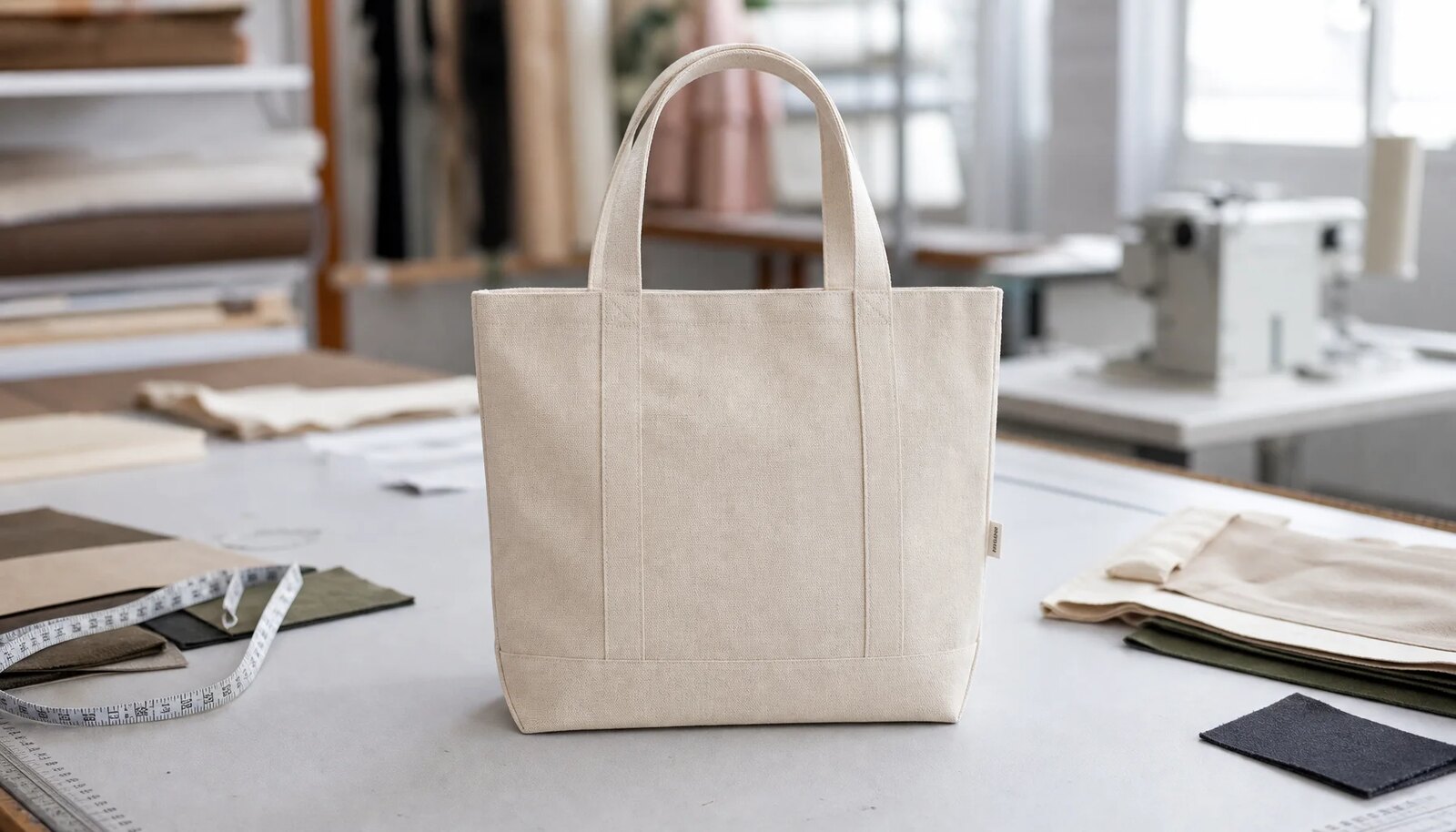
Start With the In-Hand Date, Not the Bag Spec
Lead time planning for canvas grocery totes should begin with the date the bags must be in hand, not the day the factory returns a quote. Farmers market vendors use these bags as carry items, resale items, and part of the display mix, so the real deadline is usually the first weekend of the season, not the receiving dock. If the bags arrive after that window, the commercial value falls even if the unit price looks good on paper. Most misses come from late decisions on size, print, fabric weight, or packing, not from the sewing line itself.
The safest schedule works backward from the sellable-carton date and then allocates time for sample approval, print strike-off, bulk production, inspection, and freight booking. For an overseas order, the actual sewing window may be only a slice of the calendar, but the full program still needs room for artwork lock, material sourcing, line scheduling, and transit. Treat lead time as a chain of decisions, not a single promise. That is the difference between a quote that sounds fine and an order that actually lands on time.
- Define the date the first sellable cartons must land.
- Freeze size, fabric, print, and packing before comparing quotes.
- Reserve separate time for sample approval and freight booking.
- Keep a buffer for artwork changes, replacement samples, and shipping delays.
Lock the Core Spec Before You Request Pricing
A quote for canvas grocery totes is only useful if the supplier is pricing the same bag you plan to buy. The core spec should include finished dimensions, gusset depth if there is one, fabric weight, handle length, handle width, thread color, print method, and packing method. If any of those items stay open, the factory will either pad the price or assume a simpler build than the buyer expects. That is where quote-to-order disputes start. A clean tech pack usually saves more time than pressure on the factory later.
For farmers market vendors, the usual starting point is a natural canvas tote with cotton webbing handles and a one-color logo. A standard body size around 14 x 16 in or 15 x 15 in is often workable for produce and mixed grocery use, but the right size depends on the load and the sales format. If the tote needs to stand upright, say so. If it should fold flat for display, say that too. Bag geometry changes pattern cutting, sewing time, and carton efficiency, which is why the shape belongs in the RFQ instead of a later note.
- Send body dimensions, gusset depth, and handle drop in the first RFQ.
- Name the fabric weight in oz and GSM, not just canvas.
- Specify whether the bag should stand upright, fold flat, or both.
- Include thread color and reinforcement details if they matter to the brand presentation.
Choose Fabric Weight Around the Load, Not the Aesthetic
Fabric weight drives cost, bag body, and how the tote behaves in use. A common entry point is 10 oz canvas, roughly 340 GSM, which works for light grocery loads, produce, and general market carry. Many private-label buyers move to 12 oz canvas, about 406 GSM, because it adds structure without making the bag overly stiff. Heavy-use retail programs often move to 14 oz, around 475 GSM, especially when the tote needs to carry bottles, jars, or repeated weekly groceries without collapsing. These are not universal standards, but they are practical sourcing references.
The wrong fabric choice creates lead-time risk because it changes sewing behavior, thread consumption, and sometimes print performance. Heavier canvas can require different needles, tighter seam control, and more careful tension setup to avoid puckering or skipped stitches. If you want stable dimensions, state whether the measurement is taken before or after finishing and whether the canvas is pre-shrunk. If you are ordering colored canvas, lining, or contrast handles, include all of that in the first RFQ so the factory does not have to reopen the schedule after approval.
- 10 oz / 340 GSM is a practical starting point for light market loads.
- 12 oz / 406 GSM is often the best balance for resale, branding, and daily carry.
- 14 oz / 475 GSM fits heavier loads and a more premium retail position.
- Heavier fabric should trigger stronger seam and load testing before bulk approval.
Pick the Print Method That Matches the Timeline
On canvas grocery totes, print choice affects schedule almost as much as fabric choice. One-color screen print is usually the most efficient route for a flat logo, especially when the art sits on one side and the buyer wants dependable repeatability. Once the design adds multiple colors, tight registration, or full-coverage graphics, the factory needs more setup, more checks, and sometimes a longer drying or curing cycle. For small runs, a woven label, side label, or patch can sometimes move faster than a complicated print, but that choice changes the look and the perceived value of the bag.
Send vector artwork, exact placement dimensions, and Pantone references before asking for a schedule. A digital mockup is not enough if the logo has fine lines or if the placement sits near a seam. Request a strike-off or print sample on the actual fabric, because canvas texture can distort small details. If the bag will be handled often or washed, ask how the supplier tests rub resistance and cure quality so the approved sample is not only visually correct but durable in use.
- One-color screen print is usually the fastest and most controllable option.
- Multi-color art needs more setup and more opportunities for delay.
- Labels or patches can reduce print complexity on short runs.
- Use a real strike-off on the actual fabric before bulk approval.
Read the Quote for Schedule, Not Just Unit Price
A useful quote should let the buyer compare suppliers on the same basis. If a quote does not state fabric weight, bag dimensions, handle length, print colors, sample charge, MOQ, lead time from deposit, and packing method, then it is not really comparable. Low prices often hide unknowns: the fabric may need to be woven, the sample may not be included, the carton count may be loose, or the lead time may be quoted in working days while the buyer assumes calendar days. Those gaps matter more than a small difference in unit price.
The best sourcing route depends on the program. A direct factory usually gives the cleanest control over sewing and repeat production, but the buyer has to manage spec discipline. A trading company can help when the order is small or the team wants a broader sourcing package, but responsibility can become less visible if fabric, print, and packing are handled through different lines. A local decorator or nearshore route can win on speed for urgent launches, but the unit cost rises and the assortment is usually narrower. Choose the route that fits the launch window, not the route with the prettiest quote sheet.
- Compare suppliers only after the quote shows the same spec basis.
- Separate sewing time from material sourcing time.
- Ask whether the route is direct factory, trading company, or local decoration.
- Treat unclear lead-time wording as a risk, not a detail.
MOQ Is a Timing Tool, Not Only a Price Lever
MOQ on canvas grocery totes is usually tied to fabric width, cut efficiency, print setup, and packing labor. A simple tote in natural canvas with one-color print can often sit at a lower MOQ because the factory can nest panels efficiently and use common materials. Add lining, contrast handles, metal hardware, or multiple print versions, and the MOQ tends to rise because each added component creates another material order and another line change. Buyers sometimes read MOQ as a fixed rule, when it is really a reflection of how many production steps the supplier must absorb.
For schedule planning, MOQ should be treated as a lever that affects both material lead time and assembly complexity. A low MOQ that depends on special materials can take longer than a higher MOQ on a standard bag. Ask whether the MOQ is per color, per size, per artwork version, or per order total. If the program will repeat, lock the same spec and packing format now so the second order does not start from zero. Reorders are usually easier only when the first order was disciplined enough to create a stable baseline.
- Low MOQ is not automatically a faster schedule.
- Each added component tends to raise MOQ and risk.
- Clarify whether MOQ is per color, per size, or per print version.
- Repeat orders go faster when the first spec is kept stable.
Use Samples to Remove Unknowns Before Bulk Sewing
A sample should prove more than logo placement. The buyer needs to see how the fabric feels, how the handles sit, whether the print stays crisp on canvas texture, and how the seams behave under load. For a farmers market tote, the best test is practical: fill the bag with the kind of goods the end user actually carries, such as produce, jars, bottles, or mixed groceries. If the tote twists, collapses, or pulls at the handle anchor, the issue is not cosmetic. It usually means the pattern, handle spacing, or seam reinforcement needs to be corrected before mass production.
The fastest sample process starts with a clean tech pack. Include finished dimensions, seam allowance, thread color, handle length, print size, label position, and the acceptable tolerance for each critical feature. Approve one signed reference sample and keep it attached to the PO file. If color on natural canvas matters, review the sample under daylight and under the same lighting the receiving team will use. Many disputes come from a bag that looks acceptable in one environment but reads too warm, too grey, or too uneven in another.
- Use a real load test that reflects market use, not only a visual review.
- Lock the tech pack before the factory cuts bulk material.
- Keep one signed reference sample for production and inspection.
- Review color under daylight if the base fabric is natural canvas.
Define QC Thresholds Before Production Starts
Quality control on canvas grocery totes should focus on the features that affect retail value and usable life. Finished size matters because retailers and distributors often need consistency across cartons and reorders. Print placement matters because a small shift can make a logo look unprofessional even when the bag is technically usable. Stitch quality matters even more because these bags carry weight, and loose threads or weak reinforcement at the handle anchor will show up quickly once end users start loading them weekly. A tote can pass a casual glance and still fail the buyer's standard if the seams are uneven or the fabric is stained.
Before bulk production starts, the buyer and supplier should agree on the inspection standard and the defect categories. If you use AQL, define what counts as critical, major, and minor so the factory knows where the line is. Decide how many cartons will be opened, how many bags will be pulled from each carton, and what happens if the defect rate is too high. It is much cheaper to stop a batch at line inspection than to receive a full shipment and argue over rejects in the warehouse later.
- Agree on tolerances for size, print placement, and handle symmetry.
- Reject loose threads, skipped stitches, stains, and visible weave defects.
- Define critical, major, and minor defects before production starts.
- Decide who inspects cartons and what happens after a failed check.
Treat Packing as a Production Step, Not an Afterthought
Packing decisions affect lead time more than many buyers expect. A tote that ships folded in bulk cartons can move quickly, while a bag that needs individual polybagging, a barcode sticker, a belly band, or an insert card needs extra labor and a separate signoff on the packing artwork. Carton dimensions, carton count, and palletization also influence freight cost and warehouse handling. If those details are still changing when production is ready to close, the factory may finish sewing but still miss the ship date because packing is not ready to release.
For farmers market vendors, the packing plan should balance presentation with practical handling. Buyers often want a neat folded tote that looks retail-ready without creating unnecessary labor. Overpacking makes cartons heavy and expensive to move; underpacking creates wrinkled goods and inconsistent shelf appearance. Put the packing spec into the RFQ so the supplier can price labor correctly and so the receiving team knows exactly what to expect. If the product needs to reach retail shelves, make sure the carton marks and barcode system are ready before the bulk order starts.
- Bulk fold is usually fastest and cheapest.
- Individual polybags, insert cards, and belly bands add labor and delay.
- Carton size and pallet plan affect freight and warehouse handling.
- Packing artwork should be approved before bulk sewing closes.
Build a Working Lead-Time Map With Buffers
A practical schedule needs milestones, not just one promised ship date. Start with RFQ and tech pack completion, then move through sample making, strike-off approval, pre-production confirmation, bulk sewing, inspection, packing, and shipment. For planning only, an overseas order might need 1 to 2 weeks for sample and artwork alignment, 3 to 5 weeks for bulk production, and another block for freight depending on the route. A domestic or nearshore route shortens the production cycle, but it does not remove the need for approval gates. If the buyer is still changing the logo or pack format, even the fastest supplier will lose time.
Buffers should sit where risk is highest. That usually means the first sample, the print match, and carton label approval. The buffer should not be spent on waiting to decide the spec. If the launch date is fixed, simplify the tote and make the order easier to produce: one size, one canvas weight, one print color, and one packing format. That is the cleanest way to protect the calendar. A more complex bag can still be viable, but only if the buyer accepts more time and a higher chance of rework.
- Use milestones for sample, bulk, inspection, packing, and freight.
- Put buffers around artwork, print matching, and carton labels.
- Keep the spec simple if the launch date is hard.
- Avoid changing the bag after the production sample is approved.
Specification comparison for buyers
| Spec decision | Recommended option | When it fits | Buyer risk to check |
|---|---|---|---|
| Fastest path to first delivery | Stock canvas tote with local overprint or simple label application | Short season, event deadline, or a test order that has to land in a few weeks | Color, size, and handle options are limited; repeat consistency can vary by lot |
| Best balance of cost and control | Direct factory order with standard body size and one-color screen print | Repeat farmers market program or private-label resale line with enough runway for sampling and freight | Lead time is only reliable if art, fabric weight, packing, and carton data are frozen early |
| Smallest viable pilot | Trading company that can aggregate a mixed order across one or more factories | Market test, new SKU launch, or buyer who wants lower commitment before scaling | Responsibility can blur if sample approval, packing, and bulk production happen in different places |
| Most durable brand execution | Factory with in-house cutting, sewing, and print control | Heavy-use grocery bags, weekly market carry bags, and reorder business | Ask how print cure, stitch density, and handle-anchor reinforcement are checked |
| Best for retail-ready packing | Factory that can do barcode stickers, insert cards, belly bands, and carton labeling | Programs that route through a warehouse, distributor, or retail receiving team | Late label approval can stop packing even after sewing is finished |
| Lowest landed cost at scale | Standardized direct-factory order with one size, one fabric, one print color, and bulk fold packing | High-volume replenishment where the buyer can keep the spec simple | Savings disappear quickly if you add lining, multi-color art, or individual packaging |
| Best when compliance paperwork matters | Supplier that can issue invoice, packing list, material declaration, and export documents cleanly | Distributor programs, retail onboarding, or cross-border receiving with document checks | Document gaps can delay receiving even when the bags are physically finished |
| Best under an urgent deadline | Nearshore or domestic decoration route using an existing blank tote base | Launches with a fixed market date and little tolerance for ocean freight risk | Unit price is higher, so the question is whether the schedule value justifies it |
Buyer checklist before sampling
- Freeze the finished size, gusset, handle length, fabric weight, and print method before asking for quotes.
- Specify whether MOQ is per color, per size, per print version, or per total order.
- Approve one signed sample or strike-off and keep it as the production reference.
- State the expected load, such as produce, bottles, or mixed groceries, so the factory can build and test the bag properly.
- Confirm packing format, carton count, carton marks, and barcode location before the PO is released.
- Ask for a dated lead-time breakdown covering sample making, print setup, bulk sewing, inspection, packing, and freight booking.
- Align on defect tolerance for size, print placement, stitching, stains, and color variation before mass production starts.
- Build a buffer for artwork revision, sample correction, and shipping delays, especially if the launch date is fixed.
Factory quote questions to send
- What is the exact fabric spec, including oz and GSM, and is it greige, bleached, dyed, enzyme-washed, or pre-shrunk?
- What finished dimensions are you quoting, including body width, height, gusset, handle length, and handle drop?
- Is the MOQ based on total quantity, per print color, per size, per packing version, or per material color?
- What is included in the lead time: fabric purchase, sample making, print setup, sewing, packing, inspection, and export booking?
- Which print method is quoted, and what changes in price or schedule if the artwork moves from one color to multiple colors?
- What sample charges apply, how many revision rounds are included, and what is the timeline for a first sample and a strike-off?
- Can you quote alternative packing methods, such as bulk fold, individual polybag, belly band, barcode sticker, or insert card?
- What are the acceptable size tolerances and the inspection standard used for the bulk lot?
- What is the factory's weekly capacity for this style, and where does my order sit in the production queue?
- Which documents ship with the order, including packing list, commercial invoice, carton marks, material declaration, and any test reports if needed?
Quality-control points to confirm
- Finished body size should stay within the agreed tolerance, typically about +/- 1/4 in (6 mm) on width and height, unless the bag is unusually oversized or lightly constructed.
- Handle length and handle drop should be consistent within about +/- 1/4 in (6 mm), and both handles should hang evenly without visible twist.
- Print placement should match the approved mockup within about +/- 1/8 to 1/4 in (3 to 6 mm), with enough margin from seams, top hem, and side gusset.
- Stitching at handle anchors, side seams, and base corners should show no skipped stitches, loose thread bundles, or seam slippage.
- Fabric should be free of holes, oil marks, heavy shading, broken yarns, and visible weave defects that stand out on retail display.
- Color should track the approved strike-off or signed sample under daylight, not only under warehouse lighting.
- Carton count, carton marks, barcode labels, and pack ratio must match the PO and packing list exactly.
- A loaded bag should pass a practical carry test at the target use load, often 10 to 15 lb (4.5 to 6.8 kg) for grocery use, or your real expected load if it is higher.