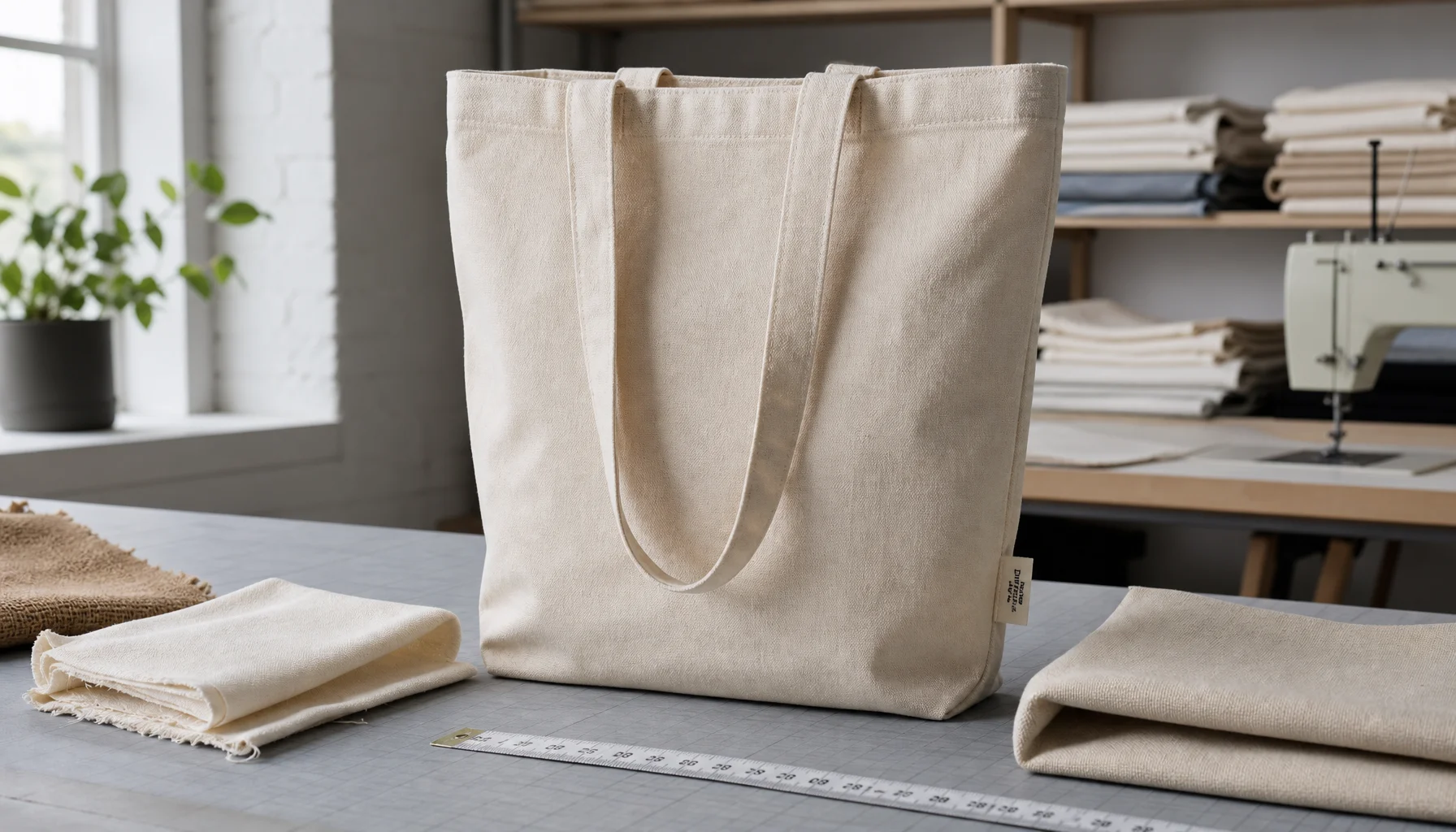
Why fabric weight deserves an early sourcing decision
Canvas grocery totes look simple from the outside. A rectangle, two handles, a logo, maybe a gusset. In production, though, fabric weight touches nearly every cost and quality decision: body strength, hand feel, print sharpness, sewing difficulty, carton gross weight, freight efficiency, and how the tote is perceived when a customer picks it up in store.
Two supplier photos can show almost the same natural canvas bag while the physical samples feel completely different. A tote made from roughly 270 GSM finished canvas will fold and price differently from one made from roughly 400 GSM finished canvas. The difference becomes obvious when the bag is filled with groceries, stacked in cartons, printed with a large logo, or sold as a branded accessory rather than handed out as packaging.
Many procurement problems start with an RFQ that says only “cotton canvas tote, natural color, logo printed.” That leaves the factory to choose the fabric weight, fabric stage, weave quality, seam allowance, handle reinforcement, and packing method. The quote may come back quickly, and it may look competitive, but it is not a controlled comparison. A supplier quoting lighter unfinished canvas can appear cheaper than a supplier quoting finished 10 oz canvas with reinforced handles, even though the two bags are not equivalent.
For eco apparel brands, the tote often has to do more than one job. It may be a store shopping bag, a gift-with-purchase item, a paid merchandise SKU, a reusable grocery bag, and a brand signal. That is possible, but the tote must be specified as a carrying product, not only as a logo surface. Fabric weight should be selected together with size, gusset, handle drop, reinforcement, printing, packing, and material claim requirements.
A clearer RFQ sounds specific without being complicated: “10 oz cotton canvas, approximately 340 GSM finished fabric, plus or minus 5 percent, natural color, finished size 38 W x 40 H x 10 cm bottom gusset, shoulder handles, reinforced handle bases, one-color screen print.” That one sentence gives sourcing, sampling, production, and inspection the same target.
- Underweight canvas can reduce FOB cost but may create sagging, weak hand feel, and lower customer confidence.
- Overweight canvas can improve structure but raises material cost, cutting resistance, seam bulk, carton weight, and landed cost.
- GSM should control the spec because ounce terms are not used consistently by every supplier or market.
- The approved sample must represent final fabric weight if it will be used as a bulk QC standard.
- A substitute-fabric sample can help confirm shape, but it should not approve final GSM, print result, or hand feel.
The useful GSM bands: 8 oz, 10 oz, and 12 oz canvas
Most commercial canvas grocery totes sit in a practical finished-fabric range of about 270-400 GSM. Below that range, the product usually starts to feel more like a lightweight promotional shopper unless the size is modest and the load is light. Above it, the tote may become a premium accessory, but the extra cost, carton bulk, and sewing complexity need a clear commercial reason.
Buyers often talk in ounce bands: 8 oz, 10 oz, and 12 oz canvas. As a working guide, 8 oz is often around 270 GSM, 10 oz around 340 GSM, and 12 oz around 400 GSM. Treat these as practical buying references, not laboratory conversions. Ounce descriptions may depend on fabric-width conventions, local commercial shorthand, or how the supplier measures the fabric.
That is why “finished GSM” matters. Canvas can be described as greige fabric before dyeing and finishing, dyed fabric, washed fabric, pre-shrunk fabric, or finished ready-to-cut fabric. Dyeing, washing, compaction, and finishing can change weight, width, shrinkage, and hand feel. If one supplier quotes greige weight while another quotes finished weight, the lower price may simply reflect a different measuring point.
For many tote programs, plus or minus 5 percent on finished GSM is a workable commercial tolerance, provided the supplier agrees before order placement. A 340 GSM target with a 5 percent tolerance gives an approximate control range of 323-357 GSM. If the brand needs a very tight hand feel, a specific retailer requirement, or a more controlled premium presentation, the tolerance should be discussed and priced accordingly.
The cleanest procurement approach is to list both the familiar ounce term and the controlling GSM. For example: “10 oz canvas, approximately 340 GSM finished fabric, GSM to control sampling and bulk inspection.” This reduces confusion while still allowing suppliers who quote in ounces to understand the intended market category.
- 8 oz / about 270 GSM: budget reusable level, softer body, easier folding, lower fabric consumption.
- 10 oz / about 340 GSM: balanced retail level for many eco apparel and grocery tote programs.
- 12 oz / about 400 GSM: premium structured level with higher material cost, seam bulk, and carton weight.
- Finished GSM should appear in the RFQ, PO, approval sample notes, and inspection checklist.
- Do not compare quotes until fabric stage, GSM tolerance, dimensions, gusset, handle spec, print method, and packing are aligned.
Match canvas weight to how the tote will actually be used
The right canvas weight is not chosen in isolation. Start with the real load case. A tote used for folded T-shirts, sweatshirts, and accessories at an apparel checkout does not need the same construction as a tote promoted for bottles, canned goods, produce, and pantry items. If the use case is mixed apparel and everyday shopping, 10 oz canvas around 340 GSM with a practical bottom gusset is often a strong starting point.
For free-with-purchase programs, the commercial goal is usually a reusable bag that feels credible without consuming too much margin. In that scenario, 8 oz canvas can work well if the bag is not oversized and the handles are properly reinforced. If the tote will be sold as merchandise, customers will judge it against other accessories. Then 10 oz or 12 oz canvas, cleaner stitching, better folding, and more controlled presentation may be worth the extra cost.
Do not let GSM become the only answer to every performance question. If the buyer is worried about bottles, handle-base reinforcement and gusset seam strength may matter more than moving from 10 oz to 12 oz. If the concern is logo quality, the answer may be a smoother print face, simpler artwork, adjusted ink, or a different print process. If the goal is a premium look, a neat top hem, consistent shade, and tidy thread trimming can be just as visible as heavier fabric.
Procurement should ask merchandising, retail, and ecommerce teams how the bag will be positioned. Is it packaging, a reusable grocery item, a loyalty gift, a staff accessory, or a paid SKU? That answer changes the acceptable defect level, packing method, hangtag requirement, barcode handling, carton allocation, and sample approval standard. A tote sold online as a product needs tighter visual control than a tote placed inside a larger campaign bundle.
One useful rule: choose the lowest fabric weight that still meets the real use case after construction is properly specified. That keeps cost, folding, carton weight, and freight under control without weakening the product.
- Folded apparel and light shopping: consider 8 oz or 10 oz, depending on target price and brand positioning.
- Everyday grocery and apparel crossover use: 10 oz finished canvas is often the safest first spec to test.
- Premium paid merchandise: 12 oz can be appropriate when the higher landed cost is justified.
- Bottle-heavy use: strengthen handle reinforcement, seam allowance, and gusset construction before simply raising GSM.
- Multi-account or distributor programs: standardize one body spec and vary branding details to protect MOQ efficiency.
Construction details that carry the load
A grocery tote is a sewn load-bearing product. Fabric weight helps, but it cannot rescue weak handles, narrow seam allowance, loose stitching, or a poorly built gusset. In real use, a well-constructed 340 GSM tote can outperform a heavier bag that relies on single-line handle stitching and thin seam margins.
Gusset selection changes both usability and cost. A flat tote is economical, easy to stack, and efficient for simple apparel packaging, but it does not hold groceries as well as a gusseted body. A 10-12 cm bottom gusset gives practical capacity for produce, boxed items, and folded apparel while keeping construction manageable. A full side-and-bottom gusset adds more volume and shape, but it increases fabric consumption, cutting complexity, sewing time, carton cube, and price.
Handles should be specified in numbers, not adjectives. Shoulder-carry grocery totes commonly use total handle length around 60-70 cm, depending on the bag height and intended drop. Handle width around 2.5-3.8 cm is common for comfort and strength. The final choice should be checked with a filled sample, because a handle that looks fine on a flat table can feel too short, too narrow, or twisted when the bag is loaded.
Self-fabric handles give a matched canvas look and can support a clean brand aesthetic. Cotton webbing handles can offer a stable, consistent hand and may reduce some sewing bulk. Either choice needs reinforced attachment. Box-X stitching, cross-stitching, or bartack reinforcement is more appropriate for repeat-use grocery totes than a simple single seam. The top hem also needs enough depth and stability to support the handle base without tearing or rippling.
Thread quality and stitch control are easy to overlook because they rarely appear in marketing copy. They show up later as skipped stitches, broken threads, seam grin, puckering, or weak back tacks. Put the construction standard into the tech pack and approval notes so the inspector is not left judging vague “factory standard” workmanship.
- Bottom gusset: 10-12 cm is a practical range for many grocery-style canvas totes.
- Full gusset: better shape and volume, but higher fabric use, sewing labor, and carton cube.
- Top hem: must be stable enough to support handle attachment and still look clean at retail.
- Handle drop: approve it on a filled sample, not only from a flat measurement.
- Seam allowance: too narrow can cause failure even when the body fabric is heavy.
- Reinforcement: specify box-X, cross-stitch, or bartack for repeat-use programs.
Material composition and sustainability documentation
Eco apparel buyers often source canvas totes because the bag supports a broader sustainability message. The physical spec and the marketing claim, however, should be managed as two connected but separate workstreams. Canvas grocery totes may be conventional cotton, organic cotton, recycled cotton, recycled-content blends, cotton-polyester blends, or another construction. Each route can affect price, MOQ, hand feel, shade, surface texture, strength, and documentation.
Organic cotton may fit a brand promise, but buyers still need to confirm that the exact weight and construction are available. A supplier may have organic cotton fabric, but not necessarily the requested 10 oz or 12 oz canvas in the desired width, shade, MOQ, and lead time. Recycled cotton can be attractive, but recycled fiber content may influence yarn regularity, flecks, shade consistency, and print surface. Blends may help cost or stability, yet they can change both the customer perception and the claim language.
Natural undyed canvas is common for eco-positioned totes and can avoid the added time and variation of dyeing. Still, natural canvas is not a perfectly uniform white or cream surface. Seed flecks, slub, small dark specks, neps, and tonal variation may be normal, depending on the fabric grade. Buyers should approve a physical standard that shows the acceptable range. A clean digital rendering should never be the visual standard for natural cotton canvas.
Documentation needs to be checked before hangtags, ecommerce copy, retailer forms, or packaging claims are finalized. A supplier statement may relate to the yarn, the fabric, a facility process, a transaction certificate, or the completed tote. Those are not the same thing. If a retailer requires a particular compliance file, chain-of-custody document, transaction certificate, or fiber declaration, confirm scope, timing, and cost before sampling begins.
The safest wording in sourcing documents separates the measurable product from the claim. For example: “10 oz canvas, approximately 340 GSM finished fabric, natural color, organic cotton documentation required for the applicable order scope.” That tells the factory it must meet both the physical performance target and the documentation requirement.
- Specify fiber composition in the RFQ instead of adding the sustainability claim after price negotiation.
- Ask whether documentation covers yarn, fabric, transaction, facility, process, or finished tote bags.
- For recycled cotton, review surface texture, shade range, and strength expectations before approving fine artwork.
- For organic cotton, confirm MOQ and lead time for the exact GSM rather than accepting a substitute weight.
- For natural canvas, approve flecks, slub, neps, and shade variation with physical swatches.
Printing on canvas: where artwork meets texture
Canvas is not a smooth poster board. The fabric surface, weave openness, slub, seed flecks, and finishing all influence how artwork appears. Heavier canvas may have a more pronounced texture. Open or irregular weave can break up fine lines and make large solids look less even. A logo that looks crisp in a PDF may look different once it is printed on natural canvas.
Screen printing is usually the best starting point for 1-3 spot-color canvas grocery totes. It is scalable, familiar to most tote factories, and well suited to bold logos, short text, and moderate print areas. It is not risk-free. Large solid blocks can show pinholes where ink does not fully bridge the weave. Thin linework, small registered icons, and tiny legal text should be enlarged, simplified, or tested before bulk approval.
Dark dyed canvas adds another layer of control. Light ink on dark fabric may need an underbase or heavier ink deposit, which can change cost and hand feel. Ink must be cured correctly before stacking or folding. Poor curing can cause blocking, smudging, cracking, rubbing, or transfer. If the tote will be packed with the print touching another part of the bag, the final fold should be reviewed during sample approval.
Heat transfer and digital printing can be useful for gradients, photographic artwork, or smaller mixed-artwork programs. They are not automatically better for every canvas tote. Transfers may have a visible edge or a different hand feel. Digital processes may require pretreatment and tighter color control. For procurement, the control point is simple: approve a physical strike-off on the exact production fabric, exact body color, actual print method, and final artwork size.
Print placement should also be measurable. State the distance from top hem, side seam, centerline, or bottom gusset. If the tote has a gusset, confirm whether the print should sit visually centered on the flat front panel or centered on the full bag width when opened.
- Screen print: the practical default for simple spot-color logos at medium and high volume.
- Large solids: check pinholes, uneven ink deposit, cracking, unwanted shine, and hand feel.
- Fine details: test them on the real canvas face before bulk artwork approval.
- Dark colors: confirm underbase, curing, rubbing, and color-matching expectations.
- Print placement: set a tolerance from clear reference points such as top hem and side edges.
- Strike-off: approve a physical sample, not only a digital mockup or rendered image.
MOQ and quote comparison traps
Canvas tote quotes often differ because suppliers are not quoting the same bag. One factory may assume stock natural canvas, another custom dyed fabric. One may include a small one-color print, while another prices a larger print with underbase. One may include reinforced handles, while another assumes simple stitching. Without a controlled RFQ, the lowest quote may simply be the least complete quote.
MOQ is also layered. There can be a fabric MOQ, dyeing MOQ, printing MOQ, label MOQ, packing MOQ, and a sewing-line efficiency threshold. If every SKU changes fabric color, body size, gusset, handle length, print size, label, and packing method, the factory may treat the program as several small productions instead of one larger run. That usually increases cost and makes inspection harder.
A more efficient approach is to build a core tote platform. Keep the finished size, finished GSM, gusset, handle construction, thread color, print area, and packing method consistent. Then vary logo color, woven label, hangtag, or carton allocation where needed. This gives merchandising some flexibility while helping the supplier cut, sew, pack, and inspect more consistently.
When comparing 8 oz, 10 oz, and 12 oz options, hold all other variables steady. Ask each supplier to quote the same dimensions, same gusset, same handles, same reinforcement, same print size, same print method, same label, same packing, and same documentation requirement. Only then does the cost difference reflect fabric and production reality rather than hidden shortcuts.
A good quote package should separate charges clearly. Sampling, screens, artwork setup, documentation, special packing, and freight-related carton data should not be buried inside vague unit pricing. Procurement teams make better decisions when they can see which cost drivers are tied to fabric weight and which come from branding or handling choices.
- Separate sample charge, screen charge, artwork charge, bulk unit price, packing cost, documentation cost, and carton data.
- Ask MOQ per fabric color, material type, artwork, print color count, label type, packing format, and construction variant.
- Stock natural canvas usually has easier MOQ and faster lead time than custom dyed canvas.
- Custom dyeing adds lab dip approval, shade-lot risk, possible higher minimums, and extra timing.
- A shared body spec improves replenishment, carton planning, warehouse receiving, and inspection consistency.
Sample approval: slow down before bulk speeds up
A strong pre-production sample is more than a photo opportunity. It should lock the fabric weight, hand feel, finished dimensions, gusset shape, handle comfort, stitching, print density, label placement, fold, and packing method. If the first sample is made in substitute fabric, label it as a shape or construction sample only. Do not use it to approve final GSM, print behavior, or retail hand feel.
Before approving bulk, handle the sample the way a customer will. Fill it with the intended load: folded garments, light groceries, or heavier mixed shopping. Watch the base, top opening, handle bases, side seams, and gusset corners. Does the base sag more than expected? Do the handles twist? Does the print distort? Do the seams strain? This practical review does not replace any formal retailer-required testing, but it catches many avoidable design problems early.
Measurements should be recorded, not remembered. Note width, height, bottom gusset, side gusset if any, handle total length, handle drop, handle width, top hem depth, print position, label placement, and packed dimensions when relevant. Sewn cotton bags will have some variation due to fabric relaxation, cutting, sewing tension, and packing. The acceptable range must be agreed before the factory begins bulk production.
Keep physical standards whenever possible. One approved sample should stay with the buyer or inspection team, and one should stay with the supplier. If color, texture, or print density is important, sealed swatches and signed strike-offs are safer than email photos. Many disputes happen because design, procurement, the factory, and QC all thought “approved” meant something slightly different.
The sample comments should be specific. “Looks good” is not enough. Better notes include “top hem approved,” “handle reinforcement approved as box-X,” “natural flecking approved to attached swatch,” “print density approved to strike-off,” and “bulk to keep 10 oz / approximately 340 GSM finished fabric within agreed tolerance.”
- Approve a production fabric swatch before the final sample if fabric timing is tight.
- Approve the print strike-off on the same GSM and body color as bulk production.
- Review the tote empty, filled, standing, folded, and inside-out where practical.
- Photograph handle bases, top hem, gusset corners, inside seams, print edge, and labels.
- Record tolerances and accepted natural-canvas irregularities in the sample comments.
- Approve the final fold and packing method if appearance after unpacking matters.
QC plan, tolerances, and inspection detail
A canvas grocery tote QC plan should cover measurement, workmanship, print quality, packing, cleanliness, and basic functional checks. If the buyer uses AQL inspection, the PO should define critical, major, and minor defects. Critical issues may include contamination, needle fragments, mildew, wrong material claim, wrong artwork, or structurally unsafe handle attachment. Major issues may include dimensions outside tolerance, poor print curing, broken stitches, obvious shade mismatch, or incorrect packing quantity.
GSM control should happen before thousands of bags are finished. Ideally, the factory checks fabric rolls before cutting and keeps records. The buyer or inspection team can also compare production swatches against the approved standard, or use controlled finished-bag weight comparison as a warning sign. Finished bag weight is not a perfect GSM test because size, handles, labels, and seams affect weight, but consistent underweight results deserve investigation.
Dimensional tolerances belong in writing. Cotton sewn goods can vary because of fabric relaxation, cutting method, sewing tension, pressing, and packing. A common commercial tolerance may be around plus or minus 0.5-1.0 cm on key bag dimensions, but the right tolerance depends on the construction and buyer expectation. Print placement should also have a clear tolerance from the top hem, side seam, centerline, or another stable reference point.
Handle strength needs a defined method. Some programs require formal lab testing; others use a practical static load check during inspection. Either way, the method should be set before production: load weight, duration, sample quantity, loading position, and failure criteria. “Strong handles” sounds reassuring, but it cannot be inspected consistently.
Inspectors should not look only at the front panel. Turn the bag inside out if possible. Check handle bases, top hem, side seam, bottom seam, gusset corners, loose threads, skipped stitches, and trimming. For natural canvas, compare flecks and slub to the approved physical standard. For dark dyed canvas, check shade consistency, rubbing, dust transfer, and pressure marks from packing.
- Check GSM, fabric appearance, dimensions, handle construction, print, labels, cleanliness, odor, and packing.
- Define critical, major, and minor defects if AQL inspection will be used.
- Agree dimension tolerances and print-placement tolerances before production starts.
- Inspect handle reinforcement and stress points closely; front-panel photos are not enough.
- Check multiple cartons and, where possible, multiple production lots or shade lots.
- Record failures with photos, measurements, carton numbers, and lot references.
Packing, carton weight, and landed-cost impact
Fabric weight changes landed cost beyond the unit FOB price. A 12 oz tote uses more material than a 10 oz tote, but it can also increase carton gross weight and reduce units per carton because thicker canvas, gussets, reinforced handles, and labels add bulk. When comparing fabric weights, ask for units per carton, carton dimensions, net weight, gross weight, and packing method for each option.
Packing affects how the tote looks when it reaches the store or customer. Over-compressed cartons may save space, but they can create hard creases, crushed gusset corners, pressure marks, and distorted handles. These issues are more noticeable on heavier fabric and dark dyed canvas. Under-packed cartons waste freight cube and allow bags to shift, rub, or deform. The goal is controlled bundle density: efficient, but not damaging.
Many eco apparel brands want to reduce individual polybags. That can be a reasonable sustainability choice, but it requires better carton discipline. Without individual bags, totes need clean inner bundles, a carton liner if specified, moisture protection, and careful handling to reduce dust, odor, and scuffing. If the tote is sold as merchandise, hangtags, barcodes, and label surfaces also need protection.
Carton marking deserves attention. Incorrect SKU labels, missing PO numbers, wrong carton counts, inconsistent barcode placement, or missing country-of-origin marking can cause receiving delays, chargebacks, and allocation errors. For multi-account programs, packing instructions should state carton quantity, inner bundle quantity, assortment rules, carton label position, and visible markings.
Ask for packing photos before final inspection, especially when the order uses heavier canvas or retail hangtags. A beautiful sample can still arrive poorly if the carton plan is weak.
- Request carton data for each GSM option: L x W x H, units per carton, net weight, and gross weight.
- Define flat pack, half-fold, bundle count, carton liner, hangtag protection, and polybag policy.
- Add moisture-control requirements for long ocean transit or humid storage conditions.
- Check dark dyed canvas for rubbing, dust transfer, shade issues, and pressure marks after packing.
- Confirm carton markings, barcodes, SKU labels, PO numbers, and country-of-origin marking requirements.
- Include packing verification in final inspection, not only product workmanship review.
Specification comparison for buyers
| Spec decision | Recommended option | When it fits | Buyer risk to check |
|---|---|---|---|
| Budget reusable grocery tote fabric | 8 oz canvas, approximately 270 GSM finished fabric | High-volume promotions, gift-with-purchase campaigns, event retail bags, light grocery use, folded apparel, and programs where low FOB cost is the main constraint | Confirm finished GSM, not greige weight; require reinforced handles because lighter bodies can sag; avoid oversizing the bag for heavy grocery use |
| Everyday retail grocery tote fabric | 10 oz canvas, approximately 340 GSM finished fabric | Most eco apparel brands needing a reusable tote with good retail hand feel, manageable carton weight, practical screen-printing surface, and repeat-use credibility | Some suppliers use 10 oz loosely; set a finished GSM tolerance such as plus or minus 5 percent and compare finished bag weight against the approved sample |
| Premium grocery or merchandise tote fabric | 12 oz canvas, approximately 400 GSM finished fabric | Paid merchandise, premium store bags, heavier grocery use, structured presentation, and programs where the tote is a product rather than only packaging | Higher fabric consumption, cutting resistance, seam bulk, freight weight, and carton creasing risk; confirm machine capability at handle bases and gusset corners |
| Canvas measurement control | Finished GSM plus oz shorthand in the RFQ | International quote comparison where ounce terms may be used differently by suppliers | Ask whether the quoted value is greige, dyed, washed, pre-shrunk, or finished weight; finished GSM should control sampling and QC |
| Bag body shape | Bottom gusset 10-12 cm for practical grocery capacity; full side-and-bottom gusset for higher volume | Reusable grocery bags that must hold produce, boxed items, folded apparel, and mixed retail purchases better than a flat event tote | Gusset depth changes fabric consumption, folding method, sewing time, carton cube, and apparent capacity; do not compare flat and gusseted quotes as equal |
| Handle construction | Self-fabric or cotton webbing handles, 2.5-3.8 cm wide, 60-70 cm total length for shoulder carry, reinforced with box-X, cross stitch, or bartack | Everyday grocery totes where comfort and load-bearing reliability matter | Single-line attachment, short back tack, low stitch density, or narrow seam allowance can fail before the canvas body does |
| Seams and thread | Lockstitch with controlled stitch density, clean top hem, sufficient seam allowance, reinforced stress points | Retail programs where totes will be handled repeatedly and inspected visually by customers | Vague “standard stitching” invites shortcuts; specify acceptable seam appearance, no skipped stitches, no broken threads, and trim loose ends |
| Print method | Screen print for 1-3 spot colors; transfer or digital only when artwork complexity justifies it | Most logo-driven canvas grocery totes at medium and high volume | Large solids can show pinholes on textured canvas; dark canvas may require underbase; approve a strike-off on the exact fabric and body color |
| Material claim and documentation | Separate the physical spec from organic, recycled, or other certification requirements | Eco apparel brands using sustainability copy, hangtags, retailer compliance documents, or ecommerce product claims | A supplier statement may not cover finished goods; confirm whether documentation applies to yarn, fabric, transaction certificate, facility, or completed tote |
Buyer checklist before sampling
- Define the real load case before selecting GSM: folded apparel only, light grocery use, mixed grocery use, or heavier bottle-and-produce use.
- State both oz shorthand and finished GSM, with GSM as the control value; for example, 10 oz canvas, approximately 340 GSM finished fabric, plus or minus 5 percent unless a tighter range is required.
- Clarify whether the quoted fabric weight is greige, dyed, washed, pre-shrunk, coated, or finished ready-to-cut fabric.
- Specify finished dimensions in centimeters or inches: width, height, bottom gusset, side gusset if any, handle total length, handle drop, handle width, top hem depth, and print area.
- Select the body type early: flat tote, bottom-gusset tote, or full side-and-bottom gusset tote, because each changes fabric consumption and carton volume.
- Define handle material, handle width, handle drop, reinforcement type, thread color, stitch density expectation, back-tack requirement, and seam allowance rather than accepting “factory standard.”
- Match the print method to the artwork and fabric face; require a print strike-off on the same GSM, same body color, and actual print size before bulk approval.
- Set dimensional tolerances in the PO or tech pack; common soft-goods tolerances may be around plus or minus 0.5-1.0 cm on key bag dimensions, but agree the exact values with the factory.
- Require approval samples that show front, back, inside seams, top hem, handle bases, bottom gusset, print edge, label placement, and the final folding or packing method.
- Confirm MOQ by body fabric color, fabric type, artwork, print color count, label type, packing format, and construction variant to avoid hidden minimums after sampling.
Factory quote questions to send
- What is the finished fabric weight in GSM after dyeing, washing, shrinking, or finishing, and what tolerance will you control during bulk production?
- When you say 8 oz, 10 oz, or 12 oz canvas, are you referring to finished fabric weight, greige fabric weight, or a local commercial shorthand?
- What is the fiber composition: conventional cotton, organic cotton, recycled cotton, recycled blend, polyester-cotton blend, or another construction?
- What documentation can you provide for the material claim, and does it cover yarn, fabric, transaction, facility process, or finished tote bags?
- What weave, yarn count, and fabric construction are used, and can you send a physical swatch showing slub, nep, seed flecks, and weave openness?
- Is the fabric stock natural canvas, stock dyed fabric, greige fabric for dyeing, or custom dyed fabric, and what MOQ and lead time apply to each route?
- What fabric shrinkage allowance and cutting wastage are included in the quote, especially for dyed, washed, or pre-shrunk canvas?
- What is the estimated fabric consumption per bag for the quoted dimensions, gusset, top hem, and handles?
- What thread type, stitch type, stitch density, seam allowance, and reinforcement method are included at the handle bases and stress points?
- What handle material, width, total length, and drop are included, and can they support shoulder carry when the bag is filled?
Quality-control points to confirm
- Verify finished GSM against the approved sample and RFQ tolerance using fabric swatches, roll checks, or controlled finished-bag weight comparison; investigate systematic underweight results.
- Check finished width, height, bottom gusset, side gusset, top opening, handle total length, handle drop, handle width, and print placement against the approved tolerance table.
- Inspect handle attachment for box-X, bartack, or approved reinforcement type, with no skipped stitches, broken threads, loose back tack, seam grin, puckering, or distorted fabric at the handle base.
- Perform a practical handle/load check according to the buyer-approved method, such as a static hanging check with the intended load profile, and record failures or visible seam strain.
- Confirm top hem depth, side seam alignment, bottom seam straightness, gusset symmetry, and inside trimming; off-grain cutting can cause twisting even when measurements look acceptable.
- Review print color against the approved strike-off under consistent lighting; check registration, centering, edge sharpness, pinholes, ink bleeding, smudging, poor curing, cracking, and unwanted shine.
- For dark dyed canvas, check rubbing, dust transfer, shade consistency between panels and handles, and obvious lot-to-lot shade mismatch.
- For natural canvas, compare slub, black specks, seed fragments, shade variation, and weaving irregularity to the approved physical standard instead of a digital mockup.
- Check labels, woven tabs, care labels, hangtags, barcode labels, and any claim wording against approved artwork and placement.
- Inspect for odor, dampness, mildew, oil marks, rust marks, needle fragments, metal contamination, carton dust, loose threads, and foreign fibers.