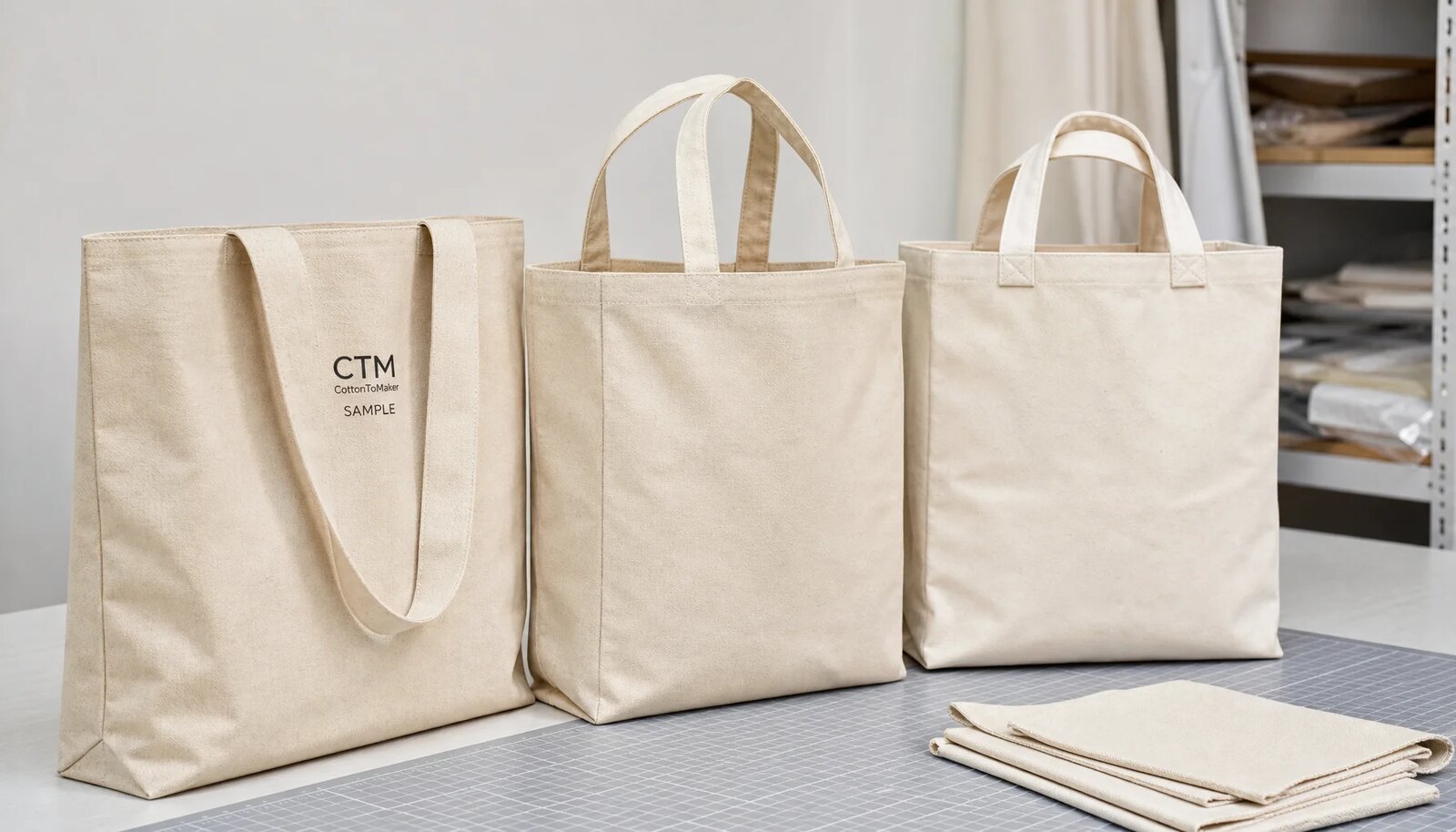
Start With Load, Channel, and Risk
Canvas grocery totes sound simple until buyers compare quotes. The product names are not standardized. One factory may describe an 8 oz flat tote as a grocery bag because it holds brochures and a few light purchases. Another may use the same phrase for a 12 oz gusseted tote with reinforced shoulder handles. If procurement teams compare only the item name and FOB unit price, the lowest quote may be lower because the bag is smaller, the fabric is lighter, the handles are weaker, the sewing is simpler, or the packing is less controlled.
Start the RFQ with the use case. A free entrance bag for maps, flyers, postcards, and sponsor materials does not need the same construction as a paid retail tote used for jars, books, candles, soaps, textiles, produce, or ceramic goods. The better buying question is not just “what fabric weight is best?” It is “what load, price point, appearance, reuse expectation, packing method, and delivery deadline must this tote support?”
For B2B craft fair programs, define the tote's commercial role before asking for price. Promotional bags usually prioritize cost, delivery reliability, and simple printing. Resale bags need better structure, cleaner sewing, attractive folding, and a print that looks deliberate on textured canvas. Vendor packaging must survive concentrated loads and repeated handling. Premium merchandise needs tighter fabric control, stronger visual inspection, and a sample process that reflects real bulk production.
- For light visitor handouts, specify 8 oz canvas around 270 GSM, simple artwork, and modest load expectations.
- For standard reusable grocery use, specify 10 oz canvas around 340 GSM with a real gusset and reinforced shoulder handles.
- For premium resale or branded merchandise, specify 12 oz canvas around 400 GSM with cleaner structure and stronger visual control.
- For heavy vendor loads, specify 14 oz canvas around 475 GSM only when load testing, retail price, and freight budget justify the upgrade.
- For every quote, state finished dimensions, gusset depth, handle length, fabric weight, print method, packing method, and QC expectations together.
Use Oz and GSM Correctly
Canvas weight is often discussed in ounces by North American buyers and in GSM by mills and factories. For tote sourcing, 8 oz canvas is approximately 270 GSM, 10 oz is approximately 340 GSM, 12 oz is approximately 400 GSM, and 14 oz is approximately 475 GSM. Those conversions help suppliers align quickly, but they are not enough on their own. A quote still needs a tolerance and a verification method.
Treat ounce labels as shorthand, not a complete fabric specification. Suppliers may be referring to greige fabric, dyed fabric, washed fabric, finished fabric, or a stocked fabric sold under a trade name. Dyeing, washing, starching, softening, coating, and moisture content can all change handfeel. A stiff tote is not automatically stronger; it may be heavily finished. A softer tote may still meet GSM but look less structured on a craft fair display table.
For procurement control, the purchase order should state target weight, approximate conversion, acceptable tolerance, and how the factory or inspector will verify it. A common commercial tolerance is ±5% on finished bulk fabric when both sides agree. Ask whether the supplier can cut a known fabric area, weigh it, and calculate GSM from the actual bulk material. That evidence is more useful than a catalog name, mill label, or verbal assurance.
- Write “10 oz canvas, approximately 340 GSM, finished fabric tolerance ±5%” instead of “medium canvas.”
- Ask whether the quoted fabric weight is measured before dyeing, after dyeing, after washing, after finishing, or at cutting.
- Do not compare natural canvas and dyed canvas as if only color changed; dyeing affects MOQ, shade control, lead time, and cost.
- Ask whether softener, starch, coating, washing, or enzyme treatment is used because finish changes handfeel and print behavior.
- Require written approval before any supplier substitutes a lower GSM, different weave, different blend, or different finish.
Choose Weight by Commercial Position
Most craft fair tote programs land in one of four positions: economical giveaway, standard reusable grocery tote, premium retail merchandise, or heavy-duty vendor tote. Each one has a different cost and risk profile. Fabric weight affects material cost, sewing time, print behavior, carton cube, freight cost, and how customers judge value. More weight is not always better. Less weight is not always wrong.
An 8 oz canvas tote can work well for broad distribution and light-duty use. It folds easily, keeps unit cost down, and usually suits simple one-color artwork. The tradeoff is panel sag, reduced opacity, and a less premium feel, especially on larger bags. Avoid pairing a very large grocery shape with 8 oz fabric unless the program is clearly light-duty and the handles are still reinforced.
A 10 oz tote is often the practical middle option for craft fairs. It can support repeated market use when the size is reasonable, the gusset is real, and the handle attachment is controlled. A 12 oz tote gives more structure and a stronger retail feel for gift shops, event merchandise, and branded vendor packaging. A 14 oz tote should be treated as a specialty choice for heavier contents or rugged positioning because it increases fabric consumption, seam bulk, carton weight, and the need for careful print and sewing checks.
- Use 8 oz for giveaways, sponsor bags, light market shopping, and low-unit-cost promotional programs.
- Use 10 oz for standard reusable grocery totes when buyers need reliable function without premium material cost.
- Use 12 oz for paid retail totes, gift shop programs, premium craft fair branding, and bags displayed on hooks or shelves.
- Use 14 oz for books, jars, ceramics, candles, or rugged merchandise only after confirming sewing quality and handle comfort.
- Do not choose fabric weight alone; pair each weight with correct size, gusset, handle, thread, seam, print, and packing requirements.
Specify Size, Gusset, and Capacity
Fabric weight does not fix a capacity problem. A flat tote made from heavy canvas can still behave poorly as a grocery tote because it has little bottom volume. For craft fair use, a side and bottom gusset, boxed bottom, or T-bottom is usually more practical. These constructions help the bag carry irregular purchases without forcing all stress into the side seams.
State finished dimensions after sewing, not cutting dimensions. A common grocery tote range is 35-40 cm wide, 38-45 cm high, and 10-15 cm deep, but the best size depends on what the tote must carry and how it will be displayed. A candle or jar vendor may prefer a shorter, wider bag that sits securely. An event organizer may want a taller tote for posters, catalogs, textiles, and mixed purchases. A retail buyer may need a shape that folds cleanly and fits an existing fixture.
Measurement points matter. Width may mean front-panel width, flat width including side folds, or total cut width before sewing. Height may be measured from the top edge to the bottom seam, or to the lowest point of a boxed base. Gusset depth may be checked at the side, bottom, or opened base. If those points are not defined, two suppliers can quote the same nominal size and deliver bags with different real capacity.
- Specify finished dimensions such as 38 W x 42 H x 12 D cm instead of only “large grocery tote.”
- Confirm whether the tote is flat, side-gusseted, bottom-gusseted, boxed-bottom, T-bottom, or made with a separate base panel.
- Set finished-size tolerance, commonly ±1 cm for body width and height unless the program requires tighter control.
- Request a loaded sample photo using representative products such as jars, folded textiles, produce, books, or boxed items.
- Confirm whether the bag must stand open, hang flat, fold compactly, fit a display bin, or ship efficiently in cartons.
Engineer Handles Before Upgrading Fabric
Handle failure is one of the fastest ways for a grocery tote to disappoint customers. A buyer may specify 12 oz canvas and still receive a weak bag if the handle attachment is poorly sewn. Handle material, width, length, placement, reinforcement, seam allowance, thread tension, and stitch pattern deserve the same attention as fabric weight.
Shoulder handles around 65-70 cm are common because craft fair shoppers may carry the tote while walking for hours and holding other purchases. Shorter handles can reduce cost and make the bag look compact, but they are less convenient for grocery use. Wider handles improve comfort, especially with heavier canvas or dense contents. Very narrow handles can dig into the shoulder even when the body fabric is strong.
Ask how the handles are made and attached. Self-fabric handles can look coordinated and premium, but they use more material and can become bulky on 12 oz or 14 oz canvas. Cotton webbing handles can be efficient and strong, yet the webbing width, weave, color, shrinkage, and handfeel still need approval. Box-X stitching, cross-stitch reinforcement, or bar-tacks should be written into the specification. “Reinforced handles” is too vague to inspect consistently.
- Define handle length, width, material, color, placement from side seams, and reinforcement pattern in the specification sheet.
- Use box-X, cross-stitch, bar-tack, or equivalent stress-point reinforcement for reusable grocery loads.
- Check handle comfort by loading the sample and carrying it by hand and on the shoulder for several minutes.
- Ask for a hanging load test or pull test with load weight, duration, sample size, and pass-fail criteria stated before production.
- Review stitch density and seam allowance at handle points because weak sewing can defeat otherwise strong canvas.
Match Print Method to Canvas Texture
Most canvas grocery totes for craft fairs use screen printing. It is practical for bold logos, sponsor marks, event names, and one-to-three-color artwork. Natural canvas can print well, but its texture may interrupt fine lines, small reversed text, and delicate details. A digital mockup helps with scale and placement. It does not prove ink opacity, edge sharpness, or adhesion on the actual fabric.
Heat transfer may be suitable for complex artwork, gradients, small quantities, or many colors where screen setup is not economical. The tradeoff is handfeel; the print may sit on the fabric instead of looking integrated into the canvas. Digital printing can support detail, but color accuracy, wash behavior, cost, and production consistency depend on fabric, pretreatment, printer setup, and ink system. Embroidery can look premium for a small mark, though large embroidery areas may pucker the panel and add cost quickly.
Approve a print strike-off on the exact production canvas weight, fabric color, fabric finish, ink system, and print size. This is especially important for 12 oz and 14 oz canvas, dark dyed fabric, large ink coverage, fine-line artwork, and prints close to seams or folds. Check opacity, registration, edge quality, rubbing, cracking, peeling, and whether the print still looks acceptable after the planned packing fold.
- Use screen print for bold craft fair logos, sponsor graphics, retail brand marks, and simple one-to-three-color designs.
- Use heat transfer or digital print only when artwork complexity, low MOQ, or variable designs justify the tradeoff.
- Avoid tiny serif text, thin outlines, small reversed type, and large solid ink blocks unless tested on production canvas.
- Define print size, print position from finished seams, ink references, registration tolerance, and whether front-only or two-sided printing is included.
- Require a strike-off before bulk production when artwork quality matters or when fabric weight, fabric color, or finish changes.
Control MOQ and Cost Drivers
MOQ is shaped by more than factory preference. It depends on fabric availability, dye-lot size, cutting efficiency, sewing-line setup, print screens, packing labor, and the number of SKUs. Natural canvas is usually the most flexible because it is commonly stocked. Custom dyed canvas often requires higher MOQ because the fabric must be dyed, matched, dried, finished, tested, and cut as one controlled lot.
The main cost drivers are fabric weight, finished size, gusset depth, handle material, print colors, print area, labels, hangtags, barcodes, packing method, and inspection requirements. Heavier canvas increases material use and carton gross weight. Deeper gussets require more fabric and sewing time. More print colors add screens, setup, ink control, drying control, and approval steps. Individual polybags, retail labels, hangtags, and barcode stickers add labor and carton volume.
If several craft fair designs are being ordered, the best cost strategy is often to standardize the blank tote. Use the same fabric weight, color, size, handle construction, and packing method, then vary the printed artwork. This lets the supplier buy and cut one fabric lot while managing separate print setups. It also simplifies incoming inspection, warehouse receiving, reorder planning, and replacement stock.
- Quote natural canvas separately from bleached, dyed, organic, recycled, washed, coated, or blended canvas options.
- Ask MOQ by fabric color, size, handle construction, artwork, print method, and packing method rather than accepting one generic MOQ.
- Consolidate multiple craft fair designs on the same blank tote to reduce fabric waste and simplify production control.
- Expect heavier canvas to raise FOB cost, carton gross weight, freight cost, and warehouse space requirements.
- Use individual polybags only when retail presentation, barcode control, or distribution rules require them; otherwise consider bulk or bundle packing.
Approve Samples That Match Bulk
Sampling should prove the production standard, not just the general idea of a tote bag. A shape sample made from substitute fabric can help confirm dimensions early, but it should not be the final approval for bulk. The final pre-production sample should use the correct canvas weight, fabric color, handle construction, stitch pattern, print method, label, hangtag if any, and intended packing fold.
For time-sensitive craft fair orders, split sample approval into checkpoints. First approve the fabric swatch so color, weave, and handfeel are directionally correct. Then approve the blank structural sample for size, gusset, handles, seams, and sewing method. Next approve the print strike-off. Finally approve the full pre-production sample and, when presentation matters, a packed sample or carton photo. This staged process reduces the chance of discovering basic construction or print issues after fabric has been cut.
Test the sample like a buyer, not only like a merchandiser. Load it with representative goods, carry it by the handles, fold it the way it will be packed, rub the printed area lightly, and review the tote under consistent lighting. If the bag will be resold, check how it looks stacked, hung, banded, or polybagged. Keep one signed or sealed approval sample with the supplier and one with the buyer or inspection team.
- Approve a fabric swatch, blank structural sample, print strike-off, pre-production sample, and packed sample when order risk justifies it.
- Measure the sample against finished dimensions, gusset depth, handle length, handle width, handle placement, and print position from seams.
- Load the sample with realistic contents for several hours to observe handle stress, seam distortion, and bottom shape.
- Check whether the approved packing fold creates unacceptable creases through the printed logo or front panel.
- Keep matched approval samples at the factory and with the buyer so final inspection has a physical reference.
Set QC Thresholds Before Cutting
Quality control should focus on failures that affect real craft fair use: handles tearing, seams opening, prints rubbing off, bags arriving stained, carton assortments being wrong, or dimensions varying between lots. A few loose threads may be minor. Wrong artwork, wrong fabric color, failed handles, or incorrect fabric weight can make the order commercially unusable. Define critical, major, and minor defects before cutting and sewing begin.
Measurable thresholds reduce disputes. Finished body size might allow ±1 cm. Print placement might allow ±0.5-1 cm depending on artwork size and visibility. Handle length might allow ±1.5 cm. Fabric GSM might allow ±5% unless otherwise agreed. Color should be checked under consistent lighting against the approved fabric swatch, lab dip, ink drawdown, or strike-off. If using AQL or another sampling standard, state the inspection level, acceptable quality limits, and defect classifications in the purchase order.
Inspection should cover both product and packing. Product checks include fabric defects, size, gusset, stitch tension, seam allowance, handle reinforcement, print quality, odor, cleanliness, and count. Packing checks include carton strength, carton marks, assortment, barcode or label accuracy, pieces per carton, gross weight, net weight, and whether the folding matches the approved sample. For larger orders, cartons should be selected from early, middle, and late production to catch lot variation.
- Classify critical defects such as wrong artwork, wrong fabric color, broken handles, open seams, contamination, or unsafe foreign objects.
- Classify major defects such as incorrect gusset depth, failed handle test, fabric holes, poor stitch tension, obvious shade mismatch, or print misregistration.
- Classify minor defects such as small loose threads, slight fold marks, or minor shade variation within the approved tolerance.
- Verify actual fabric weight from bulk material using a measured-area GSM check rather than only a mill label.
- Require inspection photos of measurements, handle reinforcement, print close-ups, inside seams, carton labels, and packed goods.
Plan Packing, Freight, and Event Timing
Packing choices can change both landed cost and event readiness. A 12 oz gusseted tote takes more carton space than an 8 oz flat tote. A 14 oz tote can raise gross weight enough to affect freight planning and manual handling. If bags are compressed too tightly, heavy creases may run across the logo and make the tote look less valuable at the craft fair table.
Ask for pieces per carton, carton dimensions, gross weight, net weight, packing fold, inner bundle method, carton mark format, and whether individual polybags are included. Bulk packing is efficient for event handouts and wholesale distribution. Counted bundles or paper bands help receiving teams control quantity while reducing individual plastic use. Individual polybags may be appropriate for retail resale, barcode scanning, or multi-location distribution, but they add labor, cost, and volume.
Build the schedule backward from the fair date, not forward from the supplier's best-case production estimate. Include artwork preparation, sample making, courier transit, buyer review, fabric purchasing, dyeing if applicable, cutting, sewing, printing, drying, final inspection, carton correction if needed, export booking, customs clearance, domestic freight, and repacking. Natural canvas with simple screen print is usually the lowest-risk path. Custom dyed fabric, multiple artworks, retail labeling, individual packing, and late artwork revisions add risk.
- Request carton quantity, carton dimensions, gross weight, net weight, packing fold, inner bundle method, and carton marks in the quote.
- Use bulk packing for event distribution, bundle or paper band packing for counting control, and polybags only when retail handling requires them.
- Avoid folding directly through large dark prints or thick ink areas unless the packed sample proves the crease is acceptable.
- Book inspection before production is complete so the supplier and inspector can reserve the release date.
- Add schedule buffer for custom dyeing, artwork revisions, print strike-offs, peak season capacity, freight booking delays, and carton rework.
Specification comparison for buyers
| Spec decision | Recommended option | When it fits | Buyer risk to check |
|---|---|---|---|
| Low-cost visitor giveaway tote | 8 oz canvas, approximately 270 GSM, finished GSM tolerance normally ±5% if agreed, flat or shallow gusset construction | Sponsor bags, entry handouts, brochures, postcards, maps, lightweight craft fair purchases, low-price promotional programs | Can feel thin on large panels; confirm finished dimensions, actual GSM test method, seam allowance, handle reinforcement, opacity, and whether the supplier is quoting true canvas or a lighter plain cotton fabric |
| Standard craft fair grocery tote | 10 oz canvas, approximately 340 GSM, 35-40 cm W x 38-45 cm H x 10-12 cm gusset, 65-70 cm shoulder handles | Most reusable market bags for makers, farm stalls, fair organizers, subscription boxes, and mid-price resale programs | Some suppliers round 9 oz, 9.5 oz, and 10 oz under one label; require GSM result from bulk fabric, pre-production sample, and defined handle load test |
| Premium reusable grocery tote | 12 oz canvas, approximately 400 GSM, defined side and bottom gusset or boxed bottom, reinforced handle attachment | Retail brands, museum shops, gift shops, premium craft fair merchandise, vendor packaging for heavier handmade goods | Higher fabric consumption, folded bulk, and carton weight affect freight and storage; approve carton quantity, packing fold, print strike-off, and user comfort |
| Heavy-duty vendor or merchandise tote | 14 oz canvas, approximately 475 GSM, stronger thread, adequate needle size, wide handles or durable webbing | Books, jars, ceramics, candles, small home goods, premium rugged positioning, heavier multi-item purchases | Can be stiff, costly, and harder to sew cleanly at corners; inspect needle holes, seam bulk, skipped stitches, print coverage, and handle comfort before bulk release |
| Finished tote dimensions | State finished measurements after sewing, for example 38 cm W x 42 cm H x 12 cm D, with measurement points defined | Procurement buyers need comparable capacity and carton planning, not only a style name or cutting pattern | Factories may quote cutting size, flat width including folds, or front-panel width; specify finished body width, height, gusset depth, and accepted tolerance |
| Gusset construction | Side plus bottom gusset, boxed bottom, T-bottom, or separate base panel depending on capacity and display need | Grocery use, vendor resale, booth packaging, and bags that must stand or hold irregular goods | A flat tote in heavy canvas can still have poor grocery capacity; request sample photos loaded with representative products |
| Handle construction | Cotton webbing or self-fabric handles, 2.5-3.8 cm wide, 65-70 cm shoulder length, box-X, cross-stitch, or bar-tack reinforcement | Long craft fair visits, grocery loads, retail reuse, and vendor packaging where handle failure creates complaints | Thin handles and weak stitch patterns fail before body fabric; define handle length tolerance, stitch density, reinforcement area, and load test pass criteria |
| Print method on canvas | Screen print for 1-3 spot colors; heat transfer or digital print only when design complexity, small MOQ, or multi-color artwork requires it | Craft fair logos, sponsor marks, shop branding, seasonal artwork, and vendor collections | Canvas texture breaks fine lines and reversed text; require strike-off on exact bulk fabric weight, color, finish, ink system, and print size |
| Fabric color planning | Natural canvas for MOQ flexibility; bleached, dyed, organic, recycled, washed, or coated canvas quoted as separate options | Distributor assortments, retail programs, craft fair organizer merchandise, and brand-controlled colorways | Custom dye lots create shade and MOQ risk; require approved lab dip or swatch, color tolerance method, and confirmation that GSM is measured after finishing |
Buyer checklist before sampling
- Define the tote's commercial role first: free visitor giveaway, standard reusable grocery tote, premium retail tote, or heavy-duty vendor packaging tote.
- Specify finished dimensions after sewing, including body width, height, side gusset, bottom gusset or boxed bottom depth, and measurement points.
- State fabric weight in both ounces and GSM, such as 10 oz / approximately 340 GSM, with an agreed tolerance such as ±5% on finished bulk fabric.
- Ask whether the quoted weight is measured on greige fabric, dyed fabric, washed fabric, finished fabric, or the final production fabric delivered to cutting.
- Separate natural, bleached, dyed, washed, coated, organic cotton, recycled cotton blend, and cotton-poly blend options in the RFQ instead of mixing them in one price comparison.
- Define handle material, handle length, handle width, handle placement from side seams, reinforcement pattern, thread type if required, and load-test expectation.
- Set seam details: seam allowance, stitch density target, stress-point reinforcement, inside finishing method, and whether loose threads must be trimmed.
- Send production-ready artwork with print size, print position from finished seams or top edge, number of colors, Pantone or ink reference, and acceptable registration tolerance.
- Require a fabric swatch, blank structural sample, print strike-off, pre-production sample, and packed sample when quantity, resale value, or event date creates material risk.
- Ask suppliers to quote MOQ by fabric color, bag size, handle construction, artwork, print method, packing method, and whether several artworks can share one blank tote lot.
Factory quote questions to send
- What is the exact target canvas weight in ounces and GSM, and what finished-fabric tolerance can you control during bulk inspection?
- Is the quoted material natural cotton canvas, bleached canvas, dyed canvas, washed canvas, coated canvas, recycled cotton blend, organic cotton canvas, or another blend?
- Is fabric weight measured on greige fabric, after dyeing, after washing, after finishing, or on the final material actually used for bulk cutting?
- Can you provide yarn count, weave description, cotton content, finishing process, and whether the finish includes softener, starch, coating, washing, or enzyme treatment?
- Are the quoted dimensions finished dimensions after sewing, or cutting dimensions before sewing, shrinkage, and seam allowance?
- Where exactly do you measure body width, body height, side gusset, bottom gusset, handle length, and print position?
- What is the gusset construction: flat tote, side gusset only, bottom gusset, boxed bottom, T-bottom, or separate base panel?
- What handle material, handle width, handle length, handle placement, reinforcement pattern, and reinforcement stitch count are included in this price?
- What thread type, stitch density, seam allowance, inside seam finishing, and stress-point reinforcement are standard for this construction?
- What hanging load or pull test do you recommend for this tote, and what load, duration, and pass-fail criteria can you document?
Quality-control points to confirm
- Fabric weight should be verified by cutting a measured area from bulk fabric and weighing it, then converting to GSM, not only by reading a mill label or supplier style name.
- Finished tote dimensions should be checked at defined measurement points, commonly with tolerance such as ±1 cm for body width and height and ±1.5 cm for handle length unless the order specifies otherwise.
- Gusset depth should be measured consistently at the side and bottom because a small reduction in gusset depth can materially reduce grocery capacity.
- Handle attachment should pass the agreed hanging load or pull test without seam tearing, stitch popping, fabric distortion, broken thread, or handle elongation beyond the agreed limit.
- Handle placement should be symmetrical from side seams and top edge so the loaded tote hangs evenly and does not twist during use.
- Seams should show balanced stitch tension, adequate seam allowance, no skipped stitches, no open seams, no loose thread nests, and consistent reinforcement at stress points.
- Stitch density should be checked against the approved sample because loose stitch spacing can reduce strength even when canvas weight is within tolerance.
- Print adhesion should pass agreed dry rub and light wet rub checks without heavy ink transfer, cracking, peeling, or missing ink on raised canvas texture.
- Print placement should be measured from finished seams or top edge, not from a rough fold line, with tolerance agreed before bulk printing.
- Print color should be checked against the approved ink reference or strike-off under consistent lighting, especially for dyed canvas and brand-color artwork.