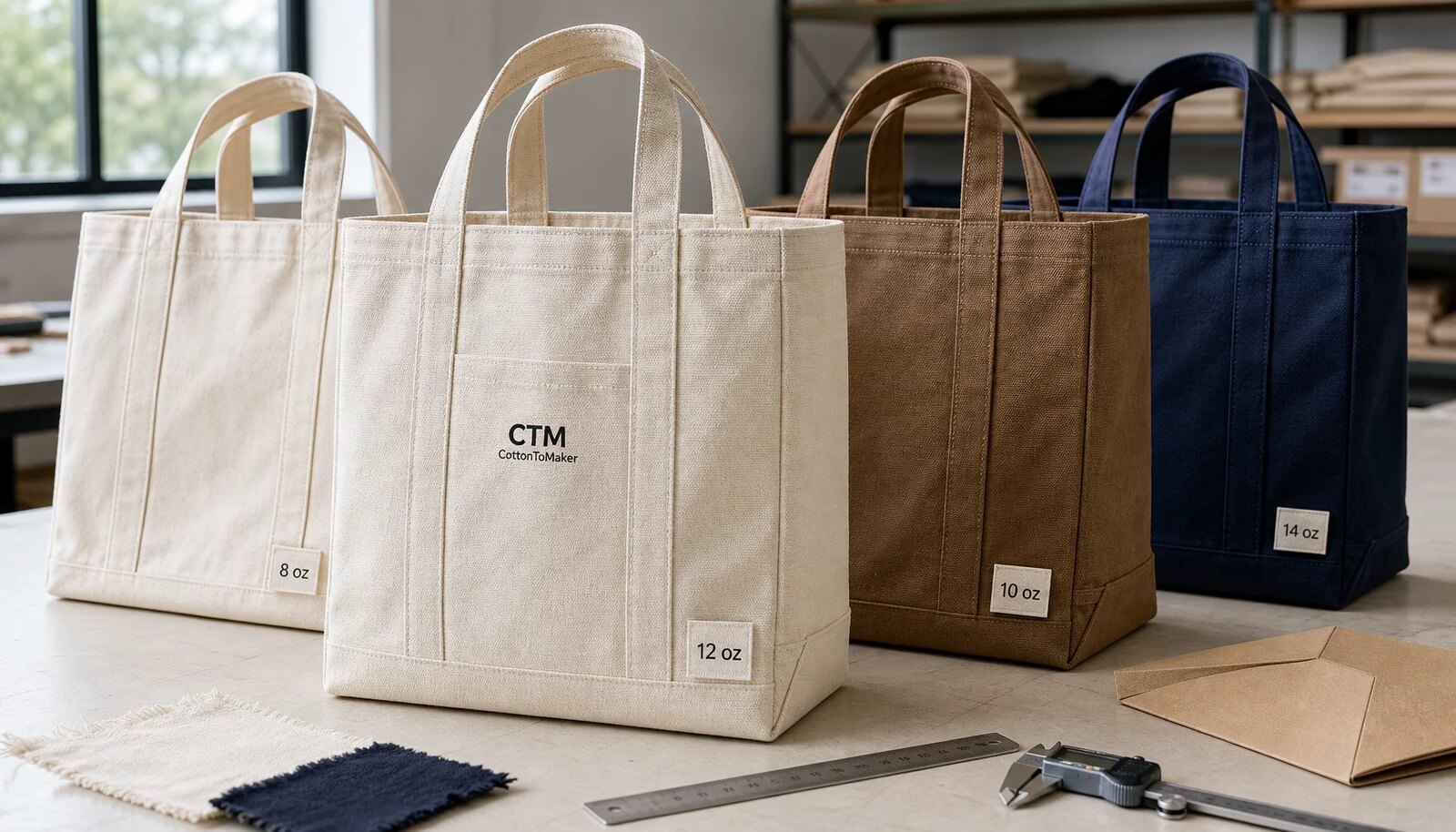
Start With the Carrying Job, Not the Fabric Label
A canvas grocery tote for a coffee roaster has to do a specific job. Sometimes it is a low-cost café giveaway. Sometimes it is paid merchandise on a retail shelf. It might be a subscription insert, a wholesale partner promo, a loyalty reward, or the carrier for a holiday bundle. Those uses look similar in a mockup, but they should not be sourced the same way. A bag that carries two coffee pouches from the counter to a car does not need the same fabric, gusset, handle drop, or load test as a grocery tote expected to carry coffee, oat milk, jars, filters, cans, and produce every week.
Start the RFQ with the contents. Write the expected load in simple, checkable terms: four to six 250 g coffee bags, four 12 oz coffee bags, two oat milk cartons, a boxed brewer, retail accessories, canned cold brew, or a mixed grocery load. This tells the factory where the bag will be stressed. The weak point may be the handle base, top hem, bottom seam, gusset corner, or a printed fold line. Once that is clear, the buyer can decide whether the answer is heavier canvas, better reinforcement, a deeper gusset, or a different packing method.
Fabric weight matters, but it is not the whole bag. A stable 10 oz canvas tote with a good top hem, proper seam capture, and reinforced handles can outperform a loose 12 oz tote made with weak stitching. On the other hand, a 14 oz tote can look excellent in a café display while adding freight volume, stiff folds, slower sewing, and more visible needle marks. The goal is not to buy the heaviest tote. The goal is to buy the lowest-risk tote that matches the customer promise, retail price, and landed cost target.
- Define the use case before asking for prices: giveaway, paid merchandise, grocery replacement, subscription insert, wholesale promo, or gift carrier.
- List the expected contents and approximate weight instead of using vague terms such as strong, durable, or heavy duty.
- Choose fabric weight together with gusset, handle drop, stitch reinforcement, print method, and packing plan.
- Use a stricter appearance standard for paid merchandise than for a free event handout.
- Keep the customer promise realistic: a light promo tote should not be marketed as a weekly grocery replacement bag.
Understanding Oz, GSM, and Finished Canvas Weight
Canvas is often sold by ounce weight, but procurement teams should ask for GSM as well. Ounces usually describe fabric weight per square yard. GSM means grams per square meter. Both can be useful, yet neither tells the full story without a swatch. Two suppliers may both say 10 oz canvas, while one fabric feels tighter, denser, or stiffer because of yarn count, weave density, finishing, or moisture content. GSM gives buyers a more measurable comparison point, but it still needs a tolerance and a physical reference.
For early screening, useful reference ranges are 8 oz at about 270 GSM, 10 oz at about 340 GSM, 12 oz at about 410 GSM, and 14 oz at about 475 GSM. Treat these as practical guides, not universal rules. A tightly woven 10 oz fabric can feel firmer than a looser 12 oz fabric. Washed canvas may feel thicker or softer after processing without automatically improving load performance. Dyed canvas may shrink differently and may react to ink differently from natural unbleached canvas.
The number buyers need is the finished production fabric weight. Ask whether the weight is measured in greige form, after dyeing, after washing, after printing, or after all finishing. A quote that only gives the pre-finish weight can create disappointment when the bulk bag feels lighter or softer than the approved sample. Many canvas tote programs use a finished GSM tolerance around plus or minus 5% when no special laboratory standard is required. If the program is premium retail merchandise, you can request a tighter range, but it must be agreed before the purchase order and realistic for the fabric source.
- Ask for oz and GSM on the quotation, sample tag, swatch label, invoice specification, and QC checklist.
- Confirm whether the weight is measured before or after dyeing, washing, printing, or final finishing.
- Record the approved swatch with supplier, date, project code, color, finish, oz, GSM, and intended order.
- Use GSM tolerance language in the PO so receiving teams know when a fabric-weight issue is a claimable defect.
- Do not treat words like premium, thick, heavy canvas, or grocery grade as specifications unless they are backed by measurable data.
Choosing 8 oz, 10 oz, 12 oz, or 14 oz
For many coffee roasters, the practical sweet spot is 10 oz to 12 oz canvas. A 10 oz tote can offer a good balance of hand-feel, printability, sewing speed, carton density, and landed cost. It is often suitable for café merchandise, reusable retail bags, local customer purchases, and loyalty programs when the construction is right. A 12 oz tote usually feels more substantial. That extra hand-feel can help when the bag is being sold, bundled with premium coffee, or positioned as a more durable grocery-style item.
Do not dismiss 8 oz canvas automatically. It can be the right choice for café openings, trade shows, event handouts, subscription inserts, and short-distance promotional use. The important part is positioning. Call it a light reusable tote or promo carry bag, not a heavy-duty grocery replacement. Test dark ink for strike-through. Check whether the body fabric distorts at the handle base when loaded with the expected coffee bags. If the sample looks good empty but twists or pulls badly when filled, the cost saving may turn into a brand problem.
A 14 oz tote sits in a different category. It can suit paid merchandise, premium gift bundles, and retail programs where the tote itself is part of the product value. Still, heavier is not always simpler. The factory may need larger needles, stronger thread, slower sewing, and more careful fold control. The finished totes may take more carton space, reducing pieces per carton and increasing CBM. Dense prints on thick folded canvas can show pressure marks or cracking if packed too tightly. Before bulk production, approve the full tote and the way it will be folded and shipped.
- 8 oz: use for light promotional campaigns, event giveaways, and inserts where cost and distribution volume matter most.
- 10 oz: use for everyday café retail and reusable carry bags when good construction and moderate landed cost are priorities.
- 12 oz: use for more premium grocery-style totes, paid merchandise, and repeated local shopping use.
- 14 oz: use for structured premium merchandise or gift bundles when higher material, sewing, and freight costs are acceptable.
- Repeat print, sewing, load, and packing checks if the fabric weight changes after sample approval.
Size, Gusset, and Handle Drop Drive Usability
A tote can be made from the right canvas weight and still disappoint customers if the shape is wrong. Coffee bags, jars, cans, filters, boxed brewers, bakery items, and retail accessories all sit differently inside a bag. Flat totes are efficient to cut, sew, fold, and ship. For grocery-style use, though, a side gusset, bottom gusset, or boxed bottom often makes the bag easier to load. A gusset helps coffee bags stand more naturally and reduces pressure on side seams. For gift sets, the bottom shape may matter more than moving from 10 oz to 12 oz fabric.
The RFQ should state finished dimensions, not just a visual mockup. Include finished body width, finished height, side gusset, bottom gusset, top hem depth, handle width, and handle drop. Also state when those dimensions are measured. Is it after sewing? After pressing? After washing? After final finishing? If a supplier measures cut panels instead of finished totes, the delivered bags may feel smaller than expected. A small tolerance table prevents arguments later.
Handle drop deserves real attention. A short hand-carry handle can reduce cost and may look tidy on a café fixture, but grocery users often expect a shoulder carry. A shoulder-friendly handle drop often sits around 25-30 cm, though the right target depends on the market, tote size, and product load. Longer handles use more material and create more leverage at the attachment point, so the handle base must be reinforced properly. A comfortable handle with weak stitching is not a usable grocery tote.
- Specify finished width, height, side gusset, bottom gusset, top hem depth, handle width, and handle drop in the tech pack.
- Use real coffee bags and retail items to test whether the tote loads easily and stands acceptably when filled.
- Select self-fabric handles for a consistent canvas look or cotton webbing handles for a stable, clean, repeatable handle option.
- Require box stitch, cross-stitch, bartack, or equivalent reinforcement for grocery-style carry rather than straight stitching only.
- Show seam allowance and handle insertion depth in drawings so the factory does not interpret cut size as finished size.
Canvas Finish: Natural, Bleached, Dyed, or Washed
Natural unbleached canvas is a common fit for coffee roasters because it feels tactile, simple, and reusable. It also tends to be easier to source at smaller quantities than custom dyed fabric. But natural canvas is not pure white and it is not visually perfect. Cotton seed flecks, tiny slubs, and mild shade variation may be normal when they match the approved swatch. Oil stains, mildew marks, watermarks, dirty handling, strong odor, and obvious weaving faults are a different matter and should be listed as defects.
Dyed canvas gives a roaster more control over a brand system or seasonal retail assortment. It also adds sourcing controls. Ask for a lab dip or bulk fabric swatch, define shade tolerance, and confirm whether dyeing changes the MOQ. Dark body colors may need different ink choices to reach the right opacity. Light dyed colors may show lot-to-lot variation. If reorders are likely, keep a physical shade standard from the approved lot and ask the supplier how repeat shades will be managed.
Bleached and washed canvas can work, but neither should be treated as a small cosmetic change. Bleached canvas may give cleaner print contrast, while washed canvas can feel softer and more relaxed. Washing may also change shrinkage, hand-feel, surface texture, dimensions, and GSM. If the final tote is washed after sewing, inspect and measure it after washing, not before. Do not approve a natural canvas sample and assume a dyed, bleached, or washed version will sew, print, fold, or pack the same way.
- Use natural canvas when classic roaster branding, lower complexity, and visible cotton character are acceptable.
- Use dyed canvas when brand color control or retail assortment value justifies lab dips, shade tolerance, and possible higher MOQ.
- Use bleached canvas when cleaner print contrast matters more than a raw natural look.
- Use washed canvas only after confirming shrinkage, hand-feel, print durability, and finished measurements.
- Define acceptable natural flecks separately from stains, odor, mildew, watermarks, oil marks, and large slubs.
Print Specs for Coffee Roaster Artwork
Coffee roaster artwork often has more detail than buyers realize. Circular seals, coordinates, farm or origin names, tasting-note text, small badges, map lines, QR codes, and dense black logos can look sharp on a coffee pouch mockup and then soften on canvas. The weave breaks tiny details. Ink can absorb unevenly. Fine lines may fill in or disappear. Before screens are made, ask the supplier to review minimum line thickness, minimum readable text height, registration risk, and the print size limit for the selected canvas.
Screen printing is usually the safest route for bold one-color to three-color roaster graphics. Water-based ink can give a softer hand and a natural look that works well on cotton canvas, but opacity depends on the fabric color, ink formula, and curing. Plastisol-style ink may deliver stronger surface coverage in some cases, though the hand-feel can be heavier. Heat transfer or digital printing may be useful for full-color artwork or lower quantities, but those methods still need testing for edge clarity, rub performance, finish, and overall brand fit.
The printed strike-off is where many future problems are caught. It should be made on the actual production fabric with the intended ink, mesh or print setup, and curing method. Include the smallest text, thinnest line, largest solid ink area, most color-sensitive logo element, and any QR code. Review it under consistent lighting. Rub it lightly. Fold it the way the finished tote will be folded in the carton. Check for cracking, transfer, blocking, pressure marks, loss of opacity, and blurred edges before bulk panels are printed.
- Use screen print for bold roaster logos, badges, origin graphics, slogans, and repeat merchandise programs.
- Require a production-fabric strike-off for Pantone-critical logos, dense black prints, fine artwork, and QR codes.
- State print size, placement from top and side edges, number of colors, registration tolerance, and whether print may cross a seam or gusset.
- Avoid tiny tasting notes, thin map lines, and small QR codes on coarse 12 oz or 14 oz canvas unless the strike-off proves readability.
- Check folded print areas before bulk packing, especially when ink coverage is heavy or cartons will be tightly packed.
Quote Structure and MOQ Traps
A low tote price is not useful unless the specification is the same. One factory may quote 10 oz natural canvas with one-color printing and bulk packing. Another may quote 12 oz dyed canvas with webbing handles, hangtags, barcode labels, and separated cartons. Those are not comparable offers. A procurement-ready quote should show fabric weight, finished size, gusset, handle type, reinforcement, print method, color count, packing method, pieces per carton, carton dimensions, estimated CBM, sample lead time, bulk lead time, and Incoterm.
MOQ also needs to be broken down by component and process. A supplier may offer a lower MOQ for standard natural canvas because the fabric is in stock. MOQ can rise for dyed fabric, special handle colors, multiple artwork versions, large print areas, hangtags, barcode labels, plastic-free retail packing, or specific carton assortments. A 600 piece order split across three body colors and four prints can be harder to run than a 1,000 piece order of one clean SKU.
Ask for controlled alternatives. For example, request the same size, same handle, same artwork, same print method, and same packing in 10 oz and 12 oz natural canvas. Then request a separate option for dyed canvas or 14 oz premium construction. Keep the variables stable. If fabric, artwork, handle, packing, and carton quantity all change at once, you will not know whether the price difference comes from material, labor, printing, setup, or logistics.
- Compare suppliers using the same finished size, fabric weight, handle construction, artwork, print method, and packing instructions.
- Ask MOQ by fabric, color, handle, artwork, print color count, hangtag, barcode, and carton assortment.
- Request pieces per carton, carton dimensions, gross weight, net weight, and estimated CBM before approving the landed cost.
- Separate standard natural canvas quotes from dyed, washed, premium 14 oz, or retail-packed versions.
- Treat missing packing and carton data as a quote risk because freight can change the true landed cost.
Sample Approval That Matches Bulk Production
A digital mockup is useful for layout, but it cannot prove fabric weight, weave stability, shrinkage, handle comfort, ink absorption, seam strength, or packed appearance. A stronger approval route uses four physical controls: labeled fabric swatch, printed strike-off, full pre-production sample, and sealed reference sample. This sequence helps prevent a common sourcing problem: approving a nice-looking sample that was made from substitute fabric or printed with a method that will not be used in bulk.
The fabric swatch confirms weight, color, finish, texture, and natural-character expectations. The strike-off confirms print color, edge sharpness, opacity, registration, ink hand-feel, curing, and folding behavior. The full pre-production sample proves the complete product: finished dimensions, gusset shape, handle drop, handle width, top hem, seam allowance, stitch density, thread, reinforcement method, print placement, label or hangtag, fold direction, and packing concept.
Review the pre-production sample like it came from the shipment, not like it is a design sketch. Measure it. Load it with the intended coffee bags and grocery items. Carry it, hang it, and inspect the handle bases afterward. Look inside the seams and bottom corners. Fold it using the proposed carton fold and check the print. If the buyer later changes fabric weight, finish, body color, handle material, print size, print method, or packing, repeat the relevant approval step. Small changes can create new production risks.
- Approve the fabric swatch before print testing so the print is tested on the correct canvas.
- Approve the printed strike-off before bulk panels are printed or screens are locked for production.
- Approve the full pre-production sample before cutting or sewing bulk if construction risk is significant.
- Keep one sealed approval sample at the factory and one with the buyer or third-party inspector.
- Repeat sample checks when fabric weight, finish, artwork, print method, handle construction, or packing changes.
QC Tolerances and Inspection Priorities
Canvas grocery tote QC should be measurable. The purchase order should include tolerances for finished dimensions, fabric weight, print placement, shade, stitch quality, and carton packing. For many tote programs, buyers may use finished dimension tolerances around plus or minus 1 cm for body dimensions and tighter placement tolerances for logos when retail presentation matters. The exact numbers should be negotiated with the supplier and matched to the design. Soft sewn goods can move during cutting, sewing, washing, and pressing, so unrealistic tolerances can raise cost and rejection risk.
Define major defects before inspection. For a coffee roaster tote, major defects often include wrong fabric weight, wrong color, weak handle stitching, open seams, missed handle capture, severe twisting, dimensions outside tolerance, print misregistration, ink smears, poor curing, mildew odor, oil stains, dirty handling, mixed SKUs, wrong barcode, or incorrect carton count. Minor issues may include small loose threads or minor natural flecks if they match the approved standard. The QC checklist should make that difference clear.
Load testing should reflect the declared use. If the tote is meant to hold four to six coffee bags plus light groceries, test with a similar weight and shape. Define the test weight, duration, lift or hang method, and pass or fail criteria. After the test, inspect the handle bases, top hem, stitch lines, gusset corners, and bottom seam. A sample that survives one quick lift but shows popped stitches, stretched handle points, or fabric tearing should not be accepted as a grocery-positioned tote.
- Measure finished width, height, side gusset, bottom gusset, top hem, handle width, handle drop, and print position after final finishing.
- Check fabric GSM against the approved tolerance and compare hand-feel to the sealed swatch or approval sample.
- Inspect handle reinforcement, stitch density, seam capture, thread trimming, inside seams, gusset corners, and top hem consistency.
- Check print color, registration, opacity, smearing, pinholes, curing, fold marks, and placement across cartons, not only on top samples.
- Classify oil stains, mildew, odor, watermarks, open seams, broken stitches, and wrong SKU labels as serious shipment risks.
- Use the sealed approval sample during inspection so factory QC, third-party QC, and buyer receiving teams apply the same standard.
Packing, Moisture Control, and Freight Planning
Packing affects both landed cost and how the tote looks when the buyer opens the carton. Heavy canvas folded too tightly can develop hard creases. If the fold line crosses the main logo, a good print can look damaged on arrival. The RFQ should state fold direction, inner quantity, carton quantity, carton dimensions, and whether the printed face needs protection. Fixed inner packs of 10 or 20 pieces often make counting easier and help receiving teams separate SKUs faster.
Fabric weight changes freight math. A 14 oz tote may not look dramatically more expensive at the unit level, but the thicker folded body can reduce pieces per carton and increase CBM. Ask for carton dimensions, net weight, gross weight, and estimated CBM before approving the landed cost. If cartons will be handled manually, keep gross weight practical for the warehouse. If the goods ship to a distributor, café chain, or retailer, carton labels should show PO, SKU, color, artwork version, quantity, carton number, gross weight, net weight, destination, and barcode or routing details.
Cotton canvas needs moisture planning, especially for sea freight, humid seasons, or long warehouse dwell time. Natural canvas can absorb moisture and may develop odor or mildew if cartons are stored or shipped in damp conditions. Buyers can request dry storage, moisture-aware carton handling, desiccants where appropriate, and final carton inspection before shipment. Plastic-free packing can support brand values, but it still has to protect the totes from dirt and moisture. Paper bands, bulk inner bags, and master cartons should be selected for the shipping route, not just for appearance.
- Specify fold direction so the main logo is not sharply creased through the print center.
- Set fixed inner quantities and carton quantities so receiving teams can count and separate SKUs quickly.
- Request carton dimensions, pieces per carton, gross weight, net weight, and CBM before finalizing freight estimates.
- Confirm barcode, hangtag, paper band, polybag, or plastic-free packing requirements before production starts.
- Use moisture-control planning for cotton canvas during sea freight, humid seasons, or long warehouse dwell times.
- Audit carton labels against PO, SKU, artwork version, color, quantity, carton number, destination, and routing requirements.
Specification comparison for buyers
| Spec decision | Recommended option | When it fits | Buyer risk to check |
|---|---|---|---|
| Fabric weight for standard roaster retail | 10 oz to 12 oz canvas, typically about 340-410 GSM depending on yarn, weave, finishing, and moisture content | Good balance for branded café merchandise, reusable retail bags, coffee subscription pick-ups, and loads such as four to six 250 g or 12 oz coffee bags plus light groceries | Do not compare ounce labels alone; require finished GSM, GSM tolerance, swatch approval, and confirmation of whether weight is measured before or after dyeing, washing, or final finishing |
| Fabric weight for low-cost campaigns | 8 oz canvas, often about 270 GSM, with conservative load positioning and reinforced handle stitching | Works for café opening giveaways, trade show handouts, subscription inserts, wholesale promos, and short carry distances where unit cost and freight efficiency matter | Avoid calling it heavy duty unless tested; lighter canvas can stretch, show print strike-through, feel less premium, and distort at handle points under repeated grocery loads |
| Fabric weight for premium merchandise | 14 oz canvas, commonly about 475 GSM, with appropriate needle size, stronger thread, reinforced top hem, boxed bottom, and wider gusset where needed | Fits paid merchandise, holiday gift bundles, roaster retail shelves, wholesale partner kits, and premium brand collaborations | Higher material cost, slower sewing speed, thicker folded volume, reduced pieces per carton, visible needle holes, and higher print cracking or pressure-mark risk if folding is not controlled |
| Canvas color and finish | Natural unbleached canvas for classic coffee branding; dyed, bleached, or washed canvas only with shade, shrinkage, and MOQ controls | Natural canvas suits craft roaster positioning and lower complexity; dyed canvas supports brand systems, seasonal SKUs, and retail assortments | Natural seed flecks and small slubs may be acceptable, but oil stains, mildew, watermarks, odor, and dirty handling are not; dyed lots need lab dip, shade tolerance, and crocking review |
| Print method for roaster branding | Screen print with water-based or soft-hand ink for bold artwork; review plastisol, heat transfer, or digital only after sample testing | Best for café logos, badges, slogans, origin graphics, and one to three spot colors on textured canvas | Fine origin text, QR codes, map lines, gradients, and dense ink areas can fail on coarse weave; require a production-fabric strike-off and define print placement tolerance |
| Handle construction | Self-fabric handles or cotton webbing around 30-32 mm wide, attached with cross-stitch, box stitch, bartack, or equivalent reinforcement | Suitable for grocery-style carry, shoulder use, café retail browsing, and repeated customer use | Handle drop, seam capture, stitch density, thread strength, and reinforcement area must match the load claim; short hand-carry handles can reduce cost but disappoint grocery users |
| MOQ and SKU strategy | Keep one fabric weight, one body color, one handle type, and limited artwork versions when order quantity is near MOQ | Best for 300-1,000 piece roaster, distributor, or multi-café orders that need stable cost and manageable QC | Splitting a PO across many colors, prints, handle colors, hangtags, and barcode packs can raise the effective MOQ and create extra screens, setup charges, and inspection complexity |
| Packing and logistics | Flat pack by fixed inner quantity, export carton with agreed fold direction, moisture control, carton markings, and carton weight limits | Best for import orders, distributor receiving, café chains, retail shelf preparation, and clean presentation at arrival | Random folding can crease prints; heavier totes increase CBM; confirm pieces per carton, carton dimensions, gross weight, barcode location, and pallet fit before production |
| Sample approval route | Approve fabric swatch, print strike-off, full pre-production sample, then seal a reference sample for bulk QC | Essential for Pantone-sensitive logos, premium merchandise, paid retail SKUs, launch campaigns, and wholesale partner requirements | A digital mockup does not validate GSM, hand-feel, shrinkage, print absorption, handle comfort, seam strength, load performance, carton fit, or packed appearance |
Buyer checklist before sampling
- Define the commercial role first: free café giveaway, paid merchandise, grocery replacement bag, wholesale partner promo, subscription insert, loyalty reward, holiday bundle carrier, or retail shelf SKU.
- State the expected contents in measurable terms, such as four to six 250 g coffee bags, four 12 oz coffee bags, filters, canned beverages, oat milk cartons, jars, or boxed gift sets.
- Specify finished width, height, side gusset, bottom gusset, top hem depth, handle drop, handle width, seam construction, fabric weight in oz and GSM, and whether dimensions are measured after sewing, pressing, washing, or finishing.
- Request finished fabric GSM with an agreed tolerance, commonly around plus or minus 5% for many canvas tote programs unless a stricter range is written into the purchase order.
- Clarify whether the quoted fabric is greige, natural unbleached, bleached, piece dyed, yarn dyed, washed, laminated, or chemically finished, because each affects shade, shrinkage, hand-feel, MOQ, and print result.
- Request fabric swatches for shortlisted weights and label each swatch with supplier name, fabric source if available, oz, GSM, color, finish, date, and project code.
- Send vector artwork with Pantone references, print size, print position from top and side edges, color count, minimum line thickness, minimum readable text height, and any QR code scannability requirement.
- Ask the factory to flag artwork risks before screens are made, including broken thin lines, ink bleeding, low contrast on natural canvas, registration difficulty, print distortion near seams, and heavy ink cracking at fold lines.
- Require a printed strike-off on actual production fabric using the intended ink system and curing method before bulk fabric is cut or bulk panels are printed.
- Approve a full pre-production tote that confirms fabric hand-feel, finished dimensions, gusset shape, handle comfort, seam allowance, stitch density, reinforcement, print placement, folding method, and packed appearance.
Factory quote questions to send
- What is the finished fabric weight in both oz and GSM, and is that weight measured before dyeing, after dyeing, after washing, after printing, or after all final finishing?
- What GSM tolerance will you commit to in production, and how will fabric weight be checked during incoming fabric inspection or bulk cutting?
- Can you provide labeled swatches for 8 oz, 10 oz, 12 oz, and 14 oz canvas from the same mill or current stock source, with GSM, color, finish, and date marked on each swatch?
- What yarn count, weave density, shrinkage expectation, or practical hand-feel difference should we expect between your 10 oz and 12 oz canvas options?
- Is the quoted canvas natural unbleached, bleached, piece dyed, yarn dyed, washed, or chemically finished, and what natural flecks, slubs, shade variation, or surface irregularity should be considered acceptable?
- What is the MOQ by fabric weight, body color, handle material, handle color, print artwork, print color count, hangtag, barcode, and packing method?
- Which print method do you recommend for our artwork, and what minimum line thickness, text height, QR code size, halftone limitation, or registration tolerance may fail on the selected canvas?
- Will you make a printed strike-off before the full pre-production sample, and will it use the actual production fabric, same ink, same mesh or print setup, and same curing process intended for bulk?
- What handle reinforcement is included in the quote: cross-stitch, bartack, box stitch, folded seam capture, extra backing patch, or only straight stitching?
- What stitch density, thread type, needle size range, seam allowance, and inside seam finishing will be used for the body, gusset, top hem, and handle attachment?
Quality-control points to confirm
- Fabric weight tolerance should be written into the PO; for many canvas grocery tote orders, buyers use a practical finished GSM tolerance around plus or minus 5% unless a stricter range is required and accepted by the supplier.
- Finished dimensions should be measured after sewing, pressing, washing, or final finishing, not only from the cutting pattern; body width, height, side gusset, bottom gusset, top hem, handle width, and handle drop need separate tolerance lines.
- Handle attachment should pass the declared load test without seam tearing, stitch popping, bartack failure, top hem opening, handle elongation beyond the agreed limit, or visible fabric distortion at the stress point.
- Top hem and handle insertion require close inspection because weak folding, narrow seam allowance, missed seam capture, or poor backstitching can cause failure even when the canvas weight is adequate.
- Stitching should be even and secure, with no skipped stitches, loose threads at handle points, broken needle damage, open seams inside the gusset, twisted handles, uneven top hems, or raw edges where finished seams were specified.
- Print color should be checked under consistent lighting against the approved strike-off, Pantone target, or physical reference while allowing for the influence of natural canvas base color, fabric texture, and ink absorption.
- Print adhesion and curing should pass agreed dry rub, light wet rub if required, and fold checks; ink should not crack, flake, smear, block, or transfer during normal folding and carton packing.
- Registration should be checked for multi-color artwork, especially circular roaster logos, small badges, origin maps, fine line illustrations, and text near the edge of the print area.
- Print placement tolerance should be measured from fixed bag edges after sewing; common inspection points include distance from top hem, side edge, centerline, gusset fold, and bottom seam.
- Natural cotton seed flecks and minor slubs may be acceptable on unbleached canvas, but oil stains, mildew marks, large slubs, dirty handling marks, odor, watermarks, and obvious weaving faults should be classified separately.