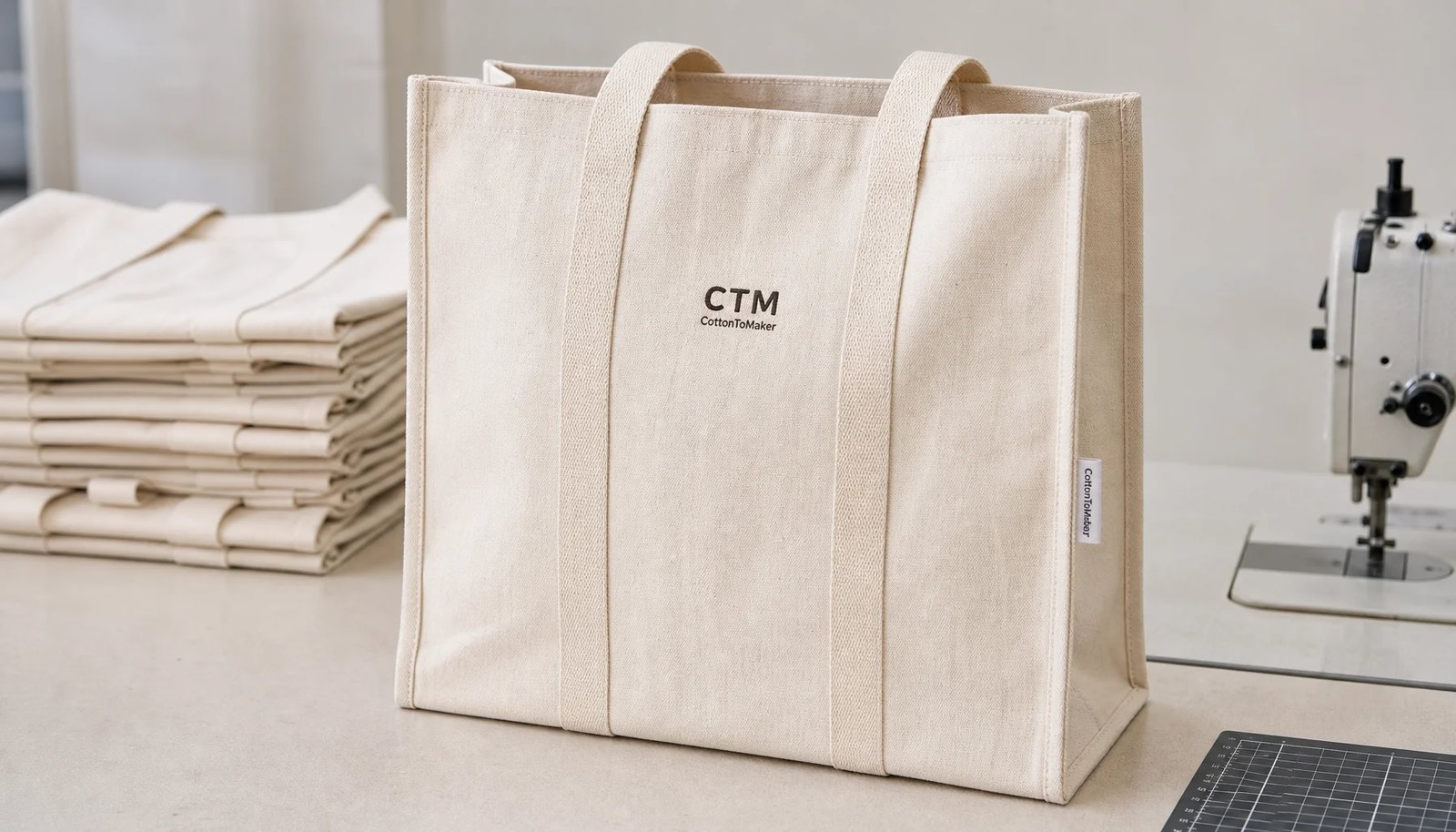
Start With The Event Use
A canvas grocery tote for a trade show is not the same buying decision as a thin cotton giveaway bag. Exhibitors usually need the tote to carry catalogs, swatch cards, samples, water bottles, and other booth material during a long day. That means the RFQ should begin with load, visibility, and handling conditions, not only with logo size and target price.
The best wholesale canvas grocery totes for trade show exhibitors are specified around a finished job: how the bag will sit on a booth table, how it will be handed out, how it will be packed into event kits, and how long the attendee is expected to use it. When those details are missing, suppliers will quote the cheapest interpretation and the buyer will receive offers that are difficult to compare.
- For light brochures only, a 10 oz canvas grocery tote can be acceptable if the seams and handles are reinforced.
- For catalogs, boxed samples, or retail resale, move toward 12 oz canvas or a tested reinforced construction.
- For premium brand positioning, prioritize fabric handfeel, print edge quality, and consistent folding over the absolute lowest unit price.
- For distributor programs with many logos, keep the base bag standardized and change only print artwork to control lead time and MOQ.
Choose Fabric Weight By Function
Canvas weight is one of the first quote variables to lock. Many suppliers quote in ounces while some quote in GSM, and the conversion is not always exact because finishing, washing, and fabric construction affect the final handfeel. As a practical reference, 10 oz canvas is often around 280 GSM, while 12 oz canvas is often around 340 GSM, but the purchase order should state the accepted finished GSM range instead of relying on the ounce label alone.
For trade show use, the fabric should be firm enough to stand partly open and not twist badly when loaded. Natural unbleached canvas has visible cotton flecks and may make some ink colors look warmer. Bleached canvas gives a cleaner print base but can cost more and may need more careful quality control for stains. Dyed canvas adds brand color options, but it normally changes MOQ, lab dip timing, and colorfastness testing.
- Natural 10 oz canvas: cost-efficient for large exhibitor giveaways with simple spot-color logos.
- Natural 12 oz canvas: better structure for grocery-style totes, heavier booth literature, and reusable retail positioning.
- Bleached canvas: better for clean white-background branding, but inspect stains and shade consistency carefully.
- Dyed canvas: useful for brand matching, but include lab dip approval, rubbing fastness, and fabric MOQ in the schedule.
Size And Gusset Affect Usability
A grocery tote needs volume. A common mistake is approving a large flat panel size but ignoring the gusset. The finished bag may look large in a front photo, yet carry poorly because it has no depth. For trade show exhibitors, a bottom gusset of about 8-12 cm is often more useful than adding extra height, because booth materials stack horizontally and attendees want the bag to sit upright when placed on the floor or a chair.
The handle length also deserves more attention than it usually gets. A 55-65 cm shoulder handle works for most event use, especially in cold-weather markets where attendees may wear coats. Wider handles feel more comfortable when the bag is loaded, but they add fabric or webbing cost. If the bag will be placed inside exhibitor welcome kits, confirm the folded size because larger gussets and long handles can affect carton count and kitting efficiency.
- Useful event size range: around 38-42 cm wide by 35-40 cm high with an 8-12 cm gusset.
- Print-safe front panel: keep artwork away from side seams, bottom folds, and heavy crease lines.
- Handle width: 2.5-3.5 cm is a practical range for comfort and cost balance.
- Reinforcement: use cross stitching or bartacks at stress points, especially on 12 oz bags.
Match Print Method To Artwork
Screen printing remains the most practical choice for most wholesale canvas grocery totes. It gives strong color, reliable durability, and predictable cost when the artwork uses one to three spot colors. Water-based ink works well on natural canvas when a softer handfeel is desired. Pigment or plastisol-style options can improve opacity, but the print hand and compliance requirements should be reviewed before approval.
Heat transfer or digital transfer can make sense for small quantities, gradients, or detailed full-color artwork, but it should not be accepted blindly for a large solid logo. Large transfer films can feel stiff on canvas and may crease during folding. Embroidery is usually better for smaller premium marks rather than large front-panel exhibitor branding, because stitch count can increase cost and distort lighter canvas.
- Use screen print for simple logos, large event branding, and repeat distributor programs.
- Use transfer print only when artwork complexity justifies the added film feel and cost.
- Use embroidery for small premium marks, not for large grocery tote panels with fine text.
- Require a print strike-off or full pre-production sample when Pantone color or handfeel matters.
Understand MOQ Logic
MOQ is not only a sales number. It is driven by fabric availability, cutting efficiency, print setup, sewing line scheduling, packing method, and the number of logo versions. Stock natural canvas allows the lowest MOQ because the factory can draw from existing fabric. Custom dyed canvas, custom width fabric, unusual handles, and multiple print colors push the factory toward higher minimums.
For trade show exhibitors, the cleanest buying structure is often one standardized tote with several logo versions. That can work if the print method, print size, bag size, and fabric remain the same. If every exhibitor wants a different fabric color, handle color, label, and carton mark, the order becomes several small productions rather than one bulk order, and the unit price will reflect that.
- Separate MOQ by bag body, fabric color, print design, and packing version.
- Ask whether lower MOQ uses stock fabric, leftover fabric, or a different print method.
- For multi-logo orders, group artwork approvals so the printing line is not stopped repeatedly.
- Do not compare MOQ quotes unless size, fabric, handle, print colors, and packing are identical.
Read The Quote Like A Cost Sheet
A useful quote should show more than one unit price. Procurement teams should be able to see what is included and what is treated as an extra. The most common hidden differences are screen charges, sample fees, custom label cost, carton marking, inner polybag use, export carton quality, and domestic delivery to the forwarder. A quote that looks cheaper may simply have pushed several production items outside the unit price.
Quantity tiers should be requested using realistic event volumes, not random round numbers. For example, 500, 1,000, 2,500, and 5,000 pieces may reveal where printing and sewing efficiency improves. If the buyer needs several event drops over a season, ask whether fabric can be reserved or whether repeat orders are priced independently. Canvas market pricing and dye lots can change, so a quote validity period should be written clearly.
- Unit price: tied to finished bag spec, not a vague canvas tote description.
- Setup cost: screens, films, embroidery digitizing, custom label mold, or packing artwork.
- Sample cost: sample fee, freight, and whether it is refundable after bulk order.
- Logistics data: carton size, gross weight, CBM, port terms, and delivery point.
Approve Samples With Real Criteria
A pre-production sample should be made with the same canvas weight, print method, handle material, sewing construction, and folding method planned for bulk. A photo sample is not enough when the tote will be used at a major event. The buyer should physically load the sample with the intended contents, carry it by hand and shoulder, fold it as packed, and inspect whether the print cracks, marks, or sits too close to creases.
Sample comments should be written as measurable corrections. 'Make it better' creates confusion. A better note is 'move logo 2 cm upward, reduce print width from 30 cm to 27 cm, change handle length from 50 cm to 60 cm, and keep the same canvas weight.' Once approved, the signed sample or clearly photographed sample record becomes the production standard for sewing, print placement, color, and packing.
- Measure finished width, height, gusset, handle length, and handle width.
- Weigh the fabric sample or request a GSM test report if weight is critical.
- Compare print color to Pantone under stable lighting, not under mixed warehouse light.
- Fold the sample for 24 hours and inspect print marks before approving bulk packing.
Set QC Thresholds Before Production
Canvas grocery totes are simple products, but bulk defects can still damage an event program. Common problems include shade variation, loose threads, uneven gussets, handles sewn at different lengths, crooked logos, ink smudges, oil stains, odor, and weak bartacks. These are not issues to discover after cartons arrive at the show warehouse.
A practical inspection plan combines visual checks with functional checks. AQL sampling can cover general workmanship, but the buyer should add specific acceptance criteria for dimensions, print placement, print adhesion, and load performance. If the bag will be sold in retail rather than given away, raise the cosmetic standard and define packaging appearance more tightly.
- Dimension tolerance: define acceptable variation for body size, gusset, and handle length.
- Print tolerance: define position variance and reject heavy smudges, pinholes, and color contamination.
- Load test: agree on test weight and duration based on expected event contents.
- Odor and stains: reject strong chemical odor, mildew smell, oil marks, and visible dirt on the front panel.
Control Packing And Event Handling
Packing is part of the product for trade show orders. Bags may go through a forwarder, distributor warehouse, event advance warehouse, and booth delivery before anyone opens the carton. If the fold is inconsistent or the print is pressed against rough seams, the exhibitor may receive totes with visible creases or scuff marks on the logo area.
Bulk packing is usually the most economical, but it must still be organized. Inner bundles can help counting and kitting. Individual polybags add cost and waste, so they should be used only when retail presentation, moisture control, or kit cleanliness requires them. Carton marks should match the buyer's receiving process, including item number, quantity, event name if needed, and carton sequence.
- Confirm pieces per carton based on actual folded bag volume, not only a factory estimate.
- Keep print panels facing the same direction to reduce scuffing and speed unpacking.
- Use moisture protection when shipping during humid seasons or long ocean transit.
- Mark cartons with SKU, logo version, quantity, gross weight, net weight, and carton number.
Build A Schedule With Buffers
Trade show tote orders have a fixed deadline, so the production plan should work backward from the in-hand date, not the event opening day. The in-hand date should allow time for receiving, internal distribution, booth shipment, and emergency sorting. When the buyer approves artwork late, the lost time usually comes out of sample review, inspection, or freight buffer, which increases risk.
A realistic schedule includes artwork proofing, sample production, sample transit, revision time, bulk fabric preparation, printing, cutting, sewing, inspection, packing, export clearance, and transport. Rush orders can be done in some situations, especially with stock natural canvas and simple screen printing, but the buyer should understand what is being compressed. Skipping the pre-production sample or final inspection may save days and create a larger event problem.
- Reserve extra time for dyed fabric, lab dips, multi-color prints, and multiple logo versions.
- Do not start bulk printing until logo size, position, Pantone, and print method are approved.
- Book inspection before the factory finishes packing so defects can still be corrected.
- For fixed event deadlines, compare air, sea, rail, and courier options using carton CBM and gross weight.
Specification comparison for buyers
| Spec decision | Recommended option | When it fits | Buyer risk to check |
|---|---|---|---|
| Fabric weight for grocery-style handout tote | 10 oz to 12 oz canvas, usually about 280-340 GSM after finishing | Trade show giveaways that must feel substantial, hold catalogs, samples, water bottles, or light retail purchases | Low GSM may look acceptable in photos but collapse on booth tables and show print-through on dark ink areas |
| Bag construction | Box gusset with bottom width of 8-12 cm and side seams bartacked at handle stress points | Exhibitors expecting attendees to carry brochures and mixed booth materials for several hours | Flat totes are cheaper but reduce carrying capacity and make the bag look like a document sleeve instead of a grocery tote |
| Handle length | 55-65 cm shoulder handle, 2.5-3.5 cm webbing width | Most North American and EU trade show use where the bag should fit over coats or business jackets | Short handles save material but create complaints at events because the tote can only be hand-carried |
| Print method | Water-based screen print for 1-3 spot colors; pigment screen print for stronger opacity; heat transfer only for detailed art or short runs | Logo-focused exhibitor totes where cost, durability, and brand color control matter | Full-color transfers can raise unit cost and may feel plasticky on canvas if the film is large |
| Logo placement | Single-side center print within a defined safe area, normally 24-30 cm wide depending on bag size | Event bags where the tote is carried in crowds and brand visibility is the main value | Oversized art placed too close to seams can distort during sewing, folding, or packing |
| MOQ structure | Base MOQ tied to fabric dyeing, printing setup, and sewing line efficiency; lower MOQ possible for stock natural canvas | Buyers testing a new event program or ordering multiple booth versions | A very low MOQ quote may use stock fabric, limited size choices, or digital transfer printing that changes the cost model |
| Packing format | Bulk pack 50-100 pcs per export carton, folded consistently with print protected from heavy creases | Distributor and exhibitor deliveries where cartons move through warehouses, booth advance receiving, or show-site handling | Overtight packing can crease printed panels, while mixed folding can slow event kit assembly |
| Inspection standard | AQL-based final inspection with added functional load test and print rub test | Bulk orders where the tote is brand-facing and failure at the event is visible | Generic visual inspection may miss handle strength, uneven gussets, and print adhesion problems |
Buyer checklist before sampling
- Define the event date, required in-warehouse date, and final art approval deadline before requesting price.
- Specify finished bag size, gusset width, handle length, fabric weight in oz and GSM, and whether fabric must be natural, bleached, dyed, or organic.
- Send logo files in vector format with Pantone references, print size, print location, and whether color tolerance is critical.
- State whether the tote will carry catalogs, samples, groceries, bottles, or retail goods so the factory can judge fabric and handle strength correctly.
- Request unit price by quantity tier and make sure tooling, screen charges, sample charges, packing, labels, and inland freight are separated.
- Require a pre-production sample using actual fabric, actual print method, actual handle construction, and the same folding method planned for bulk.
- Set acceptance criteria for dimensions, fabric weight tolerance, print placement, print color, handle pull strength, odor, stains, loose threads, and carton marking.
- Confirm carton size, gross weight, pieces per carton, polybag policy, carton marks, barcode or SKU labeling, and pallet requirements if applicable.
- Lock the inspection date and shipping mode before bulk production starts, not after the bags are already packed.
- Keep one approved sample with the buyer, one with the factory, and one with the inspection team when the order value justifies third-party QC.
Factory quote questions to send
- Is the quoted canvas made from stock fabric or custom woven/dyed fabric, and what is the finished GSM tolerance?
- What is the fabric composition, yarn count if available, shrinkage range, and whether the fabric is pre-shrunk or washed after weaving?
- Which print method is included in the price, how many colors are included, and are screen charges or film charges quoted separately?
- What is the maximum print area for the proposed bag size without crossing seams, gussets, or folded areas?
- What handle material, handle width, handle length, and bartack reinforcement are included in the quote?
- What MOQ applies to natural canvas, dyed canvas, custom size, and each print design or logo version?
- How many days are needed for artwork proof, sample making, sample revision, bulk fabric preparation, printing, sewing, inspection, and packing?
- What packing method is included, how many pieces per carton, and what are the estimated carton dimensions and gross weight?
- Can the factory provide photos or video of similar canvas grocery totes from current production, without exposing other customers' private branding?
- What test or inspection data can be supplied for fabric weight, colorfastness, print adhesion, needle detection if required, and handle load performance?
Quality-control points to confirm
- Finished fabric weight should stay within the agreed tolerance, commonly +/-5% unless a tighter tolerance is written into the purchase order.
- Bag dimensions should be measured flat after sewing, with tolerance such as +/-1 cm for width and height and +/-0.5 cm for handle width where practical.
- Print placement should match the approved sample within an agreed tolerance, often +/-0.5 cm to +/-1 cm depending on bag size and artwork.
- Pantone color should be checked under consistent lighting, with clear tolerance for natural canvas because the base fabric affects ink appearance.
- Handle attachment must show clean bartacks or reinforced stitching, with no skipped stitches, loose thread nests, or weak seam starts.
- A loaded hanging test should be agreed for intended use, for example 8-12 kg for a short period when the bag is expected to carry catalogs and samples.
- Print adhesion should pass a dry rub and light scratch check, and transfers should be checked for edge lifting after folding.
- Cartons should be dry, correctly marked, and packed so the print surface is not crushed by handles, buckles, or uneven fold stacks.