Why durability fails on canvas grocery totes
Most canvas grocery tote failures do not start with the center of the fabric panel. They start at the load points. Handles pull away, bartacks break, top hems tear, gusset corners fray, bottom seams open, prints crack on fold lines, and cartons arrive with hard creases that make a good bag look tired before it reaches the shelf. That is why a loose brief like premium reusable tote or heavy canvas bag creates so much risk. The sample may look right in a photo while the production run is built with a lighter canvas, weaker reinforcement, or a faster sewing method.
Eco apparel brands have a more complicated brief than a standard promotional buyer. The tote may be sold at retail, given with purchase, used as checkout packaging, packed into a launch kit, or carried daily after purchase as a visible brand object. It needs to feel natural and aligned with the brand, but it also has to work under real loading conditions. A soft canvas hand can be desirable for an eco aesthetic. Too much softness, however, can reduce body and recovery. A large graphic can look strong on a strike-off and still fail in cartons if the ink is under-cured or the print crosses a hard fold line.
The practical answer is to translate the commercial use into measurable acceptance criteria. Instead of asking for durable canvas, specify finished GSM, working load, seam construction, handle reinforcement, print method, packing style, and inspection rules. That gives the estimator, sample room, sewing line, and inspector the same target. It also makes supplier quotes comparable on construction instead of on unit price alone.
The durability checklist should cover the full chain, not just one component. If the handles are strong but the gusset corners are weak, the bag still fails. If the body fabric is stable but the print blocks in cartons, the program still fails. Procurement needs a build spec that matches the brand promise and the actual use case.
- Promotional tote logic usually assumes light loads, limited reuse, and simple visual inspection.
- Grocery tote logic assumes repeated loading, shoulder carry, cart handling, floor contact, and higher seam stress.
- Eco apparel programs need to balance appearance, material story, durability, and claim documentation.
- A useful durability checklist covers fabric, handles, seams, print, packing, and QC together.
Start with use, not just size
Dimensions matter, but size alone does not define performance. Two bags can both measure 380 x 400 x 120 mm and behave very differently once they are sewn in different fabric weights with different handle geometry and different seam allowance. A sourcing brief should describe what the tote must carry, how it will be held, how often it will be reused, and what impression it must create at retail. A paid grocery tote needs a stronger standard than a one-time gift bag. A wholesale packaging tote may need better fold recovery and barcode handling than load capacity.
A useful brief separates normal working load from temporary validation load. For example, a brand may define daily carry at 8 kg or 10 kg, then ask the factory to validate the bag at a higher short-duration load. The exact numbers should match the tote size and the commercial promise. If the bag will be marketed or implied as a grocery tote, the construction and testing should support that claim. If it is mainly a fashion retail bag, a lower load target may be acceptable, but that should be deliberate rather than accidental.
This is also where overbuilding gets expensive. Not every tote needs lining, zippers, snaps, thick webbing, and oversized print coverage. Those choices add cost, lead time, weight, and defect points. In many cases the right answer is to reinforce the actual failure points instead of adding features that do not improve the use case. A clean brief might read: open-top canvas grocery tote for eco apparel retail resale, normal carry load 10 kg, shoulder carry, unlined, natural canvas, one-color water-based screen print, flat-packed in counted bundles. That sentence prevents a lot of confusion before sampling starts.
- State whether the tote is for resale, checkout packaging, gift-with-purchase, staff use, launch kits, wholesale packaging, or grocery reuse.
- Define normal working load and temporary validation load separately.
- State whether the bag must stand upright, fold flat, fit a shelf, fit a mailer, or recover quickly after carton packing.
- Clarify whether washability is a claim; if yes, define wash method, shrinkage tolerance, and post-wash print standard.
- Identify the key trade-off: lowest landed cost, premium appearance, fast delivery, certified material, stronger durability, or reduced packaging.
Specify canvas weight, weave, and finishing in buyer language
For reusable grocery-style canvas totes, many buyers start around 12 oz to 14 oz canvas, which is roughly 340 to 400 GSM finished fabric weight. That range is usually more structured than light promotional cotton while still practical for sewing, folding, and freight. Lighter fabrics can work for fashion totes, low-load retail packaging, or gift use, but they should not be described as grocery-duty without validation. Heavier canvas can feel premium and hold shape well, but it can also increase needle breakage, corner bulk, carton volume, and unit cost. If the handles are not designed for the extra body, the bag can feel stiff rather than useful.
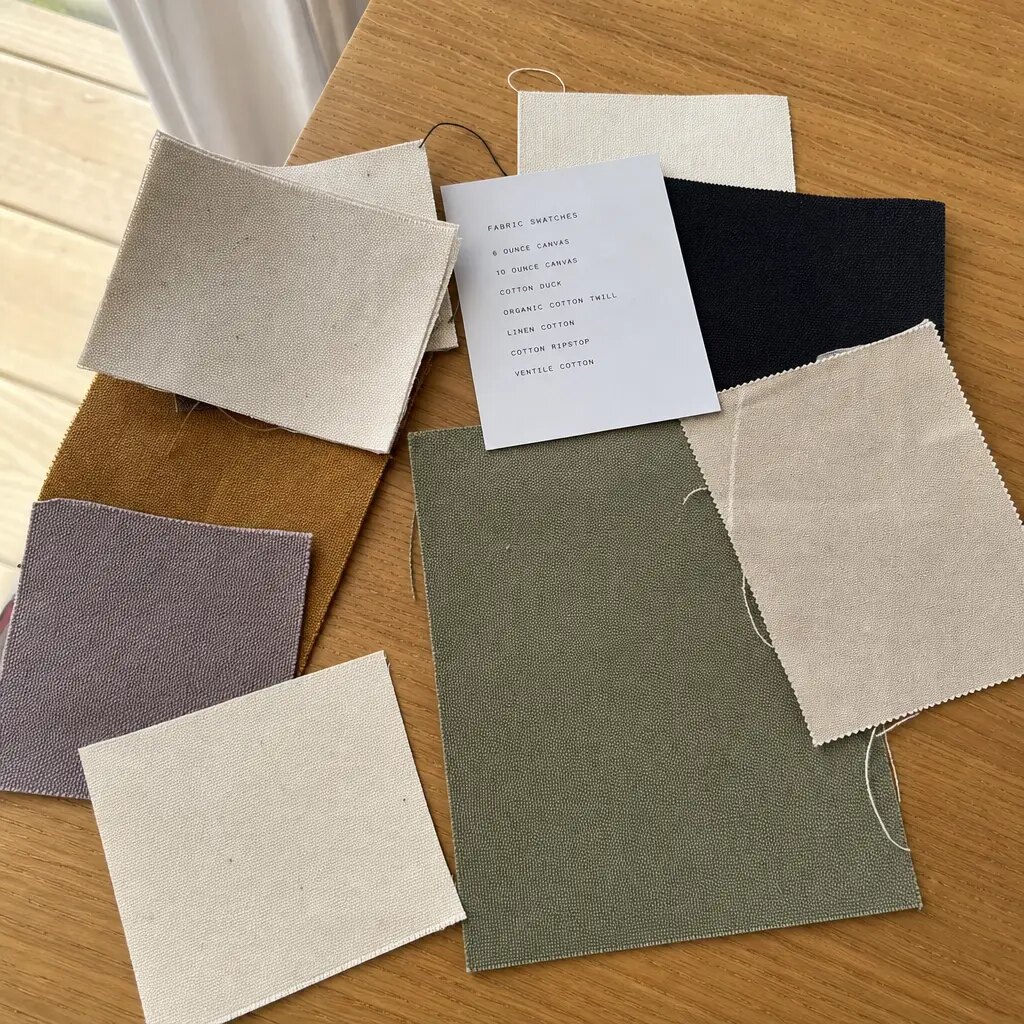
The word finished matters. A weight quoted before dyeing, washing, compacting, or softening may not match the fabric in bulk production. Dyeing changes hand feel and can affect shrinkage. Washing can soften the fabric but reduce crisp structure. Softening can make the bag feel better in the hand while making the panels less stable in carton pack-out. Natural undyed canvas may show seed flecks, slubs, and shade variation; some eco apparel brands want that texture, while others need a cleaner retail face. Buyers should define the acceptable character of the cloth instead of assuming all natural canvas is interchangeable.
A stronger RFQ asks suppliers to state the measurement basis in plain language. 12 oz canvas is less useful than 370 GSM finished cotton canvas, ±5% tolerance, measured after dyeing and finishing. If the material claim matters, separate the claim documents from the performance requirements. Organic cotton, recycled cotton blends, or other certified inputs can support brand positioning, but they still need the same handle load testing, seam review, and print checks as conventional canvas.
- Common reusable grocery tote range: 340 to 400 GSM finished canvas, depending on target load, hand feel, and cost.
- Useful tolerance language: finished GSM ±5%, with the supplier confirming whether the value is checked before cutting or on finished bulk fabric.
- Ask whether the fabric is stock, made-to-order, dyed, washed, enzyme-treated, softened, compacted, or sanforized.
- For natural canvas, define acceptable seed flecks, slubs, shade bands, dark fibers, panel matching, and stains.
- For dyed canvas, request lab dip approval, bulk shade tolerance, crocking checks, and a lot-control plan for body panels and handles.
Treat handle design as the load-bearing decision
Handles are where many canvas grocery totes succeed or fail. Strong body fabric cannot compensate for narrow handles, weak stitching, short insertion, poor bartacks, or reinforcement placed too close to a raw edge. Grocery use creates repeated downward force, twisting, swinging, and shoulder movement. When a bag is loaded with bottles, folded denim, or books, the handle joint becomes the stress concentration point. That is why procurement should specify handle material, width, drop, attachment method, and reinforcement size with the same care as fabric weight.
Self-fabric handles can give the bag a more integrated look and may suit eco apparel aesthetics. Cotton webbing can deliver more consistent strap strength and may be easier to sew onto thicker canvas. Either can work if the attachment is engineered properly. For shoulder-carry grocery totes, a 30 to 40 mm finished handle width is often more comfortable than a narrow decorative strap. Handle drop commonly sits around 250 to 300 mm for shoulder carry, but the right value depends on bag height, user profile, and whether the tote is meant to sit over a coat. Longer handles increase leverage at the attachment point, so reinforcement matters more, not less.
The reinforcement must be measurable in the tech pack and visible in inspection. Reinforced handles is not enough. Better language specifies box-X stitch dimensions, bartack count, row count, stitch density, attachment depth, thread color and type, and whether the handle is inserted into the top hem or sewn onto the outside panel. A practical sewing target may land around 7 to 9 stitches per inch on medium-heavy canvas, but the supplier should confirm what is suitable for the exact fabric, needle, and thread. If the handle is inserted into the hem, confirm that the load-bearing stitches catch enough handle material. If it is applied externally, confirm that the reinforcement sits far enough from weak edges and seam ends.
- Specify handle material: self-fabric canvas, cotton webbing, dyed-to-match webbing, contrast webbing, or certified trim.
- Define handle width, handle drop, handle spacing, attachment depth, and reinforcement size.
- Use box-X stitching, bartacks, or multiple rows of lockstitch at stress points; do not rely on a single top-hem stitch line.
- Check that left and right handles match in length and are not twisted, stretched, or cut off grain.
- Inspect reinforcement symmetry because crooked handle joints are both visual defects and load-risk indicators.
Engineer seams, gussets, and hems for repeated grocery use
A grocery tote needs usable volume, not just a large front panel. Bottom and side gussets let the bag carry folded apparel, boxed items, bottles, and daily shopping without forcing the side seams to absorb all the stress. A 100 to 150 mm bottom gusset is common for reusable grocery-style totes, but the right dimension depends on the product mix and the carton packing plan. Wider gussets improve capacity and standing shape, yet they also create bulky corners and more seam stress. The corner construction matters as much as the gusset width.
Internal finishing should be a deliberate choice. Overlocked seams are common and cost-effective for standard unlined totes. Bound seams create a cleaner premium interior and can improve fray control, but they add cost and sewing complexity. Raw edges are rarely appropriate for a grocery tote that is expected to be reused. Lining can create a finished interior, but it should solve a real need such as gift assortments, cosmetics, glass items, or a premium retail presentation. If lining is added only to cover weak internal seams, the buyer pays for complexity without solving the problem.
The top hem is an overlooked structural point. It affects handle security, top-edge stability, and appearance after repeated loading. A narrow or uneven top hem can curl, twist, or fail to anchor inserted handles. The RFQ should state top hem width, seam allowance, internal finishing, and whether handle attachment stitching must pass through both the hem and the body panel. During sample review, turn the bag inside out. Many future failures are visible in the gusset and hem before they are visible from the branded side.
- Use a bottom gusset when the tote must carry groceries, folded apparel, boxed accessories, or bottles.
- Define internal finishing: overlock, bound seam, French seam where appropriate, or lined construction.
- Check gusset corners for seam allowance, fray control, missed overlock, and bulky intersections.
- Specify top hem width and how handles are secured into or onto it.
- Avoid vague terms such as premium stitching unless they are tied to measurable construction details.
Control print durability before approving artwork
For eco apparel brands, the print is part of the product value, not a finishing afterthought. It must look clean at retail and survive rubbing, folding, packing, and everyday use. Water-based screen printing is often practical for simple logos, bold artwork, and medium to large production runs. It can keep a softer hand than heavier ink deposits when it is cured correctly. Digital pigment printing can be useful for detailed artwork, gradients, or small runs, but it needs validation because pretreatment, fabric absorbency, printer settings, and curing conditions all affect durability.
Print performance is not only about ink choice. Placement, coverage, and pack-out matter. Large print areas across fold lines are more likely to show cracking, abrasion, or permanent crease marks. Dark ink on natural canvas makes crocking easier to see if curing is weak. Dyed canvas adds colorfastness concerns, especially with damp rubbing. If bags are stacked too soon after printing or compressed in cartons before full curing, the surfaces can block, stick, or transfer. Those are process-control failures, and the buyer should check them at strike-off and pre-production stages.
Artwork approval should include a strike-off or pre-production sample using the intended fabric. Review print color, edge sharpness, ink hand, placement tolerance, rub performance, and fold-zone appearance. If the tote will be sold as washable, assess the print after the stated wash process. Do not approve a beautiful sample unless the supplier confirms that bulk production will use the same ink system, screen mesh or digital setup, curing route, and fabric finish.
- Match print method to artwork: screen print for simple solids; digital pigment for validated short-run or detailed designs.
- Set print placement tolerance, such as ±5 mm for small logos and tighter if the design aligns to seams or labels.
- Use dry rub and damp rub checks on print areas and dyed fabric areas.
- Check for cracking, pinholes, ink build-up, poor edge definition, strike-through, and print blocking after stacking.
- Confirm whether washing, dyeing, or garment finishing happens before or after printing.
Use samples to validate the real build
A showroom sample proves silhouette and branding direction. It does not prove bulk durability. The more useful approval path starts with a pre-production sample made from production-like canvas, handles, print method, labels, seam construction, and packing fold. That sample should be measured, weighed, photographed, physically tested, and retained as the approved standard. This matters even more when the order uses a new supplier, a new fabric, a custom dye, a certified input, a large print, or a handle construction that has not been used before.
Durability testing should be practical and tied to the declared use case. If the buyer sets a normal working load of 10 kg, the sample can be validated at a higher temporary load, such as 12.5 to 15 kg, for a defined hang time. The exact level should match the bag size and the product promise. Pass criteria should be visible and objective: no handle detachment, no broken bartacks, no top-hem tearing, no seam opening beyond the agreed allowance, no fabric tearing at the handle joint, and no severe distortion that makes the bag unsellable.
If washability is part of the claim, test it before bulk cutting. Measure the sample before and after the wash cycle stated on the care label. Review width, height, gusset, handle drop, twisting, print cracking, and shade change. If washability is not a claim, buyers may still want some dimensional-stability information so customer service teams know what to expect. Testing at sample stage is far cheaper than discovering after mass production that a handle needs a larger box-X or a print needs to move away from a fold line.
- Request a pre-production sample from production-like material, not substitute sample-room fabric.
- Record actual sample GSM, finished bag weight, dimensions, handle drop, reinforcement details, print method, and carton fold.
- Retain one sealed approved sample at the factory and one buyer reference sample where practical.
- Define load-test weight, hang time, number of tested units, and failure criteria before bulk production.
- If washable, measure shrinkage and review print, handle twisting, seam distortion, and shade change after the stated wash process.
Set inspection tolerances and pass levels before production
A common procurement gap is asking for testing without defining what passing means. A supplier may say the tote passed internal load testing, but that can mean a quick informal hang using whatever weight is nearby. A stronger RFQ defines working load, validation load, duration, sample quantity, and visible failure conditions. If the tote is marketed as a daily grocery bag, the strength requirement should be more demanding than for a gift-with-purchase tote. The threshold should match bag size, material, and commercial promise rather than an arbitrary number copied from another program.
Dimensional and visual tolerances should also be written. Practical starting points are ±10 mm for finished width, height, and gusset; ±15 mm for handle drop; and ±5 mm for handle width, small label placement, and logo placement, unless the design needs tighter control. These are not universal standards, but they give the buyer and the factory a concrete basis for discussion. When artwork aligns to seams or panels, define exact measurement points from the top edge, side seam, or bottom fold.
Final inspection can use AQL sampling, but the defect list has to be tote-specific. Handle detachment, broken bartacks, sharp metal trim, mildew odor, wrong certification label, and severe print transfer should not be treated as minor issues. Major defects may include crooked print, mismatched handle length, seam opening, stains, shade panels, skipped stitches, and wrong dimensions outside tolerance. Minor defects may include small loose threads or slight natural fabric variation within the approved standard. Defect classification should be agreed before inspection, not argued after goods are packed.
- Define working load, validation load, hang time, sample quantity, and pass/fail criteria.
- Use written measurement tolerances for bag dimensions, handle drop, handle width, labels, and print placement.
- Create critical, major, and minor defect classifications specific to canvas grocery totes.
- Use the approved pre-production sample as the reference for shade, hand feel, construction, and print.
- Use final inspection to confirm bulk consistency, not to resolve unresolved design decisions.
Compare supplier quotes by construction, not unit price alone
A low quote for canvas grocery totes often comes from a quiet specification reduction. The supplier may use lighter finished GSM, narrower handles, fewer stitches, a smaller gusset, rawer internal seams, cheaper labels, denser carton packing, or a print method that looks acceptable on day one but performs poorly after rubbing. If procurement compares only unit price, the cheaper quote can look efficient while carrying more claim risk, replacement risk, and retail dissatisfaction.
A useful quote comparison forces each supplier to state what is included. Ask for finished GSM, composition, fabric route, dye process, handle material, handle width, reinforcement method, seam finishing, print method, label package, packing method, carton gross weight, testing plan, and MOQ assumptions. Some suppliers will not provide a full cost breakdown, but they should be able to confirm whether the quoted price matches the requested specification. If two quotes are far apart, ask for construction notes and sample photos before pushing the higher quote down.
MOQ also needs careful interpretation. A quote for 5,000 pieces may assume one body color, one artwork, one size, one label version, and one packing method. If the brand wants three colors, two print placements, and separate retail barcodes, the effective MOQ per SKU can change the price and the lead time. Dye lots, fabric booking, screen setup, print strike-offs, label production, and certification paperwork can all move the number. The cleanest comparison ties MOQ tiers to the actual assortment plan, not to a simplified headline order size.
- Compare finished GSM, composition, gusset, handles, reinforcement, seam finishing, print, labels, packing, and tests side by side.
- Ask where the first meaningful price break occurs and what assumptions it depends on.
- Separate MOQ by body color, artwork, size, label version, certification requirement, and packing method.
- Confirm whether sample fees, screen charges, test fees, certification document handling, and inspection support are included.
- Treat unusually low quotes as prompts for clarification, not automatic savings.
Protect goods in packing and transit
A tote can pass sewing inspection and still arrive in poor condition if the packing route is wrong. Canvas grocery totes are often flat-packed in bundles to control freight cost, but heavy compression can create stubborn fold marks. The risk gets worse when a printed panel sits directly on a hard fold or when bags are packed before ink is fully cured. Natural cotton canvas can also absorb humidity during storage and transit. Tight cartons without route-appropriate moisture control can lead to odor, mildew concerns, poor recovery, or damaged retail presentation.
Packing should be tested before bulk shipment. A carton trial can show whether the proposed fold creates pressure across the print, whether handles leave marks, whether bundle counts are easy to verify, and whether carton gross weight is practical for warehouse handling. Many importers try to keep cartons around 12 to 15 kg gross weight where possible because receiving teams handle them repeatedly. Sustainability preferences also matter. Some brands restrict individual polybags, but eliminating them requires a better plan for moisture, dirt, and print protection.
The packing specification should be as concrete as the sewing specification. State fold method, bundle quantity, carton quantity, carton dimensions range, gross weight target, carton marking, SKU separation, desiccant or moisture plan if required, and whether polybags, paper bands, or tissue separators are allowed. If the bag is sold folded with a paper band, insert, hangtag, barcode, or retail label, the supplier should make a packing sample before mass packing. That prevents a good production run from becoming a receiving or retail display problem.
- Set fold method and avoid placing major prints on hard fold lines when possible.
- Cap carton gross weight and avoid over-compression that damages canvas recovery.
- State whether individual polybags are required, restricted, replaced with paper bands, or not allowed.
- Use route-appropriate moisture protection for ocean freight, humid seasons, or long warehousing.
- Open trial cartons after compression to review fold recovery, print blocking, odor, count accuracy, and carton strength.
Specification comparison for buyers
| Spec decision | Recommended option | When it fits | Buyer risk to check |
|---|---|---|---|
| Body fabric weight | 12 oz to 14 oz canvas, approximately 340 to 400 GSM finished fabric weight, with a stated tolerance such as ±5% on finished fabric | Reusable grocery carry, eco apparel retail resale, paid brand totes, staff issue, and moderate-to-heavy daily use | Some quotes use greige, nominal, or pre-finish weight instead of finished GSM. Require the measured basis, the stage of measurement, and the tolerance on finished bulk fabric. |
| Fabric composition and claim basis | Conventional cotton for standard programs; organic cotton, recycled cotton blend, or another certified input only when documentation is required | Eco apparel brands that need a material claim, a certification story, or traceability in addition to physical durability | Certification supports the claim, not the strength. Ask for composition, certificate scope, transaction documents if applicable, and the same load testing used for non-certified fabric. |
| Weave and finishing route | Plain canvas with a stable, balanced weave; standard dyeing, washing, compacting, or softening only when the hand feel or shade calls for it | Retail totes that need a clean surface, predictable sewing behavior, and consistent handle performance | Softening can improve hand feel but reduce body. Excess finish can also change shrinkage, hand, and seam behavior, so bulk must match the approved sample. |
| Handle construction | 30 to 40 mm finished handle width, self-fabric or cotton webbing, with box-X or bartack reinforcement and a stitch density matched to the fabric | Shoulder-carry grocery totes designed for repeated loading, especially when the bag will hold bottles, denim, shoes, or books | Handle failure usually comes from narrow straps, short insertion, weak backtacks, low stitch density, or reinforcement placed too close to the edge. |
| Bottom and side gusset | A full bottom gusset commonly 100 to 150 mm, with controlled seam allowance and reinforced or clean-finished corners | Totes that must carry folded apparel, produce, boxed goods, or mixed shopping without collapsing | Flat totes can price lower but push more stress into the side seams and reduce usable volume. Wider gussets need stronger corner finishing. |
| Seam finishing | Overlocked internal seams for standard unlined bags; bound seams for cleaner premium interiors or tighter fray control | Unlined retail grocery totes where repeated use and inside appearance matter | Raw edges, weak overlock coverage, and inconsistent seam allowance can fray at the bottom corners. Lining should solve a real need, not hide poor construction. |
| Print method | Water-based screen print for simple 1 to 3 color artwork at scale; digital pigment only after strike-off validation for detailed or short-run designs | Eco apparel logos, restrained retail graphics, and natural-canvas visual identities | Poor curing can cause crocking, cracking, blocking, or transfer. Require dry rub, damp rub, tape adhesion, fold-zone review, and wash review if washability is claimed. |
| Dimensional tolerance | Typical starting point: ±5 mm for handle width and label placement, ±10 mm for bag width, height, and gusset, and ±15 mm for handle drop unless the design needs tighter control | Bulk inspection where shelf presentation, packing, and bag usability all matter | Loose tolerances create mismatched SKUs, uneven carry balance, poor carton fit, and a visibly inconsistent retail set. |
| Load validation | Define the normal working load, then test sample and random bulk units at a temporary validation load such as 1.25x to 1.5x the working load for an agreed hang time | Reusable grocery-style totes where the buyer makes or implies strength expectations | Avoid vague language like strong enough. State pass and fail: no broken stitches, no handle detachment, no seam opening beyond the agreed limit, and no severe distortion. |
Buyer checklist before sampling
- Define the commercial use clearly: paid retail tote, checkout packaging, gift-with-purchase, launch kit, staff issue, wholesale packaging, or long-term reusable grocery tote.
- State the normal working load in kilograms, such as 8 kg, 10 kg, or 12 kg, and keep the temporary validation load separate.
- Specify finished fabric weight, not only nominal canvas weight: for example, 370 GSM finished cotton canvas, ±5% tolerance after dyeing, washing, or finishing.
- Confirm fabric composition and claim basis: conventional cotton, organic cotton, recycled cotton blend, recycled polyester blend, or another certified material, with documentation requirements separated from performance requirements.
- List finished dimensions: width, height, bottom gusset, side gusset if any, top opening, handle drop, handle width, handle spacing, and the tolerance for each measurement.
- Define seam construction by zone: side seams, bottom seam, gusset corners, top hem, internal overlock or binding, seam allowance, and thread color.
- Set handle reinforcement details: box-X size, bartack count or row count, stitch density, attachment depth, thread type, and whether reinforcement must pass through the top hem and body panel.
- Clarify handle material: self-fabric canvas, cotton webbing, dyed-to-match webbing, contrast webbing, or certified trim with traceability documents.
- Approve print method by artwork and use case: print size, number of colors, placement tolerance, ink system, curing method, and testing for rub, adhesion, blocking, and wash if applicable.
- Define appearance standards for natural canvas: acceptable seed flecks, slubs, shade variation, odor, stains, oil marks, and panel matching.
Factory quote questions to send
- What is the proposed finished GSM after dyeing, washing, compacting, softening, or finishing, and what production tolerance will you guarantee?
- Is the canvas stock fabric or mill-booked fabric, and can you confirm composition, weave type, yarn count or construction if available, and expected shrinkage range before cutting?
- Are you quoting nominal ounce weight, greige weight, or finished fabric weight, and how will GSM be checked in bulk?
- What certification documents can you provide if the material is organic cotton, recycled cotton, or another certified input, and are those documents included in the quoted price?
- What are the finished bag dimensions, handle drop, handle width, gusset width, seam allowance, and measurement tolerances included in this quote?
- Are the handles self-fabric, cotton webbing, dyed webbing, or another trim, and what is the finished handle width, thickness, and attachment depth?
- How many stitching rows, bartacks, or box-X reinforcements are included at each handle joint, and what stitch density do you normally hold on this fabric weight?
- What thread type and approximate thread size do you recommend for this construction, and is contrast thread or dyed-to-match thread included?
- What internal method do you use for load testing: test weight, hang time, number of samples, and failure definition?
- Does the unit price include bottom gusset, top hem, inside overlock or bound seams, labels, hangtags, carton marks, and the requested packing method?
Quality-control points to confirm
- Measure finished width, height, bottom gusset, side gusset if any, top opening, handle drop, handle width, handle spacing, and label placement against the approved spec and tolerance.
- Verify finished fabric weight against the approved standard because lighter canvas is a common hidden cost reduction in tote programs.
- Compare bulk fabric shade, hand feel, weave density, surface character, odor, and shrinkage behavior against the approved lab dip, strike-off, and pre-production sample where applicable.
- Check fabric defects including holes, stains, oil spots, weaving bars, excessive slubs outside the approved natural-canvas standard, shade panels, and contamination.
- Inspect handle attachment for skipped stitches, loose thread ends, short backtacks, broken bartacks, uneven stitch density, puckering, and reinforcement not fully caught in the body panel.
- Check that box-X or bartack placement is symmetrical, correctly sized, and positioned far enough from raw edges or weak seam allowance.
- Load-test random finished units using the agreed weight and hang time; reject units showing handle tearing, stitch breakage, seam opening, top hem tearing, or severe permanent distortion.
- Review side seams, bottom seams, top hem, and gusset corners for raw-edge fraying, seam slippage, broken stitches, missed overlock, and inconsistent seam allowance.
- Rub test printed and dyed areas with dry and slightly damp white cloth to detect under-cured ink, dye crocking, or surface transfer.
- Check print placement, color match, curing, cracking at fold zones, pinholes, ink build-up, edge sharpness, and blocking between stacked printed panels.