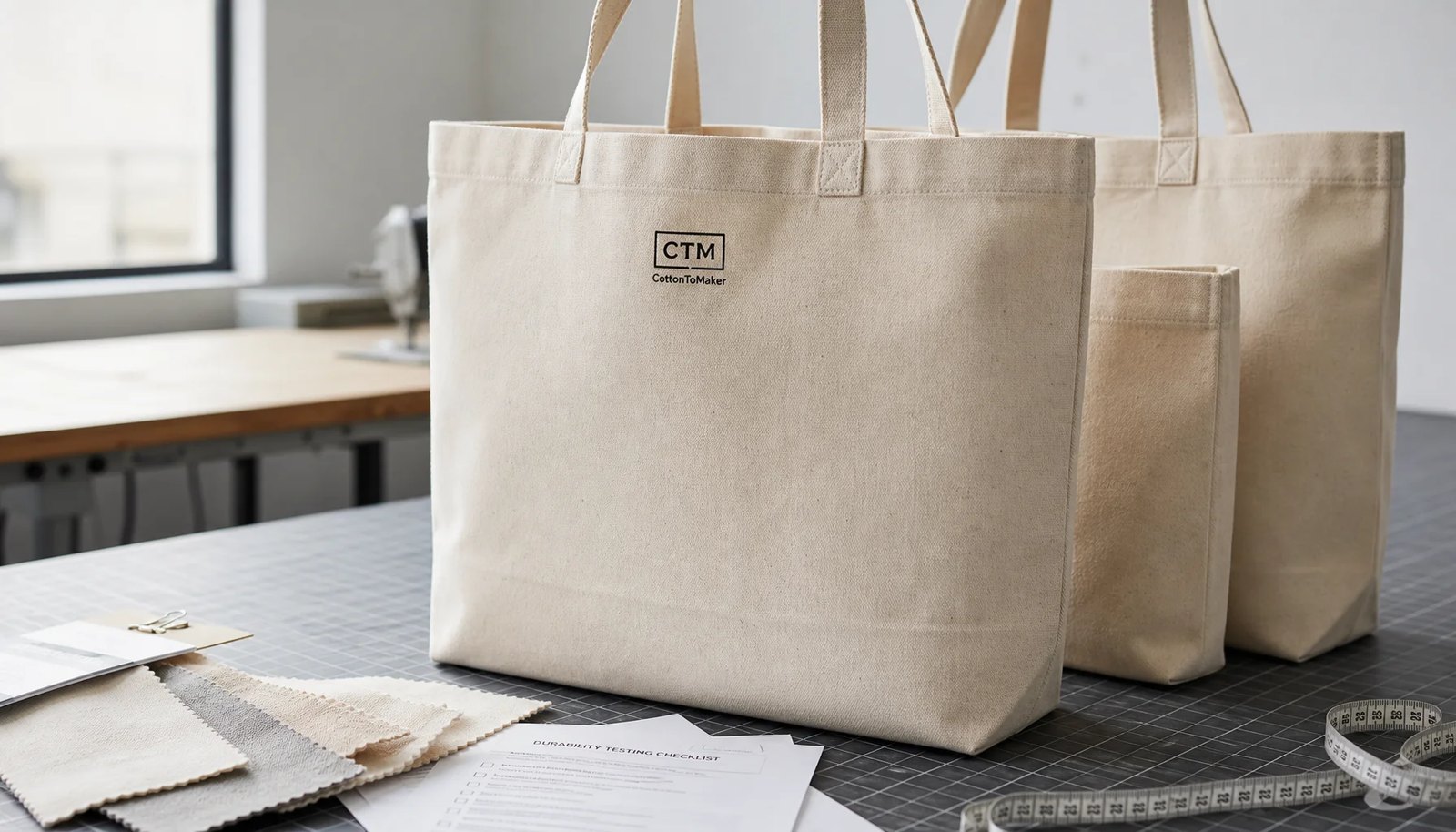
Start with the bookstore use case, not a generic tote description
A canvas grocery tote for a university bookstore has a harder job than a lightweight conference giveaway. It may sit on a retail shelf, serve as a checkout bag, hold orientation items, support a department campaign, or ship as part of an alumni bundle. Those uses look similar in a mockup, but they stress the bag in different ways. Textbooks press hard against bottom seams. Bottles swing against side panels. Hoodies add bulk. Boxed merchandise pushes into the gusset corners.
That is why the RFQ should begin with the tote’s job, not with a vague line such as “heavy-duty canvas tote.” A resale item needs clean sewing, pleasant handfeel, repeatable shade, and a logo finish that looks worth buying. A checkout tote needs dependable load performance, handle comfort, accurate carton counts, and fast stockroom handling. An orientation tote should be tested with the actual kit contents because flat brochures, bottles, and rectangular boxes do not behave like loose filler weights.
The use case also controls tolerances. Retail resale usually needs tighter shade and print-placement control than a one-day giveaway. A replenishment SKU needs consistent fabric lots, carton labeling, and repeatable packing. Licensed university marks may require formal review before bulk production starts. When the buyer writes these conditions into the request, the supplier is quoting a real product specification, not guessing from a picture.
- For retail resale, prioritize handfeel, shade consistency, clean sewing, logo finish, and shelf-ready packing.
- For checkout use, prioritize load capacity, handle comfort, carton count accuracy, and quick stockroom unpacking.
- For orientation kits, test the complete packed kit because item shape affects gusset and corner strain.
- For alumni or premium merchandise, consider heavier canvas or refined labeling while still requiring load and print tests.
- For multi-department programs, include SKU separation and carton labeling in the first quote request.
Turn campus loads into durability targets
Durability should be written as a test, not as an adjective. Before asking suppliers to quote, weigh the products the tote is expected to carry: a textbook or two, a hoodie, a notebook, a drink bottle, stationery, snacks, and small gifts. Then look at shape. Ten pounds of folded apparel spreads differently than ten pounds of books. Hard book edges press into the bottom seam. Bottles add swinging force at the handles. A boxed tumbler can create point pressure at the gusset.
Once the normal load is clear, add a safety margin. Customers overpack bags. Staff lift quickly. Students may carry the tote across campus longer than intended. The RFQ should state the test weight, how the weight is distributed, how long the tote is suspended, whether lift cycles are required, and what counts as failure. A practical pass condition is no handle tear-out, no open seam, no bottom corner split, no top hem rupture, and no severe distortion after the test.
Finished-bag testing matters because the tote works as a system. Fabric strength alone does not prove that the handles, thread, seam allowance, stitch density, gusset shape, top hem, and print finish will perform together. A strong canvas panel can still fail if the handle stitch line is too close to the fabric edge. Use the same durability method during sample approval and bulk QC so the results can be compared fairly.
- Build the test load from actual bookstore items or rigid weights shaped to imitate books and bottles.
- State test weight, load distribution, hang time, lift-cycle count, sample quantity, and pass/fail rules in the RFQ and PO.
- Inspect after testing for handle tear-out, top hem strain, open seams, bottom corner splits, seam slippage, and distortion.
- Repeat the same test on the blank sample, printed pre-production sample, and random bulk units.
- Ask for photos or inspection notes so the buyer and factory share the same definition of failure.
Specify canvas weight, GSM, weave, and finish
Canvas tote quotes often start with ounce weight, but ounce weight is not enough for procurement. For university bookstore grocery totes, 12 oz to 16 oz cotton canvas is a practical working range, roughly 390 to 540 GSM depending on yarn, weave density, and finishing. A lighter 10 oz canvas may be acceptable for a soft promotional bag, but it may not feel structured enough for a grocery-style tote that must stand on a counter and carry books. A dense 14 oz canvas can outperform a loose 16 oz fabric because weave tightness and yarn quality affect strength, sewing stability, and perceived value.
Finishing changes the final product. Natural canvas is common for campus stores because it has a familiar cotton look and avoids the cost and lead time of custom dyeing. It can also show seed flecks, slubs, and shade variation. Dyed canvas can support a school-color direction, but dye lots need control, and dark shades may require a print underbase for opacity. Washed canvas feels softer and more premium, yet it can lose structure and may make printed edges less crisp than firmer canvas.
Request both swatches and a sewn blank sample. The swatch helps the buyer judge shade, opacity, handfeel, slubs, and weave density. The sewn sample shows how the fabric behaves at the top hem, handles, side seams, and boxed corners. For bookstore retail, structure is part of quality. A tote may be strong, but if it collapses on display or looks limp when packed, it may not fit the merchandising plan.
- List nominal ounce weight and approximate finished GSM; ask whether weight is measured before or after finishing.
- Request GSM tolerance, shade tolerance, and rules for mixing shade lots within one SKU.
- Define the fabric as natural, bleached, dyed, washed, organic, recycled blend, or conventional cotton.
- State whether seed flecks, slubs, and minor weaving irregularities are acceptable for the retail program.
- Compare swatches by handfeel, weave tightness, opacity, structure, and sewing behavior, not price per ounce only.
Build handles and seams around failure points
Canvas grocery totes rarely fail first in the center of the panel. The weak points are usually the handle attachment, top hem, side seam, or bottom gusset corner. When a shopper carries textbooks and bottles, force moves from the bag body into the handle ends. If the handle is sewn through a weak fold, the stitch line sits too close to the edge, the seam allowance varies, or the thread does not match the canvas, the handle can tear out even on a heavy-looking bag.
The quote should define handle material, width, drop, spacing, attachment height, and reinforcement pattern. Folded self-fabric handles give a coordinated canvas look when built well. Cotton webbing handles, often around 1.25 to 1.5 inches wide for this style, can feel smoother in the hand and distribute load effectively. Reinforcement may use box-X stitching, cross-stitching, bar tacks, or approved multi-row lockstitch. The important point is simple: the approved pattern must pass through the intended fabric layers and remain consistent in bulk production.
Stitch density and thread choice deserve the same attention. Around 8 to 10 stitches per inch is a useful reference for many canvas tote seams, but the factory should adjust for canvas thickness, needle size, thread type, and seam bulk. Too few stitches can loosen. Too many can perforate the canvas and create a tear line. Review the sewn sample after load testing, not only before it. A seam that looks tidy on the table may reveal movement after repeated lifting.
- Specify handle material, width, drop, spacing, and whether the tote must work for shoulder carry.
- Require box-X, bar tack, cross-stitch, or approved multi-row reinforcement at handle ends.
- Confirm handle stitching passes through all intended top hem or panel layers, not one weak layer.
- Define side seam, bottom seam, boxed corner, top hem, seam allowance, thread color, and loose-thread allowance.
- Reject skipped stitches, broken thread, open seams, weak back-tacking, crooked handles, and reinforcement placed too close to raw edges.
Use a finished-bag testing checklist
A useful durability checklist is short enough for factory QC to run consistently and specific enough to prevent arguments later. It should test the finished tote as a complete product: handle attachment, top hem, load performance, side seams, bottom gusset, shape retention, and print behavior. Fabric reports can support the file, but they do not replace testing the finished bag.
Start with a static load test. Place the agreed weight inside the tote in the agreed distribution, suspend the bag by its handles for the agreed time, and inspect every stress point. Then add a lift-cycle check. Repeated pick-up and set-down movement better reflects real customer handling and often exposes handle stitching movement, seam slippage, or corner strain that a static hang misses.
Print checks should happen after curing, not immediately after printing. A dry rub check can reveal ink transfer. A fold check using the planned packing fold can show cracking, flaking, offset, or hard crease damage. Tape-pull or light scratch checks may reveal poor adhesion. Add wet rub or wash testing only if the product will be sold with those expectations; unnecessary wash claims can add cost and create disputes without improving the tote’s normal use.
- Static load: agreed weight and hang time, with no handle tear-out, open seam, bottom split, or severe distortion.
- Lift cycle: repeated pick-up and set-down at the agreed weight, followed by stress-point inspection.
- Gusset review: inspect bottom corners and side seams for seam slippage, puckering, tearing, or distortion.
- Print dry rub: rub the cured print with a dry white cloth and check transfer against the approved standard.
- Fold check: fold across the printed panel as packed and inspect for cracking, flaking, offset, or permanent crease damage.
- Post-test review: compare handle drop, body shape, and seam integrity to the sealed approved sample.
Set tolerances and AQL before production
Do not wait until inspection day to decide what is acceptable. The purchase order should list the approved sample, measurement points, tolerances, defect classifications, and sampling approach. Otherwise, the supplier may call visible variation normal while the bookstore sees unsellable product. For main tote dimensions, +/- 1 cm is a common practical tolerance for canvas bags, although premium retail programs may choose tighter limits. Print placement needs its own rule, usually measured from the top hem and centerline.
Defect classification keeps inspection decisions from becoming personal opinions. Critical defects include safety, contamination, or severe compliance problems such as mildew, sharp foreign objects, or unauthorized logo use. Major defects affect function or saleability: open seams, weak handles, wrong artwork, severe shade mismatch, print cracking, incorrect size, mixed cartons, or failed load tests. Minor defects are small appearance issues that do not affect function, such as a minor loose thread or natural canvas variation within the approved standard.
AQL should also be agreed before production. Many consumer-goods inspections use sampling standards such as ANSI/ASQ Z1.4 or ISO 2859-1, but the buyer and supplier must agree on the inspection level and acceptable quality limits. The exact values depend on order value and risk tolerance. For licensed bookstore merchandise, wrong logo, wrong color, and failed load testing should be treated more seriously than small cosmetic variation.
- Define measurement points for width, height, gusset, handle drop, handle spacing, and print placement.
- Use the sealed sample as the visual standard for fabric, stitching, print handfeel, fold, and packing.
- Classify defects as critical, major, and minor before inspection begins.
- Include functional tests, not only appearance checks, in the AQL inspection plan.
- State rework, replacement, discount, reinspection, and shipment-hold procedures in the PO.
Choose print methods by artwork and use
University bookstore graphics may include school marks, mascots, department names, class years, event dates, and store branding. Screen printing is often the first method to quote for solid one-color or two-color designs because setup cost can be spread across volume and the result can be durable when ink deposit and curing are controlled. It also gives good opacity on natural canvas. The caution is large ink coverage: if the deposit is too heavy or curing is poor, the print can feel stiff, crack, or offset.
Heat transfer can work for smaller runs, complex multicolor artwork, or frequent department changes, but it must be tested on the exact canvas. Canvas texture can reduce contact area and affect adhesion. Transfers may also feel different from screen print on a large grocery tote panel. Digital printing can handle detail and gradients, but buyers should check color consistency, rub performance, and whether the method suits the canvas surface and expected handling.
Licensed university marks need extra discipline. Provide vector artwork, Pantone targets, logo clear-space rules, approved size, and placement instructions. Do not ask the factory to rebuild a mark from a low-resolution image. The printed pre-production sample should be reviewed by the buyer or licensing team before bulk printing. In the inspection plan, wrong logo, wrong color, and unapproved placement should be major or critical defects depending on license requirements.
- Use screen print for solid bookstore logos and medium-to-large orders with controlled color count.
- Use heat transfer only after testing adhesion, handfeel, edge durability, fold behavior, and rub performance on final canvas.
- Use embroidery or woven labels for small premium branding details, not large grocery tote graphics by default.
- For dark dyed canvas, specify underbase, opacity, curing, and handfeel expectations.
- Approve vector artwork, Pantone references, print size, placement, and license use before screens or transfers are made.
Control MOQ, SKU count, and quote drivers
MOQ is not only about the number of bags. It is tied to fabric procurement, dye-lot minimums, cutting efficiency, sewing setup, print screens, ink preparation, packing separation, inspection workload, and shipment handling. A bookstore may think of the order as one tote program, but if twelve departments need twelve different logos, the factory sees twelve controlled artwork versions. Each version can add setup charges, proofing time, carton-labeling work, and risk of mixed cartons.
The simplest way to protect cost is to standardize the base tote. Keep one fabric, one size, one gusset, one handle, one thread color, one label position, and one packing method where possible. Then vary artwork in a controlled way. Group department designs by print size, color count, and placement. If every department changes canvas color, handle drop, gusset depth, and print method, the program loses most of its consolidation benefit.
Quote comparison should separate the unit price from setup and handling costs. Screen charges, sample fees, proofing fees, hangtags, barcode labels, individual polybags, carton upgrades, and inspection fees all affect landed cost. Freight can change the answer too. A thicker tote packed flat may present better, but it increases carton cube. A lower unit price is not a better buy if packing, defect risk, or SKU complexity raises the total cost.
- Standardize the base tote before adding department artwork versions.
- Ask for price breaks by total order quantity and by quantity per artwork version.
- Separate unit price from screen charges, sample fees, label costs, barcode application, packing upgrades, and inspection fees.
- Request carton dimensions, pieces per carton, gross weight, and total cube before comparing landed cost.
- Require SKU-specific carton labels to reduce receiving errors and department misallocation.
Approve samples in stages
A staged sample process prevents many bulk production disputes. Begin with a blank construction sample made from the proposed production fabric, handle material, seam method, thread, gusset, top hem, and label arrangement. Load it with representative bookstore items. Put it on a counter. Check handle comfort, corner strength, shelf appearance, and overall structure. If the blank tote fails construction review, approving artwork will not solve the real problem.
After the blank construction is approved, request a printed pre-production sample. This sample should use production-intent fabric, thread, handle, ink or transfer material, label, and final packing fold. Substitute fabric can hide problems with print adhesion, shade, crease behavior, and sewing thickness. The printed sample should lock print size, placement, color, opacity, handfeel, curing performance, fold behavior, and final presentation.
Document the approved standard carefully. Record the date, version number, fabric weight and GSM, finished dimensions, tolerances, handle drop, reinforcement pattern, print method, print size, packing method, and accepted limitations such as natural flecks. Keep one sealed sample with the buyer and one with the factory. During inspection, compare bulk goods to that sealed sample, not to a digital mockup or an old email attachment.
- Approve blank construction before printed artwork.
- Use final or production-intent materials for the printed pre-production sample.
- Test the printed sample after full curing, not immediately after printing.
- Record tolerances for dimensions, handle placement, print location, color, fabric variation, and packing fold.
- Do not allow bulk substitutions unless a revised sample is produced, tested, and approved before cutting or printing.
Plan packing, labels, and campus receiving
Packing affects appearance, freight cost, and receiving speed. Canvas grocery totes may be flat-packed, folded once, bundled, individually polybagged, or bulk packed. Flat packing protects structure and large printed panels but increases carton volume. Tight folding saves cube, but it can create hard creases, print cracking, or ink offset, especially on heavyweight canvas with large graphics.
Campus receiving teams need cartons they can lift, count, and allocate quickly. Cartons should not be so heavy that stockroom staff struggle to move them, and they should not be underfilled enough to waste space. The RFQ should request pieces per carton, carton dimensions, net weight, gross weight, carton numbering, and packing photos. If the order includes multiple artwork versions, separate each version by carton where possible or clearly bundle and label them inside the carton.
Moisture control matters because cotton canvas can pick up odor or mildew if packed damp or stored poorly. Ocean freight, humid warehouses, and long domestic distribution routes raise that risk. Bags should be clean and dry before packing, cartons should suit the route, and moisture protection should not make unpacking impractical. For resale, decide early whether hangtags, barcode stickers, care labels, price labels, or individual polybags are applied at the factory or after arrival.
- Use flat packing for premium retail presentation or large prints where hard creases are unacceptable.
- Use light folding only after the fold test confirms no cracking, offset, or unacceptable crease marks.
- Mark cartons with PO number, SKU, design name, quantity, carton number, gross weight, and destination.
- Separate artwork versions by carton whenever possible to reduce receiving and allocation errors.
- Confirm whether barcodes, hangtags, care labels, price labels, or polybags are included in the quote.
Specification comparison for buyers
| Spec decision | Recommended option | When it fits | Buyer risk to check |
|---|---|---|---|
| Fabric weight for bookstore grocery tote | 12 oz to 16 oz cotton canvas, approximately 390-540 GSM depending on yarn, weave density, and finishing; request finished GSM, not only nominal ounce weight | Retail resale, checkout bags, orientation kits, alumni bundles, department merchandise, and mixed purchases with books, bottles, apparel, stationery, and snacks | Do not award by ounce weight alone. A loose 16 oz canvas can feel bulky but perform worse than a tighter 14 oz. Require swatches, finished GSM tolerance, and a sewn sample from production-intent fabric. |
| Finished size and gusset | Common grocery-style range: 14-16 in W x 15-17 in H with 4-6 in bottom gusset; final size must match the bookstore’s merchandise load and display method | Bookstore counters, retail display stacks, welcome kits, and reusable shopping bags where textbooks and boxed items need a stable base | A shallow gusset reduces usable capacity; an oversized gusset creates corner strain. Specify finished dimensions and tolerance, commonly +/- 1 cm for main dimensions unless a tighter program standard is required. |
| Handle construction | 1.25-1.5 in cotton webbing or folded self-fabric handles, reinforced with box-X, cross-stitch, bar tack, or approved multi-row lockstitch through the top hem/panel layers | Hand carry and shoulder carry, especially where buyers carry textbooks, bottles, and apparel across campus | Handle tear-out is a frequent failure point. Define handle drop, handle spacing, stitch pattern, seam allowance, and load-test pass criteria on the finished bag. |
| Seam and hem method | Double-needle lockstitch or equivalent durable construction, folded top hem, secure side and bottom seams, back-tacked stress points, and practical 8-10 SPI adjusted to fabric thickness | Retail programs where durability, neat appearance, and lower return risk matter more than the lowest promotional cost | Excessive stitch density can perforate canvas; low stitch density can loosen. Approve the actual sewn sample and inspect skipped stitches, broken thread, seam slippage, and corner strain after load testing. |
| Thread and sewing details | Polyester or cotton-wrapped polyester thread is commonly used for strength and abrasion resistance; thread size should suit canvas thickness and needle choice | Heavy canvas totes where seams and handle attachment must remain secure under repeated lifting | If thread is too thin or the needle is wrong, seams can abrade, pucker, or cut the fabric. Ask the supplier to specify thread type, color, approximate size, needle choice, and stress-point reinforcement. |
| Print method for bookstore graphics | Screen print for solid university marks and medium-to-large quantities; tested heat transfer or digital print for complex smaller runs; embroidery or woven label for small premium details | Licensed logos, bookstore branding, class-year designs, alumni merchandise, and department versions | Large ink coverage can crack, offset, or feel stiff if deposit and curing are poorly controlled. Specify Pantone targets, placement tolerance, rub/fold/tape-pull checks, curing expectation, and whether wash performance is claimed. |
| MOQ and SKU plan | One base fabric, one size, one handle, one gusset, one thread color, and 2-4 controlled artwork versions when possible | Bookstores coordinating multiple departments, events, alumni weekends, orientation, and replenishment programs | Too many small logo versions raise setup cost, proofing time, carton separation work, and mis-pick risk. Ask for price breaks by total quantity and by artwork quantity. |
| Sample approval route | Blank construction sample first, then printed pre-production sample using final fabric, handle, thread, print method, label, and packing fold | New supplier onboarding, licensed logos, heavier load targets, premium resale totes, or strict campus launch dates | Approving only a digital proof or substitute-fabric sample invites disputes. Seal one approved sample with the buyer and one with the factory for inspection comparison. |
| Packing and carton standard | Flat-packed or lightly folded in export cartons with moisture protection, SKU separation, carton labels, manageable carton weight, and packing photos before shipment | Campus receiving docks, distributor warehouses, bookstore stockrooms, e-commerce fulfillment, and direct-to-store replenishment | Over-compressed cartons create hard creases and print offset; under-filled cartons increase freight cube. Request pieces per carton, carton dimensions, net/gross weight, and artwork-specific carton labels. |
Buyer checklist before sampling
- Define the tote role: retail resale item, checkout bag, orientation kit container, department gift, alumni merchandise, event giveaway, or distributor replenishment SKU.
- List the expected load by item type: textbooks, notebooks, hoodies, drinkware, boxed merchandise, snacks, tech accessories, brochures, and mixed grocery-style purchases.
- Set a target loaded weight for testing. Many bookstore programs should test above the normal expected purchase weight; the exact value should be based on actual merchandise plus a safety margin.
- Provide finished dimensions: width, height, bottom gusset, side gusset if applicable, top opening width, handle width, handle drop, handle spacing, and print panel size.
- Specify fabric by nominal ounce weight and approximate finished GSM; state if the canvas is natural, bleached, dyed, washed, organic cotton, recycled blend, or conventional cotton.
- Ask for fabric tolerances: GSM tolerance, shade tolerance, shrinkage expectation if washability is claimed, acceptable slubs/seed flecks, and whether shade lots may be mixed within one SKU.
- Define handle material: self-fabric canvas or cotton webbing, width, drop, attachment location, reinforcement pattern, and whether shoulder carry is required.
- Specify side seam, bottom seam, boxed corner, top hem, handle-end construction, seam allowance target, back-tacking, thread color, and loose-thread allowance.
- Require finished-bag durability testing, not fabric-only reporting. Include test weight, load distribution, hang time, lift-cycle method, sample quantity, and pass/fail criteria.
- Define print requirements: vector artwork, Pantone references, color count, print size, placement tolerance, opacity, curing requirements, licensed mark approval, and acceptable print handfeel.
Factory quote questions to send
- What fabric are you quoting by nominal ounce weight and finished GSM, and what GSM tolerance applies to bulk production?
- Is the canvas greige, natural, bleached, dyed, washed, pigment-dyed, organic, recycled blend, or conventional cotton, and is the weight measured before or after finishing?
- Can you send swatches showing handfeel, weave tightness, shade, opacity, slubs, seed flecks, and the bulk fabric lot standard?
- What finished dimensions are included in your quote: width, height, bottom gusset, side gusset, top opening, handle width, handle drop, and handle spacing?
- What dimensional tolerance do you propose for main bag size, gusset depth, handle drop, handle spacing, and print placement?
- What seam construction will you use for side seams, bottom gusset, top hem, and handle ends, and what seam allowance and stitch density range do you recommend?
- What thread type and approximate thread size will you use, and is it suitable for repeated loaded lifting on 12-16 oz canvas?
- Will the handle be self-fabric or cotton webbing, and will the attachment be box-X, cross-stitch, bar tack, or another reinforced construction?
- Can you perform finished-bag static load testing on the blank sample, printed pre-production sample, and random bulk units? If yes, what weight, time, and sample quantity do you recommend?
- Can you include a lift-cycle check, such as repeated pick-up and set-down with the agreed weight, and record photos of handle stitching before and after?
Quality-control points to confirm
- Finished dimensions must match approved tolerances, commonly +/- 1 cm for main bag width, height, and gusset unless the buyer specifies tighter tolerances.
- Print placement should be measured from fixed reference points, such as top hem and centerline; common tolerance is often +/- 0.5 cm to +/- 1 cm depending on artwork size and panel shape.
- Handle drop must be consistent across sampled units so the tote functions as approved for hand carry, shoulder carry, or both.
- Handle spacing and attachment position must match the sealed sample; uneven handles cause twisting under load and poor retail presentation.
- Finished-bag static load testing must be performed at the agreed weight with no handle tear-out, top hem rupture, open seam, bottom corner splitting, or severe distortion.
- Loaded lift-cycle checks should inspect handle stitching and top hem after repeated pick-up and set-down movement, not only after static hanging.
- Side seams, bottom seams, and gusset corners must be straight, secure, and free from skipped stitches, broken thread, open seams, seam slippage, puckering, or weak back-tacking.
- Handle reinforcement must pass through all required fabric layers, with box-X, cross-stitch, bar tack, or approved multi-row stitching positioned correctly and not too close to raw edges.
- Stitch density must remain within the approved range; excessively dense stitching can perforate heavy canvas, while loose stitching can unravel or appear low-grade.
- Thread color must match the approved sample unless contrast stitching is specified; shade drift should be treated as a visible defect for retail programs.