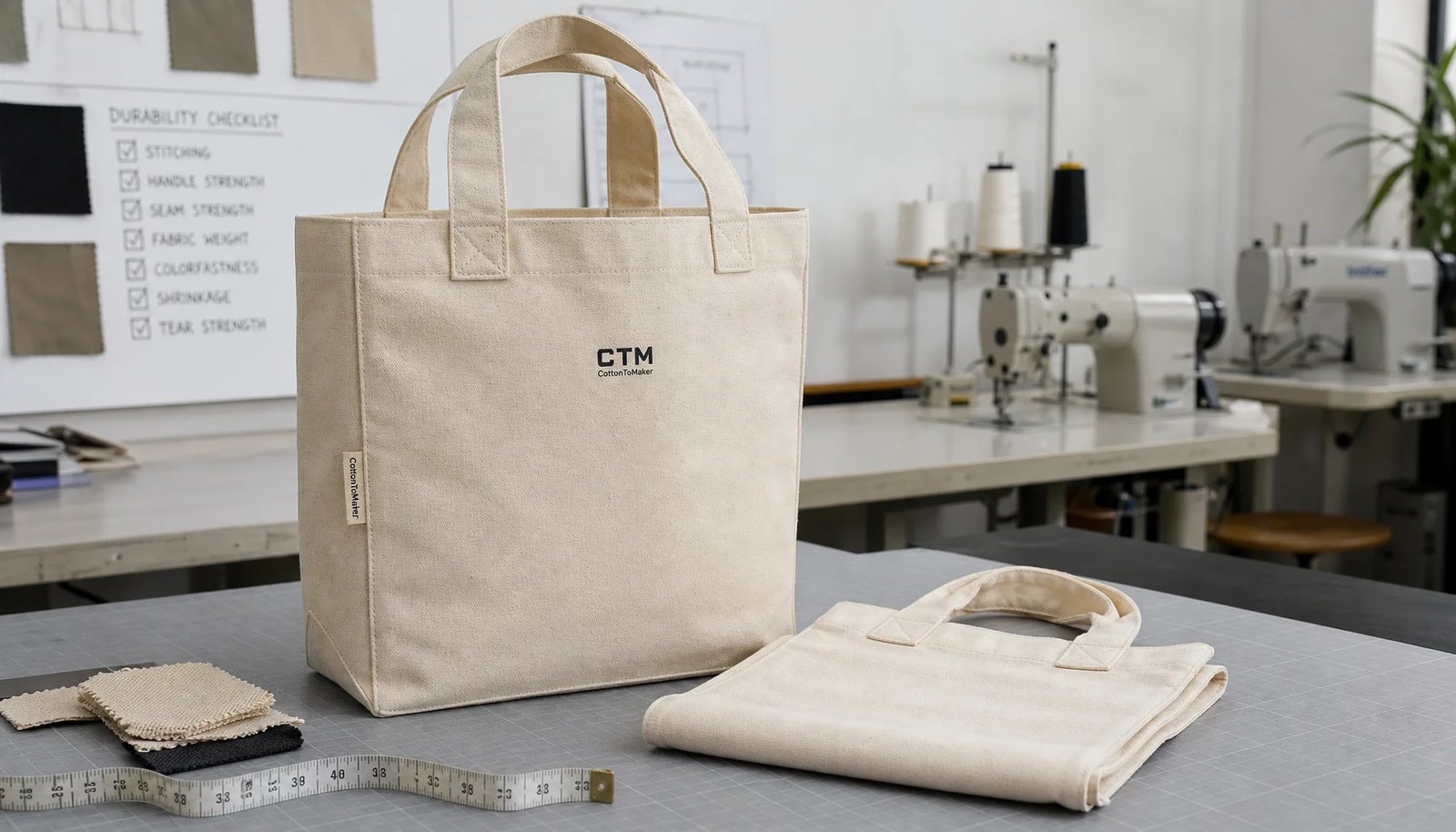
Start With the Tote's Job
A trade show tote is handled like freight before it is judged like branding. It gets packed in a rush, carried across a venue, set on the floor, overfilled with literature or samples, shipped to a warehouse, and sometimes reused at a second event. The canvas grocery totes durability testing checklist for trade show exhibitors has to reflect that route, because most failures start with the wrong assumption about how the bag will actually move through the program.
Separate the order by function before you compare suppliers. A brochure handout bag, a sample-kit bag, a grocery-style tote, and a retail merchandise bag can share a shape and still need very different fabric weights, reinforcement, and packing formats. If the tote will only hold paper collateral, the build can stay lighter. If it has to carry boxed samples or bottles, the strength requirement changes the whole spec.
Trade show nuance matters. Bags sent direct to a venue are judged under time pressure at receiving and again at the booth. Bags shipped through a distributor are handled a second time when they are counted and repacked. Bags used for sponsor kits need to survive insert cards, hangtags, and presentation standards that a plain giveaway bag never faces. The right quote is the one that matches the route, not the one with the lowest printed unit price.
- Define the heaviest filled load by item type and weight, not just by bag count.
- State whether the bag will be handed out, sold, shipped, stored, or reused.
- Note the event route: factory to warehouse, direct to venue, or multi-stop distribution.
- Treat the tote as a transport item first and a branding item second.
Write A Spec That Can Be Quoted
A useful tote spec is short, explicit, and measurable. It should include fabric composition, finished weight, color, finished dimensions, handle drop, gusset depth, seam construction, reinforcement method, print method, tolerance, packing format, and delivery date. If any of those fields are vague, the factory will fill in the gaps with its own defaults, and those defaults are rarely aligned with trade show handling requirements.
Write the spec as if another buyer will need to compare three quotations side by side. That means avoiding words like heavy, premium, or strong unless they are paired with a number, a build detail, or a test condition. A supplier can quote a natural canvas body with one reinforcement scheme and another supplier can quote a visually similar bag with a weaker one. Without a shared spec, those prices are not comparable.
Version control matters more than many teams expect. A tote for one event may need a different insert card, carton mark, or logo placement from the next event, even when the body is the same. If those variations are not tracked as separate revisions or SKUs, the factory can mix instructions and still believe it is fulfilling the order correctly. Keep the body spec stable and manage artwork, labels, and packout as controlled variables.
- Write one revision-controlled spec sheet for the bag body and one for artwork or packout changes.
- Use numbers for fabric weight, dimensions, tolerance, and handle drop.
- Separate sourcing compliance from build quality so neither gets lost in the quote.
- Ask the supplier to confirm the measurement method before you approve the spec.
Set Fabric Weight Against Real Load
For many exhibitor programs, 10 oz to 12 oz cotton canvas is the most practical starting point. It gives enough body to look intentional on a registration counter, enough strength for standard literature or moderate sample packs, and enough flexibility to pack efficiently for freight. When the tote is expected to be resold, reused often, or carry dense contents such as bottles, boxed kits, or catalogs in bulk, 14 oz to 16 oz canvas is the more realistic direction. Heavier cloth is not automatically better; it just moves the failure point to stitching, thread, or packaging if the rest of the build does not keep up.
Ask what the quoted fabric weight refers to. Finished fabric, washed fabric, and greige fabric are not interchangeable. A nominal weight can change after finishing, shrinkage, or dyeing, and that affects both hand feel and size control. If the tote has to fit a retail shelf, an insert card, or a standardized event kit, request the post-finish size expectation instead of only the cut size. Pre-shrunk or dimensionally stabilized fabric is worth discussing when the dimensions matter after pressing and folding.
Color and blend also affect how the tote behaves in inspection. Natural cotton canvas is easy to compare between samples, but dyed canvas can hide seam issues or show them more clearly depending on the shade. Recycled cotton or blended canvas can introduce slub variation, tone variation, or a less uniform print surface. That can be acceptable, but only if the approved visual standard already reflects it. Otherwise, ordinary textile variation turns into a production dispute.
- 10 oz to 12 oz canvas fits most standard trade show giveaway programs.
- 14 oz to 16 oz canvas is a better fit for retail or repeat-use programs.
- Ask whether the quoted weight is finished fabric weight and whether shrinkage is controlled.
- Request the post-finish size expectation if the bag must hold inserts or fit a shelf.
Engineer The Stress Points
Most tote failures start where the load transfers into the bag: the handle attachment, top hem, bottom corners, and seam intersections. Those points deserve more attention than the front panel because they determine whether the bag survives one event or several. A buyer can review a clean mockup and still miss the construction detail that will fail when the bag is lifted by one handle or packed with dense contents.
Handles need a reinforcement pattern that spreads the load into the body rather than concentrating it on a narrow stitch line. Box-X stitching or a dense bartack pattern is usually easier to defend than a single straight seam, especially for trade show bags that may be carried by one strap, swung quickly, or stuffed and repacked. The top hem should be folded cleanly so the edge does not unravel under repeated use. Bottom gusset corners should be reinforced because the stress from setting the bag down and refilling it hits the same corners again and again.
Ask for a construction drawing or close-up sample that shows seam allowance, stitch direction, thread type, and the location of each reinforcement point. A vendor that can explain how the load moves through the tote is usually a better manufacturing risk than one that only describes the bag visually. Buyers do not need to engineer the sewing line themselves, but they do need enough detail to tell whether the construction is intended for actual use or only for a sales sample.
- Prefer box-X or dense bartack reinforcement at the handle base.
- Check the top hem for a clean fold and no exposed raw edge that can fray.
- Inspect gusset corners, because they usually show wear before the middle panel does.
- Request a construction sketch or close-up sample before approving bulk.
Use Durability Tests You Can Defend
Durability testing should be written as a method, not as a slogan. Define the load, the fixture, the duration, the number of cycles if movement is involved, and the pass-fail criteria. Use the real filled contents whenever possible. A tote filled with soft padding can pass a test that a boxed sample kit would fail immediately. If the bag is intended for event handouts, test it with the same literature stack. If it is meant for dense merchandise, test it with that weight and shape, not a generic filler object.
A practical validation set should include at least one static test and one use test. A static hang test checks whether handles, top hem, and seams hold under a sustained load without tearing or permanent deformation that makes the bag unusable. A carry or swing test checks whether the handles or top seam shift when the load is lifted, set down, and lifted again. A fold test checks whether the bag can be packed flat and still present well after compression. If the tote will be stored in cartons for a period of time, a packed-storage or carton-compression check adds useful information about creasing and print blocking.
Use concrete thresholds so the result can be defended inside procurement. For a standard giveaway tote, a reasonable starting point is 5 kg static load for 5 minutes with no seam opening, handle pullout, or stitch failure. For a heavier kit tote, a 8 kg to 12 kg static load may be more appropriate. A carry test can be set at 25 lift-and-carry cycles for a giveaway tote or 50 cycles for a repeat-use tote. For print and surface checks, 20 dry-rub passes with no visible transfer to a white cloth is a practical benchmark, and a 10-cycle fold test should not produce edge lift, blocking, or cracking that changes the bag's appearance.
- Require the test method, fixture, duration, and failure criteria, not only the result.
- Test with the actual filled contents whenever possible.
- Add both static and movement-based checks if the bag will be carried, not only stored.
- If the program matters, request traceable lab evidence tied to the approved sample ID.
Test Print On The Final Build
The bag can be structurally sound and still fail commercially if the logo cracks, rubs off, or shifts out of position. For simple exhibitor logos on natural or dyed canvas, screen print is usually the most durable and economical route. It performs best when the ink system, screen count, and cure are matched to the specific cloth. A strike-off on the wrong fabric weight or wrong color is not a real approval, because the print can behave differently once it lands on production canvas.
Heat transfer and digital print have their place, especially when the artwork is detailed or the quantity is small. But those methods need more scrutiny on a tote that will be folded, stacked, and rubbed in transit. Transfer edges can lift, and a tight fold line can expose a crease pattern that was not obvious on a flat sample. If the bag will be packed flat for event distribution, check the print in the packed state, not just on a table.
The print review should include one dry rub check, one fold check, and a placement check against the approved sample. In procurement terms, that means documenting how far the print can shift, what color range is acceptable, whether blocking is allowed in the carton, and whether the buyer accepts any edge gloss or film feel. These are small details until the tote is used at scale, and then they become the most visible defect in the program.
- Screen print is usually the best baseline for simple logos on canvas.
- Run dry rub and fold tests on the exact artwork, not on a substitute sample.
- Check print placement against the approved sample and write down the allowed shift.
- Inspect packed samples for blocking, edge lift, and crease-related cracking.
Compare Suppliers On Evidence, Not Promises
A strong sample is useful, but procurement still needs to know whether the supplier can repeat it. Ask what evidence sits behind the sample. The most useful answer connects the sample to a specific fabric lot, a specific print setup, and a traceable test record. If the vendor cannot connect the sample to a material record, the sample may be impressive but it is not very predictive.
Request supporting documents that match the market. Those can include fiber composition declarations, chemical or restricted-substance declarations, and any buyer-specific compliance paperwork that applies to the destination market. If the program will be sold or redistributed in a regulated market, ask for the documents early so compliance does not become a last-minute procurement surprise. The point is not to collect paper for its own sake; it is to prove that the same supply chain used for the sample is the one used for the bulk order.
The supplier conversation also needs a failure path. Ask what happens if the pre-production sample fails on load, print, or packing. A competent vendor should be able to describe root-cause analysis, corrective action, a revised sample, and the condition under which production resumes. If the response is vague, the buyer is being asked to accept variation without a recovery plan. That is weak risk control for an event-critical order.
- Ask which tests are in-house and which are third-party, and request the sample ID for each report.
- Request traceability from sample to material lot where possible.
- Separate compliance documents from performance evidence so one does not substitute for the other.
- Require a written corrective-action path before releasing bulk production if a sample fails.
Control MOQ, Lead Time, And Packing
MOQ is rarely about sewing alone. It is usually driven by fabric purchasing, dye batches, cutting efficiency, print setup, label work, and packout labor. That is why a simple-looking tote can carry different minimums depending on whether the body is stock natural canvas, custom-dyed, or blended. The same is true for handle colors and multi-version artwork. If you ask for several variants at low quantity, the factory will either raise the unit price or quietly change assumptions later.
The most effective way to keep the quote comparable is to start with one body, one color, one handle construction, one print method, and one packing format. Once the base version is clear, ask for pricing deltas on controlled variations. That makes the true cost drivers visible. It also prevents the common problem where a cheap-looking quote grows after the supplier adds extra screen setup, label changes, or a second sampling round that was never captured in the original request.
Trade show schedules make lead time a real sourcing variable. A tote for a spring show may need sample approval, bulk production, inspection, freight booking, and venue delivery inside a narrow calendar window. Ask whether the quoted lead time includes pre-production sampling, revisions, bulk sewing, carton consolidation, and any third-party inspection window. If the answer is no, the number on the quote is not a real delivery commitment.
- Keep the first RFQ simple so the price reflects one stable build, not multiple variations.
- Ask for price deltas by body color, handle color, print version, and packing format.
- Confirm whether lead time includes sample revisions, inspection, and freight booking.
- Use the same approved build for reorders unless you intentionally change the spec.
Inspect The First Run And Lock Reorders
The first bulk run should be treated as a controlled release, not as a routine shipment. Keep a retained approval sample, have the factory keep one as well, and check the first production lot against both. The inspection should include dimensions, stitching, print placement, packing accuracy, carton marks, and a functional check on a sample from the production lot. If the order is important, the inspection should happen before the goods are released for final shipment.
AQL can be part of the process, but it should not be the only process. Counting defects tells you something, but it does not replace a function check on handles, seams, and print durability. A tote can pass by count and still fail because the handle reinforcement is visually weak or the print cracks when the bag is folded. For handling goods, the inspection sheet should combine measurable items with a short functional checklist that is easy for the inspector to follow.
When something fails, the response should be operational, not emotional. Quarantine the lot, identify whether the issue is material, sewing, print, or packing, and decide whether rework or remanufacture is needed. Then retest the corrected samples before release. That path is slower than accepting a partial issue, but it is far cheaper than discovering a bag failure at a show where there is no time to replace it.
- Keep a retained sample on both buyer and factory sides.
- Use AQL only alongside a functional inspection checklist.
- Quarantine any failed lot until root cause and corrective action are approved.
- Release production only after the corrected sample matches the approval standard.
Specification comparison for buyers
| Spec decision | Recommended option | When it fits | Buyer risk to check |
|---|---|---|---|
| Fabric weight | 10 oz to 12 oz cotton canvas, roughly 280-340 GSM, with finished-fabric weight stated in the quote | Standard trade show handouts, brochure totes, and light sample kits that need a clean retail look | A strong-looking mockup can still fail if the weave is loose, shrinkage is not controlled, or seam construction is weak |
| Heavy-use build | 14 oz to 16 oz canvas, roughly 380-450 GSM, with stronger thread and reinforced stress points | Retail merchandise, VIP kits, and repeat-use programs that may carry bottles, books, or dense sample packs | Heavier cloth increases sew time, freight weight, and carton cost, and it exposes weak needles, poor thread choice, or underbuilt handles |
| Handle construction | Self-fabric or webbing handles with box-X stitching or dense bartacks at both attachment ends | Most exhibitor programs that need a durable carry feel and predictable lift performance | Short reinforcement zones, thin stitch lines, and weak handle-end anchoring usually fail before the body fabric does |
| Durability validation | Pre-production sample plus documented static load, carry-cycle, fold, and rub tests using the final build | Any order that will be shipped, reused, or handed out with product samples | Testing only helps if the fixture, load, duration, sample ID, and failure criteria are written down and matched to the order |
| Print method | Screen print for simple logos; transfer or digital only after fold and rub checks pass on the final canvas | Most branding programs on natural or dyed canvas with medium to high quantity | Ink cracking, edge lift, or color rub-off can turn a structurally sound bag into a rejected bag |
| Packing plan | Flat packed with carton counts, event labels, and moisture protection where transit risk is high | Warehouse delivery, direct-to-venue shipments, or multi-event allocations | Vacuum packing and aggressive compression can crease heavy canvas and distort printed panels |
| Supplier evidence | Lab report or traceable internal test record, compliance documents, and a corrective-action path if samples fail | First orders, new vendors, or programs with compliance requirements in the target market | A polished sample without evidence does not show whether the bulk run will repeat the same result |
Buyer checklist before sampling
- Define the tote by use case first: brochure handout, sample kit, grocery carry, retail merch, or sponsor pack. Write the heaviest filled load in kg and the actual contents, not just a bag category.
- State fabric weight in oz and GSM, and say whether the quoted number is finished fabric weight. Ask the supplier to identify the exact fabric base or roll lot behind the sample.
- Lock finished dimensions, handle drop, gusset depth, seam type, reinforcement method, and tolerance in one revision-controlled spec sheet.
- Require a pre-production sample made with final fabric, final print method, final reinforcement, and final packing format before bulk release.
- Set a load test around real contents. For a standard event tote, a common starting point is 5 kg to 8 kg static hold for 5 minutes with no seam opening, handle pullout, or failure that prevents use.
- Ask for a carry-cycle check on the same build, such as 25 lift-and-carry cycles for a giveaway tote or 50 cycles for a repeat-use tote, with no progressive tear at the handle base.
- Require fold, rub, and abrasion checks on the exact artwork and canvas color, not on a substitute fabric or an earlier sample.
- Ask the supplier to show which tests are in-house and which are third-party, then request the method, fixture, sample ID, and date for each report.
- Get carton data before freight is booked: carton dimensions, gross weight, net weight, pieces per carton, carton marks, and moisture protection. Keep manual cartons near 15 kg or 33 lb unless the receiving site allows more.
- Define what happens if a sample fails: hold bulk production, issue a corrective action, resubmit a revised sample, and re-inspect before shipment.
Factory quote questions to send
- What exact canvas spec are you quoting, including finished GSM, fiber composition, shrinkage expectation, and whether the fabric is stock or custom woven?
- What seam construction, stitch density, and handle reinforcement are included in the price, and can you share a construction sketch or close-up sample photo?
- What static load, carry-cycle, fold, or rub tests have you already run on this build, and what fixture, duration, and failure criteria did you use?
- Which parts of the validation are supported by a third-party lab, and can you provide the report with sample ID, date, and test method?
- What finished-size tolerance can you hold for width, height, gusset, and handle drop after sewing and pressing?
- Which print method do you recommend for our artwork, and what are the known limits for rub, fold, cracking, color shift, and placement drift?
- What are the MOQ and price breaks by body fabric, body color, handle color, print version, and packing style?
- What is included in the sample process: strike-off, pre-production sample, revision rounds, and any associated fees?
- What packaging format, carton size, gross weight, and labeling scheme should we use for freight and venue receiving?
- If the pre-production sample fails, what is your corrective-action process and how long does it take to issue a revised sample?
Quality-control points to confirm
- Finished dimensions, handle drop, and gusset depth measured flat against the approved tolerance using the same method on sample and bulk.
- Fabric weight verified by supplier spec, lab record, or traceable roll data for the exact material used in the run.
- Handle attachment inspected for reinforcement shape, stitch density, and no tearing or distortion after the agreed load test.
- Bottom corners and side seams checked after loading for seam opening, stitch skips, thread breaks, or stress whitening.
- Top hem inspected for clean folding, consistent stitch line, and no raw-edge fray that could accelerate wear.
- Print checked for correct placement, cure, color match, rub resistance, fold-line cracking, ghosting, and blocking after packing.
- Interior seams checked for loose thread chains, exposed raw edges, oil stains, contamination, and trim quality.
- Carton count, carton marks, and packing method verified before release, especially for direct-to-venue or multi-destination shipments.
- Moisture protection reviewed for long transit or warehouse storage, including carton condition, liners, or desiccants if needed.
- For a first run, a common starting point is critical defects at 0, major defects at AQL 2.5, and minor defects at AQL 4.0, paired with a functional pull test on a sampled unit from each inspected lot.