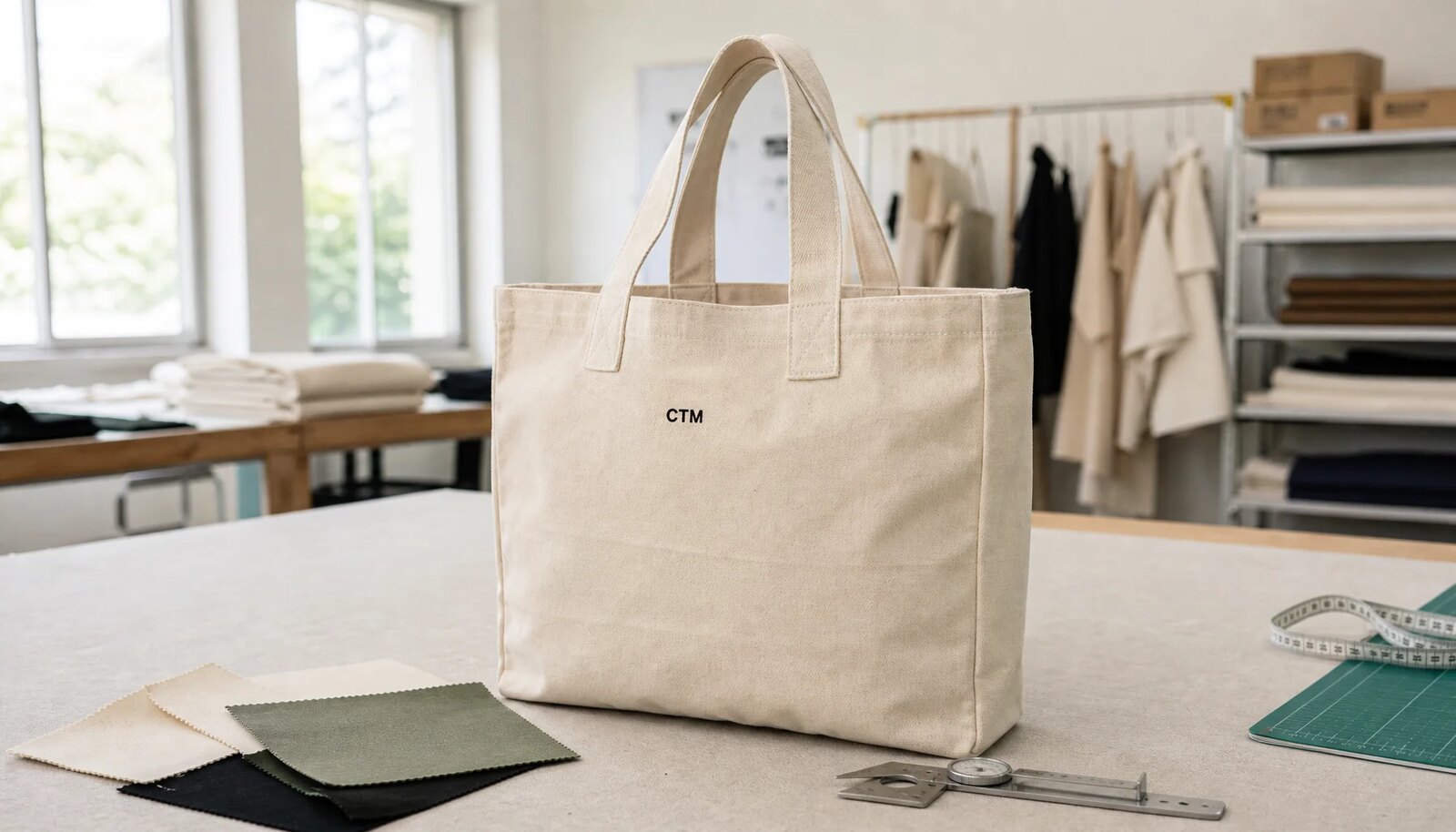
Why durability belongs in the RFQ, not after sampling
Two canvas grocery tote quotations can look identical in a spreadsheet and describe very different bags. One supplier may price a light promotional tote with simple top-hem handles. Another may quote a gusseted grocery bag with reinforced handle anchors, stronger thread, and heavier cartons. A third may use a heavier fabric but reduce cost through shallow handle insertion or low stitch density. If the RFQ only says “canvas tote with logo,” the buyer is not comparing like with like.
For eco apparel brands, the tote often carries more than groceries. It carries the reuse message, the retail presentation, and sometimes the customer’s first physical impression of the brand outside the garment itself. A bag that tears at the handle after a few shopping trips undermines the sustainability story. At the same time, choosing the heaviest canvas for every program is not automatically better. Extra weight can raise unit cost, carton weight, freight cost, and storage volume without fixing the real failure point.
A durability standard gives the sourcing team measurable language. Instead of asking whether a tote is “strong,” the buyer can ask whether the sample passes a defined 10 kg static load check, how many lift cycles were tested, what stitch density is used at the handle anchor, and how much seam opening is allowed after testing. These details make price comparison cleaner and reduce arguments after bulk production.
The standard does not need to become a laboratory manual. It should cover the practical points that decide field performance: target load, canvas weight and tolerance, weave quality, handle reinforcement, seam allowance, stitch density, print method, sampling stage, load testing, inspection, and packing. Once those items are written before quoting, factories can price the same construction and buyers can judge value instead of chasing the lowest incomplete line item.
- Primary failure points are handle anchors, lower side seams, bottom corners, gusset intersections, and stiff print fold zones.
- Fabric certification or organic status does not automatically prove durability; construction and testing still matter.
- A sealed approved sample plus written tolerances is stronger than photo approval alone.
- Durability should be controlled in the RFQ, sample approval, production QC, and final inspection, not added after cartons are packed.
- Small savings from lighter fabric, weak stitching, or overfilled cartons can turn into larger costs through claims, replacements, and poor retail experience.
Start with the load profile before choosing canvas weight
A grocery tote should be designed from the load outward. Before debating 10 oz, 12 oz, or 14 oz canvas, define what the customer will carry and how they will carry it. A checkout tote for folded apparel does not need the same structure as a grocery tote expected to hold produce, pantry items, boxed goods, bottles, and repeated shoulder carry.
Write the use case in one plain sentence inside the RFQ. For example: “Reusable canvas grocery tote for repeated shoulder carry, rated working load 10 kg, gusseted bottom, reinforced handles, one-color screen print.” That sentence prevents a supplier from pricing the bag as a light merchandise tote. For a premium grocery program, the target may move to 12 kg. For a smaller retail tote, 6 kg to 8 kg may be enough. The important point is to name the target rather than rely on words such as “heavy duty” or “strong canvas.”
Static load and repeated use are separate risks. A tote may hang with 10 kg for several hours and still fail after many lift-and-set-down cycles, because cyclic stress attacks the handle stitching and lower corners. Grocery loads are also uneven. Cans, bottles, jars, and sharp-cornered boxes push against seams differently from folded apparel. If the product is marketed for repeated grocery use, include both a holding check and a practical lift-cycle check.
The load profile also affects comfort. Shoulder handles need enough drop to fit over clothing, but long handles create more swing and leverage. Hand-carry handles can be shorter and may feel more controlled under weight. State whether the bag is for shoulder carry, hand carry, or both. That one decision changes handle length, reinforcement, and customer expectation.
- Define rated working load: common B2B targets are 8 kg, 10 kg, or 12 kg depending on size and positioning.
- State whether testing is static load, repeated lift cycle, or both; each needs its own pass/fail rule.
- Specify carrying mode: hand carry, shoulder carry, or dual use.
- Use gusseted or boxed-bottom construction for mixed groceries and higher volume; keep flat construction for lighter use cases.
- Review handle comfort on a loaded sample, not only on an empty showroom sample.
Specify fabric weight, weave, and tolerance with sourcing accuracy
Canvas weight is easy to compare, but it is not the whole durability specification. For grocery-positioned totes, 12 oz to 14 oz cotton canvas, approximately 407 to 475 GSM, is a common working range. A 10 oz canvas can be suitable for smaller reusable retail totes or apparel purchase bags. It may feel underbuilt for grocery messaging unless the weave is compact and the construction is well reinforced. A 16 oz canvas can feel premium, but it adds sewing bulk, material cost, carton weight, and freight impact.
Ask for both oz and GSM where possible because suppliers use both systems. Then ask how the number is measured. GSM can refer to greige fabric before finishing, finished fabric, washed fabric, printed panels, or finished bag panels. These values are not always the same. A clearer spec would read: “12 oz cotton canvas, target 407 GSM finished fabric, tolerance ±5%, bulk to match approved sample handfeel and weave.” If the supplier can only provide a nominal fabric weight, confirm the measurement basis before comparing quotes.
Weave quality matters as much as weight. A loose weave can feel thick in hand but distort under load, fray at cut edges, show seam grin, and print with less sharp detail. A tighter canvas usually supports cleaner sewing and more stable print edges, though it may feel firmer and cost more. Natural canvas can have some slub and shade variation, but the approved range should be visible and agreed. Oil stains, mildew odor, dirty handling, and strong shade bands across panels should not be waved through as “natural character.”
Eco apparel buyers also need to separate material claims from performance. Organic cotton, recycled cotton blend, undyed cotton, dyed canvas, and conventional cotton canvas can all be used in tote programs. Each claim may require different documents, but certificates do not replace load testing. A certified fabric with shallow handle insertion can still fail at the anchor.
- 8 oz to 10 oz: usually better for giveaways, light merchandise bags, and low-load apparel purchases.
- 12 oz: a practical balance for many reusable grocery totes with good print surface and manageable freight.
- 14 oz: more structure and premium handfeel, with higher material cost and carton weight.
- State GSM tolerance, such as ±5%, or an agreed minimum/maximum range based on the approved sample.
- Inspect weave tightness, yarn cleanliness, shade, handfeel, odor, and surface defects, not only fabric weight.
Engineer the seams, handles, and bottom corners
Most canvas tote failures begin where stress is concentrated. The weak spots are predictable: handle anchors, the top hem, lower side seams, bottom corners, and gusset junctions. A heavy fabric body will not rescue a weak stitch pattern. For grocery use, the RFQ should define seam construction and reinforcement instead of leaving them to the factory’s default.
State the seam type and finished seam allowance. Many tote constructions use about 8 mm to 12 mm finished seam allowance on load-bearing seams, but the right value depends on the seam type, fabric thickness, and edge finish. The edge may be folded, bound, overlocked, enclosed, or combined with a gusset. What matters is that the buyer and supplier approve the standard before sampling. During inspection, seam grin, fraying, missed catching, and inconsistent allowance should be treated as durability issues, not cosmetic comments.
Handle construction needs the closest review. For shoulder grocery totes, box-X stitching, cross stitching, reinforced bar tacks, or multiple parallel reinforcement lines are usually more reliable than a single straight stitch through the top hem. The handle should insert deeply enough into the body or hem to spread the load, and both ends should be symmetrical. If the handle is self-fabric, specify finished width, number of layers, folding method, and topstitching. If it is webbing, specify fiber, width, thickness, color, handfeel, and whether cotton-look polyester webbing is acceptable.
The bottom design is the other major stress decision. Flat totes are simple and economical, but groceries push outward and downward, concentrating force at the lower corners. A bottom gusset or boxed bottom improves capacity and load distribution, but it creates seam intersections that must be sewn consistently. If the bag later gains pockets, lining, bottle sleeves, zippers, or large labels inserted into seams, retest the sample because the load path has changed.
- Require handle reinforcement type in writing: box-X, cross stitch, bar tack, or another approved pattern.
- Specify handle width, handle drop, insertion depth, and symmetry tolerance.
- Check stitch density and sewing tension at load-bearing seams and handle anchors.
- Inspect gusset corners for skipped stitches, bulky weak points, seam grin, and uneven seam allowance.
- Retest after adding pockets, lining, zippers, bottle dividers, or heavy labels because trims can change stress distribution.
Treat printing as a durability variable, not just decoration
Printing is often discussed after the construction is chosen, but it can affect performance, handfeel, folding, and packing. Water-based screen printing is common for simple eco apparel logos because it can offer a softer hand and controlled cost on natural cotton canvas. Pigment-style effects may suit a rustic brand look, but natural canvas shade variation can make color matching less exact. Heat transfers can work for small accents or detailed graphics, yet larger transfers may feel stiff and should be flex tested.
Large ink coverage changes the way a tote moves. A dense front graphic can create a stiff panel that cracks along fold lines or shows rub marks after carton compression. Dark ink on natural canvas can scuff visibly and may transfer if curing is incomplete. If artwork sits near a gusset, over a thick seam, or across a high-flex fold area, approve it on an actual tote or production canvas panel, not only on a digital proof.
Print placement should have reference points and tolerance. Define the print centerline, distance from the top edge, distance from the side seam or body center, maximum allowed placement variation, and whether minor distortion near seams is acceptable. Also view the logo with the gusset opened. A mark that looks centered on a flat empty panel may look off when the bag is filled.
Curing and packing timing belong in print QC. Under-cured ink can feel tacky, transfer onto adjacent bags, or fail rub checks. Aggressive carton packing can press print surfaces together before the ink has stabilized. For large or dark prints, ask the factory how long printed panels or finished bags rest before folding and whether tissue, paper interleaving, or a revised fold is needed.
- Use print strike-offs on actual production canvas for color-sensitive, large, dark, or detailed artwork.
- Specify ink type, color target, print size, placement tolerance, and curing method.
- Fold and flex printed samples before approval to check cracking, flaking, stiffness, and transfer.
- Check print after packed-sample compression, not only immediately after printing.
- Avoid placing heavy ink across high-flex fold zones or thick seam intersections unless tested.
Use sampling to approve construction, performance, and packing
A good sampling process separates visual approval from production approval. The first useful stage is often a construction sample. It may use available fabric or temporary artwork, but it should confirm body proportions, gusset shape, handle drop, handle width, seam construction, reinforcement method, and carrying comfort. This is the easiest stage to fix a handle that feels too narrow, a bottom that collapses poorly, or a top hem that cannot support the reinforcement cleanly.
Use a print strike-off when artwork risk is meaningful. This matters for dark ink on natural canvas, fine-line logos, large coverage, brand color targets, or soft-hand requirements. The strike-off should be made on actual production canvas or fabric from the approved lot where possible. A paper proof confirms layout; it does not prove ink absorption, edge sharpness, curing, or handfeel.
The pre-production sample is the key durability approval. For a grocery tote, it should use final fabric weight, final fabric finish, final handle material, final thread, final labels, final print, and proposed folding and packing. If any substitute is used, mark the approval as partial and list the open points. Otherwise, a buyer may think durability is approved when only shape or artwork was approved.
Record approval in measurable language. Keep a report with finished dimensions, tolerances, fabric specification, handle drop, reinforcement type, stitch density, print placement, label placement, packing method, and load-test result. Keep one sealed approved sample at the factory and one with the buyer or inspection agency. Final inspection should compare bulk production against both the written specification and the physical sample.
- Construction sample: approve shape, gusset, handle system, seam build, and comfort.
- Print strike-off: approve ink color, edge quality, curing, handfeel, and rub/flex performance on canvas.
- Pre-production sample: approve final fabric, print, thread, labels, trims, measurements, folding, and packing.
- Loaded sample review: test the sample at the target load and inspect handles, seams, bottom corners, and print folds.
- Approval record: include photos of inside seams, handle anchors, measurements, tolerance notes, and pass/fail test results.
Durability testing checklist with practical pass/fail rules
Not every canvas grocery tote order needs an expensive laboratory program. Every serious B2B order does need defined pass/fail checks. The core controls are static load, repeated lift cycle, seam opening review, handle attachment review, print rub or flex review, and dimensional stability when washing is claimed. The goal is not paperwork for its own sake. The goal is to prevent subjective disputes once bulk goods are sewn and packed.
A static load test checks whether the tote holds a defined load for a defined time without immediate failure. A practical internal standard may be 10 kg for 24 hours for a tote rated at 10 kg, with no handle detachment, no seam burst, and no major deformation beyond the agreed limit. A shorter in-line screening test can also be used during final inspection, but do not confuse a quick screening check with a longer qualification test at sample stage.
A repeated lift test is closer to real grocery behavior. The tote is loaded to the target weight, lifted by the handles, set down, and repeated for an agreed number of cycles. Buyers can set the cycle count according to risk level, retail channel, and price point. The standard should state cycle count, lift height if controlled, sample quantity, and pass/fail rules. Failures include broken stitches, handle tear-out, seam opening beyond tolerance, fabric tearing, or reinforcement distortion.
Write seam and handle thresholds before production starts. For example, a buyer may allow no handle detachment and no broken reinforcement stitching, while limiting seam opening after testing to a measured value such as 2 mm to 3 mm depending on seam type and location. If any opening is allowed, define where and how it is measured. If no opening is acceptable at load-bearing seams, say so plainly.
Print testing should follow the artwork risk. A small one-color logo may need a rub check and fold check. Large coverage may need flexing, stuffing, carton compression review, and transfer checks. If the tote is marketed as washable, add wash shrinkage, skew, colorfastness, seam condition, and print appearance after laundering. If the care instruction is spot-clean only, load, rub, and packing performance may matter more than laundering.
- Static load example: target load such as 10 kg for a defined duration, with no handle failure or seam burst.
- Repeated lift example: load to target kilograms, lift and set down for agreed cycles, then inspect handle anchors and bottom seams.
- Handle rule: zero tolerance for detachment, tearing at anchor, or broken reinforcement on tested samples.
- Seam rule: define maximum allowed opening in millimeters and classify failure as major or critical depending on location.
- Print rule: no tackiness, major cracking, flaking, transfer, or severe rub-off after agreed checks.
- Record load weight, duration, cycle count, sample quantity, carton source, and pass/fail result.
Production QC and final inspection points for grocery totes
Final QC for canvas grocery totes should check construction, not just logo appearance. Inspectors should measure body width, height, gusset depth, bottom width, top opening, handle drop, handle width, and print placement. They should compare bulk fabric with the sealed approved sample for shade, weave, handfeel, surface cleanliness, odor, and slub level. Natural variation is acceptable only within the approved range.
Inside construction matters. Inspectors should turn samples inside out or open seams visually where possible to review seam allowance, stitch density, back-tacking, loose threads, skipped stitches, broken threads, and handle insertion. A tote can look clean from the outside while the inside seam is shallow or inconsistently caught. Handle anchors deserve attention on every inspected sample because one weak handle can create a serious customer complaint.
Agree defect classification before inspection. Critical defects may include unsafe contamination, severe mold, wrong certified material claim, or immediate handle failure under the agreed load check. Major defects may include incorrect dimensions beyond tolerance, wrong fabric weight, weak handle reinforcement, seam opening, wrong print position, severe stains, wrong packing, or carton overweight. Minor defects may include small loose threads, slight slub variation, or minor shade variation within the approved standard.
Random loaded-bag checks are useful because many failures are invisible on a flat sample. The inspector can select bags from different cartons, load them to the agreed screening weight, hold or lift them according to the instruction, and examine handle anchors, seams, and bottom corners afterward. This does not always replace formal sample-stage testing, but it is a strong production control.
QC should begin before cartons are sealed. A first-output check compares early production with the approved pre-production sample. It can catch wrong handle drop, incorrect stitch pattern, fabric lot differences, misaligned print, and label placement errors before hundreds or thousands of pieces are sewn. Waiting until final packed inspection makes rework slower and more expensive.
- Use AQL or another agreed sampling plan, with critical, major, and minor defects defined in advance.
- Measure dimensions on multiple samples from different cartons and record actual values.
- Inspect inside seams, top hem, handle anchors, lower corners, and gusset intersections.
- Compare fabric and print to the sealed approved sample, not only to digital artwork.
- Run random loaded-bag checks where agreed and record load, time or cycles, quantity, and result.
- Treat wrong packing, carton overweight, moisture, odor, and incorrect shipping marks as QC issues.
Packing, carton strength, and moisture control affect delivered durability
A well-made canvas tote can still arrive damaged if packing is weak. Heavy canvas adds carton weight quickly, especially with gussets, wide handles, large prints, or retail tags. Overfilled cartons may reduce freight cost per unit, but they can create hard creases, print offset, handle distortion, carton bulging, and crushed corners. In warehouse handling, cartons that are too heavy are more likely to be dropped, damaged, or rejected by distribution teams.
Eco apparel brands often prefer to reduce individual polybags. That can be a reasonable sustainability choice, but it needs a cleanliness and moisture-control plan. Options include master carton liners, paper bundling, kraft bands, tissue between printed surfaces, route-appropriate moisture protection, and clear handling instructions. Plastic-free packing without dust or humidity control can expose natural canvas to dirt, odor, and mildew risk.
Make carton specifications part of the RFQ. Include pieces per carton, carton dimensions, carton gross weight limit, fold direction, print-facing direction, barcode labels, shipping marks, and whether cartons will be palletized or hand-loaded. If printed surfaces face each other, confirm that the ink is fully cured and will not transfer under pressure. If handles are folded sharply, check that they recover without twisting.
Test the packing before mass packing. Pack the pre-production sample or a small pilot quantity using the proposed method, leave it compressed for a defined period, then open it and inspect print transfer, fold recovery, handle distortion, odor, and carton condition. For retail programs moving through several warehouses, buyers may also request a carton drop or compression check, especially when cartons are heavy or routes are demanding.
- Set maximum carton gross weight according to warehouse and carrier requirements, not only freight cost.
- Specify fold direction so print surfaces are protected and handles do not twist.
- If avoiding individual polybags, require carton liners, paper bundling, or another clean protection method.
- Confirm carton size, pieces per carton, and gross weight before mass packing.
- Inspect for moisture, mildew odor, carton bulging, weak tape, dirty liners, and wrong shipping marks.
- Do not approve aggressive carton counts unless print transfer and fold recovery have been checked.
MOQ, lead time, and quote comparison for durable tote programs
Durable tote programs often run late because the RFQ hides lead-time assumptions. A quick quote may rely on stock natural canvas. A custom-dyed canvas, organic cotton source, recycled blend, heavier weave, special handle webbing, or woven-to-order fabric may add weeks before cutting begins. Printing and trims also affect schedule. A one-color front screen print is simpler than multiple print positions, inner pockets, retail tags, care labels, and special packing.
Count lead time from the right milestone. For a durability-sensitive order, the realistic production clock starts after pre-production sample approval and material readiness, not only after deposit payment. If artwork is approved late, handle length changes, or the fabric source switches, the timeline changes. Ask each supplier what is included in quoted lead time: fabric procurement, lab dips, strike-offs, sample shipping, printing, sewing, inspection, packing, and export booking.
MOQ should be judged by the true cost drivers. A factory may accept a low total quantity, but if the order splits into several fabric colors, two sizes, multiple logo designs, and different packing methods, the supplier is managing several small productions. That can create surcharges, slower scheduling, fabric lot inconsistency, or pressure to simplify construction. First programs are easier to control when buyers limit variables: one body fabric, one color, one size, one handle type, and one print setup.
Normalize quotes before comparing price. A lower FOB price may be based on lighter GSM, looser weave, narrower handles, single-row stitching, lower stitch density, no print strike-off, no load testing, cheaper cartons, or looser inspection terms. A higher quote may include better construction and lower claim risk. Compare landed value, including freight impact, carton efficiency, sample cost, inspection, rework risk, and retail suitability.
Blank answers are procurement risk. If a supplier does not state seam allowance, handle insertion depth, stitch density, GSM tolerance, carton gross weight, or testing method, do not assume the best version is included. The strongest quote is the one that clearly matches the intended durability standard and can repeat the approved sample in bulk.
- Ask whether quoted fabric is stock, custom finished, custom dyed, certified, or woven to order.
- Count lead time from approved pre-production sample and material readiness whenever possible.
- Keep first orders simple to reduce lot variation and production complexity.
- Normalize quotes by GSM, weave, handle reinforcement, seam construction, print method, packing, testing, and inspection standard.
- Include freight impact because heavier canvas and larger gussets reduce units per carton.
- Treat missing construction and QC details as commercial risk, even when unit price looks attractive.
Specification comparison for buyers
| Spec decision | Recommended B2B specification | When it fits | Buyer risk to control |
|---|---|---|---|
| Target use and load | Define intended use plus rated working load, commonly 8 kg, 10 kg, or 12 kg for reusable grocery programs; specify static and cycle tests separately | Eco apparel brands selling reusable shopping totes, farmers market bags, retail merchandise bags, or loyalty program totes | If the RFQ says only “canvas tote,” suppliers may quote a light promotional bag that looks acceptable in photos but is not built for grocery loads |
| Fabric weight | For grocery positioning, shortlist 12 oz to 14 oz cotton canvas, approximately 407 to 475 GSM; state tolerance such as ±5% or agreed lot range | Balanced durability, structure, printability, and freight efficiency for most branded grocery totes | Nominal oz/GSM may be measured before finishing; bulk may arrive lighter, looser, or softer than the approved sample unless measurement basis is defined |
| Fabric construction | Specify 100% cotton canvas, organic cotton canvas, recycled cotton blend, or cotton/poly blend; require the bulk fabric to match approved sample weave, handfeel, shade, and surface quality | Brands with sustainability claims, natural handfeel requirements, and screen-printed branding | A loose weave can feel thick but have poorer seam holding, more print distortion, more fraying, and higher dimensional variation |
| Finished dimensions | State width, height, gusset depth, bottom width, top opening, handle drop, and tolerances; common finished measurement tolerance is ±1 cm unless tighter is needed | Private-label tote programs where retail appearance and carton planning matter | Uncontrolled shrinkage, cutting variation, or sewing drift can change capacity, logo position, and units per carton |
| Bag shape | Use bottom gusset, boxed bottom, or side/bottom gusset for grocery volume; maintain adequate seam allowance at load-bearing seams, often about 8 mm to 12 mm finished | Mixed grocery loads including boxed goods, produce, bottles, apparel, and pantry items | Flat totes are cheaper but concentrate stress at lower corners and may not meet customer expectations for reusable grocery carry |
| Handle attachment | Require box-X, cross stitch, multi-line bar tack, or approved reinforced stitch; specify finished handle width, handle drop, insertion depth, and stitch pattern | Shoulder carry, repeated lifting, heavier loads, and premium reusable tote programs | Single-row top-hem stitching, shallow handle insertion, narrow straps, or inconsistent back-tack are common causes of handle tear-out |
| Thread and stitch density | Use strong polyester or poly-core thread; specify stitch density on main seams and handle reinforcement, for example measured as stitches per inch or per 3 cm | Orders needing repeatable sewing strength across bulk production | Cotton-only thread may support a natural story but can lose strength through abrasion, moisture, and washing; low or uneven stitch density weakens the bag |
| Print method | Water-based screen print for simple logos; pigment print for softer rustic effects; heat transfer only where handfeel and flex performance are acceptable | Eco apparel branding with moderate ink coverage on natural canvas | Large heavy ink areas can stiffen panels, crack on folds, transfer in cartons, or hide fabric defects unless strike-offs and curing checks are approved |
| Sample approval | Approve construction sample, print strike-off on actual canvas when needed, and pre-production sample using final fabric, final print, labels, trims, folding, and packing | Private-label sourcing where durability and retail readiness must be locked before bulk | Approving a substitute sample can leave GSM, handle drop, seam allowance, print curing, carton fit, and label placement unverified |
Buyer checklist before sampling
- Define the channel and use case before requesting price: grocery carry, apparel checkout bag, retail merchandise tote, event giveaway, staff uniform bag, or loyalty gift.
- State rated working load in kilograms and whether the bag must pass static load, repeated lift cycle, or both. Do not accept “heavy duty” as a test standard.
- Specify finished bag dimensions: body width, body height, side gusset, bottom gusset or boxed bottom width, top opening, and measurement tolerance for each point.
- Specify handle details: finished width, handle drop, material, number of layers, insertion depth into the top hem or body panel, reinforcement stitch pattern, and acceptable left-right symmetry tolerance.
- State canvas weight in both oz and GSM where possible, with measurement basis: greige fabric, finished fabric, washed fabric, printed panel, or finished bag panel.
- Require fabric composition and claim support: conventional cotton, organic cotton, recycled cotton blend, dyed canvas, natural undyed canvas, or cotton/poly blend. Keep certification documents separate from durability acceptance.
- Ask for weave description or fabric quality benchmark, and require bulk to match the sealed approved sample for shade, handfeel, weave tightness, slub level, and surface cleanliness.
- Specify seam construction on side seam, bottom seam, gusset junction, top hem, inside finishing, and label insertion areas. Include minimum seam allowance where applicable.
- Specify thread type, thread color, approximate thread count if available, and stitch density on load-bearing seams and handle reinforcement.
- Define print method, artwork size, ink type, Pantone or color target, placement from top and side reference points, placement tolerance, and curing requirement.
Factory quote questions to send
- What exact fabric is included in the quotation: composition, oz, GSM, weave type if known, color, finish, and finished fabric width?
- Is GSM measured on greige fabric, finished fabric, washed fabric, printed panel, or finished bag panel? What tolerance will you commit to in bulk, for example ±5%?
- Is the fabric stock, greige fabric to be finished, custom dyed, organic certified, recycled-content blend, or woven to order? How does this change MOQ and lead time?
- What shrinkage or dimensional change do you expect if the fabric is washed or steam finished? Is the tote intended to be washable or spot-clean only?
- What seam construction is included on side seams, bottom seam, boxed bottom or gusset corners, top hem, pocket seams, and label insertion points?
- What is the finished seam allowance on the main load-bearing seams, and how is it controlled during sewing and inspection?
- How many stitches per inch or stitches per 3 cm do you run on the main seams, top hem, and handle reinforcement?
- What thread type, thread count or size, and thread color are included? Is the thread polyester, poly-core, cotton, or another type?
- What handle material is included: self-fabric canvas, cotton webbing, polyester webbing, or blended webbing? What are the width, thickness, handle drop, and insertion depth?
- What reinforcement is included at the handle anchor: box-X, cross stitch, bar tack, multiple parallel stitch lines, or only top-hem stitching?
Quality-control points to confirm
- Fabric GSM should be checked against the agreed range using multiple samples from different fabric rolls, cut panels, or finished bags when lot variation is suspected.
- Inspectors should compare bulk fabric to the sealed approved sample for shade, weave tightness, handfeel, slub level, pilling risk, foreign fibers, stains, oil marks, odor, and mildew signs.
- Finished dimensions should stay within agreed tolerance for width, height, side gusset, bottom gusset or boxed bottom, top opening, and bottom width.
- Handle length, handle drop, handle width, insertion depth, and left-right symmetry should be measured across the inspection sample set, not only on one golden sample.
- Handle reinforcement must match the approved method with no skipped stitches, loose ends, broken thread, missed back-tack, short insertion depth, wrong stitch pattern, or visible tearing at the anchor.
- Side seams, bottom seams, gusset corners, top hem, and pocket seams should show adequate seam allowance and no seam grin under light manual tension.
- Stitch density should be checked against the approved standard, especially at load-bearing seams, top hem, and handle box-X or bar-tack areas.
- Thread color, thread type, and sewing tension should be consistent. Puckering, loose looping, untrimmed thread nests, and broken stitches should be treated as durability risks, not only appearance defects.
- Print placement should be centered within approved tolerance and evaluated after the gusset is opened and after the bag is folded, not only while the front panel lies flat.
- Print surface should be free from pinholes, smudges, poor registration, dirty marks, under-curing, tackiness, excessive stiffness, visible cracking, flaking, and major shade variation.