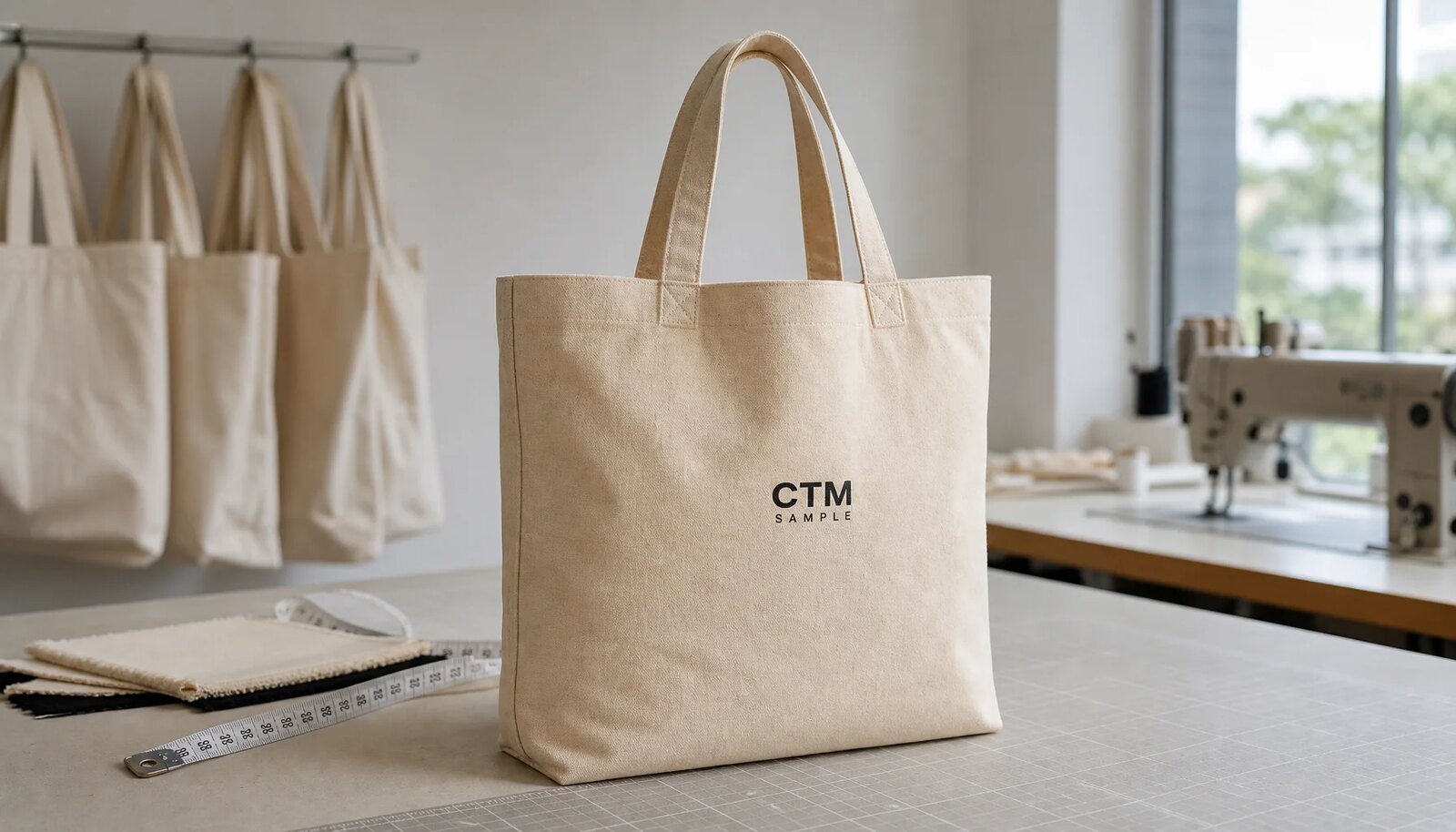
Plan Backward From The In-Hand Date
Canvas grocery totes for craft fairs are tied to a fixed selling window, so the procurement deadline is the required in-hand date, not the opening day of the fair. Goods may need to arrive early for warehouse receiving, carton count, sponsor kit assembly, vendor distribution, retail tagging, or delivery to a fairground. A tote that lands two days before the event can still be late if the team needs three days to sort and stage cartons.
Build the schedule backward from the in-hand date and show each approval gate. The critical path typically includes RFQ comparison, artwork proofing, sample production, sample courier, buyer approval, fabric preparation, printing, sewing, trimming, packing, inspection, export handover, freight, customs, domestic delivery, and receiving. When a buyer takes several days to approve a sample or payment, those days are part of the lead time.
The safest lead time depends on order complexity. A natural stock-canvas tote with one-color screen print has fewer approval steps than a dyed tote with contrast handles, custom labels, retail belly bands, and multiple SKUs. For a first international sea-freight order, buyers should protect a broad planning window rather than relying on the fastest possible factory sewing time.
- Use the warehouse or event-site in-hand date as the procurement deadline.
- Add receiving, repacking, retail tagging, carton segregation, and local delivery to the plan.
- Ask suppliers for both fastest completion date and safer planned completion date.
- Set a freight switch deadline before sea freight is no longer viable.
- Assign one buyer-side owner for artwork, sample, inspection, and shipment release.
Choose The Tote Type Before Pricing
The best tote specification depends on how the bag will be used at the craft fair. A sponsor giveaway can be simple if it only carries brochures and light purchases. A resale tote displayed beside handmade goods needs better cosmetic consistency, stronger folding presentation, and cleaner print edges. A vendor kit may need predictable carton sorting by booth, sponsor, or event day.
Buyers should define the commercial role before asking suppliers for best price. Economy giveaway totes can use lighter canvas, simpler stitching, and bulk packing when the priority is reach. Standard craft fair grocery totes usually need a gusset, shoulder handles, and reinforced handle stitching because shoppers may carry jars, candles, books, ceramics, packaged food, or textiles. Premium resale totes may justify heavier canvas, custom labels, hang tags, or individual packing, but those choices add approvals and freight volume.
Separate fixed requirements from negotiable preferences. If the event date, print artwork, quantity, and destination are fixed, the buyer may need flexibility on fabric shade, packing style, or decoration method. This gives the supplier room to recommend stock materials or simpler production routes without weakening the buying brief.
- State whether the bag is for resale, sponsor giveaway, vendor kit, shopper use, wholesale stock, or replenishment.
- List expected contents such as jars, candles, ceramics, books, apparel, food packs, or catalogs.
- Choose flat totes for low-bulk giveaways and gusseted totes for grocery-style capacity.
- Reserve premium packing for retail channels that need shelf presentation or SKU control.
- Mark must-have specifications separately from preferences in the RFQ.
Specify Canvas Weight And Material
Fabric weight is one of the most common reasons canvas tote quotes fail to compare. Ask for both oz and GSM, and clarify that canvas ounces normally refer to ounces per square yard. A supplier quoting 10 oz cotton canvas and another quoting a lighter cotton blend may appear similar on unit price while delivering very different hand-feel, structure, print result, and carton weight.
For reusable craft fair grocery totes, 10 oz to 12 oz cotton canvas, roughly 280 to 340 GSM, is a strong starting range. It gives more body than lightweight promotional cotton while remaining manageable for sewing, folding, and freight. An 8 oz to 10 oz tote can suit light giveaways or short programs. A 12 oz to 14 oz tote can support a premium resale feel, but buyers should check whether heavier fabric increases needle breakage risk, sewing time, fold bulk, carton weight, and freight cost.
Natural canvas is lower risk when timing is tight because suppliers may have stock fabric. Dyed canvas, bleached canvas, recycled-content claims, organic cotton claims, and custom-color fabric require more documentation or approval. If color is important, approve lab dips and retain a physical standard; phone photos are not enough for a fixed-date branded order.
- Request fiber content, weave, oz per square yard, GSM, and stock status in every quote.
- Use 8 oz to 10 oz for light promotional programs with limited carrying expectations.
- Use 10 oz to 12 oz for most reusable grocery-style craft fair totes.
- Use 12 oz to 14 oz only after checking freight, folding, and sewing impact.
- State fabric weight tolerance in the PO, commonly plus or minus 5 percent unless tighter terms are agreed.
Lock Size, Gusset, And Handles
A grocery tote is judged by usable capacity and carrying comfort, not just front-panel dimensions. The RFQ should specify finished width, finished height, bottom gusset, side gusset if used, handle width, finished handle length, and handle drop. Finished measurements mean the bag after sewing and normal finishing; cut-panel dimensions do not give the buyer a reliable receiving standard.
A common craft fair grocery tote may sit around 38 x 42 cm with a 10 to 12 cm gusset, but the right size depends on merchandise, display space, and carton planning. A deeper gusset helps the bag stand open and carry boxed goods, but it increases fabric use and carton CBM. A flat tote is cheaper and easier to fold, but it works more like a document bag than a grocery bag.
Handles deserve specific control because they are a high-stress point. Shoulder handles may use a finished length around 55 to 65 cm and a width around 2.5 to 3.5 cm, depending on comfort and fabric weight. Require the reinforcement method in writing, such as box stitch, cross stitch, bartack, or reinforcement patch, then verify it on the sample and bulk inspection.
- Specify finished dimensions, not cut-panel dimensions.
- Confirm gusset depth because it affects capacity, cutting yield, carton volume, and freight.
- Measure handle width, finished handle length, and handle drop on the physical sample.
- Name the approved reinforcement pattern and reject weaker substitutions.
- Ask whether the tote is intended to stand upright when lightly filled.
Control Artwork Before Sampling
Decoration can drive more delay than sewing. Canvas texture, slubs, and absorbency affect line sharpness, ink coverage, and color appearance. A digital mockup does not prove that thin lines, small sponsor text, QR codes, gradients, or heavy ink coverage will perform on a 10 oz or 12 oz cotton surface.
Screen printing is the common B2B choice for one to three solid colors on canvas because it is repeatable once screens are approved. Each added color, however, adds setup, registration, drying, and inspection risk. Heat transfer may suit detailed artwork or smaller runs, but buyers should check film edge visibility, hand-feel, fold cracking, and durability. Embroidery can work for small logos but is rarely efficient for large grocery tote graphics.
A complete decoration spec includes vector artwork, Pantone references, print method, color count, print side, print size, placement from top edge or seams, and allowed tolerance. For resale or sponsor programs, approve a printed pre-production sample on the actual fabric with the actual print process before releasing bulk production.
- Send vector artwork and avoid very small text on coarse canvas.
- State print placement in centimeters from the top edge, side seam, or bottom seam.
- Set print placement tolerance, typically plus or minus 0.5 cm to 1 cm by artwork size.
- Confirm whether proofing, screen setup, ink mixing, drying, and curing are in the timeline.
- Check printed samples for rub resistance, tackiness, bleeding, fold cracking, and color match.
Make MOQ And Landed Cost Comparable
MOQ is not only a sales preference; it is tied to fabric availability, cutting efficiency, print setup, label production, sewing-line planning, packing labor, and carton utilization. A supplier may accept a lower MOQ for stock natural canvas with one-color print, then require more pieces for dyed canvas, contrast handles, custom labels, multi-artwork splits, or retail-ready packing.
Buyers should request a price ladder instead of a single unit price. Volumes such as 300, 500, 1,000, and 3,000 pieces can show where fixed setup costs are absorbed and where carton efficiency improves. If several craft fairs share the same base tote, ask whether the factory can cut and sew one blank body while separating finished goods by print artwork, hang tag, carton mark, or destination.
Compare landed cost, not factory unit price alone. Canvas totes are bulky for their value, so packing method, carton dimensions, CBM, Incoterm, duty assumptions, and domestic delivery can change the best supplier choice. Every quote should state what is included and what is separate, including samples, screens, lab dips, labels, hang tags, barcode stickers, export cartons, inspection support, freight, and duty.
- Confirm whether MOQ applies per artwork, fabric color, size, label, packing style, or total PO.
- Request price breaks at realistic quantities rather than one unit price.
- Ask if multiple event artworks can share the same blank tote body.
- Require carton dimensions, gross weight, net weight, pieces per carton, and CBM.
- Compare total landed cost at the destination, not product price alone.
Use Samples As Risk Tests
A sample should test the product standard, not only the appearance. For canvas grocery totes, sample review should cover fabric hand-feel, finished measurements, gusset capacity, handle comfort, reinforcement, print placement, ink curing, seam quality, odor, fold method, and presentation after unpacking. If the tote is sold at a craft fair booth, the sample should be judged as a retail item, not just a shipping unit.
The strongest pre-production sample uses the actual fabric, actual print method, actual handles, actual label, and intended packing method. When substitute fabric is used because bulk material is not ready, document the difference and require a bulk swatch before cutting approval. For dyed fabric, compare lab dips or bulk swatches to a physical color standard under consistent light.
Make sample approval measurable. Record width, height, gusset, handle length, handle drop, print size, print placement, fabric weight, and packing method. Load the bag with realistic craft fair goods, then inspect handle attachment, side seams, and bottom corners. Rub the print after curing and fold the tote as it will be packed to check cracking, sticking, and crease impact.
- Use a sample approval form with measurements, fabric, print, handle, label, packing, and approval date.
- Measure the sample against tolerances instead of approving only by photo.
- Perform a realistic load simulation and inspect reinforcement afterward.
- Check print cure with dry rub, light scratch, and fold checks.
- Allow time for one correction sample or written deviation approval before bulk release.
Set Packing And Carton Rules Early
Packing affects presentation, freight cost, receiving labor, and damage risk. Bulk flat packing is efficient for organizers distributing cartons directly to vendors or event staff. Individual polybags improve protection and retail handling but add material, labor, volume, and sometimes sustainability concerns. Belly bands, hang tags, barcode labels, and kraft sleeves support retail merchandising but require artwork proofing and inspection.
Canvas can absorb moisture and odor, so storage and packing conditions matter. Over-compressed cartons may reduce CBM but create deep creases that make a resale tote look poor at a booth. Oversized cartons may protect presentation but increase volumetric freight. The purchase order should define fold method, pieces per carton, maximum carton weight, carton marks, and whether cartons are single-SKU, mixed-SKU, or segregated by event.
Carton marks should make receiving easier. Include purchase order number, SKU, artwork, color, quantity, destination, and event name when relevant. Request pre-pack photos and final carton photos before shipment release, especially for first orders, multiple artworks, or multi-destination craft fair programs.
- Confirm bulk pack, individual polybag, belly band, hang tag, barcode label, or retail sleeve requirements.
- Set fold method, pieces per carton, maximum carton weight, carton marks, and mixed-carton rules.
- Request carton dimensions, gross weight, net weight, and CBM before freight booking.
- Reject damp cartons, mildew odor, incorrect marks, or packing that differs from the approved sample.
- Ask for pre-pack and final carton photos on first orders and multi-SKU programs.
Inspect Before Shipment Release
Final inspection should be tied to the purchase order and approved sample. The inspection plan should check measurements, fabric weight, handle drop, reinforcement, seam quality, print placement, print cure, color match, odor, stains, carton quantity, carton marks, and packing method. For craft fair totes, cosmetic defects matter because the bag may be a sponsor-facing item or a resale product.
Use clear tolerances before production starts. A typical sewn-bag tolerance may allow plus or minus 1 cm for width and height, plus or minus 0.5 cm to 1 cm for gusset depth, and plus or minus 0.5 cm to 1 cm for handle-related measurements, depending on the specification. Print placement tolerance should be stated by artwork size. Fabric weight should be checked against the agreed oz and GSM range.
Do not leave inspection decisions until goods are already moving. If defects are found, decide whether the supplier will rework, replace, sort, discount, or request a written deviation approval. Hold shipment release until evidence is complete. For fixed craft fair dates, this discipline prevents a rushed shipment of totes that cannot be sold, gifted, or distributed as planned.
- Inspect against the signed sample, PO, artwork proof, and packing standard.
- Include measurement, print, seam, handle, odor, stain, quantity, and carton-mark checks.
- Run a realistic load simulation on sampled bags and review handle stress points.
- Confirm final carton count, pieces per carton, carton weight, and CBM before release.
- Document rework or deviations in writing before shipping.
Specification comparison for buyers
| Timeline gate | Buyer responsibility | Supplier responsibility | Lead-time risk controlled |
|---|---|---|---|
| RFQ freeze | Confirm in-hand date, quantity, destination, Incoterm, target use, artwork status, packing needs, and must-have specifications. | Confirm stock fabric options, MOQ rules, price breaks, sample cost, setup cost, estimated cartons, and realistic production window. | Prevents quote comparisons based on different fabric, packing, delivery, or artwork assumptions. |
| Artwork and spec approval | Send vector artwork, Pantone references, print size, placement, finished bag dimensions, gusset, handle drop, and label requirements. | Check artwork printability on canvas, flag small text or heavy coverage issues, and issue proof or layout for approval. | Avoids screen remake, print position disputes, and late changes after material is cut. |
| Material approval | Approve stock canvas swatch or lab dip; confirm fiber content, weight in oz and GSM, shade standard, and allowed tolerance. | Provide swatches, fabric availability, shrinkage expectation, and notice if bulk fabric must be dyed or woven to order. | Controls fabric shade, hand-feel, weight mismatch, and delay from non-stock material. |
| Pre-production sample | Measure and sign sample for size, gusset, handles, reinforcement, print, label, fold method, and packing presentation. | Make sample using agreed construction and, when possible, actual fabric and actual decoration method. | Catches construction and print risks before bulk cutting, sewing, and printing. |
| Bulk production release | Approve sample or issue written deviation approval; confirm no further artwork, packing, or carton mark changes. | Book fabric, cutting, printing, sewing, trimming, and packing capacity against the approved sample. | Protects the production slot and reduces rework from moving targets. |
| Inline or pre-final check | Review production photos or inspection findings early enough for correction before all cartons are sealed. | Share measurement, print, seam, handle, packing, and carton-mark evidence from production. | Finds repeated defects while rework is still possible. |
| Final inspection and shipment release | Approve inspection result, accepted deviations, carton count, shipping marks, and freight handover plan. | Present finished goods, carton list, carton dimensions, gross weight, CBM, and export documents as agreed. | Prevents shipping incorrect quantity, wrong cartons, wet packing, or unapproved defects. |
| Freight handover | Confirm pickup address, consignee details, delivery deadline, customs data, and freight switch deadline if schedule slips. | Hand over goods by the latest safe date with packing list, invoice, carton data, and booking details. | Reduces risk of missing the craft fair because of avoidable logistics delay. |
Buyer checklist before sampling
- Set the required in-hand date separately from the public craft fair date, then add time for receiving, carton count, repacking, local delivery, and event-site staging.
- Classify the order as resale merchandise, sponsor giveaway, vendor kit, shopper bag, wholesale stock, or multi-event replenishment before requesting price.
- Specify finished width, finished height, gusset depth, handle width, finished handle length, handle drop, fabric weight in oz and GSM, and reinforcement pattern.
- Send vector artwork with Pantone references, print side, print size, placement from edges, color count, and any QR code or small-text requirements.
- Ask all suppliers to quote the same Incoterm, named place, packing method, pieces per carton, carton dimensions, gross weight, CBM, and payment terms.
- Separate unit price from sample cost, screen cost, lab dip cost, label cost, hang tag cost, packing cost, inspection support, freight, duty, and domestic delivery.
- Confirm whether MOQ applies per artwork, fabric color, size, label, packing style, or total purchase order.
- Approve a pre-production sample for first orders, dyed fabric, new artwork, custom labels, retail packing, or fixed-date sponsor programs.
- Set measurable tolerances for finished size, fabric weight, handle drop, print placement, print color, carton quantity, and allowed overage or shortage.
- Release shipment only after inspection evidence, accepted rework, or written deviation approval is complete.
Factory quote questions to send
- What exact fabric is quoted, including fiber content, weave, oz per square yard, GSM, shrinkage expectation, shade option, and whether the material is stock or made to order?
- Are the measurements finished dimensions after sewing and normal finishing, or cut-panel dimensions before sewing?
- What handle construction is included: self-fabric or webbing, handle width, finished handle length, handle drop, stitch pattern, stitch density, and reinforcement size?
- What load check can you perform on the approved sample or bulk goods, and what construction limits should we know before confirming the order?
- Which decoration method is quoted, how many colors are included, what maximum print area is allowed, and which setup fees are separate?
- What artwork details could change price or timing, such as gradients, halftones, tight registration, metallic ink, high ink coverage, QR codes, or small text?
- Does the quote include pre-production sample, courier, lab dip, screen setup, label, hang tag, barcode sticker, inner packing, export carton, carton marks, and inspection support?
- What MOQ applies to each fabric color, artwork, size, label, and packing style, and what price breaks apply at 300, 500, 1,000, and 3,000 pieces?
- How many calendar days are needed for proofing, sample making, sample courier, buyer approval, fabric preparation, printing, sewing, trimming, packing, inspection, and export handover after deposit?
- What tolerances apply to finished size, fabric weight, handle drop, print placement, print color, quantity overage or shortage, and carton quantity?
Quality-control points to confirm
- Finished size should match the signed sample and purchase order. For sewn canvas totes, a commercial tolerance of plus or minus 1 cm for width and height and plus or minus 0.5 cm to 1 cm for gusset depth is common unless tighter terms are contracted.
- Fabric weight should be checked from bulk fabric or a retained swatch. State the allowed range in both oz and GSM; plus or minus 5 percent is a common procurement tolerance when the buyer has not contracted a tighter standard.
- Handle length and handle drop should be measured on finished bags after sewing, not on loose handle strips. For self-fabric handles, confirm handle width, stitch placement, and finished drop against the approved sample.
- Handle attachment should match the approved reinforcement pattern, such as box stitch, cross stitch, bartack, or reinforcement patch, with no skipped stitches, loose thread nests, open seams, or stitching too close to the edge.
- Print placement should match the approved artwork layout. A tolerance of plus or minus 0.5 cm may be suitable for smaller marks, while larger graphics may require plus or minus 1 cm if agreed before production.
- Ink should be cured with no tackiness, heavy bleeding, major cracking, dirty edges, severe pinholes, or obvious color mismatch against the approved physical or Pantone standard. Include dry rub and light scratch checks on printed samples.
- Canvas panels should be clean and commercially acceptable, with no oil marks, mildew smell, insect contamination, heavy stains, excessive shade mixing, or large slubs in the main print area.
- Seams should be straight enough for retail or event presentation, with consistent stitch density, no open side seams, no missed bottom corners, and no sharp loose threads that affect handling.
- Packing should match the approved method, including fold style, pieces per carton, inner protection, carton marks, carton dimensions, carton gross weight, barcode or SKU labels, and moisture-control requirements.
- Random inspection should include measurement, print comparison, seam and handle review, realistic load simulation, quantity count, packing count, carton mark review, odor check, and shipment photo documentation before release.