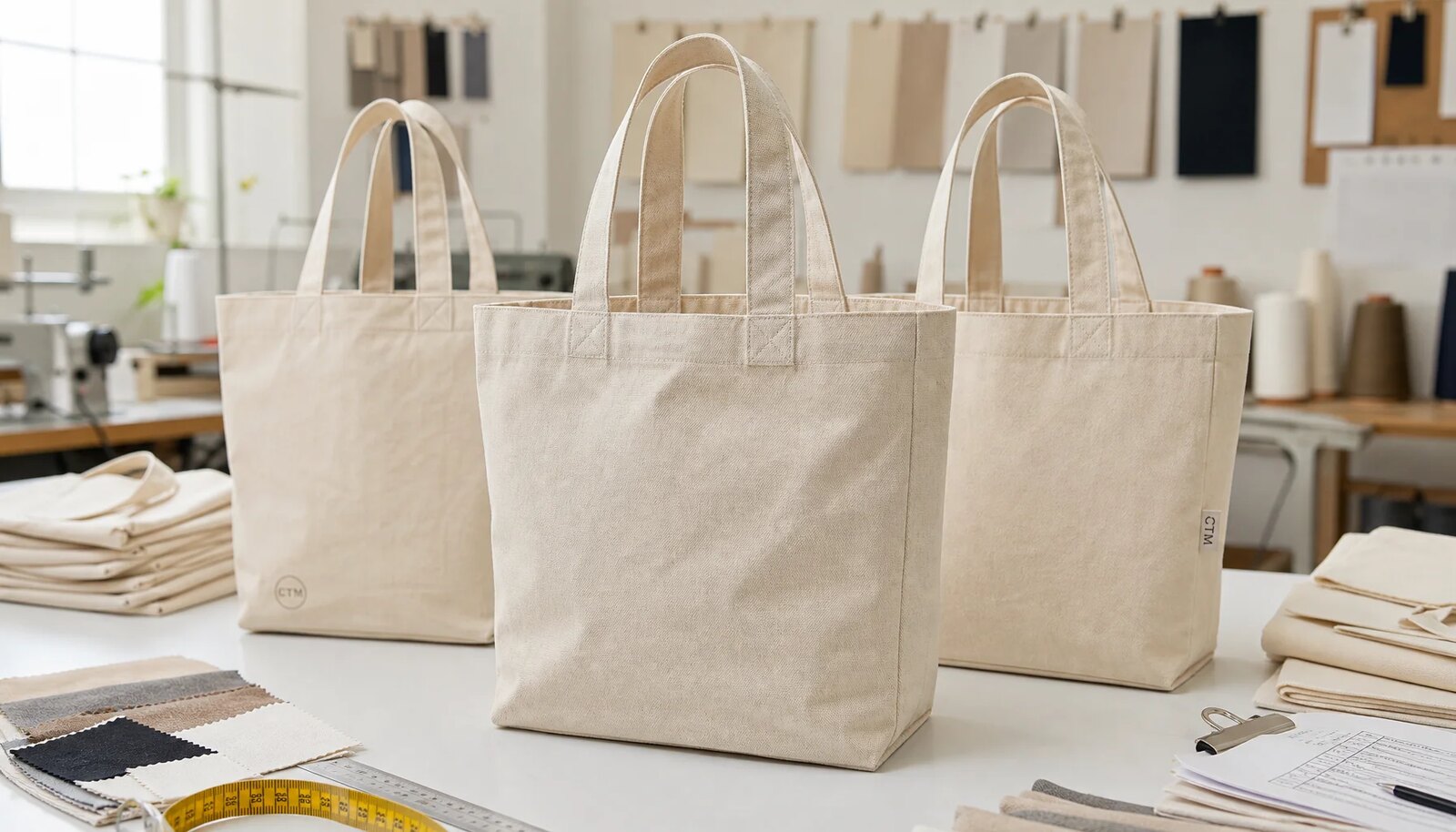
1. Start With the Tote's Commercial Job
Canvas grocery totes for craft fairs are not the same sourcing problem as thin conference totes. A shopper may use one bag for candles, jars, ceramics, books, packaged food, yarn, soaps, folded textiles, small framed prints, and purchases from several booths. The bag also has to look credible on a display table. For B2B procurement, the fabric weight is only one part of the answer. The weight, gusset, handle reinforcement, seam finish, decoration method, retail labeling, and carton plan all need to support the same end use.
Before asking for price, define what the tote must do after it leaves the supplier. A one-day sponsor giveaway can work with a lighter hand than a tote sold in a museum shop, co-op, or artisan retail program. A distributor serving many craft fair brands may want one standard body that can carry several different logos. A retail buyer may care more about shelf appearance, barcode accuracy, and lower visible defect rates. A factory can quote any of these routes, but not from the vague instruction canvas grocery tote.
Fabric weight also changes costs that do not show up clearly in the first unit price. Moving from 8 oz to 12 oz increases cloth consumption by weight, may reduce pieces per carton, and can raise freight, warehouse handling, and parcel cost. Heavier cloth can also require slower sewing, heavier needles, and more careful folding to avoid hard creases. The strongest procurement choice is rarely the heaviest possible canvas. It is the lightest construction that still meets the load, retail feel, print quality, and margin target.
- Define use case: giveaway, craft fair booth merchandise, wholesale resale, grocery reuse, subscription insert, or sponsor gift.
- Set expected load: light purchases, mixed booth items, groceries, books, jars, or heavier boxed goods.
- Match fabric weight to construction: a 10 oz body with weak handles may fail before an 8 oz body with proper reinforcement.
- Include retail requirements early: barcode, hangtag, side label, belly band, inner bundle, or carton assortment.
- Ask for quotes in at least two fabric weights while cost and freight sensitivity are still open.
2. Fabric Weight Ranges: 8 oz, 10 oz, 12 oz, and Beyond
Canvas weight is commonly listed as ounces per square yard in U.S.-style specifications and as grams per square meter in many international quotes. The conversion is straightforward: 1 oz/yd² is approximately 33.9 GSM. On that basis, 8 oz is about 271 GSM, 10 oz is about 339 GSM, and 12 oz is about 407 GSM. In live sourcing, suppliers may round the numbers, and finishing can change the finished cloth. The approved swatch and pre-production sample should control the order, not the rounded label alone.
For canvas grocery totes for craft fairs, 10 oz canvas is often the most useful benchmark. It normally gives enough body for reusable shopping while staying manageable for sewing, folding, and freight. It feels more substantial than a thin giveaway tote without drifting into rugged tool-bag territory. When the tote is sold as premium merchandise, 12 oz can add structure and perceived value. For sponsor giveaways or lower-price seasonal events, 8 oz can still work if the handles, seams, and gusset are not under-specified.
Above 12 oz, the buyer should have a clear reason for the added weight. A 14 oz or heavier tote may fit a premium market carryall, a dense produce program, or a brand story built around toughness. It may also feel too stiff for normal craft fair grocery use. Heavy canvas can create stronger fold memory in cartons, and a coarse surface may not print fine details as cleanly. The real question is simple: will the end customer value that extra weight after freight, packing, and handling are included?
- 8 oz / about 271 GSM: lower-cost, softer, lighter-duty; best for event giveaways and light shopping programs.
- 10 oz / about 339 GSM: balanced option for general reusable craft fair grocery totes and multi-design wholesale programs.
- 12 oz / about 407 GSM: stronger hand feel for premium resale, boutique display, and heavier repeat use.
- 14 oz+ / about 475 GSM+: specialty heavy-duty choice; evaluate stiffness, sewing quality, carton weight, and consumer comfort.
- Compare the same bag size and construction across weights so the fabric decision is not confused with a sewing downgrade.
3. GSM Is Not Enough: Fabric Basis, Weave, Shrinkage, and Shade
Two bags can both be sold as 10 oz canvas and still look, print, and perform differently. Yarn size, weave density, finishing route, cotton quality, recycled content, bleaching, dyeing, washing, softening, and moisture content all change the finished product. A tightly woven 10 oz canvas may print cleaner and feel more controlled than a loosely woven 12 oz fabric. For craft fair retail, where customers often handle the tote before buying it, surface feel and shade consistency can matter as much as the weight number.
Procurement teams should ask whether the quoted weight is greige or finished. Greige fabric is fabric before final finishing. After bleaching, dyeing, washing, softening, or other treatment, the weight, shrinkage, shade, and surface texture can change. If the buyer approves a natural canvas swatch and the factory later switches to another finishing route, the bulk tote may feel thinner, look darker, shrink more, or print differently. The purchase order should state that the bulk fabric must match the approved swatch for weight basis, hand feel, shade range, and surface quality.
Natural canvas also needs realistic visual standards. Unbleached cotton may show seed specks and small slubs. That can support an artisan or natural product story, but it may not suit crisp logo reproduction or premium retail photography. Bleached canvas gives a cleaner print background but can show dirt more easily. Dyed canvas adds lab dip approval, colorfastness checks, and shade-lot control. For repeat programs, keep a signed swatch and require the factory to retain the same production standard.
- State fabric as finished weight whenever the tote is bleached, dyed, washed, softened, or coated.
- Ask for composition: 100% cotton, cotton-poly blend, recycled cotton blend, organic cotton, or another material.
- Request weave description and surface feel; tighter canvas usually supports cleaner logo edges.
- Approve shade range before printing light logos, pastel artwork, or retail photography.
- Keep one signed swatch with the buyer and one with the factory for reorder and dispute control.
4. Construction Specifications That Make the Weight Work
Fabric weight does not make a grocery tote durable by itself. Many failures happen at the handle roots, bottom corners, side seams, and gusset folds rather than in the center of the canvas panel. A B2B specification should explain how the fabric is sewn. For repeated market use, handle attachments should use box-X stitching, cross-stitching, bartacks, or another agreed reinforcement method. A single line of stitching at the handle root is a weak specification for grocery-style loads.
The gusset is just as important. A real grocery tote needs usable side and bottom depth so jars, boxes, folded textiles, and produce can stand upright. Common finished gusset depths for this category are often in the 10-15 cm range, but the right choice depends on bag width, height, and contents. A very deep gusset on 8 oz canvas can make the bag collapse. A 12 oz fabric can support a broader base, but the finished bag may become bulkier to fold. Approve the tote both flat and filled.
Handle drop should be measured as a finished dimension from the top edge of the bag to the peak of the handle. Short drops suit hand-carry market totes; longer drops support shoulder carrying during a full day at a fair. Handle width and layers matter too. A narrow self-fabric handle can cut into the hand under load, while a well-made cotton webbing handle can improve comfort and stability. If the look must stay fully canvas, specify folded self-fabric handle width, stitch rows, and reinforcement size.
- Specify finished width, height, gusset depth, handle drop, handle width, and acceptable tolerance in the RFQ.
- Use box-X stitch, cross-stitch, bartack, or double reinforcement for handle roots on reusable grocery totes.
- Define seam finish: lockstitch plus overlock, bound seam, French seam, or other construction as appropriate to the sales channel.
- Check stitch density and thread quality; heavy fabric with loose stitching is not a durable specification.
- Approve a filled sample to verify capacity, balance, handle comfort, and bottom shape.
5. Decoration: Match Print Method to Canvas Weight and Artwork
Screen printing is usually the most practical decoration method for canvas grocery totes used in craft fair programs. It works well for bold logos, event marks, sponsor names, and one to three solid colors. It is also efficient for many wholesale runs and multi-design programs. Still, the buyer has to define the artwork size, print side, placement from the top edge or seams, number of colors, Pantone references if required, and whether the print can sit near a gusset or fold line.
Canvas texture changes print results. A coarse 12 oz canvas may break up fine lines or small text more than a smoother 8 oz or 10 oz cloth. Large solid ink blocks can look strong at approval and then crack later if curing is poor or if cartons are packed before ink is fully set. Heat transfer can reproduce gradients, photographs, or many colors, but the film edge and hand feel may not fit every natural-canvas product. Embroidery can look premium for a small mark, yet dense embroidery on lighter canvas may pucker the panel.
A reliable approval process uses the exact fabric weight selected for bulk. A logo approved on screen or paper is not enough. The supplier should provide a printed strike-off or pre-production sample using the intended ink, transfer, or embroidery method. Buyers should check dry rub, damp rub, fold resistance, edge clarity, and placement. If the tote will be folded across the printed area, the packing fold should be part of print approval rather than a late warehouse surprise.
- Use screen print for bold solid logos, simple event graphics, and scalable wholesale production.
- Use heat transfer for gradients, photographs, fine detail, or many colors only after approving hand feel and edge appearance.
- Use embroidery for small premium marks; avoid large dense embroidery on lightweight canvas unless puckering is tested.
- Keep fine text, QR codes, and thin lines away from coarse weave areas unless a physical sample proves readability.
- Require dry rub, damp rub, fold, and cure checks before approving bulk production.
6. RFQ Structure for Multi-Design Craft Fair Programs
Craft fair tote orders often include several logos, seasonal graphics, sponsor marks, or regional event versions. That creates a sourcing challenge. Fabric cutting and sewing are more efficient in larger standardized lots, while printing and packing may split into smaller design batches. The cleanest structure is usually one standard tote body with design-specific printing. Standardize the size, fabric weight, handle drop, thread color, label position, packing fold, and carton quantity. Then vary the artwork.
Separate body MOQ from print MOQ. A supplier may accept a sewn-body quantity of 1,000 or 3,000 pieces but charge extra when the total is divided into many designs. Screen setup, film output, ink mixing, print table cleaning, color changes, hangtag handling, barcode labels, and carton sorting all add cost. These charges are not automatically a problem. They just need to be visible before the purchase order is placed. A quote that hides them can become expensive later.
A design matrix is the best control document for distributors, agencies, and brand owners serving multiple craft fair accounts. The matrix should list each SKU, artwork file name, revision date, quantity, print colors, print side, label, hangtag, barcode, inner pack, carton mark, and ship-to destination. It lowers the risk of wrong logos, mixed cartons, incorrect barcodes, and retail-ready units packed into the wrong assortment.
- Quote one shared tote body first, then list print versions as separate line items.
- Ask for charges per screen, per color, per side, per design, per barcode, and per special packing version.
- Keep construction identical across designs whenever possible to avoid cutting and sewing line changes.
- Use artwork file names and revision dates in the PO to prevent old logos from entering production.
- If reorder speed matters, ask whether blank sewn stock can be held and printed later under controlled conditions.
7. Quote Comparison: From FOB Price to Landed Cost per Usable Tote
The lowest unit quote is not always the lowest cost. One supplier may quote finished 10 oz canvas, reinforced handles, screen print, trimming, export cartons, and clear tolerances. Another may quote a lighter nominal fabric, single stitching, loose packing, and unclear print curing. Unless the RFQ fields are identical, the buyer is comparing different products. A useful quote comparison sheet should include finished dimensions, fabric weight basis, composition, construction, decoration, labels, packing, carton data, lead time, payment terms, sample cost, setup cost, and inspection support.
Landed cost matters for canvas grocery totes because fabric weight changes freight economics. A 12 oz tote may show only a modest FOB increase over 10 oz, but the heavier product can reduce carton quantity and raise gross weight. For air freight, parcel distribution, or multi-warehouse delivery, that can change the true cost per usable tote. Request estimated carton dimensions, pieces per carton, and gross weight at the quote stage. If final carton data is not available before sampling, ask for a planning estimate and require an update after the pre-production sample.
Separate first-order costs from repeat-order costs. Screen charges, digital setup, woven label setup, hangtag design setup, sample fees, and artwork cleanup may be one-time or periodic. Individual polybags, barcode labels, retail belly bands, inner bundles, carton labels, and design sorting usually repeat every order. For wholesale programs, a supplier with a slightly higher first quote may still be the better partner if repeat costs, defect rates, and packing accuracy are better controlled.
- Compare fabric weight, construction, and print method line by line, not only unit price.
- Calculate cost per 1,000 totes including carton cube, gross weight, setup, sample, inspection, and packing.
- Request separate pricing for 8 oz, 10 oz, and 12 oz using the same size and sewing construction.
- Identify one-time charges versus repeat charges before approving budgets for seasonal reorders.
- Treat vague quote terms such as heavy canvas, standard handle, or good carton as incomplete data.
8. Sample Approval Should Simulate Real Use
Photo approval is not enough for canvas grocery totes. A buyer needs to touch the fabric, inspect the seams, place representative goods inside, check print quality on the actual canvas texture, and see how the tote folds into the carton. A blank sample can confirm size quickly, but the pre-production sample should include final fabric, final decoration, final handle reinforcement, final label, final hangtag or barcode, and final packing method.
Load testing does not need to be complicated, but it should be repeatable and tied to the product promise. For a reusable grocery-style tote, place a realistic load inside and lift it repeatedly by the handles. Watch the handle roots, bottom corners, side seams, and gusset folds. Look for distortion, broken thread, twisting, and print cracking near fold lines. If the tote is for resale, also check shelf appearance, loose threads, shade uniformity, label position, and whether the bag looks balanced when filled.
The approved sample should become a production control reference. Sign and date it, photograph it from multiple angles, and keep one sample with the buyer and one at the factory. If a third-party inspection is used, give the inspector the approved sample or a detailed inspection file. Natural canvas has normal variation, so the standard should separate acceptable seed specks and minor slubs from unacceptable oil stains, dirty folds, mildew odor, mixed shade panels, or poor logo-area defects.
- Approve the tote both flat and filled; flat measurements alone do not prove grocery performance.
- Photograph front, back, side gusset, bottom gusset, inside seam, handle root, print close-up, label, and carton fold.
- Test with representative items such as jars, books, boxes, candles, soaps, textiles, packaged food, or produce.
- Check handle comfort and balance by carrying the filled sample, not only by measuring the handle drop.
- Do not release bulk production until fabric, print, reinforcement, labels, packing fold, and QC criteria are approved.
9. Bulk QC: Practical Tolerances and Defect Classification
Canvas is a natural woven material, but B2B buyers still need measurable acceptance criteria. Common major defects include wrong fabric weight, wrong finished size, wrong artwork, severe print misplacement, broken handles, open seams, oil stains, dirt marks, mildew odor, mixed logos in cartons, and barcode errors. Minor defects may include small loose threads, small natural slubs away from the print area, or slight shade variation within the approved range. These definitions should be agreed before inspection, not negotiated during a shipment dispute.
Write tolerances in commercial units. A common starting point is plus or minus 5% for fabric weight against the approved standard, plus or minus 1 cm for finished width and height, plus or minus 0.5-1 cm for gusset depth, plus or minus 1 cm for handle drop, and plus or minus 5 mm for standard print placement. These are practical negotiation points, not universal rules. If the buyer needs tighter control, the supplier should confirm feasibility and price before production begins.
Inspection should match the sales channel. A low-cost event giveaway may allow more minor appearance variation than a boutique resale tote, but critical defects should never be normalized. Mold, sharp contamination, severe odor, unsafe material, wrong customer artwork, and broken handle construction should be treated as critical or rejectable. For multi-design craft fair programs, SKU accuracy is a major QC issue. A visually good tote is still a defect if it carries the wrong barcode or is packed into the wrong customer carton.
- Set AQL level and defect classifications before production starts; do not rely on supplier default definitions.
- Use signed samples, swatches, artwork files, and measurement diagrams as inspection references.
- Inspect logo areas more strictly than hidden internal areas because retail customers see the front panel first.
- Check carton assortment, barcode accuracy, hangtag placement, and SKU separation for every design version.
- Require carton condition checks: dry cartons, correct marks, no overpacking, no crushed corners, and manageable gross weight.
10. Packing, Lead Time, and Event-Date Risk
Packing decisions affect both presentation and landed cost. Flat packing is usually safest for 10 oz and 12 oz canvas grocery totes because it reduces permanent creasing and keeps printed panels protected. Tight rolling can save some space, but it may create hard creases, especially on heavier canvas or large solid prints. Inner bundles help counting and warehouse handling. Individual polybags may be required by some retailers, but they add cost, labor, and packaging waste.
Carton planning should happen before mass packing. Confirm pieces per carton, carton dimensions, gross weight, carton board strength, inner pack count, carton marks, and whether cartons are suitable for export or parcel handling. For many tote programs, carton weight rather than carton volume becomes the handling limit, especially with 12 oz and heavier canvas. If the goods will move through a distributor or retail warehouse, ask for maximum carton weight and labeling rules before approving the packing plan.
Craft fair programs are often tied to fixed event dates, so timeline control is a procurement risk. The production schedule should include artwork approval, swatch approval, fabric purchase, cutting, printing, curing, sewing, trimming, final inspection, packing, carton correction, export handover, and delivery. Late barcode files, revised sponsor logos, delayed hangtags, and unclear SKU assortments can stop packing even after the totes are sewn. Request milestone dates and freeze artwork and packing data before the factory begins bulk work.
- Use flat packing for most reusable canvas grocery totes to reduce crease and print damage risk.
- Confirm carton quantity, dimensions, gross weight, inner bundle count, and carton marks before freight booking.
- Build cure time into the schedule for large screen prints and do not pack printed panels while tacky.
- Freeze artwork, barcodes, labels, hangtags, and ship-to data before cutting or printing starts.
- For event deadlines, track milestone dates instead of relying only on a promised final ship date.
Specification comparison for buyers
| Spec decision | Recommended option | When it fits | Buyer risk to check |
|---|---|---|---|
| General craft fair retail tote | 10 oz canvas, approximately 339 GSM, quoted on a finished-weight basis when possible | A strong first benchmark for reusable grocery totes sold, gifted, or bundled at craft fairs. It has enough body for jars, books, candles, packaged food, folded textiles, small boxes, and mixed booth purchases without becoming a heavy carryall. | Confirm whether the supplier means finished fabric weight, greige weight, or a nominal mill label. Control bulk production with an approved swatch for hand feel, shade, weave, and print surface. |
| Premium reusable grocery tote | 12 oz canvas, approximately 407 GSM | Useful for museum shops, artisan brand merchandise, co-ops, boutique resale, higher perceived value programs, and heavier repeat-use grocery loads. | Heavier canvas increases material consumption, sewing resistance, carton gross weight, freight cost, and crease risk. Ask for carton cube and gross weight before approving the upgrade. |
| Budget or event giveaway tote | 8 oz canvas, approximately 271 GSM | Works for lower-cost promotional craft fair bags, sponsor giveaways, seasonal events, or light shopping where resale expectations are modest. | A large gusset can make 8 oz canvas feel limp. Print strike-through, seam distortion, and weak handle roots also become more visible if construction is downgraded. |
| Heavy-duty specialty tote | 14 oz canvas and above, approximately 475 GSM+ | Best reserved for rugged market totes, tool-style carryalls, premium produce bags, or programs where durability is part of the brand story. | Often more than normal craft fair grocery use requires. Check needle damage, fold marks, carton weight limits, sewing consistency, and whether consumers find the bag too stiff. |
| Fabric basis in the RFQ | State oz per square yard and GSM, plus whether the weight is greige or finished | Essential when comparing suppliers across regions, because some quote in ounces and others quote in GSM. | Do not accept phrases such as thick canvas, heavy cotton, or premium canvas without a numeric weight, basis, tolerance, and physical swatch. |
| Handle construction | Self-fabric or cotton webbing handles with box-X stitch, cross-stitch, or bartack reinforcement | Practical for grocery tote loads where shoppers carry jars, books, candles, packaged food, yarn, ceramics, or several booth purchases at once. | Specify handle width, finished drop, stitch pattern, reinforcement size, thread color, and stitch density. A single-row attachment is usually not enough for repeated grocery use. |
| Bottom and gusset | Full side and bottom gusset, commonly 10-15 cm finished depth for grocery-style use | Helps boxed goods, jars, folded textiles, and produce stand upright instead of forcing everything into a flat promotional bag. | Flat totes are cheaper but perform poorly as grocery totes. Measure the finished gusset after sewing and approve the sample while filled, not only flat. |
| Logo decoration | Screen print for solid artwork; heat transfer for gradients or many colors; embroidery for small premium marks | Screen printing is usually the most scalable choice for natural canvas with one to three solid colors. | Require a print strike-off, curing confirmation, dry and damp rub checks, fold testing, and written placement tolerance before mass production. |
| Multi-design MOQ strategy | One shared bag body with design-specific printing and packing matrix | Helps distributors, agencies, and event buyers spread cutting and sewing volume across several craft fair logos, sponsors, or seasonal graphics. | Factories may charge per screen, color, side, setup, barcode, carton mark, and packing version even when the sewn body is identical. Ask for these charges upfront. |
Buyer checklist before sampling
- Define finished bag width, height, gusset depth, handle drop, handle width, fabric weight in oz and GSM, fabric basis, and dimensional tolerance before requesting pricing.
- State whether the tote is for giveaway, resale, wholesale distribution, grocery reuse, boutique merchandise, or event sponsor use, because fabric weight and reinforcement should match the load expectation.
- Request actual 8 oz, 10 oz, and 12 oz canvas swatches from the same mill or fabric source intended for production, not generic showroom swatches from unrelated stock.
- Ask suppliers to identify whether the quoted canvas weight is greige, finished, bleached, dyed, washed, softened, coated, or laminated, and whether shrinkage has been allowed in cutting.
- Specify fabric composition, such as 100% cotton canvas, cotton-poly blend, recycled cotton blend, organic cotton, or conventional cotton, and require the supplier to state if any certification is being claimed.
- Approve a pre-production sample with final fabric, final artwork, final print color, final handle length, final gusset shape, final label position, final retail finish, and final packing fold.
- Set measurable QC thresholds for fabric stains, oil marks, mildew odor, fabric weight, broken stitches, open seams, print placement, print color, rubbing, size tolerance, handle strength, barcode accuracy, carton marking, and mixed-SKU packing.
- Compare quotes by landed cost per usable tote, not only FOB unit price; include carton cube, gross weight, print setup, sample fee, inspection cost, inland freight, packaging, and expected defect allowance.
- Separate one-time charges from repeat charges, including screens, films, digital setup, artwork cleanup, sampling, hangtag setup, woven label setup, barcode handling, and carton label management.
- Ask for carton quantity, carton dimensions, gross weight, inner bundle count, polybag policy, recycled-content packaging options, and maximum carton weight before freight booking.
Factory quote questions to send
- What exact canvas weight are you quoting in oz per square yard and GSM, and is it measured before or after bleaching, dyeing, washing, softening, coating, or other finishing?
- What is the fabric composition, weave description, yarn count if available, shrinkage expectation, and acceptable shade range for the quoted canvas?
- Is the fabric weight based on greige fabric, finished fabric, or supplier nominal weight, and what tolerance can you guarantee against the approved swatch?
- Can you provide 8 oz, 10 oz, and 12 oz swatches from the same intended production source so we can compare hand feel, opacity, shade, and print surface accurately?
- What finished tote dimensions are included in the price: width, height, side gusset, bottom gusset, handle drop, handle width, seam allowance, and finished measurement tolerance?
- What handle reinforcement is included in the quoted price: box-X stitch, cross-stitch, bartack, double-row stitching, or only single lockstitch?
- What thread type, thread count or size if available, stitch density, seam finish, and needle specification will be used for 8 oz, 10 oz, and 12 oz versions?
- What print method do you recommend for our artwork on natural canvas, and what limitations apply to thin lines, small text, large solid ink areas, gradients, seams, gussets, or fold lines?
- What are the print placement tolerances, print color tolerances, curing process, and rub-test standards you use for cotton canvas bags?
- Can the same tote body be produced with several logo designs under one fabric MOQ, and what additional cost applies per design, screen, color, side, barcode, or packing version?
Quality-control points to confirm
- Fabric weight should match the approved swatch within the agreed tolerance; plus or minus 5% is a common commercial starting point, but the PO should state the exact basis and test method.
- Finished tote dimensions should stay within practical sewing tolerance, commonly plus or minus 1 cm for width and height and plus or minus 0.5-1 cm for gusset depth unless a tighter tolerance is agreed.
- Handle drop should match the approved sample, commonly within plus or minus 1 cm, because shoulder comfort, retail appearance, and carton folding consistency are affected by small changes.
- Handle width, fabric layers, and reinforcement size should match the signed sample; no skipped stitches, loose reinforcement corners, needle cuts, seam slippage, or uneven stress points should be accepted at handle roots.
- Stitch density should be consistent with the approved construction, commonly checked as stitches per inch or stitches per 3 cm, with no long skipped areas, thread snarls, broken threads, or open seam ends.
- Print placement should follow the approved artwork layout with a written tolerance, commonly plus or minus 5 mm for a standard centered front logo and tighter only if the artwork requires it.
- Print color should be checked against approved strike-off or Pantone reference under consistent lighting; natural canvas shade variation should be considered when approving color.
- Ink or transfer must be cured and bonded; dry rub and slightly damp white-cloth rub checks should not show unacceptable transfer, smearing, powder residue, or tackiness.
- Printed panels should be checked after folding because large ink blocks can crack or crease if the print was under-cured or packed too tightly before curing.
- Natural canvas should be free from obvious oil stains, dirt marks, water marks, mildew odor, heavy slubs in logo areas, mixed shade panels within one bag, and dirty fold lines.