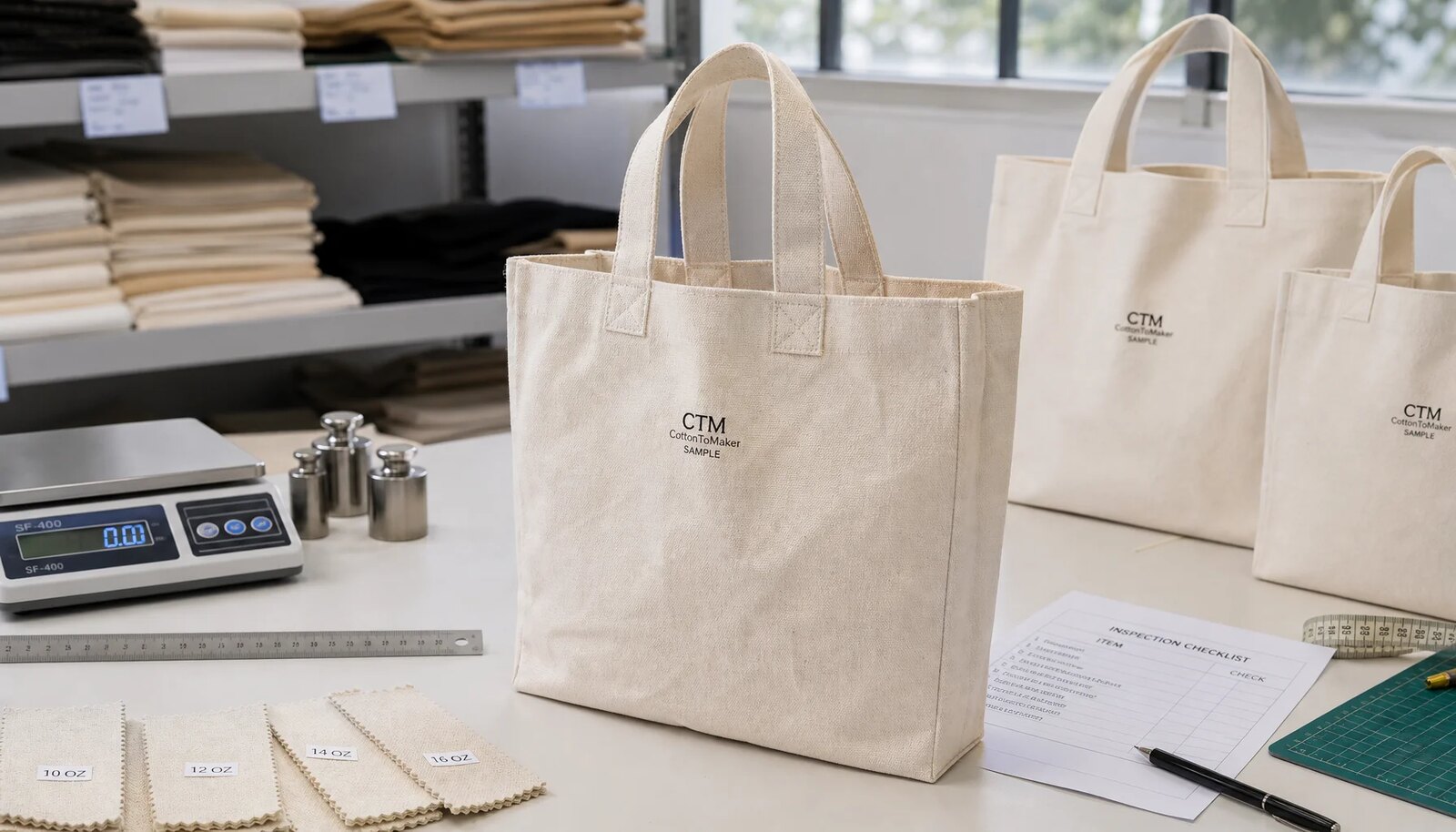
Start With the Real Use Case
Canvas grocery totes for craft fairs do harder work than lightweight promotional bags. They are packed quickly at checkout, bumped through crowds, set on rough booth tables, and reused after the event. Many carry dense goods: candles, jars, ceramics, books, packaged food, textiles, or several purchases from different makers. A tote built for a catalog handout is not automatically ready for that workload.
Start with the job the bag must perform. Is it a booth giveaway, a paid retail carrier, a sponsor-branded event tote, or a premium reusable grocery-style bag? That decision drives almost every practical specification: fabric weight, gusset depth, handle reinforcement, seam finish, print method, carton packing, and inspection severity. If the use case is vague, suppliers will fill in the blanks differently, and the lowest quote may simply be the weakest construction.
A good RFQ does not say only natural canvas tote with logo. It states finished dimensions, gusset, fabric weight, intended load, handle method, print method, sample tests, tolerances, and packing. For craft fair programs, this discipline matters because the event date is fixed. Weak handles, print transfer, mixed cartons, or wrong dimensions usually show up when there is little time left to remake goods.
- Define load class: 8 kg for light retail, 10 kg for standard grocery-style use, or 12 kg for heavier mixed goods.
- State finished dimensions rather than mockup dimensions or flat artwork proportions.
- Clarify whether the bag must stand open, fold compactly, or present as a premium resale item.
- Identify functional failure points: handle anchors, top hem, bottom seam, gusset corners, and print adhesion.
- Separate cosmetic preferences from critical requirements so inspection decisions are easier.
- Use one signed spec sheet as the quoting baseline for every supplier.
Fabric Weight and Canvas Specification
For canvas grocery totes used at craft fairs, 10 oz cotton canvas, approximately 340 GSM, is a common starting point. Many buyers move to 12 oz, approximately 407 GSM, when the tote needs more structure or will carry heavier mixed goods. Lighter 6 oz or 8 oz canvas can be fine for paper goods, apparel, brochures, or small accessories, but it may sag and feel underbuilt as a grocery-style carrier. Heavier 14 oz or 16 oz canvas can look premium, yet it adds cost, carton weight, freight volume, folding stiffness, and sewing demands.
Ask what the quoted weight actually means. One supplier may quote greige fabric before finishing. Another may quote finished fabric. A third may use an old catalog description that does not match current stock. That small wording gap can change handfeel, opacity, and load confidence. Request a physical swatch, then require the pre-production sample to use the same fabric lot or a clearly documented equivalent.
Material type also affects buying risk. Natural cotton canvas gives the familiar craft-market look, but shade can vary between cotton lots. Dyed canvas adds dye-lot MOQ and shade-control issues. Recycled cotton blends may show more lint, specks, and fiber variation. Organic cotton should be specified only when certification, transaction documents, and material segregation are required and budgeted. If a sustainability claim will appear on packaging or marketing, check the documentation before the order is priced.
- Light-duty option: 8 oz to 10 oz canvas for apparel, paper goods, or low-weight event giveaways.
- Standard option: 10 oz to 12 oz canvas for reusable craft fair grocery totes carrying mixed goods.
- Premium option: 12 oz to 16 oz canvas when structure, handfeel, and reuse value outweigh freight sensitivity.
- Specify whether GSM is greige, finished fabric, washed fabric, or finished bag body weight.
- Request swatches for fabric color, surface texture, lint level, odor, and print compatibility.
- Ask whether the fabric is pre-shrunk and what shrinkage is expected after home washing if care claims are made.
Dimensions, Gusset, and Carry Ergonomics
Specify the tote as a finished product, not as a flat artwork rectangle. The buyer should define finished width, height, gusset depth, bottom construction, handle length, handle drop, handle width, and measurement method. A 38 x 40 cm flat tote behaves very differently from a 38 x 35 x 10 cm boxed-bottom tote. For craft fair checkout, a gusseted base often helps the bag stand open while staff pack bulky items.
Comfort affects durability more than many buyers expect. If a handle is too narrow, too short, or awkwardly placed, customers shift grip or overload one side, which stresses the anchor points. Shoulder-carry totes often use a handle drop around 22-28 cm. Hand-carry retail totes may use a shorter drop. Handle width often falls around 2.5-3.8 cm, depending on size, load target, and visual style. Wider handles distribute weight better, but premium webbing can raise cost.
Tolerances belong in the PO, not in a late inspection argument. Cotton cutting and sewing cannot hold rigid plastic-product tolerances, but uncontrolled variation causes problems with packing, print alignment, and shelf presentation. As a practical starting point, use width and height plus or minus 1 cm, gusset plus or minus 0.5-1 cm, handle drop plus or minus 0.5 cm, and print placement plus or minus 0.5-1 cm, adjusted only when the design or process requires it.
- Use finished size format: width x height x gusset, with the measurement point clearly defined.
- Specify bottom construction: boxed bottom, side gusset, bottom gusset, or flat tote.
- Define handle length and handle drop separately to avoid shoulder-carry misunderstandings.
- Control handle pair consistency so left and right handles are not visibly uneven.
- Write tolerances into the RFQ and PO before sampling begins.
- Ask the supplier to measure at least five samples during pre-production and report results.
Handle and Seam Construction
Handles are where many canvas grocery totes fail first. Strong fabric will not save a bag if the handle is inserted too shallowly, the stitch tension is poor, or the top hem collapses under load. For load-bearing craft fair totes, handle tape should usually extend 7-10 cm into the bag body. A box-X, cross-stitch, or equivalent reinforcement spreads stress better than a short straight stitch or isolated bar tack.
Be precise about handle material. Cotton webbing is common, durable, and consistent with a natural canvas look. Self-fabric handles can look cleaner when the buyer wants a matched appearance, but they must be folded and stitched correctly. Polyester webbing may improve consistency, although it changes the handfeel and visual story. If handle color differs from the body, ask whether MOQ, dye-lot control, or lead time changes.
Seams deserve the same attention as handles. Overlocked internal seams reduce fraying. Bound seams can improve the inside appearance on premium totes. A folded top hem strengthens the opening and gives the handle anchor a stable base. Bottom corners and gusset intersections need close inspection because load concentrates there. A sample may look tidy on the table and still fail after repeated lifting if seam allowance is narrow or corner stitching is skipped.
- Handle insertion: target 7-10 cm into the body for load-bearing grocery-style totes.
- Reinforcement: require box-X or cross-stitch unless a tested alternative is approved.
- Seam allowance: specify a functional minimum, commonly at least 1 cm where construction allows.
- Top hem: define width and fold method so handle anchors are stable and clean.
- Stitching: reject skipped stitches, loose tension, broken thread, open seams, and weak backstitching at stress points.
- Inspection photos: request inside and outside handle anchor images, not only front beauty shots.
Sample Durability Testing Checklist
Treat the pre-production sample as a working prototype, not just an artwork mockup. It should use the final fabric weight, final handle material, final reinforcement, final seam finish, final print process, final label, and intended packing method. If the supplier sends substitute fabric or temporary decoration, approve it only as a shape reference. It should not release bulk production.
The testing routine should be repeatable and unambiguous. At minimum, check loaded hang performance, lift cycles, handle anchors, bottom seams, print rub, folding, odor, and dimensions after loading. Match the test to the actual use case. For many standard craft fair grocery totes, 10 kg for 2 hours is a practical pre-production benchmark. Heavier programs may test at 12 kg. Lighter retail programs may use 8 kg.
Document every test with photos, measurements, and clear pass/fail notes. If a sample fails, the correction should be measurable. Increase handle insertion from 6 cm to 8 cm. Change straight stitching to box-X. Reinforce the gusset seam. Move the print away from a fold line. Instructions such as make stronger or improve quality are too easy to misread and too hard to inspect later.
- Loaded hang test: test at the agreed load, such as 10 kg for 2 hours, suspended by both handles.
- Lift cycle test: lift and set down the loaded tote 25-50 times to expose weak stitching and handle slippage.
- Handle anchor review: inspect fabric tearing, stitch breakage, thread tension, and symmetry after testing.
- Bottom and gusset review: check corners for open seams, seam creep, skipped stitches, or distortion.
- Print rub test: perform dry rub and light wet rub on the printed area and check transfer to a white cloth.
- Fold test: fold as packed, reopen, and check print cracking, crease marks, and panel distortion.
- Odor check: reject strong chemical, mildew, smoke, or oily odor because cartons can intensify it.
- Post-test measurement: remeasure width, height, gusset, and handle drop to see whether load caused unacceptable deformation.
Print Method and Artwork Controls
Screen printing is usually the most reliable bulk option for simple craft fair logos, sponsor marks, and one-to-three-color artwork. It can bond well to cotton canvas when ink, mesh, curing, and fabric surface are controlled. Still, screen print is not automatic approval. Ink can feel too thick, crack on folds, transfer in packing, or lose edge sharpness on coarse canvas.
Heat transfer, digital printing, and specialty decoration can be useful for gradients, small seasonal batches, or full-color designs. They need more careful validation. Coarse canvas can reduce detail, and large transfers may feel stiff or crack when folded. If the bag will be folded through the print area, test that fold before approval. If customers will carry boxed goods or rough jars inside the tote, rub resistance matters as much as color match.
Artwork controls should cover print size, placement, face, color reference, number of colors, registration tolerance, and any underbase requirement. Pantone references help, but cotton canvas shade and ink thickness influence perceived color. Do not rely only on a digital mockup. Approve a strike-off on the actual canvas, then keep it as the color and handfeel reference for inspection.
- Use screen print for simple logos, repeat programs, and solid one-to-three-color craft fair branding.
- Use heat transfer or digital only after adhesion, fold, peel, and rub testing on the actual canvas.
- Set print position tolerance, commonly plus or minus 0.5-1 cm depending on bag size and design.
- Avoid very fine lines on coarse canvas unless the supplier proves printability with a strike-off.
- For dark canvas, confirm underbase printing, added handfeel, color shift, and extra cost.
- Confirm curing time before packing to reduce ink transfer between stacked or folded totes.
MOQ, Quote Structure, and Landed Cost
Canvas tote MOQ is rarely just a sewing number. It may depend on fabric rolls, dye lots, handle webbing, print setup, labels, packing materials, and carton marking. A 500-piece quote may be valid for stock natural canvas with one logo and master carton packing. Change to dyed fabric, private labels, or individual packaging, and the minimum can move.
Ask for line-item pricing so quotes can be compared honestly. Separate the base unit price from sample charges, screen charges, strike-off fees, label costs, custom packing, carton marking, inspection support, and freight data. Quantity breaks at 500, 1,000, 2,500, and 5,000 pieces are useful only after the same construction is locked. Otherwise, the cheaper quote may be cheaper because the tote is lighter, less reinforced, or packed differently.
Landed cost includes more than unit price. Review carton CBM, gross weight, sample freight, inspection cost, duty, local delivery, and rework risk. Heavier canvas can improve perceived value but raise freight cost. Flat packing can improve presentation and reduce creasing, yet increase carton footprint. Folded packing can save CBM, but it may create logo creases. The best sourcing decision balances price, durability, sellable condition, event timing, and warehouse handling.
- Quote basis: one size, one fabric color, one handle color, one logo, one print location, one label, and one packing method.
- Ask for separate prices for 10 oz, 12 oz, and any premium canvas option if final spec is not locked.
- List excluded costs: sample, screens, strike-off, label, packing upgrade, carton mark, mold or cutting setup if applicable.
- Confirm overrun and underrun tolerance, commonly a small percentage on custom production, before issuing the PO.
- Compare carton CBM and gross weight because freight can outweigh small unit-price differences.
- Ask whether multiple designs can share fabric cutting while remaining separated for print, packing, and carton labels.
Approval Workflow and Production Control
A controlled approval sequence prevents many bulk-order mistakes. For a new canvas grocery tote, the usual flow is fabric swatch, print strike-off, pre-production sample, revision if needed, golden sample approval, and then bulk production. Repeat orders can move faster, but only after confirming that fabric source, handle construction, print settings, and packing have not changed.
Approval comments should be measurable and version-controlled. If the handle drop is too short, state the required handle drop and tolerance. If reinforcement looks weak, specify insertion depth and stitch pattern. If the print sits too low, state the distance from the top edge. Every revision should have a version number, because factories can easily work from an old PDF, chat image, or sales sample if controls are loose.
Before bulk cutting, ask the factory to confirm the bill of materials and production settings. That includes body fabric, handle material, thread color, label, artwork file, screen setup, packing method, carton quantity, carton marks, and inspection requirements. The approved sample should be sealed, signed, or otherwise marked as the golden sample. Inspect finished goods against that sample and the signed spec sheet, not against memory or a polished sales photo.
- Approve fabric swatch for color, GSM, surface texture, odor, shrinkage risk, and print suitability.
- Approve print strike-off for color, registration, edge sharpness, handfeel, curing, and rub resistance.
- Approve pre-production sample for measurements, handle drop, gusset, stitch quality, label, and load test result.
- Issue written corrections with numbers, such as increase handle insertion to 8 cm or move print up 1 cm.
- Seal the golden sample and keep one reference with the supplier and one with the buyer or inspector.
- Confirm all revisions in the PO or spec sheet before cutting bulk fabric.
Packing and Carton Requirements
Packing is part of quality control. Canvas can hold hard creases, and printed panels may transfer if totes are stacked too tightly or packed before ink is stable. Craft fair programs often need fast receiving, clear carton identification, and separation by event, booth, design, or SKU. Specify those details before the supplier calculates carton size and labor.
Flat packing usually gives the cleanest presentation for resale totes and premium event bags, but it increases carton footprint. Folding reduces CBM and freight cost, yet it can crease the logo or distort a boxed bottom. Individual polybags protect against dirt and moisture, though they may conflict with plastic-reduction goals. Paper bands or bundle packs can work well if the receiving team can handle them efficiently.
Keep carton weight practical. Where possible, target master cartons under about 18-20 kg gross weight unless the receiving warehouse approves heavier cartons. Confirm carton dimensions, pieces per carton, gross weight, CBM, inner moisture protection, carton marks, and carton strength. For sea freight, humid routes, or long storage, moisture control matters because cotton canvas can absorb odor and humidity.
- Confirm packing style: flat, folded, individual polybag, paper band, bundle pack, or master carton only.
- Define pieces per carton, carton dimensions, gross weight, CBM, and maximum acceptable carton weight.
- Position printed faces to reduce ink-to-ink contact and avoid hard folds through large printed areas where possible.
- Use inner liner or moisture protection for sea freight, humid routes, or long warehouse storage.
- Require carton marks with PO, SKU, design name, color, quantity, carton number, and country of origin if needed.
- Request packing photos before shipment so mixed designs or incorrect folding are caught early.
Inspection Criteria and Defect Triage
Final inspection should combine measurement checks, workmanship review, functional testing, print review, packing verification, and carton audit. Define critical, major, and minor defects before inspection begins. Critical defects make the tote unsafe or unusable, such as broken handle stitching, open load-bearing seams, severe contamination, unsafe foreign matter, or strong mildew odor. Major defects affect saleability or function: wrong size, wrong fabric, crooked print, weak reinforcement, visible stains, mixed designs, or nonconforming packing. Minor defects are limited cosmetic issues that do not affect use.
If using AQL, state the sampling plan and defect classes in the purchase order or quality annex. Generic AQL wording is not enough. The inspector needs to know whether a loose thread is minor, whether a stain is major, and whether handle anchor failure is critical. For event-critical orders, include functional checks from finished goods, such as loaded hang testing on selected pieces and print rub checks on actual production bags.
The inspection report should include a measurement table, defect photos, load test result, print rub result, carton count, carton dimensions, gross weight, packing images, and rework instructions. If pieces are rejected, the supplier should separate, repair, or replace them before shipment. That step protects the buyer from a familiar problem: cartons arrive on time, but weak handles or mixed specs appear only when staff are unpacking for the craft fair.
- Critical defects: handle anchor failure, open structural seam, severe contamination, unsafe foreign matter, or unusable odor.
- Major defects: wrong size, wrong fabric, weak reinforcement, incorrect print, visible stains, mixed SKU, or nonconforming packing.
- Minor defects: small loose threads, minor washable marks, or slight appearance variation within approved standard.
- Measurement checks: width, height, gusset, handle drop, handle width, print placement, and label placement.
- Functional checks: loaded hang, handle pull review, seam stress review, dry rub, wet rub, and fold inspection.
- Packing checks: carton count, SKU separation, carton labels, barcode scanability, moisture protection, and carton condition.
Specification comparison for buyers
| Spec decision | Recommended option | When it fits | Buyer risk to check |
|---|---|---|---|
| Fabric weight | 10 oz to 12 oz cotton canvas, approximately 340-407 GSM before finishing; confirm finished GSM on the bag body | Reusable craft fair grocery-style bags carrying candles, jars, books, ceramics, packaged food, textiles, or mixed purchases | Some quotes use greige fabric weight, not finished fabric weight; require swatch weight confirmation and finished-bag sample testing |
| Bag shape | Boxed bottom with side gusset, commonly 8-12 cm gusset for grocery-style loading | Booths that need bags to stand open, accept bulky goods, and pack quickly during customer checkout | Flat totes may quote cheaper but load poorly; confirm finished width, height, bottom depth, and whether dimensions are measured before or after sewing |
| Handle reinforcement | Cotton webbing or self-fabric handles with box-X or cross-stitch; handle tape inserted 7-10 cm into body | Programs targeting 8-12 kg customer carry loads with repeated lifting during events | Bar tacks alone may not spread load; inspect stitch box size, insertion depth, thread tension, and fabric tearing around anchor points |
| Seam construction | Folded top hem, overlocked internal seams, reinforced bottom/gusset corners, and minimum 1 cm functional seam allowance | Reusable retail bags where seam strength and clean internal appearance affect perceived quality | Narrow seam allowance, skipped stitches, or raw edges can fray after loading and handling even if the sample looks acceptable |
| Print method | Screen print for 1-3 spot colors; heat transfer or digital only after adhesion, fold, and rub testing | Craft fair logos, sponsor marks, event branding, and maker-market resale totes | Ink can crack, transfer, or feel stiff on coarse canvas; require print strike-off on actual canvas and curing confirmation |
| MOQ basis | MOQ quoted by size, body fabric color, handle color, artwork, print color count, label, and packing method | Distributors combining several craft fair designs or seasonal programs | Headline MOQ may apply only to stock natural canvas and one logo; custom dyeing, private label, or retail packing can raise MOQ |
| Sample approval | Material swatch, print strike-off, and pre-production sample using final fabric, handle, stitching, label, and packing | First order, new supplier, changed artwork, changed load target, or any event-critical delivery | Photo approval cannot prove load performance, rub resistance, handle drop, carton compression, odor, or fabric handfeel |
| Inspection standard | Measurement checks plus functional tests; define critical, major, and minor defects; use AQL only with agreed defect classes | Importers, promotional distributors, retailers, and brand owners needing shipment release criteria | Without defect classes, buyers and factories debate loose threads while missing real failures such as weak handle anchors |
| Export packing | Flat or controlled fold packing in master cartons, moisture protection, carton marks, and carton gross weight target under 18-20 kg where practical | Sea freight, warehouse storage, event replenishment, or multi-SKU distribution | Over-compression causes creases, print transfer, warped gussets, carton bursting, and receiving errors |
Buyer checklist before sampling
- Define finished width, height, gusset depth, handle width, handle length, handle drop, body fabric GSM, handle fabric, color, and acceptable tolerance before requesting price.
- State the intended load target, such as 8 kg for light retail use, 10 kg for standard grocery-style use, or 12 kg for heavier craft fair loads, and require sample testing at that weight.
- Specify whether fabric weight is greige, washed, finished fabric, or finished bag body weight; ask for physical swatch confirmation instead of relying only on catalog descriptions.
- Require handle tape insertion depth of 7-10 cm for load-bearing designs, with box-X or equivalent reinforcement visible and consistent on both handles.
- Set measurement tolerances, for example width and height plus or minus 1 cm, gusset plus or minus 0.5-1 cm, handle drop plus or minus 0.5 cm, and print position plus or minus 0.5-1 cm.
- Approve print method, Pantone or LAB color target, artwork size, print placement, ink curing requirement, dry rub check, light wet rub check, and acceptable print handfeel.
- Ask the supplier to quote unit price, sample charge, screen charge, label charge, packing upgrade, carton marking, and any overrun or underrun policy as separate line items.
- Confirm MOQ by fabric color, size, handle color, logo design, print color count, label type, and packing method, not only by total combined quantity.
- Include seam finish, stitch density target, thread color, backstitching, seam allowance, top hem width, loose thread limits, contamination limits, and odor rejection criteria in the PO.
- Require a sealed golden sample or signed pre-production sample after approval so bulk inspection has a physical standard for fabric, sewing, print, and packing.
Factory quote questions to send
- What exact fabric weight are you quoting in oz and GSM, and is that greige fabric, finished fabric, washed fabric, or finished bag body weight?
- Is the canvas natural, bleached, dyed, recycled cotton blend, organic cotton, or cotton-poly blend, and what shade tolerance do you normally control between fabric lots?
- What yarn or weave construction can you provide for the quoted canvas, and do you have a physical swatch from current stock or only a historical reference?
- What finished dimensions, gusset depth, top hem width, seam allowance, handle width, handle length, and handle drop are included in the quotation?
- What sewing tolerance do you apply for width, height, gusset, handle drop, and print placement, and can those tolerances be written into the order confirmation?
- What handle material and reinforcement will be used, how deep is the handle inserted into the bag body, and will the stitching be box-X, cross-stitch, bar tack, or another method?
- What load test can you perform on the pre-production sample, such as 10 kg for 2 hours, and what is considered a failure?
- Which print method are you quoting, how many colors and positions are included, and what curing, adhesion, dry rub, wet rub, or fold test will be performed?
- What is the MOQ for one size, one fabric color, one handle color, one logo design, one label type, and one packing method?
- Can multiple craft fair logo designs share the same fabric MOQ, and what extra screen, setup, packing separation, or carton marking charges apply?
Quality-control points to confirm
- Finished size tolerance should normally be controlled within plus or minus 1 cm for width and height; gusset depth within plus or minus 0.5-1 cm; handle drop within plus or minus 0.5 cm unless a wider handmade tolerance is approved.
- Print placement should normally be controlled within plus or minus 0.5-1 cm depending on tote size, with tilt and off-center printing classified as major when visibly inconsistent against the approved sample.
- Loaded hang testing should match the declared use case, for example 10 kg for 2 hours for standard grocery-style craft fair use, with no handle tearing, open seams, severe distortion, or stitch failure.
- Lift cycle testing should include repeated lifting and setting down of a loaded sample, such as 25-50 cycles at the agreed load, to expose weak handle anchoring that a static hang test may miss.
- Handle pull review should check stitch breakage, fabric tearing around the stitch box, handle tape elongation, uneven handle lengths, and whether both handle anchors are sewn symmetrically.
- Seams should show consistent stitch density, clean backstitching, no skipped stitches, no open seams, no needle damage, and no weak points at bottom corners or gusset intersections.
- Fabric should be checked before cutting and during final inspection for slubs beyond approved standard, oil spots, weaving defects, shade variation, mildew, excessive lint, odor, contamination, and visible stains.
- Print QC should include color match against the approved standard, edge sharpness, curing, dry rub, light wet rub, cracking after folding, print transfer risk, and acceptable handfeel on coarse canvas.
- Carton packing should prevent moisture exposure, print-to-print transfer, heavy creasing, carton bursting, mixed SKU errors, barcode issues, and overweight cartons that are unsafe or impractical for warehouse handling.
- Final inspection should classify critical defects, major defects, and minor defects before shipment so release decisions are based on agreed commercial and functional risk, not subjective appearance debates.