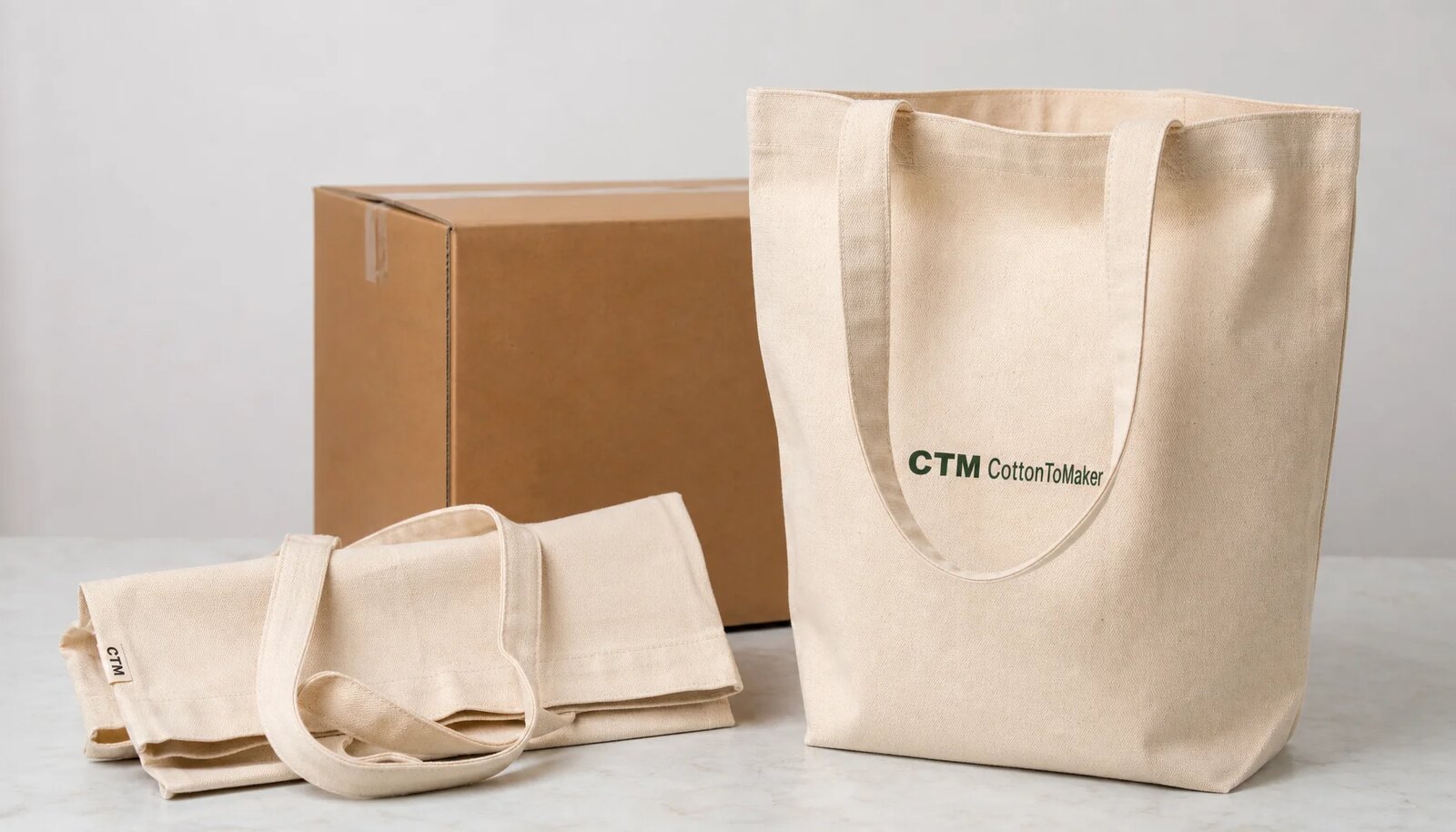
The Buying Problem Is Not Only the Tote
Canvas grocery totes for craft fairs are often ordered under time pressure: a fair date is fixed, sponsor artwork arrives late, and the buyer wants a reusable bag that looks more substantial than a thin giveaway shopper. The common mistake is treating the carton packing plan as a warehouse detail after the tote price is already approved. For this product, packing affects print condition, carton cube, freight cost, warehouse receiving, and event distribution.
A grocery tote is bulkier than a flat cotton bag because the fabric is heavier and the gusset adds volume. If the factory packs too many pieces into an oversized carton, the print can crease and the carton can deform. If the factory packs too few, air freight or LCL freight becomes expensive. The RFQ should connect the product specification and packing plan from the beginning, so every supplier quotes the same real shipment instead of a loose bag sample.
- Treat finished size, gusset, handle length, print area, fold direction, and pieces per carton as one commercial specification.
- Use carton gross weight and carton cube as quote comparison points, not after-order corrections.
- Require the sample to be folded the same way the bulk goods will be packed.
Choose Canvas Weight Around Use, Not Habit
For craft fair grocery totes, the practical fabric range is usually 10 oz to 12 oz canvas, roughly 280 to 340 GSM depending on weave and supplier standard. An 8 oz canvas can work for light giveaway bags, but it may feel weak for grocery use when buyers carry candles, jars, ceramics, books, or packaged food. A 14 oz canvas feels premium but increases fabric cost, sewing difficulty, carton weight, and freight cube.
When comparing quotes, do not accept only the word canvas. Ask for GSM, ounce weight, weave type, and whether the fabric is natural, bleached, dyed, or washed. Natural unbleached canvas has cotton seed flecks and shade variation, which many craft fair brands like, but it changes print appearance. Bleached canvas gives a cleaner print background but adds processing cost and may require better shrinkage control.
- 8 oz canvas: acceptable for low-cost giveaways, weaker for heavy purchases.
- 10 oz canvas: balanced option for most reusable craft fair grocery totes.
- 12 oz canvas: stronger hand feel, better retail value, higher carton weight.
- 14 oz canvas: premium but may reduce pieces per carton and raise freight cost.
Set the Grocery Tote Shape Before Pricing
A craft fair grocery tote normally needs more usable volume than a standard flat tote. The key construction choices are finished height, width, bottom gusset, side gusset, handle width, and handle drop. A common buyer error is requesting only front panel size, then discovering that the bag cannot hold boxed goods or that the handles are too short for shoulder carry.
For procurement comparison, specify finished dimensions with tolerance. For example, a buyer might state 38 cm width by 35 cm height by 12 cm gusset, with 2.5 cm wide handles and 58 cm total handle length. The exact size can change by market, but the quote must include enough detail for the factory to calculate fabric consumption and carton volume. Reinforcement matters because grocery totes are loaded heavier than event flyers or T-shirts.
- Use box-bottom or full gusset construction when the tote must stand and hold retail purchases.
- Use cross-stitch or bar-tack handle reinforcement for heavier loads.
- Define whether seams are inside overlocked, bound, or French-seamed if appearance matters.
- Avoid very wide gussets unless the carton plan allows enough fold depth.
Printing Choices That Survive Folding
Screen printing is usually the best commercial method for canvas grocery totes when the artwork uses one to three solid colors. It gives good coverage, predictable unit cost at volume, and simple color control. Water-based ink can feel softer on canvas, while plastisol or heavier ink systems may give stronger opacity but can crack or mark if the tote is folded before full curing. The buyer should not approve print quality only from a flat, unfolded sample.
Heat transfer can be useful for complex full-color artwork or smaller batches, but it changes the hand feel and may not suit every natural canvas surface. Embroidery can look premium, yet it adds cost and can pucker if the canvas weight and backing are not matched. For craft fair programs, printing is often the best balance, but the RFQ should define artwork size, placement tolerance, color reference, and fold-risk testing.
- Print placement tolerance should normally be written in millimeters, not described as centered only.
- Dark ink on natural canvas needs rub and transfer checks before bulk packing.
- Large solid print areas should be tested after folding under carton pressure.
- Sponsor logos should be approved at final print size, not scaled from a presentation file.
MOQ Logic for Craft Fair Programs
MOQ is not just a supplier preference. It comes from fabric ordering, cutting efficiency, sewing line setup, print screen setup, and packing labor. A factory may accept a low total quantity, but the unit price will rise if the order is divided into many small artwork versions. For craft fair programs, this matters because organizers often need one base tote with different sponsor logos, city names, or vendor groups.
The buyer should request pricing by scenario. One design at 3,000 pieces, three designs at 1,000 pieces each, and six designs at 500 pieces each can have very different setup costs and production risk. If the tote body is the same, the factory may cut and sew in one batch, then split printing. That can save cost, but only if artwork approvals are ready and carton marks are controlled by design.
- Separate the MOQ for blank sewn bags from the MOQ for each printed design.
- Request the extra cost for each additional print screen, color, or artwork change.
- Use one common bag body when possible to protect sewing efficiency.
- Avoid last-minute artwork splits after fabric is cut, because carton allocation becomes harder.
Build the Carton Packing Plan Early
The carton packing plan should be approved before bulk sewing finishes. For 10 oz to 12 oz canvas grocery totes, buyers often use inner packs of 10 or 25 pieces and export cartons that stay around 12 to 18 kg gross weight. The correct number depends on tote size, fabric thickness, fold method, print area, and destination warehouse rules. A heavy carton may look efficient on paper but fail during manual handling.
The fold method is part of product quality. If the print is folded sharply through a large logo, the bag may arrive with permanent crease marks. If handles are twisted or forced into the fold, the front panel can look uneven at retail. The factory should provide a packing sample or packing photo showing one folded bag, one inner polybag, carton loading direction, carton label, and final carton closure.
- Define pieces per inner polybag and pieces per export carton in the purchase order.
- Keep carton weight practical for one-person lifting in event distribution.
- Use double-wall cartons for heavy canvas or long export routes.
- Place desiccant or moisture control only when appropriate and allowed by the buyer.
Quote Data That Makes Landed Cost Visible
A low FOB tote price can be misleading if the carton cube is poor. Canvas grocery totes are not as compressible as thin non-woven bags, and a gusseted tote creates more air space when folded badly. Procurement teams should compare the supplier quote with carton dimensions, pieces per carton, gross weight, net weight, and estimated CBM per thousand pieces.
For a fair comparison, request a price sheet that separates bag cost, print cost, setup cost, sample cost, inner packing, export carton, hangtag or barcode label, inspection support, and any special carton mark requirement. This helps the buyer identify whether a supplier is truly efficient or simply hiding cost in vague packing assumptions. It also helps freight forwarders estimate ocean LCL, FCL, or air backup costs before the event date becomes urgent.
- Calculate CBM per 1,000 pieces for every supplier quotation.
- Compare gross weight per carton against warehouse handling limits.
- Separate one-time print setup cost from repeat-order unit cost.
- Request carton dimensions before approving the cheapest unit price.
Sample Approval Must Include Packing
A loose sample can look perfect and still fail in bulk packing. The approval sample should use the final canvas weight, final sewing construction, final handle reinforcement, final print method, and final fold direction. If the buyer approves only a photo or a thin substitute fabric, there is no reliable standard for checking the shipment later.
For craft fair programs, the sample review should include a small packing simulation. Fold the sample as proposed, place weight or pressure on it for a short period, then inspect the printed area, handle crease, and front panel appearance. This is not a laboratory test, but it catches many practical issues before the order reaches carton sealing. Keep one signed sample at the factory and one with the buyer or inspection agent.
- Measure finished size after the sample is sewn, folded, and relaxed.
- Rub the print with a clean white cloth after curing.
- Fold through the actual print area and inspect for cracking or transfer.
- Photograph the approved fold and carton loading method for the packing instruction.
QC Thresholds for Receiving Confidence
Quality control should reflect how the tote will be used. For canvas grocery totes, important checks include fabric weight, finished dimensions, seam strength, handle attachment, print color, print placement, odor, moisture, loose threads, and carton count. A buyer who only inspects general appearance may miss weak handles or mixed design cartons that cause event distribution problems.
Set practical acceptance criteria in the purchase order. Size tolerance may be plus or minus 1 cm depending on construction. Print placement tolerance may be plus or minus 5 mm to 10 mm depending on artwork and panel size. Handle pull expectations should match intended load; if the tote will carry heavy grocery items, the factory should know that reinforcement is not decorative. The final inspection should include carton opening, not only top-layer viewing.
- Open cartons from different pallet positions to verify count and fold consistency.
- Check handle stitching under tension, especially at bar-tack or cross-stitch points.
- Inspect print after rubbing and folding, not only by looking at the top panel.
- Reject wet, moldy, or strong-smelling cartons before goods enter retail or event storage.
Lead Time Risks Around Event Dates
Craft fair orders have a hard deadline. If the tote arrives after the event, the product may have little value. A realistic lead time includes artwork finalization, sample making, sample courier transit, sample approval, fabric booking, cutting, sewing, printing, curing, inspection, packing, export customs, and freight. Buyers often count only sewing time and then lose days when artwork or sample comments are late.
Canvas fabric availability can also change timing. Natural canvas may be faster if stock fabric is acceptable, while dyed or custom-washed fabric adds more days. Large solid prints need proper curing time before tight packing. If air freight is the backup plan, carton cube becomes even more important because bulky packing can cost more than the tote itself. The schedule should identify the last safe date for artwork approval and the last safe date for shipment release.
- Freeze artwork before cutting if print panels require exact placement.
- Leave time for print curing before cartons are compressed and sealed.
- Book inspection before the planned packing completion date, not after all cartons are loaded.
- Keep an air freight backup estimate based on actual carton dimensions.
Specification comparison for buyers
| Spec decision | Recommended option | When it fits | Buyer risk to check |
|---|---|---|---|
| Fabric weight | 10 oz to 12 oz canvas, roughly 280-340 GSM, pre-shrunk if washing is expected | Reusable grocery totes sold or gifted at craft fairs where the bag must stand better than a thin cotton shopper | Low GSM quoted as canvas may collapse under jars, candles, or ceramics and can look cheap after printing |
| Bag construction | Box-bottom or gusseted tote with reinforced handle stitching | Vendors need a grocery shape that holds retail purchases and sits on a table during booth sales | Flat totes may quote cheaper but reduce usable volume and increase customer complaints at the event |
| Handle length | 55-65 cm shoulder handle with cross-stitch or bar-tack reinforcement | General retail buyers want one handle length that works for hand carry and shoulder carry | Short handles save fabric but make the bag less useful when packed with heavy craft fair purchases |
| Print method | Screen print for 1-3 solid colors; heat transfer only for complex artwork or small runs | Most craft fair logos, sponsor marks, and booth graphics use solid colors on natural canvas | Ink migration, poor curing, or thick plastisol can crack when totes are folded tightly in cartons |
| MOQ logic | MOQ based on fabric procurement, print setup, and carton cube, not only bag quantity | Programs with mixed designs, sponsor logos, or multiple event cities need realistic split-order planning | Too many small print versions can raise unit cost and delay approval even when total order volume looks high |
| Inner packing | Flat-folded units in 10 or 25 pieces per polybag, aligned print-to-print only when ink is fully cured | Importers need clean counting, easier warehouse receiving, and controlled carton weight | Fresh ink, dark print, or pressure marks can transfer if bags are packed too soon or too tight |
| Export carton | Double-wall carton for heavy canvas, about 12-18 kg gross weight per carton | Distribution warehouses and event teams need cartons that can be lifted safely without bursting | Oversized cartons reduce carton count but may fail drop handling and increase crushed corners |
| Sample approval | Pre-production sample with final fabric GSM, handle length, print color, fold method, and carton label draft | Buyers need one signed standard that connects product quality to packing execution | A nice loose sample is not enough; carton folding can expose print cracking, creasing, or size variation |
| Quote comparison | Request unit price, print setup, sample charge, carton dimensions, pieces per carton, gross weight, and lead time separately | Procurement teams comparing factories, trading companies, or regional suppliers need landed-cost visibility | The lowest FOB unit price can lose value if carton cube, repacking labor, or late print approval is ignored |
Buyer checklist before sampling
- Define the exact tote use: grocery carry, craft fair giveaway, retail resale, vendor kit, or sponsor merchandise.
- Specify canvas GSM or ounce weight, finished size, gusset, handle length, and reinforcement method in the RFQ.
- Send artwork with Pantone references, print size, placement tolerance, and whether print must survive tight folding.
- Require a pre-production sample made with final fabric, final print method, and the proposed folding direction.
- Approve carton plan before mass production: pieces per polybag, pieces per carton, carton dimensions, gross weight, and carton mark format.
- Set acceptance criteria for size tolerance, print color tolerance, seam strength, handle pull, carton burst resistance, and barcode readability if used.
- Compare quotes by landed cost per usable tote, not only FOB unit price.
- Reserve lead time for fabric dyeing or bleaching, print curing, sample courier time, inspection, and export booking.
- Confirm whether spare bags, replacement labels, or mixed carton assortments are needed for event distribution.
- Align warehouse receiving rules with the factory packing plan before cartons are sealed.
Factory quote questions to send
- What canvas weight are you quoting in GSM and ounce, and is the fabric greige, bleached, dyed, or pre-shrunk?
- What is the finished tote size, gusset depth, handle width, handle length, and handle reinforcement method?
- Which print method is included, how many colors are quoted, and what print curing or wash resistance standard is used?
- What is the MOQ for one design, and what is the cost effect if the order is split into several sponsor or city designs?
- How many pieces are packed per inner polybag and per export carton, and what are the estimated carton dimensions and gross weight?
- Can you make the approval sample using the same fabric lot or production fabric standard planned for bulk?
- What tolerances do you apply for size, GSM, print placement, color shade, and carton quantity variance?
- What production lead time starts after sample approval, artwork approval, deposit, or fabric booking?
- Which quote items are separate: sample cost, mold or screen setup, print setup, carton mark printing, hangtags, barcode labels, and inspection support?
- Can you provide packing photos, carton drop test record if needed, and finished goods inspection data before shipment?
Quality-control points to confirm
- Fabric weight should be checked against the approved GSM or ounce standard with a practical tolerance agreed before production.
- Finished tote dimensions should be measured after sewing and folding, not only from cut panels.
- Handle stitching should show consistent reinforcement with no skipped stitches, loose threads, or weak bar-tacks.
- Print color should be compared under neutral light against approved artwork or Pantone target with realistic fabric absorption allowance.
- Print adhesion and curing should be tested by rub, fold, and light scratch checks before cartons are packed.
- Carton quantity should match the approved packing instruction, with no mixed designs unless the carton mark clearly states the assortment.
- Carton gross weight should remain practical for warehouse handling, especially for 10 oz to 12 oz canvas grocery totes.
- Carton labels should include item code, design code, quantity, carton number, gross weight, net weight, and destination if required.
- Random cartons should be opened during final inspection to verify folding direction, inner bag count, moisture control, and print protection.
- Moisture and odor should be checked before sealing cartons because heavy natural canvas can trap humidity during long ocean freight.