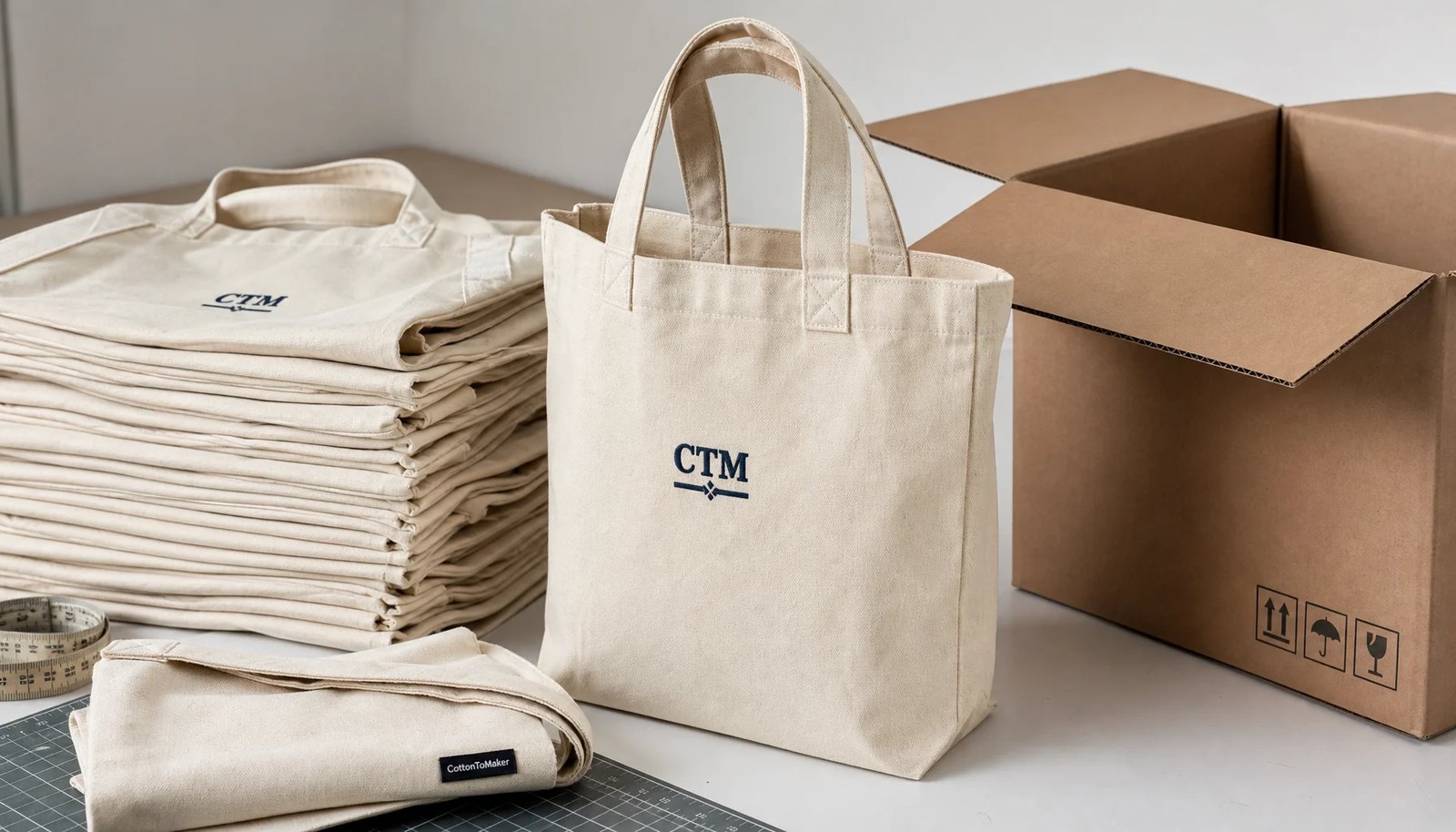
Start with the receiving route
A canvas grocery totes for university bookstores carton packing plan should start with how the cartons will be received, counted, moved, and stored. The tote design matters, but the wrong packing plan can turn a simple order into extra labor for bookstore staff, campus receiving, or a 3PL. Heavy cartons slow unloading. Bulging cartons stack poorly. Mixed designs create inventory errors. Weak labels force staff to open cartons before they know where the goods belong.
University bookstore orders often serve more than one channel. The same tote may be a checkout reusable bag, a resale item, an orientation kit component, an alumni weekend item, or a department giveaway. A single central warehouse can accept larger bulk cartons. A multi-store or event allocation usually needs smaller cartons, inner bundles, or destination labels.
Ask for the carton plan during the RFQ, not after production. At quote stage, request pieces per carton, estimated carton dimensions, net weight, gross weight, total cartons, total CBM, inner bundle count, carton board type, sealing method, and carton marks. These details help procurement compare landed cost, stockroom space, and labor impact, not only unit price.
The plan should be confirmed with a first packed carton before full mass packing. That carton should use final totes, final fold, final bundle method, final carton board, final tape method, and final label. If it exceeds the weight target, compresses the print, bulges, or creates uneven corners, the supplier can still adjust carton quantity or fold method before hundreds of cartons are sealed.
- Set a maximum gross carton weight, often about 18 to 20 kg unless your receiving team approves more.
- Define whether cartons must be separated by SKU, logo, color, destination, or delivery date.
- Ask for total cartons and total CBM before comparing freight quotes.
- Require first-carton photos of the open carton, sealed carton, label, scale weight, and measured dimensions.
- Confirm campus rules for pallet height, delivery appointments, carton labels, and receiving windows.
Choose canvas weight by use
“Canvas tote” is too vague for procurement. For bookstore grocery totes, 10 oz to 12 oz cotton canvas is a practical starting range, roughly 340 to 407 GSM depending on weave and finishing. It provides more structure than lightweight promotional cotton while still folding into cartons without excessive volume. It is suitable for apparel, notebooks, drink bottles, snacks, small gifts, and moderate book loads.
Ask suppliers to quote both ounces per square yard and GSM, and ask when the weight is measured. Some quotes refer to greige fabric, some to dyed fabric, and some to finished fabric. That difference affects hand feel, shrinkage, and comparability. A written weight tolerance, commonly +/-5%, gives inspectors a usable standard.
Fabric composition should also be written clearly. Standard 100% cotton canvas is straightforward for retail tote programs. If the tote is described as recycled cotton or organic cotton, name the documentation required before placing the order. Depending on the claim and sales channel, the buyer may need a scope certificate, transaction certificate, product certificate, material declaration, chain-of-custody document, or supplier declaration tied to the actual order.
Natural canvas usually has seed flecks, slubs, and shade variation. That may be acceptable or even preferred for campus sustainability messaging, but it should be approved against a physical sample. Dyed canvas can support school colors, but it adds lab dip approval, shade-lot control, crocking risk, and sometimes higher MOQ.
- 8 oz canvas is economical but may feel light for bookstore resale.
- 10 oz canvas balances cost, strength, foldability, and freight efficiency.
- 12 oz canvas improves perceived value but raises carton weight and CBM.
- 14 oz canvas can feel premium but reduces packing efficiency and needs stronger sewing control.
- Dyed canvas requires lab dip approval, lot control, and crocking review for dark school colors.
Specify finished construction
A bookstore grocery tote is defined by usable volume, not only front-panel size. A common starting point is a finished body around 15 x 16 inches with a 5 to 6 inch bottom gusset. That size works for checkout use, folded apparel, notebooks, convenience items, and small gifts without becoming an oversized beach tote. If the program includes boxed gift sets or bulky hoodies, increase the gusset only after checking shelf space and carton impact.
Specify finished dimensions rather than pattern dimensions. Cutting, sewing, washing, pressing, dyeing, and fabric relaxation can change final size. Practical starting tolerances are +/-0.5 inch for body width and height, +/-0.25 to 0.5 inch for gusset depth, +/-0.5 inch for handle length, and +/-0.25 inch for print placement where the construction allows.
Name the gusset and handle construction. A boxed bottom helps the bag stand better when filled and is useful for grocery-style use. Side-and-bottom gussets can increase volume but change folding and carton shape. Handles of about 22 to 24 inches support shoulder carry for students, parents, alumni, and campus visitors. Handle width of 1.25 to 1.5 inches usually feels better than narrow tape.
“Reinforced handles” should be replaced with a specific stitch pattern. Box-X, dense bar tack, or reinforced cross stitching can all work if the factory can produce them consistently. Inspection should confirm stitch density, thread security, and stress-point quality.
- Measure the finished tote laid flat with seams aligned.
- Define gusset depth and bottom construction, not only total bag size.
- Measure handle length from attachment point to attachment point.
- Approve the reinforcement stitch pattern before bulk sewing.
- Confirm whether the tote must stand upright for retail display.
Control licensed print work
Most university bookstore canvas grocery totes use screen printing because campus marks often rely on solid spot colors. Screen printing is efficient for one- to three-color logos, alumni graphics, department marks, event designs, and bookstore branding. The RFQ should include vector artwork, Pantone references or approved physical standards, logo size, clear-space requirements, and placement dimensions from fixed edges.
Licensed marks need version control. The supplier should not choose an old mascot file, adjust colors without approval, or substitute a department name. The PO should identify the approved artwork file, date, logo version, print size, placement, and approval authority. If a university licensing or brand office must review the strike-off, include that step in the lead time.
Heat transfer can support complex graphics, gradients, or low quantities that do not justify multiple screens. It still needs testing on canvas for edge lift, cracking, hand feel, and fold marks. Digital printing can work for detailed artwork, but coarse natural canvas may reduce edge sharpness. Embroidery is better for small premium logos than for large grocery tote front panels.
The packing plan can affect print quality. A print may pass as a flat strike-off and fail after tight folding. Large ink coverage, white underbases, and dark logo blocks should be checked after curing and after the approved fold method. Inspect for opacity, registration, dry rub, blocking, cracking, and permanent crease marks.
- Use screen print for most solid bookstore logos and mascot marks.
- Use heat transfer only after checking edge lift, cracking, and feel on canvas.
- Use digital print only after testing color and edge clarity on the actual fabric.
- Record licensed artwork file names and approval dates.
- Review large ink areas after folding, not only when flat.
Plan MOQ by SKU
MOQ is shaped by fabric availability, cutting efficiency, sewing setup, print screens, ink mixing, inspection time, and carton utilization. A supplier may quote a low total order quantity, but price and risk change when that quantity is split across many designs. University bookstore orders often include separate SKUs for the main store, athletics, alumni weekend, orientation, departments, and events.
List the order by SKU, artwork version, fabric color, print color, destination, and required delivery date. A total order of 2,000 pieces may look efficient, but eight designs of 250 pieces require more setup and packing control than one design of 2,000 pieces. Ask suppliers to show price breaks at practical quantities such as 500, 1,000, 2,500, and 5,000 pieces, with setup charges separated where possible.
Carton math should be part of MOQ planning. If an approved carton holds 50 pieces and one SKU is ordered at 275 pieces, the result is five full cartons and one partial carton. That is manageable if the partial carton is clearly labeled. It becomes a receiving problem if staff cannot tell whether a carton is intentionally partial, short packed, or mixed.
Mixed-SKU cartons reduce carton count but increase receiving risk. Use them only when the bookstore, 3PL, or event team approves the label format. For dyed canvas, confirm whether the low-MOQ color is stock fabric or custom dyed, and approve the physical shade before production.
- Request price breaks by total quantity and by SKU split.
- Separate setup charges for screens, ink, artwork, and sample work.
- Identify partial cartons before shipment.
- Avoid mixed cartons unless receiving teams can count them easily.
- Confirm whether dyed fabric is stock shade or custom lab-dipped color.
Select the carton strategy
Carton quantity cannot be finalized from drawings alone. It depends on canvas weight, gusset depth, handle bulk, print coverage, fold method, inner bundle method, carton board, and moisture protection. A 10 oz natural canvas tote with a small one-color print may fit 100 pieces per carton. A 12 oz tote with long handles, a wide gusset, and heavy front print may be safer at 50 or 75 pieces.
The best plan is not the tightest plan. It is the plan that is countable, stackable, dry, protective of the print, and acceptable to the receiving route. Too much compression can crease ink, distort handles, and bulge cartons. Too little fill can let cartons collapse in transit. Consistent folds and handle direction matter because uneven handle stacks create high corners.
Use 50, 75, and 100 pieces per carton as comparison points. Ask the supplier to estimate dimensions, weight, and CBM for each practical option. Then compare freight cost, lift weight, stockroom space, count accuracy, and staff handling. The comparison table in this article can be adapted into the RFQ.
For multi-location programs, inner bundles of 25 or 50 pieces often reduce counting time. For a single central warehouse, bulk cartons may be more efficient. For e-commerce or welcome kits, individual polybags may be necessary, but they should be justified by fulfillment requirements rather than added automatically.
- Use 100 pcs/carton only if weight, bulging, and print pressure are acceptable.
- Use 75 pcs/carton when 100 is efficient but too compressed.
- Use 50 pcs/carton for heavier totes, multiple destinations, or easier handling.
- Use inner bundles to simplify count and allocation.
- Confirm actual first-carton data before final freight booking.
Define materials and labels
Many university bookstores prefer reduced-plastic packaging, but protection still matters. Bulk packing can work if totes are clean, dry, fully cured, and packed in strong cartons. Paper belly bands, kraft sheets, paper bundle straps, or recyclable ties can support counting without individual polybags. If the bags will be sold loose at checkout, avoid packaging that creates extra labor at store level.
Individual polybags are useful for e-commerce, direct-to-student programs, welcome kits, gift sets, or items that must stay clean until handoff. They also add labor, plastic, volume, and unpacking time. If used, define polybag size, warning text where required, ventilation, recycled-content preference if applicable, and whether the polybag is part of the retail presentation.
Moisture control depends on route and season. Cotton canvas absorbs humidity, and printed totes should not be sealed while damp or warm. For long sea freight or humid storage, a carton liner or desiccant plan may be considered. At the same time, sealing damp canvas inside plastic can create odor or mildew risk. Ask the supplier to state drying time after printing and storage conditions before packing.
Carton board should be specified. A 5-ply export carton is usually safer for imports, pallet stacking, and long domestic handling. A strong 3-ply carton may work for controlled local delivery. Labels should show PO, SKU, design or logo name, color, quantity, carton number, total cartons, destination, and any campus routing code.
- Approve bulk pack, inner bundle, or polybag use by distribution model.
- Specify paper bands or ties if plastic-free packing is requested.
- Use 5-ply cartons for export, pallet stacking, or rough handling routes.
- Define tape method, label position, and carton mark format.
- Include destination labels for event, department, or store-level allocation.
Approve samples and first carton
A pre-production sample should prove fabric, finished size, gusset structure, handle comfort, stitch reinforcement, print method, logo placement, and fold behavior. A loose sample alone does not prove that the tote will pack well. Buyers often find carton-level issues later: cracked print, blocking between panels, distorted handles, high carton corners, or cartons that exceed receiving weight.
Use final fabric weight and color whenever possible. A blank construction sample can validate size and sewing, but it cannot approve ink behavior, logo color, or fold damage. If the order uses licensed university marks, the print strike-off should be reviewed by the right licensing or brand contact before bulk printing. Record the artwork file name and approval date.
Sample review should include practical measurements and use checks. Measure body width, height, gusset depth, handle length, handle width, top hem, and print placement. Load the tote with realistic bookstore contents such as a textbook, water bottle, folded hoodie, notebooks, or packaged snacks. Check handle comfort, seam stress, and gusset stability.
First-carton approval should happen before full packing. Review the final fold, handle tuck direction, bundle count, carton fit, carton label, carton number format, sealing method, scale weight, and measured dimensions. Reopen folded totes from the first carton and inspect large print areas for cracking, blocking, gloss marks, or permanent creases.
- Approve final fabric, color, stitching, print method, and packing approach together.
- Keep the approved sample as the inspection standard.
- Measure and photograph sample results for the approval file.
- Check fold damage before authorizing bulk packing.
- Reject first-carton plans that bulge, over-compress prints, or exceed weight limits.
Write measurable QC criteria
Quality control should classify defects as critical, major, or minor before inspection begins. Critical issues may include mold, contamination, unsafe objects, severe odor, or wrong licensed marks. Major issues may include wrong fabric weight, wrong size, failed handle reinforcement, open seams, incorrect print color, severe stains, mixed SKUs, or carton shortages. Minor issues may include small loose threads, slight wrinkles, or natural slubs inside the approved standard.
Inspection is more effective when it is staged. Incoming fabric inspection catches stains, holes, shade jumps, wrong weight, dampness, and lint before cutting. Inline sewing inspection catches handle and seam problems before the run is complete. Post-print inspection catches color, registration, curing, opacity, and rub issues. First-carton inspection catches count, fold, weight, label, and carton strength problems.
Measurements should be repeatable. Inspectors should measure finished body width and height with the tote laid flat, gusset depth at the correct seam points, handle length from attachment to attachment, print placement from fixed edges, and carton weight on a scale. Fabric weight checks should follow the agreed basis: greige, dyed, washed, or finished fabric.
Load checks should be defined instead of using vague language such as “strong enough for books.” The buyer and supplier can agree on a realistic test weight and duration that matches intended use, then inspect handle joints, seams, and gusset corners for tearing, skipped stitches, or distortion. The test should be set before production, not invented during a dispute.
- Set tolerances for size, print placement, fabric weight, shade, and carton count.
- Inspect fabric before cutting and prints before folding.
- Check handle reinforcement, side seams, bottom seams, gusset corners, and top hems.
- Treat wrong licensed logos and wrong SKU mixes as major defects.
- Photograph defects, rework, and final carton labels before acceptance.
Build the campus timeline
University bookstore tote orders are tied to fixed dates such as orientation, move-in week, homecoming, graduation, alumni weekend, athletic events, bookstore promotions, and holiday retail periods. If the order arrives late, the demand window may already be gone. Build the schedule from required steps rather than accepting one broad production estimate.
A practical timeline includes artwork preparation, licensing approval, lab dip approval for dyed canvas, material booking, pre-production sample, print strike-off, bulk cutting, printing, curing, sewing, trimming, QC, folding, first-carton approval, final packing, freight booking, and delivery appointment scheduling. If one step slips, ask which tasks can continue without adding quality or licensing risk.
Carton data affects freight timing. Forwarders and domestic carriers need carton dimensions, gross weight, total cartons, and CBM to estimate cost and secure space. If these figures are unknown until packing is complete, procurement may lose options and pay for rushed freight. Preliminary carton data at quote stage and actual first-carton data during early packing reduce that risk.
Split shipments can protect a deadline, but they add cost and receiving complexity. If needed, identify priority SKUs, destination labels, carton numbering, inspection requirements, and whether the early shipment must use the same approved carton plan as the balance.
- Lock artwork and licensing approvals before bulk printing.
- Add buffer for lab dips, strike-off revisions, and curing time.
- Confirm campus delivery windows, blackout dates, and receiving contacts.
- Use first-carton data for freight booking as early as possible.
- Approve split shipments only after comparing deadline protection with added cost.
Specification comparison for buyers
| Packing option | Best use case | Typical carton target | Procurement risk to control |
|---|---|---|---|
| Bulk packed, 100 pcs/carton | Large single-SKU bookstore stock orders where totes are sold loose at checkout and cartons move by pallet or central receiving | Lowest carton count and CBM if fabric is 8 oz to 10 oz, print area is moderate, and gross weight stays acceptable | Can over-compress handles and printed panels; require first-carton photos, actual scale weight, and a fold-after-print review |
| Bulk packed, 75 pcs/carton | Balanced option for 10 oz to 12 oz canvas totes with gussets, shoulder handles, and standard one- or two-color campus marks | Often a practical middle point when 100 pcs/carton is too heavy or bulges but 50 pcs/carton adds freight cost | Still needs count discipline; specify inner stack direction, handle tuck, carton dimensions, and maximum gross weight |
| Inner bundled, 50 pcs/carton | Multi-location bookstore replenishment, orientation-kit staging, or orders split by logo, department, event, or destination | Simple receiving count, lower lift weight, less compression, and easier partial-carton control | More cartons and higher freight volume; make sure labels show SKU, design, quantity, PO, carton number, and destination |
| Inner bundled, 25 pcs/bundle inside 50 or 100 pcs/carton | 3PL intake, event allocation, campus departments, or stores that replenish shelves in small batches | Improves count accuracy without individual polybags and supports staged distribution | Bundle material can mark prints or slow unpacking; approve paper bands, kraft sheets, ties, or bundle labels before packing |
| Individual polybag, then master carton | E-commerce fulfillment, welcome kits, gift sets, direct-to-student shipments, or items that must stay clean until handoff | Carton quantity varies because polybags add volume; 50 to 75 pcs/carton is common for heavier canvas | Adds plastic, labor, unpacking time, warning-label requirements, and CBM; use only when the distribution model requires it |
| 5-ply export carton with pallet plan | Imported orders, long domestic routes, campus central receiving, repeated handling, or warehouse storage | Designed around stackability, carton integrity, and safe handling rather than maximum compression | Weak specs cause crushed corners and count disputes; define board grade, tape method, pallet height, stretch wrap, and label position |
Buyer checklist before sampling
- Define finished tote body size, gusset depth, handle length, handle width, handle material, fabric oz/GSM, fabric composition, fabric color, and whether dimensions are measured after sewing, washing, dyeing, or finishing.
- State the use case: bookstore resale item, checkout grocery tote, orientation giveaway, alumni merchandise, event kit bag, welcome bag, convenience-store reusable bag, or e-commerce fulfillment item.
- Provide vector artwork with Pantone or approved brand color references, imprint size, clear space, logo version, licensing rules, and whether the mark can print directly on natural canvas without an underbase.
- Specify print placement by measurements from the top edge, side seam, and bottom seam; avoid relying only on “center front” or “standard placement.”
- Set tolerances for body size, gusset depth, handle length, print position, fabric weight, shade variation, stitching, odor, stains, loose threads, and carton count.
- Require a pre-production sample using final fabric, final color, final print method, final stitching, final handle reinforcement, final fold, and proposed packing approach.
- Request a print strike-off on production fabric when using white ink, dark school colors, large ink coverage, fine mascot details, or licensed marks.
- Set carton quantity target, maximum gross carton weight, carton dimension limit if relevant, inner bundle count, carton board strength, sealing method, and polybag policy.
- Confirm receiving route: one warehouse, multiple bookstore locations, campus receiving dock, 3PL, event venue, parcel-style fulfillment location, or staged delivery by date.
- Require first-carton photos showing finished tote, folded tote, inner bundle, open carton, sealed carton, carton label, carton scale weight, and carton dimension measurement.
Factory quote questions to send
- What exact canvas will be used by oz per square yard and GSM, and is that weight measured before washing, after washing, after dyeing, or after finishing?
- Is the fabric 100% cotton, recycled cotton blend, organic cotton, cotton-poly blend, or another composition, and which documentation is included if a claim is printed or advertised?
- For recycled or organic cotton claims, can you provide the applicable scope certificate, product certificate, transaction certificate, material declaration, or chain-of-custody document required by the buyer?
- What are the finished bag dimensions, gusset construction, handle length, handle width, handle material, reinforcement stitch pattern, and dimensional tolerances?
- What sewing construction is quoted for side seams, bottom seams, gusset corners, top hem, handle attachment, seam allowance, and stitch density?
- What print method is included, how many colors are included, what setup charges apply, and is Pantone matching or a physical ink standard included?
- Will you provide a print strike-off on production fabric, and what curing, dry rub, fold, cracking, or blocking checks will be performed before bulk printing?
- How many pieces fit per carton using the proposed fold, and what are the estimated carton dimensions, net weight, gross weight, total cartons, and total CBM?
- What carton board, tape method, inner bundle count, bundle material, moisture protection, carton marks, and palletization option are included?
- Does the price include screen setup, artwork handling, pre-production sample, sample freight, inner bundles, master cartons, carton labels, export marks, and first-carton photos?
Quality-control points to confirm
- Fabric weight should match the approved specification within the written tolerance, commonly +/-5%, and the report should state whether weight is checked before or after finishing.
- Fabric composition, color, weave, hand feel, and visible seed flecks or slubs should match the approved physical sample; normal natural-canvas variation should be defined before production.
- Incoming fabric should be checked before cutting for oil marks, stains, holes, weaving defects, heavy slubs outside the approved standard, odor, dampness, and excessive lint.
- Finished body dimensions, gusset depth, handle length, handle width, top hem height, and print placement should be measured against the signed sample and PO tolerances.
- Handle attachment must show the approved reinforcement pattern with no skipped stitches, broken threads, open seams, loose thread trapped at stress points, or tearing after the agreed load check.
- Side seams, bottom seams, boxed corners, gusset seams, and top hems should be straight, secure, and free from open seams, twisting, sharp thread ends, or functional puckering.
- Screen print should match the approved strike-off for color, opacity, edge sharpness, registration, placement, and curing; dry rub should not show unacceptable transfer after the agreed test method.
- Large print areas should not crack, block, transfer, stick, or show permanent crease damage after the tote is folded using the approved carton method and reopened.
- Licensed logo versions should match the approved artwork file; obsolete mascots, wrong department names, wrong class years, and unapproved color substitutions should be treated as major defects.
- Bag count per inner bundle and export carton must match the packing list; no mixed colors, mixed designs, or mixed POs should be packed together unless the buyer approved the label format.