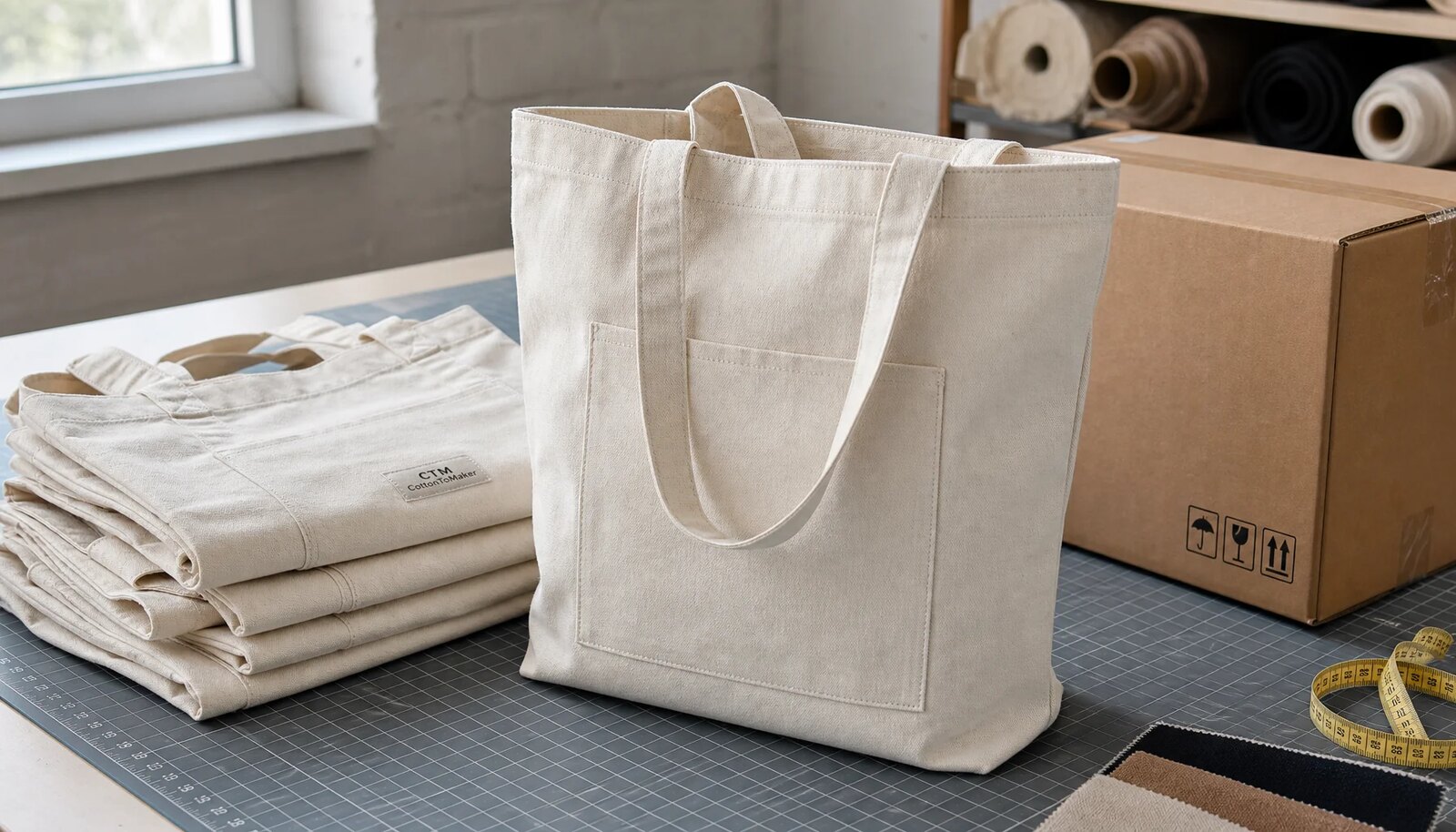
Make packing part of the product, not an afterthought
For an event planner, a canvas grocery tote is not truly ready when the sewing line trims the last thread. It becomes useful when the cartons arrive clean, labeled, countable, and easy for the receiving team to move. A good tote can still create a bad event-day problem if the cartons are too heavy, the logo is creased through the center, or every box contains a slightly different quantity.
That is why a canvas grocery totes carton packing plan for event planners belongs in the RFQ and purchase order, not in a late freight email after the unit price is already approved. Packing affects freight cube, pallet fit, registration setup, kit assembly speed, shortage claims, and print condition. When the PO only says “canvas tote with logo, standard packing,” the supplier will usually choose the method that fits its packing line. That method may not fit your venue workflow.
Start with the physical use. Will totes be handed out at check-in, placed on seats, pre-loaded with sponsor items, sold as merchandise, or split across several cities? Each route needs a different balance of cost, protection, and count control. Loose bulk cartons may be fine for one giveaway table. Bundles of 25 or 50 often work better for multi-room distribution. Individual polybags can protect VIP kits, but they also add cost, unpacking time, and waste.
The goal is not to overcomplicate a simple bag order. The goal is to make the packing visible before production begins. A supplier can quote accurately only when it knows the fold, count, carton size, board strength, markings, and destination pattern. Your receiving team can plan labor only when it knows how many cartons will arrive and how the goods are grouped.
- Put fold method, pieces per carton, inner bundle count, carton dimensions, and gross weight limit in the same spec as fabric, dimensions, and artwork.
- Choose packing around the event workflow: registration desk, sponsor booth, seat drop, kit assembly, resale, warehouse staging, or multi-city distribution.
- Request packed-sample photos showing the tote folded, bundled, placed in the carton, sealed, and marked.
- Treat inconsistent carton counts as a product defect because they slow receiving and make shortage disputes harder to resolve.
Start with use case, load, and venue handling
Fabric weight and carton count make more sense after the buyer defines what the tote must carry. A light conference handout with a badge insert, agenda, and flyer does not need the same construction as a grocery-style tote expected to hold bottled drinks, catalogs, sponsor samples, retail products, or post-event shopping. Event teams often begin with artwork because the logo is visible. Procurement should begin with load and handling because those are what stress the bag.
Use plain, concrete language in the RFQ. If the tote will carry one printed program, one water bottle, and two small samples, write that. If it is intended to be reused as a grocery bag after the event, write that too. The factory can then recommend canvas weight, handle reinforcement, seam construction, and carton count against a real use case rather than a vague phrase like “premium heavy duty tote.”
The use case also changes packing. If staff will place one tote on every chair, the carton should open cleanly and the top layer should look presentable. If volunteers are feeding several registration lanes, fixed inner bundles reduce counting errors. If a fulfillment team will insert sponsor products, the fold should let workers open the tote quickly without shaking it out or re-pressing every unit.
Venue handling deserves early attention. Some venues receive palletized freight at a dock. Others require hand unloading through a service entrance, elevator, or temporary storage room. A carton that looks efficient on a freight quote can be miserable on site if it is bulky, heavy, or poorly labeled. Ask the event operations team how the cartons will actually move during the final 24 hours.
- Light handout use: prioritize clean print, easy opening, low carton weight, and fast distribution.
- Grocery-style event use: specify stronger handle reinforcement, stable bottom construction, and carton weights staff can handle safely.
- Kit assembly: use inner bundles and a fold method that lets workers open totes quickly for inserts.
- Merchandise resale: reduce hard creasing, keep surfaces clean, and use simple carton quantities for inventory control.
- Multi-destination delivery: use destination codes, consistent carton counts, and carton-number sequencing by ship-to location.
Specify canvas weight and dimensions as inspection data
Canvas grocery totes often fall in the 8 oz to 12 oz range, but the right fabric depends on the program. An 8 oz or 9 oz canvas can work for light event giveaways where the tote carries paper inserts and a few small items. A 10 oz canvas is often a practical middle point for grocery-style promotional programs because it gives better structure while keeping carton weight manageable. An 11 oz or 12 oz canvas gives a firmer hand and more premium feel, but it increases unit weight, may reduce pieces per carton, and can raise freight cube.
Ask how the supplier measures fabric weight. Some quotes refer to greige fabric before finishing. Others refer to finished canvas after dyeing, washing, or calendaring. Finishing can change shrinkage, hand feel, and final weight. Two vendors can both quote “10 oz canvas” and be pricing different materials unless the RFQ states the basis and tolerance. Ask for oz/yd2 or GSM, specify whether finished weight matters, and keep the approved sample as the visual and tactile reference.
Dimensions need the same discipline. State finished width, height, gusset depth, handle drop, handle width, and artwork position in millimeters. Sewn cotton bags will not behave like molded plastic parts. Fabric relaxes, cutting stacks shift, and seams consume fabric. For many event orders, +/- 10 mm on body dimensions and +/- 5 mm on handle drop may be workable, but the buyer should set the tolerance around kit fit, brand presentation, and inspection practicality.
Construction is part of performance. A lighter fabric with clean seams, controlled stitch density, and reinforced handles can outperform a heavier fabric with poor sewing. For grocery-style totes, define whether the bag uses side gussets, a bottom gusset, boxed corners, self-fabric handles, cotton webbing handles, cross-stitch reinforcement, bartacks, or a box-and-X stitch. These choices affect strength, folding thickness, carton count, and how the tote stands on a table.
- State finished fabric weight and tolerance, not just “canvas” or “heavy canvas.”
- Define width, height, gusset depth, handle drop, and handle width in millimeters with inspection tolerances.
- Ask whether the sample fabric and bulk fabric come from the same fabric source and finishing process.
- Specify seam type, stitch density target, thread color, bartack or box-stitch position, and loose-thread trimming.
- Confirm whether natural canvas marks are acceptable or whether the event brand requires cleaner dyed or bleached fabric.
Approve artwork placement before approving the fold
Decoration and packing need to be reviewed together. A screen-printed logo may look perfect on a flat tote and still crease through the center after folding. Heat transfer, digital transfer, puff ink, high-density ink, and large solid ink areas can be more sensitive to pressure and rubbing. For branded event programs, approve artwork position and fold method before bulk decoration begins.
Screen printing remains common for canvas grocery totes when artwork uses one or two spot colors and the quantity supports setup cost. It can be durable on cotton canvas when ink is cured correctly and the design sits on a reasonably flat panel. Woven labels or side labels work when the buyer wants a subtle brand detail instead of a large print field. Embroidery can suit smaller marks, but buyers should account for backing, thread density, puckering risk, longer production time, and higher cost.
Logo placement should be expressed in measurements, not just a mockup. State artwork width and height, distance from the top edge, horizontal centerline, and minimum distance from seams, gussets, handle anchors, and fold lines. If the tote has a pocket or boxed bottom, confirm whether the decoration sits on one flat fabric layer or crosses a thickness change. Inspectors can check artwork consistently only when the standard is measurable.
Ask the factory to fold a decorated sample exactly as planned for bulk packing. Reopen it after compression and look at the logo, ink surface, and surrounding fabric. Decide whether the crease pattern is acceptable before production. This matters for sponsor logos, retail resale, VIP gifts, and press-facing events where totes may be photographed immediately after unpacking.
- Keep critical artwork away from bottom folds, side seam bulk, gusset edges, and handle anchor reinforcement.
- For two-sided printing, confirm whether printed panels touch each other inside the carton and whether ink transfer is possible.
- Ask for a folded decorated sample or detailed photo sequence before approving final packing.
- Measure artwork from fixed edges so bulk inspection is not based on visual judgment alone.
- Confirm curing, drying, and cooling time before folding so prints are not packed while tacky.
Choose a packing format that matches the labor model
The best carton plan is the one that helps the event team work quickly and accurately. Loose bulk packing is usually the lowest-cost format and can be acceptable when all totes go to one central handout table. The risk is that loose units can shift, wrinkle, and become harder to count if the carton is underfilled, overfilled, or handled roughly.
Inner bundles add some material and labor cost, but they make distribution predictable. Bundles of 25 or 50 pieces are common because they divide cleanly across registration lanes, conference rooms, sponsor tables, and kit-building stations. Specify whether bundles are tied with cotton tape, paper banded, belly-banded, or wrapped in a clear bag. If the event has sustainability goals, paper bands or reusable ties may be preferable to individual plastic packaging, as long as they still protect the goods.
Individual polybags should be used for a clear reason. They help when totes must stay clean through multiple handling points, when units are packed into attendee kits, or when the bag is sold as merchandise. They also add opening labor, disposal volume, and material cost. If polybags are required, specify thickness, closure type, suffocation warning text where applicable, logo visibility, barcode label requirements, and whether the bag must meet an internal recyclability policy.
Carton count is a tradeoff between freight, lifting, counting, and damage control. A carton with 100 lightweight totes may reduce carton quantity but become heavy or awkward. A carton with 50 pieces may raise carton material cost but improve count-out and reduce compression. For multi-location programs, consistent carton quantities usually matter more than squeezing every possible unit into a box.
- Loose bulk: best for one-destination giveaways where low packing cost and fast opening matter most.
- Inner bundles: best for count control, volunteer distribution, room allocation, and kit assembly.
- Individual polybags: best for cleanliness, resale, VIP presentation, or multi-touch fulfillment, but they add labor and waste.
- Paper bands or belly bands: useful when count control is needed without fully bagging each tote.
- Palletized cartons: efficient for warehouse receiving, but confirm whether the final venue can receive pallets or requires hand unloading.
Engineer carton count, cube, weight, and marks
A master carton is a handling tool, not just a box. The supplier should quote carton length, width, height, pieces per carton, net weight, gross weight, carton board construction, sealing method, and whether cartons will be palletized. Without those details, the buyer cannot compare freight cube, pallet utilization, warehouse space, or receiving labor. A low tote unit price can become less attractive if the carton plan wastes space or increases damage risk.
Set a maximum gross carton weight before the supplier finalizes pieces per carton. The correct limit depends on company policy, destination rules, and whether cartons are moved by hand, pallet jack, or forklift. Many event teams prefer cartons that can be lifted by one person without awkward handling, but the buyer should follow its own workplace and logistics requirements. The key is to set a target, then confirm it on the packed sample and packing list.
Carton board strength should match the load and route. A light domestic shipment may not need the same carton construction as export cargo moving through factory loading, forwarder consolidation, container loading, customs inspection, warehouse receiving, and final venue delivery. Ask whether the carton is single-wall or double-wall corrugated board and whether it is suitable for the proposed gross weight and stacking plan.
Markings prevent receiving confusion. A plain carton labeled only “tote bag” is risky when the event uses multiple colors, sponsors, artwork versions, or destinations. Carton marks should match the PO and packing list. For split shipments, use destination codes and carton numbering by destination, such as Destination A carton 1 of 18, instead of one long sequence that forces receivers to sort manually.
- Require carton L x W x H, pieces per carton, net weight, gross weight, and carton board construction in every quote.
- Define pieces per inner bundle, bundles per carton, and whether odd cartons are allowed.
- Use carton marks for PO number, SKU or item name, color, artwork version, quantity, carton number, total cartons, destination, net weight, and gross weight.
- Ask for open-carton and sealed-carton photos before shipment release.
- For pallet delivery, confirm cartons per layer, layers per pallet, pallet dimensions, stretch wrap, labels, and whether mixed SKUs are allowed on one pallet.
Write the RFQ so quotes can be compared line by line
A strong RFQ turns a general tote request into a comparable production plan. If one supplier quotes a 10 oz finished natural canvas tote with inner bundles and export cartons while another quotes an 8 oz stock blank in loose cartons, the prices are not comparable. The buyer is not choosing between suppliers. The buyer is choosing between different products.
Include finished tote dimensions, fabric weight and tolerance, color standard, handle details, seam construction, artwork file, decoration method or decoration expectation, quantity breaks, delivery deadline, packing format, carton count, carton markings, sample requirements, inspection requirements, and shipping term. For event planners, also include the distribution model: one destination or multiple destinations, pallet receiving or carton receiving, kit assembly or direct handout, and any venue restrictions on delivery date or carton size.
Ask suppliers to respond with separated cost lines. A useful B2B quote breaks out blank tote cost, decoration setup, decoration running cost if separate, labels, hangtags, inserted collateral if any, inner packing, master cartons, palletization, sample costs, inspection, export charges if relevant, freight terms, and lead time by stage. It should state MOQ by fabric color and artwork version, not just one overall MOQ.
Clear assumptions matter. If a supplier says “standard packing,” ask for the actual count and carton dimensions. If it says “10 oz canvas,” ask whether that is greige or finished weight. If it says “custom logo included,” ask how many colors, what print area, and what print method. Procurement accuracy comes from removing hidden substitutions before the PO is issued.
- Use the same quantity breaks for all bidders, such as 1,000, 3,000, 5,000, and 10,000 pieces.
- Require the same fold method, carton count, carton marks, and shipping term in each quote.
- Ask suppliers to write all assumptions, especially for fabric source, finished weight, carton board, decoration method, and sample revisions.
- Reject undefined quote language such as “standard size,” “normal packing,” “good quality,” or “heavy duty” unless the supplier defines it.
- Request lead time by stage: fabric, cutting, sewing, decoration, curing, packing, inspection, and freight handover.
Approve samples in the order production will happen
One sample is not enough for a serious event order. A blank sample confirms body size, fabric hand feel, gusset shape, handle drop, seam quality, reinforcement, and overall construction. A decorated sample confirms artwork placement, print opacity, ink feel, color, curing, edge quality, and how the artwork sits on the canvas texture. A packed sample confirms fold direction, bundle count, carton fit, carton board performance, gross weight, and carton markings.
The approval sequence should follow production logic. First approve construction and fabric. Do not spend time refining print position on a tote body that may still change. Second, approve decoration on the correct body and fabric. Third, approve folding and packing with decorated units because decoration and folding interact. If the event date is fixed, build sample review time into the procurement calendar instead of treating it as optional.
Sample comments should be measurable. Instead of “logo should be a little higher,” write “move logo center 20 mm upward from current sample.” Instead of “handles feel short,” state the required handle drop and tolerance. Keep dated photos, measurement notes, artwork version, and approval status in one record. The supplier, inspector, freight coordinator, and receiving team should all be working from the same approved standard.
If the supplier changes fabric lot, dye process, print method, fold method, carton count, or carton board after approval, require written confirmation and updated photos. A change that looks small to the factory can affect print creasing, carton weight, count-out speed, or shade consistency. For repeat event programs, keep the signed master sample and carton spec from the previous order so the next order does not restart from memory.
- Blank sample approval: finished dimensions, fabric weight, fabric color, gusset, handles, seams, bartacks, stitch density, and hand feel.
- Decorated sample approval: print method, artwork position, color, opacity, curing, edge sharpness, ink hand feel, and fold sensitivity.
- Packed sample approval: fold method, logo exposure, inner bundle count, carton count, carton dimensions, net weight, gross weight, sealing method, and carton marks.
- Approval record: sample version, date, buyer approver, supplier contact, measurement notes, and photo set.
- Change control: require re-approval if fabric, print, construction, fold, carton count, or carton board changes.
Set QC tolerances before bulk packing begins
Quality control should be specific enough that the factory and inspector can apply it without guessing. Common tote issues include size drift, shade variation, weak handle anchors, uneven stitching, open seams, ink misalignment, ink transfer, dirty surfaces, inconsistent folding, wrong carton count, and damaged cartons. A buyer does not need an overly complex manual, but the purchase order should include measurable tolerances and visual acceptance criteria.
Measurement tolerance should cover body width, height, gusset depth, handle drop, handle width, seam allowance where relevant, and artwork position. Fabric checks should cover weight, color, obvious weaving flaws, stains, and whether natural canvas marks are acceptable. Sewing checks should classify open seams, skipped stitches, loose threads, twisted handles, weak bartacks, and puckering. Decoration checks should cover registration, color match method, opacity, curing, edge sharpness, and ink transfer after folding.
Packing QC is often where event orders lose time. Inspectors should open random cartons and verify fold direction, pieces per bundle, bundles per carton, total pieces per carton, carton mark accuracy, and carton condition. If the carton says 50 pieces and actually contains 48 or 52, the issue is more than a warehouse inconvenience. It can create shortage claims, delay kit assembly, and force manual recounts close to the event date.
For larger or date-critical programs, plan pre-shipment inspection before cargo leaves the factory. The inspection can be performed by factory QC, buyer staff, or a third party depending on risk and order size. The important point is timing. Once goods are in transit, fixing defects is expensive and often impossible. Remote review should include photos of random finished units, stitching close-ups, print close-ups, open cartons, sealed cartons, carton marks, and the final packing list.
- Set dimensional and artwork tolerances before cutting and printing begin.
- Inspect handle anchors and bottom seams because they are the key load-bearing areas.
- Check print after folding, not only on a flat production table.
- Open random cartons and compare actual count with carton marks and the packing list.
- Hold shipment release until packing photos, count sheet, and any inspection report are reviewed.
- Classify defects as critical, major, or minor so the supplier understands what must be corrected before shipment.
Balance landed cost against schedule risk
Unit price is only one part of a canvas grocery tote order. A low unit price can lose its advantage if the carton plan increases freight cube, damages prints, slows receiving, or forces the event team to re-sort goods. Landed cost should include product cost, decoration, labels, hangtags, inserted collateral, inner packing, master cartons, palletization, inspection, export charges where relevant, freight, duties, domestic delivery, warehouse handling, and event-site handling.
Carton dimensions and gross weight are required for a real landed-cost comparison. If one supplier packs 50 pieces per carton and another packs 100, the carton count, cube, handling effort, and damage profile are different. If one supplier uses a stronger carton and another uses a light carton, the cheaper box may not survive the route. Compare product cost and logistics cost together, especially when delivery moves through several touchpoints before the event.
Schedule risk belongs in the same comparison. A supplier with a slightly higher price but clear sample control, defined tolerances, reliable carton photos, and a practical inspection process may be a better choice for an immovable conference date. A very low quote with vague packing details may be acceptable for an internal giveaway with flexible timing, but it is risky for a public launch, retail activation, or multi-location program.
The sourcing route should match the event constraint. Direct factory sourcing can provide strong control over fabric, sewing, printing, and carton packing when the buyer writes a clear spec. Domestic decoration can rescue small rush orders or late artwork but may rely on imported blanks with fixed packing. Trading companies can coordinate complex sourcing, but they should still provide factory-level specifications. The best option is the one that gives procurement a reliable product, a workable carton plan, and enough schedule buffer to solve problems before the event.
- Compare landed cost using carton dimensions and gross weight, not unit price alone.
- Include receiving labor, repacking risk, and count verification when evaluating packing formats.
- Build schedule buffer for sample revisions, packed-sample approval, inspection, and freight booking.
- Choose the sourcing route based on the event’s main constraint: speed, control, budget, artwork complexity, or multi-destination delivery.
- Confirm who owns problem resolution if defects are found: factory, trader, decorator, freight partner, or buyer representative.
Specification comparison for buyers
| Sourcing route | Best-fit order profile | Packing control level | Procurement watchout |
|---|---|---|---|
| Direct factory with custom carton spec | Repeat event programs, one main tote size, controlled artwork, or orders where carton cube and pallet fit affect landed cost | High, if the RFQ and PO define fold method, pieces per carton, carton board construction, gross weight limit, carton marks, and packed-sample approval | Do not release bulk sewing until the supplier confirms packed sample photos, carton dimensions, net weight, gross weight, and carton-count method |
| Factory stock body with custom print | Shorter-lead programs that can use an existing tote body, standard handle length, and available canvas color | Medium to high, depending on whether the factory permits custom inner bundles, carton count, carton labels, and shipping marks | Stock canvas shade, finished fabric weight, handle drop, and carton dimensions may change by production lot unless locked in writing |
| Integrated sewing and print factory | Brand-sensitive event orders where logo position, print durability, bartacks, seam alignment, and packing consistency all matter | High, because one supplier controls cutting, sewing, decoration, folding, packing, and final carton photos | Ask for decorated and packed samples, not only a blank tote or a digital artwork proof |
| Trading company coordinating multiple factories | Mixed colors, multiple fabric weights, phased delivery, or multi-city programs that need sourcing flexibility | Medium, if the trader provides named factory data, packing photos, inspection reports, and carton specifications | Responsibility can blur when fabric, sewing, printing, and packing are handled by different subcontractors |
| Domestic decorator using imported blanks | Rush orders, smaller quantities, or late artwork changes where offshore custom production time is not available | Low to medium, because blank carton formats may already be fixed before decoration begins | You may gain speed but lose control over carton cube, fold consistency, shade consistency, and blank-body construction details |
| Freight-forwarder managed sourcing | Programs where routing is complex and the tote construction has already been standardized | Medium, if product QC remains assigned to a named factory, buyer representative, or inspection company | Logistics teams may optimize freight while under-specifying stitching, print protection, carton strength, and count verification |
| Marketplace or aggregator seller | Very small pilots, informal handouts, or internal tests where carton optimization is not critical | Low, because inventory may come from mixed lots, repacked cartons, or inconsistent blanks | Screen for weak handles, mixed carton counts, incomplete markings, shade variation, and missing product tolerances |
| Split production across two factories | Large campaigns needing capacity backup, regional supply continuity, or staged production windows | Medium, with one signed master sample, identical artwork files, shared tolerance sheet, and common packing instruction | Shade variation, print-position drift, carton-size differences, and inconsistent bundle counts become harder to control |
Buyer checklist before sampling
- Define finished tote width, height, gusset depth, handle drop, and handle width in millimeters, with tolerances such as +/- 10 mm for body dimensions and +/- 5 mm for handle drop unless your brand standard requires tighter control.
- State fabric weight in oz/yd2 or GSM and require the supplier to identify whether the quoted value is greige fabric, finished fabric, dyed fabric, washed fabric, or certified material.
- Confirm fabric composition, weave, color, and shade tolerance, including whether natural canvas slubs, seed marks, neps, and minor yarn variation are acceptable.
- Specify seam construction: side seam, bottom seam, boxed corner or gusset method, seam allowance, stitch type, stitch density, thread color, loose-thread trimming, and handle reinforcement.
- Define handle reinforcement precisely, such as cross-stitch, box stitch, bartack, or folded-and-stitched anchor, and state where reinforcement should sit relative to the tote top edge.
- Lock print method, artwork size, print location, number of colors, ink type when relevant, curing expectation, and whether artwork can cross seams, gussets, pockets, or fold lines.
- Confirm whether totes ship empty, with hangtags, with inserts, individually polybagged, paper-banded, belly-banded, or grouped in inner bundles for count-out.
- Define the fold method with an approved photo: flat fold, side fold, half fold, tri-fold, handle tucked, handle exposed, logo visible, or logo protected inside.
- Set pieces per inner bundle, bundles per master carton, pieces per master carton, target carton dimensions, maximum gross carton weight, and whether cartons will be palletized.
- Require carton markings to show PO number, item name or SKU, fabric color, artwork version, carton number, total cartons, quantity per carton, gross weight, and destination code for split shipments.
Factory quote questions to send
- What exact canvas weight are you quoting, in oz/yd2 or GSM, and what tolerance do you hold after weaving, dyeing, finishing, cutting, and sewing?
- Is the fabric stock natural canvas, made-to-order greige canvas, custom dyed canvas, washed canvas, or certified material, and how does that choice affect MOQ, color repeatability, and lead time?
- What are the finished tote dimensions, gusset construction, handle drop, handle width, seam allowance, stitch type, stitch density, thread color, and reinforcement method included in the price?
- What dimensional tolerances are included in your standard production control, and can you hold tighter tolerances if the event requires exact kit or shelf fit?
- Which decoration method will you use, how many colors are included, what is the maximum print area, and how far will artwork sit from seams, handles, bottom fold, and gusset edges?
- What curing or post-print handling process is used for the chosen print method, and how do you check for ink transfer, cracking, rubbing, or adhesion issues after folding?
- Can you provide a folded decorated sample or folded sample photos showing whether the print area is exposed, compressed, creased, or touching another printed surface in the carton?
- How many pieces will go into each inner bundle and master carton, and what are the expected carton length, width, height, net weight, and gross weight?
- What carton board construction are you quoting, such as single-wall or double-wall corrugated carton, and is it suitable for the proposed gross weight, export handling, and pallet stacking?
- Does the MOQ or unit cost change if we request custom carton dimensions, printed carton marks, individual polybags, paper bands, hangtags, inserted collateral, or palletization?
Quality-control points to confirm
- Fabric weight matches the agreed oz/yd2 or GSM range within the allowed tolerance, and the measurement basis is consistent across approved sample and bulk goods.
- Finished tote width, height, gusset depth, handle drop, handle width, seam allowance, and artwork position stay within the written measurement tolerance.
- Canvas shade, visible slubs, seed marks, neps, dye variation, and overall hand feel match the signed sample or written acceptance standard.
- Side seams, bottom seams, gusset seams, and top hems are even, with no open stitches, skipped stitches, loose threads, seam twisting, puckering, or needle damage that affects appearance or strength.
- Handle anchors are straight, symmetrical, reinforced as specified, and free of twisting, loose bartacks, weak cross-stitches, or misaligned box stitches at load points.
- Print registration, centering, color, opacity, edge sharpness, ink coverage, and curing meet the approved decorated sample, with no cracking, peeling, tackiness, excessive hand feel, or ink transfer after folding.
- Artwork is not placed on an unapproved hard crease, compressed edge, high-rub surface, handle anchor bulk, or carton pressure point.
- Fold direction, handle placement, logo visibility, inner bundle count, bundle wrapping, and master carton count are consistent across inspected cartons.
- Carton board, tape, sealing method, liner or inner protection, and carton fill support the agreed gross weight without corner crush, panel bowing, moisture damage, loose flaps, or bursting.
- Carton labels, PO number, SKU or item name, artwork version, color code, destination, carton number, total cartons, quantity, net weight, and gross weight match the packing list and purchase order.