Why carton planning belongs in the tote RFQ
For coffee roasters, canvas grocery totes are often bought as café merchandise, loyalty gifts, event bags, or ecommerce add-ons. The tote spec matters, but the packing plan often decides whether the order arrives clean, countable, and economical to distribute. A low ex-factory unit price can become less attractive when cartons are oversized, over-compressed, weak, or marked in a way that creates receiving labor.
A useful carton packing plan connects the physical tote to freight and warehouse handling. Fabric GSM, gusset depth, handle bulk, print area, fold direction, inner bundle count, carton board grade, gross weight, and total CBM all affect landed cost. These fields should be in the RFQ, not negotiated after production is finished.
The best objective is not simply the fewest cartons. Coffee roasters usually need a practical balance: cartons light enough for hand handling, strong enough for transit, efficient enough for freight, and organized enough for café or 3PL receiving. Ask suppliers to quote carton dimensions, pieces per carton, net weight, gross weight, total cartons, total CBM, and inner packing method with the same seriousness as unit price.
- Avoid vague quote lines such as packed in export cartons without carton size, count, or gross weight.
- Set a maximum gross weight before the supplier decides how many totes to force into each carton.
- Treat fold method and print protection as part of product quality, not only logistics.
- Require single-SKU cartons unless a written assortment map is approved.
- Reconfirm the carton plan after the pre-production sample, because actual fabric and handle bulk change packing math.
Start with the tote specification that drives carton size
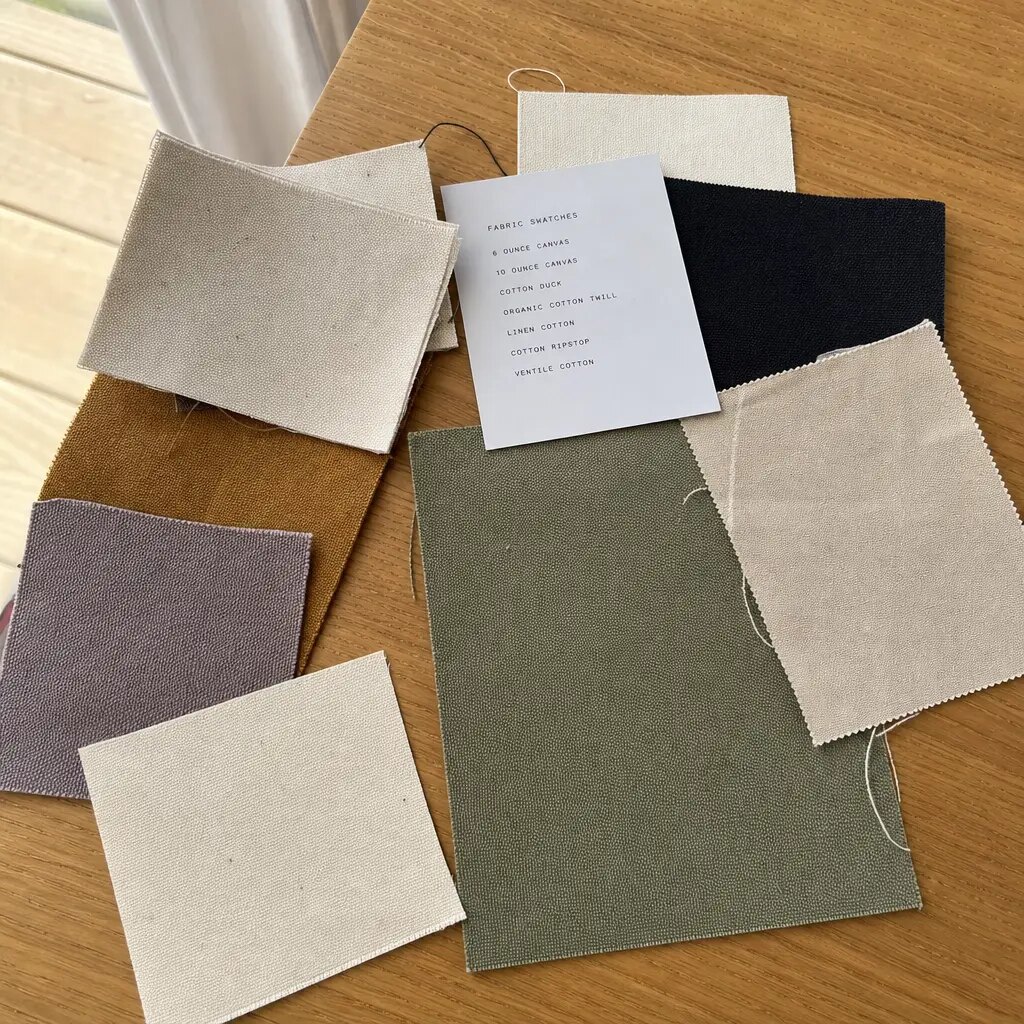
Most coffee roaster grocery totes sit in the middle of the canvas range. A practical target is 10-12 oz canvas, roughly 280-340 GSM finished fabric, with a written tolerance such as +/-5%. This weight feels more substantial than a lightweight giveaway bag but still folds into manageable export cartons. If the supplier quotes only nominal ounces, ask for finished GSM and the measurement method.
A common grocery-style size is around 35 x 40 x 10 cm finished, with a side or bottom gusset. That format can hold multiple retail coffee bags, filters, jars, or small merchandise. A flat tote packs more efficiently, but a gusseted tote is often more useful in cafés and markets. The buyer should decide whether customer function or carton cube is the priority.
Handles also change packing. A 2.5-3 cm self-fabric handle with a 25-30 cm drop is a common shoulder-carry range. The handle insertion depth and reinforcement method should be defined: box-X, cross-stitch, or bartack reinforcement is preferable to a single straight seam for dense coffee products. Wider handles and deeper insertions improve use but add folded thickness.
- Define body width, height, gusset, handle drop, handle width, and handle insertion depth before requesting quotes.
- For grocery use, 8-12 cm gusset depth is often more useful than a completely flat tote.
- Use finished GSM, not only fabric marketing terms such as premium canvas.
- Ask whether the quoted fabric is stock natural, dyed, bleached, organic, recycled, or custom woven.
- Recheck carton count if GSM, gusset depth, handle width, or print coverage changes after sampling.
Compare carton count options before choosing 50, 75, or 100 pcs
The right pieces-per-carton number depends on the tote, route, and receiving site. For canvas grocery totes, 50-100 pcs per carton is a realistic working range, but the range should not be applied blindly. A flat 10 oz tote with a small logo may tolerate 100 pcs per carton. A 12 oz gusseted tote with wide handles and a large print may be safer at 50 or 75 pcs.
A 50-piece carton usually reduces compression and keeps gross weight lower. It is helpful for café allocation and hand handling, but it creates more cartons and may increase total CBM. A 75-piece carton is often the middle option for standard grocery totes. A 100-piece carton reduces carton count but can create bulging, print offset, deep fold marks, or heavy master cartons if the tote is too bulky.
Do not approve a carton count without the corresponding dimensions and weight. Buyers should compare total cartons, total CBM, gross weight per carton, and downstream labor. A carton plan that saves freight at origin may cost more if receiving teams must re-sort mixed cartons, handle overweight boxes, or reject damaged print surfaces.
- 50 pcs/carton: safer for heavier canvas, deeper gussets, large prints, or café allocation.
- 75 pcs/carton: useful balanced option for many 10-12 oz grocery tote programs.
- 100 pcs/carton: best reserved for flatter, lower-bulk totes with low print-risk surfaces.
- Set a gross-weight cap, commonly around 12-16 kg for hand-handled cartons.
- Require a packed-sample photo or physical carton before approving high carton counts.
Worked example: sample packing plan for a roaster order
The following example shows the type of calculation a buyer should request. It is not a universal specification; it is a sample model for comparing supplier quotes. Assume a coffee roaster orders 1,500 natural canvas grocery totes, finished size 35 x 40 x 10 cm, 300 GSM fabric, self-fabric handles, and one-color screen print.
Option A uses 50 pcs per carton. If the carton is 50 x 42 x 30 cm, the CBM is 0.063 per carton. For 1,500 pcs, that means 30 cartons and about 1.89 CBM. If net weight per bag is 180 g, net weight per carton is 9.0 kg. With carton and inner packing, gross weight might be around 10.0-10.5 kg. This is easy to handle but uses more cartons.
Option B uses 75 pcs per carton. If the carton is 55 x 45 x 34 cm, the CBM is 0.084 per carton. The order needs 20 cartons and about 1.68 CBM. Net weight per carton is 13.5 kg, with gross weight perhaps around 14.7-15.2 kg. This may be a better balance if the bags are not compressed and the print passes folded-storage checks.
Option C uses 100 pcs per carton. If the carton is 60 x 48 x 38 cm, the CBM is 0.109 per carton. The order needs 15 cartons and about 1.64 CBM. Net weight is 18.0 kg per carton, with gross weight possibly above 19 kg. The CBM is slightly better, but the handling and compression risk may be unacceptable for a café network or 3PL routing guide.
The landed-cost implication is clear: the lowest CBM option is not automatically best. If a heavier carton increases damage, inspection failures, worker handling issues, or parcel forwarding cost, the 75-piece plan may be the stronger procurement decision. Ask freight partners whether chargeable weight, minimums, palletization, or destination handling fees change the real comparison.
- Example formula: carton CBM = length x width x height in meters.
- Total CBM = carton CBM x total cartons.
- Net carton weight = bag unit weight x pieces per carton.
- Gross carton weight = net carton weight plus carton, liner, bundle, and label weight.
- Compare landed cost using unit price, inland freight, ocean or air freight, destination charges, and receiving labor.
Plan print, curing, and folding together
Most coffee roaster totes use one-color or two-color screen printing on natural canvas. That is usually cost-effective and suitable for logos, event graphics, origin artwork, and retail merchandise. However, print approval should not stop at the loose sample. A print that looks correct on a flat tote can fail after folding if the ink is under-cured, still tacky, or placed on a hard crease.
Ask the factory to confirm the cure process and the time between printing, cooling, folding, and bundling. Dark ink, large solid areas, and heavy coverage need extra attention. Bags should not be packed warm or damp. Fold direction matters too: a large logo folded directly on a ridge may show a line after unpacking, even if the ink itself is technically cured.
A simple approval routine is effective. Review artwork placement, approve a print strike-off, then request folded sample photos. For higher-risk prints, use a dry rub check with a white cloth and inspect the print after 24-48 hours of folded storage. Look for tackiness, blocking, cracking, offset, or visible transfer to neighboring bags.
- Define print placement tolerance, such as +/-5 mm or +/-10 mm depending on artwork size.
- Avoid placing heavy ink coverage on severe fold lines when retail appearance matters.
- Confirm whether prints are air dried, oven cured, heat pressed, or cured by another controlled process.
- Require bags to cool and cure before bundling or sealing in polybags.
- Inspect printed bags from packed cartons, not only loose samples.
Choose inner packing by route and receiving process
Inner packing should match how the totes will travel and be used. Bundle polybags of 10 or 25 pcs are common because they protect against dirt and speed up counting. Ten-piece bundles are useful when cartons will be split among cafés, events, sales reps, or wholesale kits. Twenty-five-piece bundles are efficient for central warehouse receiving.
Individual polybags are not always necessary. They may help with ecommerce pick bins, retail presentation, humid routes, or sensitive print faces, but they add cost, handling time, and packaging waste. They can also trap moisture if the totes or prints are not fully dry. If individual packing is used, specify bag size, warning text if required, barcode label placement, and whether the polybag must be sealed or resealable.
Paper bands are a lower-plastic option for controlled routes. They allow fast visual counts and are easy for café teams to remove, but they offer limited dust and moisture protection. For ocean freight or long storage, consider carton liners or desiccant, but do not use desiccant as a substitute for dry fabric and properly cured ink.
- Use 10-piece bundles for café allocation or event kits.
- Use 25-piece bundles for centralized receiving and lower packing material use.
- Use individual polybags only when presentation, humidity, or fulfillment handling justifies them.
- Check bundle pressure so bands or bags do not crease handles, gussets, or print areas.
- Approve photos of the bundle, closure, label, and count before production packing.
Specify carton construction, marks, and freight format
A tote order can pass product inspection and still cause problems if the cartons fail. For export shipments, a 5-ply carton is a practical default, with board grade suitable for loaded weight, stacking, and humidity exposure. The tape pattern should be approved, often an H-tape pattern for heavier cartons. If cartons will be stacked in storage, check the carton footprint and maximum stack height.
Shipping marks should help the receiving team. A useful carton label includes PO number, SKU or design code, bag color, print color if relevant, quantity per carton, carton number, total carton count, gross weight, net weight, and country of origin where required. If the buyer uses barcodes, specify label size, location, scan orientation, and whether labels must remain visible after palletizing.
Decide whether the shipment is palletized or floor loaded. Pallets improve forklift handling and can reduce carton abrasion, but they may increase chargeable cube. Floor loading may save cube in some ocean shipments, but it increases hand handling and stack pressure. The carton board and packing method should match that decision.
- Require carton dimensions, gross weight, board grade, and tape method in the quote.
- Use single-SKU cartons whenever possible for 3PL and warehouse accuracy.
- If cartons are mixed, require a printed assortment breakdown on the carton or inside the carton.
- Approve barcode and shipping mark placement before mass packing.
- Request final carton photos showing marks, tape, labels, and carton numbering.
Use MOQ assumptions that reflect tote complexity
MOQ for coffee roaster totes should be discussed by design and by material choice. Stock natural canvas with a simple screen print may be possible at lower quantities than dyed fabric, custom labels, special trims, certified cotton, or multi-color artwork. A broad MOQ statement is less useful than a quote that separates the drivers.
For many standard natural canvas programs, 300-500 pcs per design is a practical benchmark, but it is not a rule. Smaller orders may be possible with higher setup cost and more manual packing. Larger orders may allow more consistent cutting, printing, carton sizing, and SKU separation. If multiple café designs are needed, standardize the body, handle, fabric, and carton method, then vary only the print where possible.
Packing style can also affect MOQ and cost. Individual polybags, barcode labels, destination sorting, and café-specific assortment cartons all add labor. Ask whether these services require a minimum quantity per SKU or per destination. Reorders should also repeat the approved carton plan; otherwise, the same tote may arrive in a different carton count or gross weight.
- Ask MOQ by design, fabric color, print color count, custom label, and packing style.
- Stock natural canvas generally supports lower MOQ than dyed or custom fabric.
- Standardize the tote body if several print designs are needed.
- Avoid random mixed cartons unless receiving labor is acceptable.
- Compare delivered cost per usable tote, not only ex-factory unit price.
Build QC around function, print, and cartons
Quality control should focus on what affects use, retail appearance, and receiving accuracy. Natural canvas may include small slubs or weave variation, so the approved standard should distinguish acceptable natural texture from major defects. Critical issues include mold, unsafe contamination, wrong goods, or sharp foreign objects. Major issues include broken seams, unusable handles, wrong carton counts, under-cured print transfer, severe stains, or incorrect SKU packing.
Use a written inspection plan. Many buyers use a general inspection sampling approach, such as Level II with agreed AQL limits, but the important point is alignment before shipment. Measurements should be taken from random packed cartons, not only from loose pieces on the sewing line. Check finished width, height, gusset, handle drop, handle insertion depth, stitch density, seam allowance, and reinforcement.
Print inspection should include placement, color, edge clarity, registration, tackiness, cracking, rub resistance, and offset after folded storage. A simple dry rub test with a clean white cloth can identify obvious curing problems. For packing QC, verify bundle count, pieces per carton, carton dimensions, gross weight, barcode placement, shipping marks, SKU separation, and carton number sequence.
Carton durability checks are also useful. Inspect cartons from different stack positions for crushing, moisture, dirty interiors, and tape failure. Where appropriate, request a basic carton drop or handling check and stack observation. If the carton plan says 75 pcs at a maximum gross weight, inspection should confirm that the packed shipment actually follows that plan.
- Measure totes from several cartons, not only one production bundle.
- Check handle reinforcement and insertion depth at all stress points.
- Run print rub and folded-storage checks before shipment release.
- Classify critical, major, and minor defects before inspection starts.
- Verify carton weights and dimensions against the approved packing plan.
- Open top, middle, and lower stack cartons to check compression and print offset.
Protect the schedule at the packing stage
Packing is often treated as the final detail, but it can become the schedule bottleneck. Printed totes need curing time, trimming, thread cleaning, folding, bundling, labeling, carton marking, and final inspection. If the order has multiple café designs, barcodes, individual polybags, or destination-sorted cartons, the packing stage may take longer than expected.
Build the schedule around packed-carton completion, not only sewing completion. The purchase order calendar should include artwork approval, print strike-off, pre-production sample, bulk printing, curing, sewing completion, trimming, QC, folding, bundling, carton packing, carton marking, final inspection, and ex-factory handoff. Event-driven roaster orders need extra buffer because missing a launch date can make the merchandise less useful.
Do not shorten curing time simply to meet a freight cutoff unless the print risk is understood. A shipment can leave on time and still arrive with offset or blocking defects. Final inspection should happen after packing whenever possible so carton count, dimensions, weights, and labels are verifiable.
- Ask the supplier for a packed-carton completion date, not only a production completion date.
- Approve packing method before bulk goods reach the folding table.
- Allow extra time for individual polybags, barcodes, and destination sorting.
- Schedule final inspection after cartons are packed and marked.
- For event orders, confirm ex-factory date, freight cutoff, and latest carton-mark approval date.
Specification comparison for buyers
| Packing option | Best fit | Typical effect on freight and handling | Procurement risk to check |
|---|---|---|---|
| 50 pcs per carton | 12 oz or heavier canvas, gusseted totes, wide handles, large print areas, café-by-café allocation | More cartons and usually higher total CBM, but lower gross weight per carton and less compression damage | Confirm carton count and CBM do not erase the unit-price saving; check whether partial cartons are clearly labeled |
| 75 pcs per carton | Most 10-12 oz grocery totes with moderate gusset and standard handles | Balanced carton weight, count accuracy, and cube efficiency for many import and 3PL routes | Require packed-sample dimensions because small changes in fold method can change carton height and CBM |
| 100 pcs per carton | Flat or shallow-gusset 10 oz totes with small print and low handle bulk | Fewer cartons and potentially lower handling cost, but higher compression and heavier master cartons | Set maximum gross weight and inspect for print offset, deep fold marks, bulging cartons, and carton bursting |
| Individual polybag | Ecommerce pick bins, retail-ready presentation, humid route, sensitive print face | Adds labor, material, and disposal burden; may improve cleanliness and unit handling | Only seal fully dry, cured bags; trapped moisture can cause odor, mildew risk, or print blocking |
| 10 or 25 pcs bundle packing | Central warehouse receiving, café allocation, event kits, wholesale distribution | Faster counting than loose packing; less material than individual polybags | Confirm bundle pressure does not crease handles, gussets, or printed panels |
| Paper band bundles | Plastic-reduction programs and controlled domestic routes | Low material use and fast visual counts, but limited dust and moisture protection | Check band tension, carton cleanliness, and whether a liner or desiccant is still needed |
| Palletized cartons | Warehouse receiving, LTL, long storage, easier forklift handling | Better carton protection and faster receiving, but may increase chargeable cube | Confirm pallet height, carton orientation, stretch wrap, corner protection, and barcode visibility |
| Floor-loaded cartons | Some ocean freight moves where cube efficiency is the priority | Can reduce pallet cube but increases hand loading, compression exposure, and carton abrasion | Use stronger cartons; inspect stack damage and confirm receiving site can unload loose cartons |
Buyer checklist before sampling
- Define finished tote width, height, gusset, handle width, handle drop, handle insertion depth, reinforcement stitch pattern, and folded orientation in the RFQ.
- Specify finished fabric weight, such as 300 GSM +/-5% or 10-12 oz canvas, rather than using vague terms like heavy cotton.
- State the real use case: retail coffee bags, jars, mugs, event kits, subscription inserts, or grocery add-ons.
- Provide print artwork size, placement, color count, Pantone reference if needed, and whether the design crosses a fold line or gusset.
- Set a maximum carton gross weight acceptable to your roastery, café teams, 3PL, or parcel-forwarding route.
- Require the quote to show pieces per carton, carton dimensions, net weight, gross weight, total cartons, and total CBM.
- Choose inner packing deliberately: individual polybags, 10-piece bundles, 25-piece bundles, paper bands, carton liner, desiccant, or no inner packing.
- Request photos of the folded tote, bundle, open carton, closed carton, shipping marks, and scale reading before bulk packing.
- Approve SKU separation rules, carton numbering, barcode placement, destination codes, and country-of-origin marking before production packing starts.
- Schedule final inspection after packing is complete so carton count, carton weight, labels, and carton condition can be checked.
Factory quote questions to send
- What finished GSM are you quoting, what tolerance applies, and how will GSM be checked during production or inspection?
- Is the canvas stock natural, bleached, dyed, organic, recycled, or made-to-order, and how does that affect MOQ, shade control, certification, and lead time?
- What finished bag size, gusset style, handle width, handle drop, handle insertion depth, reinforcement stitch, and stitch density are included?
- What print method, ink type if known, print area, placement tolerance, and cure process are included in the price?
- How long are printed bags cooled or cured before folding, bundling, and carton packing?
- How many pieces per carton do you recommend at our GSM, gusset, handle, and print coverage without forced compression?
- What are the carton outer dimensions, net weight, gross weight, board grade, total cartons, and total CBM for the full order?
- Does the quote include individual polybags, bundle polybags, paper bands, carton liners, desiccant, barcode labels, shipping marks, palletization, or floor-loaded cartons?
- Can you provide folded-bag, bundle, open-carton, closed-carton, carton-mark, and gross-weight photos before bulk packing?
- What is the MOQ by design, fabric color, print color count, custom label, packing style, and destination sorting requirement?
Quality-control points to confirm
- Use an inspection sampling plan agreed before shipment, such as general inspection Level II with AQL limits appropriate to the order, while treating safety, severe contamination, and wrong goods as critical issues.
- Measure finished body width, height, gusset depth, handle width, handle drop, and handle insertion depth against approved tolerances, commonly +/-1 cm unless tighter limits are specified.
- Verify finished fabric GSM from bulk panels or cut swatches across more than one carton or production bundle, not only from the original fabric name.
- Check handle root strength by confirming box-X, cross-stitch, or bartack reinforcement, adequate insertion depth, stitch density, and no skipped stitches at stress points.
- Classify defects clearly: critical defects include mold, foreign sharp objects, wrong SKU, or unsafe contamination; major defects include broken seams, under-cured print transfer, wrong carton count, or unusable handles; minor defects include small natural slubs within the approved standard.
- Inspect print placement, color, registration, edge clarity, pinholes, ink marks, tackiness, cracking, blocking, and offset after folded storage.
- Run an agreed print rub check, such as repeated dry rubbing with a clean white cloth, and reject visible transfer beyond the approved limit.
- Open cartons from top, middle, and bottom stack positions to check compression marks, fold damage, print offset, odor, moisture, and carton crushing.
- Check carton packing against the plan: inner bundle count, pieces per carton, SKU separation, carton dimensions, net weight, gross weight, tape pattern, carton number sequence, barcode placement, and shipping marks.
- For export shipments, add carton drop, stack, and moisture checks where appropriate, including visual carton integrity after handling and confirmation that liners or desiccants match the PO.