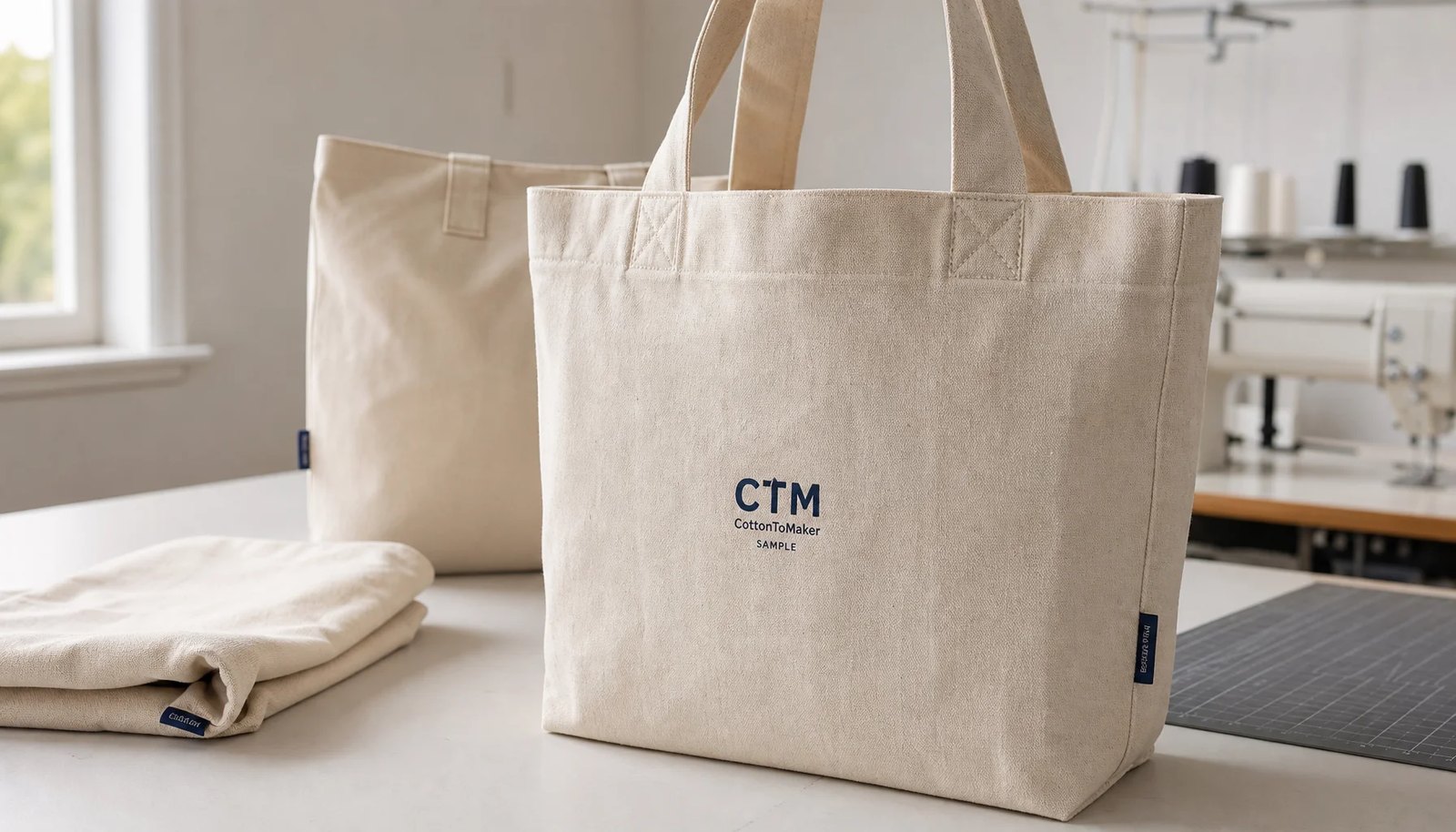
Start With the Real Campus Load
University bookstore totes carry denser, less predictable loads than most promotional cotton bags. A shopper may place two textbooks, a hoodie, a stainless bottle, notebooks, chargers, snacks, and small gifts into one open-top tote. The stress is not spread evenly. It concentrates at the handle bases, top hem, side seams, boxed bottom corners, and printed panel.
Treat the bag as a reusable retail carry product when it will be sold near textbooks or used as a grocery-style checkout tote. The RFQ should name the expected load, target use, likely contents, and reuse expectation. This makes durability something a factory can quote, sample, test, and repeat.
The phrase canvas grocery totes for university bookstores durability testing checklist is useful as a search theme, but the supplier brief should be shorter and measurable. Ask for fabric GSM, finished size, handle reinforcement, load test, print approval, packing method, and inspection criteria.
- Define expected load before selecting canvas weight.
- List likely contents instead of saying general bookstore merchandise.
- Inspect stress points after loading, not only when the tote is empty.
- Use the same pass/fail rules for samples, production inspection, and reorders.
- Do not approve bulk production from photos alone.
Map the Tote to the Bookstore Program
Different campus programs need different tote specifications. A welcome-week bag filled with flyers does not need the same construction as a retail tote expected to carry textbooks and bottled drinks. A premium alumni item needs stronger presentation control than an internal event kit. A multi-store bookstore program may need barcode and carton accuracy as much as sewing strength.
Before asking for prices, decide which failure would damage the program most. For retail, the common risks are handle breakage, customer returns, weak print, and inconsistent shelf presentation. For orientation, the risks are late delivery, count errors, and slow distribution. For licensed marks, the risks are wrong artwork, color mismatch, or production starting before approval.
This definition improves supplier comparison. A factory that is strong in simple event bags may not be the right fit for tight print placement, UPC labeling, or bookstore distribution. A premium quote may look high until canvas weight, handle width, reinforcement, print control, and packing are compared line by line.
- Retail checkout tote: prioritize load strength, print quality, and neat finishing.
- Orientation kit: prioritize delivery timing, carton counts, and easy bundle handling.
- Premium alumni item: prioritize heavier hand feel, stitching consistency, and presentation.
- Licensed campus mark: prioritize strike-off approval and artwork version control.
- Reorder program: prioritize retained samples, item codes, and unchanged materials.
Choose Canvas Weight and Fiber
Fabric sets the ceiling for durability. For mixed university bookstore use, 10 oz to 12 oz cotton canvas, often around 340 to 410 GSM before washing, is a practical buyer target range. An 8 oz canvas can work for light apparel or event giveaways, but it is usually a weaker choice for books and bottles. A 14 oz canvas may feel premium, but it raises sewing difficulty, carton weight, freight cost, and retail price pressure.
Avoid vague material wording. Canvas can mean natural cotton, bleached cotton, dyed cotton, recycled cotton blend, organic cotton, cotton-poly blend, or a fabric that only looks canvas-like. Ask for fiber content, GSM, color state, finish, and tolerance. If recycled or organic content is part of the retail story, confirm the documentation before using the claim on hangtags, product pages, or bookstore signage.
Natural canvas is common for campus totes because it has a familiar reusable look and works well for simple logos. It still varies by lot. Navy, crimson, green, orange, and gold inks may shift on an unbleached base compared with a digital mockup. Dyed canvas can support school colors, but it usually adds lab-dip approval, dye-lot risk, higher MOQ, and possible crocking checks.
- Light use: 8 oz to 10 oz for low-load events or apparel.
- Core bookstore use: 10 oz to 12 oz with tested seams and reinforced handles.
- Premium use: 12 oz to 14 oz when freight and sewing costs are acceptable.
- RFQ wording: state oz, GSM, fiber content, finish, and tolerance.
- Approval control: treat fabric lot, blend, and color changes as new approvals.
Lock Size and Measurement Rules
A useful tote specification starts with finished dimensions. Many bookstore grocery totes use buyer target ranges around 35 to 42 cm wide, 35 to 40 cm high, and 10 to 15 cm deep at the gusset or boxed bottom. These are not standards. If the tote must hold a textbook bundle, orientation kit, boxed drinkware, or apparel set, test the size with real contents before artwork and pattern approval.
Tolerances prevent disputes. Practical starting points are often +/-1 cm for body width and height, +/-0.5 cm to +/-1 cm for gusset depth, and +/-1.5 cm for handle length, if the factory confirms they can hold them. Print placement may be held within +/-0.5 cm to +/-1 cm depending on artwork size and whether printing happens before or after sewing. Tighter control can raise reject rates and inspection time.
Define how each measurement is taken. Width may be measured flat across the front panel. Height may run from the top edge to the bottom fold. Gusset depth may be taken across the bottom panel. Handle length and handle drop are different measurements and should not be mixed. An annotated photo is often enough to prevent buyer and factory measuring in different ways.
- Specify finished width, height, gusset depth, handle length, handle drop, and handle width.
- Name the measurement points for every dimension.
- Confirm whether print placement is measured from edge, seam, or panel centerline.
- Test the size with real bookstore contents before approving artwork.
- Record approved sample weight as a quick reorder check.
Build Strength Into Stress Points
Handle attachment is the first construction detail to control. Dense books pull down while the user pulls up and outward, concentrating force on four small sewing areas. A single straight stitch across each handle end is not enough for a reusable bookstore tote. Stronger options include box-X stitching, bar tacks, reinforced cross stitching, or double-row attachment with secure back tack.
Handle width affects comfort and durability. For shoulder-carry bookstore totes, 3 to 4 cm handles are a practical buyer target range. A 55 to 60 cm handle length measured end-to-end can support shoulder use, depending on bag height and desired drop. Narrow handles can cut into the shoulder and concentrate stress. Overlong handles can make the loaded tote swing low while walking across campus.
Side seams, top hem, and bottom corners are the next failure points. A practical construction may include overlocked side seams plus top stitch, a folded top hem, and accurately formed boxed bottom corners. Many canvas programs use about 8 to 10 stitches per inch depending on fabric thickness and thread; confirm the factory's recommendation and inspect against the approved sample.
- Require a named handle reinforcement method at all four handle bases.
- Specify handle width, length, drop, insertion depth, and attachment position.
- Check stitch density, seam allowance, thread security, and back tack.
- Inspect boxed bottom symmetry after the tote is loaded.
- Request close-up sample photos of handle bases, seams, hem, and corners.
Control Printing and Licensed Marks
University bookstore totes often carry licensed marks, mascot graphics, department names, alumni messages, or bookstore branding. For solid one- to four-color artwork, screen printing is usually a reliable method on cotton canvas when ink deposit and curing are controlled. For gradients or complex artwork, heat transfer or digital transfer may be suitable, but only after adhesion, flex, edge-lift, and hand-feel checks.
Pantone references help, but they do not replace a printed strike-off. Natural canvas is not a white base, so school colors can look warmer or duller than they do on screen or paper. The strike-off should be made on actual or production-equivalent canvas and should record Pantone target, ink count, print size, placement, artwork version, and acceptable texture show-through.
Licensed artwork needs one approval path. The bookstore buyer, procurement team, and campus licensing office may review different details. If comments reach the supplier separately, the wrong revision can enter production. Use one consolidated approval file and state clearly when bulk printing may begin.
- Use screen print for bold logos, wordmarks, and mascot graphics.
- Use transfer printing only after adhesion, flex, and edge-lift review.
- Approve a physical strike-off before bulk printing.
- Set print placement tolerance before production starts.
- Keep a retained printed sample for reorder comparison.
Run Practical Durability Tests
Durability testing should be simple, repeatable, and written into the RFQ. Start with a static load test. Fill the tote to the target weight, suspend it by both handles, hold it for the agreed duration, and inspect every stress point. For light retail use, 8 kg may be enough. For book-and-grocery use, 10 to 12 kg is a stronger buyer target. A two-hour hold can be used as an internal benchmark if both buyer and supplier agree to it.
Passing should mean no broken stitches, open seams, fabric tearing, handle pullout, severe distortion, or seam slippage beyond the agreed limit. Slight fabric stretch may be acceptable if it matches the approved sample and does not weaken the structure. Record pass/fail criteria before testing, not after a marginal sample appears.
Static load is not the whole story. Repeated lift testing checks what happens when a loaded tote is picked up and set down many times. A practical buyer check may use 25 to 50 lift cycles at the agreed weight, followed by inspection. Handle pull, bottom-corner stress, top-hem distortion, and post-load print review should be included because real users do not carry the bag gently or evenly.
If washability is claimed, test it. Measure width, height, gusset, handle length, and print condition before washing and after drying. Check shrinkage, handle twisting, seam rotation, fabric fuzzing, and ink cracking. If the tote is not marketed as washable, do not imply a wash-performance claim; use a normal care label and basic dimensional stability expectations instead.
- Static load: define weight, hold time, hanging method, sample count, and pass criteria.
- Repeated lift: test loaded pickup and set-down cycles.
- Handle pull: check stitch popping, webbing distortion, and fabric rupture.
- Seam review: inspect side seams, top hem, bottom seam, and boxed corners.
- Print review: check dry rub, tape adhesion, and flex after loading.
- Wash review: test only when washability is claimed.
Approve Samples as Production Standards
The pre-production sample should represent the production order, not an attractive sales sample. It should use the quoted fabric, handle tape, thread, reinforcement, print method, label, fold, and packing. A common sourcing problem is approving a sample made from available stock fabric and receiving bulk goods made from different fabric, narrower handles, or simplified stitching.
Create a short sample approval sheet. Record sample date, version number, fabric oz and GSM, fiber content, finished size, handle length, handle width, handle drop, reinforcement, stitch density reference, print colors, placement, label position, and packing method. Note approved deviations clearly.
For reorders, keep one sealed approved sample with the buyer and one with the factory. Assign item codes by fabric, color, size, artwork, label, and packing method. If the factory proposes a substitute fabric, handle, thread, ink, label, or carton, require written approval before cutting or printing.
- Approve a sample made from quoted materials and production-equivalent methods.
- Record GSM, sample weight, dimensions, handle width, and print placement.
- Photograph front, back, handle base, top hem, interior seam, bottom, print, label, fold, and carton.
- Freeze artwork version, Pantone target, labels, and packing method.
- Require written approval for any material or construction change.
Compare Quotes Without Hidden Gaps
MOQ depends on how standard the tote is. Natural cotton canvas, standard shoulder handles, one-color screen print, and bulk packing usually support lower minimums. Dyed canvas, custom handles, woven labels, hangtags, UPC stickers, bound seams, special finishing, retail packaging, or complex artwork can increase MOQ because each component may have its own batch minimum.
Separate the cost drivers in the quote. Fabric weight, fabric consumption, handle width, gusset depth, reinforcement method, sewing time, print setup, color count, ink coverage, labels, trimming, folding, inspection support, carton strength, and packing all affect real unit cost. A large gusset uses more fabric. Wider handles improve comfort but cost more. A five-color mascot graphic requires more setup and color control than a one-color bookstore wordmark.
To compare suppliers fairly, normalize the specification before comparing unit prices. Ask every factory to quote the same size, GSM, handle width, reinforcement, print size, color count, label, packing, inspection support, and Incoterm. If one quote is far lower, check for lighter fabric, narrower handles, missing strike-off, reduced carton quality, excluded screen charges, or a weaker load test.
- Request quantity breaks only at realistic bookstore order volumes.
- Separate sample fees, strike-off costs, screen charges, packing, and inspection support.
- Compare landed cost using carton CBM and gross weight, not only ex-factory price.
- Check low-price outliers for missing reinforcement or lighter fabric.
- Confirm whether reorders keep the same material and print standard.
Plan Packing for Bookstore Receiving
Packing affects freight cost, damage risk, receiving speed, and store labor. Canvas grocery totes are bulkier than thin cotton bags, and heavier canvas increases carton weight quickly. A buyer planning range of 50 to 100 pieces per export carton may be practical for some programs, but the correct number depends on tote size, fabric weight, fold method, individual packing, and carton handling limits.
Flat folding is usually a good default for open-top grocery totes because it controls carton shape and helps the bag recover for display. If the order ships to several campus stores, departments, or events, inner bundles of 10 or 25 pieces can speed receiving and allocation. Individual polybags should be used only when needed for barcode control, cleanliness, or retail presentation because they add cost and waste.
Carton marks should match the purchase order and routing requirements. At minimum, include item code, description, color, artwork version, quantity, PO number, carton number, gross weight, net weight, carton dimensions, and country of origin where required. During inspection, verify carton count, folding method, mixed-version prevention, marks, and carton condition before shipment.
- Request carton dimensions, pieces per carton, gross weight, and net weight in the first quote.
- Confirm bulk packing, inner bundles, individual polybags, hangtags, and UPC stickers.
- Avoid overly heavy cartons unless palletized receiving is planned.
- Use carton marks that match PO, item code, artwork version, and routing needs.
- Inspect packing before shipment, not after bookstore receiving finds errors.
Specification comparison for buyers
| Supplier option | Best bookstore fit | Specify in the RFQ | Main risk to verify |
|---|---|---|---|
| 8 oz to 10 oz cotton canvas | Orientation inserts, apparel-only promos, light welcome bags, low-load event use | Fabric oz and GSM, finished size, handle width, reinforcement if more than light goods are expected | Can look acceptable in photos but underperform with textbooks, bottles, or repeated shoulder carry |
| 10 oz to 12 oz cotton canvas | Core retail tote, grocery-style checkout bag, mixed bookstore merchandise | Approx. 340 to 410 GSM as a buyer target range, agreed GSM tolerance, reinforced handles, load test method | Low quotes may quietly reduce GSM, handle width, seam allowance, or reinforcement |
| 12 oz to 14 oz heavy canvas | Premium alumni merchandise, higher-price retail totes, long-reuse programs | Bulk fabric GSM, sewing capability, thread/needle suitability, carton weight, freight CBM | Heavier fabric may increase sewing defects, carton weight, freight cost, and retail price pressure |
| Natural cotton canvas | Classic campus look, simple logos, lower-complexity print programs | Unbleached shade range, print strike-off on actual canvas, odor and contamination checks | Natural shade variation can shift school colors and make digital approvals unreliable |
| Dyed cotton canvas | School-color bodies, department collections, premium assortments | Lab dip, bulk shade tolerance, crocking check, dye MOQ, reorder shade plan | Color approval adds lead time; bulk lots and reorders may vary |
| Recycled or organic cotton canvas | Sustainability assortments and programs needing material claims | Fiber-content documents, blend ratio, label wording, traceability documents required by sales channel | Unsupported claims create retail, licensing, or compliance risk |
| Screen-print capable factory | Bold wordmarks, mascots, bookstore logos, one- to four-color artwork | Pantone targets, print size, color count, ink system, curing controls, printed strike-off | Ink may under-cure, crack, bleed, or look dull on textured canvas |
| Transfer-print capable factory | Gradients, small detailed art, many-color graphics where screens are inefficient | Adhesion, flex, edge-lift, hand-feel, and wash review on production-equivalent canvas | Transfers can feel stiff, lift at edges, or crack when the filled tote flexes |
| Bookstore/DC packing-capable supplier | Multi-store allocation, online fulfillment, barcode-controlled retail programs | Pieces per carton, inner bundles, UPC stickers, hangtags, carton marks, carton dimensions | Poor packing causes count errors, barcode mismatches, crushed folds, and receiving delays |
Buyer checklist before sampling
- Define the use case: retail grocery tote, textbook carry bag, checkout add-on, orientation kit, alumni gift, event giveaway, or premium bookstore merchandise.
- State the expected loaded weight and likely contents, such as textbooks, hoodie, drink bottle, notebook, stationery, snacks, and small gifts.
- Specify fabric by oz, GSM, fiber content, weave, color state, finish, and acceptable GSM tolerance instead of asking only for a canvas tote.
- List finished dimensions: body width, height, gusset or boxed-bottom depth, handle length, handle drop, handle width, and measurement points.
- Frame size and load numbers as buyer targets, not universal standards; confirm what the factory can hold consistently in bulk production.
- Require handle reinforcement at all four attachment points, such as box-X stitching, bar tack, dense cross stitch, or an approved equivalent construction.
- Define durability testing: target load, hold time, hanging method, sample count, repeated lift cycles, and pass/fail rules.
- Check seams, bottom corners, handle bases, top hem, and print condition after loading, not only on an empty sample.
- State artwork size, Pantone references, color count, ink or transfer type, placement tolerance, texture show-through allowance, and approval version.
- Confirm whether licensed marks require buyer approval, bookstore approval, campus licensing approval, a printed strike-off, or a sealed reference sample.
Factory quote questions to send
- What exact fabric weight in oz and GSM is quoted, what tolerance applies, and will GSM be checked from production fabric before cutting?
- Is the canvas natural, bleached, dyed, washed, recycled, organic, cotton-poly blended, or otherwise finished, and what fiber-content documentation is available?
- What are the finished measurement points and tolerances for body width, height, gusset depth, handle length, handle drop, handle width, label placement, and print placement?
- Which handle reinforcement is included: box-X, bar tack, cross stitch, double row, or another method, and can close-up sample photos be provided?
- What seam type, stitch density, thread specification, seam allowance, top hem width, and boxed-bottom method are included in the unit price?
- What static load, repeated lift, handle pull, seam slippage, and bottom-corner checks can be performed before shipment, and how many pieces will be tested?
- What print method is quoted, how many colors are included, what ink or transfer system is suitable for textured canvas, and are setup or screen charges included?
- Will a printed strike-off be made on actual or bulk-equivalent canvas, and will bulk printing wait until strike-off and pre-production sample approval?
- What are the MOQs for natural canvas, dyed canvas, custom handle color, woven label, hangtag, UPC sticker, individual polybag, and custom carton mark?
- What is the sample lead time, strike-off lead time, production lead time after approval, inspection window, and realistic peak-season buffer?
Quality-control points to confirm
- Bulk fabric weight should be checked against the approved specification, such as a buyer target of 340 to 410 GSM for many 10 oz to 12 oz canvas programs, with written tolerance before cutting.
- Fabric shade, weave density, hand feel, odor, stains, slubs, broken yarns, lint, and contamination should be inspected from roll goods, not only finished bags.
- Finished dimensions should stay within agreed tolerances, commonly around +/-1 cm for width and height, +/-0.5 cm to +/-1 cm for gusset depth, and +/-1.5 cm for handle length when accepted by the factory.
- Handle attachments should pass the agreed load without broken stitches, seam tearing, handle pullout, fabric rupture, or distortion beyond the approved reference sample.
- Handle webbing should be checked for width, twist, shrinkage, color consistency, insertion depth, edge fraying, and secure reinforcement at all four attachment points.
- Side seams, bottom seams, boxed corners, and top hem should show even stitch density, no skipped stitches, no open seams, no unapproved exposed raw edges, and no loose thread clusters.
- Print should pass dry rub, basic tape adhesion, and flex review without obvious flaking, cracking, color transfer, edge lifting, or uneven coverage beyond the approved strike-off.
- Logo placement should stay within the agreed tolerance from the top edge, side seam, and panel centerline, with normal sewing variation recorded before production.
- Labels, hangtags, UPC stickers, care labels, and carton marks should match the purchase order, licensed artwork approval, item code, and bookstore receiving instructions.
- Cartons should match the packing list for count, inner bundles, gross weight, dimensions, carton marks, and condition, and should remain practical for manual handling unless palletized.