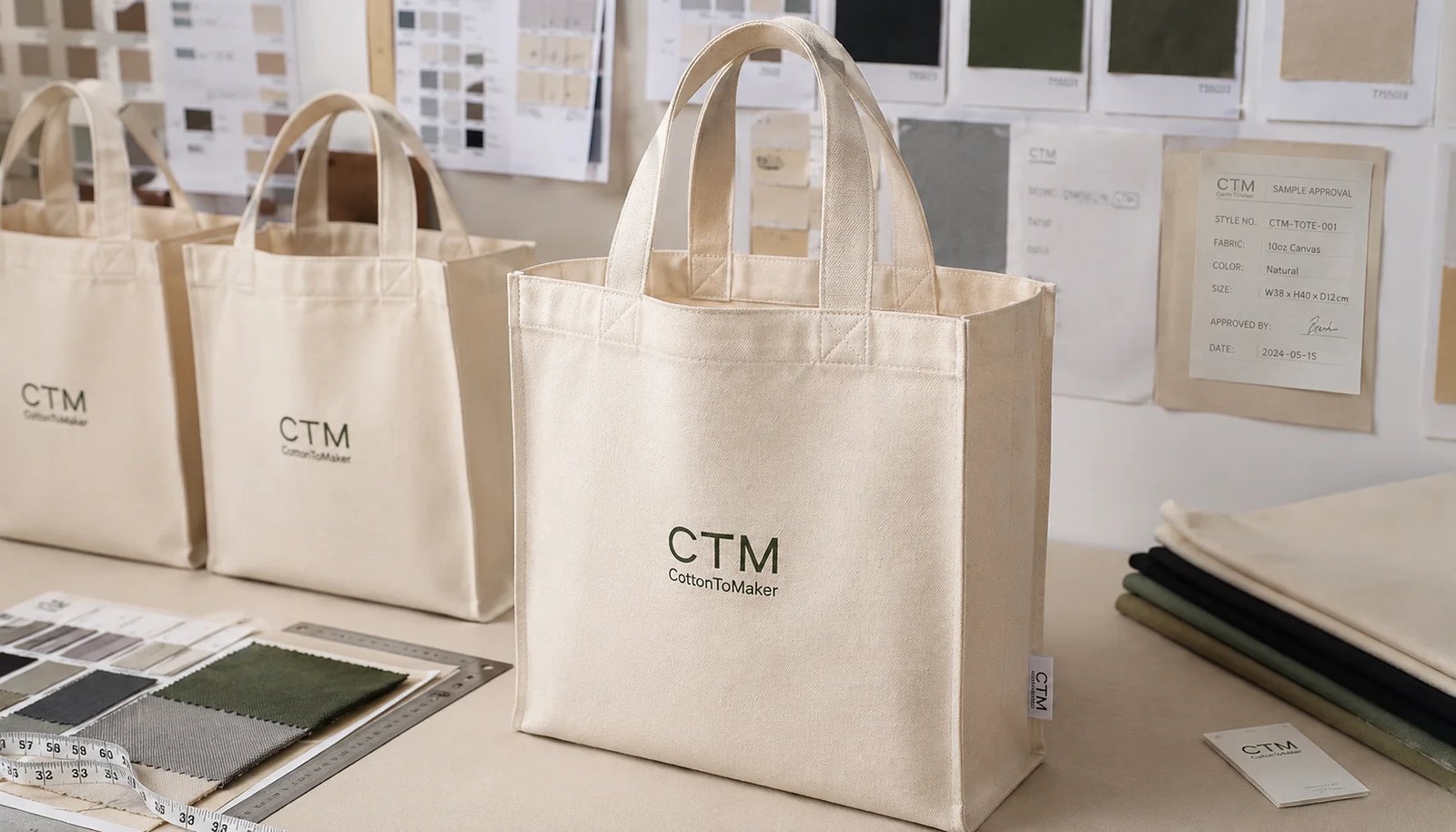
Start the pricing plan with the tote's job, not the lowest unit cost
A canvas grocery tote for a skincare brand can serve several jobs: carrying refill bottles, packaging a holiday set, supporting a clean beauty retail launch, or replacing disposable checkout bags in a concept store. Those uses look similar in a product photo but they do not need the same fabric, handle reinforcement, packing, or inspection standard. A tote carrying two lightweight face serums has different risk from a tote carrying shampoo refills, glass jars, and a folded brochure pack.
The most common RFQ mistake is asking for “canvas tote bag, natural, logo printed, bulk price” and then comparing replies as if every supplier quoted the same item. Factories will fill the missing details with their own default construction. One supplier may quote 8 oz cotton canvas with simple handles. Another may quote 12 oz canvas with reinforced sewing and individual packing. The price gap looks like supplier margin, but often it is a different bag.
- For retail sale: prioritize consistent appearance, neat sewing, barcode packing, and carton protection.
- For gift-with-purchase: balance appearance with cost; 8-10 oz canvas may be enough if the contents are light.
- For refill programs: specify load capacity, handle reinforcement, and gusset size for bottles.
- For distributor kits: confirm carton packing and inner pack quantities so warehouse teams can allocate stock cleanly.
Define the bag structure around skincare pack dimensions
Skincare items are often small but dense. Glass jars, pump bottles, refill pouches, and boxed sets create point loads in the bottom corners of a tote. A grocery tote normally needs more base stability than a flat promotional tote. If the bottom gusset is too narrow, bottles tilt and push against the side seams. If the handle drop is too short, the bag may look neat on a shelf but feel awkward when carried over a coat.
For a practical grocery tote format, many buyers start with a finished size around 35-40 cm wide, 35-42 cm high, and 10-15 cm bottom gusset. Handle drop often falls in the 25-30 cm range for shoulder carry. These are not fixed rules, but they give the factory enough direction to estimate fabric consumption correctly. A 2 cm change in gusset and a longer handle can affect fabric yield, sewing time, carton size, and final landed cost.
- Use boxed product dimensions to test the gusset, especially if the tote must hold standing bottles.
- Choose a boxed bottom or side-and-bottom gusset when the tote must sit upright for retail photos or refill use.
- Avoid oversized bags for small skincare kits; excess fabric increases cost and makes the program look underfilled.
- State whether handles are self-fabric canvas, cotton webbing, or contrast webbing, because the cost structure differs.
Fabric weight and GSM: where bulk price changes first
Fabric is usually the largest cost driver in canvas grocery totes. Suppliers may quote by ounces, GSM, or local fabric descriptions. For reference, 8 oz canvas is often around 270 GSM, 10 oz around 320-340 GSM, and 12 oz around 380-410 GSM, depending on weave and finishing. The numbers are not universal, so a professional quote should include both the commercial fabric name and a measurable GSM target.
Skincare brands often prefer natural unbleached canvas because it fits clean, botanical, or low-waste positioning. Natural canvas can show cotton seed specks, slubs, and shade differences. That is normal, but the acceptable level should be agreed before production. If the print area contains very small text or pale ink, heavier texture may reduce sharpness. In that case, a smoother 10 oz canvas may print better than a coarse 12 oz fabric.
- 8 oz canvas: suitable for light gift bags and lower-cost campaigns, but may feel thin for a grocery tote.
- 10 oz canvas: good middle point for skincare grocery totes with moderate structure and reasonable bulk price.
- 12 oz canvas: better hand feel and durability, but higher fabric cost, larger carton weight, and sometimes higher sewing needle wear.
- Washed canvas: softer and more premium, but can change shrinkage, dimensions, shade, and unit cost.
Print method decisions that affect price and rejection rate
For bulk canvas grocery totes, one-color screen printing is usually the most stable cost option. It handles simple skincare brand logos, short claims, and clean line art well. Multi-color screen print adds screens, setup time, registration risk, and sometimes higher rejection if the artwork has tight alignment. Heat transfer can achieve detailed graphics but may not match the natural feel many skincare brands want on canvas.
The best print method depends on artwork, not only order quantity. A large solid logo in dark ink on natural canvas may need careful squeegee pressure and curing to avoid patchy coverage. A fine botanical illustration may lose detail on coarse canvas. Metallic ink, very pale beige ink, and small legal copy should be tested before bulk approval. A factory can quote quickly, but the print risk is only visible when the actual fabric and artwork meet.
- Screen print: best for simple logos, one to three colors, and stable bulk cost.
- Digital print: useful for complex color artwork but may cost more and require hand-feel approval.
- Heat transfer: sharp detail, but test wash resistance, edge feel, and cracking risk.
- Embroidery: premium look for small logos, but slow and costly on large grocery tote panels.
- Woven side label: good secondary branding when the front print must stay minimal.
MOQ logic: why the first quantity break matters
Bulk pricing is not a straight line. The first meaningful price break normally appears when fabric purchasing, cutting layout, print setup, and packing labor become efficient. For a stock tote with one-color print, a supplier may accept a few hundred pieces. For a custom cut-and-sew grocery tote with specific GSM, gusset, handle reinforcement, woven label, and individual barcode packing, MOQ often moves higher because the factory must reserve fabric and production time.
Instead of asking only for 500, 1,000, and 5,000 pcs, ask what changes at each level. Sometimes 1,000 pcs and 2,000 pcs share almost the same labor cost but differ in fabric buying efficiency. Sometimes carton CBM improves when packing is optimized at a higher quantity. A clear pricing plan helps brand owners decide whether to order one large batch, split by region, or approve a smaller launch order with a higher unit cost.
- Separate sample charge, screen charge, mold or label setup, and unit price in the quote.
- Request price breaks using the same spec and packing method, not simplified versions at low quantity.
- Clarify whether overrun or underrun tolerance applies, especially on custom fabric production.
- For repeat programs, ask whether the supplier can hold screens, patterns, or approved trims for future orders.
How to compare supplier routes without hiding real cost
Direct factory sourcing usually gives better control of fabric, sewing, and print execution, but it requires a more complete RFQ and stronger approval discipline. A distributor or trading company may be useful for urgent or mixed-SKU orders, but the buyer should not assume they are controlling the factory process unless they can provide production samples, carton data, and inspection evidence. The right route depends on volume, timeline, import ability, and how much customization the skincare program needs.
For a true landed-cost comparison, unit price is only one line. Carton dimensions, pieces per carton, gross weight, CBM, local charges, inspection cost, duties, inland freight, and warehouse handling can change the real cost per usable tote. A heavier 12 oz tote may look only slightly more expensive ex-factory, but it can increase freight and handling cost. A poorly packed cheaper tote may create retail rejects, which is a more expensive problem than a few cents saved in production.
- Compare EXW, FOB, CIF, and DDP offers only after converting them to the same landed-cost model.
- Use carton CBM per 1,000 pieces to estimate freight impact between fabric weights and packing methods.
- Include inspection and sample courier cost in the program budget.
- Value supplier transparency: fabric GSM test, clear carton data, and pre-production sample notes reduce commercial risk.
Sample approval should copy the mass production process
A good sample is not just a pretty tote. It is a miniature contract for bulk production. For skincare canvas grocery totes, the pre-production sample should use the planned fabric weight, handle type, print method, logo size, label, folding, and packing. If the sample is made from whatever fabric is available that day, it can still help with general shape, but it should not be treated as final production approval.
Approval comments must be measurable. “Looks premium” or “make logo a bit higher” is not enough for a sewing line. Better comments are: front logo center 14 cm below top edge, print width 22 cm, handle drop 28 cm, seam allowance hidden, no broken stitch within handle box, and finished size tolerance plus or minus 1 cm. Photos are useful, but written measurements prevent arguments during inspection.
- Keep one signed sample with the buyer and one sealed sample at the factory.
- Mark approved fabric shade, print color, stitch color, handle length, and packing method.
- Run a basic load test on the sample using real skincare products or equivalent weight.
- If the brand team changes artwork after approval, restart print sample approval before bulk printing.
Packing choices: clean retail presentation versus freight efficiency
Canvas totes collect dust and can pick up carton odor if packing is not planned. Skincare buyers are sensitive to cleanliness because the tote often sits beside beauty products or goes directly to consumers as part of a gift set. Individual polybags protect against moisture and dirt, but they add cost and may conflict with plastic-reduction messaging. Kraft paper bands or bulk packing reduce plastic but require better carton lining and cleaner warehouse handling.
Carton configuration affects both cost and operational flow. If a distributor ships 24 totes per store, packing 100 pieces per carton creates extra counting labor. If an ecommerce team inserts one tote into each skincare kit, folded size and opening direction matter. Carton marks should include PO number, item code, color, quantity, gross weight, net weight, carton size, and country of origin where required. Missing carton data slows inbound receiving even when the product is acceptable.
- Individual polybag: best for retail cleanliness, barcode control, and long warehouse storage.
- Bulk pack: lower packing cost and less plastic, but higher risk of dust, wrinkles, and transfer marks.
- Kraft band: useful for eco-positioned programs, but test whether the band dents or stains natural canvas.
- Inner carton or bundle packing: practical when goods are allocated by store, distributor, or kit assembly line.
Lead time planning and schedule risks in tote production
A realistic schedule starts after final artwork, sample approval, deposit, and packing confirmation. For custom canvas grocery totes, production may involve fabric preparation, cutting, printing, curing, sewing, trimming, inspection, packing, and export carton preparation. Rush orders often fail at the print or packing stage because these steps need drying time, space, and organized handling. Cutting fabric before artwork is approved may save time but creates waste risk if the print placement changes.
Skincare programs often tie tote delivery to product launch dates, retail resets, or seasonal gift periods. The tote is treated as a supporting item until it becomes the reason kits cannot ship. Build a buffer for sample revision, print strike-off approval, carton mark confirmation, and booking. If the order needs sea freight, schedule risk is not only factory lead time; port congestion, customs documents, and warehouse appointment slots can all affect final availability.
- Reserve extra time for natural canvas shade approval if the brand has strict color expectations.
- Approve print strike-off before bulk printing, especially for pale ink or fine artwork.
- Freeze carton marks before packing starts to avoid relabeling delays.
- Do not treat production completion date as warehouse arrival date; include export, freight, customs, and inland movement.
Quote data that should be visible before awarding the order
A professional factory quote for canvas grocery totes should let procurement compare the same bag across suppliers. The quote should identify fabric weight, finished size, gusset, handle material, print method, logo size, packing, carton quantity, lead time, payment terms, Incoterm, and quote validity. If these data points are missing, the buyer is not comparing price; they are comparing assumptions.
The quote should also show what is excluded. Common exclusions include sample courier charge, screen setup, Pantone matching fee, barcode label printing, individual polybag, inner carton, third-party inspection, and special export documentation. Exclusions are not a problem when they are clear. They become a problem when the buyer awards based on a low headline price and discovers the missing cost after artwork approval.
- Request unit price by quantity break with identical spec at each break.
- Require carton dimensions, gross weight, net weight, and pieces per carton.
- Record sample lead time separately from bulk production lead time.
- State quote validity, because cotton fabric cost and freight conditions can move.
- Keep revision numbers on every quote so artwork, spec, and packing changes do not get mixed.
Specification comparison for buyers
| Spec decision | Recommended option | When it fits | Buyer risk to check |
|---|---|---|---|
| Direct factory bulk order | Use for 1,000+ units with fixed fabric, size, logo, and packing requirements | Best for skincare brands running seasonal retail programs, refill campaigns, or distributor kits where unit cost and repeatability matter | Low quote may exclude inner cartons, reinforced handle sewing, export carton strength, or pre-production sample revision time |
| Trading company or local distributor | Use when order volume is small, delivery is urgent, or you need mixed products in one shipment | Useful for pilot launches, retail market tests, or when the buyer lacks import handling capacity | Higher unit cost and less visibility on fabric GSM, print ink, sewing tolerance, and actual factory QC control |
| Stock tote with custom print | Choose an existing natural canvas grocery tote size and add one or two color logo print | Good for 300-1,000 pcs launch orders, event gift bags, or fast skincare campaign replenishment | Stock fabric may vary between batches; handle length, shade, and shrinkage may not match future repeat orders |
| Custom cut-and-sew tote | Specify body size, gusset, handle length, fabric GSM, stitching, and packing from the start | Best for premium skincare brands needing retail shelf consistency, higher load capacity, and packaging fit | Requires clearer tech pack, higher MOQ, longer sampling, and approval discipline before bulk cutting |
| Natural 10-12 oz canvas | Select 10 oz for value programs and 12 oz for more structured retail grocery totes | Fits skincare refill sets, routine shopping bags, apothecary-style branding, and eco-positioned gift packaging | Different mills quote oz and GSM differently; verify actual fabric weight, shrinkage, and shade before approval |
| One-color screen print | Use water-based or pigment screen print on flat front panel with controlled curing | Most cost-effective for minimalist skincare logos, botanical marks, and retail slogans under bulk pricing | Fine serif text, low-contrast beige ink, and large solid areas can expose uneven coverage on textured canvas |
| Inside polybag or plastic-free packing | Choose individual polybag only when retail cleanliness is critical; use kraft band or bulk pack for plastic-reduction programs | Skincare buyers often need clean presentation, barcode control, and moisture protection during import storage | Plastic-free packing can increase rubbing, dust marks, and carton moisture risk if carton lining is not planned |
| Sea freight replenishment plan | Plan bulk production with 25-35 days production time after sample approval, then ocean freight buffer | Best for annual skincare calendar programs, retail chain allocations, and distributor replenishment orders | Late artwork approval, fabric dye lot delays, and carton mark changes can consume the delivery buffer quickly |
Buyer checklist before sampling
- Define the tote purpose before requesting price: retail sale, gift-with-purchase, refill carrier, event giveaway, or distributor kit bag.
- State finished size, gusset, handle length, handle width, and whether the tote must hold boxed skincare sets upright.
- Specify fabric clearly by oz and GSM where possible, for example natural cotton canvas 10 oz / approximately 340 GSM or 12 oz / approximately 400 GSM.
- Set a target load requirement based on real contents, not a vague heavy-duty claim; include expected product weight plus safety margin.
- Send logo artwork in vector format and state print size, color count, Pantone reference, placement, and whether both sides are printed.
- Decide if the bag needs individual packing, barcode sticker, hangtag, carton assortment, or retail-ready carton marks before comparing quotes.
- Require a pre-production sample using bulk fabric quality, bulk handle construction, bulk print ink, and actual packing method.
- Lock approval criteria for fabric shade, sewing tolerance, print position, print color, odor, stain level, and carton condition.
- Compare quotes using the same Incoterm, carton quantity, gross weight, CBM, sample fee policy, and payment terms.
- Keep at least one approved sealed sample at the buyer side and one at the factory side for production reference.
Factory quote questions to send
- What fabric weight are you quoting in oz and GSM, and is it greige, bleached, dyed, or washed canvas?
- Is the fabric stock material or fresh mill production, and what color shade variation should we expect between production lots?
- What is the MOQ for this exact size, fabric weight, handle construction, print method, and packing method?
- At which quantity breaks does the unit price change, and what cost component changes at each break: fabric purchase, print setup, labor, carton, or freight efficiency?
- Which print method are you quoting, what ink type will be used, and what is the maximum print size without extra screen or handling cost?
- Will the sample be made with bulk fabric and bulk print technique, or is it only a reference sample from available material?
- What sewing construction is included for handles: single cross stitch, box stitch, reinforced X stitch, or full-length handle tape?
- How many pieces per export carton, what are carton dimensions, gross weight, net weight, and estimated CBM per 1,000 pieces?
- What inspections are performed before packing, and can you provide an AQL plan or internal inspection report before shipment?
- What is the production lead time after sample approval and deposit, and which items can delay it: fabric arrival, print plate, accessory, or packing material?
Quality-control points to confirm
- Fabric weight should be verified from a cut sample by GSM measurement, not only by supplier description.
- Finished bag size should stay within agreed tolerance, commonly plus or minus 1 cm for body width and height and plus or minus 0.5 cm for handle width.
- Handle attachment must pass a practical load test using the buyer's expected filled weight plus safety margin.
- Print position should be measured from top edge and side seams, with a tolerance agreed before mass production.
- Print color should be compared under consistent light against approved Pantone or signed color sample.
- No visible oil marks, mildew odor, heavy slubs on logo area, broken stitches, skipped stitches, or open seams should be accepted for retail packs.
- Cartons should be dry, export grade, correctly marked, and strong enough for stacking during sea freight and warehouse handling.
- If individual polybags are used, bag opening and folding direction should match the buyer's unpacking or retail display process.