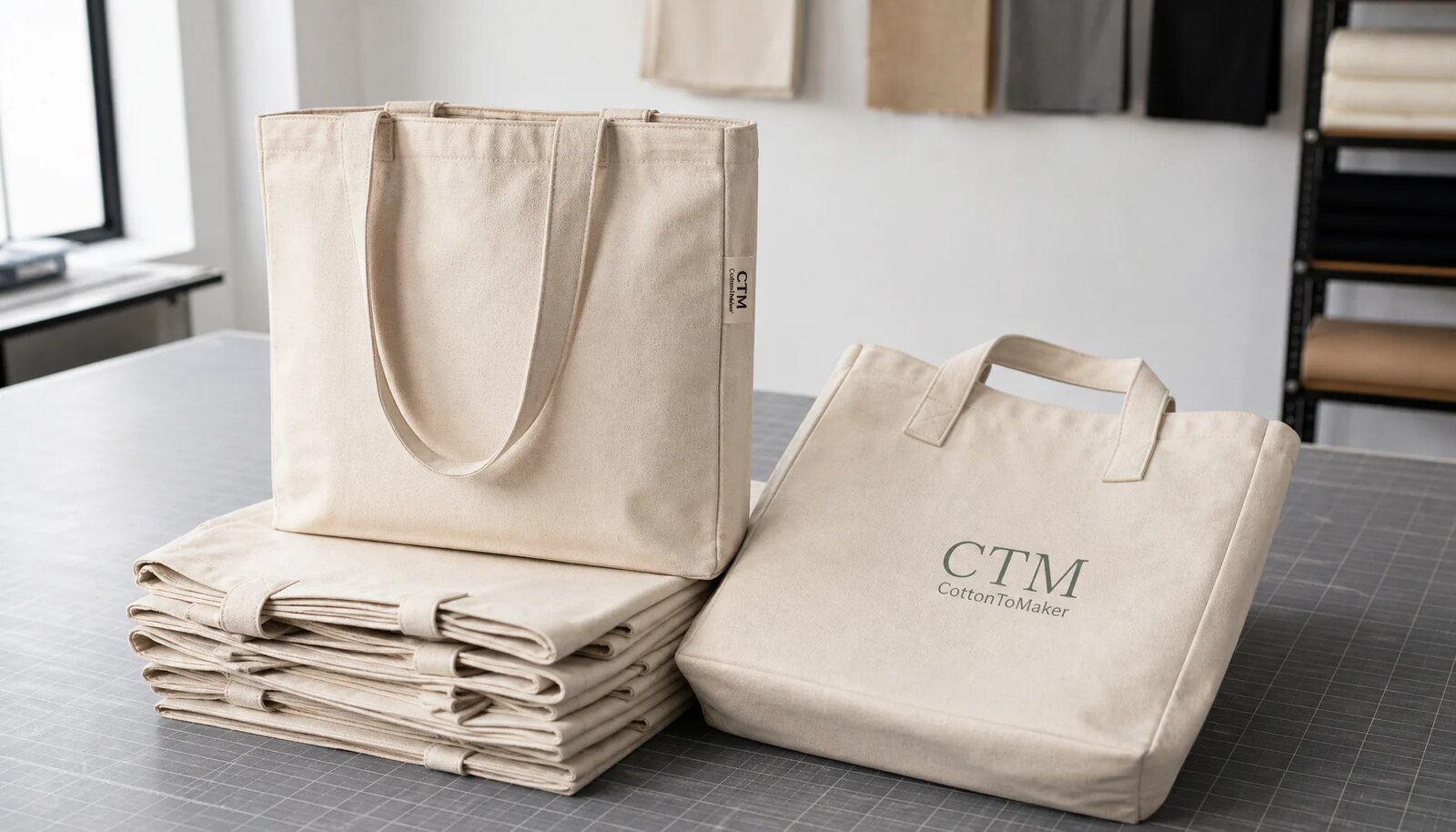
Start with the tote’s commercial job, then price it
A canvas grocery tote looks simple, but the cost can move quickly once fabric weight, handle strength, artwork, packing, and freight are defined. For an eco apparel brand, the same tote may be a paid accessory, a gift-with-purchase, a wholesale packaging item, a market-day giveaway, or a subscription insert. Each job deserves a different pricing plan.
If the tote is sold at retail, buyers should spend more on consistent shape, a cleaner front print panel, stronger handle finish, and neat folding. If the tote is mainly a grocery promotion, durability and landed cost usually matter more than a premium fold. If it replaces disposable packaging for apparel, carton efficiency and barcode accuracy may be just as important as the fabric hand feel.
Do not ask suppliers for “a bulk canvas grocery tote” and expect comparable quotes. One factory may price an 8 oz flat tote with a one-color print and bulk packing. Another may assume 12 oz canvas, a gusset, woven label, X-box handles, and retail folding. The price gap may look like supplier advantage, but it is really a spec gap.
A useful buying plan separates three numbers: the factory unit price, the decoration and packing add-ons, and the landed cost. Procurement should know which features increase perceived brand value and which simply add weight, labor, or carton cube.
- Define whether the tote will be sold, gifted, used for grocery carry, or used as apparel packaging.
- Spend on handle reinforcement when customers will carry heavy goods.
- Spend on folding, labels, and cleaner panels when the tote is a retail item.
- Compare quotes only after fabric, dimensions, print count, packing, and delivery term are aligned.
Build a quote-ready spec sheet
The fastest way to get useful pricing is to issue one clear spec sheet. Include finished width, height, gusset depth, handle width, handle length, handle drop, fabric weight, canvas finish, body color, top hem, side seam, bottom construction, print method, print area, label type, packing format, order quantity, destination, and delivery term.
Avoid vague language such as “heavy canvas,” “standard grocery size,” or “eco tote.” These phrases do not control fabric consumption, cutting yield, sewing time, or freight. A standard-looking tote can be flat or gusseted, narrow-handled or shoulder-length, 8 oz or 12 oz, bulk-packed or retail-folded.
A practical RFQ uses a base version and optional upgrades. For example, price the base at 10 oz natural canvas, one-color front screen print, X-box self-fabric handles, and bulk packing. Then ask separately for 12 oz canvas, a woven side label, two-color print, retail folding, barcode stickers, and individual packaging. This shows which upgrades are worth keeping.
The spec sheet should also state the target sales channel. A paid retail tote may need tighter dimensional tolerance and cleaner thread trimming than a free event tote. A grocery tote may need a more practical load check than an apparel packaging insert. The clearer the use case, the less padding suppliers add for uncertainty.
- Issue one base spec before asking for multiple variants.
- Ask suppliers to price upgrades as separate line items.
- Include artwork files, print size, color references, and placement measurements.
- State whether the order needs retail labels, hang tags, barcodes, carton marks, or special folding.
Use realistic price bands as planning ranges, not promises
Canvas tote pricing changes by region, cotton market, labor cost, exchange rate, freight lane, certification requirement, and season. Still, procurement teams need a starting point for budget planning. For many bulk custom programs, a basic 8 oz natural cotton tote with one-color print may land in a lower planning band, while a 12 oz gusseted retail tote with labels and tighter finishing can be substantially higher.
As an indicative factory-cost planning range, a simple 8 oz flat tote may quote around $1.20-$2.10 at higher bulk quantities. A 10 oz grocery tote with gusset, self-fabric handles, and one-color print often plans closer to $1.80-$3.20. A 12 oz retail-grade tote with reinforced handles, woven label, two-color print, and controlled fold may plan around $2.80-$5.50 or more. These are not guaranteed prices; they are budget bands to help buyers identify outlier quotes.
Cost usually breaks into material, cutting and sewing, decoration, packing, overhead and margin, and freight. For a 10 oz tote, fabric can be one of the largest components. Heavier canvas increases fabric cost, sewing effort, carton weight, and freight exposure. A second print color may look small in artwork review but can add screen setup, registration labor, and rejection risk.
The important habit is to ask what changed when the price changes. If a supplier is 25% cheaper, check whether the canvas is lighter, the tote is smaller, the handle is shorter, the print is smaller, the carton is packed tighter, or QC is thinner. If a supplier is higher, ask whether they included charges other suppliers excluded.
- Treat price bands as budgeting tools and validate them with current RFQs.
- Expect heavier fabric to increase both unit cost and freight cost.
- Ask suppliers to show setup fees separately from unit price.
- Investigate any quote that is dramatically below the group average.
Choose canvas weight, finish, and sustainability claims carefully
For grocery and apparel-brand tote programs, the common working range is 8 oz to 12 oz canvas. An 8 oz tote can work for light promotions and low-cost giveaways, but it may sag, wrinkle, and feel less substantial. A 10 oz fabric is often the balanced choice for reusable grocery carry. A 12 oz canvas gives a firmer retail hand feel but costs more to buy, sew, pack, and ship.
GSM and ounce weight should be written into the spec because different suppliers use different habits of description. As a rough guide, 10 oz canvas is often around 340 GSM and 12 oz around 400 GSM, though weave and finishing can affect the hand feel. Ask for swatches from the intended fabric lot, not only a showroom swatch.
Finish changes both look and risk. Natural canvas supports a low-intervention aesthetic but can show shade variation, seed flecks, and lot differences. Bleached canvas can make some prints look cleaner but may cost more. Dyed canvas introduces minimums and shade-control issues. Washed or softened canvas can feel more premium but may bring more size and color variation.
Sustainability claims require documentation. A natural-colored cotton tote is not automatically organic, recycled, certified, or low-impact. If your product page, hang tag, or wholesale deck uses those claims, ask before sampling what documents the supplier can provide and exactly which component the claim covers.
- Use 8 oz only when price and light-duty use dominate.
- Use 10 oz for standard reusable grocery and apparel-promo programs.
- Use 12 oz when retail structure and premium hand feel justify the extra cost.
- Confirm certificates and fiber-content documents before using sustainability language.
Price the tote by cost drivers, not just quantity
Quantity improves pricing, but it is not the only lever. A 5,000-unit order split across five artwork versions, two body colors, and two packing formats may price worse than a 3,000-unit order in one clean spec. The factory is pricing fabric yield, cutting efficiency, print setup, sorting, labeling, inspection, and packing labor.
A realistic cost breakdown for a 10 oz natural canvas grocery tote might look like this in planning terms: fabric and trim 35%-50%, cutting and sewing 20%-30%, decoration 8%-20%, packing 3%-10%, overhead and margin 10%-20%, with freight and duty outside the factory price. The exact percentages vary, but the pattern is useful: fabric, sewing, and decoration are the big levers.
MOQ should be requested by variable. Fabric color may have one minimum, print artwork another, woven labels another, and retail folding another. A supplier may accept 1,000 units for stock natural canvas but require 2,500 or more for dyed fabric. A one-color logo may be efficient at 1,000 units; a multi-color print with several screens may need more volume to absorb setup.
Ask for price breaks at quantities that match your demand plan rather than arbitrary numbers. Common planning tiers include 500, 1,000, 2,500, 5,000, and 10,000 units. The goal is to see when the price actually improves and whether the savings come from the same spec or from hidden simplification.
- Keep first production to one body size and one base fabric where possible.
- Limit artwork variants until the base cost is validated.
- Request MOQ by fabric, print, label, size, and packing format.
- Ask what operational assumption changes at each price break.
Calculate landed cost before choosing the supplier
The lowest FOB unit price is not always the lowest landed cost. Canvas totes are relatively bulky, and a small change in fold, carton count, or fabric weight can affect freight. Buyers should ask for carton dimensions, gross weight, units per carton, total cartons, and estimated CBM with every quote.
For example, assume a 2,500-unit order of 10 oz gusseted totes at a $2.35 FOB unit price, one-color print included, bulk packed 100 units per carton. The factory value is $5,875. If ocean freight, destination handling, duty, inspection, and local delivery add $1,250, the landed cost becomes about $2.85 per tote. If retail folding and barcode stickers add $0.18 per unit and increase carton cube enough to add another $300 freight impact, the landed cost moves closer to $3.15.
At 5,000 units, the factory price may drop to $2.10 because setup and cutting are more efficient. But if the heavier 12 oz upgrade raises the unit price to $2.75 and increases freight by $0.20-$0.40 per unit, the brand should be sure the premium feel supports the selling price. This is the difference between buying a tote and managing margin.
Delivery terms must be normalized. EXW leaves more transport responsibility with the buyer. FOB is useful for import planning. Delivered pricing can be convenient, but only if the supplier states what is included and excluded. Quotes are comparable only when the same spec, packing, inspection, and destination basis are used.
- Request carton data and CBM before purchase order release.
- Build a landed-cost sheet with unit price, setup, packing, freight, duty, inspection, and local delivery.
- Compare 10 oz and 12 oz options after adding freight impact.
- Do not approve retail folding or individual packaging without checking carton cube.
Match supplier type to volume, speed, and control needs
Direct factory sourcing is often best for repeat programs with stable specifications. It can provide better visibility into fabric, cutting, sewing, printing, and QC. The trade-off is that the buyer must manage development details, sample comments, inspections, and logistics more carefully.
Trading companies can be valuable when the buyer needs one contact across several product categories or does not have time to manage factory-level detail. The price may include added margin, but the coordination can be worth it. The key is to confirm whether the same factory that made the sample will make the bulk order.
Domestic converters and local printers are useful for urgent campaigns, smaller tests, and programs where speed matters more than unit cost. They may use imported blank totes or locally sourced fabric, so the buyer should still confirm canvas weight, handle construction, and repeat availability.
Regional sourcing also affects risk. Long-distance import routes may lower unit cost but require more lead time, freight planning, and documentation. Nearshore or domestic routes may reduce transit uncertainty but increase production cost. For a planned retail program, direct import can make sense. For a last-minute launch event, speed may justify a higher local unit price.
- Use direct factories for repeatable custom totes and higher bulk volumes.
- Use trading partners when coordination capacity is limited.
- Use domestic options for speed, low-volume tests, or deadline-sensitive campaigns.
- Normalize specs before judging any route as cheaper or more expensive.
Control print, labels, and brand presentation
One- or two-color screen printing is usually the most efficient decoration route for bulk canvas totes with simple logos. It works well when the artwork is bold, the print area is reasonable, and the order can absorb setup. Fine lines, small type, gradients, and large solid ink areas require more caution because canvas texture affects print edges and coverage.
Each additional print color adds setup, registration work, and inspection risk. Ask whether screen charges are included, whether repeat screens are stored, and what happens if the artwork changes. For short runs or detailed artwork, heat transfer or digital decoration may be practical, but buyers should check surface feel, fold behavior, edge lift, and durability under normal handling.
Approve color on the actual fabric. A Pantone reference on paper will not look identical on natural or dyed canvas. The correct standard is a controlled visual target on the approved cloth, with an agreed tolerance. If exact brand color is critical, request a strike-off before full production.
Labels and packaging details also shape brand perception. A woven side label can make a simple tote feel more finished. A hang tag may be useful for retail storytelling. A barcode sticker may be mandatory for receiving. Price these items early because they add manual handling and can create rework if placement is wrong.
- Use bold artwork and limited print colors for better bulk economics.
- Ask for minimum line weight and minimum readable text size on the chosen canvas.
- Approve a printed strike-off or pre-production sample on actual fabric.
- Confirm woven label, hang tag, barcode, and care-label requirements before quoting closes.
Approve samples and QC standards before bulk release
The pre-production sample is the production gate. It should use final fabric, final dimensions, final handle construction, actual print, label, thread, fold, and packaging. If a sample uses substitute fabric or temporary decoration, treat it as a development sample, not a bulk approval sample.
Once approved, create a sealed golden sample. Mark it with the PO number, artwork revision, fabric reference, approval date, and any accepted tolerance notes. Keep one sample with the buyer and one with the supplier. This prevents arguments later when teams change or reorders happen months after the first run.
A basic sample review should be physical, not only visual. Lay the tote flat and measure width, height, gusset, handle length, and handle drop. Turn it inside out to inspect seam allowance, loose threads, raw edges, and skipped stitches. Load it with a realistic grocery weight and check the handle joins, top hem, bottom corners, and side seams.
For final inspection, agree whether the order will follow AQL sampling or a simpler pass-fail standard. Define major defects such as wrong fabric, wrong artwork, weak handles, unreadable barcodes, heavy print smearing, mixed SKUs, or incorrect carton counts. Define minor defects such as small thread tails or slight fold variation if they do not affect saleability.
- Do not release bulk production from an incomplete sample.
- Measure every key dimension the same way the factory will measure it.
- Load-test the sample using the expected real-world carry weight.
- Use a golden sample and written defect definitions for final inspection.
Lock packing, cartonization, and reorder data
Packing is a cost item, not a warehouse afterthought. Bulk packing in master cartons is usually lowest cost. Retail folding, individual bags, belly bands, hang tags, barcode labels, inner packs, and special carton marks all add labor. None are wrong, but each should be priced before production starts.
The fold should match the channel. A retail tote may need a neat fold that shows the logo and scans correctly. A wholesale or promotional tote may be better bulk packed to reduce labor and freight. If the fold increases carton cube, the freight impact should be visible in the landed-cost sheet.
Carton checks should be part of inspection. Confirm units per carton, inner pack count, barcode scan, carton marks, PO number, destination labels, gross weight, and carton condition. Weighing sample cartons helps identify count errors before shipment.
For repeat orders, ask the supplier to retain the golden sample, print file, carton specification, fabric reference, and tolerance sheet. Reorder consistency depends on documented details, not memory. If the original fabric lot cannot be held, ask how close the replacement lot can be and whether a new swatch approval is required.
- Price bulk pack, retail fold, individual packaging, and barcode labels separately.
- Confirm carton dimensions, gross weight, and total CBM before shipment booking.
- Inspect carton count and labeling, not only product appearance.
- Keep fabric, artwork, sample, and carton records for replenishment orders.
Specification comparison for buyers
| Supplier route | Typical cost position | Best fit | Buyer risk to check |
|---|---|---|---|
| Asia direct factory | Often lowest FOB unit cost at 2,000+ units; strong for repeat programs when the spec is stable | Eco apparel brands, importers, distributors, and retail programs with planned lead time | Requires clear specs, sample control, inspection planning, and accurate freight calculation |
| Asia trading company | Usually higher than direct factory due to margin, but may bundle sourcing, artwork, QC, and shipping coordination | Brands buying several accessory categories or teams without factory-management bandwidth | Less visibility into the sewing/printing site; confirm whether the quoted factory will produce bulk |
| Domestic printer/converter | Higher unit cost, but faster sampling and shorter transit; useful when freight uncertainty or urgency matters | Small tests, event deadlines, local campaigns, quick replenishment, and low-MOQ decorated totes | Fabric source and base tote quality may vary; confirm origin, dimensions, and handle reinforcement |
| Stock blank tote plus local decoration | Good for 100-1,000 units when speed is more important than custom construction | Pop-ups, influencer kits, small retail drops, and proof-of-demand tests | Limited control over canvas weight, handle length, dye lot, and repeat consistency |
| Fully custom program | Best cost control at scale but requires MOQ, development time, and approved samples | Paid retail totes, private-label grocery bags, and recurring apparel packaging programs | Variant creep can erase savings; lock size, print count, packing, labels, and tolerance early |
| Premium certified material route | Higher material cost and documentation effort; price depends on certification scope and availability | Brands making organic, recycled, or certified-fiber claims in retail copy or wholesale decks | Claims must match documentation; natural-looking canvas alone does not prove sustainability claims |
Buyer checklist before sampling
- Define the tote’s role: paid retail accessory, grocery promotion, gift-with-purchase, wholesale packaging, subscription insert, or event merchandise.
- Specify finished width, height, gusset depth, handle width, handle drop, top hem, seam finish, canvas weight, body color, and expected carry load.
- Choose a base fabric tier before requesting prices: 8 oz for very budget programs, 10 oz for standard reusable grocery use, or 12 oz for firmer retail presentation.
- Lock artwork assumptions: print method, number of colors, print size, placement, Pantone or visual color target, label style, and whether setup charges are included.
- Ask for MOQ by fabric color, print setup, size, label, and packing format instead of accepting one headline MOQ.
- Request unit price breaks at realistic quantities such as 500, 1,000, 2,500, 5,000, and 10,000 units if your demand plan may scale.
- Get carton data with the quote: units per carton, carton dimensions, net weight, gross weight, and estimated CBM or cubic feet.
- Compare EXW, FOB, and delivered pricing only when each quote uses the same fabric, dimensions, print count, packing method, and inspection standard.
- Approve a pre-production sample made with final fabric, final handle construction, actual print, label, thread, fold, and packaging.
- Set written QC tolerances for fabric weight, finished dimensions, handle placement, stitch defects, print alignment, carton count, and barcode readability.
Factory quote questions to send
- What exact canvas weight, GSM or oz, weave, finish, and color are you quoting, and is the fabric stock or made to order?
- What are the finished tote dimensions, gusset depth, handle length, handle drop, and allowed tolerance for each measurement?
- What handle reinforcement is included: X-box stitching, bar-tack, double-topstitching, or another method?
- What practical carry-load test can you perform or support for this construction, and how will failures be recorded?
- How many print colors, screens, plates, or transfer passes are included in the price, and what is the charge for each additional color or setup?
- What MOQ applies separately to fabric color, print artwork, print color, label type, size variant, and packing format?
- Can you quote price breaks for 500, 1,000, 2,500, 5,000, and 10,000 units using the same spec and packing?
- How many totes are packed per carton, what are the carton dimensions, gross weight, and total estimated CBM for each quantity tier?
- Which costs are excluded: samples, screens, labels, hang tags, barcode stickers, inspection, inland freight, duty, palletization, or local delivery?
- Will the pre-production sample use final bulk fabric, thread, print ink, label, fold, and packaging?
Quality-control points to confirm
- Fabric weight should match the approved spec within the agreed tolerance, commonly around plus or minus 5% unless the buyer accepts a wider range.
- Finished width, height, gusset, handle length, and handle drop should be measured flat using the same method used at sample approval.
- Handle joins should show consistent reinforcement with no skipped stitches, loose backtacks, broken thread, pulled seams, or distorted top hems.
- A practical load check should confirm that handles, side seams, bottom corners, and gusset seams do not tear, creep, or distort beyond the approved standard.
- Print placement should remain centered within the written tolerance and free from heavy smearing, pinholes, ghosting, shade streaks, or obvious registration errors.
- Small text, QR codes, and barcodes should be tested on the actual canvas surface before bulk production because texture can reduce readability.
- Inside seams should be clean enough for the selling channel, with controlled raw edges, secure thread trimming, and no loose fabric that can fray during use.
- Labels, hang tags, barcode stickers, and carton marks should match the approved artwork, placement, scan requirements, and purchase order information.
- Carton counts should match the packing list; sample cartons should be weighed to catch under-packed, over-packed, or mixed-SKU cartons.
- Final release should reference either an AQL plan or a written pass-fail standard, plus the sealed golden sample.