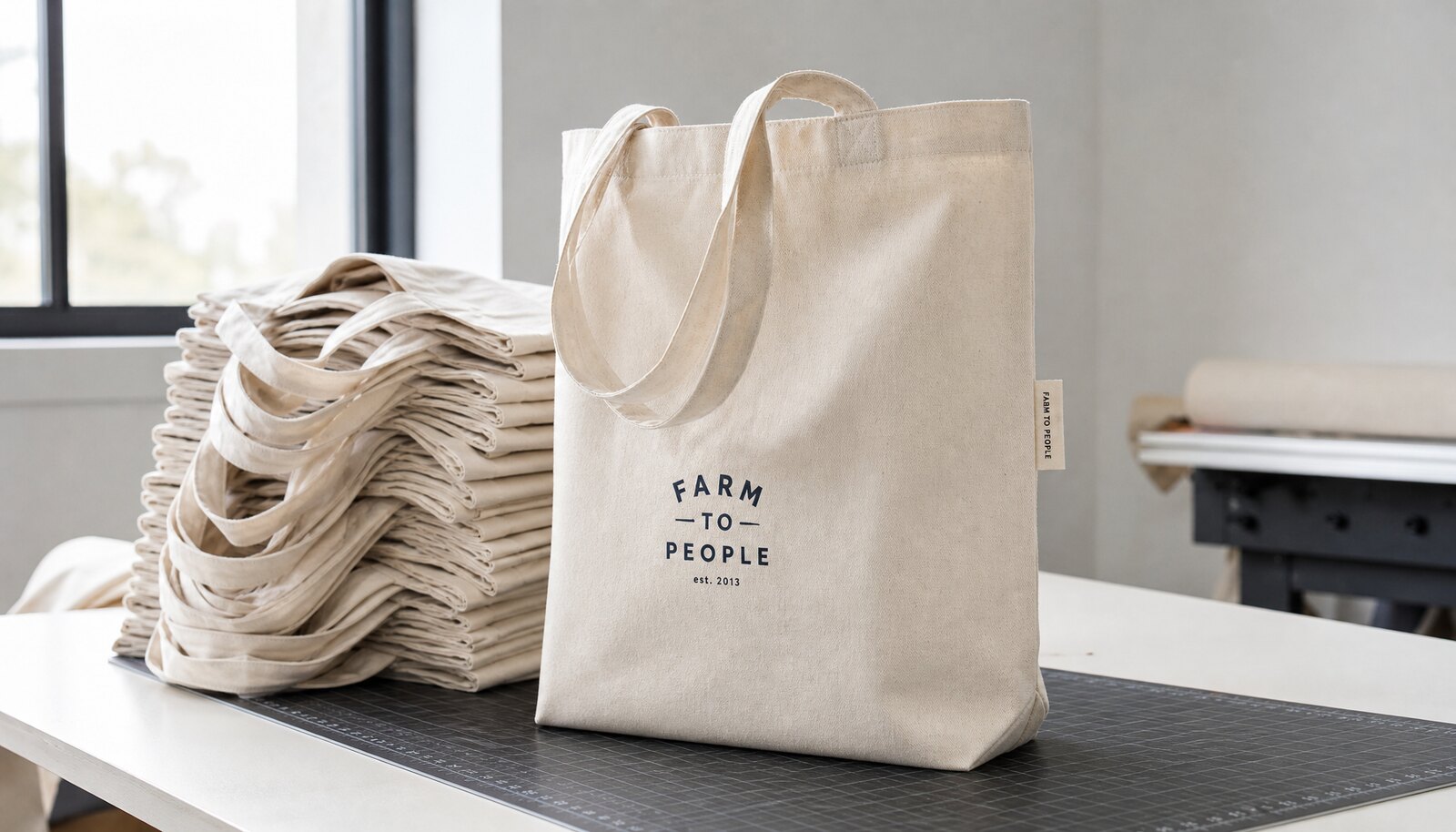
Why winery buyers need a tighter tote spec than a normal promo bag
A canvas grocery tote for a boutique winery does more than carry purchases to the car. It sits on a retail shelf, gets reused in daily shopping, becomes a visible brand object, and often carries heavier items than a standard event giveaway. That means the buying brief has to cover structure, print durability, and packing, not just logo placement.
The most common sourcing mistake is comparing quotes that are not built on the same spec. One supplier may quote a lighter canvas, a simpler print, and loose bulk packing, while another is pricing heavier fabric, reinforced handles, and retail-ready finishing. Those are not direct alternatives. A useful RFQ forces every bidder to answer the same questions so the team can compare landed cost and likely reject rate instead of headline unit price only.
- Treat the tote as a functional carry item and a brand surface at the same time.
- Write the use case into the brief so the factory does not guess at load, size, or finish.
- Keep the comparison focused on measurable specs, not descriptive marketing language.
Start with the job the tote has to do
Before choosing fabric or print method, define how the tote will be used. A tasting-room retail tote, a club gift insert, a bottle carrier, and a grocery-style reusable bag all need different structure. A wine club insert may prioritize foldability and cube efficiency. A retail tote may need better shelf shape and cleaner print presentation. A bottle-heavy bag needs stronger handles and sidewall stability.
The best way to avoid spec drift is to write a single line that describes the working job and the load target. For example: one-bottle carry, two-bottle carry, general retail merchandise, or everyday grocery use. Then attach a weight target in pounds or kilograms. This becomes the baseline for fabric weight, handle reinforcement, and the pull test. If a supplier quotes a bag that meets the visual brief but not the load brief, the quote is incomplete, not competitive.
- Define the primary job: retail resale, tasting-room merch, bottle carry, or club fulfillment.
- Write the maximum load target in the RFQ so the factory can size the bag honestly.
- If there are two use cases, choose the heavier one as the default spec.
Choose fabric weight, shrinkage, and finish deliberately
Fabric weight is the first commercial decision that changes both feel and performance. For many boutique winery programs, 12 oz canvas is a practical starting point because it gives enough body for retail presentation without moving into a very heavy or expensive build. If the tote will regularly carry wine bottles or heavy groceries, 14 oz is a better baseline because it gives more structure and reduces handle stress. Lighter canvas can work for simple merchandising, but it will collapse more easily and show wear sooner.
Do not rely on a hand-feel sample alone. Ask for the fabric spec in oz/yd2 or GSM, the weave description, and the finish treatment. If the canvas is pre-shrunk or washed, request the expected shrinkage allowance in writing. A common procurement target is 3% or less for pre-shrunk goods if finished size matters; untreated canvas needs a clear allowance because dimensions can change after cleaning or repeated use. Natural canvas can hide minor imperfections better, while bleached canvas can give a cleaner retail look but may show stains more easily during handling and warehousing.
- 12 oz canvas: common balance of cost, body, and print surface.
- 14 oz canvas: better for bottle carry and premium shelf presence.
- Pre-shrunk or washed canvas: use when finished size and post-use consistency matter.
Construction details that control carry performance
For a canvas tote, the seams and handles matter more than the front panel. Buyers should ask for stitch density, reinforcement pattern, handle width, and seam allowance, because these details are what keep the bag alive after repeated use. A practical target on load-bearing seams is often 7-9 stitches per inch, with a dense reinforcement pattern at the handle root. If the supplier cannot describe the reinforcement clearly, the order is not ready for approval.
Handle testing should be part of sample review. Look at the root of the handle, not just the center span, because that is where failures show up first. For standard retail totes, many buyers set an internal pull-test target around 15-20 kgf / 33-44 lbf without visible seam opening or stitch failure. If the bag is intended for bottles, set the target higher. Also check handle symmetry, drop length, and how the tote hangs when filled. A tote can be technically strong and still feel awkward if the handle geometry is wrong.
- Ask for stitch density on the main seams and the handle reinforcement area.
- Use a pull test that matches the tote's real use, not a generic promotional bag target.
- Verify handle drop, symmetry, and bag balance with a loaded sample.
Print, labels, and retail presentation
Most winery buyers use screen print because it is durable, economical, and clean on coarse canvas when the artwork is simple. One or two spot colors with solid shapes usually print best. Heat transfer can work for short runs or detailed artwork, but it needs more scrutiny because abrasion resistance and repeat use can vary. For a more premium presentation, a woven or sewn label can elevate the bag without crowding the front panel. The right answer depends on the artwork, not on whichever method is easiest for the supplier.
Print quoting needs the same discipline as fabric quoting. Ask for the number of colors, print area in inches or centimeters, one-side versus two-side print, and the smallest line or type size the factory can hold on the chosen canvas. Fine text and thin lines are the first things to blur on a textured surface. If the tote is retail-resold, also specify care label, country-of-origin mark, barcode placement, and whether the bag needs a hangtag or tissue insert. Those small items affect shelf readiness and labor at receiving.
If your brand uses a narrow logo, light typography, or detailed line art, ask for a production-like strike-off before mass printing. The purpose is not just to see color; it is to test registration, edge sharpness, and whether the fabric weave swallows thin details. This is especially useful on natural canvas, where the texture can make a design look rough even when the ink color is correct.
- Screen print: best for simple logos, repeat orders, and strong durability.
- Heat transfer: useful for small runs or complex art, but test abrasion and edge hold.
- Woven or sewn label: useful when the brand wants a more premium, less promotional look.
Compare supplier routes without mixing quote types
The sourcing route changes the quote, the risk profile, and the amount of control you get. A direct factory is usually the best option when the winery wants to lock the fabric, sewing, print, and packing details. That route gives the buyer the most visibility into actual production and the most leverage on QC. A trading company can help when the order includes several product types or when the buyer wants one contact to coordinate multiple factories, but the quote should still identify the actual plant and break out middleman charges clearly. A domestic decorator or reseller may be useful when speed matters more than unit economics, but their price often reflects convenience and a narrower spec range.
The key is not to call one route better in the abstract. Match the route to the need. If you need a custom tote line that will be reordered, direct factory sourcing usually gives better continuity and cleaner reorders. If this is a small campaign tied to a launch date, a domestic partner may reduce delay. Either way, ask the same questions: who makes the bag, what gets subcontracted, how are defects handled, and what evidence exists that the quoted spec can actually be produced at scale. If the supplier cannot name the factory or refuses to share sample evidence, the quote should be treated as incomplete.
A strong RFQ also forces the supplier to tell you whether the quote includes development work or just the finished bag. Many procurement teams lose time because one vendor prices a sample-ready tote while another prices a bag that still needs artwork cleanup, screen prep, or revised carton dimensions. The result is a misleading spreadsheet. Quote the route, the production method, and the delivery point together, or the comparison will not hold up.
- Direct factory: best for spec control, repeat orders, and transparent QC.
- Trading company: useful for bundled sourcing, but insist on factory identification.
- Domestic decorator: useful for speed, but compare unit price against total landed cost, not convenience.
How MOQ and pricing really work on custom canvas totes
MOQ is not just a factory number. It is the point where fabric purchasing, print setup, sewing efficiency, and packing labor stop being economical for the supplier. On canvas grocery totes, the real minimum often changes by color, print count, label style, and pack method. A low headline MOQ can still be expensive if the supplier charges separately for every screen, plate, label, or special carton. That is why a buyer should ask for a price ladder, not a single quote.
The cleanest way to compare vendors is to request the same spec at 2 or 3 quantities, such as a pilot run and one or two reorder levels. That shows whether the factory has a real scale break or just one price dressed up as flexibility. Also ask what happens on reorders. A quote that looks competitive once can become expensive if the supplier resets setup fees every time. If the winery expects seasonal artwork changes, hold the body spec constant and vary only the print or label where possible. That keeps the production line simpler and usually reduces rework.
Sample cost should be handled separately from bulk cost. A real development quote should show sample charge, setup charge, and reimbursement logic if the order is placed. If a supplier refuses to itemize those parts, the quote is hard to audit and hard to compare. For procurement, the useful number is not just the first carton price; it is the total cost to get approved bags to your warehouse with the repeatable spec still intact.
- Ask for pricing at multiple quantities so the scale break is visible.
- Separate bulk price from sample, screen, plate, and label setup charges.
- Confirm whether reorders keep the same setup or reset development fees.
Sample approval and QC thresholds that prevent surprise claims
A sample should prove the production risks, not just show the artwork. A proper pre-production sample needs the actual fabric, the actual print process, the actual handle reinforcement, and ideally the actual packing method. The buyer should measure finished size, inspect seam quality, and test the bag under load. If the tote is supposed to carry bottles or heavy retail goods, the sample should survive a pull test without seam opening or visible stitch distortion. Photos alone are not enough, because they do not show handle strength or how the bag behaves when weighted.
Set tolerances before the bulk order begins. For many tote programs, a practical body dimension tolerance is about +/- 0.5 in / 1.3 cm, handle length should be controlled tightly enough that the bag wears evenly, and shrinkage should be defined in advance rather than discovered later. If the supplier is using pre-shrunk or washed canvas, ask how they verify post-finish dimensions. If they are using untreated canvas, ask how they account for variance. The goal is not to eliminate all variation; it is to make sure the variation stays inside the retail and functional window you can accept.
Inspection should separate cosmetic issues from functional failures. A loose thread can be trimmed. A crooked handle, broken seam, severe print smear, or out-of-tolerance body size is a production defect. Before inspection begins, agree on the sampling method, the defect classification, and the pass-fail standard. If the order is important enough to matter financially, it is important enough to inspect on a written standard rather than on judgment alone.
- Approve the sample against the actual production spec, not a reference bag.
- Test the tote with weight and inspect the handle root, bottom seam, and side seams.
- Write the defect thresholds into the PO so acceptance is not debated later.
Packing, carton cube, freight, and warehouse handling
Packing is where a tote quote can look cheap on paper and become expensive in freight. Canvas bags are bulky relative to their unit price, so the carton plan matters as much as the sewing plan. Bulk fold packing is the lowest-cost option, but it can leave the bag less retail-ready. Polybag or tissue inserts help keep the print surface clean and can reduce rubbing during transit. For winery resale or club fulfillment, the buyer should decide whether the receiving team wants speed, appearance, or maximum cube efficiency, because the packaging solution changes with the priority.
Ask for carton dimensions, case pack, gross weight, and pallet pattern before approving the PO. A useful handling target is to keep gross carton weight around 15-20 kg / 33-44 lb so warehouse staff can move cases safely and consistently. Overstuffed cartons crush the bag body and damage print. Underfilled cartons waste cube. The best quote will show how many units fit per carton without compressing the tote shape, not just how many units fit if the factory forces them in. If the order will move by ocean freight, ask whether the carton is export-grade and whether the factory uses any moisture protection appropriate to the route.
If the winery will store the bags in a back room, tasting space, or fulfillment area, add practical requirements: easy-open cartons, clear outer labels, and a case pack that the team can count without sorting loose units. If the bags will be retail-displayed immediately, ask for finish protection on the print face and a carton strategy that does not create a lot of crease recovery work after opening.
- Compare freight by carton cube, not only by unit price.
- Keep gross carton weight in a manual-handling range when possible.
- Require carton dimensions and case pack before you approve the order.
What to send in the RFQ so the quote is actually usable
The simplest way to get better pricing is to send a cleaner brief. The RFQ should include the bag use case, target load, fabric weight or GSM, finished dimensions, handle length, print method, number of colors, packing style, quantity, target ship date, and destination. If the winery wants a premium retail look, say so explicitly. If the bag is a club gift or a seasonal add-on, say that too. Suppliers quote more accurately when they know what tradeoff matters most.
It also helps to send one reference file that contains the exact version of the artwork, the spec sheet, and a note on which items are fixed and which are open for value engineering. For example, the body size may be fixed, but the label, tissue, or carton print may be flexible. That gives suppliers room to optimize without changing the actual product identity. A good procurement package also asks for evidence: a sample photo set, a production calendar, carton data, and a statement of what is subcontracted. The more the quote depends on assumptions, the less useful it is for a purchase decision.
The closeout step should be a signed spec sheet or approval email that names the approved sample, the approved artwork version, and the inspection standard. This is boring paperwork, but it is what protects the buyer when the bulk shipment arrives and someone asks whether the tote was supposed to be 12 oz or 14 oz, or whether the print was supposed to be one side or both.
- Send one RFQ package with the use case, spec, artwork, packing, and deadline together.
- Mark which items are fixed and which can be value-engineered.
- Keep the approved sample version and the purchase order linked by the same spec number or revision date.
Specification comparison for buyers
| Spec decision | Recommended option | When it fits | Buyer risk to check |
|---|---|---|---|
| Fabric weight / structure | 12 oz canvas for general retail; 14 oz for bottle carry or heavier grocery loads | Best for boutique wineries that want a tote with visible body, repeat use, and shelf appeal | If the sample feels correct but the fabric is underweight, the bag may sag once filled; require the weight in oz/yd2 or GSM and a finished sample |
| Shrinkage / finish | Pre-shrunk or washed canvas with a stated shrinkage allowance | When the bag must hold its dimensions after customer use or light cleaning | Untreated canvas can shrink or skew print placement after washing; require a target shrinkage of 3% or less for pre-shrunk goods, or a written allowance if untreated |
| Stitch density / seams | Main seams at about 7-9 stitches per inch with reinforced stress points | For bags that will carry bottles, pantry goods, or repeated retail use | Below this range, seams can look loose or fail under load; confirm actual stitch count on the production sample |
| Handle reinforcement | Box-X or dense bartack reinforcement at the handle roots | When customers will hand-carry, shoulder-carry, or load the tote heavily | Single short bartacks are a weak point; ask for the exact reinforcement pattern and inspect thread break at the sample |
| Print method | Screen print for simple logos and repeat orders; woven or sewn label for premium branding | Best when artwork is one to two spot colors with clean edges | Fine type, gradients, and thin lines can blur on coarse canvas; ask the factory for smallest printable line and type size |
| MOQ structure | Tiered MOQ by color, print color, label, and pack style | Useful when you need one core tote plus small seasonal variations | A low headline MOQ can hide setup fees or force stock colors; ask for the true minimum per version |
| Supplier route | Direct factory for spec control; trading company for bundled sourcing; domestic decorator for speed | Choose based on order size, lead time, and how much production detail you need to control | Hidden margin, unclear factory ownership, or vague QC plans make quotes hard to compare |
| Packing / carton plan | Flat pack with agreed insert and export carton; keep gross carton weight around 15-20 kg / 33-44 lb | For warehouse handling, retail replenishment, and lower freight damage risk | Overstuffed cartons crush bag shape and print; ask for carton dimensions, case pack, and pallet pattern |
| Documentation / evidence | Pre-production sample photos, inline QC photos, final carton photos, and signed spec sheet | For importers comparing multiple suppliers before PO placement | Without visual evidence and a signed spec version, it is hard to prove what was approved |
Buyer checklist before sampling
- Define the tote's primary use before quoting: retail resale, tasting-room merch, gift-with-purchase, club shipment insert, or grocery use. The use case determines the load target, handle length, and acceptable finish.
- Write the load requirement in the brief. For general retail use, many buyers start around 5-7 kg / 11-15 lb; for bottle-heavy use, set a higher internal target and require a pull test.
- Lock the fabric spec in writing: oz/yd2 or GSM, weave type, natural or bleached shade, finish treatment, and an explicit shrinkage allowance.
- Approve the artwork with exact print size, placement, number of colors, Pantone references if color-matched branding matters, and whether the design prints on one side or both.
- Confirm the handle geometry: width, length, drop, attachment method, and whether the grip needs to fit hand carry, shoulder carry, or both.
- Request a production sample that matches the actual fabric, print method, stitching, label placement, and packing method, not a decorated reference bag.
- Compare landed cost instead of unit price only. Include setup charges, sample fees, screen or plate charges, labeling, carton cost, inland freight, and expected ocean or air cube.
- Set tolerances before production starts: finished size, handle length, print placement, stitch quality, and acceptable cosmetic variation for natural canvas.
- Ask for a written schedule with sample approval, bulk cutting, print prep, sewing, QC, packing, and ship date milestones.
- Specify acceptable defects in the PO, including loose threads, stain marks, skipped stitches, print smears, panel skew, crooked handles, and carton damage.
Factory quote questions to send
- What is the exact fabric specification, including oz/yd2 or GSM, weave density, and whether the canvas is natural, bleached, washed, or pre-shrunk?
- What is the quoted price based on: blank bag only, one-side print, two-side print, woven label, or retail-ready packing?
- What MOQ applies by color, print color, label variation, and size, and are mixed colors or mixed artwork versions allowed in one order?
- What are the finished size tolerances for width, height, gusset depth, and handle length, and what shrinkage allowance do you use after finishing or washing?
- How are the handles reinforced, and can you state the stitch pattern, stitch density, thread type, and pull-test method used on the sample?
- What pull-test target do you recommend for this tote, and what happens if the bag fails at the handle root or side seam?
- What packing method is included: bulk fold, polybag, tissue insert, barcode sticker, hangtag, or master carton label?
- What is the production lead time after sample approval, and what steps can delay the order if artwork, fabric, or carton stock changes?
- Can you provide pre-production sample photos, inline inspection photos, and final carton photos before shipment?
- What carton size, case pack, and gross weight do you plan to use, and how many units fit per carton without crushing the tote body or print area?
Quality-control points to confirm
- Fabric weight must match the approved spec within the agreed tolerance, and the cut swatch should not show oil marks, major slubs, or shade streaks that stand out in retail light.
- Finished dimensions should stay within the agreed tolerance on a representative sample. A practical target for many tote programs is about +/- 0.5 in / 1.3 cm on body dimensions, unless the design requires tighter control.
- Handle attachment should survive a manual pull test at the agreed target, commonly set around 15-20 kgf / 33-44 lbf for standard retail totes and higher if the tote is meant for heavier loads.
- Main seams should show even stitch length and no skipped stitches. A common procurement target is 7-9 stitches per inch on load-bearing seams, with stronger reinforcement at the handle roots.
- Print edges should be centered, clean, and free from heavy bleeding, double images, or visible misregistration beyond the agreed limit.
- If the tote is pre-shrunk or washed, confirm that the sample does not shrink beyond the stated allowance after a controlled wash or soak test.
- Labels, barcodes, care marks, and origin marks should match the approved placement and remain readable after packing and handling.
- Cartons must close without bowing, crushing, or moisture damage, and the case pack should preserve the tote shape so the bag opens cleanly at receipt.
- Agree on a sampling plan before inspection starts, whether it is AQL-based or a simple lot-check, so the accept-or-reject decision is not improvised after the goods arrive.