1. Why compliance belongs at the start of tote sourcing
Wholesale canvas grocery totes look easy to buy until quotes arrive. One supplier may price a thin natural cotton promotional tote. Another may assume a reinforced 300 GSM grocery bag with a gusset, two-side print, retail labels, and carton-level barcode rules. Both quotations can say custom canvas tote, but they are not the same product.
For eco apparel brands, supplier compliance is not only about certificates. It is the operating discipline that keeps the approved product from drifting. The actual canvas lot, print ink, thread, labels, packing materials, subcontractors, and inspection standard must match the purchase order and the claims your brand makes.
The goal is not to collect unrelated PDFs. The goal is to ask for evidence tied to the order: what material is used, who controls it, which claims are supported, what is inspected, what can be substituted, and who signs off before shipment.
- Use compliance as a buying filter before negotiating the final unit price.
- Separate factory-level evidence from order-specific product evidence.
- Require written approval before any fabric, ink, label, trim, or packing substitution.
- Compare suppliers on the same tote specification, not on generic eco bag wording.
2. Build the specification before asking for price
A photo can start the RFQ, but a factory needs measurable details. Start with finished dimensions in W x H x Gusset format. A flat 38 x 42 cm tote is different from a 38 cm W x 35 cm H x 12 cm gusseted grocery tote. Gusset depth changes fabric consumption, sewing time, carton volume, and how the bag carries weight.
Canvas weight should be stated in measured GSM. For many grocery-oriented canvas totes, 280-320 GSM is a practical starting range because it balances structure, printability, and freight cost. Lighter canvas may work for giveaways; heavier canvas may suit resale merchandise. Avoid mixing GSM and oz terms unless the supplier confirms the measured GSM equivalent.
Handle details matter as much as body fabric. Specify handle drop, handle width, handle material, attachment depth, and reinforcement pattern. Short handles may be fine for hand carry. Longer drops are more practical for shoulder carry, especially with a full grocery load.
- State finished measurements after sewing, pressing, washing, or curing if applicable.
- Define top width, height, gusset depth, handle drop, handle width, and measurement tolerance.
- Specify seam finish: overlocked, bound, turned, or another approved construction.
- Name the use case so the supplier does not price a light promotional tote for a grocery program.
- Attach a simple technical sketch if dimensions or gusset shape are easy to misread.
3. Control fabric, GSM, shade, and claim language
Eco apparel buyers often request organic cotton, recycled cotton, or undyed natural canvas. Those terms need careful handling. Conventional cotton canvas, recycled cotton blend, organic cotton canvas, and cotton-poly canvas have different sourcing routes, minimums, documentation, hand-feel, and repeat consistency. Decide what claim will appear on the product page, hangtag, or retailer file before you approve the material.
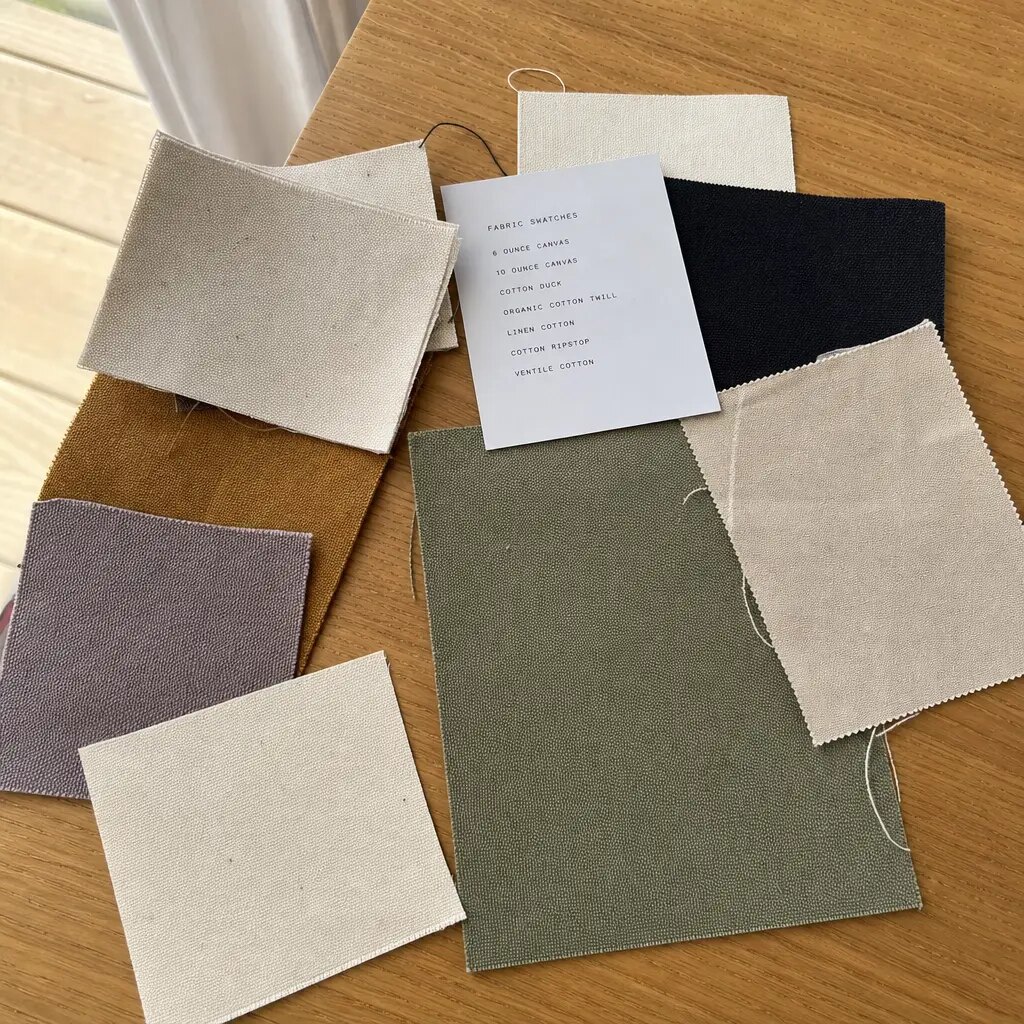
Natural canvas is not one universal shade. It can range from cream to beige and may include slubs or seed specks. Those features can support an understated eco look when approved. They become a quality problem when bulk lots vary widely or when a print is placed over visible contamination.
If a certification or content claim is required, ask what document applies to the exact material. Depending on the claim system and channel requirement, buyers may need a material scope certificate, transaction certificate, composition test, supplier declaration, or chain-of-custody record. Do not assume a general factory certificate covers your order.
- Keep composition wording consistent across quote, sample tag, PO, invoice, packing list, and label.
- Approve a natural canvas shade band, not only one attractive swatch.
- Ask whether fabric is stock, mill-booked, nominated, or purchased from the open market.
- Clarify whether testing is on fabric, printed panels, or finished totes.
- Include shrinkage expectations when bags are washed, dyed, steamed, pressed, or heat-cured.
4. Make logo and branding requirements production-ready
Decoration is a major quote variable. A small one-color logo on one side is not commercially equal to a large two-side print, embroidery patch, sewn side label, and hangtag set. Give suppliers the logo size in centimeters, number of colors, number of print sides, placement from top and side edges, color reference, and acceptable placement tolerance.
Water-based screen printing is often used on cotton canvas because it can deliver a softer hand than heavier ink systems. It still needs a strike-off. Canvas absorbency, curing, mesh selection, and operator setup can affect color, edges, cracking, and ink transfer. Pantone references guide the target, but the approved physical strike-off should become the production standard.
Other branding methods can be useful. Heat transfer may suit fine detail, digital print may help short-run graphics, embroidery can feel more apparel-led, and woven patches or sewn labels can create a premium finish. Each method adds different QC points, lead time, and cost.
- Define print size, side count, color count, and placement tolerance, often +/- 0.5 to 1 cm depending on design.
- Ask whether dark canvas requires an underbase and whether that changes cost or hand-feel.
- Include hangtags, sewn labels, barcode stickers, care labels, patches, and paper bands in the quote.
- Reject vague terms such as eco ink unless the supplier can identify the ink system and provide required safety or restricted-substance information.
- Confirm who pays for screen charges, strike-offs, failed print panels, and reprints caused by supplier error.
5. Normalize MOQ and price breaks
MOQ should be broken down by the variables that actually drive production. A supplier may offer a low minimum for stock natural canvas in a standard size, but require much higher quantities for custom dyed fabric, nominated certified material, woven labels, or retail-ready packing. A single MOQ number is rarely enough.
If your brand runs seasonal campaigns, consider one approved blank tote base with different artwork versions. That can keep sewing efficient while allowing campaign flexibility. Confirm screen charges, artwork minimums, SKU separation, and whether all artworks can ship in the same order.
Normalize every quote before comparing. Use the same GSM, composition, dimensions, handle reinforcement, print coverage, labels, packing, testing, inspection, and Incoterm assumptions. Otherwise, the lowest quote may only be excluding work that another supplier included.
- Request price breaks at realistic volumes, such as 500, 1,000, 3,000, and 5,000 units if those fit your buying plan.
- Ask what changes at each price break: fabric yield, setup amortization, line efficiency, or packing method.
- Compare landed program cost, not only ex-factory unit price.
- Check quote validity, fabric price assumptions, sample fees, testing cost, inspection cost, and export terms.
- Clarify whether overrun or underrun quantities are allowed and how they will be billed.
6. Ask for compliance documents that match the order
Compliance evidence should answer specific buyer questions. Is the factory acceptable for your sales channel? Is the material composition supported? Are recycled or organic claims documented? Are inks and trims controlled against restricted-substance requirements? Are labels accurate? Are cartons prepared for the receiving warehouse?
Build a document matrix instead of chasing random files. Include the document name, owner, due date, scope, validity period, and whether it is factory-level or order-specific. Examples include factory audit status if required, business license, material composition proof, material scope certificate where applicable, transaction certificate if required by the claim system, finished-product test reports, restricted-substance declarations, ink safety information, label approval records, and final inspection report.
Be precise without overclaiming. Not every tote program requires every certificate. Requirements depend on destination market, retailer rules, claim wording, materials, and whether the tote is sold or used as packaging. The safest approach is to define the required evidence before quotation and attach it to the PO.
- Check audit validity dates if retailer or corporate channels require social compliance evidence.
- Confirm whether material certificates cover the supplier, the material, and the specific production period or lot.
- Keep approved label artwork and claim wording in the compliance file.
- Require lot traceability for fabric, ink, labels, and finished cartons where the claim or retailer requires it.
- State who pays for retesting after a supplier-caused failure and how failed goods will be segregated.
7. Use samples as approval gates, not presentation props
Samples should prevent bulk drift. A practical sample path is fabric swatch or lab dip, print strike-off, construction sample, pre-production sample, and top-of-production sample or first-piece photos. The pre-production sample is the key gate because it should represent the bulk-intended fabric, final construction, final decoration, labels, and packing approach.
Record sample approval in measurable language. Note finished dimensions, GSM target, handle drop, handle width, reinforcement method, print size, print placement, label placement, fold method, carton plan, and any approved natural fabric variation. If a sample uses substitute fabric, approve it only for construction and keep fabric approval open.
Keep one approved reference sample with the supplier and one with the buyer when possible. If a third-party inspection is planned, the inspector should receive the approved sample, PO, artwork, packing instructions, defect list, and tolerance sheet before inspection.
- Swatch approval: shade, texture, GSM, hand-feel, slub level, and print compatibility.
- Strike-off approval: ink color, opacity, scale, registration, curing appearance, and hand-feel.
- Construction sample approval: gusset, seams, top hem, handle attachment, label position, and workmanship.
- Pre-production approval: bulk-intended fabric, final print, final trims, final labels, and agreed packing.
- Top-of-production check: first sewn and printed pieces before full output continues.
8. Set QC tolerances and defect rules before production
Quality control should focus first on load-bearing areas: handles, top hem, side seams, bottom seam, and gussets. A tote can look clean in photos but fail in use if handle stitching is shallow, the top hem is weak, or thread tension is inconsistent. The approved sample should define reinforcement and stitching expectations.
Agree on tolerances before inspection. Practical starting points for many simple canvas grocery totes are +/- 1 cm for body width and height, +/- 0.5 to 1 cm for gusset depth, +/- 1 cm for handle drop, and +/- 0.5 to 1 cm for print placement. Adjust these for washed canvas, heavy fabric, unusual construction, or premium retail quality.
Defect classification prevents subjective arguments. Critical defects include safety, legal, or contamination issues. Major defects include broken seams, loose handles, wrong print color, large stains, severe shade mismatch, incorrect labels, or wrong SKU packing. Minor defects include small loose threads or natural surface marks within the approved limit.
- Check top width, body height, gusset depth, handle drop, handle width, and print placement at consistent points.
- Inspect handle reinforcement for complete stitching, secure ends, no skipped stitches, and correct attachment depth.
- Treat holes, oil stains, mildew odor, needle cuts, broken yarns, and dirty front panels as major defects unless otherwise agreed.
- Check print for cracking, tackiness, ink transfer, bleeding, registration error, and under-curing.
- For AQL inspection, provide the sampling plan, defect list, approved sample, artwork, PO, and packing requirements.
9. Lock packing, receiving, and timeline details
Packing affects cost, freight, receiving accuracy, and brand presentation. A simple wholesale program may use bundled flat packing in master cartons with no individual polybags. A retail-ready program may need hangtags, paper bands, barcode stickers, single-SKU cartons, carton sequence labels, and weight limits. These requirements should be quoted from the start.
Sustainability preferences must become exact instructions. If individual polybags are not allowed, state whether paper bands, bulk bundles, carton liners, or no inner wrap are acceptable. If moisture risk is high, define liner and desiccant requirements. Cotton canvas should not be packed damp after printing, washing, pressing, or humid storage.
Lead time should be planned around approvals, not only sewing days. Confirm when the clock starts: deposit, PO confirmation, artwork approval, sample approval, fabric arrival, or strike-off approval. Add time for lab dips, testing, label review, inspection booking, and shipment handover. Many tote delays come from late artwork files, unresolved claim wording, missing barcodes, or changing carton marks.
- Request pieces per carton, carton dimensions, gross weight, net weight, and total carton count with the quote.
- Define fold method and how print-to-print contact will be prevented.
- Provide barcode format, carton mark wording, PO number, SKU code, carton numbering, and routing requirements.
- Set carton weight limits if your warehouse or retailer has handling rules.
- Ask for milestone updates at fabric receipt, first print, first sewn piece, in-line QC, packed cartons, and inspection booking.
Specification comparison for buyers
| Supplier option | What to verify | Commercial advantage | Buyer risk to control |
|---|---|---|---|
| Direct sewing factory | fabric swatch, approved sample, seam close-ups, logo test photos, packing pilot, and final inspection evidence | Better sample-to-bulk control and faster production feedback | May be weaker on export paperwork or branded packing unless checked early |
| Trading company | Factory name, production photos, trim-source proof, and who owns QC decisions | Can coordinate small mixed orders and extra services | Markup can hide real factory capability and slow defect decisions |
| Specialized bag workshop | bag size, gusset, handle drop, seam allowance, stitch density, reinforcement patch, and loading expectation | More practical for detailed construction, trims, and repeat programs | Capacity may be limited during peak seasons |
| Low-price general supplier | 8-12 oz cotton canvas, 120-220 gsm cotton, recycled cotton, or blended fabric selected by use case and target price | Useful for simple promotional runs with loose specs | Material downgrades, weak packing, and vague inspection scope can erase savings |
| Retail-ready supplier | fold method, inner bundle, carton count, carton mark, moisture protection, SKU separation, and warehouse receiving needs | Can handle labels, SKU separation, carton marks, and receiving rules | Higher unit cost must be compared against reduced warehouse work |
| Compliance-focused supplier | Fabric records, labeling review, test plan, and production traceability | Safer for retail programs and repeat brand orders | Documentation claims need evidence, not only sales language |
| Local sample room plus bulk factory | Signed sample, bulk factory handoff, first-piece photos, and deviation owner | Good for complex branding before large production | Sample room quality may not match bulk line unless handoff is controlled |
Buyer checklist before sampling
- Define the use case first: grocery carry, apparel merchandise bag, event giveaway, store packaging, subscription insert, or resale product. This drives GSM, gusset, handle drop, reinforcement, packing, and QC severity.
- Write finished dimensions as W x H x Gusset, for example 38 cm W x 35 cm H x 12 cm gusset. State that measurements are taken on finished bags after sewing, pressing, washing, or curing if those processes apply.
- Specify composition and weight clearly: conventional cotton canvas, recycled cotton blend, organic cotton canvas, cotton-poly canvas, dyed canvas, washed canvas, or prepared-for-print canvas. Use measured GSM, such as 300 GSM +/- 5%, instead of relying only on oz language.
- If the supplier quotes in ounces, require the equivalent measured GSM and ask whether the oz term refers to square yard, linear yard, or local trade usage.
- Define handle construction: self-fabric or webbing, width, drop, attachment depth, stitch pattern, bartack or box-stitch requirement, and whether shoulder carry is expected.
- State print method, logo size, number of sides, number of colors, color reference, placement from edges, and placement tolerance. Request a strike-off on actual or closest bulk canvas before mass printing.
- List compliance evidence required before production or shipment: audit validity if required, material composition proof, material scope certificate where applicable, transaction certificate if required, test reports, restricted-substance declaration, ink information, and label approval records.
- Control the sample path: fabric swatch or lab dip, print strike-off, construction sample, pre-production sample using bulk-intended inputs, and top-of-production sample or first-piece photos.
- Specify packing in the RFQ: no individual polybag or approved alternative, bundle count, fold method, pieces per carton, carton dimensions, carton weight limit, moisture protection, barcode labels, SKU separation, carton marks, and packing list format.
- Request quote breakout for fabric, decoration, trims, labels, hangtags, packaging, sampling, testing, inspection, setup charges, inland freight, export terms, and any buyer-nominated material surcharges.
Factory quote questions to send
- What canvas composition and measured GSM are included in this quote? What GSM tolerance can you control in bulk, and how is it checked before cutting?
- Is the fabric stock, mill-booked, nominated by the buyer, or open-market purchased? Can fabric lot records be linked to our PO?
- If recycled or organic content is claimed, what evidence can you provide: material scope certificate, transaction certificate, supplier declaration, or other order-linked documentation? What does the document actually cover?
- Are you quoting natural, bleached, piece-dyed, yarn-dyed, washed, or prepared-for-print canvas? Does the price include lab dip, shade-band approval, shrinkage allowance, or additional wastage?
- What finished dimensions, gusset type, handle width, handle drop, seam finish, reinforcement method, and measurement tolerances are included?
- Which decoration method is priced: water-based screen print, pigment print, heat transfer, digital print, embroidery, woven patch, or sewn label? How many colors, sides, and square centimeters are included?
- How do you control print curing, rubbing, color matching, cracking, registration, and ink transfer after folding? Can you provide a strike-off before bulk approval?
- What is the MOQ by fabric, color, size, artwork, label, and packing method? Can multiple artworks share one blank tote production run?
- Which processes are subcontracted, including dyeing, printing, embroidery, washing, ironing, labeling, and packing? Who performs QC after each handoff?
- What inspection method do you accept: in-line checks, final AQL, 100% print visual check, or buyer-arranged third-party inspection? What defect categories will be used for seams, handles, fabric, print, labels, and packing?
Quality-control points to confirm
- Fabric composition, GSM, shade, hand-feel, and surface texture should match the approved swatch and quote. A common GSM tolerance is +/- 5% when confirmed by the fabric source.
- Finished measurements should be checked at defined points. Practical starting tolerances are about +/- 1 cm for width and height, +/- 0.5 to 1 cm for gusset, and +/- 1 cm for handle drop, adjusted for construction and fabric behavior.
- Handle attachment must match the approved reinforcement method, such as bartack, box stitch, cross stitch, or reinforcement patch. Inspect skipped stitches, loose threads, weak ends, and shallow attachment depth.
- Stitch density should be consistent across top hem, side seams, bottom seams, gusset, and handles. If needed, set a practical range such as 7-10 stitches per inch after confirming machine suitability for the canvas thickness.
- Print position, size, color, opacity, and coverage should match the approved strike-off. Check for under-cured ink, cracking, tackiness, pinholes, bleeding, registration errors, and ink transfer after folding.
- Side seams, bottom seam, gusset folds, and top hem should align without twisting. The finished bag should hang, fold, and stand as intended by the approved sample.
- Natural canvas may show approved slubs or seed specks, but holes, oil marks, mildew odor, dirty fold marks, needle cuts, broken yarns, and contamination on brand-facing panels should be treated as defects.
- Sewn labels, care labels, hangtags, barcode stickers, paper bands, and claim labels must match approved files for wording, spelling, SKU, placement, orientation, and language requirements.
- Carton count, assortment, SKU separation, barcode readability, carton sequence numbers, shipping marks, and packing list data must match the PO and receiving instructions.
- Moisture protection, carton strength, carton weight, and stacking condition must suit the route. Cotton canvas should not be packed damp after printing, washing, pressing, or humid storage.