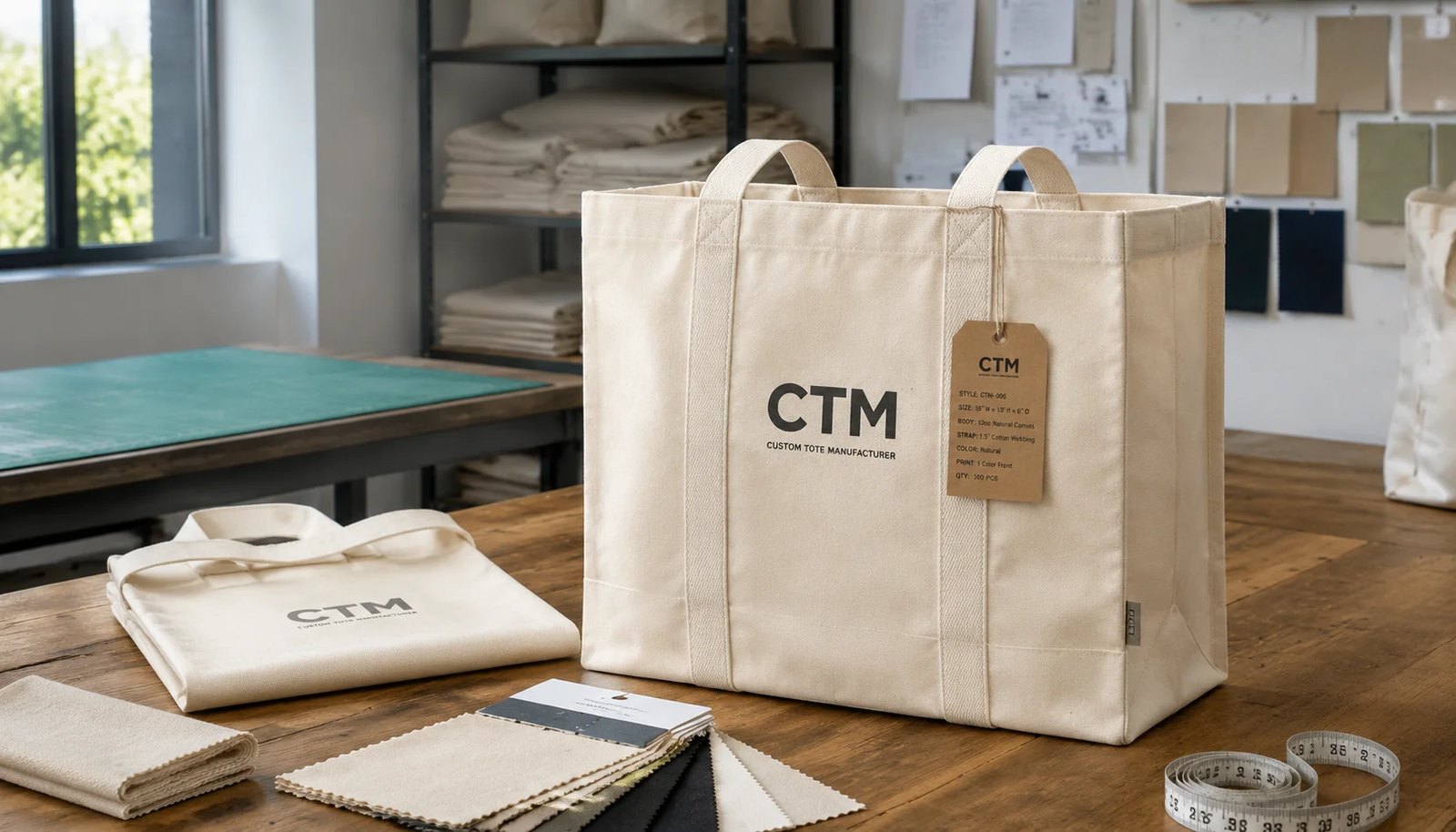
Why this RFQ often goes wrong for natural grocer tote programs
Canvas grocery totes look simple, but quote gaps usually start because buyers describe them like generic promotional bags while stores use them like working retail carriers. A natural grocer program often needs a bag that can carry produce, jars, boxed goods, and repeat weekly use. If the RFQ only says canvas tote with logo, suppliers will fill in the blanks differently: one may quote 8 oz cotton, another 12 oz canvas, another a blend, and all three prices will look far apart without being directly comparable.
The second problem is that grocery tote programs usually have chain-specific details: eco positioning, store logo variations, backroom counting, and freight sensitivity. That means construction, print method, and packing matter as much as the unit price. A clean RFQ should remove hidden variables before sampling starts. The goal is not to make the document longer. The goal is to make supplier assumptions visible so you can compare offers on the same base.
- Typical missing RFQ fields: finished GSM, gusset depth, handle width, print size, and carton pack.
- The biggest avoidable cost error is comparing a flat 8 oz promo tote against a gusseted 12 oz grocery tote.
- The biggest avoidable quality error is approving a sales sample that was not made from bulk fabric and final print method.
Choose the right canvas spec before requesting price
For natural grocer use, the fabric decision should start from carrying need, not from a target price alone. In most grocery tote programs, 10 oz to 12 oz finished canvas is the practical range, with 12 oz, roughly 340 GSM, being the safer default when the bag will regularly carry glass bottles, cans, or multiple boxed items. Lighter 8 oz to 9 oz bags can work for promotional reuse or lighter purchases, but they feel less stable, collapse more easily, and tend to show seam stress faster at the handle join.
Size and gusset shape also affect real carrying performance. A common grocery tote shape is a medium-to-large body with both side and bottom gussets so the bag opens easily at checkout and stands better on a counter or in a car trunk. Flat totes are cheaper and easier to pack, but they do not perform the same way in grocery use. If your stores plan to sell the bag as a reusable shopping staple rather than a seasonal giveaway, specify side and bottom gussets from the start.
- Practical starting spec: 340 GSM natural canvas, full side and bottom gusset, top hem, reinforced handles.
- If the retail position is premium, consider cotton webbing handles for better hand feel and load comfort.
- If shade consistency matters, note that natural unbleached canvas can vary slightly lot to lot.
Print method decisions that change both price and reject risk
Most natural grocer tote designs are best quoted in one- or two-color screen print. Water-based screen print usually gives the right retail look on canvas: lower plastic feel, solid logo coverage, and cost control at volume. It is especially suitable for straightforward logos, store names, produce graphics, and simple slogans. If buyers send artwork with thin lines, distressed effects, or detailed illustrations without flagging those features, one supplier may still quote standard screen print while another will move to digital or more screens, creating a pricing gap that is really an artwork issue.
Natural canvas is not a perfectly white paper surface. Print color can read warmer because the base cloth is cream or beige. If exact Pantone matching is important, state that in the RFQ and approve against physical strike-off or PP sample, not only artwork on screen. Also define print area in millimeters. A front logo at 220 x 220 mm is not the same cost as a near-full-panel print, even if both are described casually as one-color front print.
- Water-based screen print is the standard cost-performance choice for most canvas grocery totes.
- Large dark print areas can increase drying time, setoff risk, and lead time pressure in humid weather.
- A woven side label or inside care label adds small cost but helps retail presentation and traceability.
MOQ logic: how to structure multi-store or multi-logo orders
MOQ should be managed by production logic, not only by negotiation pressure. A factory buys fabric by lot, cuts by marker, and sets up print by artwork. If a natural grocer group wants the same bag body for several store logos, buyers can often reduce cost by standardizing the base canvas, dimensions, handle, and packing while splitting only the front print. That lets the factory run one fabric booking and one sewing base, then separate by print design or final assortments.
Problems start when buyers split small quantities across too many colorways or logo versions. Even if the total order is large, each logo still creates setup, handling, and packing complexity. A supplier may accept the split but recover the cost through higher unit price, longer lead time, or looser print tolerance. In the RFQ, ask for MOQ by total order, by color, and by artwork version. That gives a clearer picture than one headline MOQ number.
- Best cost structure: shared body spec across all stores, limited logo variations, common carton pack.
- If store-specific barcodes are needed, mention them early because they affect final packing labor.
- Very low MOQ per logo often makes digital print look attractive, but bag body cost still dominates.
What a usable supplier quote should include
A good quote for wholesale canvas grocery totes should separate cost drivers instead of hiding them in one line. At minimum, buyers should see base bag price, print cost by method and color count, sample charges, label or hangtag charges if any, packing adders, testing if requested, and trade term assumptions. Without this structure, later changes such as handle upgrade, larger print, or lower carton count become difficult to price fairly because there is no baseline.
Quote data also needs enough operational detail to support freight planning. Carton size, units per carton, gross weight, and estimated container loading quantity directly affect landed cost. It is common for two factories to quote similar FOB bag prices while one packs inefficiently, causing a meaningful freight penalty per unit. Buyers who only compare the ex-factory or FOB line often miss this.
- Request unit price at 3 volume breaks, such as example quantities for pilot, core, and annual program.
- Require carton dimensions in centimeters and gross weight per carton in kilograms.
- Ask whether the quote assumes individual polybag, bulk polybag, or no inner polybag.
Sample approval: what must be frozen before bulk production
Sample approval for canvas totes should move through stages with a clear purpose. A digital layout is for visual placement only. A counter sample is for shape, basic size, and construction review. The pre-production sample should be made from the intended bulk fabric, with final print method, real handle material, actual labels, and target packing. If the PP sample uses substitute cloth or a different print process, the approval loses most of its value.
For natural grocer buyers, the PP sample should be reviewed like a mini production lot. Put actual grocery items inside, inspect handle comfort, foldability, print appearance on natural canvas, and shelf presentation if the bag is sold at checkout. This is also where practical issues surface: does the gusset open well, does the print crack when folded, does the carton pack create deep crease marks, and does the barcode placement work in stores.
- Approve measurement points on a simple spec sheet with tolerances, not only on email comments.
- Use the PP sample to lock print size, logo position, handle drop, and label placement.
- If retail presentation matters, review one packed sample exactly as it will arrive in the carton.
QC thresholds that prevent the usual bulk claims
Most bulk claims on canvas grocery totes come from four areas: fabric substitution, print inconsistency, handle weakness, and packing mistakes. These can be reduced by setting acceptance criteria before production starts. For example, if the fabric is meant to be 340 GSM finished, the buyer should state the tolerance and whether testing is needed. If the print must be centered, define the acceptable position deviation. If the bag is sold in stores rather than used only as transport packaging, front-panel fabric defects should be more tightly controlled.
Handle strength deserves more attention than many RFQs give it. The tote may look correct at inspection but still fail under grocery loads if reinforcement is too short, stitch density is inconsistent, or the webbing edge frays. A practical QC note is to specify reinforcement style at the handle base and review seam condition at gusset corners. These are small sewing details, but they decide whether the bag becomes a long-term reusable item or an early return problem.
- Body size tolerance should be written in centimeters and measured after finishing and printing.
- Reject standards should cover skipped stitches, open seams, heavy stains, holes, and major print smears.
- If rustic slub texture is acceptable on natural canvas, say so; otherwise inspectors may apply different standards.
Packing plan: where warehouse and freight costs quietly increase
Packing is often treated as a final admin detail, but for grocery totes it directly affects labor cost, freight efficiency, and appearance on arrival. Buyers should choose carton counts based on receiving logic. For chain distribution centers or import warehouses, 25 or 50 pieces per inner pack often works better than random bulk counts because recounting is faster and stock transfers are cleaner. If stores need shelf-ready bundles or barcode-separated assortments, the factory needs that instruction before production packing starts.
Carton dimensions and compression matter as well. Canvas bags can be packed densely, but over-compression creates hard fold lines and can mark large printed panels, especially in humid conditions or when ink cure time is short. On the other hand, underfilled cartons waste container space. A practical RFQ asks for recommended pack count, carton size, and gross weight, then compares suppliers on landed cost per bag rather than unit price only.
- State whether individual polybags are banned for sustainability or retail handling reasons.
- Set a carton gross weight cap if your warehouse or retail channel has manual handling limits.
- Ask for photos of packed export cartons during sample stage for barcode and mark review.
Lead time planning and the delays buyers can actually prevent
Canvas tote lead time is usually less about sewing capacity alone and more about approval sequencing. Fabric booking, print screen preparation, label confirmation, and carton mark approval all sit upstream of final sewing and packing. If artwork is still moving after the fabric is booked, the delay may be manageable. If size, gusset, or handle length changes after the sample is approved, the whole cutting plan may need to shift. That is why RFQs should separate sample lead time from bulk production lead time and define when the production clock starts.
Peak season pressure adds another layer. Before major retail periods, factories can still accept orders but become less flexible on small changes, split assortments, and rush repacking. Natural grocer buyers often combine seasonal promotions with evergreen core bags, so it helps to reserve fabric and capacity on core SKUs early, then leave artwork-specific details for the final stage where possible. That approach works only if the bag body spec is standardized.
- Use a milestone plan: artwork freeze, PP sample approval, deposit, bulk start, inspection ready, vessel cut-off.
- Do not treat quoted lead time as starting from PO date unless the factory explicitly says so.
- Buffer extra days for dark prints, humid weather drying, and custom labels or hangtags.
How to compare landed cost instead of chasing the cheapest bag
A lower bag quote can become a higher landed cost if the fabric is lighter, the carton pack is inefficient, or the reject rate is higher. For procurement teams, the more useful comparison is cost per usable delivered bag. That includes FOB price or ex-factory price, estimated freight from carton volume, expected inspection and testing cost, and probable rework risk if the supplier is light on construction control. Even a small packing difference can matter at volume because totes are low-unit-value items with meaningful cubic impact.
In practice, buyers should compare at least three scenarios: a lighter promo-style canvas, a standard grocery-grade canvas, and a premium reinforced version. The standard grocery-grade version often wins because it balances sell-through quality, repeat use, and freight efficiency. The premium version can make sense when the bag is sold as branded merchandise at a higher retail price. The lightweight version only makes sense if the use case is clearly promotional and the load expectation is low.
- Compare quote scenarios on the same bag dimensions and print area whenever possible.
- Include expected container loading quantity in your quote comparison sheet.
- If two quotes differ sharply, the first place to check is finished GSM and gusset construction.
Specification comparison for buyers
| Spec decision | Recommended option | When it fits | Buyer risk to check |
|---|---|---|---|
| Fabric weight | 12 oz canvas, about 340 GSM | Best balance for grocery loads, repeat retail use, and stable print surface | Some factories quote lighter cloth as 12 oz by unfinished weight or before washing; require finished GSM tolerance and fabric test basis |
| Bag construction | Bottom gusset plus side gussets, stitched turned seams | Needed when the bag must stand better, carry boxed items, or hold produce jars | Flat bags look cheaper but collapse in use; gusset depth must match shelf-pack and carton count assumptions |
| Handle material | Self-fabric handles or cotton webbing 25-30 mm wide | Self-fabric suits lower cost programs; webbing suits heavier loads and premium retail feel | Handle drop and attachment area often change after sample stage; weak reinforcement causes failures at checkout loads |
| Print method | Water-based screen print, 1-2 spot colors | Most cost-effective for natural grocery branding on medium to dark canvas | Fine lines, halftones, and exact Pantone matches may need plastisol, discharge, or digital print with different cost and hand feel |
| Logo placement | Centered front print with fixed print area noted in mm | Best for mainstream store programs and easy inspection | Suppliers may quote on approximate artwork size; print area beyond standard screens can raise setup and reject risk |
| MOQ route | Bulk by colorway and print design, with shared base fabric across SKUs | Good for chain programs needing several store versions without separate fabric purchases | Low split MOQ across many stores can increase waste, setup cost, and lead time if not grouped by same fabric and print |
| Inner packing | Flat packed 25 or 50 pcs per polybag, then export carton | Works for retail backroom counting and importer warehouse handling | Overpacked cartons reduce CBM efficiency and can crush printed panels; underpacked cartons cause shape distortion and recount labor |
| Pre-production sample path | Digital artwork approval plus one physical PP sample from bulk fabric | Important when fabric shade, print opacity, and gusset proportions matter | Approving only a mockup or salesman sample leads to mismatched bulk look because real bulk fabric and print paste behave differently |
| Factory source route | Direct bag factory with in-house cutting and sewing, outsourced printing only if audited | Best for stable quality, faster corrections, and clearer responsibility on construction defects | Trading firms can be useful for mixed-category consolidation, but accountability on fabric, print, and packing errors must be written clearly |
Buyer checklist before sampling
- State finished bag size in millimeters: width x height x side gusset x bottom gusset, with handle drop and handle width.
- Specify finished fabric type and target GSM, for example cotton canvas 340 GSM finished, natural unbleached, with acceptable tolerance.
- Define load expectation such as everyday grocery use with jars, produce, and boxed goods; note if a formal load test is required.
- Attach artwork with print size in millimeters, Pantone references, print side count, and whether slight shade variation on natural canvas is acceptable.
- Confirm seam construction, reinforcement points, and handle attachment method, especially if using webbing or contrast handles.
- List sample stages required: digital layout, counter sample, pre-production sample from bulk fabric, and shipping sample if needed.
- Set packing format: units per polybag, units per carton, target carton dimensions, gross weight cap, barcode labels, and carton marks.
- Request quote separation for sample charge, print setup, bulk unit price, packing adders, testing, and freight terms.
- Ask for lead time by stage: lab dip or fabric confirmation, sample days, production days after deposit and artwork approval, inspection readiness, and port cut-off.
- Require QC criteria covering measurement tolerance, print position tolerance, visible stains, seam defects, and carton count accuracy.
Factory quote questions to send
- What finished fabric GSM are you quoting, and is it measured before or after washing, printing, and finishing?
- Is the quoted canvas made from combed cotton, regular cotton, or a cotton blend, and what is the weave construction?
- Does your price include side and bottom gussets, inside overlock, turned top hem, and handle box-x reinforcement?
- What print method is included in the quote, how many colors, what print size, and what artwork limitations affect pricing?
- What is your MOQ by color, by print design, and by total order if several store logos share the same base bag?
- Can you make a pre-production sample from bulk fabric and final print method, and will that sample fee be credited in bulk?
- What carton pack are you quoting, what are the carton dimensions and gross weight, and how many bags fit per 40HQ by your estimate?
- Which parts are done in-house and which are subcontracted, especially printing, washing, label sewing, and final packing?
- What in-line and final inspections do you run for stitch quality, print registration, needle control, and carton count?
- What is the realistic production lead time in peak season if artwork approval or fabric booking slips by one week?
Quality-control points to confirm
- Finished bag measurements within agreed tolerance, typically +/- 1 cm on body dimensions and +/- 0.5-1 cm on handle drop depending on size.
- Fabric weight and hand feel consistent with approved sample; no substitution of lighter canvas hidden by starch or stiff finishing.
- Print placement centered and level within agreed tolerance; print color and opacity consistent across cartons.
- No major oil marks, weaving defects, holes, broken yarns, or heavy slubs on the front print area unless rustic fabric character is pre-approved.
- Handle reinforcement stitches complete with no skipped stitches, loose threads, open seams, or twisted handles.
- Seam strength suitable for intended grocery use; stress points at gusset corners and handle joins reviewed during inspection.
- Carton count, barcode labels, carton marks, and assortment split exactly match packing list and purchase order.
- Metal contamination and needle control procedure documented if the retailer requires it, even though the product is textile-based.
- Moisture-sensitive packing checked before container loading; cartons must be dry and not packed immediately after printing if ink cure time is incomplete.