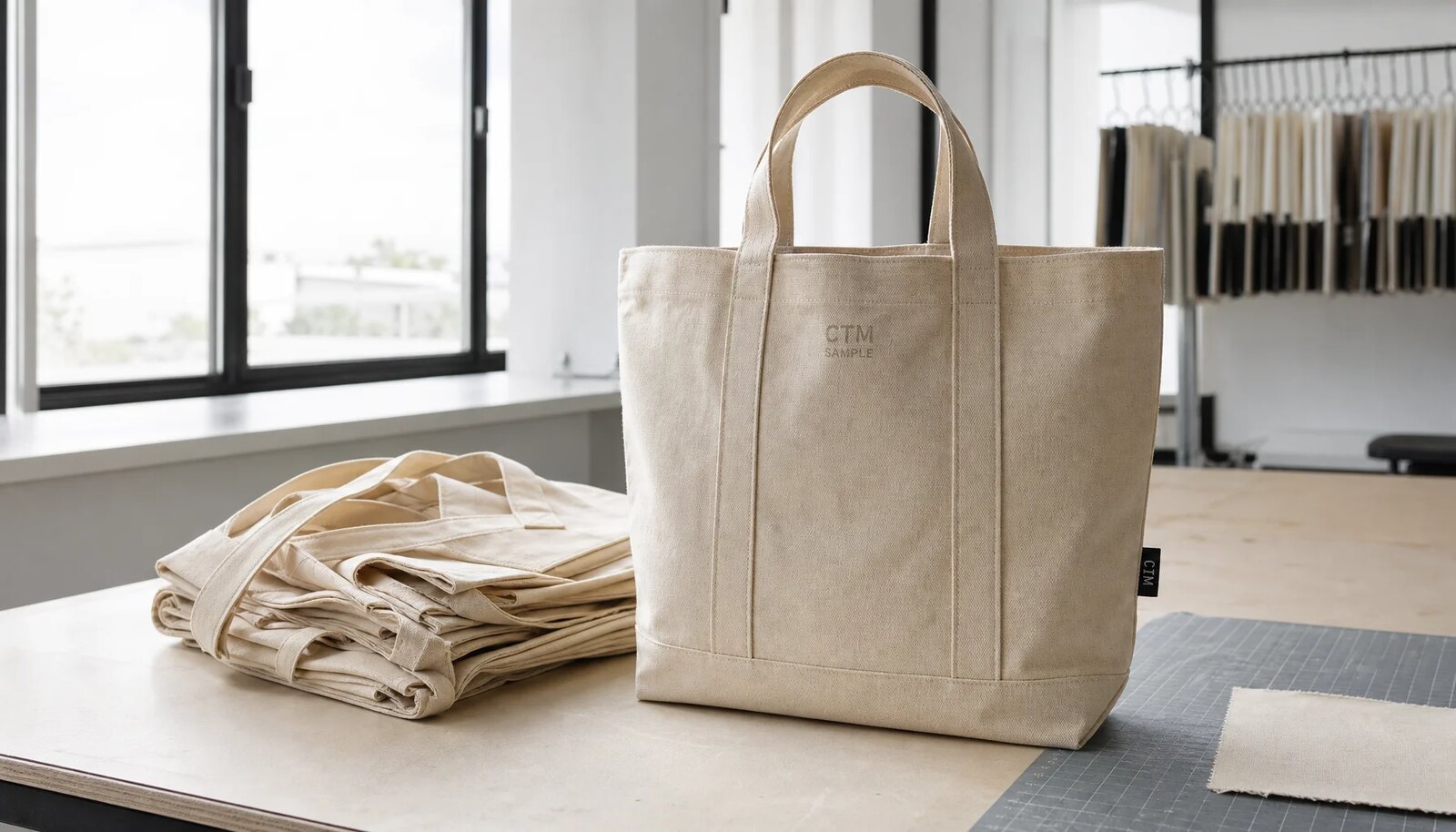
Start With the Real Use Case, Not Just a Tote Size
Canvas grocery totes for farmers market vendors have a harder job than many promotional bags. They may be sold at a stall, used as a checkout bag, bundled with a CSA pickup, or given to shoppers by a regional food co-op. On a busy market day, that same bag might carry apples, bread, leafy greens, eggs, flowers, canned goods, honey, and glass jars. A tote designed only to hold a catalog and a T-shirt is not the same product.
This is where many RFQs go wrong. A buyer sends a short note asking for a natural canvas tote with a logo, and suppliers fill in the blanks. One factory may price a stock 10 oz tote with short handles. Another may quote a custom 12 oz grocery tote with a full gusset and shoulder handles. A third may include individual polybags, while another assumes bulk packing. The lowest number on the sheet may simply be the least complete quote.
A better RFQ describes the carrying job, the selling environment, and the minimum construction standard. If the tote will be reused weekly, it needs reasonable load performance and durable handle attachment. If it will be sold as merchandise, print finish, odor, fold quality, tags, and carton presentation matter more. The goal is not to make every bag overbuilt. The goal is to make sure every supplier prices the same fabric, same construction, same decoration, same packing, and same delivery responsibility.
- State whether the tote is a reusable grocery bag, vendor merchandise item, gift-with-purchase, CSA pickup bag, or low-cost promotional giveaway.
- Describe what it must carry: produce, bread, flowers, bottles, glass jars, eggs, pantry items, or mixed market purchases.
- Tell suppliers the intended working load instead of using loose words like strong, heavy-duty, or premium.
- Separate must-have requirements from optional upgrades, so suppliers do not guess where to save cost.
- Require suppliers to list all assumptions, substitutions, and exclusions directly in the quote.
Lock the Finished Bag Specification Before You Ask for Price
A useful RFQ starts with finished-product measurements. Finished size is what the buyer receives after cutting, sewing, pressing, washing, and folding. It is not the same as cut-panel size. For canvas grocery totes, procurement should specify finished width, finished height, gusset depth, handle drop, handle width, print area, and label location in millimeters. A simple technical drawing prevents a surprising amount of back-and-forth.
Common farmers market grocery totes often fall around 380-430 mm wide, 350-400 mm high, and 100-180 mm deep. That range is only a starting point. A flower vendor may prefer a taller open tote. A jam, sauce, or honey brand may need a wider base and lower height so jars sit more securely. A produce vendor may care more about volume and easy loading than shelf structure. If the bag needs to stand upright on a display table, bottom construction matters as much as overall size.
Tolerances should also be written into the RFQ. Canvas totes are sewn goods, so exact molded-part precision is not realistic. A practical starting point is to ask suppliers whether they can hold finished width and height around +/- 10 mm, gusset around +/- 5-10 mm, and print placement around +/- 5 mm, subject to sample approval. If the bag must fit a retail tray, mailer, shelf, or display fixture, say so early. Tight tolerances can affect sewing time, inspection effort, and reject rate.
- Include finished width, height, gusset, handle drop, handle width, seam reference, and print placement on one drawing.
- Use millimeters for factory clarity, even if your internal product brief also uses inches.
- Ask suppliers to confirm their proposed dimensional tolerance before sample approval.
- Clarify whether the tote is flat, boxed-bottom, T-gusset, side-gusset, or full bottom-gusset construction.
- If the tote must fit a shelf, display bin, mailer, or carton, include those limits in the RFQ.
Specify Canvas Weight, Finish, and Fiber Content Without Ambiguity
Fabric weight is one of the biggest cost drivers, yet it is often described too casually. Canvas may be quoted in ounces per square yard or GSM. As a rough conversion, 10 oz is about 339 GSM, 12 oz is about 407 GSM, and 14 oz is about 475 GSM. Actual mill values can vary by weave and finishing, so the RFQ should ask for the exact GSM, the tolerance, and whether weight is measured before or after washing or finishing.
For farmers market grocery totes, 10 oz canvas may work for lighter event bags or low-cost giveaways. A 12 oz canvas is often a stronger baseline for reusable grocery programs because it gives more body and supports cleaner screen printing. A 14 oz canvas can make sense for sturdier retail totes or bags expected to carry heavier jars and bottles. Heavier fabric is not automatically the best choice, though. It raises cost, carton weight, and freight volume. It can also feel too stiff if the bag is meant to fold small.
Finish needs the same clarity. Natural unbleached canvas has cotton flecks and visible shade variation. Bleached canvas offers a cleaner print surface but creates a different look. Dyed canvas requires lab dip or swatch approval and may carry higher minimums. Washed canvas feels softer but can shrink and vary more. If recycled content, organic cotton, or other sustainability claims are part of the program, require supporting documents before those claims appear on hangtags, websites, or retail packaging.
- Ask for both oz/yd² and GSM, plus the acceptable GSM tolerance for bulk production.
- State natural, bleached, dyed, washed, or enzyme-washed fabric; do not let the supplier choose the finish silently.
- Require a fabric swatch, lab dip, or approved shade band for dyed or color-sensitive programs.
- Confirm fiber content and any certification requirements before using claims on retail hangtags or product pages.
- Avoid vague terms such as thick canvas or eco canvas unless they are tied to measurable specifications.
Engineer Handles, Seams, and Gussets for Grocery Loads
A grocery tote rarely fails because the center of the canvas panel gives up first. More often, the problem starts at the handle attachment, bottom seam, or gusset corner. Those areas need their own RFQ lines. Define handle material, finished handle width, handle drop, reinforcement method, seam type, and gusset style. For shoulder carry, many programs use a handle drop around 250-320 mm, but the right length depends on bag height and shopper experience.
Do not write reinforced handles and assume the supplier understands the standard. Ask for the actual construction: box-X stitching, cross-stitching, bar-tacks, rivets plus stitching, or another approved method. For canvas grocery totes, box-X or bar-tack reinforcement at each handle stress point is a reasonable expectation. If the bag will carry heavier market purchases, the handle should extend far enough into the body panel to spread load, and the reinforcement area should be checked closely during inspection.
The gusset determines usable capacity and stability. A flat tote is cheaper but less practical for bulky produce, loaves of bread, or jars. A side and bottom gusset creates a more useful grocery shape. If the bag needs to stand upright on a table or shelf, request a boxed bottom, stronger bottom seam, or optional removable base board. Each option changes price and packing density, so include it in the first RFQ instead of adding it after sampling.
- Specify handle material, finished width, handle drop, and reinforcement method in the base quote.
- Use concrete language such as 30 mm cotton webbing handle with box-X stitching instead of strong handle.
- Ask for photos of the supplier’s actual handle attachment and bottom seam construction.
- Set a target working load, commonly 8-12 kg for grocery use, and ask how the supplier validates it.
- Confirm whether a base board, bottom reinforcement, or boxed gusset is included or quoted as an option.
Use an RFQ Matrix Suppliers Can Complete Without Guessing
A strong canvas grocery tote RFQ is easier to compare when it is built as a table instead of a long email. The first block should cover the product: finished size, canvas weight, fabric finish, handle, gusset, seams, label, and working load. The second block should cover decoration: artwork file, number of colors, print method, ink type, print size, placement, and strike-off requirement. The third block should cover commercial terms: quantity, MOQ ladder, sample cost, production lead time, packing, Incoterm, port, destination, and payment terms.
Ask suppliers to break out the quote. A single all-in unit price can hide important differences. Request separate lines for blank bag cost, print setup, per-color print charge, second-side print, woven label, hangtag, individual packing, master carton if charged separately, and freight if included. This makes it easier to see whether a supplier is truly efficient or simply omitting a requirement that another supplier included.
Add a clear no-substitution instruction. It does not need to sound legalistic, but it should be direct: no change to fabric weight, weave, color, handle construction, print method, label, packing, carton size, or production factory without written buyer approval. The approved pre-production sample should be treated as the production standard, not as a loose reference.
- Request a quote matrix with price breaks at relevant quantities such as 500, 1,000, 3,000, 5,000, and 10,000 pieces.
- Ask for MOQ by fabric color, print design, handle color, label type, and packing style.
- Require suppliers to state whether the quote uses stock fabric, stock blanks, or custom-cut production.
- Ask suppliers to list all exclusions, tooling charges, screen charges, sample charges, and freight assumptions.
- State that unapproved substitutions are not accepted after sample approval or PO placement.
Choose Decoration for Durability, Artwork, and Repeat Orders
Screen printing is usually the most practical decoration method for canvas grocery totes when the artwork is a one-color or two-color logo, market name, slogan, or simple illustration. It can be economical at volume and durable when the ink is properly selected and cured. On natural canvas, opacity matters because cotton flecks and texture can reduce perceived sharpness. A digital mockup is not enough; request a print strike-off on the actual canvas planned for production.
Heat transfer and digital printing can be useful for short runs, gradients, full-color artwork, or frequent design changes. They are not automatically poor choices, but they need testing against the tote’s real life. Farmers market bags rub against tables, crates, produce bins, car trunks, and other purchases. If the decoration cracks, peels, or abrades quickly, the buyer may still get complaints even if the sewing is acceptable.
Translate creative artwork into production language. Provide vector files where possible, identify Pantone or spot colors, define print size in millimeters, and show placement from the top edge, side seam, or centerline. If artwork wraps near a seam or gusset, ask the supplier to confirm feasibility because canvas movement during sewing can make perfect alignment difficult. Woven labels, side tabs, and sewn patches are good options when the brand wants a more premium look or a decoration less affected by fabric texture.
- Use screen print for simple solid-color logos and repeatable volume programs.
- Use heat transfer or digital print when artwork complexity justifies it, but require rub and adhesion checks.
- Specify Pantone references, print size, print position, print side, and placement tolerance such as +/- 5 mm.
- Approve a strike-off on the same fabric color and weight planned for production.
- Quote second-side print, side-gusset print, woven labels, patches, and hangtags as separate cost lines.
Run Sampling in Stages Instead of Approving Too Early
Sampling should remove uncertainty one step at a time. If the buyer is still deciding on size, structure, or fabric handfeel, begin with an existing reference sample or a blank construction sample. That confirms the tote body before artwork adds another variable. Once the construction is close, move to a print strike-off or decorated sample. Final approval should be a pre-production sample made with the actual canvas, handle, stitching, print, label, folding method, and packing planned for bulk production.
Every approved sample needs written notes. Record the sample date, version number, measured dimensions, fabric weight, artwork file name, approved color references, handle changes, print placement, and any accepted deviation. If a gusset or handle drop changes after sample review, update the production file. Otherwise, the factory may follow an older sample while the buyer expects the revised email instruction to control production.
Discuss lead time at each stage. A blank construction sample can be faster than a fully printed pre-production sample. Custom fabric, dyed canvas, woven labels, and special retail packing can all extend the calendar. In the RFQ, ask for sample lead time in working days after confirmed artwork and payment, plus bulk lead time after pre-production sample approval. This wording matters because many delays happen before the factory considers the order officially released.
- Use an existing sample to evaluate supplier capability, not as final production approval.
- Approve blank construction before print if the tote shape, gusset, or handle is new.
- Require a strike-off for color, opacity, registration, and curing before bulk printing.
- Use the pre-production sample as the production control sample for sewing, printing, labeling, folding, and packing.
- Keep one signed physical sample or approved photo pack available for QC and receiving teams.
Set Quality-Control Rules Before Production Starts
Canvas tote QC should focus on function, brand presentation, and receiving accuracy. Functional defects include broken stitches, missing reinforcement, seam pop, fabric tears, and handle failure. Presentation defects include stains, strong odor, crooked print, shade mismatch, ink bleed, poor folding, and loose threads. Receiving defects include wrong carton quantity, missing labels, unreadable barcodes, incorrect carton marks, and pack counts that do not match the purchase order.
Many buyers use AQL sampling for soft goods inspections, often with AQL 2.5 for major defects and AQL 4.0 for minor defects. The exact standard should be selected by the buyer and stated in the PO. Critical defects, such as mold, unsafe contamination, or a structural failure that makes the bag unusable, should generally have zero tolerance. The important point is simple: define the defect categories before shipment. Good quality is not a measurable inspection standard.
The inspection checklist should include dimension measurement, GSM verification where practical, stitch inspection, handle attachment inspection, load check, print inspection, odor check, packing check, and carton count. For load testing, ask for a practical working-load check such as filling the tote to 8-12 kg and hanging or carrying it for a defined period, followed by inspection of seams and handles. For print, check registration, placement, curing, rub resistance, and ink coverage against the approved strike-off.
- Classify defects as critical, major, or minor before production starts.
- Set measurable tolerances for dimensions, print placement, fabric weight, and carton quantity.
- Inspect load-bearing areas first: handles, handle attachment, bottom seam, and gusset corners.
- Check print cure and rub resistance, not only visual alignment in factory photos.
- Require a corrective-action plan if inspection finds repeated stitching, print, odor, or packing defects.
Treat Packing, Labels, and Cartons as Part of the Product
Packing is not an afterthought in B2B procurement. Bulk-packed totes may be best for farmers market associations, distributors, and wholesale programs because they reduce packaging material and speed unpacking. Individual polybags may be needed for retail resale, ecommerce fulfillment, or shelf protection, but they add cost, labor, waste handling, and sometimes compliance requirements. The RFQ should state exactly whether the tote is bulk folded, individually bagged, paper-banded, hangtagged, barcoded, or packed with an insert card.
Carton planning affects both freight and receiving. Ask suppliers to quote pieces per carton, carton dimensions, gross weight, net weight, and total CBM. Canvas totes are not fragile, but overpacked cartons can deform bags, crush hangtags, or exceed warehouse handling limits. Underpacked cartons raise freight cost. If the buyer has pallet limits, carton weight limits, or distribution-center routing rules, include them before production begins.
Labels need to match the destination market and buyer requirements. This may include country-of-origin marking, fiber content labeling, suffocation warning language for polybags, barcode labels, PO number, SKU, color code, carton number, and carton quantity. If cartons are routed to several market locations or regional warehouses, wrong marks can cost more operational time than a small sewing defect. The pre-production sample or packing mockup should include the final fold, inner pack, barcode, hangtag, and carton mark format.
- State pieces per inner pack and pieces per master carton in the RFQ.
- Request estimated carton size, gross weight, net weight, and CBM for landed-cost calculation.
- Specify carton marks with PO number, SKU, description, quantity, country of origin, and carton sequence.
- Confirm polybag thickness, suffocation warning requirements, and barcode placement if individual packing is used.
- Require the supplier to photograph packed cartons and carton labels before shipment release.
Compare Supplier Routes by Landed Cost, Not Just Unit Price
Canvas grocery totes can be sourced through a direct cut-and-sew factory, trading company, sourcing agent, domestic decorator, or stock-bag supplier with local printing. Each route solves a different problem. A direct factory is often better for custom dimensions, repeat orders, and tighter control of fabric and sewing. A trading company can help when the buyer is consolidating totes with packaging or other accessories. A domestic decorator may be useful for a small test run or urgent launch, though unit cost can rise at larger quantities.
Compare every quote on the same landed-cost basis. EXW is not the same as FOB, and neither is the same as delivered warehouse pricing. The landed-cost model should include bag unit cost, decoration, screen/setup charges, labels, packing, inland freight, export fees, ocean or air freight, duty, brokerage, destination handling, and warehouse receiving. Ask for carton dimensions and CBM early because bulky cotton bags can create freight differences that are invisible in the unit price.
MOQ also needs a commercial reality check. A higher MOQ can reduce unit cost, but it may create excess inventory if the market season is short or the artwork is tied to one event year. A lower MOQ is safer for a pilot, but setup charges and local decoration can make unit economics unattractive. Request a price ladder and separate MOQ rules by fabric, print version, and packaging. Then procurement and merchandising teams can decide whether to launch one standard SKU, several vendor-specific artwork versions, or a smaller test order.
- Normalize every quote to the same Incoterm, destination, pack method, and artwork version count.
- Separate product cost from print setup, label cost, packing cost, and freight cost.
- Ask who owns QC, rework, and replacement cost if defects are found before shipment.
- Use MOQ ladders to decide whether multiple artwork versions are commercially sensible.
- Do not approve a low quote until fabric weight, handle construction, print method, and packing are confirmed.
Specification comparison for buyers
| RFQ item | Recommended specification to request | Typical tolerance or quote detail | Procurement risk to control |
|---|---|---|---|
| Finished bag size | Quote finished dimensions, not cut-panel size; common grocery tote range is about 380-430 mm W x 350-400 mm H with 100-180 mm gusset | State dimension tolerance, often +/- 10 mm for width/height and +/- 5-10 mm for gusset, subject to approved sample | Suppliers may measure from different points unless the drawing clearly marks width, height, gusset, and handle drop |
| Canvas weight | Specify oz/yd² and GSM; 12 oz is roughly 407 GSM and 14 oz is roughly 475 GSM, depending on mill conversion and finish | Ask supplier to state GSM tolerance, commonly around +/- 5%, and whether weight is measured before or after washing/finishing | A vague heavy canvas quote can become a thinner promotional tote if fabric weight is not locked down |
| Fabric finish | Call out natural unbleached, bleached, dyed, enzyme-washed, or washed canvas separately | Require shade approval against lab dip, approved bulk swatch, or shade band; specify no strong chemical or mildew odor | Natural cotton shade varies by lot; repeat orders may not match if the acceptable shade range is not defined |
| Handle construction | Specify self-fabric or cotton webbing handles, 25-38 mm finished width, and 250-320 mm handle drop for shoulder carry when needed | Require box-X, cross-stitch, or bar-tack reinforcement at every handle attachment; define stitch density such as 7-9 SPI if needed | Handle attachment is usually the first practical failure point when shoppers carry produce, jars, and bottles |
| Load expectation | State intended working load, for example 8-12 kg for mixed produce and packaged foods, and require a sample load check | Ask what in-house load test is included: static hang time, pull test, carrying test, and seam inspection after loading | Fabric weight alone does not prove strength; seam construction and reinforcement determine real performance |
| Print method | Use screen print for 1-3 solid colors; heat transfer or digital print for complex artwork; woven label for premium branding | Require Pantone references, print area in mm, placement tolerance such as +/- 5 mm, and a printed strike-off before bulk | Unapproved print choices can crack, bleed, misregister, feel plasticky, or shift color across repeat orders |
| MOQ structure | Ask MOQ separately for blank bags, printed bags, custom size, custom-dyed fabric, label, and individual packing | Request price breaks at 500, 1,000, 3,000, 5,000, and 10,000 pcs if those quantities are relevant | A low MOQ may be based on stock blanks, while a higher MOQ may reflect true custom cut-and-sew production |
| Packing format | Define bulk pack, inner polybag, individual polybag, paper band, hangtag, insert card, barcode label, and carton count | State pieces per inner and master carton; require carton marks with PO, SKU, quantity, gross/net weight, and carton number | Wrong carton labels or pack counts can delay warehouse receiving even when the totes themselves pass inspection |
| Inspection plan | Request pre-shipment inspection against AQL or a buyer-defined checklist for dimensions, stitching, print, odor, packing, and carton count | For general consumer goods, buyers often use AQL 2.5 for major defects and 4.0 for minor defects, but the buyer should define the rule | Without agreed acceptance criteria, defect discussions become subjective after goods are already finished |
Buyer checklist before sampling
- Define the selling role: checkout bag, reusable retail tote, vendor merchandise, CSA pickup bag, giveaway, or bundled promotion.
- Provide a dimensioned drawing with finished width, height, gusset, handle drop, handle width, print area, and label position in millimeters.
- Specify canvas weight in both oz/yd² and GSM where possible, including tolerance, finish, color, and whether the fabric is natural, bleached, dyed, or washed.
- State the required construction: side seam type, bottom seam, gusset style, handle material, handle width, handle drop, and reinforcement method such as box-X or bar-tack.
- Set a target working load, such as 8 kg, 10 kg, or 12 kg, and ask the supplier to confirm their proposed construction is suitable for that use.
- List artwork requirements: vector file format, Pantone or spot-color references, number of colors, print size, placement tolerance, and whether a strike-off is required.
- Separate costs for the bag body, printing, screen/setup charges, labels, hangtags, inner packing, master cartons, and sample fees.
- Request MOQ and price ladders by quantity, artwork version, fabric color, handle color, and packing format.
- Confirm sample sequence: existing reference sample, blank construction sample, print strike-off, and pre-production sample made with final materials.
- Define inspection criteria for dimensions, GSM, fabric shade, stitch defects, seam strength, print registration, print curing, odor, stains, and packing accuracy.
Factory quote questions to send
- Are you quoting a made-to-order bag or decorating a stock blank, and where are the bags cut and sewn?
- What exact canvas weight are you quoting in oz/yd² and GSM, and what fabric weight tolerance will you commit to in bulk production?
- Is the fabric natural unbleached cotton, bleached cotton, dyed canvas, recycled cotton blend, or another composition, and can you provide fiber content details?
- What weave and finish are included: plain weave canvas, duck canvas, washed canvas, enzyme wash, or softener finish?
- What are the finished dimensions, gusset style, handle drop, and handle width you are quoting, and what measuring tolerance applies?
- What seam construction will be used for the side seams, bottom seam, gusset, and handle attachment? Can you provide photos of the actual stitch pattern?
- What stitch density do you normally use for this tote, and how do you control skipped stitches, broken threads, and loose ends?
- What working load do you recommend for this construction, and what in-house load or pull test can you perform before shipment?
- Which print method are you quoting, what ink type is used, and how many colors are included in the base unit price?
- What is the surcharge for each additional print color, screen, artwork version, second-side print, side-gusset print, woven label, or hangtag?
Quality-control points to confirm
- Confirm fabric weight against the approved specification using the agreed measurement method; state the acceptable tolerance, such as +/- 5% GSM, instead of relying on handfeel.
- Measure finished width, height, gusset, handle length, handle drop, and print placement on a statistically meaningful sample, not only on one top-of-carton unit.
- Inspect handle attachments for box-X, bar-tack, or approved reinforcement at all stress points; reject missing reinforcement, skipped stitches, broken thread, or visibly loose load-bearing seams.
- Check stitch density and seam consistency along side seams, bottom seams, gusset seams, and handle join areas; inconsistent stitching can indicate machine setting or operator issues.
- Run a practical load check using the agreed working load, such as 8-12 kg, and inspect afterward for seam pop, handle elongation, fabric tearing, bottom distortion, and stitch breakage.
- Check print registration, ink coverage, edge sharpness, opacity, curing, cracking, ghosting, pinholes, heavy ink buildup, and bleed into the canvas texture.
- Perform a simple dry rub check on printed areas and, if required by the buyer, request wash or wet-rub testing from the supplier or a third-party lab.
- Compare bulk fabric shade to the approved sample or shade band under consistent lighting; natural canvas should be controlled for unacceptable yellowing, staining, or obvious lot mismatch.
- Inspect odor at carton opening and after airing; reject strong mildew, solvent, fuel, or chemical odor that would make the totes unsuitable for retail display.
- Verify labels, hangtags, barcodes, country-of-origin marks, fiber content labels, suffocation warnings, and carton marks against the buyer-approved artwork and pack plan.