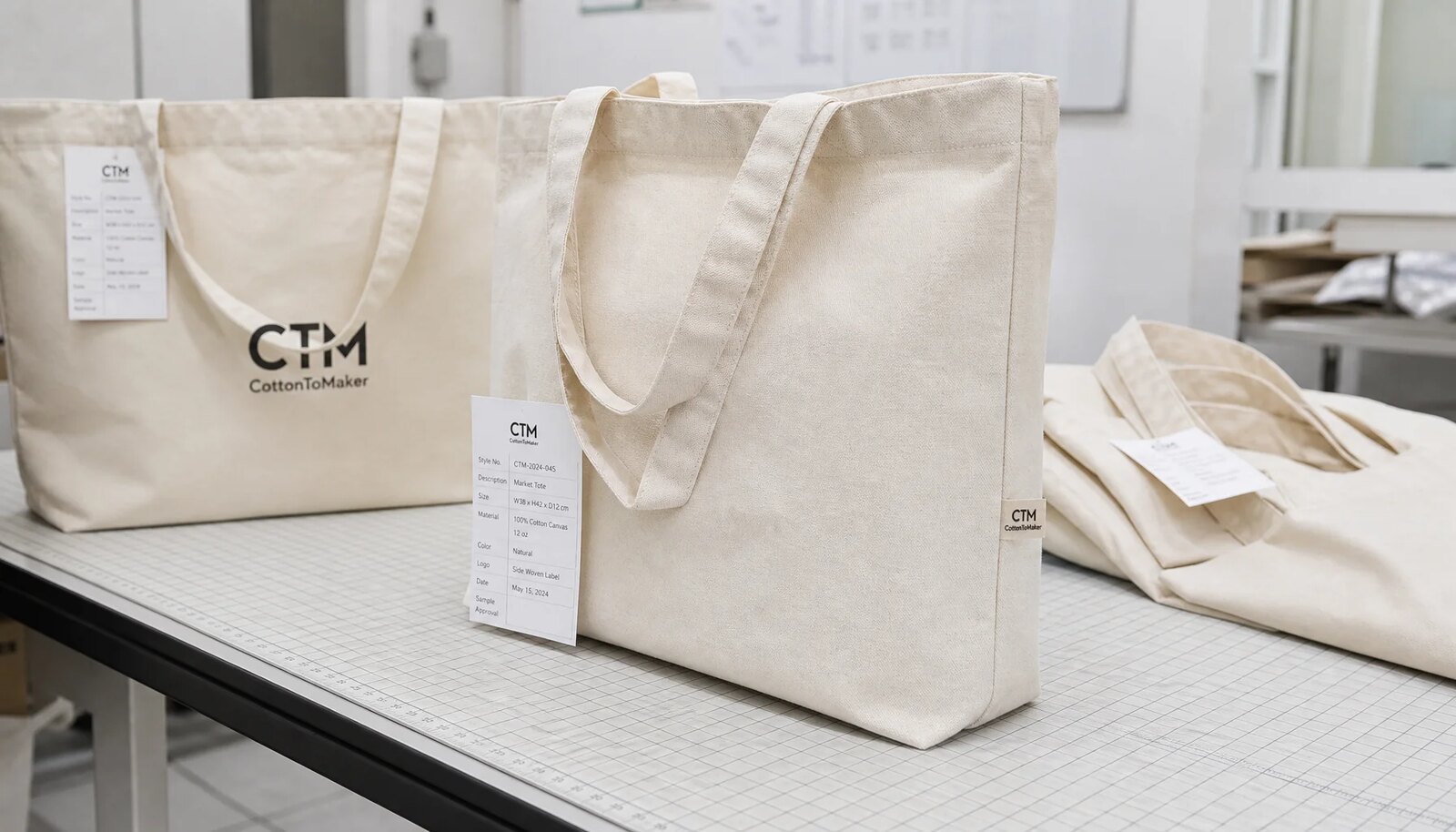
1. Start with the buying use case
Canvas grocery totes are simple to sketch and easy to under-spec. A product photo tells a supplier the shape, but not the load target, fabric tolerance, shrinkage expectation, reinforcement standard, print durability, packing format, or claim documentation. That is why two quotes for a natural canvas tote can look similar and still carry very different commercial risk.
For an eco apparel brand, the tote may be sold at retail, used as elevated store packaging, included with a collection, or offered as a reusable grocery bag. Each route needs a different standard. A giveaway tote may accept lighter fabric and bulk packing. A resale grocery tote needs stronger handles, cleaner finishing, stable print, better carton labeling, and fewer presentation defects.
Write the use case before asking for price. State the intended load, selling channel, presentation level, whether the consumer may wash the bag, and which sustainability claims will appear in product copy. Once these points are fixed, fabric weight, handles, print method, inspection level, and supplier evidence can be chosen with less guesswork.
- Define the use case and expected load in the RFQ.
- State whether the tote is retail merchandise, packaging, or promotion.
- Treat sustainability language as a documented product claim.
- Send the same spec sheet to every supplier for fair comparison.
2. Make the RFQ price-comparable
Procurement control starts in the RFQ. If the RFQ asks for one all-in price, the supplier can reduce cost by changing fabric weight, using stock handles, reducing stitch density, simplifying packing, or excluding setup charges. Those differences often appear later as sample revisions, failed inspection, or receiving rework.
Ask for a line-by-line quote: fabric, cutting and sewing, printing, woven label or hangtag, individual packing, master cartons, sample charges, setup fees, inspection support, and freight basis. This does not prevent final price negotiation. It shows which cost drivers move when the buyer changes from 10 oz to 12 oz canvas, adds a second print color, requests paper bands, or changes from a blank-stock program to full custom production.
Separate MOQ by component. Fabric, dyed color, organic or recycled material, screen printing, woven labels, carton printing, and retail packaging may all have different minimums. For a new tote program, request a pilot tier and a reorder tier. The pilot controls cash and demand risk; the reorder tier shows whether the construction is viable once the style becomes replenishable.
- Request price breaks at 1,000, 3,000, 5,000, and 10,000 pieces if those volumes fit your forecast.
- Separate one-time setup fees from repeat unit costs.
- Ask which costs are excluded: courier, inspection, certification, rework, carton upgrade, or freight.
- Require written approval before any substitution of fabric, handles, print method, labels, or packing.
3. Specify canvas beyond ounces
Fabric weight matters, but it is not the full specification. A tote described as 10 oz canvas can vary in hand feel, opacity, strength, shade, and shrinkage depending on yarn, weave, finishing, dyeing, and washing. Many grocery and retail tote programs use 10 oz to 12 oz cotton canvas because it balances strength, printability, hand feel, and freight bulk. That is a useful starting point, not a universal rule.
Eco apparel buyers should be exact about fiber and claim route. Conventional cotton, organic cotton, recycled cotton, and recycled blends carry different documentation, cost, strength, and shade considerations. Recycled cotton may show more color variation and can have shorter fibers depending on feedstock, so approve strength, hand feel, and shade before bulk cutting. Organic or recycled claims should be supported by order-relevant evidence, not only a generic supplier presentation.
Common documentation frameworks include GOTS and OCS for organic-related claims and GRS or RCS for recycled-content claims, depending on the product and supply chain. OEKO-TEX may support certain chemical-safety positioning. REACH declarations matter for EU market exposure, and CPSIA-related evidence may be relevant if the tote is intended for children's or youth assortments. The exact requirement depends on market, product use, and claim wording.
- Quote fabric in both oz and GSM, plus weave, finish, and color standard.
- Ask whether fabric is stock, mill-made, dyed, washed, or pre-shrunk.
- Approve natural seed flecks and shade variation by physical sample, not assumption.
- Record width and height shrinkage separately if washability is expected.
4. Engineer handles for real grocery loads
The most common structural risk is not usually the front panel. It is the handle base, side seam, bottom seam, or bottom corner. Grocery loads are uneven: bottles, jars, cans, boxed goods, and produce create point stress. A tote can look clean on a table and still fail if the handle reinforcement is decorative rather than structural.
Choose handle construction around the load target and brand position. Self-fabric handles give a cohesive look when folded, stitched, and reinforced correctly. Cotton webbing can improve strength and add a utilitarian hand feel. Heavier loads may need bartacks, box stitches, cross stitches, reinforcement patches, or a double-layer handle base. The right choice depends on canvas weight, handle width, seam allowance, and appearance standard.
Handle drop affects usability as well as measurement control. Too short, and the tote is uncomfortable over the shoulder. Too long, and it can drag or feel unstable when loaded. Finished dimensions should be measured after sewing, pressing, and folding. Put width, height, gusset, handle width, handle drop, and reinforcement style into the inspection chart.
- Set a handle drop tolerance, commonly around +/-10 mm where suitable.
- Use stitch density targets such as 8-10 stitches per inch unless another standard is approved.
- Require reinforcement that captures the handle base and load path.
- Run a load or pull test during sampling and final inspection.
5. Choose the logo method by risk, not habit
Print is the most visible brand risk on many tote orders. A strong bag can still fail commercially if the logo is off-center, under-cured, dull, cracked, scuffed, or poorly registered. Screen print is often efficient for simple one- or two-color repeat artwork. Heat transfer can suit short runs, gradients, or detailed graphics. Embroidery gives texture but can distort lighter canvas or create backing concerns. Woven labels reduce print-curing risk and work well for subtle branding, but they add trim control and sewing placement checks.
The decision should match artwork, order size, durability needs, fabric texture, and inspection practicality. Large ink coverage on rough canvas needs opacity and curing checks. Fine type may fill in. Transfers need edge and adhesion checks. Embroidery needs puckering and thread-trim checks. Woven labels need placement, attachment, and claim accuracy checks.
Move approval from digital artwork to a physical strike-off on production canvas. Natural canvas can warm or dull ink colors, and textured fabric can soften edges. Specify placement in millimeters from fixed points, such as top edge and side seam. Then inspect color, placement, opacity, registration, hand feel, and durability with the tests that fit the product promise.
- Use screen print for simple repeat logos when setup cost is justified.
- Use transfer when detail or short-run flexibility matters, then test adhesion and edges.
- Use embroidery only after checking puckering, backing, and distortion on the chosen canvas.
- Use woven labels for low-print-risk branding, then inspect label content and stitch attachment.
6. Make sampling a production gate
A sample is useful only when it represents bulk production. Many problems start when a buyer approves a polished sample made from available showroom fabric, hand-corrected sewing, or a different print process. That sample can guide design, but it cannot control production unless it uses intended fabric, final construction, final print method, and proposed packing.
Create a sample approval package rather than approving a photo alone. Include the sealed sample, measurement chart, fabric swatch or report, print strike-off, label proof, packing proof, accepted tolerances, and any approved deviations. If the handle drop is 5 mm shorter than the drawing and accepted, record it. If bulk fabric will come from another lot, require confirmation before cutting.
Sampling should also trigger price and schedule reconfirmation. Fabric weight, handle reinforcement, print size, number of colors, hangtags, and packing can all change cost or lead time. Treat every approved revision as a controlled product version, then carry that version into the PO and inspection checklist.
- Mark showroom or handmade samples as design references only.
- Keep sealed samples with procurement and QC, and require one retained at the factory.
- Reconfirm unit price, setup fees, MOQ, and lead time after final sample approval.
- Do not allow bulk cutting until sample and written spec match.
7. Use an inspection-grade QC checklist
A useful canvas grocery totes quality inspection checklist for eco apparel brands must be measurable enough for an inspector to apply consistently. Appearance checks matter, but they are only one part of quality control. The checklist should include AQL level, defect classification, measurement tolerances, stitching, handle strength, print checks, label checks, packing checks, and evidence required for shipment release.
Agree the AQL plan before production. Many retail-bound orders use General Inspection Level II with example limits such as Critical 0.0, Major 2.5, and Minor 4.0. These are examples, not a universal rule. Retailer requirements, order value, product risk, and buyer policy may require a stricter or different plan. The supplier should know the acceptance criteria before goods are sewn.
Define defects clearly. Critical defects include mold, contamination, needle fragments, unsafe sharp objects, or incorrect legally sensitive labels. Major defects include open seams, failed load test, wrong fabric, wrong size beyond tolerance, wrong artwork, poor curing, severe stains, missing barcodes, incorrect carton count, or handle detachment. Minor defects include small loose threads, light wrinkles, slight approved shade variation, or small cosmetic marks within limit.
Measurement checks should be recorded, not guessed. Typical starting tolerances may include +/-5 mm for print placement, +/-10 mm for handle drop, and +/-10 mm to +/-15 mm for larger finished dimensions. The final tolerance depends on bag size, fabric behavior, and retail requirement. Record the actual measurements in a chart with photos of out-of-tolerance pieces.
- Put defect classes and tolerances in the PO or inspection appendix.
- Check stitch density with a ruler and compare to the sealed sample.
- Use a defined 10 kg to 15 kg load test only if load, duration, sample size, and pass condition are agreed.
- Require photos of measurements, defects, load tests, carton labels, and packed cartons.
8. Control print, labels, and sustainability claims
Claims can create as much risk as sewing defects. If a tote says organic cotton, recycled cotton, undyed, low-impact dye, or chemical-safe, the claim should be supported by the correct documents for the market and wording. A broad factory certificate may not prove that the material in this order supports the exact product claim.
Check label content against the approved artwork and documents. Fiber content, country of origin, care instruction, barcode, retail price tag, hangtag copy, organic claim, recycled claim, and compliance language must match the PO. An incorrect claim can become a retailer rejection or legal exposure, even when the tote itself is well made.
Print testing should be aligned with the promise. For a washable tote, use a wash check and compare before/after measurements and print condition. For a non-washable retail tote, dry rub, fold, and packing-scuff checks may be enough. The key is to approve the method before bulk production and keep the result in the order file.
- Request order-specific documents before approving claim language.
- Check GOTS, OCS, GRS, RCS, OEKO-TEX, REACH, or CPSIA-related evidence where relevant.
- Treat unsupported sustainability claims as major commercial risk.
- Inspect label placement, content, attachment, barcode scanability, and hangtag accuracy.
9. Pack for the selling channel
Packing can protect margin or quietly damage it. Bags that arrive wet, dirty, crushed, mislabeled, over-compressed, or counted incorrectly can create warehouse rework, retailer chargebacks, delayed launches, and customer complaints. Packing should be quoted and approved with the product, not decided after sewing.
Start with the channel. A retail tote may need a hangtag, barcode, price sticker, individual polybag, paper band, folded presentation, or shelf-ready carton. A tote used as apparel packaging may only need clean flat packing and accurate carton marks. Some eco apparel brands prefer reduced plastic, but that decision must still protect cleanliness, moisture resistance, and retailer receiving rules.
Cartons need practical limits. Ask for carton dimensions, count per carton, gross weight, net weight, carton markings, and pallet plan if needed. The inspector should open cartons from different parts of the shipment, verify counts, confirm fold method, check carton labels, and ensure cartons are clean, dry, sealed, and not bulging.
- Approve fold method, inner pack, master carton count, carton label, and barcode placement.
- Specify polybag, paper band, desiccant, moisture barrier, or reduced-plastic requirements clearly.
- Check carton counts by opening cartons across the lot, not only the top carton.
- Request pre-shipment photos of packed cartons and pallet arrangement when palletized.
10. Link inspection results to remedies
A checklist is stronger when it is tied to commercial action. Before production, state what happens if the lot fails inspection: rework, sorting, replacement, discount, re-inspection, shipment hold, or another remedy in the purchase terms. This is practical, not adversarial. It tells the supplier that inspection results affect shipment approval and payment timing.
Match the remedy to the defect. Critical defects usually require shipment hold and investigation. Major defects may require sorting, repair, replacement, or re-inspection. Minor defects may be accepted if they remain within AQL and do not affect retail presentation. If the problem is systemic, such as all prints placed too low or all handles sewn short, random sorting may not solve it.
After delivery, review what actually happened. Did the warehouse find count errors? Were cartons too heavy? Did totes arrive more wrinkled than expected? Did customers report print scuffing, shrinkage, or uncomfortable handles? Convert those findings into the next RFQ and PO. Reorders become easier when real receiving and customer feedback become measurable specifications.
- Define remediation before bulk production starts.
- Require re-inspection after major rework unless the buyer waives it in writing.
- Separate isolated defects from systemic defects when deciding whether sorting is enough.
- Update the next PO with receiving, retail, return, and customer feedback.
Specification comparison for buyers
| Sourcing decision | Best-fit option | Cost or lead-time effect | Inspection target or tolerance | Buyer evidence to request |
|---|---|---|---|---|
| Fabric weight | 8 oz for light promo use; 10-12 oz for many grocery or retail totes; heavier canvas for premium load-bearing styles | Heavier fabric increases unit cost, carton weight, freight volume, and sometimes MOQ | Weight within agreed tolerance, often +/-5%; no holes, weak weave lines, mildew odor, severe slubs, or oil marks | Swatch, GSM/oz report, fabric lot record, and confirmation that fabric is stock, mill-made, dyed, washed, or pre-shrunk |
| Fiber and claim route | Conventional cotton, organic cotton, recycled cotton blend, or mixed-fiber canvas | Organic and recycled routes may add documentation checks, material lead time, and higher minimums | Fiber content and claim wording match approved label and order documents; no unsupported organic or recycled claim | GOTS, OCS, GRS, or RCS documents where relevant; scope certificate, transaction certificate, fiber statement, invoices, or chain-of-custody evidence |
| Chemical compliance | Standard cotton canvas, dyed canvas, printed canvas, or finished fabric | Testing and compliant inputs can add cost but reduce retailer and market-entry risk | Dyes, inks, finishes, and trims comply with buyer market requirements | OEKO-TEX where applicable, REACH declarations for EU, CPSIA-related evidence for children's or youth products where relevant, and ink/finish declarations |
| Shrinkage control | Greige, dyed, washed, or pre-shrunk canvas | Pre-shrunk or washed fabric can cost more and extend production, but reduces size complaints | Width and height shrinkage measured separately after agreed wash method; final result meets buyer tolerance | Before/after wash measurements, care recommendation, sample photos, and retained test record |
| Handle construction | Self-fabric handles, cotton webbing, reinforced webbing, box stitch, cross stitch, or bartack | Webbing and reinforcement add sewing time but improve confidence under grocery loads | Handle drop often +/-10 mm; attachment passes agreed load or pull test without seam opening or fabric tear | Close-up sample photos, stitch density record, reinforcement pattern, and load-test result |
| Print method | Screen print for simple repeat runs; heat transfer for short runs or detailed art; embroidery for premium texture; woven label for low-print-risk branding | Screen setup affects small orders; transfers add material cost; embroidery is slower and can distort light canvas; woven labels add trim and sewing steps | Placement often +/-5 mm; color matches approved standard; print or label survives agreed rub, fold, wash, or pull checks | Artwork file, Pantone or approved standard, strike-off on production canvas, rub or wash result, curing note, and label proof |
| MOQ route | Stock blank with custom print, standard custom cut, or full custom fabric and trim | Stock blanks are faster but limit control; full custom improves control but raises MOQ and timing | Bulk matches sealed sample; no fabric, handle, label, or print substitution without written approval | Quote breakdown by fabric, sewing, print, trims, packing, sample, setup, inspection support, and freight basis |
| Packing format | Loose bulk pack, paper band, individual polybag, hangtag, barcode, or retail-ready fold | Retail packing adds labor and material; flat bulk packing can reduce freight volume | Correct fold, inner count, master carton count, barcode, carton marks, carton condition, and moisture protection | Packing diagram, carton marking proof, carton dimensions, gross/net weight, and pre-shipment packing photos |
| Inspection plan | Factory QC, third-party final random inspection, or during-production inspection | Third-party inspection adds cost and schedule hold time but improves control before balance payment | AQL level, defect classes, measurement sample size, load test, print test, and packing checks agreed before production | Inspection booking, AQL standard, defect list, measurement chart, photos, test records, and corrective action report |
Buyer checklist before sampling
- Define the tote use case: grocery carry, retail resale, apparel store packaging, subscription insert, event giveaway, or staff accessory. Include intended load and presentation standard.
- Create one master spec sheet with finished width, height, gusset, handle drop, handle width, fabric weight, fiber content, finish, color, reinforcement, print size, placement, labels, packing, carton count, and barcode rules.
- Ask suppliers to separate fabric, cutting/sewing, printing, trims, labels, inserts, individual packing, master cartons, samples, setup fees, inspection support, and freight basis.
- Confirm whether the quoted fabric is stock, mill-made, dyed to order, washed, pre-shrunk, organic, recycled, or blended. Request order-relevant evidence for any claim.
- Set tolerances before sampling: finished dimensions, handle drop, print placement, stitch density, fabric weight, shrinkage, color approval method, and maximum carton weight.
- Request a pre-production sample made with intended bulk fabric, final handles, final reinforcement, production print method, and proposed packing.
- Approve a sealed sample and matching written spec before bulk cutting. Keep one sample with procurement, one with QC, and require the supplier to retain one at the factory.
- Collect evidence at each gate: fabric report before cutting, print strike-off before printing, inline sewing photos, packing photos, final inspection report, and corrective action records if needed.
- Book inspection against an agreed AQL plan. Define critical, major, and minor defects, measurement sample size, load test, rub or wash test, and carton checks.
- Tie failed inspection results to remedies: rework, sorting, replacement, discount, re-inspection, shipment hold, or air shipment of replacements when commercially necessary.
Factory quote questions to send
- What is the exact fabric weight in oz and GSM, weave type, fiber composition, finish, and color standard for the quoted canvas?
- Is the fabric in stock, mill-made, dyed to order, washed, pre-shrunk, organic, recycled, or blended? What MOQ and lead-time changes apply to each route?
- Which documents can you provide for organic cotton, recycled cotton, dye, finish, or chemical compliance claims, and are they tied to this order rather than only to the factory profile?
- Can you support GOTS, OCS, GRS, RCS, OEKO-TEX, REACH, or CPSIA-related evidence where relevant to our market and claim language?
- What are your standard tolerances for finished width, height, gusset, handle drop, print placement, fabric weight, and shrinkage after washing? Will you accept our PO tolerance table?
- How many stitches per inch are used on the side seam, bottom seam, top hem, and handle attachment? What reinforcement is included: bartack, box stitch, cross stitch, patch, or double-layer base?
- What load or handle pull test do you perform, what weight or force is used, how long is it held, and what result requires rework?
- Which print method is included, how many colors are included, what ink or transfer type is used, and which setup, screen, artwork, or color-matching fees are separate?
- Can you provide a strike-off on the actual production canvas before bulk printing? What dry rub, wet rub, wash, fold, or tape-pull checks can you record?
- Is the pre-production sample made from bulk fabric and production sewing, or is it a handmade reference sample? How many revision rounds and courier costs are included?
Quality-control points to confirm
- Use an agreed AQL plan for final random inspection. Many retail-bound tote orders use General Inspection Level II with examples such as Critical 0.0, Major 2.5, and Minor 4.0, but the final plan should match order risk, retailer rules, and buyer policy.
- Classify defects before inspection. Critical defects include mold, contamination, needle fragments, unsafe sharp objects, incorrect legally sensitive labels, or construction failure that makes the bag unsafe. Major defects include open seams, weak handle attachment, wrong size beyond tolerance, wrong artwork, poor curing, severe stains, incorrect count, failed load test, or missing barcode. Minor defects include small loose threads, light wrinkles, slight shade variation within the approved range, or small cosmetic marks within the agreed limit.
- Verify fabric weight and composition against the approved spec. Check fabric weight within the agreed tolerance, often +/-5% when specified, and reject unauthorized substitution. Inspect for holes, thin spots, weak weave lines, oil marks, mildew odor, unacceptable slubs, and mismatched shade panels.
- Measure finished dimensions on the inspection sample. Record width, height, gusset, handle width, handle drop, and print placement from fixed reference points. Example tolerances include +/-5 mm for print placement, +/-10 mm for handle drop, and +/-10 mm to +/-15 mm for larger finished dimensions, depending on construction and buyer requirement.
- Check stitching density and seam security. A practical target for many canvas grocery totes is 8-10 stitches per inch on main seams unless the approved sample uses another setting. Reject skipped stitches, broken stitches, loose tension, open seam ends, twisted handles, uneven hems, or reinforcement that misses the handle base.
- Test handle strength using the agreed method. A buyer-level grocery tote test may hang 10 kg to 15 kg for a set period, or use a pull-test fixture with specified force. The pass condition should be no seam opening, no fabric tear, no handle detachment, and no visible reinforcement failure.
- Inspect print quality against the approved strike-off. Check placement, registration, opacity, edge sharpness, ink coverage, curing, cracking, pinholes, bleeding, ghosting, scorch marks, transfer edges, and fold-line damage. Use dry rub and, where relevant, wet rub, wash, fold, or tape-pull checks.
- Check shrinkage when washability, pre-shrunk fabric, or consumer washing is claimed. Measure before and after the agreed wash method, record width and height separately, and inspect print condition after washing.
- Inspect labels, hangtags, and claims. Fiber content, origin marking, barcode, care instruction, price tag, organic claim, recycled claim, and chemical-compliance wording must match approved artwork and documentation.
- Review packing before shipment release. Confirm fold method, inner pack count, polybag or paper band requirement, carton strength, carton markings, carton dimensions, gross weight, moisture protection, and quantity per carton. Cartons should be clean, dry, sealed, and not over-compressed.