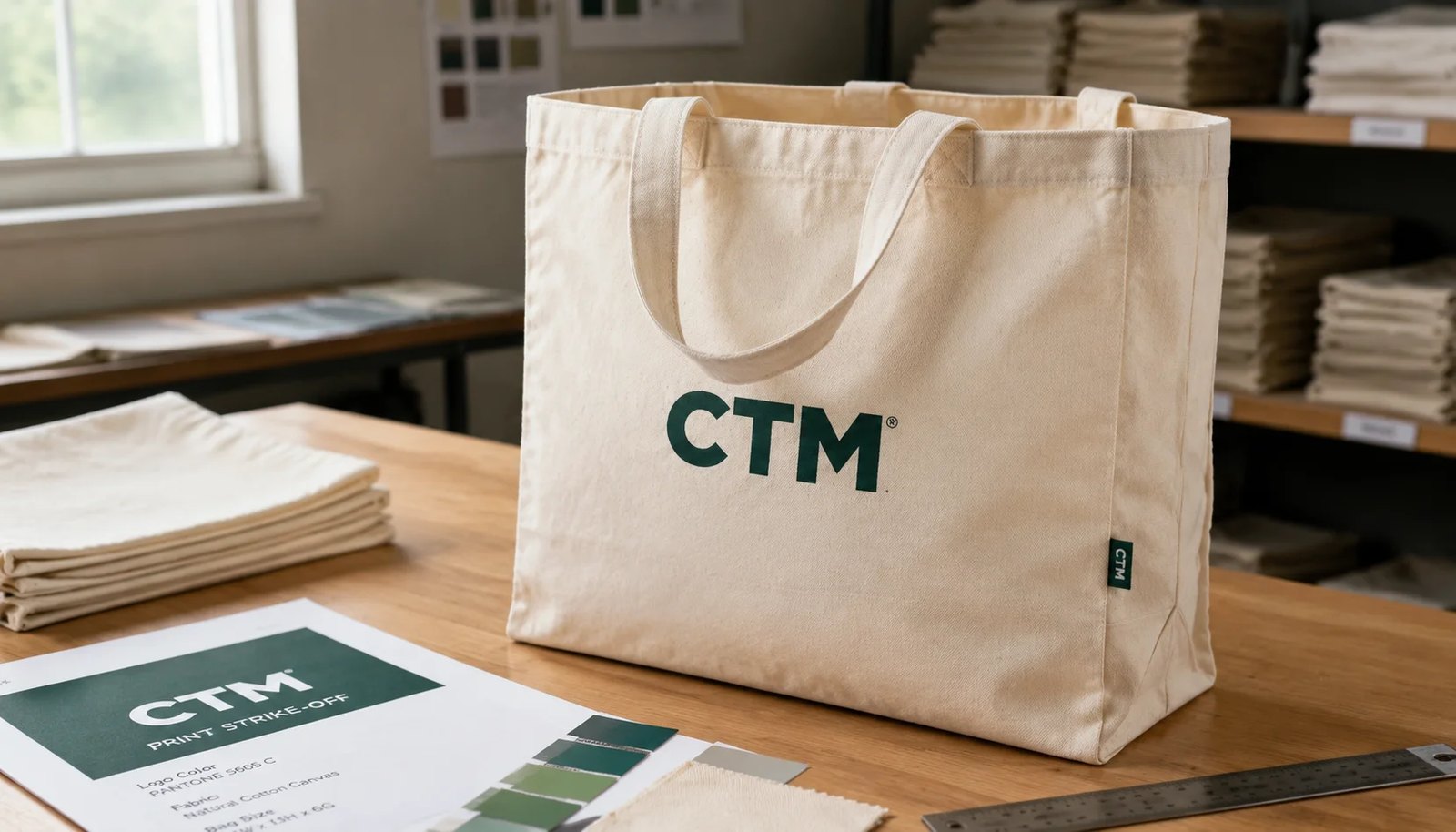
Why print proofing fails on grocery totes more often than buyers expect
Natural grocer tote programs usually look simple: one reusable canvas bag, one green or black logo, one seasonal launch date. The trouble starts because canvas is not a smooth paper surface. Ink sits on a textured weave, natural cotton shade changes the way colors read, and the tote is sewn from multiple panels that can shift artwork position if the print happens before final sewing. Many delayed approvals happen because the buyer signs off on a clean digital proof that does not reflect the real fabric, real absorbency, or real logo edge spread.
For grocery retail, the bag is also functional merchandise, not only a giveaway. Shoppers load produce, bottles, and pantry items into it. That means the bag usually needs heavier canvas, reinforced handles, and gussets. Those construction choices affect where the print sits and how the panel stays flat during printing. A proofing process that works for light promotional totes often fails on grocery bags because heavy canvas, side gussets, and folded hems create more visual variables.
- Paper proofs confirm artwork layout, not print behavior on canvas
- Natural cotton base tone changes final logo color appearance
- Large grocery tote panels can distort slightly after sewing and pressing
- Heavy canvas absorbs ink differently than light cotton sheeting
- Gusset folds can create visual centering issues if tolerances are not defined
Start with the bag construction before discussing print color
If the RFQ starts with logo art and ignores the bag build, suppliers will quote against different assumptions and the proofing cycle becomes messy. For grocery totes, a practical starting point is 10 oz to 12 oz canvas, roughly 280 to 340 GSM. This range gives enough body for supermarket use without moving into oversized, expensive utility bags. Lighter 8 oz canvas can work for promotional reuse, but many buyers underestimate how quickly it looks soft and collapsed on shelf, especially with a bottom gusset.
A common buying mistake is to specify only flat width and height. Grocery bags need depth. A typical format might include 10 cm to 15 cm side and bottom gussets, depending on bottle count and shelf presentation. Handle construction matters too. Self-fabric handles are common for a natural grocer look, but they should be wide enough and reinforced with box or cross stitching. Once these structural choices are defined, the print supplier can judge how flat the print area will be and whether the panel should be printed before or after bag assembly.
- Practical grocery tote canvas range: 280 to 340 GSM
- Below about 250 GSM, shape retention and premium feel usually drop
- State finished dimensions including gusset depth in mm
- Specify handle width, finished drop, and stitch reinforcement
- Mention whether the front logo is printed on cut panels or finished bags
Choose the print method based on artwork behavior, not habit
For most natural grocer tote programs, water-based screen print is the best default for simple brand marks on natural canvas. It gives a softer hand feel and a less plastic surface than heavy ink film methods. It also fits the visual language of organic retail better than a shiny print. That said, water-based printing on absorbent natural cotton will not behave like coated packaging. Fine reverse text can close up, and dark green can look different on warm unbleached canvas than on bleached ivory fabric.
Plastisol or higher-opacity pigment systems may make sense when coverage is critical, especially on darker dyed canvas or when white print must stay crisp. Digital direct printing can look attractive for short runs and multi-color artwork, but on textured heavy canvas it often gives less predictable saturation and edge sharpness than buyers expect. If the logo is a simple one- or two-color supermarket identity, screen printing remains easier to control at scale. The right proof is not a PDF; it is a strike-off on actual production fabric.
- Water-based screen print: softer hand feel, good for natural canvas branding
- Plastisol: stronger opacity, but can feel heavier and less natural
- Pigment print: workable for simple colors, verify rub resistance after curing
- Digital print: suitable for short runs and image art, but edge quality on coarse canvas must be tested
- For small text or reverse art, set minimum line and text sizes in the RFQ
Build a proofing path that catches color and registration problems early
The cleanest approval path has three stages. First, approve the artwork layout with dimensions, panel location, and Pantone references where relevant. Second, approve a physical strike-off on the same canvas and color planned for production. Third, approve a pre-production sample that shows the final sewn bag with actual handle, gusset, print placement, and packing fold. Buyers often try to save a few days by combining these stages, but that usually shifts risk from the sample room into bulk production.
The most expensive errors in canvas tote printing are not always dramatic misprints. More often they are borderline approvals: green is slightly too dull, thin letters fill in, the logo sits too close to the hem after sewing, or one side of the print looks heavier because the panel tension changed. These are exactly the defects a strike-off and pre-production sample should expose. If the launch date is tied to a store campaign, approving the right sample sequence is cheaper than rushing rework or discounting imperfect stock.
- Digital proof: confirms artwork size, position, and copy
- Print strike-off: confirms color, opacity, hand feel, and line clarity on actual fabric
- Pre-production sample: confirms construction, print placement, and folding effect in packed condition
- Do not approve color from phone photos alone
- Keep one signed physical sample or approved standard image under daylight reference
Set acceptance criteria for artwork legibility and placement
Many tote programs fail because the buyer says the logo should be centered and readable, but the factory needs measurable tolerances. For canvas grocery bags, a practical print placement tolerance might be plus or minus 5 mm from the approved reference point, depending on bag size and seam variation. If the logo is near the top hem, define the exact distance from the finished top edge after sewing, not from the cut panel. If the bag has a side gusset, specify whether visual centering should use front panel width only or the full bag width including gusset fold.
Legibility standards should be equally concrete. On textured canvas, very thin positive lines under about 0.6 mm and small reverse details are risky. If the artwork includes a tagline, specify minimum text height after printing, not just in the Illustrator file. Also define what counts as a reject defect. Tiny pinholes outside the main logo may be acceptable in utility bags, while broken strokes inside the brand name are usually not. These details reduce subjective disputes at final inspection.
- Example placement tolerance: plus or minus 5 mm from approved centerline and top edge reference
- Use finished bag measurements, not cut-panel measurements, for final approval
- Minimum positive line recommendation: 0.6 mm on textured canvas
- Increase reverse text size beyond standard packaging artwork if needed
- Identify major defect zones: brand name, icon, slogan, barcode area if printed
Understand the cost drivers hidden behind simple tote quotes
Procurement teams often receive canvas tote quotes that look close on unit price but are built on different assumptions. The main cost drivers are fabric weight, bag size, gusset depth, print color count, print area, handle construction, labels, and packing density. A low quote may use lighter canvas, a smaller print area, or relaxed color matching. Another may include a strike-off and barcode labeling while the cheaper one does not. If you compare only unit price, you can award the order to the quote with the highest downstream risk.
MOQ logic also affects cost. Natural stock canvas with one-color screen print usually allows lower MOQs because the mill and print setup are simple. Add dyed fabric, a second print location, inside care labels, or retail-ready individual packing, and the MOQ can rise because each step creates separate setup and handling cost. Buyers launching in phases should ask for a price ladder by volume and by colorway rather than a single MOQ answer. This shows whether a smaller test run is genuinely feasible or just technically possible at an inefficient price.
- Major quote drivers: GSM, size, gusset, print colors, print area, handles, labels, packing
- Natural stock canvas usually supports easier MOQ than custom dyed fabric
- One-color print is often the most stable cost-per-unit structure
- Retail barcode stickers, insert cards, and individual polybags add handling cost
- Request volume breaks to evaluate pilot launch versus full rollout
Sample approval should include fold marks, curing, and rub behavior
A good pre-production sample is not only about logo appearance on a flat table. Grocery totes are folded, bundled, cased, shipped, and then handled at store level. Ink that looks fine when freshly cured can scuff, offset, or show pressure marks if the supplier packs bags too tightly before the print fully stabilizes. That is why the sample review should include a packed and folded condition, not only a steamed beauty sample. Natural grocer programs often prioritize a clean, understated look, so visible pressure transfer inside the fold can create avoidable complaints.
Curing and rub performance deserve direct attention, especially for dark logos on natural fabric. The buyer does not need to dictate the factory chemistry, but the quote and sample review should establish whether the print has a dry hand feel, whether there is visible cracking when the bag is folded sharply, and whether loose ink transfers onto adjacent fabric. If a bag will carry groceries repeatedly, the print should remain readable after normal use, even if some gentle softening is acceptable over time.
- Review one unfolded sample and one sample packed as shipment condition
- Look for offset transfer or shadow marks inside folded bags
- Rub the print with a clean light cloth to detect loose surface ink
- Check whether sharp folds cause immediate cracking on heavy ink deposits
- Record curing appearance under daylight, not only warm indoor lighting
Packing specs matter because print damage often happens after sewing
Importers sometimes treat packing as a final admin detail, but for printed canvas totes it is part of quality control. If export cartons are overfilled to save freight, prints can become compressed and create set creases or color transfer. If bags are packed before the print is fully stable, stacked pressure can leave visible marks that only show when the retailer opens cartons. Grocery programs also often split stock by store or region, so poor carton marking creates costly warehouse re-sorting.
A practical packing spec should define units per inner bundle, units per carton, maximum carton weight, carton dimensions if freight planning matters, and whether moisture protection is needed. For sea shipments in humid periods, a simple moisture barrier or more careful carton lining can reduce mold and damp odor risk on natural cotton goods. If the bag is sold at retail rather than used only as a giveaway, decide early whether individual polybags are acceptable from a sustainability standpoint or whether belly bands, paper hangtags, or bulk shelf-ready packing are preferred.
- Flat pack in controlled bundle counts such as 25 or 50
- Cap carton gross weight to protect handling and reduce compression damage
- Define shipping marks, item code, colorway, and destination labeling
- Consider moisture protection for long sea transit in humid seasons
- Match packing style to retail use, giveaway use, or DC redistribution
Plan the lead time around approval gates, not only factory days
A factory may quote 25 to 35 days for bulk production, but buyers should separate manufacturing days from approval time. The true schedule begins with artwork finalization, then any color confirmation, then strike-off review, then pre-production sample approval, and only after that full bulk printing and sewing. If your internal marketing team takes a week to approve logo tone on natural canvas, that week is part of the sourcing timeline whether the supplier mentions it or not.
Seasonal grocery promotions make this especially important. Earth Day, reusable bag drives, loyalty campaigns, and store opening calendars often have hard in-store dates. Build backward from ex-factory and leave buffer for corrections at the strike-off stage. If the supplier is using stock natural canvas, timing is usually simpler. If custom dyeing, woven labels, or multiple regional SKUs are involved, each added component can extend pre-production. A milestone plan is more useful than a single promised ship date.
- Typical path: artwork approval, strike-off, pre-production sample, bulk, inspection, booking
- Stock natural canvas shortens material lead time versus custom dyed fabric
- Custom labels and barcode work add handling and coordination time
- Internal buyer approval delays often cause more schedule slip than sewing time
- Request ex-factory milestone dates rather than only total lead time
Use a quote comparison workflow that includes landed cost and quality risk
When comparing suppliers, procurement should not stop at FOB unit price. Two quotes that differ by a few cents may result in very different landed outcomes once carton efficiency, print reject risk, repacking, and store compliance labor are considered. A supplier offering slightly stronger canvas and cleaner proofing support can be cheaper in practice if it prevents relabeling, markdowns, or replacement orders. This is especially true for natural grocer retail where the bag itself reflects the store brand values.
A good comparison sheet puts commercial and technical criteria in one place. Include GSM, print method, MOQ logic, included sample stages, packing count, estimated carton cube, and quality tolerances. Then score supplier evidence: do they provide actual strike-offs, construction details, and clear assumptions, or only a broad quote number? The supplier that answers with measurable production data is usually easier to manage during bulk production than the one that simply says no problem to every request.
- Compare quotes on the same print area, same GSM, same packing basis
- Convert carton data into freight planning where possible
- Include setup charges and sample fees in total buy cost
- Note whether quote includes physical strike-off and PPS sample
- Score supplier clarity and evidence, not only responsiveness speed
Specification comparison for buyers
| Spec decision | Recommended option | When it fits | Buyer risk to check |
|---|---|---|---|
| Base fabric weight | 10 oz to 12 oz canvas, about 280 to 340 GSM | Best for weekly grocery carry, better shape retention, lower return risk than light promotional canvas | Some factories quote 8 oz body weight but use lighter gussets or handles; require tolerance by panel and finished bag weight range |
| Natural fabric shade | Define acceptable base shade as natural unbleached or bleached ivory before proofing print color | Important when brand green, black, or red must read consistently across seasons | Print color can drift because natural cotton base varies lot to lot; approve print on actual bag fabric, not on white paper only |
| Print method | Water-based screen print for solid logos and short copy; plastisol only if opacity is critical on dark dyed canvas | Most natural grocer bags use simple branding and need a soft hand feel | Digital mockups hide edge spread and ink penetration; request physical strike-off showing line sharpness and reverse-side show-through |
| Artwork line thickness | Minimum positive line 0.6 mm and reversed text 1 pt larger than marketing artwork | Fits logos with leaf icons, organic slogans, and small registration marks | Fine script or thin reverse elements can fill in on textured canvas; reject paper-proof-only approvals for small art |
| Handle construction | Same fabric self-material handles with reinforced box stitch or cross stitch | Best for grocery loads and lower complaint rate than narrow webbing on economy bags | Handle length may be quoted center-to-center or full cut length; state finished drop and stitch pattern in RFQ |
| Sample stage | Approve in sequence: digital layout, print strike-off on actual fabric, then full pre-production sample | Useful when artwork color is brand-sensitive and bag panel seams may affect logo position | Skipping strike-off often leads to approved size but wrong color density or rough print hand feel in bulk |
| Packing method | Flat packed in poly bundle by 25 or 50, export carton with moisture barrier if sea freight in humid season | Good for grocery programs with store distribution and barcode labeling | Over-compressed cartons can crease prints and distort gussets; define carton weight cap and packing count tolerance |
| MOQ structure | Base MOQ by fabric color and print color count, often lower on natural fabric with one-color print | Useful for chain rollouts testing one region before national launch | Supplier may quote low MOQ but add hidden setup charges or split production across shade lots; tie MOQ to one fabric lot when possible |
| Lead time path | 25 to 35 days bulk after sample approval for stock natural canvas; longer if custom dyed, washed finish, or woven labels added | Fits regular seasonal promotional planning for Earth Day, loyalty programs, and store openings | Lead time quote may exclude artwork separation, strike-off approval, and booking delay; request milestone schedule, not one total number |
Buyer checklist before sampling
- State finished bag size with gusset depth, handle drop, seam allowance, and print area in millimeters, not approximate inches only.
- Specify canvas weight in oz and GSM, and note whether tolerance applies to finished fabric or greige fabric before washing.
- Define natural fabric shade expectation: unbleached natural, bleached natural, or dyed color, because print color approval depends on base tone.
- List print method by panel: water-based screen print, pigment print, plastisol, heat transfer, or digital direct print where applicable.
- Set maximum artwork colors and note whether Pantone match is required or only close visual match on cotton canvas.
- Require a print strike-off on actual tote fabric before pre-production sample if logo color or small text matters.
- Document minimum readable text size and minimum line thickness for textured canvas printing.
- State logo position tolerance from top hem and side seams, for example plus or minus 5 mm.
- Confirm whether handles are self-fabric or cotton webbing and define finished handle drop and reinforcement stitch type.
- Set acceptable print defects: no pinholes in major logo areas, no visible ghosting, no major misregistration, no ink smearing on folded bundles.
Factory quote questions to send
- What exact canvas construction are you quoting: plain weave canvas, weight in GSM, yarn count if available, and whether the quoted weight is finished weight?
- Is the fabric from stock natural canvas or fresh-woven against order, and how much shade variation should we expect between production lots?
- What print method are you pricing for this artwork, and what is the practical limit for line thickness, small text, and color accuracy on this fabric?
- Does your MOQ apply per size, per artwork, per print color count, or per fabric color lot?
- What setup charges are included: screen charges, color separation, strike-off, sample fee, woven label setup, carton marking, or barcode sticker application?
- Can you provide a print strike-off on the same fabric and color as production, not only a paper proof or image rendering?
- What is your standard logo position tolerance and print size tolerance on cut-and-sewn tote bags with gussets?
- How do you control handle strength and seam security, and what in-house load test or stitch inspection do you use before packing?
- What carton dimensions and gross weight are expected at the quoted packing count, and how many units fit in a 20GP or 40HQ as packed?
- What is your production timeline by step: lab dip if dyed, strike-off, pre-production sample, bulk printing, sewing, final inspection, and booking ready date?
Quality-control points to confirm
- Fabric weight within agreed tolerance, with random roll or finished bag checks recorded against the approved GSM range.
- Base fabric shade visually consistent to approved standard; no mixed lots causing visible logo color difference across cartons.
- Print color reasonably matching approved standard on actual canvas; no severe dullness, over-inking, or patchy coverage in main logo area.
- Artwork placement within approved tolerance from top edge, side seam, and centerline on both front and back if printed both sides.
- No major print defects such as ghosting, double image, obvious misregistration, pinholes in key logo elements, or offset transfer inside folded bag.
- Handles attached with approved stitch pattern; no skipped stitches, loose threads affecting strength, or uneven handle length beyond tolerance.
- Finished size, gusset depth, and handle drop within agreed tolerance after sewing and any post-print curing.
- Cartons packed to count, dry, correctly labeled, and not over-compressed in a way that permanently creases the print or bag shape.