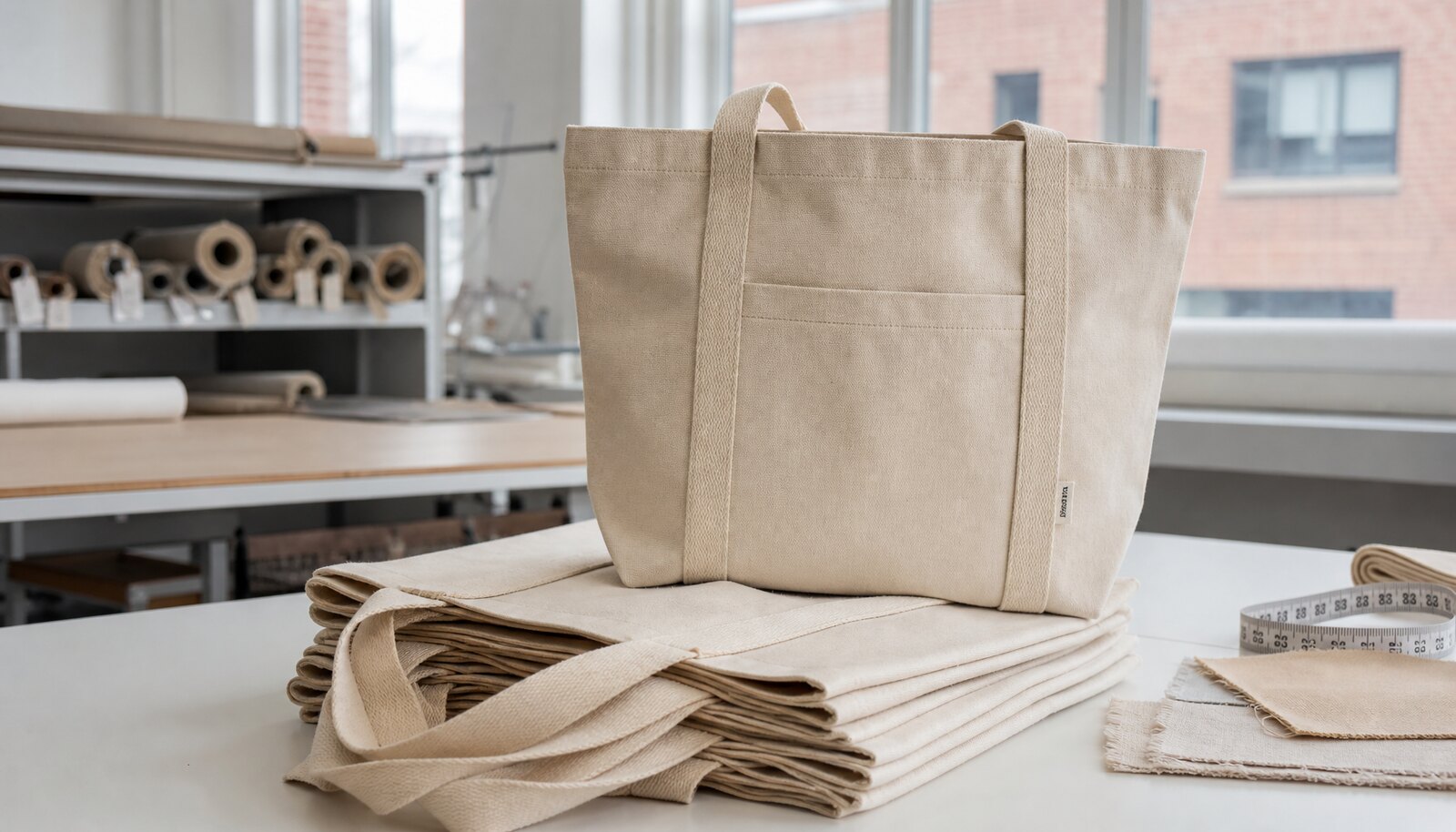
1. Treat MOQ as a Manufacturing Result, Not Just a Number
Canvas grocery totes look straightforward. That is exactly why MOQ conversations can go wrong. A buyer asks for 500, 1,000, or 2,500 logo totes; the factory is thinking about fabric rolls, cutting efficiency, sewing line changeover, print screens, packing labor, carton planning, and idle time between jobs. Minimum order quantity is rarely just a sales rule. It is usually the quantity at which the supplier can run the order without too much waste or disruption.
For corporate gifting, the lowest number on a quote sheet is not always the safest number. The tote may hold onboarding materials, samples, bottles, books, apparel, catalogs, or retail-style gifts. It might go to a kitting warehouse, several regional offices, or a fixed-date event. If handles pull out, the logo is visibly off-center, the canvas feels weak, or cartons arrive with confusing labels, the issue is public, urgent, and costly to repair. A lower MOQ only helps if the finished tote still protects the brand experience.
A better negotiation breaks the tote into controllable variables: fabric, size, handle, stitch construction, print method, artwork area, labels, packing, inspection, and shipping terms. Some details should stay firm because they affect performance. Others can be simplified. Stock natural canvas, a standard grocery tote shape, one print position, and bulk cartons usually give the factory a cleaner production path than custom dyeing, special trims, oversized artwork, and individual retail packing.
- Ask what is driving the MOQ: fabric purchase, dye lot, cutting efficiency, print setup, sewing line time, packing labor, or shipment sorting.
- Negotiate for the lowest workable MOQ, not the lowest number that removes sampling, inspection, or construction control.
- Compare suppliers only after fabric weight, finished size, handle spec, print method, packing, and trade term are aligned.
- Protect the features recipients notice first: fabric hand feel, handle strength, print placement, cleanliness, and overall presentation.
2. Start the RFQ With the Gift Contents and Load Requirement
The most useful tote specification starts with the contents. A bag for brochures and a notebook does not need the same gusset, handle reinforcement, or fabric weight as a bag carrying two glass bottles, boxed merchandise, a laptop accessory kit, or a stack of catalogs. Before asking for price, list the intended contents, estimated total weight, largest item dimensions, sharp corners, and whether the tote needs to stand upright during packing or display. Those details help the supplier recommend a construction that fits the actual job.
For many corporate grocery-format totes, 10 oz to 12 oz canvas is a practical starting range. If the ounce figure is ounces per square yard, 10 oz is about 339 GSM and 12 oz is about 407 GSM. Still, do not assume every quote uses the same basis. Some suppliers use “oz canvas” loosely, or quote greige weight instead of finished weight. If the gift contents are dense or heavy, 12 oz to 14 oz canvas with reinforced handles and stronger bottom seams may be a better route. That upgrade should be deliberate because it can affect material cost, sewing speed, folded thickness, carton cube, and freight.
Size should come from fit, not habit. A common grocery tote may fall around 35 to 40 cm wide, 35 to 42 cm high, with a 10 to 15 cm gusset, but your kit should decide the final dimensions. If a box must lie flat, the bottom gusset matters. If recipients will carry the tote over the shoulder, handle drop may need to be around 25 to 30 cm. If the tote is hand-carry only, a shorter handle can look neater and may reduce material use. Write the finished size as width x height x gusset, then define handle drop and handle width.
- Include content list, estimated load, largest item size, and carry style in the first RFQ.
- Specify canvas as oz/yd² and/or GSM, plus color, finish, and acceptable fabric weight tolerance.
- Ask for two fabric options when uncertain, such as 10 oz and 12 oz, using the same size, print, and packing assumptions.
- Require a physical sample when the tote will carry dense items, sharp corners, or premium gift contents.
3. Know Which Specification Changes Push MOQ Up
MOQ usually rises when the factory must buy special materials, change a process, or accept a higher reject risk on a small run. Stock natural canvas, standard cotton webbing, standard thread, and an existing tote pattern often support a lower quantity. Custom dyed canvas, special handle tape, contrast stitching, metal trims, inner pockets, unusual gussets, or nonstandard dimensions can trigger larger material minimums or new pattern work. Even a small design change may add a separate production checkpoint.
Custom color is one of the most common MOQ traps. Stock natural, black, navy, or other regularly dyed canvas may be available from current inventory. A custom color usually needs lab dips, approval cycles, and a dye lot large enough for the mill or dye house to run efficiently. There is no universal minimum that applies to every supplier. Ask whether the color is stock, whether lab dip approval is required, what shade tolerance applies, and whether the supplier must purchase extra fabric beyond your order quantity.
Print and packing can also move the minimum. A one-color screen print on one side is usually efficient because setup and registration are manageable. Multiple colors, second-side artwork, oversized coverage, tight registration, or graphics close to seams add time and defect risk. Packing deserves the same scrutiny. Bulk packing by fixed count per carton is production-friendly. Individual polybags, tissue wrapping, hangtags, inserts, barcodes, retail cartons, and destination sorting create more labor stations and more chances for errors.
- MOQ usually increases with custom dyeing, nonstandard size, multiple print locations, special trims, retail packing, or split shipments.
- MOQ is usually easier with stock canvas, a standard grocery tote pattern, one print location, and bulk cartons.
- Ask whether unused custom fabric or trim is charged to the order, retained by the supplier, or available for repeat production.
- If a supplier offers an unusually low MOQ, confirm that sample approval, inspection access, and material consistency are still included.
4. Build a Quote Sheet That Separates the Cost Drivers
Two suppliers can both quote “12 oz canvas grocery tote with logo” and still mean very different products. One may be using 12 oz finished canvas; another may be quoting a lighter fabric described by a local trade name. One may include screen setup and cartons; another may exclude setup, samples, carton cost, or inspection support. A structured quote sheet prevents procurement from comparing incomplete numbers.
Ask suppliers to separate the base tote, printing, screen or plate setup, artwork strike-off, woven label, hangtag, insert, packing materials, carton cost, sample fee, inspection support, freight term, and lead time. Then request quantity breaks using the exact same specification. You want the requested low MOQ, the factory’s efficient MOQ, and a higher tier that reflects better fabric use or production efficiency. This shows the real cost of flexibility and helps internal stakeholders decide whether a smaller first order is worth the premium.
Trade terms also need to be clear. EXW, FOB, CIF, DAP, and DDP do not represent the same landed cost or responsibility. A canvas tote is not especially heavy, but carton cube can grow quickly depending on fabric weight, folding method, and pack count. Individual polybags or thick folds may increase volume. In some programs, a slightly higher unit price is acceptable if the packing plan reduces warehouse handling or if the supplier supports stronger inspection control. The useful comparison is full program cost, not only the bag unit price.
- Use one RFQ template for all suppliers so fabric, size, print, packing, and terms are identical.
- Ask for itemized costs instead of one bundled unit price.
- Request low-MOQ, efficient-MOQ, and repeat-order quantity breaks.
- Confirm overrun/shortage policy, payment terms, quote validity, export documents, and whether inspection time is included.
5. Negotiate MOQ by Removing Low-Value Complexity
Good MOQ negotiation does not mean stripping out everything that makes the tote reliable. Reducing fabric weight, removing handle reinforcement, skipping samples, or accepting vague tolerances can create expensive failures. Better levers are stock fabric color, standard dimensions, fewer print colors, one print position, a simpler label package, and bulk packing. These changes make the order easier to run while preserving the tote’s practical value.
A useful method is to ask for three versions of the same program. Version one: the ideal specification at the supplier’s standard efficient MOQ. Version two: the lowest workable MOQ using stock canvas, standard size, one print location, and bulk packing. Version three: a repeat-order or annual forecast price if the program is likely to continue. This gives procurement a real decision table: pay a premium for a smaller launch order, buy the efficient quantity, or standardize the design for repeat use.
Be concrete when asking the supplier to lower MOQ. Instead of saying, “Can you do 500 pieces?” try: “If we use your stock natural 12 oz canvas, standard 38 x 40 x 12 cm grocery tote pattern, 30 mm cotton webbing handles, one-color screen print on one side, and 100 pieces per carton bulk packing, what is your lowest workable MOQ and what setup fees apply?” That question signals that you understand the production constraints and gives the factory room to offer a practical solution.
- Simplify fabric color before reducing fabric weight.
- Simplify artwork and packing before removing QC controls.
- Standardize one size and one handle construction if several departments order similar totes separately.
- Use repeat-order potential only when it is credible; do not promise volume that has not been approved.
6. Specify Fabric, Stitching, and Handle Construction Precisely
Canvas language needs precision in B2B sourcing. State fiber content, fabric weight, color, finish, and tolerance. If the tote must be cotton canvas, say so. If recycled cotton, organic cotton, or blended canvas is required, ask for supporting documentation and confirm whether the material changes print behavior, shrinkage, or hand feel. Natural cotton canvas is common for corporate gifting, but “natural” can range from cream to beige depending on yarn, processing, and production lot.
Handles deserve as much attention as fabric. A tote can be made from good canvas and still fail if the handle ends are weak. Ask whether the supplier uses self-fabric handles or cotton webbing, then define handle width, handle drop, stitch pattern, and thread color. For many corporate gift totes, 25 to 38 mm handles are practical. Box-X, cross-stitch, bartack, or double-row reinforcement should appear on the approved sample. Stitch density should be consistent; many canvas tote constructions use roughly 7 to 10 stitches per inch, but the factory’s approved standard should be documented.
Agree tolerances before cutting and sewing begin. Practical finished-size tolerance is often around ±1 cm for handle drop or gusset and ±2% for larger body dimensions, but supplier capability varies. Fabric weight tolerance may be around ±5% to ±8%, depending on the material and finishing route. Print placement tolerance may be around ±3 mm to ±5 mm for standard placements. These figures are not universal rules. They are starting points for a written agreement that prevents subjective arguments after delivery.
- State fabric content, weight, color, finish, and whether weight is greige or finished.
- Specify handle material, width, drop, stitch pattern, thread color, and reinforcement method.
- Document tolerances for size, fabric weight, handle length, and print placement on the PO or tech pack.
- Use the approved pre-production sample as the visual and construction reference for bulk goods.
7. Control Artwork, Print Method, and Brand Color Early
Artwork is often where a simple tote becomes a complicated order. Corporate logos may include gradients, fine lines, small legal text, narrow spacing, or strict brand colors. Textured natural canvas is not a smooth white surface, so ink can appear warmer, duller, or less sharp than it does on a digital mockup. Procurement should collect vector artwork, Pantone references where relevant, maximum print size, and brand rules before asking for final pricing.
Screen print is usually a good fit for solid one- or two-color logos, especially when repeatability matters. It can perform well when ink choice, mesh, curing, and fabric surface are controlled. Heat transfer or DTF can suit short runs, gradients, or full-color artwork, but buyers should inspect edge quality, gloss level, stretch behavior, hand feel, and rub performance on actual canvas. Embroidery can work for small premium marks, but it may raise cost and lead time, and it can distort lighter canvas if not tested.
Placement needs measurements, not vague wording. “Front center” is not enough for production. State print width and height, distance from the top hem, horizontal centerline, and clearance from side seams, gussets, pockets, and fold lines. If the totes will be folded in cartons, confirm the logo will not sit on a hard crease. For strict brand programs, approve a printed strike-off or pre-production sample under realistic lighting before mass printing.
- Send vector files and Pantone references; do not rely only on JPEG mockups.
- Ask the supplier to flag fine lines, small type, gradients, and large solid ink areas before sampling.
- Define print size and placement from fixed measurement points.
- Approve actual printed fabric or a printed pre-production sample when brand color and detail matter.
8. Make Sample Approval a Formal Procurement Gate
Sample approval should be a real purchasing gate, not a quick photo check. A physical sample confirms fabric hand feel, finished size, handle comfort, stitching, print position, odor, stiffness, fold size, and packing behavior. Photos are useful for early alignment, but they cannot tell you how the tote behaves when filled or whether the canvas feels appropriate for a corporate gift.
The sample process can be staged according to risk. A fabric swatch may be enough to choose between 10 oz and 12 oz canvas. A blank sample can confirm dimensions, gusset, handles, and sewing. A print strike-off can confirm ink, color, and detail on the actual fabric. A pre-production sample should match the final specification as closely as possible, including labels, fold method, and packing if those details affect the program. For very low-MOQ orders, multiple sample rounds may not be economical, but at least one physical approval sample should be reviewed before bulk cutting or printing.
Once approved, treat the sample as a control document. Keep one signed sample with the buyer or inspection team and one with the supplier when possible. The approval sheet should record version number, date, fabric weight, dimensions, handle details, print size, print position, label placement, packing format, and tolerances. If bulk goods differ later, the discussion can refer to an approved standard instead of personal preference.
- Measure the sample instead of approving only appearance.
- Load the sample with intended contents or a realistic weight proxy and carry it by the handles.
- Check odor, fabric shade, seam stress, bottom shape, print clarity, label placement, and fold size.
- Do not authorize bulk production until artwork, construction, tolerances, and packing are recorded.
9. Plan Packing, Cartons, and Distribution Before Production
Packing decisions affect MOQ, labor, carton count, freight, and warehouse receiving. For many corporate gifting programs, bulk packing is the most efficient route. Totes can be folded consistently and packed by fixed count per carton, then repacked by a kitting center, event team, or third-party logistics provider. Bulk packing reduces factory handling and often supports a lower minimum order quantity.
Individual polybags may be justified when totes must stay clean through several handling points, ship directly to recipients, or present like retail merchandise. But they add material, labor, waste, and sometimes carton volume. Hangtags, insert cards, tissue, barcode stickers, and retail cartons can be useful, but each one should have a clear purpose. If a warehouse will remove the packaging during kitting, retail-style packing may add cost without improving the recipient experience.
Carton planning should be finalized before shipment, not after production is complete. Ask for pack count, carton dimensions, gross weight, net weight, carton marks, and pallet requirements if any. Carton marks should include PO number, item name or SKU, color, quantity, destination, carton sequence, and country of origin where required. If goods ship to multiple offices, decide whether the factory is packing by destination or whether the 3PL will split cartons later.
- Choose bulk packing when totes will be kitted, repacked, or distributed through a warehouse.
- Use individual polybags only when cleanliness, handling protection, or direct-to-recipient presentation justifies them.
- Approve carton count, dimensions, gross weight, and marks before mass packing.
- Align carton labels with warehouse, event, or 3PL receiving requirements.
10. Set QC Standards Before the Factory Ships
Quality control for canvas grocery totes should focus on the points most likely to fail or disappoint: dimensions, fabric weight, shade, cleanliness, odor, handle attachment, seams, print placement, print quality, labels, and carton accuracy. These checks are simple when the standard is defined before production. If the buyer waits until goods arrive to decide what is acceptable, every defect becomes a negotiation.
For larger or higher-risk orders, consider a final random inspection before shipment. Many buyers use ISO 2859-1 or ANSI/ASQ Z1.4 sampling with General Inspection Level II and AQL levels such as 0 for critical, 2.5 for major, and 4.0 for minor defects, but the right plan should match buyer policy and order risk. Critical defects may include wrong artwork, unsafe contamination, mildew, severe odor, or handle failure. Major defects may include incorrect size outside tolerance, misprint, visible stains, weak stitching, wrong packing, or major shade mismatch. Minor defects may include small loose threads or slight canvas irregularities within the approved standard.
QC should also include function. Define a static load test or carry simulation using the intended gift weight plus a reasonable safety margin. The goal is not to make a canvas tote perform like industrial equipment. The goal is to confirm that it can carry the actual corporate gift contents without immediate seam or handle failure. If the shipment must meet retailer, marketplace, or internal compliance rules, include those requirements in the PO and inspection checklist.
- Define critical, major, and minor defects before production starts.
- Use the signed pre-production sample as the inspection reference.
- Measure print placement, tote dimensions, handle drop, and carton count with agreed tools and methods.
- Inspect cartons, marks, quantities, and packing condition, not only the individual tote.
Specification comparison for buyers
| Spec decision | Recommended option | When it fits | Buyer risk to check |
|---|---|---|---|
| Base fabric | 10 oz to 12 oz canvas, approximately 339 to 407 GSM when quoted as oz/yd²; confirm whether the supplier means greige, washed, or finished weight | Most corporate grocery-format gift totes, employee kits, conference bags, client gift carriers, and retail-style giveaways | If the unit is quoted only as “10 oz canvas” without GSM, finish state, or tolerance, buyers may receive thinner hand feel, higher shrinkage, or inconsistent structure |
| Heavy-load upgrade | 12 oz to 14 oz canvas, reinforced bottom seam, and box-X or cross-stitch handle bartack reinforcement | Gift kits containing books, bottles, boxed products, catalogs, samples, or dense merchandise above roughly 5 kg total load | Heavier fabric can raise material cost, sewing time, needle breakage risk, freight weight, carton cube, and MOQ if not stocked |
| Standard size route | Use a factory standard grocery tote pattern before requesting custom dimensions; define width x height x gusset, not just “large tote” | Buyers seeking lower MOQ, faster sampling, and predictable fit for event or warehouse distribution | Small changes to gusset, handle drop, or bottom shape may require new pattern work, cutting markers, and sample approval |
| MOQ route | Start with stock natural canvas, standard size, one print location, and bulk packing; then add custom items only where brand value is clear | Procurement teams that need a professional corporate gift at a lower entry quantity | A low headline MOQ can hide separate print setup, sample, label, packing, carton, or inspection costs |
| Print method | Screen print for solid one- or two-color logos; heat transfer or DTF only when artwork detail, gradients, or short-run economics justify it | Corporate logos, event marks, internal campaigns, sponsor graphics, and simple promotional art | Fine lines below about 0.5 mm, tiny text, gradients, and large ink coverage need strike-off approval on actual canvas |
| Handle construction | Self-fabric handles or 25 to 38 mm cotton webbing; specify handle drop and reinforcement pattern | Totes expected to carry real gift contents rather than only paper inserts | Handle pull-out, skipped stitches, loose thread, and weak attachment are common visible failures if reinforcement is not defined |
| Color strategy | Natural, black, navy, or supplier stock-dyed canvas with controlled logo print | Programs where timing, repeatability, and cost control matter more than full custom color matching | Custom dyeing may require lab dips, larger fabric minimums, longer lead time, shade bands, and batch-to-batch variation control |
| Branding package | One main print plus optional woven side label if it supports brand presentation; avoid unnecessary trims on low MOQ orders | Professional gifts that need visible branding without overloading production | Multiple labels, hangtags, inserts, stickers, and special placements add labor checkpoints and can increase defect opportunities |
| Packing format | Bulk packed by fixed carton count with agreed fold orientation, carton marks, carton dimensions, and gross weight | Event warehouses, kitting centers, third-party logistics, multi-office distribution, and bulk corporate gifting | Individual polybags may increase labor, waste, carton volume, and receiving complexity unless cleanliness or retail presentation requires them |
Buyer checklist before sampling
- Define the business use case: employee welcome kit, conference gift, client gift carrier, retail gift-with-purchase, grocery-format giveaway, or internal merchandise program.
- List the real contents, largest item dimensions, sharp corners, and estimated total load before selecting canvas weight or tote size.
- Specify finished size as width x height x gusset, plus handle drop, handle width, fabric weight, fabric color, thread color, seam construction, print size, and print location.
- State the canvas measurement basis: ounces per square yard and/or GSM, whether greige or finished weight, and acceptable fabric weight tolerance, commonly agreed around ±5% to ±8% depending on fabric and supplier capability.
- Ask for at least three price points: requested low MOQ, supplier’s efficient MOQ, and a repeat-order or annual forecast tier if applicable.
- Separate base tote, print, screen/setup, woven label, hangtag, insert, sample, packing material, carton, inspection, freight, and document costs in the quotation.
- Confirm whether the fabric is stock natural canvas, bleached canvas, stock-dyed canvas, or custom dyed fabric requiring lab dip and shade approval.
- Ask for written tolerances: finished size, handle drop, print placement, print color, fabric weight, carton quantity, overrun/shortage, and shade variation.
- Approve a physical pre-production sample with actual fabric, handle construction, stitching, artwork placement, label details, fold method, and packing format.
- Load-test the sample using the intended gift contents or a weight proxy before signing off on bulk production.
Factory quote questions to send
- What is your MOQ for this canvas grocery tote using stock fabric, and which requested changes would increase or decrease that MOQ?
- Which canvas weights do you keep in regular stock, and can you quote both oz/yd² and GSM for each option?
- Is the quoted fabric greige, natural finished, bleached, washed, enzyme washed, stock dyed, or custom dyed? What tolerance do you apply to fabric weight and shade?
- Can you quote our requested MOQ, your most efficient production MOQ, and the next price break using the exact same specification?
- Is the print price based on one side, one color, and a specific maximum artwork size? How does price change with extra colors, larger coverage, second-side print, or tighter registration?
- For this artwork, do you recommend screen print, pigment print, heat transfer, DTF, embroidery, or woven label? What are the limitations for small text, gradients, Pantone matching, wash/rub performance, and hand feel?
- Can you itemize base bag, printing, screen/setup, woven label, hangtag, insert, sample, packing, carton, inspection support, tooling, and freight assumptions?
- What are your standard finished size tolerance, handle length tolerance, print placement tolerance, and fabric weight tolerance for this item?
- How are the handles reinforced: box-X, cross-stitch, bartack, double row, or another method? What stitch density do you normally use on canvas totes?
- What sample stages are available: fabric swatch, blank sample, artwork strike-off, printed pre-production sample, and sealed production sample?
Quality-control points to confirm
- Finished size should be measured flat using the approved method: body width, body height, gusset depth, handle drop, and handle width. Common practical tolerances are ±1 cm for small dimensions or ±2% for body dimensions, but the agreed tolerance should be written on the spec sheet.
- Fabric weight should be verified against the approved oz/yd² or GSM target. If the buyer specifies 12 oz canvas, confirm whether the tolerance is based on finished fabric and whether ±5% to ±8% is acceptable.
- Canvas appearance should be checked against the approved sample for stains, oil marks, yarn slubs beyond the approved standard, uneven dye, holes, weaving defects, strong odor, mildew, and visible shade mismatch between panels.
- Handle attachment should match the approved reinforcement pattern. Inspect skipped stitches, loose threads, needle cuts, broken stitches, bartack placement, and secure stress points at each handle end.
- Seam construction should be reviewed at side seams, bottom seam, gusset corners, and top hem for open seams, uneven seam allowance, raw edges where not approved, puckering, and loose thread ends.
- Load performance should be tested with the intended contents or an agreed weight proxy. For corporate gift totes, buyers often define a practical static load and carry simulation instead of relying on visual inspection only.
- Print placement should be measured from fixed reference points, such as top hem and side seam centerline. A common placement tolerance is ±3 mm to ±5 mm for standard screen print, depending on artwork size and factory capability.
- Print quality should be checked for registration, ink coverage, pinholes, cracking, smudging, bleeding, color shift, rough edges, loss of detail, and unacceptable hand feel on textured canvas.
- Color approval should compare bulk goods to the signed sample or Pantone target under consistent lighting. Natural canvas affects ink appearance, so digital mockups should not be the only color standard.
- Labels, hangtags, inserts, barcodes, care labels, and carton labels should match approved artwork, placement, language, SKU, and regulatory requirements if included.