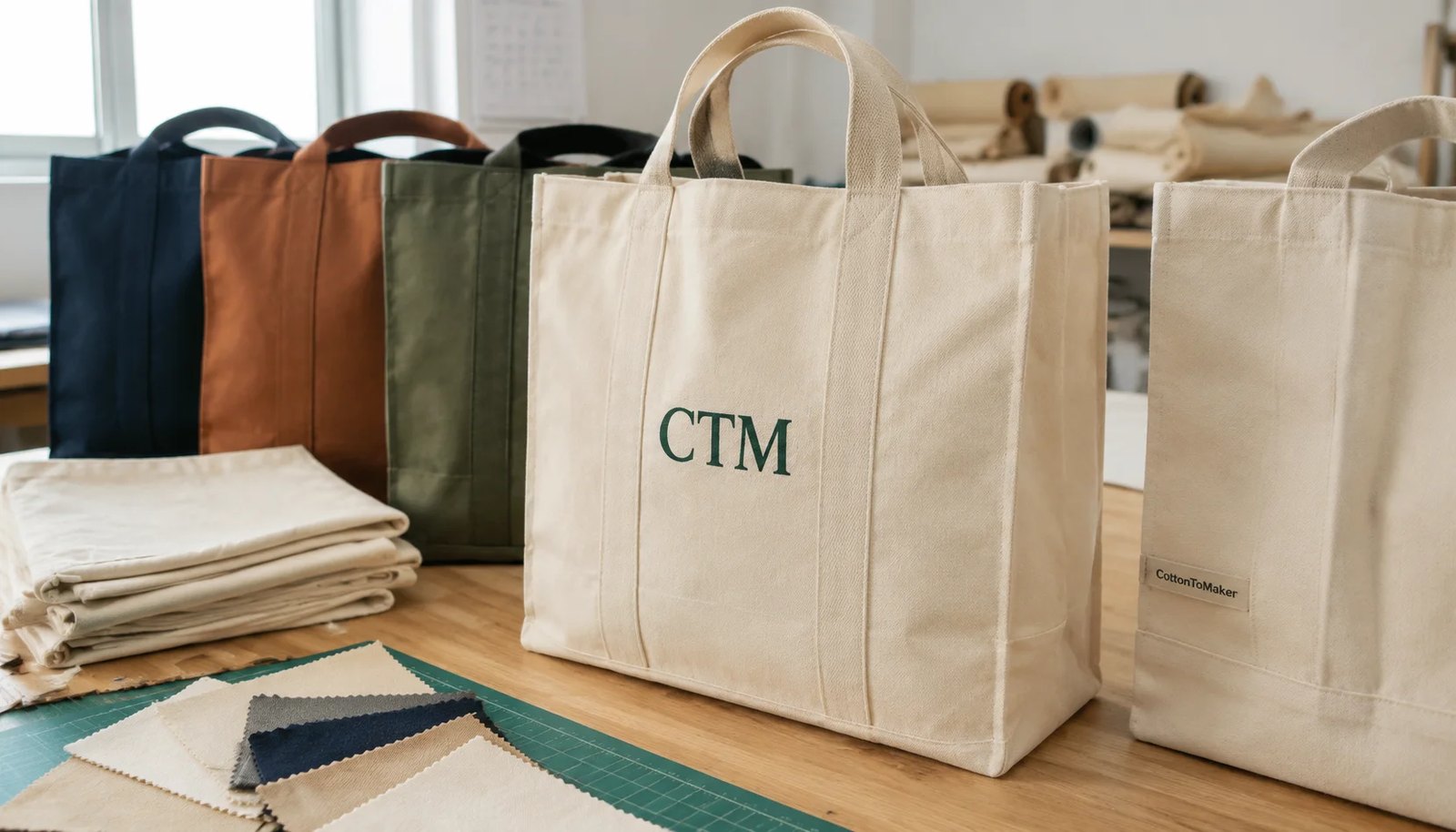
Start with the actual grocery load, not the logo artwork
Most sourcing mistakes on canvas grocery totes happen because the buying brief starts from branding and ends with a bag that looks right but performs poorly in store use. A natural grocer tote usually carries mixed loads: produce, jars, boxed dry goods, and occasional bottles. That means the first technical decision is not print area or fabric color. It is the expected carrying load and how often the customer will reuse the bag. A light promotional tote and a weekly shopping tote may look similar in a quote sheet, but they should not use the same fabric, handle construction, or seam tolerance.
For most natural grocer retail programs, the practical target is a medium-structure tote that stands up better than a thin giveaway bag but still folds flat at checkout. In factory terms, that usually means a bottom-gusseted canvas tote in the 10 oz to 12 oz range, roughly 280 to 340 GSM depending on weave and finishing. Below that range, the bag often loses shape and prints can wrinkle across the body panel. Above that range, unit cost rises, print hand feel becomes stiffer, and cartons cube out faster. If procurement defines the use case clearly at RFQ stage, supplier quotes become much easier to compare.
- Useful RFQ load description: suitable for 8 to 12 kg mixed grocery load with reinforced handles
- Better than vague wording: durable reusable bag
- State carrying style: hand carry, shoulder carry, or both
- Define if the bag must stand partly open at checkout for easier loading
Choose the right canvas weight and finish for grocery use
Canvas is often quoted loosely, and that creates immediate comparison problems. One supplier may quote 8 oz plain cotton while another quotes a true 10 oz canvas, yet both product descriptions say canvas tote. For grocery use, 10 oz to 12 oz is the normal working range because it gives enough body for a gusseted shopping bag without pushing cost into heavy-duty specialty territory. Natural canvas can show small specks and tone variation; bleached canvas gives a cleaner print base; dyed canvas gives stronger shelf appearance but introduces shade control issues on reorder.
A natural grocer buyer should also separate hand feel from performance claims. Softer finishing can improve the perceived quality in hand, but aggressive softening may reduce fabric firmness and affect print sharpness. If the bag will be sold as a premium reusable item, a cleaner weave and more consistent surface may justify the extra spend. If it is a checkout incentive item, standard natural canvas may be the better route. The important point is to quote fabric by measurable criteria, not by sales description alone.
- Typical practical range: 280 to 340 GSM for grocery totes
- Natural canvas: lower cost, more natural appearance, possible specking
- Bleached canvas: cleaner base for color accuracy, modest cost increase
- Dyed canvas: stronger visual identity, higher shade-control and MOQ requirements
- Request GSM tolerance in writing, for example plus or minus 5 percent if the supplier can support it
Bag construction matters as much as fabric weight
Buyers often try to solve load performance by increasing fabric weight only. In practice, construction details make a major difference. A 10 oz tote with a proper bottom gusset, reinforced handles, and stable seam construction can outperform a heavier bag with weak handle attachment. For grocery use, a bottom gusset of 10 to 15 cm is usually more efficient than a flat body because it improves packability for produce and boxed goods. Side gussets are useful when the bag needs a squarer profile or stronger shelf presentation, but they increase cutting waste and freight cube.
Handle design should be specified with the same care as body dimensions. A common failure in low-cost quotes is a handle that is visually acceptable but too narrow, too short, or stitched with weak reinforcement. Self-fabric handles are standard and cost-effective, but they need enough width and a proper box stitch or cross reinforcement at the stress point. If the tote is intended for shoulder carry, handle drop must be written as a measurement, not left to the sample room’s assumption.
- Recommended grocery tote handle width: 25 to 30 mm
- Useful shoulder-carry handle drop range: around 25 to 30 cm depending on bag width
- Bottom gusset improves loading efficiency more than simply enlarging panel width
- Reinforcement stitch pattern should be shown in the tech pack or approved sample photo
- Specify if inside seams should be overlocked, bound, or standard turned seams
Print method should match artwork, order size, and fabric surface
Screen print remains the most practical option for most wholesale canvas grocery totes because it gives reliable color coverage and low unit cost at medium to large volumes. It works especially well for one-color or two-color logos, store branding, and simple illustrations common in natural grocer programs. However, thick ink coverage on medium-weight canvas can stiffen the panel, and very large solid areas can crack or feel rubbery over time if not specified and cured properly. That is a production issue, not just a visual issue.
Heat transfer and digital methods can be useful for image-heavy artwork, lower MOQs, or many small artwork variations, but the buyer should understand the tradeoff. These methods may raise unit price, reduce wash or rub durability, or show a visible transfer edge depending on the artwork and film used. On darker dyed canvas, matching print color and achieving smooth adhesion can be more difficult. A good RFQ does not simply request logo print. It defines accepted print methods, artwork coverage, target appearance, and tolerance for color and placement.
- Screen print usually suits 1 to 3 spot colors and larger runs
- Request maximum print area and placement tolerance, for example plus or minus 5 mm or factory standard
- For full-panel coverage, ask whether ink build-up will affect foldability
- On dyed fabric, request a print strike-off or pre-production sample with approved Pantone reference where relevant
- If inside branding is needed, woven side labels are often cleaner than extra inside prints
MOQ logic: when stock materials beat custom fabric
MOQ is not just a factory rule; it is a result of how many variables the order introduces. A simple natural canvas tote with one-color screen print can often run at a relatively accessible MOQ because the factory may use stock greige or stock natural fabric and common sewing thread. Once the buyer requests custom dyeing, exact shade matching, multiple print positions, woven labels, or individual retail packaging, the real MOQ rises because the order creates smaller dedicated material runs and more setup waste.
For natural grocers running regional tests, distributor assortments, or seasonal programs, stock fabric colors can be the best route even if they are not a perfect brand shade. The total commercial result may be better because sample lead time is shorter, MOQ per color is lower, and reorders can move faster while demand is still being validated. For stable annual programs, custom-dyed canvas often makes sense, but only after procurement has evidence that volume will absorb the setup cost and color control process.
- Lower MOQ route: natural or stock-dyed canvas, standard size, 1-color print
- Higher MOQ triggers: custom dye, multiple SKUs, retail inserts, exact shade approval
- Request price breaks at at least three volume levels to model rollout cost
- If assortment by color is needed, ask whether MOQ is per order, per color, or per print screen
Sample approval should happen in two stages, not one
A single pre-production sample is often too late to discover the wrong bag proportions or handle ergonomics. A better process is to approve a blank construction sample first, then a full pre-production sample with final print and packing. The blank sample should be used to test opening width, gusset function, handle drop, and overall balance when loaded. This is especially useful for natural grocers because checkout teams and customers care about how the bag fills, not only how it looks flat on a table.
The second stage sample should lock down production-critical details: print position, print hand feel, seam finish, label placement, barcode application, and retail packing. If the buyer has multiple internal reviewers, this staged method prevents artwork approval from masking structural problems. It also reduces the chance that a merchandising team approves a polished photo sample while the operations team later finds the carton dimensions or bag dimensions unsuitable for distribution.
- Blank fit sample: verify size, gusset depth, handle comfort, standing behavior
- Pre-production sample: verify print, color, labels, carton marks, final folding method
- Retain one signed approval sample as the shipment standard
- Record measurements from the approved sample rather than only storing photos
Compare quotes by cost drivers, not by unit price alone
A lower quoted unit price often hides thinner fabric, smaller print area, shorter handles, or lighter packing. For procurement teams comparing multiple suppliers, it helps to break the quote into cost drivers: fabric weight and type, cutting and sewing complexity, print method and color count, trims such as labels and hangtags, sampling charges, and packing specification. Even when the factory does not give a full open cost breakdown, these variables can be listed side by side and normalized before a decision is made.
Freight should also be considered at this stage. A heavier canvas bag with larger gussets may still be the better value if it avoids customer complaints and repeat replacement. But in some retail programs the difference between a compact fold and a bulky fold changes carton count enough to affect landed cost meaningfully. A smart quote comparison includes product value, not only invoice value. If two suppliers are close on price, better dimension control, packing discipline, and sample speed often matter more than a few cents per bag.
- Normalize quote comparison by GSM, finished size, handle width, print colors, and pack method
- Note whether pricing includes screen charges, label application, barcode stickers, and export carton marks
- Compare estimated pieces per carton and carton gross weight because this affects freight and receiving labor
- Flag any quote using broad wording like premium canvas without measurable specification
Set QC thresholds before production starts
Canvas totes look simple, but quality disputes are common because buyers do not define acceptance criteria early enough. Fabric shade variation, print placement drift, irregular gusset depth, and inconsistent handle drop are typical friction points. None of these are unusual in textile production, but they must be controlled within agreed tolerances. A natural grocer retail program should also pay attention to odor after printing, lint, and thread trimming because these details affect shelf presentation immediately when cartons are opened.
QC should focus on the failure points that matter commercially, not on endless cosmetic nitpicking. For a grocery tote, the main functional risks are weak handle attachment, seam failure under load, and body dimensions that reduce carrying capacity. The main visual risks are inconsistent print appearance and shade mismatch across cartons or reorders. A buyer who sets realistic standards in the PO and pre-production approval stage usually gets smoother final inspection and fewer chargeback arguments later.
- Critical defects: broken handle attachment, severe misprint, wrong size category, major fabric damage
- Major defects: print outside agreed tolerance, obvious shade lot mixing, open seam, wrong label or barcode
- Minor defects: small thread ends, slight panel skew within tolerance, minor natural fabric specking if approved
- If load performance is important, include a basic handle pull test method in the QC plan
- Request lot segregation if multiple fabric dye lots are used
Packing and carton planning can change landed cost more than expected
A common late-stage problem is discovering that a well-made tote ships inefficiently. Grocery totes with long handles, thick canvas, and large gussets can trap air in packing if the folding method is not standardized. That raises carton cube, increases freight cost, and sometimes leads factories to over-compress cartons, which causes deep creasing or split cartons at the destination. Flat, repeatable folding with a set pieces-per-polybag and pieces-per-carton plan is not a minor detail. It is part of the product specification.
Retail buyers also need to think about how the bags will be received and redistributed. Distributor channels may want inner packs by dozen or by color assortment. Direct-to-store programs may require carton labels, scannable SKUs, or lower carton weights for easier handling. These details should be included before final quote approval, because a supplier can pack the same tote several different ways at different labor and material costs.
- Typical efficient route: flat fold, 10 or 12 pieces per polybag, then outer carton by fixed count
- Set carton gross weight target to fit warehouse handling rules
- Request carton dimensions in the quote so freight can be estimated early
- For assortments, specify ratio by color and whether mixed cartons are allowed
- If retail-ready packaging is required, note that inserts, sleeves, or hangtags add labor and carton cube
Build a realistic schedule around material and approval risk
Lead time for canvas grocery totes is rarely limited by sewing alone. The longer path usually sits in material readiness, artwork approval, screen preparation, dyeing if required, and sample sign-off. A stock-fabric order with simple print may move quickly once artwork is approved, while a custom-dyed program with woven labels and retail packaging can take much longer even before bulk cutting begins. Procurement should map these dependencies instead of treating lead time as one factory promise number.
The safest schedule is one that identifies which approvals unlock the next step. A missing barcode file or delayed Pantone sign-off can stop production just as effectively as a fabric shortage. If launch timing is tight, simplify variables first: use stock fabric, reduce colorways, standardize labels, and avoid late packaging revisions. A buyer gains more schedule control by reducing complexity than by pushing the supplier for unrealistic compression.
- Lead time factors: fabric availability, dyeing, print screen setup, sample approval, sewing capacity, inspection booking
- Ask for a milestone schedule rather than one total lead-time number
- Highlight approval deadlines for artwork, pre-production sample, and shipping marks
- For repeat orders, ask which materials can be reserved or reused to reduce setup time
Specification comparison for buyers
| Spec decision | Recommended option | When it fits | Buyer risk to check |
|---|---|---|---|
| Fabric base | 10 oz to 12 oz canvas, approximately 280 to 340 GSM | Best balance for natural grocer programs needing structure, reusability, and controlled cost | Some suppliers quote lower GSM plain cotton but describe it as canvas; request actual tested GSM tolerance and weave photo |
| Lamination or no lamination | Unlaminated canvas for most grocery totes | Preferred when the brand wants natural hand feel, foldability, and easier recycling communication | Unlaminated fabric absorbs moisture and ink differently; verify print strike-off and shrinkage after washing if wash claims are used |
| Organic vs conventional cotton canvas | Use organic only when the retail claim will be shown on pack, hangtag, or marketing | Good fit for premium private label lines and sustainability-led natural grocers | Do not pay organic premiums without transaction-level documentation requirements defined in the RFQ |
| Handle construction | Self-fabric web handles with cross-stitch reinforcement, 25 to 30 mm width | Suitable for weekly grocery loads and lower handle replacement risk in stores | Quoted handle length may not match carrying style; specify drop length, stitch box size, and pull-test expectation |
| Bag shape | Bottom gusset 10 to 15 cm, with side gusset only if shelf presentation matters | Bottom gusset carries produce, jars, and boxed items more efficiently for grocery use | Large side gussets raise cutting waste and carton cube; compare usage efficiency, not only unit price |
| Print method | Screen print for simple 1 to 3 color graphics; heat transfer only for short runs or image-heavy art | Screen print gives better unit economics and rub resistance on medium to large orders | Large ink coverage can stiffen the panel and increase set-off risk; require print position tolerance and curing standard |
| MOQ route | Dyed stock fabric for lower MOQ; custom-dyed fabric for volume programs | Stock color works for seasonal launches, tests, and distributor mixed orders | Stock lots vary by batch and may not repeat exactly; lock shade band or approve lab dip for reorders |
| Packing style | Flat pack by dozen in polybag, then export carton with carton weight cap | Reduces freight cube and keeps receiving simple for retail distribution | Overpacked cartons burst at handles and cause receiving issues; set carton gross weight target and drop-test expectation |
| Sampling route | Blank fit sample first, then pre-production sample with final print and packing | Best method when dimensions and carrying comfort matter more than only logo appearance | Skipping the blank fit stage often hides gusset depth or handle drop errors until production is already scheduled |
Buyer checklist before sampling
- Define the target load per bag, such as canned goods plus produce, before choosing GSM and handle reinforcement.
- State whether the bag will be sold, gifted at checkout, or used for a loyalty program, because this changes cost targets and expected lifespan.
- Specify finished size with tolerance, including width, height, bottom gusset, and handle drop length.
- Separate fabric requirement from sustainability claim requirement; do not mix organic, recycled, and natural-color assumptions in one line item.
- Name the print method you will accept, or state that suppliers may quote alternatives with artwork limitations clearly listed.
- Request actual fabric GSM, weave description, and whether the quoted fabric is stock, custom woven, or custom dyed.
- Require a pre-production sample showing full print placement, handle construction, inside seams, and packing method.
- Set carton gross weight and carton dimension limits to match warehouse handling and parcel or LTL rules.
- Confirm whether individual barcodes, retail inserts, belly bands, or hangtags are needed before quote comparison.
- Add an acceptance standard for color variation and print position tolerance so suppliers are pricing the same quality level.
Factory quote questions to send
- What is the quoted fabric construction in GSM, yarn count if available, and weave type, and is it stock canvas or custom made for this order?
- What size tolerance do you apply for finished bag width, height, and gusset after cutting and sewing?
- What handle webbing or self-fabric specification are you quoting, including width, folded construction, and reinforcement stitch pattern?
- Which print method is included in the quote, how many print colors, what is the maximum print area, and what print registration tolerance do you hold?
- Is the logo quoted on natural fabric, bleached fabric, or dyed fabric, and how does that affect shade consistency and print color accuracy?
- What is your MOQ by colorway and print design, and what price breaks apply at higher volume levels?
- What sample stages are included, such as blank sample, digital artwork proof, print strike-off, pre-production sample, and shipping sample?
- What are the standard AQL level and in-line inspections used for this product, and what defects are treated as critical, major, and minor?
- How will the bags be packed per inner pack and outer carton, and what is the estimated carton size and gross weight per carton?
- What lead time is needed for sample approval, bulk fabric preparation, printing, sewing, inspection, and final booking to port?
Quality-control points to confirm
- Fabric GSM should be tested from bulk fabric, not only sample swatches, with tolerance agreed in advance.
- Measure finished bag width, height, bottom gusset, and handle drop from production pieces using the same method across inspectors.
- Inspect print position, color consistency, curing, rub resistance, and edge cleanliness, especially on dark dyed canvas.
- Review seam density, skipped stitches, back-tacking, and handle reinforcement box stitch symmetry.
- Check raw edge containment inside seams so loose threads do not shed in retail display.
- Verify odor level after printing and packing, especially if bags are shipped soon after ink curing.
- Confirm carton count, assortment ratio, barcode labels, and carton marks against the packing list before container loading.
- Pull-test a sample of handles from each production lot if the bags are intended for heavy grocery loads.