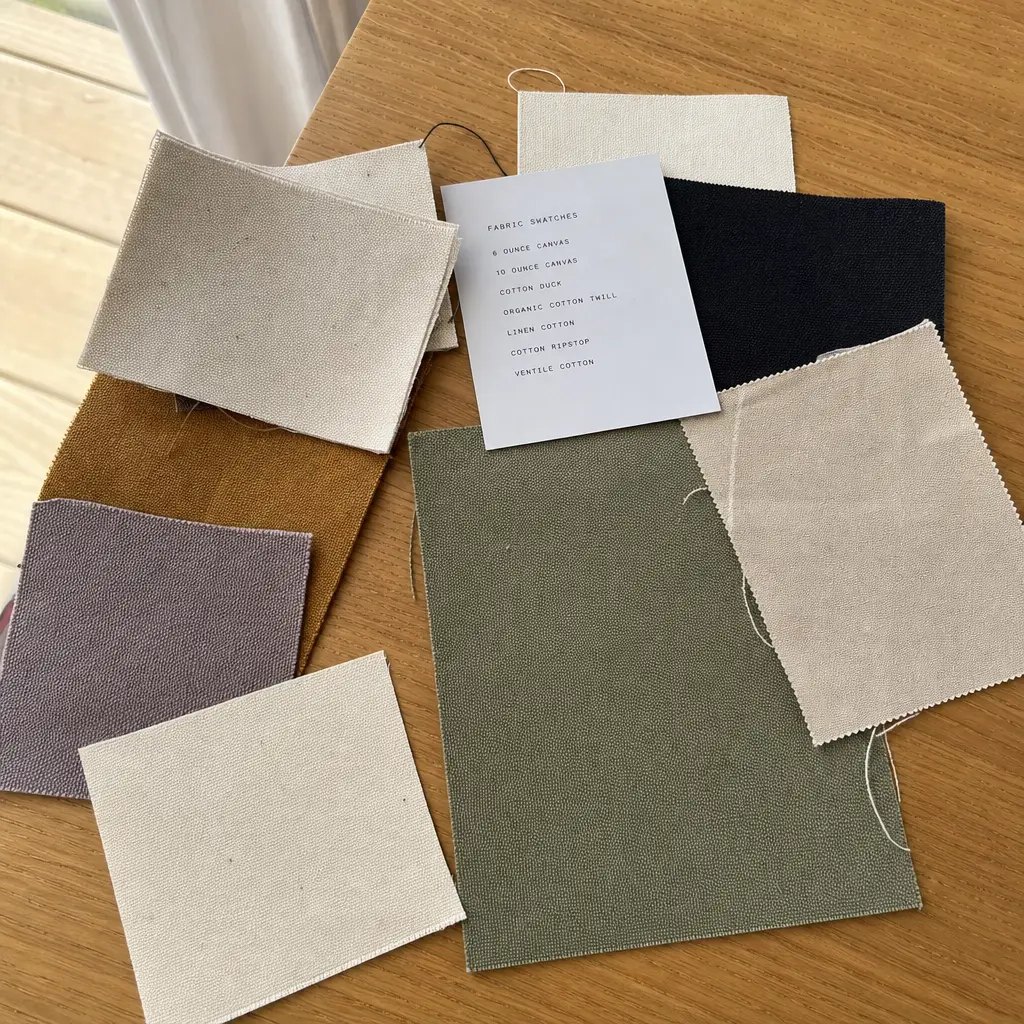
Why material selection matters more than the tote design
For canvas grocery totes, material choice drives most of the commercial outcome. It affects unit cost, print clarity, perceived quality, load behavior, and the kind of after-sales issues that procurement teams have to manage once a shipment is already in market. A tote that looks strong in a showroom sample can still disappoint if the cloth is too soft, the weave is loose, or the finish changes after printing and packing.
For tech startups, the risk is often timeline-driven. Launch teams usually want a reusable tote that feels premium, carries groceries reliably, and can be produced on a short schedule. That combination makes it tempting to focus on artwork first. In practice, the first decision should be fabric construction, because fabric determines whether the tote can hold its shape, accept decoration cleanly, and pass the simplest handling checks without distortion.
The right way to think about the purchase is as a material system, not a bag shape. Fabric weight, weave density, fiber content, finishing, seam construction, and packing method all interact. If one element changes, the visible result changes too. That is why procurement teams need a spec that is detailed enough for factories to quote the same product basis rather than a set of broad assumptions.
- Treat the canvas as the primary performance driver, not just a visual surface.
- Use the same construction basis across samples, quotes, and bulk orders.
- Separate material selection from decoration selection so the RFQ stays comparable.
How to read canvas weight without buying the wrong bag
The useful weight range for canvas grocery totes is usually around 8 oz to 12 oz, but the number only matters if everyone is measuring it the same way. A factory may quote weight on greige cloth, finished cloth, or washed cloth. Those are not equivalent, and comparing them directly can lead to false savings or inflated expectations. For buyer review, always ask how the weight was measured and whether the cloth changed after finishing.
In most grocery-use programs, 10 oz is a practical middle ground and 12 oz is the safer choice when the tote must feel more structured or handle repeated fill-and-carry cycles. An 8 oz canvas can be acceptable for low-load promotional use, but it usually offers less body, less shelf presence, and more visible distortion after packing. The bag can still be functional, but it may not feel convincing for resale or brand merchandising.
Weight alone does not guarantee performance. Two fabrics with the same nominal oz can behave differently if one has a tighter weave or better finishing. A tighter construction tends to help the bag recover after folding and improves the edge quality of printed logos. For procurement, the practical question is not only whether the tote is heavy enough, but whether it stays stable after print, sewing, and carton compression.
- 8 oz: use for light promotional programs or low-load handouts.
- 10 oz: use for standard reusable grocery totes with balanced cost and structure.
- 12 oz: use for retail resale or programs where shape retention matters.
- Ask for the same fabric lot in both blank and printed samples.
Comparison table: material tradeoffs and sourcing routes
Canvas tote sourcing gets easier when you compare not only fabric choices, but also the supplier route behind them. A quote from a direct factory, a trading company, or a multi-category sourcing desk can look similar on the page and still differ sharply in material traceability, lead time control, and corrective-action speed. Buyers should compare the full chain, not just the quoted tote price.
The table below expands the supplier and material tradeoff view. It is meant to help procurement teams decide which questions to ask before they spend time on sampling. If a supplier cannot answer these items clearly, the order may still be possible, but the comparison should be treated as incomplete until the missing data is provided.
- Direct factory quotes usually offer the cleanest view of fabric source and production control.
- Sourcing layers can be useful when you need bundled categories, but they add one more point of failure.
- A stable first launch usually comes from limiting variants before expanding the range.
Choosing fiber content, weave, and finish for startup programs
For a tech startup, the material story matters as much as the mechanics. A 100% cotton canvas often gives the most natural hand feel and a premium retail impression. That makes it attractive for customer gifts, merch drops, and resale programs where the tote becomes part of the brand experience. Cotton-rich blends can still be useful when price pressure is high or when a supplier has a more stable blended cloth source, but they need clearer approval on feel and shrink behavior.
Weave structure is the next decision. Plain weave canvas is the most common route because it is familiar to factories, predictable in sewing, and generally stable enough for printed branding. The key is weave balance. A canvas that is too open can shift during cutting and cause distortion in the print area or seam line. A tightly balanced weave tends to hold panel shape better and supports cleaner edges on logos and stitched labels.
Finishing should not be treated as a cosmetic extra. Stabilized or pre-shrunk cloth reduces the chance that the tote changes size after the first use or after steam finishing. That matters for pack-out, logo placement, and shelf presentation. If your artwork is placed close to a seam, even a small change in shrinkage can affect visual alignment. Ask whether the supplier can keep the same finish across repeat lots, because finish variation is one of the easiest ways for a program to drift over time.
- Use 100% cotton when the tote is part of a premium brand experience.
- Use cotton-rich blends only when the supplier can prove consistent behavior by lot.
- Prefer balanced plain weave for stable sewing and cleaner decoration.
- Ask whether the cloth is pre-shrunk, resin-treated, or otherwise stabilized.
Print method choices and how they interact with canvas
Printing on canvas is not just a design decision; it is a material compatibility decision. Screen printing remains the most practical choice for simple logos, repeat orders, and high-opacity decoration on natural canvas. It generally gives strong color density and a cleaner visual result when the artwork is limited to one or a few colors. For procurement, the key advantage is predictability: once the screen and cure settings are stable, the output is easier to repeat.
Heat transfer can be useful for smaller runs or artwork that would be expensive to separate into screens, but it changes the fabric hand and creates a different failure path. On a tote that will be folded, stuffed, and carried repeatedly, the printed film can crack, edge-lift, or feel stiff if the material or transfer layer is poor. It may be acceptable for a launch test, but it should be tested on the actual canvas spec before you commit to volume.
Embroidery and sewn labels are less common for grocery totes, but they can serve a premium branded use case. Embroidery can distort lighter cloth if the underlay is too dense, while a woven label may be the better choice if you want subtle branding with minimal impact on the canvas surface. The buyer question is not which decoration is the fanciest. It is which method is most durable and repeatable on the selected cloth at the target order quantity.
- Screen print: best default for simple, repeatable branding.
- Heat transfer: acceptable only after rub and fold testing on the same fabric.
- Woven label: useful when you want premium branding without large ink coverage.
- Embroidery: reserve for premium programs and confirm panel distortion risk.
Supplier evidence that turns a quote into a real comparison
A useful RFQ for canvas grocery totes should force every supplier to quote the same construction basis. That means the quote should identify fabric weight, weave, fiber content, finishing, print method, sewing details, packing format, and lead time by stage. Without that information, two suppliers may appear comparable while actually quoting different fabric grades or different packing assumptions. Procurement should treat that as a scope mismatch, not a price comparison.
The best evidence is practical, not promotional. Ask for a fabric reference or mill description, the measurement basis used for weight, and the tolerance used for finished dimensions. Ask whether the factory prints in-house or outsources the decoration stage. If the answer is “we can do it,” that is not enough. You need to know where the decision points sit, because those are the points where the order can drift from the approved sample.
Evidence also means asking how the supplier handles change control. If the original fabric becomes unavailable, who approves a substitute? If the print requires a different mesh or cure setting, who signs off? If the supplier cannot describe that process, then the risk is not just quality; it is schedule certainty. A clear change-control path is often more valuable than a slightly lower unit price.
- Request a written spec sheet that includes the measurement basis for weight.
- Ask who owns fabric approval, print approval, and bulk release approval.
- Confirm whether cutting, printing, and sewing happen in one facility or several.
- Do not accept a quote that leaves packing, carton count, or finish undefined.
MOQ strategy for first launches and repeat orders
MOQ should be managed as a cost-control tool, not just a factory constraint. The cheapest path usually comes from concentrating demand into one tote body, one fabric weight, one color, and one print position. Once you split into multiple colors or logo versions, you multiply setup work. That can increase the effective cost of every unit, even if the quoted tote price seems reasonable in isolation.
For startup procurement, a good rule is to separate test volume from full-scale volume. Use a limited launch order to validate hand feel, print response, packing behavior, and customer reception. If the factory demands a large MOQ for custom color or multiple print positions, ask whether the same visual result can be achieved through a lower-complexity construction. A one-sided print on a standard body often preserves margin much better than a heavily customized version.
Repeat orders should also be planned for the same fabric source or an approved equivalent. The second order is where many programs fail, because the first run was approved visually and the replenishment lot arrives with a subtly different hand feel or shade. Ask the supplier whether the same mill, same dye lot, or same finishing process can be reserved for future production. That is often more important than squeezing the last cent out of the initial purchase.
- Use one body, one color, and one print position where possible.
- Separate pilot volume from replenishment volume in the sourcing plan.
- Ask whether future orders can be built from the same mill or a locked equivalent.
- Treat variant count as a direct driver of setup cost and stock risk.
Lead time risk: where tote programs actually slip
For canvas grocery totes, the production schedule usually slips before sewing begins. Fabric booking, shade approval, print setup, and sample approval are the usual bottlenecks. Sewing is often the most visible stage, but it is not always the slowest. If the cloth needs custom dyeing or special finishing, the timeline can stretch well before the first cutting lay is made.
The buyer should ask for a stage-by-stage schedule. A single total lead time hides the true risk. A stronger supplier response will show fabric sourcing, sampling, pre-production approval, bulk manufacturing, packing, and export booking separately. That gives procurement a way to see whether the schedule is exposed to material lead time, capacity lead time, or freight booking lead time. Those are different risks and should be managed differently.
Lead time also needs to be checked against seasonality. If the launch depends on retail shelf windows or internal campaign dates, even a small delay in sample approval can push the delivery into a freight-congested period. That is why buyer teams should ask whether the timeline assumes fabric is already in stock, whether sample revisions are included, and what happens if the first pre-production sample misses the spec. A realistic schedule includes one controlled correction cycle, not endless back-and-forth.
- Ask for a stage-by-stage lead time, not just one calendar number.
- Confirm whether the quote assumes in-stock fabric or new material booking.
- Check how sample revisions affect the bulk schedule.
- Add buffer when custom dyeing, special finishing, or peak freight periods are involved.
Landed-cost comparison that procurement can defend
The most useful comparison is landed cost, not ex-factory price. A tote with a low unit price can become expensive once freight cube, carton count, packing labor, duty, warehouse handling, and defect risk are added. Canvas is bulky relative to its invoice value, so a small change in carton configuration can affect shipping economics more than buyers expect. That means the pack plan is part of the material decision, not an afterthought.
When comparing suppliers, build one table with the same fields for every quote: unit price, setup charges, sample charges, packing method, carton count, estimated freight impact, and expected defect allowance. That makes it much easier to see whether a quote is genuinely cheaper or just missing a hidden cost. Procurement teams should also compare the expected replacement cost if the bag fails after first use. A slightly higher unit cost can still be the lower-risk option if it reduces claims or rework.
For startup buyers, landed cost also includes brand cost. If the tote looks thin, arrives wrinkled, or feels inconsistent across lots, it can weaken the perception of the whole program. That may not appear on the purchase order, but it affects the value of the inventory. In practice, the best tote is the one that arrives on time, matches the approved sample, and can be reordered without starting the sourcing process from zero.
- Compare all quotes on the same landed-cost template.
- Include setup, packing, freight cube, and expected defect exposure.
- Do not treat low ex-factory price as the final answer.
- Ask whether carton size can be optimized to reduce shipping waste.
QC checkpoints with concrete test methods and acceptance logic
QC for canvas grocery totes should be specific enough that a factory can execute it without guessing. Start with measurements. Finished width, height, and gusset depth should be checked after sewing and any finishing step, not only on the cut panels. Set an agreed tolerance before production starts, and make sure the supplier knows whether the tote will be measured flat or filled. That avoids arguments after shipment.
For fabric, inspect the surface under daylight and warehouse lighting for slubs, stains, oil marks, mildew smell, broken yarns, and uneven shade. For construction, inspect seam straightness, bar-tack density, thread trim, and the consistency of the handle attachment. A common defect is a visually acceptable tote with uneven seam allowance or weak reinforcement at the stress points. Another is a print that looks good on the face but bleeds at the fold line or seam edge.
Practical test methods matter more than generic statements about quality. Ask the factory to define at least three checks in writing: a dimensional check on the finished bag, a loaded-carry check at the target weight, and a decoration durability check such as rub resistance or fold-line inspection. If the tote is intended for grocery use, confirm the test weight and hold time before bulk release. Even a simple internal protocol is better than no protocol, because it lets you compare lots instead of debating opinions. Include defect examples in the approval sheet so the factory knows what counts as rejectable: open seam, skipped stitch, crooked print, label misplacement, or visible contamination.
Acceptance logic should also cover packaging. A bag can pass sewing checks and still arrive damaged if cartons are overpacked or stored in damp conditions. Verify outer carton strength, packing count, moisture protection, and pallet load pattern. For import programs, ask for carton marks that help the warehouse receive by SKU without opening every box. That saves receiving time and reduces the chance of case-level disputes.
- Measure the finished tote after all finishing steps.
- Use a target-load carry test before final shipment release.
- Write defect examples into the approval document.
- Inspect cartons for crush risk, moisture exposure, and shape distortion.
Specification comparison for buyers
| Spec decision | Recommended option | Procurement tradeoff | Buyer risk to check |
|---|---|---|---|
| Fabric weight | 10–12 oz canvas for most reusable grocery programs; 8 oz only for light promo use | Higher weights usually improve shape retention, opacity, and perceived value, but add material cost and shipping weight | Confirm the supplier’s weight basis and whether the cloth is measured before or after finishing |
| GSM basis | Quote both oz and GSM on the same construction basis | Using both units reduces ambiguity across mills and regions, especially when comparing multiple factories | Ask whether the weight is greige, finished, washed, or post-print |
| Weave structure | Plain weave canvas with tight, balanced construction | Balanced weave improves panel stability, printing predictability, and seam consistency | Loose weave can distort logos, let seams pucker, and change hand feel between lots |
| Fiber content | 100% cotton for premium handfeel; cotton-rich blends only when price pressure is real | Cotton typically supports a more natural retail story, while blends can reduce cost or improve consistency depending on the mill | Check shrinkage, dye uptake, and lot-to-lot shade variation before approving a blend |
| Color strategy | One stock body color for launch, custom dye only if volume justifies it | Standard colors reduce dye risk, sampling cycles, and MOQ fragmentation | Custom colors can push lead times and increase shade-matching disputes |
| Print method | Screen print for simple logos and repeat orders | Best balance of durability, opacity, and cost at scale when artwork is limited to a few colors | Ask for cure method, rub resistance, and registration tolerance on the actual fabric |
| Decoration alternative | Woven label or small sewn patch for subtle branding | Useful when you want low visual noise and a premium hand feel without large ink coverage | Make sure the label does not distort the panel or create a scratch point against the user |
| Handle construction | Self-fabric or webbing handles with bar-tacks and reinforced stitch zones | Better load distribution and lower failure risk for grocery carry weights | Thin handles may look fine in samples but stretch or tear under repeated use |
| Bag structure | Bottom gusset plus stitched hem; pre-shrunk or stabilized fabric when possible | Gusseted construction improves usable volume and shelf presence, but increases sewing complexity | Size drift after washing or steam finishing can change pack-out and logo placement |
Buyer checklist before sampling
- Lock fabric weight in oz and GSM, not just the word canvas.
- Define finished size, gusset depth, handle length, seam allowance, and acceptable dimensional tolerance.
- Specify print method, ink type, logo placement, number of colors, and registration tolerance.
- Request blank swatch, printed sample, and pre-production sample from the same material source.
- Ask for shrinkage, colorfastness, seam strength, rub resistance, and load test criteria in writing.
- Confirm carton pack count, polybag use, moisture protection, pallet pattern, and outer carton marks.
- Match MOQ to the number of SKUs you can actually sell through in the first order.
- Confirm lead time separately for fabric booking, sampling, production, packing, and transit.
- Ask for defect categories and acceptance thresholds before approving bulk production.
- Compare landed cost, not only ex-factory price, across at least two supplier routes.
Factory quote questions to send
- What exact fabric spec are you quoting: yarn count, weave, finished weight in oz and GSM, and whether the cloth is pre-shrunk or stabilized?
- Is the quoted price based on greige canvas, bleached canvas, dyed canvas, printed goods, or a finished bag with all sewing completed?
- What is the MOQ per color, per fabric weight, and per logo version, and how does pricing change if we remove one variant?
- Which print method is included, how many colors are covered, and what setup charge applies per screen, plate, or transfer file?
- What sewing details are included: gusset, bottom reinforcement, bar-tack count, handle width, handle stitch length, and seam allowance?
- What sample stages do you offer, who approves them, and how long does each stage take from request to shipment?
- What packing format is quoted: bulk pack, individual polybag, barcode label, insert card, master carton mark, or pallet requirement?
- What QC standard do you use for measurements, print placement, loose threads, fabric defects, and carton damage?
- What test methods do you use for shrinkage, seam strength, colorfastness, print rub resistance, and loaded-carry validation?
- What portion of the lead time is fabric sourcing, cutting, printing, sewing, packing, and export booking?
Quality-control points to confirm
- Measure fabric weight on the same basis for every lot and record whether the sample is greige, finished, washed, or post-print.
- Inspect the canvas face for slubs, oil marks, mildew odor, broken yarns, shade variation, and patchy dyeing under daylight and warehouse lighting.
- Check finished dimensions after construction, not only before sewing, and compare width, height, and gusset depth to the approved tolerance.
- Verify handle attachment strength by checking bar-tack density, stitch uniformity, and the absence of skipped stitches or loose thread tails.
- Test print quality for edge sharpness, opacity, ghosting, pinholes, and seam-line distortion, especially near folds and gussets.
- Run a simple rub test on the printed area by hand or with a controlled internal method and reject any transfer that marks adjacent surfaces.
- Assess seam behavior with a loaded carry test using the agreed target weight and hold time before releasing bulk shipment.
- Check carton condition for crushing, moisture exposure, and tote deformation; confirm that handles and corners are not compressed by packing.
- Compare approved sample color and hand feel against production goods in the same light source before mass release.
- Document defect examples by category: open seam, skipped stitch, crooked print, oversized label, wrong handle length, or inconsistent color lot.