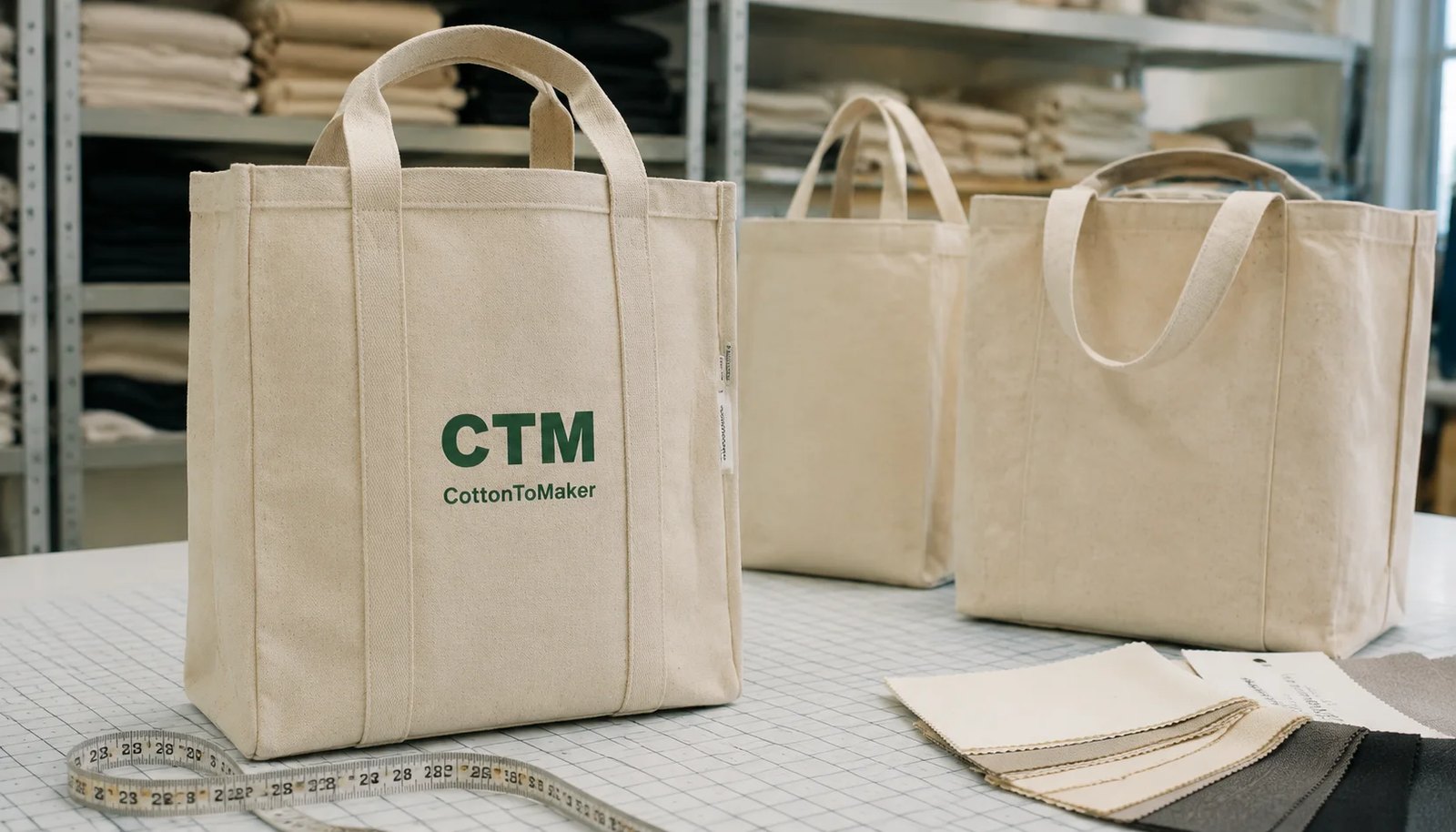
Planning Problem
Custom canvas grocery totes for liquor retailers usually fail on timing because the buyer treats them like a simple printed bag. In practice, the schedule depends on fabric weight, sewing construction, print method, artwork approval, packing format, and export booking. A tote used to carry wine bottles or spirits has a different risk profile from a thin event giveaway. If the bag must support real retail use, the factory cannot responsibly quote only from a logo and target price.
The useful starting point is not a production date. It is the retail deadline and the approval chain behind it. Liquor retailers often have fixed promotional windows around holiday periods, store openings, tasting events, loyalty campaigns, or distributor-funded programs. Missing that window can turn a good tote into dead inventory. A workable plan separates the order into specification, sampling, material booking, printing, sewing, inspection, packing, and shipment, with decision dates attached to each stage.
- For a simple natural canvas grocery tote with one-color print, plan the fastest route around stock fabric and standard construction.
- For custom dyed canvas, multi-color artwork, store-specific labels, or special packing, add buffer before promising a retail launch.
- For bottle-carry use, prioritize construction and sample testing over a small unit-price saving.
Define The Retail Load
A liquor retail tote must be specified around what it will carry. A bag used for one or two bottles plus small grocery items needs stronger handle attachment and a more stable bottom than a flat cotton shopper used at a trade event. The RFQ should state the expected load in kilograms or pounds, the typical product mix, and whether the tote will be sold, gifted, or used as a reusable shopping bag at checkout.
The common practical size range for canvas grocery totes is around 38-42 cm wide, 35-40 cm high, with a 10-15 cm gusset. A boxed bottom or side gusset helps the bag stand and accept bottles without distorting the side seams. Handle drop should be chosen by use: short hand-carry handles feel controlled with bottles, while shoulder-length handles improve comfort but place more leverage on the attachment points.
- Bottle-heavy use: use boxed bottom, reinforced handles, and a fabric weight that does not collapse under load.
- Checkout grocery use: allow enough gusset depth for cartons, mixers, and mixed retail items.
- Gift-with-purchase use: balance cost and appearance, but do not remove reinforcement if bottles may be carried.
- Paid merchandise: specify cleaner stitching, tighter print tolerance, and better packing because shoppers will judge it as a retail item.
Fabric Weight Choices
Fabric weight is one of the first lead time and cost drivers. For liquor retailers, 10 oz to 12 oz cotton canvas, roughly 340-410 GSM, is often the practical range for a reusable grocery tote. It has enough body for bottle and grocery use while still being workable for screen printing and export packing. Lighter 6 oz to 8 oz cotton may be suitable for giveaways, but it will feel less durable and may not match the retail expectation for a paid or loyalty tote.
Buyers should not compare quotes by ounce description alone. Canvas ounce references can vary by market and by supplier habit. Ask for GSM, weave density if available, and whether the fabric is stock, newly woven, washed, or dyed. Natural canvas can vary in shade between batches. If the liquor brand requires a controlled cream, black, green, burgundy, or other brand color, the color approval path can add days or weeks before production.
- 8 oz cotton canvas: cost-sensitive promotions where heavy bottle carrying is not the main use.
- 10 oz cotton canvas: balanced choice for reusable grocery totes and most liquor retail programs.
- 12 oz cotton canvas: stronger handfeel for premium retail use, with higher material cost and carton weight.
- Custom dyed canvas: better brand control, but fabric MOQ, lab dip approval, and dyeing lead time must be planned.
Print Method Timing
Screen printing is usually the most dependable method for custom canvas grocery totes when the artwork uses solid logo colors. It handles large front-panel branding well, gives a direct retail look, and keeps the unit cost manageable at bulk quantity. The factory still needs final vector artwork, Pantone references, print size, placement, and fabric color before it can confirm screens and ink matching. A large print on coarse canvas may need thicker ink and more curing time than a small logo on smooth cotton.
Heat transfer can work when the logo has gradients, small color details, or a full-color campaign graphic, but buyers should test handfeel and edge durability on actual canvas. Embroidery is stronger as a premium detail than as a large front logo because stitch count increases cost and can pucker the panel. Woven labels or sewn side labels are useful for subtle brand ID, but they create their own MOQ and lead time if custom woven from scratch.
- Use screen print for 1-3 solid colors, large logo areas, and repeatable retail branding.
- Use heat transfer only after checking wash, rub, and edge lift behavior on the selected canvas.
- Use embroidery for small premium marks, not large detailed liquor artwork.
- Use woven side labels when the buyer wants a cleaner retail finish, but include label production time in the schedule.
MOQ And Cost Logic
MOQ is not only a factory policy. It is often the combined result of fabric sourcing, print setup, sewing line efficiency, packing requirements, and artwork variations. A natural canvas tote with one print design can usually be produced more flexibly than a custom dyed tote with five store versions and separate carton marks. When procurement compares quotes, the MOQ must be read per total order, per design, per color, and per packing version.
The lowest piece price may be based on assumptions the buyer did not intend: lighter fabric, smaller print area, no sample remake, bulk packed cartons without store allocation, or no inner moisture protection. A useful quote should separate the cost drivers clearly enough for the buyer to decide where to spend money. For example, moving from 8 oz to 10 oz fabric may matter more than adding a second print color if the bag will carry bottles.
- Fabric MOQ: triggered by custom dyeing, special weave, non-stock weight, or unusual color.
- Print MOQ: affected by number of screens, print colors, and separate artwork versions.
- Sewing MOQ: affected by custom size, handle construction, gusset, and reinforcement method.
- Packing MOQ: affected by barcode labels, store allocation, individual polybags, inserts, or display cartons.
- Quote comparison rule: require every supplier to quote the same GSM, size, print area, packing, and carton data.
Sample Approval Path
A physical pre-production sample is the best schedule insurance when the tote has a fixed launch date. It should use the actual bulk fabric or a clearly identified equivalent, the final handle width and drop, the real print method, and the planned reinforcement. If the sample is made from substitute fabric, the buyer should treat it as a construction sample only and still require fabric approval before bulk cutting.
Sample approval must be time-boxed. The buyer should decide in advance who approves artwork, who approves fabric handfeel, who approves brand color, and who approves packing. Liquor retail projects can involve procurement, marketing, brand owners, distributors, and store operations. If all parties review the sample sequentially with no deadline, the production schedule will slip before fabric is even cut.
- Approve fabric weight by GSM and handfeel, not only by photo.
- Measure finished bag size, gusset, and handle drop against the RFQ.
- Review print size, edge sharpness, ink coverage, and placement on actual canvas.
- Test the sample with realistic bottle and grocery weight before bulk approval.
- Keep one signed or sealed sample as the factory production standard and one as the buyer reference.
Lead Time Map
A realistic lead time plan works backward from the required warehouse arrival date. The factory production window is only one part of the calendar. Artwork confirmation, sample making, courier transit, buyer comments, fabric booking, print screen preparation, bulk cutting, sewing, inspection, packing, and export booking all need their own place in the timeline. If any approval step is missing, the supplier may quote a production lead time that is technically correct but commercially unusable.
For planning purposes, buyers can treat standard natural canvas with one-color print as the simplest path. Custom dyed fabric, multiple print versions, retail barcode labeling, or store-level carton sorting should be treated as extended paths. The risk is highest when the buyer approves the design late but keeps the original delivery date. In that case, the factory may compress sewing and QC time, which is exactly where bottle-carry totes need attention.
- Artwork and spec freeze: confirm size, GSM, logo, print position, and packing before sample work starts.
- Sample stage: include factory sample time, courier transit, buyer review, and possible remake.
- Material stage: confirm stock fabric availability or lab dip and bulk dyeing schedule.
- Production stage: allow time for cutting, printing, curing, sewing, trimming, and inline checks.
- Final stage: reserve time for inspection, carton sealing, booking, customs documents, and pickup.
Packing And Warehouse Fit
Packing decisions affect both lead time and landed cost. Canvas grocery totes are usually packed flat in export cartons, often 50 to 100 pieces per carton depending on fabric weight, bag size, and whether individual polybags are required. Heavy 12 oz canvas takes more carton space and increases carton gross weight. A warehouse that limits carton weight may need fewer pieces per carton, which increases carton count and handling.
Liquor retailers should decide early whether bags will ship to one distribution center, multiple store locations, or a distributor warehouse. Store allocation, barcode labels, carton marks, and mixed SKU packing can add labor after sewing. If this work is not in the original quote, it becomes a late-stage cost issue and can delay release. Moisture protection also matters because natural canvas can absorb odor and humidity during storage and transit.
- For bulk warehouse receiving: use flat packing, standard export cartons, and clear SKU carton marks.
- For store allocation: provide store list, quantity per store, label format, and carton mark rules before production ends.
- For retail sale: consider individual polybag or belly band only if required by the retail display plan.
- For sea freight: review carton CBM because a thicker canvas tote can change landed cost even when unit price looks stable.
QC Acceptance Criteria
The acceptance standard should be written before production, not argued after inspection. For canvas grocery totes used by liquor retailers, the critical areas are fabric weight, seam strength, handle attachment, print clarity, print placement, and packing accuracy. Cosmetic defects matter, but a beautiful print will not compensate for weak handles when the bag is loaded with bottles.
A practical inspection plan includes incoming fabric checks, inline sewing review, print review after curing, and final random inspection before cartons are sealed. The buyer does not need to overcomplicate the standard, but the factory needs measurable limits. Size tolerance, print position tolerance, acceptable shade variation, and defect classification should be included in the purchase order or approved sample record.
- Fabric GSM: verify against approved specification before cutting bulk panels.
- Finished size: control width, height, gusset, and handle drop within agreed tolerance.
- Handle strength: inspect reinforcement and test with a load above expected retail use.
- Print position: define allowable shift from center and distance from top seam or bottom edge.
- Print quality: reject heavy smudging, pinholes in key logo areas, poor curing, and visible registration errors.
- Packing: verify pieces per carton, carton marks, SKU separation, moisture protection, and label accuracy.
Quote Comparison Workflow
Procurement teams get better pricing when the RFQ removes guesswork. The supplier should not have to infer whether the buyer wants 8 oz or 12 oz canvas, short handles or shoulder handles, one-color or three-color print, bulk cartons or store-ready packing. A detailed RFQ may take longer to prepare, but it prevents the common problem of receiving three quotes that cannot be compared.
A useful workflow is to issue a base specification, request itemized quote data, review sample feasibility, then negotiate cost drivers one by one. If the target price is tight, the buyer can decide whether to reduce fabric weight, simplify print, use stock fabric color, reduce artwork versions, or change packing. This is better than forcing a target price without knowing which part of the bag the supplier will weaken to reach it.
- Start with a fixed base spec: size, GSM, gusset, handle, print method, print area, quantity, and packing.
- Require quote data: unit price, sample cost, screen charge, MOQ rule, lead time, carton CBM, and quote validity.
- Compare construction first: fabric and handle reinforcement are more important than small print savings for bottle use.
- Compare logistics second: carton size and gross weight can change landed cost and warehouse handling.
- Negotiate by tradeoff: ask what changes if fabric moves from 12 oz to 10 oz, or if print changes from two colors to one.
Specification comparison for buyers
| Spec decision | Recommended option | When it fits | Buyer risk to check |
|---|---|---|---|
| Fabric weight for liquor retail grocery totes | 10 oz to 12 oz cotton canvas, roughly 340-410 GSM, with reinforced stress points | Best balance for wine, spirits, mixers, and general grocery items where the bag must stand up better than a thin cotton shopper | Quote may look cheaper if supplier uses 8 oz fabric or loose weave canvas; compare actual GSM, not only ounce description |
| Bag construction | Boxed bottom with side gusset, bartack or cross-stitch handle reinforcement, internal seam overlock or bound seam | Useful for bottles and rectangular cartons because the base opens properly and reduces side seam strain | Flat totes may be cheaper but load poorly; confirm finished base width and whether seams are reinforced at handle points |
| Print method | Screen print for solid retail logos; heat transfer only for small full-color artwork; embroidery only for premium limited runs | Screen print is stable for 1-3 color liquor retail branding and works well on canvas texture | Fine type, legal lines, and metallic effects can fail on coarse canvas; require print proof with actual fabric and ink |
| Sample approval route | Pre-production sample using actual fabric, handle length, print size, and packing method before bulk cutting | Recommended for seasonal campaigns, store launches, loyalty gifts, and distributor programs with brand approval steps | Digital mockups cannot prove print edge quality, shrinkage, stitching, or handle comfort; do not release bulk production from artwork alone |
| MOQ logic | MOQ based on fabric color, print color count, and sewing setup, commonly easier for natural canvas than custom dyed fabric | Natural or black canvas with one-location print is easier to schedule and consolidate | Custom dye, multiple store versions, and mixed logo colors can create hidden MOQs at fabric, print screen, and packing levels |
| Packing format | Flat packed 50-100 pcs per export carton with moisture protection and clear carton marks by SKU or store allocation | Works for warehouse receiving and later store distribution without excessive freight volume | Over-compressed packing can crease heavy canvas and transfer ink; test carton weight and carton size before mass packing |
| Lead time buffer | Plan sample approval, material booking, printing, sewing, QC, packing, and export booking as separate stages | Needed when delivery date is tied to holiday promotions, tasting events, or retail resets | The calendar often fails at approval gaps, fabric arrival, artwork revision, or vessel booking, not only at sewing capacity |
| Quote data comparison | Compare finished size, GSM, print size, color count, handle spec, packing, carton CBM, sample fee, and validity date | Allows procurement to compare suppliers on the same commercial basis instead of accepting vague per-piece prices | A low unit price can be offset by lighter fabric, smaller print, weak packing, higher freight CBM, or excluded pre-production sample cost |
Buyer checklist before sampling
- Define the retail use: bottle carry, grocery add-on, event giveaway, loyalty gift, or paid merchandise.
- Set finished tote dimensions, gusset, handle drop, fabric weight, fabric color, and maximum expected carry weight before requesting quotes.
- State whether natural canvas shade variation is acceptable or whether a controlled fabric color standard is required.
- Provide vector artwork, Pantone references, print size, print position, and any restricted brand color tolerances.
- Decide whether one approved universal design or store-specific versions will be produced.
- Require a physical pre-production sample when the order has a fixed retail launch date or brand approval requirement.
- Confirm whether MOQ is driven by fabric, print screen, sewing line setup, packing, or carton marking.
- Review export carton dimensions, carton gross weight, CBM, and pallet loading if warehouse handling limits apply.
- Build approval time into the schedule, including buyer review, brand owner comments, sample remake, and courier transit.
- Record final acceptance criteria for fabric GSM, print position tolerance, seam strength, handle reinforcement, packing, and labeling.
Factory quote questions to send
- What fabric weight will be used in GSM and ounces, and is the fabric stock or newly woven?
- What is the finished bag size, gusset width, handle width, handle drop, and seam construction included in the quote?
- Is the quoted MOQ based on total order quantity, per artwork, per fabric color, or per print color combination?
- Which print method is quoted, and what is the maximum recommended print size on this canvas texture?
- How many days are needed for artwork proof, sample making, sample courier, bulk material booking, production, QC, and packing?
- Can you provide carton dimensions, pieces per carton, gross weight, net weight, and estimated CBM before order confirmation?
- Will the pre-production sample use actual bulk fabric, actual ink color, actual handle reinforcement, and final packing method?
- What are the inspection standards for fabric defects, print defects, stitching, bag size tolerance, and carton marking?
- What costs are excluded from the unit price, such as sample fee, screen charge, mold charge, inner polybag, barcode label, or palletizing?
- How long is the quote valid, and which parts may change if fabric, exchange rate, or freight booking changes?
Quality-control points to confirm
- Fabric weight checked against approved GSM tolerance before cutting, not only after finished bags are sewn.
- Finished bag dimensions measured flat and opened, including gusset width, handle drop, and panel alignment.
- Handle attachment tested with static load and visual inspection of bartack or cross-stitch reinforcement.
- Print position tolerance agreed before production, especially for centered front-panel logos and side label placement.
- Ink adhesion and rub resistance checked after drying or curing, with attention to dark ink on natural canvas.
- Seam quality inspected for skipped stitches, loose threads, uneven tension, and weak corner points.
- Packing checked for correct pieces per carton, moisture protection, carton marks, SKU separation, and barcode labels where required.
- Random finished bag review against approved pre-production sample before final carton sealing.