Start with the delivery date, not the tote
For an eco apparel brand, a canvas grocery tote is usually attached to a commercial moment that will not wait: a store opening, wholesale pack-out, market event, subscription box, gift-with-purchase campaign, online bundle, or seasonal apparel drop. That makes lead time a purchasing requirement, not a note to clean up after price negotiation. A tote that arrives two weeks late can be perfectly made and still miss the reason it was ordered.
A useful canvas grocery totes for eco apparel brands lead time planning guide begins with the full calendar. Separate spec confirmation, quote alignment, artwork preparation, lab dip or material approval if needed, sampling, courier time, buyer review, fabric purchase, cutting, printing, sewing, trimming, in-line QC, final inspection, packing, export handoff, international freight, customs, domestic delivery, and warehouse receiving. When a supplier says production takes 25 days, clarify what starts that clock. It may mean 25 days after deposit, artwork approval, material readiness, and signed sample approval.
Work backward from the required in-hand date and create visible gates. The launch date, warehouse receiving date, freight booking date, final inspection date, packing completion date, sewing start date, fabric-ready date, sample approval date, and artwork freeze date should all be on one timeline. This keeps teams honest. Marketing may think the order is in production, while the factory is still waiting for final artwork, label artwork, barcode rules, or carton marks.
The fastest lower-risk route is usually stock natural canvas, one approved construction, one-color screen print, standard flat packing, and a written inspection plan. Custom-dyed fabric, complex artwork, multiple graphics, individual retail packing, or split shipments can still be the right decision. They simply need days assigned to them before the PO is placed.
- Set the required in-hand date before requesting quotes.
- Ask suppliers to break timing into sample, material, production, packing, inspection, export, and freight stages.
- Create freeze dates for artwork, body construction, fabric color, trims, and packing.
- Confirm whether quoted production days start at PO issue, deposit receipt, material approval, or sample approval.
- Keep receiving and warehouse processing time outside the factory production estimate.
Write the spec like the factory will build from it
A request for a natural canvas grocery tote is not enough for B2B sourcing. One supplier may quote a light flat promotional bag. Another may quote a 12 oz gusseted tote with reinforced handles. A third may include individual packing and barcode labels. The unit prices may sit in the same range, but they are not the same product.
Start with finished dimensions, not rough size language. State width, height, gusset depth, and whether the gusset is bottom, side, or boxed-bottom construction. Grocery function depends on the opening, base stability, and usable volume as much as front-panel size. If the tote needs to hold folded apparel, boxed sets, produce, market purchases, or event kits, include that intended use. A good supplier can then flag problems with handle drop, bottom shape, fabric weight, or carton size before sampling.
Handles deserve the same precision as the body. Include material, width, total length, finished drop, attachment position, and reinforcement. For hand carry, a shorter drop may be right. For elbow or shoulder carry, test the drop on a filled sample. Self-fabric handles can create a clean apparel-brand look, while cotton webbing may simplify trim sourcing when stocked. The choice affects comfort, sewing time, load performance, and appearance.
Add tolerances before production begins. Canvas shifts during cutting, sewing, printing, pressing, and packing. Use separate tolerances for body width, height, gusset depth, handle length, handle drop, print placement, and label placement. The exact numbers should be agreed with the supplier and inspector, then attached to the PO, approved sample, and QC checklist.
- Specify finished width, height, gusset depth, handle width, handle length, and handle drop.
- Define construction as flat, side-gusseted, bottom-gusseted, boxed-bottom, or reinforced-bottom.
- State seam type, top hem depth, thread color, label position, and trimming standard.
- Use reference photos only as support for written measurements and construction details.
- Attach the final spec sheet to the RFQ, PO, sample approval, and QC checklist.
Choose canvas weight without relying on shorthand
Canvas weight affects cost, structure, load feel, print appearance, carton cube, and lead time. For grocery totes, many B2B buyers specify 10 oz to 12 oz cotton canvas, roughly around 340 to 410 GSM depending on the fabric basis and supplier conversion. This is not a universal rule, but it is a practical starting point for sturdy grocery carry, paid merchandise, and higher-quality brand programs. Lighter 8 oz to 10 oz canvas can work for lower-load promotional use, but it should be treated as a deliberate cost and foldability choice.
Terminology can trip up even experienced teams. Some suppliers quote ounces per square yard, some quote GSM, and some use local shorthand that does not match measured finished weight cleanly. Ask whether the quoted weight refers to greige fabric, base cloth, or finished fabric after dyeing and finishing. If procurement compares suppliers without normalizing this, the cheaper offer may simply be a lighter bag.
Eco apparel buyers also need care around material claims. Natural-looking cotton canvas is not automatically organic, recycled, undyed, low-impact, or certified. If the program requires organic cotton, recycled cotton, a recycled-content blend, recycled-content packing, or chain-of-custody documentation, request the document type at RFQ stage. Certification scope, transaction certificates, material declarations, and supplier self-declarations are not interchangeable.
Shrinkage and finishing belong in the same conversation. Canvas can shrink during dyeing, washing, steaming, pressing, or heat curing. If the tote will be washed, dyed, or heat-cured after printing, finished measurements should be checked after that process. Do not approve a size based only on a sewn sample if a later process is expected to change dimensions.
- Use 10 oz to 12 oz canvas for many grocery, resale, and sturdy retail programs.
- Use 8 oz to 10 oz only when lower load, lighter hand feel, or budget is the priority.
- Ask for both oz and GSM when possible, plus the basis of the measurement.
- Confirm whether the fabric is conventional cotton, organic cotton, recycled cotton blend, or another composition.
- Request required certificates or material declarations before sample approval, not after bulk production.
Treat fabric color as a schedule choice
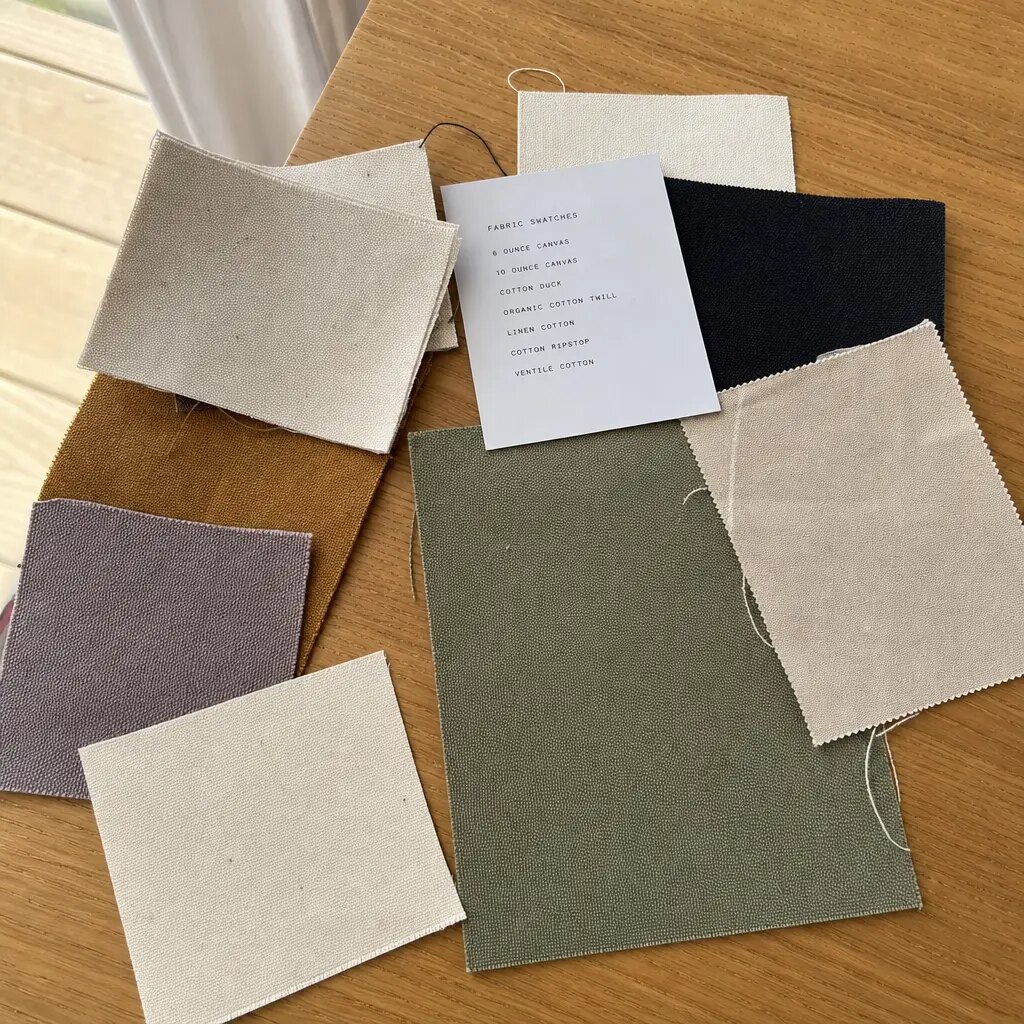
Fabric color can be one of the largest hidden lead time drivers. Stock natural, ecru, or off-white canvas is usually the most predictable choice because it may already be available from the supplier, mill, or local fabric market. That does not guarantee the exact weight, width, and quality are in stock, but it normally carries less approval risk than custom dyeing.
Custom-dyed canvas adds steps: lab dip request, lab dip production, buyer review, bulk dyeing, shade checking, and sometimes re-dyeing or shade sorting. If the tote must connect to an apparel collection color, a Pantone reference alone is not enough. Ink on paper, dyed cotton fabric, and screen print on textured canvas can all read differently. The approved lab dip or shade band should become the color standard.
Color also changes print planning. White ink on natural canvas may need opacity control. A dark body may require an underbase or different ink system. Large print coverage can change hand feel and curing time. If the order combines custom dyed fabric with multi-color artwork, prove both together in sampling. Separate approvals can hide contrast, registration, or opacity issues.
For tight calendars, ask for two quote paths: stock natural canvas and custom color. That comparison helps merchandising and marketing see the cost and timing trade-off. It also gives procurement a fallback if lab dips or bulk shade approval threaten the launch window.
- Use stock natural or ecru canvas when schedule certainty matters most.
- Plan lab dip time for any dyed-to-order body color or handle trim.
- Approve a physical shade standard where color accuracy matters.
- Ask whether custom dyeing triggers fabric MOQ or dye-lot minimums.
- Check print opacity and contrast on the final body color, not only on paper proofs.
Freeze branding before production assets are made
Branding decisions change both cost and timing. A one-color screen print on natural canvas is often the simplest route for a predictable launch. Limited-color screen printing can still run efficiently when artwork is clean and registration is not too demanding. Woven labels may suit a minimalist apparel brand, but they add label production, trim MOQ, placement checks, and often a separate approval. Heat transfers or digital methods can support more detailed graphics, but they need testing for adhesion, hand feel, heat marks, and color transfer.
Send production artwork in the format the supplier needs, usually vector files for screen print or label artwork unless another method is agreed. The RFQ should include print size, placement from top and side edges, color references, number of colors, and whether small adjustments are allowed for production. Fine lines, distressed textures, halftones, large solids, and print areas near seams or gussets should be flagged early because they affect setup and defect risk.
A strike-off or printed panel is useful for checking ink color, opacity, edge sharpness, curing, and hand feel. It does not always prove final placement on the finished bag. For first orders, paid merchandise, retailer-facing programs, or complex artwork, a pre-production sample made with bulk-equivalent fabric and print is the stronger approval standard. That sample should be signed and used by QC as the reference.
Version count needs the same discipline as MOQ. Five graphics on the same body sound simple, but each version may require separate screens, setup, proofing, packing separation, and inspection counts. If the brand needs variety, hold the body construction, fabric color, handle, and packing constant wherever possible.
- Freeze artwork before screen making, transfer production, or woven label production starts.
- State print size, color reference, and placement tolerance in the RFQ.
- Request strike-offs for important color, opacity, or hand-feel decisions.
- Confirm setup charges and MOQ by print version.
- Measure print placement from agreed reference points such as top edge, side seam, and center line.
Read MOQ as a stack of minimums
MOQ for canvas grocery totes is rarely one clean number. A supplier may quote a 2,000-piece minimum, but that figure might assume stock natural fabric, one body construction, one print, and standard bulk packing. Add multiple body colors, several artwork versions, woven labels, individual barcode labels, or split shipments, and the real minimums may change.
The main MOQ layers are fabric, dyeing, cutting, printing, label production, packing materials, and shipment handling. Body color is often more disruptive than print variation because it changes fabric sourcing and cutting. Woven labels can carry their own minimum. Individual packaging can trigger material minimums and additional labor. Store-level allocations may require separate counts, carton marks, and packing checks.
Eco apparel brands often want assortment flexibility. Procurement can support that without making production messy by standardizing the base tote. Keep one canvas weight, one body color, one handle construction, one gusset style, and one carton method. Then vary print graphics within a controlled range. This protects production flow, simplifies QC, and makes reorders easier.
Negotiation should cover quantity breaks and operating assumptions, not only the headline MOQ. A lower minimum may help with a test run, but the unit price may include more setup allocation, fewer packing options, or weaker schedule priority. A larger order with fewer variants may create a cleaner landed cost and a smoother inspection process. The right answer depends on campaign risk, storage capacity, and reorder likelihood.
- Ask for MOQ by total order, fabric color, print design, label design, trim item, packing method, and shipment split.
- Confirm whether setup charges are fixed or absorbed above a quantity threshold.
- Define acceptable overrun and underrun, often written as a percentage in the PO.
- Ask how shortages from rejected units are handled.
- Keep the base construction stable if the order needs several graphics.
Build RFQs around landed cost and calendar risk
A procurement-ready quote is more than a unit price. It should state what is included: fabric weight, composition, finished dimensions, construction, handle reinforcement, print method, number of colors, label or trim items, packing, sample charges, setup charges, MOQ, lead time by stage, carton details, and trade term. Without those details, quotes are not comparable.
Separate base product cost from add-ons. Screen setup, transfer setup, woven labels, hangtags, insert cards, individual polybags, barcode stickers, custom carton marks, third-party inspection, inland transport, document fees, and courier costs can all change the real order cost. A quote that includes these lines may look higher than one that omits them, but it may be closer to the final landed cost.
Normalize trade terms before ranking suppliers. EXW, FOB, CIF, DAP, and DDP allocate cost and responsibility differently. If your company usually buys FOB, ask each supplier to quote the same port, carton assumptions, and target shipment window. If you request DDP for budget clarity, ask what is excluded, including duties, remote delivery, appointment fees, storage, demurrage, or failed delivery charges where relevant.
A strong RFQ also asks suppliers to map the approval path. The quote should say when production time starts, what buyer approvals are needed, how long samples take, when materials are ordered, when inspection should be booked, and what shipment handoff date is realistic. That turns the quote into a planning document, not just a price snapshot.
- Compare quotes using the same spec, artwork, quantity, packing, trade term, and target ship window.
- Request separate lines for sample charges, setup charges, packing upgrades, and logistics assumptions.
- Ask for carton dimensions, gross weight, net weight, master carton count, and estimated CBM.
- Record quote validity, payment terms, deposit requirement, and production-start condition.
- Rank suppliers by landed cost, schedule clarity, and QC readiness, not unit price alone.
Use sampling to test function, not just appearance
A tote sample can photograph well and still fail procurement requirements. Grocery function depends on opening size, base shape, handle comfort, seam strength, fabric hand, print durability, folding behavior, odor, and packing presentation. Test the sample the way an end customer will use it: fill it, carry it, set it down, fold it, inspect the seams, and check whether the handles remain comfortable under load.
The sample path should match the risk. A photo sample can help confirm rough proportions or artwork direction, but it cannot prove fabric weight, hand feel, smell, print texture, or load performance. A physical sample is stronger. A pre-production sample is strongest when it uses the same fabric weight, body color, print method, trims, sewing construction, and packing as the planned bulk order.
Substitute-material samples have a place, but only if everyone labels them clearly. Factories sometimes use available fabric to speed up early shape review. That can be useful, especially when the calendar is tight, but the buyer should document what is different and avoid releasing bulk production from a substitute sample. Before cutting bulk fabric, the approved standard should match the production material and process.
Internal approval discipline matters as much as factory speed. Decide who approves construction, who approves color, who approves artwork, who approves material claims, who approves packing, and who gives final production release. Consolidated comments reduce sample loops caused by scattered feedback. For time-sensitive launches, procurement should set an approval deadline for each owner before the first sample is made.
- Measure samples after pressing using the same method planned for inspection.
- Test handle drop and comfort with realistic contents, not an empty bag.
- Check print placement, ink opacity, curing, and hand feel on the actual canvas color.
- Use the signed pre-production sample as the QC reference for bulk inspection.
- Keep a clear revision log so the factory knows what changed and why.
Write QC standards before the PO is released
Quality control should be defined before production begins. For canvas grocery totes, QC usually covers measurements, fabric appearance, sewing, handle reinforcement, print quality, labeling, cleanliness, packing, carton marks, and count accuracy. If the standards are written only when goods are ready to ship, disputes become subjective and the shipment date is exposed.
Measurement control starts with a consistent method. The tote should be laid flat in an agreed position and measured after sewing and pressing. Width, height, gusset depth, top hem, handle length, and handle drop should be recorded against the tolerance in the approved spec. Canvas is flexible, so a clear measuring method prevents unnecessary arguments between buyer, factory, and inspector.
Handle strength deserves special attention because grocery use puts stress on attachment points. The spec should identify bartack, box stitch, cross stitch, or another reinforcement method. QC should check placement, stitch density, thread breaks, skipped stitches, and distortion around stress areas. A load check or handle pull check should use an agreed weight and duration suitable for the intended use. The requirement should be realistic, repeatable, and written.
Print QC should avoid vague standards such as clean logo or good print. Define acceptable color variation, opacity, edge sharpness, registration, cracking, smudging, curing, ghosting, and placement tolerance. Natural canvas has texture and shade variation, so the signed sample or approved strike-off should be the reference. Packing QC should verify fold method, inner count, master carton count, carton marks, barcode scanability, and packing list accuracy before shipment release.
- Attach measurement, print, sewing, and packing standards to the PO.
- Use an agreed AQL level or written random inspection plan for bulk orders.
- Check handle reinforcement and load performance on random units.
- Inspect for odor, stains, water marks, oil marks, loose threads, and unacceptable creasing.
- Review packed-carton photos or inspection reports before releasing final payment or shipment.
Control packing while changes are still easy
Packing can change the calendar more than buyers expect. Flat bulk packing is often efficient for canvas grocery totes because it reduces labor, material use, and carton cube. Apparel programs may still need individual polybags, recycled-content bags, belly bands, hangtags, insert cards, barcode labels, size or color stickers, or retailer-specific carton marks. Each added component creates sourcing, production, and checking work.
Collect distribution requirements before the RFQ. If the warehouse needs a maximum carton weight, specific inner count, scannable barcode placement, carton numbering, country-of-origin marking, or store allocation, the factory needs those rules early. Repacking after production is slow because finished goods must be opened, counted, relabeled, refolded, and sealed again. It also creates new opportunities for dirt, folding inconsistency, and count errors.
Carton details affect freight planning. Heavier canvas, wider gussets, thicker handles, and individual packing can increase carton size and CBM. When comparing suppliers, ask for carton dimensions, gross weight, net weight, master carton count, and estimated CBM based on the exact packing method. Freight quotes based on assumed cartons may change once final packing is confirmed.
For eco apparel brands, packing should support both brand values and operational reality. If individual protection is not required, bulk packing may be the better fit. If individual packing is needed for retail or distribution reasons, specify material, warning text if applicable, barcode position, and sealing method. The goal is to avoid last-minute packaging choices that undermine the schedule or create waste the brand did not intend.
- Confirm flat pack, individual pack, belly band, hangtag, insert, and barcode requirements before PO issue.
- Specify inner count, master carton count, fold method, carton marks, gross weight, and maximum carton weight.
- Ask how many days packing upgrades add after sewing completion.
- Verify barcode scanability and carton-label accuracy during final inspection.
- Include open-carton and sealed-carton photos in the pre-shipment approval set.
Specification comparison for buyers
| Spec decision | Procurement-ready target | Typical planning impact | Buyer risk to control |
|---|---|---|---|
| Fabric weight | 10 oz to 12 oz cotton canvas, or an agreed GSM range such as roughly 340 to 410 GSM, confirmed as base cloth or finished fabric weight | Stock natural fabric may move quickly; custom weight, weave, or certification can add sourcing time | Oz shorthand is not always used consistently. Ask the supplier to state the measurement basis, tolerance, and expected production-lot range. |
| Body construction | Gusseted grocery tote with finished width, height, bottom or side gusset, seam type, top hem, and measurement tolerance | A structured grocery shape improves function but affects fabric yield, sewing steps, carton cube, and inspection time | A vague request for a large tote can create weak corners, awkward proportions, or poor carton efficiency. |
| Handle specification | Self-fabric folded handles or cotton webbing, with width, total length, handle drop, attachment position, and bartack or box-stitch reinforcement defined | Handle choices affect trim sourcing, sewing speed, comfort, and load-test results | Handles are a common failure point. Short, narrow, or lightly reinforced handles can fail even when the body fabric looks sturdy. |
| Fabric color | Stock natural, ecru, or undyed canvas for tight launch windows; custom dye only with lab dip, bulk shade approval, and dye-lot planning | Custom color adds lab dip review, shade approval, minimum fabric quantity, and possible mill scheduling time | Different dye lots may vary. Approve a physical shade standard and define acceptable variation before cutting. |
| Branding method | One-color screen print, limited-color screen print, woven label, or transfer selected before sample approval | Simple screen print is usually easier to schedule; labels and transfers add separate setup and approval steps | Fine lines, heavy ink coverage, tight registration, and late artwork changes can delay proofing and increase rejection risk. |
| Sampling route | Physical sample plus pre-production sample made with bulk-equivalent fabric, print, handles, trims, and packing for first orders | Adds upfront time but reduces bulk ambiguity and gives QC a signed reference | Photo-only or substitute-material approvals do not prove fabric hand, load performance, print feel, odor, or final packing. |
| MOQ structure | MOQ split by total quantity, body color, print design, label version, trim item, packing method, and shipment split | One base construction with controlled artwork variants usually schedules better than many body specs | A headline MOQ may apply only to stock fabric and standard packing. Variants can trigger separate setup or material minimums. |
| Packing method | Flat bulk pack with agreed inner count, master carton count, carton marks, barcode placement, fold method, and maximum carton weight | Individual polybags, belly bands, inserts, hangtags, and store allocations add labor and checking days | Late packing changes can force rework after finished goods are counted, folded, and sealed. |
| QC plan | Written measurement tolerances, print tolerances, appearance standards, handle-strength checks, packing audit, and AQL or sampling plan | QC must be scheduled before shipment release, not squeezed between sewing completion and freight handoff | Without objective standards, disputes become subjective and shipment decisions slow down. |
Buyer checklist before sampling
- Finished bag size: width, height, gusset depth or boxed-bottom dimensions, with measurement method and tolerance after sewing and pressing
- Canvas weight: oz and/or GSM, including whether the quote refers to greige fabric, base cloth, finished fabric weight, or local market shorthand
- Fabric composition: conventional cotton, organic cotton, recycled cotton blend, recycled content percentage if applicable, and any required certification documents
- Fabric color: stock natural, ecru, bleached, dyed-to-order, yarn-dyed, or custom woven, with lab dip requirement and approved shade standard
- Construction: seam type, seam allowance, top hem depth, bottom reinforcement if any, corner finish, exposed raw-edge allowance, and trimming standard
- Handle details: material, width, total length, handle drop, folded or webbing construction, attachment position, reinforcement method, stitch density, and thread color
- Use case: giveaway, retail resale, grocery carry, apparel packaging, wholesale kit, store opening, or event merchandise, with any expected load requirement
- Artwork: production file format, print size, color reference, ink type if specified, print placement from top and side edges, and allowed alignment tolerance
- Brand trims: woven label, side label, care label, hangtag, insert card, barcode sticker, and placement standard if used
- Print approval: strike-off, printed panel, finished sample, or pre-production sample, with approval owner and deadline
Factory quote questions to send
- What exact canvas weight are you quoting in oz and GSM, and is that greige weight, base cloth weight, finished fabric weight, or a local market shorthand?
- What tolerance do you apply to fabric weight, and can you confirm the expected weight range on the production lot before cutting?
- Is the fabric stock natural, stock dyed, greige-to-dye, custom dyed, certified organic, recycled blend, or custom woven, and how many days are required before cutting can start?
- What documents can you provide for organic cotton, recycled cotton, recycled content, or other material claims, and when can those documents be available?
- What finished width, height, gusset depth, handle width, handle length, handle drop, top hem, seam allowance, and reinforcement are included in the quoted unit price?
- What measurement tolerances do you recommend for body width, height, gusset, handle length, handle drop, print placement, and label placement?
- Which print method is included, how many colors are included, what setup charge applies, and what artwork format, Pantone reference, and minimum line weight do you need?
- Do you recommend a lab dip, print strike-off, printed panel, physical sample, and pre-production sample for this order, and how many calendar days does each step require including courier time?
- What is the MOQ by total order, body color, print design, woven label design, trim item, packing method, and shipment split?
- What overrun or underrun percentage should we approve, and how are shortages handled if units are rejected during print QC or final inspection?
Quality-control points to confirm
- Finished body measurements checked after sewing and pressing, with width, height, gusset depth, top hem, handle length, and handle drop recorded against the approved tolerance
- Canvas weight verified against the written oz or GSM range, with a consistent measurement method and attention to differences between body fabric, handle fabric, and reinforced areas
- Fabric composition and color checked against the approved material standard, lab dip, shade band, or signed pre-production sample
- Fabric appearance inspected for weaving flaws, slubs beyond approved standard, shade variation, discoloration, oil marks, water marks, dust, mildew signs, strong odor, and unacceptable creasing
- Cutting and sewing checked for panel alignment, seam allowance, straightness, puckering, skipped stitches, thread breaks, open seams, raw-edge exposure where not intended, and loose-thread trimming
- Handle reinforcement checked for bartack or box-stitch placement, stitch density, secure attachment, symmetrical positioning, and no tearing or distortion around stress points
- Load or handle pull check performed on random units using an agreed weight and duration suitable for the intended grocery or retail carry use
- Print inspected for color match, opacity, registration, edge sharpness, cracking, pinholes, smudging, curing, ink hand feel, heat marks, ghosting, and transfer risk when stacked
- Print placement measured from agreed reference points such as top edge, side seam, center line, gusset edge, or label position
- Woven label, side label, hangtag, insert card, and barcode placement verified against the approved sample and packing instruction