Start With the Bookstore Date, Not the Bag Photo
For university bookstores, the main buying problem is usually not whether a canvas grocery tote can be made. It is whether the approved tote can arrive before a fixed retail window: back-to-school, freshman orientation, parents weekend, alumni weekend, holiday gifting, or a campus sustainability campaign. Those dates do not move because fabric is late or the licensing office needs another proof.
A realistic custom canvas grocery tote schedule should work backward from the required in-store date. Imported custom production often needs 10-14 weeks from RFQ to bookstore receipt when artwork approval, sampling, production, inspection, export, customs, and inland delivery are included. If the order uses dyed canvas, multiple designs, special labels, barcode stickers, or retail packaging, add more buffer before committing the launch date to campus departments.
- Use the bookstore receiving date as the final deadline, not the vessel arrival date.
- Reserve time for university trademark or licensing approval before bulk production.
- Treat pre-production sample approval as a gate before fabric cutting and printing.
- Add buffer for holidays in the producing country and for campus receiving blackout dates.
- For repeat orders, reuse approved specs but still reconfirm fabric availability and print screens.
Define the Tote Use Before Setting the Spec
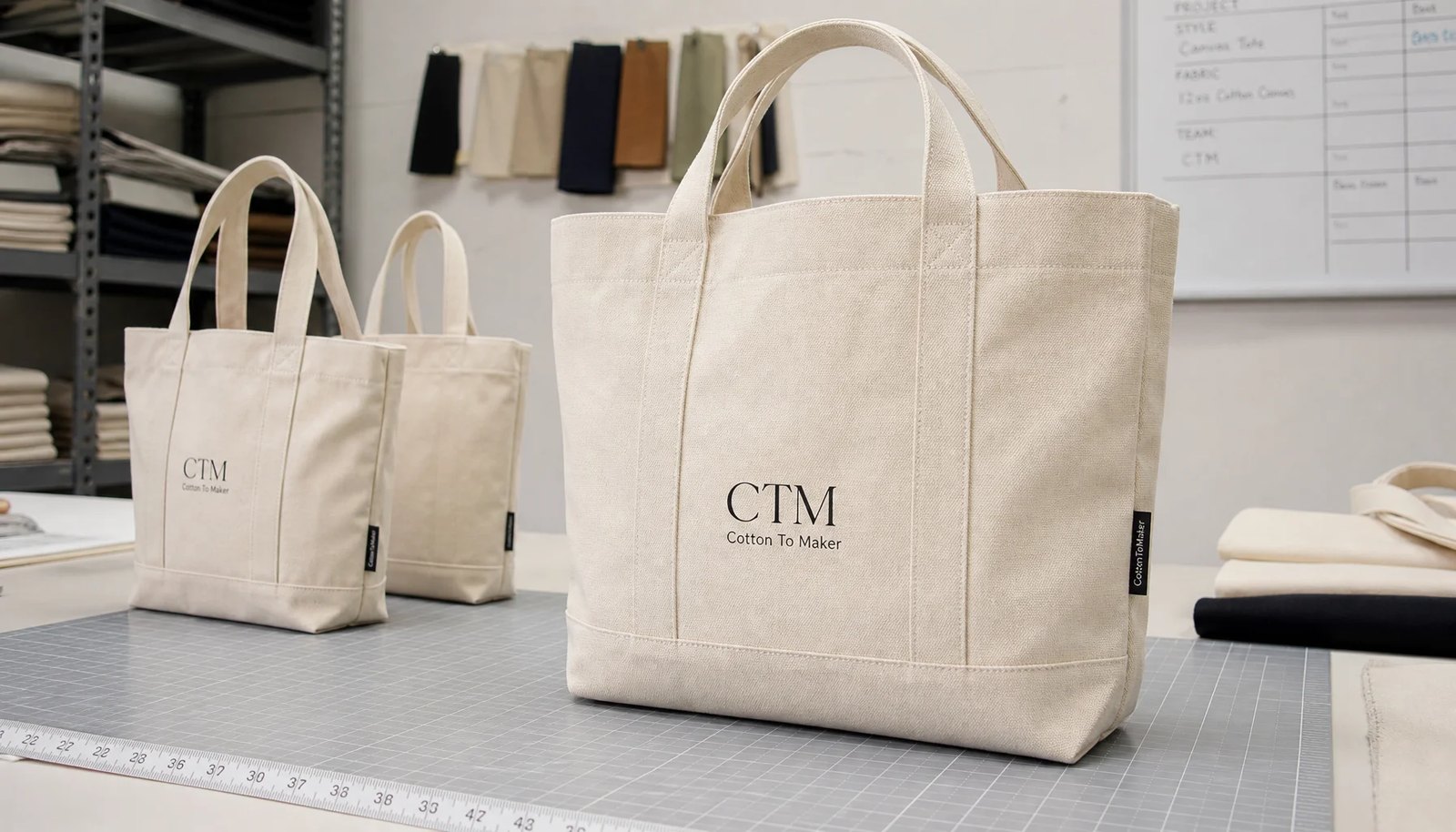
A grocery tote sold at a campus bookstore has a different job than a thin orientation giveaway. It may carry snacks, apparel, textbooks, drinkware, and multiple small purchases. The bag needs enough body to look retail-worthy on a shelf and enough seam strength to avoid complaints when used as a reusable shopping bag around campus.
The RFQ should state the selling context. A tote used only for event kits can be lighter and simpler. A tote sold beside branded apparel needs cleaner stitching, stronger handles, better print consistency, and more controlled packing. When suppliers do not know the use, they often quote the lowest construction that fits the general size, which makes comparisons misleading.
- Retail grocery tote: prioritize 10-12 oz canvas, gusset, strong handle stitching, and clean print.
- Orientation kit tote: prioritize budget, fast sampling, simple one-color print, and easy carton sorting.
- Premium bookstore merchandise: prioritize heavier fabric, branded label, better finishing, and shelf-ready packing.
- Campus sustainability program: prioritize reusable construction and clear material disclosure for buyer records.
Choose Fabric Weight With Finished GSM in Writing
Canvas tote quotes often list fabric as 8 oz, 10 oz, or 12 oz, but ounce weight can be interpreted differently by mill, region, and finish. For commercial comparison, request both ounce weight and finished GSM. A practical range for custom canvas grocery totes is usually 10 oz to 12 oz, roughly 280-340 GSM, depending on yarn count, weave density, and finishing. Lighter 8 oz canvas can work for giveaways, but it may collapse on a retail shelf and feel less durable for grocery use.
Fabric finish also changes the result. Natural canvas has visible cotton seed flecks and a campus-friendly casual look. Bleached canvas prints brighter but can show dirt faster. Dyed canvas adds brand color options but adds lead time, MOQ pressure, and color-lot risk. Washed canvas feels softer but may shrink and distort the panel more, so print placement and size tolerance need tighter control.
- Write the target fabric as both ounce weight and GSM, such as 10 oz canvas, approximately 280-300 GSM.
- State whether natural, bleached, dyed, or washed canvas is required.
- Request fabric swatches from the same source intended for bulk production.
- Confirm shrinkage and whether dimensions are quoted before or after finishing.
- For dyed canvas, require a lab dip or fabric color approval before bulk dyeing.
Construction Details That Change Lead Time and Cost
The fastest quote is usually a simple flat tote with cotton webbing handles. A bookstore grocery tote usually needs more structure: boxed bottom, side gusset, reinforced handles, and consistent top hemming. Each construction choice affects cutting efficiency, sewing time, carton volume, and final load performance. A boxed bottom adds utility but increases sewing operations and measurement points for QC.
Handle construction deserves special attention because it is the most visible failure point. For grocery use, handle width around 2.5-3.8 cm and a comfortable drop length are common, but the right choice depends on whether the tote is carried by hand or over the shoulder. Reinforced X-stitch or bartack sewing at the handle joint should be defined in the quote. If the bag will carry books or drinkware, include a load test target rather than relying on a general durability statement.
- Finished size should include width, height, gusset depth, and acceptable tolerance.
- Handle spec should include material, width, length, drop height, and stitch pattern.
- Top hem width and seam allowance should be consistent across all samples and bulk goods.
- Bottom gusset corners should be checked for puckering and weak seams.
- For heavier use, define a static load test such as holding a set weight for a set time.
Print Method Planning for School Marks
Most university bookstore canvas grocery totes use screen printing because school logos, wordmarks, department names, and mascot graphics are often solid-color artwork. Screen print is reliable on canvas when the artwork is prepared correctly, the ink is matched to fabric texture, and the print area avoids seams and deep folds. For one to four solid colors, it is usually the most stable production method for larger runs.
Heat transfer or digital methods may be useful for gradients, photo-style graphics, or short runs with many designs, but they create different risks: heavier hand feel, edge lifting, lower wash durability, or higher unit cost. Embroidery can look premium on apparel but is less common for large grocery tote graphics because stitch count, puckering, and back-side appearance add cost and complexity. The RFQ should not just say custom logo; it should define the artwork process and approval standard.
- Provide vector artwork files and PMS references, not only a JPG from a campus department.
- State print size in centimeters or inches and placement from top edge and side seam.
- Request a physical print strike-off on the same or equivalent canvas.
- Keep large solid ink areas away from heavy fold lines if totes are packed flat.
- For licensed marks, build time for university approval after the strike-off is produced.
MOQ Logic for Multiple Campus Designs
University bookstore buyers often want separate versions for the main bookstore, athletics, alumni, orientation, and different campus locations. The commercial issue is that every design can create separate screen setup, approval, packing, and inventory control work. A supplier may accept 300 pieces per design, but the unit price can rise quickly because setup time and waste are spread across fewer bags.
A better RFQ separates the base bag MOQ from the decoration MOQ. If all designs use the same fabric, size, handle, and packing, the factory may consolidate fabric purchasing and cutting while changing print screens by design. If each design uses different fabric color, labels, or carton marks, the order behaves like several smaller jobs. This is where lead time extends even when total quantity looks large.
- List each design, fabric color, print colors, and quantity as separate quote lines.
- Ask whether MOQ applies per fabric color, per print design, or total order quantity.
- Consolidate base construction when possible to reduce cutting and sewing changeovers.
- Separate setup charges from unit price so reorder economics are clear.
- For pilot programs, price a low quantity and a reorder quantity instead of forcing one number.
Sampling Gates That Prevent Bulk Rejection
For a campus bookstore order, a digital mockup is not enough. It helps confirm layout, but it does not show fabric hand feel, ink coverage on canvas texture, exact color, handle comfort, or carton presentation. The sample path should match the risk level of the order: fabric swatch, print strike-off, pre-production sample, then bulk production approval. Skipping steps may save a week but can create a larger delay if the first bulk inspection fails.
The pre-production sample should be treated as the contract sample. It should represent the approved fabric, final dimensions, print method, label position, stitching, and packing method. If a supplier sends a sample using substitute fabric or a different print process, mark it as a reference sample only. Bulk approval should not be based on a sample that the factory cannot repeat.
- Fabric swatch confirms weight, color, weave, finish, and hand feel.
- Print strike-off confirms PMS match, ink hand feel, coverage, registration, and rub resistance.
- Pre-production sample confirms finished size, gusset, handles, stitch quality, and logo placement.
- Packing sample confirms folding, polybag, carton quantity, label position, and barcode readability.
- Approval comments should be written with measurable changes, not general notes such as make it better.
Build a Lead Time Calendar With Real Risk Buffers
A clean schedule for custom canvas grocery totes usually has several separate clocks. RFQ clarification may take 2-5 working days if specs are complete. Sample making may take 5-10 working days after artwork and fabric are confirmed. Strike-off approval can take another few days, longer if school licensing must review. Bulk production may run 20-35 working days depending on quantity, fabric availability, and print complexity. Ocean freight and inland delivery can add several weeks.
The common planning mistake is to count only factory production days. For university bookstores, internal approval and receiving processes are often the bigger schedule risk. If the buyer needs totes on the floor by August, the purchase order should not be placed in late June unless stock fabric, simple print, air freight, or domestic production is already part of the plan. When the date is fixed, decide early whether to simplify the spec instead of hoping the same custom spec can compress safely.
- RFQ and quote alignment: allow time to clarify fabric, print, packing, and Incoterm details.
- Sampling: include courier time and internal approval time, not only factory sample making.
- Bulk production: protect the production slot by approving artwork and deposit on time.
- Inspection: schedule before shipment so failed goods can still be corrected.
- Freight: compare ocean, air, and split shipment options if the campus date is immovable.
Packing and Receiving Rules for Bookstore Operations
Packing affects more than freight cost. It affects how quickly bookstore staff can count, store, and move the tote into retail display. Canvas grocery totes should usually be flat packed in consistent bundles, with cartons marked by design, SKU, quantity, and destination. Random mixed cartons may save the factory a little time but create receiving labor and inventory errors at the campus store.
Avoid aggressive compression unless the buyer accepts creasing. Heavy vacuum packing can leave fold marks on canvas and may affect the print surface, especially with large ink areas. For retail merchandise, it may be better to use neat flat folding, a simple inner bundle, and cartons with practical gross weight. If the bookstore uses barcodes, hangtags, or price stickers, include those as production items in the RFQ rather than adding them after arrival.
- Define pieces per inner bundle and pieces per export carton.
- Keep carton gross weight practical for bookstore handling, often under heavy warehouse limits.
- Mark cartons by PO number, SKU, design name, color, quantity, and carton sequence.
- Confirm whether individual polybags are allowed under the university's packaging policy.
- Request carton dimensions early for freight quotation and storage planning.
Quote Data Needed for Landed-Cost Comparison
A low unit price is not a sourcing decision until the quote includes enough data to compare landed cost. For custom canvas grocery totes, the quote should show fabric spec, finished size, print method, number of colors, setup charges, MOQ, sample cost, packing, carton dimensions, gross weight, lead time, payment terms, and Incoterm. Without carton volume and weight, freight comparison is guesswork.
University bookstore buyers should also separate one-time costs from repeat costs. Screen charges, label setup, sample fees, and tooling may not repeat if the same design is reordered. However, fabric price, labor, print ink, packing, and freight will continue to affect the reorder price. A supplier that documents these details clearly is usually easier to manage than one that only sends a short price line.
- Compare EXW, FOB, CIF, DDP, or domestic delivered pricing on the same basis.
- Separate bag unit price, print setup, label setup, sample fees, packing upgrades, and freight.
- Use carton CBM and gross weight to estimate ocean, air, and warehouse handling cost.
- Clarify whether duty, customs brokerage, delivery appointment, and campus receiving charges are included.
- For annual programs, request reorder pricing and expected lead time using approved specs.
Specification comparison for buyers
| Spec decision | Recommended option | When it fits | Buyer risk to check |
|---|---|---|---|
| Fabric weight for bookstore grocery totes | 10 oz to 12 oz canvas, roughly 280-340 GSM depending on yarn count and finish | Campus grocery, textbook, and apparel purchases where the tote must stand better than a thin promo bag | Do not compare only by ounce; request GSM, finished fabric width, shrinkage, and whether the weight is before or after washing or coating |
| Bag construction | Boxed bottom with side gusset and reinforced X-stitch handles | Retail checkout bags, welcome kits, alumni merchandise, and heavier campus store purchases | Flat totes quote cheaper but hold less volume; confirm gusset width, seam allowance, handle webbing width, and load test target |
| Print method | Screen print for solid school marks; heat transfer only for high-detail artwork or low-color gradients | Most bookstore logos, mascot graphics, department names, and orientation designs | Ink cracking, poor PMS matching, and print distortion over seams; keep artwork away from gusset folds and request strike-off approval |
| MOQ planning | 500-1,000 pcs per design for stable unit cost, with lower pilot quantities priced separately | Annual bookstore replenishment, event programs, and seasonal merchandise drops | Small mixed designs can trigger multiple screen charges, fabric cutting waste, and longer setup time than one consolidated run |
| Sample path | Digital mockup, fabric swatch, print strike-off, then pre-production sample | Orders tied to school licensing approval or retail shelf presentation | Skipping strike-off saves days but increases color rejection risk; approve physical samples when PMS color and logo scale matter |
| Packing format | Flat packed by design and carton marked by SKU, not compressed randomly | Bookstore receiving teams that need fast counting, backroom storage, and store replenishment | Vacuum packing can crease canvas and damage print surface; require carton dimensions, gross weight, and inner polybag rules |
| Lead time buffer | Plan 10-14 weeks from RFQ to bookstore receipt for imported custom orders | Back-to-school, orientation, alumni weekend, and holiday retail windows | Artwork approval delays, university licensing review, and vessel schedule changes often consume more time than sewing itself |
| Supplier quote evidence | Factory quote with fabric spec, print process, sample timing, production calendar, packing details, and Incoterm | When comparing factories, traders, or domestic decorators | A low quote without GSM, carton data, and production slot dates is not comparable and may hide later add-on costs |
Buyer checklist before sampling
- Define the selling use first: checkout grocery tote, orientation giveaway, retail merchandise, or alumni gift.
- Specify finished bag size, gusset, handle drop, fabric GSM or ounce weight, and whether the tote must stand when loaded.
- Provide vector artwork with PMS references, print size, placement, and licensing approval requirements.
- Separate quote lines by design, colorway, and quantity so screen charges and MOQ effects are visible.
- Request fabric swatch, print strike-off, and pre-production sample before authorizing bulk cutting.
- Set acceptance criteria for fabric weight tolerance, print position tolerance, seam strength, carton marking, and barcode or SKU labeling.
- Build the calendar backward from the bookstore in-hand date, including sample approval, production, inspection, export, customs, and inland delivery.
- Confirm packing method, carton size, carton weight, polybag policy, and whether totes arrive shelf-ready or need repacking.
Factory quote questions to send
- What is the exact fabric construction, finished GSM, ounce weight, and expected shrinkage after finishing?
- Is the quoted canvas greige, bleached, dyed, or washed, and does the finish affect hand feel or print adhesion?
- What MOQ applies per bag size, per fabric color, per print design, and per carton packing style?
- Which print method is included in the price, how many colors are included, and what are the screen or setup charges?
- How many working days are needed for fabric sourcing, sample making, strike-off, bulk production, inspection, and export packing?
- What handle width, handle length, stitching pattern, seam allowance, and load test target are included?
- Can you provide carton dimensions, gross weight, pieces per carton, and palletization guidance for bookstore receiving?
- Which quote terms are included: EXW, FOB, CIF, DDP, or domestic delivery, and which local charges are excluded?
- What inspection standard do you use for fabric defects, print defects, stitching defects, and packing shortages?
- What happens if PMS color, fabric weight, or carton marking fails before shipment?
Quality-control points to confirm
- Finished fabric weight should stay within the agreed tolerance, commonly plus or minus 5% if no stricter tolerance is written.
- Finished bag dimensions should be measured after sewing and pressing, not only from cutting panels.
- Print placement should be controlled from top edge and side seam reference points, with a written tolerance such as plus or minus 5 mm for retail orders.
- Ink coverage should be smooth on textured canvas, with no pinholes, smearing, heavy hand feel, or visible registration shift on multi-color prints.
- Handle stitching should use reinforced X-stitch or bartack construction and pass the agreed load test without seam tearing.
- Side seams and bottom gusset corners should be checked for skipped stitches, exposed raw edges, puckering, and weak thread tension.
- Cartons should match the approved packing plan, including SKU, design name, quantity, gross weight, destination marks, and any bookstore receiving labels.
- Random inspection should include carton count, assortment accuracy, print rub resistance, odor, moisture risk, and metal contamination control where required.